Business-in-a-Box has all 141 in this category, plus the rest of the library, ready to edit. See what's inside
250K+Clients
20M+Free users
20+Years
190+Countries
10,000+Law firms
50M+Downloads
Trusted across review platforms
Capterra★★★★☆4.649 reviews
G2★★★★☆4.713 reviews
GetApp★★★★☆4.649 reviews
Google Play★★★★☆4.6179 ratings
Google Reviews★★★★☆4.567 reviews
Frequently asked questions
Do I need a written consulting agreement for a short engagement?
Yes — even for a brief project. A written agreement, even a short-form one, establishes what work was agreed, the fee, and who owns any deliverables. Without it, payment disputes and IP questions are resolved by conversation alone, which rarely ends well. For short engagements, a consulting contract or engagement letter is sufficient; a full long-form agreement is not always necessary.
What's the difference between a consulting agreement and a professional services agreement?
In practice, the terms are often used interchangeably. "Consulting agreement" typically implies advisory or strategic work by an individual or small firm. "Professional services agreement" is broader and often used by larger firms delivering defined services — IT, architecture, accounting, or marketing. The key clauses are the same; the professional services agreement usually has more formal governance and SLA provisions.
Who owns the work product created during a consulting engagement?
Ownership depends entirely on what the agreement says. Without a written assignment clause, the consultant may retain rights to deliverables in many jurisdictions. To ensure the client owns all work product, the agreement must include an explicit IP assignment or work-for-hire provision. If the consultant uses pre-existing tools or methods, those typically remain the consultant's property, with a license granted to the client.
What is a retainer consulting agreement?
A retainer agreement pays a consultant a fixed recurring fee — monthly or quarterly — in exchange for a defined number of hours or a category of services during that period. It suits ongoing advisory relationships where the client wants reliable access to the consultant's expertise without negotiating a new project contract each time.
Can a consulting agreement prevent a consultant from working for competitors?
Yes, but only if the agreement includes a non-compete clause, and only to the extent that clause is enforceable in the governing jurisdiction. Non-compete enforceability varies significantly by location; in some US states and many countries, they are strictly limited or unenforceable entirely. A confidentiality clause is more broadly enforceable and is the primary protection in most consulting agreements.
What happens if a consultant misses a deadline or delivers substandard work?
The client's remedies depend on the contract. A well-drafted agreement includes representations and warranties (the consultant will perform professionally), a process for raising and curing defects, and a termination-for-cause provision if issues aren't remedied. Without those clauses, the client is left with general contract law remedies, which are harder and more expensive to pursue.
Is a consulting agreement the same as an independent contractor agreement?
They are closely related but not identical. A consulting agreement focuses on advisory services and deliverables; an independent contractor agreement can cover any non-employment working relationship. Both establish that the provider is not an employee. The appropriate template depends on whether the work is primarily advisory, production-based, or technical.
Should consulting agreements include a limitation of liability clause?
In most cases, yes. A limitation of liability clause caps the financial exposure of each party — typically to the fees paid under the agreement. Without it, a consultant could theoretically face claims far exceeding the value of the engagement. Clients may also benefit, since it limits claims a consultant can bring for unpaid fees or lost profits.
Services and Consulting Agreement vs. related documents
Services and Consulting Agreement vs. Independent contractor agreement
A consulting agreement and an independent contractor agreement often overlap, but a consulting agreement is oriented around advisory output — recommendations, strategies, analysis — while an independent contractor agreement typically covers task-based or production work. Consulting agreements are more likely to include IP ownership, publication rights, and conflict-of-interest clauses. If your engagement involves both advisory and deliverable work, a software development and consulting agreement or professional services agreement may be the better fit.
Services and Consulting Agreement vs. Statement of work (SOW)
A consulting or services agreement is the master contract that establishes the legal framework: payment terms, IP rights, confidentiality, termination. A statement of work is a project-level attachment that defines the specific deliverables, timeline, and milestones for one engagement under that master agreement. Many professional relationships use both: one master agreement and a new SOW for each project.
Services and Consulting Agreement vs. Employment agreement
An employment agreement creates an employer-employee relationship with associated tax obligations, benefits entitlements, and labor law protections. A consulting or services agreement creates an independent contractor relationship. The distinction matters legally: misclassifying an employee as a consultant can result in penalties. If the individual works set hours, uses your tools, and has no other clients, consult an employment lawyer before using a consulting agreement.
Services and Consulting Agreement vs. Letter of engagement
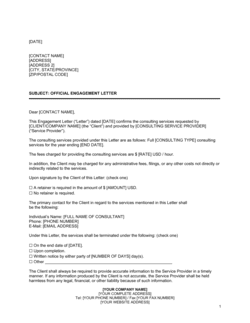
A letter of engagement (or consulting engagement letter) is a shorter, less formal document that confirms the scope and fee of an engagement — common in accounting, law, and advisory firms. A full consulting agreement includes more comprehensive legal protections. For lower-risk or shorter engagements, an engagement letter may suffice; for complex or long-term relationships, a full agreement is safer.
Key clauses every Services and Consulting Agreement contains
Regardless of the specific variant, every services and consulting agreement relies on the same core clauses to define the relationship and reduce exposure.
Scope of services. Describes exactly what the consultant or provider will and will not do — the primary defense against scope creep.
Fees and payment terms. States the rate structure (hourly, fixed, retainer), invoice schedule, and what happens if payment is late.
Term and termination. Sets the start and end date of the engagement and the notice periods required to terminate early.
Intellectual property ownership. Clarifies who owns deliverables, work product, and underlying IP created during the engagement.
Confidentiality. Prevents either party from disclosing the other's confidential business information to third parties.
Representations and warranties. Each party confirms they have the authority and qualifications to enter the agreement and perform their obligations.
Limitation of liability. Caps the financial exposure of each party in the event of a breach or claim — typically limited to fees paid.
Governing law and dispute resolution. Names the jurisdiction whose laws govern the contract and the process for resolving disagreements.
How to write a consulting services agreement
A well-drafted consulting agreement answers six questions before work starts: who, what, when, how much, who owns it, and what happens if something goes wrong.
1
Identify both parties accurately
Use the full legal names of the client entity and the consulting firm or individual — not trading names or informal references.
2
Define the scope of services
List specific deliverables, tasks, and out-of-scope items; vague scope descriptions are the leading cause of disputes.
3
Set the fee structure and payment schedule
Choose the billing model — hourly, fixed-fee, retainer, or time-and-materials — and specify invoice frequency and due dates.
4
Establish the timeline and milestones
Include start and end dates, key milestones, and any conditions that must be met before payment is released.
5
Allocate intellectual property rights
State explicitly whether deliverables are work-for-hire owned by the client, or whether the consultant retains underlying IP with a license granted to the client.
6
Add confidentiality and non-solicitation terms
Protect each party's confidential information and, where appropriate, prevent the consultant from soliciting the client's employees or customers.
7
Include termination and remedies provisions
Specify how either party can exit the agreement early, what notice is required, and what fees are owed on termination.
8
Sign and retain the executed agreement
Have authorized representatives on both sides sign, then store the signed copy somewhere both parties can retrieve it quickly.
At a glance
What it is
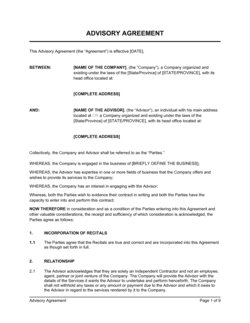
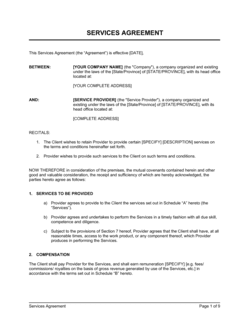
A services and consulting agreement is a written contract between a client and a service provider or consultant that defines the scope of work, fees, timeline, ownership of deliverables, and each party's obligations. It creates a legally binding record of what was agreed before work begins.
When you need one
Any time you engage a consultant, agency, or external service provider — or when you sell professional services to a client — a written agreement protects both parties and reduces the risk of scope creep, payment disputes, and IP ambiguity.
Which Services and Consulting Agreement do I need?
The right template depends on how the engagement is structured: fixed project vs. ongoing relationship, hourly billing vs. retainer, and whether the work is technical, creative, operational, or advisory.
Your situation
Recommended template
Hiring a consultant for a complex, long-term advisory engagement
Covers IP ownership, confidentiality, termination, and detailed scope provisions.
The documented description of the specific tasks, deliverables, and boundaries of a consulting engagement.
Retainer
A recurring fee paid to a consultant in exchange for reserved availability or a defined block of services during a set period.
Time and materials
A billing model where the client pays for actual hours worked plus reimbursable costs, rather than a fixed project fee.
Work product
Any tangible or intangible output — reports, code, designs, strategies — created by the consultant during the engagement.
Work for hire
A legal concept under which deliverables created by a contractor are owned by the client from the moment of creation, provided the agreement says so.
Statement of work (SOW)
A project-level document attached to a master services agreement that defines the deliverables, timeline, and fees for a specific engagement.
Master services agreement (MSA)
An umbrella contract that sets the legal terms governing all future work between two parties, with individual projects governed by separate SOWs.
Milestone
A defined point in a project at which a specific deliverable is due or a payment is triggered.
Limitation of liability
A contract clause that caps how much either party can claim from the other in the event of a breach or dispute.
Independent contractor
A self-employed individual or firm engaged to perform services who is not an employee of the client and is responsible for their own taxes.
Non-solicitation clause
A contract provision that prevents a consultant from recruiting the client's employees or approaching the client's customers for a defined period.
What is a services and consulting agreement?
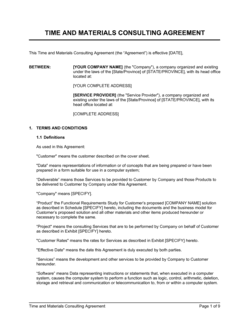
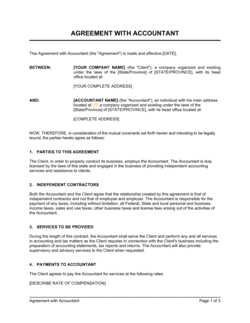
A services and consulting agreement is a legally binding contract between a client and a consultant or service provider that defines the scope of work, fees, deliverables, timeline, and the rights and responsibilities of each party. It creates a written record of exactly what was agreed before any work begins, and it governs what happens when things go off-track — a missed deadline, a disputed invoice, or a question about who owns the final deliverable.
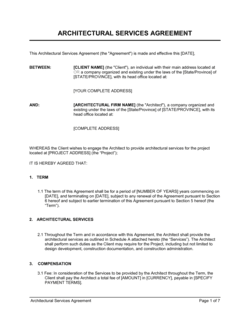
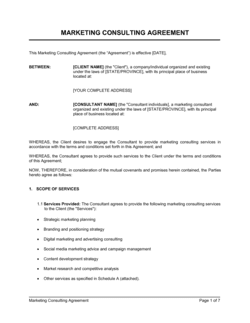
Consulting and services agreements cover a wide range of business relationships: a management consultant advising on strategy, an IT firm providing ongoing network support, a marketing agency running campaigns, an accounting firm handling the books, or an architect designing a building. The specific terms vary by engagement type, but the legal architecture is consistent: define the work, set the price, allocate ownership, and establish how to exit cleanly.
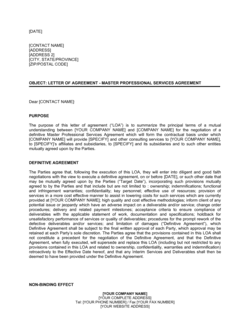
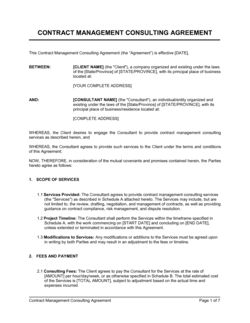
These agreements sit at the intersection of several distinct templates. A short consulting contract suits a straightforward one-time engagement. A retainer agreement governs an ongoing advisory relationship. A time-and-materials agreement tracks hourly and expense-based billing. A master professional services agreement establishes a long-term framework under which individual projects are governed by separate statements of work.
When you need a services and consulting agreement
Any time money and professional expertise change hands outside of an employment relationship, a written agreement is essential. The informal "let's get started and sort the paperwork later" approach consistently produces scope creep, unpaid invoices, and ownership disputes.
Common triggers:
A business engages a consultant for strategic, operational, or technical advisory work
An agency or firm begins delivering marketing, SEO, or advertising services to a client
A company outsources administrative, IT, or back-office functions to an external provider
A software developer or programmer is engaged to build or maintain a system
An architect or specialist professional is retained for a project-based engagement
Two related entities within a corporate group need to formalize shared services
A company signs a new client and needs a professional services agreement in place before kick-off
A consultant transitions from project-based work to an ongoing monthly retainer
Without a signed agreement, scope disputes are settled by email threads and memory, payment terms are whatever each party remembers, and IP ownership defaults to whatever the law says — which may not match what either party intended. A well-chosen template from this folder eliminates those ambiguities in under an hour.
Award-winning platform
Great Place to Work 2025
BIG Award — Product of the Year 2025
Smartest Companies 2025
Global 100 Excellence 2026
Best of the Best 2025
Create your document in 3 simple steps.
From template to signed document — all inside one Business Operating System.
1
Download or open template
Access over 3,000+ business and legal templates for any business task, project or initiative.
2
Edit and fill in the blanks with AI
Customize your ready-made business document template and save it in the cloud.
3
Share with your team
Share your files and folders with your team. Create a space of seamless collaboration.
Save time, save money, and create top-quality documents.
★★★★★
"Fantastic value! I'm not sure how I'd do without it. It's worth its weight in gold and paid back for itself many times."
Managing Director · Mall Farm
RW
Robert Whalley
Managing Director, Mall Farm Proprietary Limited
★★★★★
"I have been using Business in a Box for years. It has been the most useful source of templates I have encountered. I recommend it to anyone."
Business Owner · 4+ years
MF
Dr Michael John Freestone
Business Owner
★★★★★
"It has been a life saver so many times I have lost count. Business in a Box has saved me so much time and as you know, time is money."
Owner · Upstate Web
DM
David G. Moore Jr.
Owner, Upstate Web
Run your business with a system — not scattered tools
Stop downloading documents. Start operating with clarity. Business in a Box gives you the Business Operating System used by over 250,000 companies worldwide to structure, run, and grow their business.