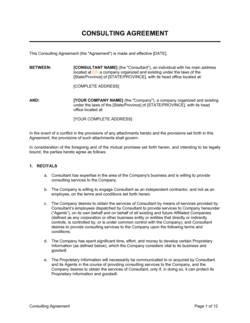
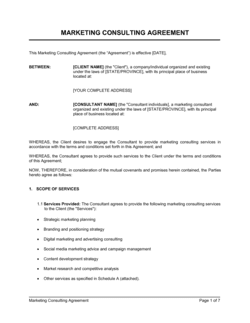
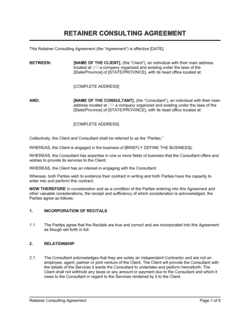
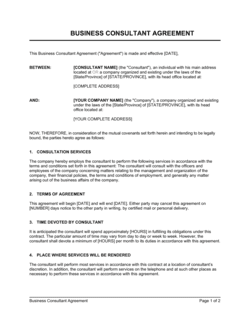
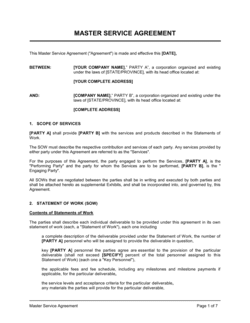
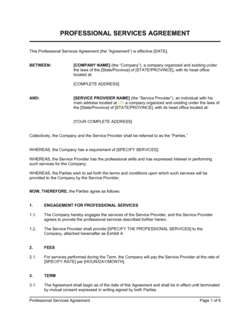
Contract Management Consulting Agreement Template

Free Word download • Edit online • Save & share with Drive • Export to PDF

7 pages25–35 min to fillDifficulty: ComplexSignature requiredLegal review recommended
Learn more ↓
FreeContract Management Consulting Agreement Template

At a glance

What it is
A Contract Management Consulting Agreement is a legally binding document between a client organization and an independent consultant engaged to design, implement, audit, or improve the client's contract management processes, systems, or lifecycle operations. This free Word download covers scope of services, fees, deliverables, IP ownership, confidentiality, and termination in a single professional document you can edit online and export as PDF.
When you need it
Use it when engaging an external consultant to review your contract portfolio, stand up a contract management function, select or implement a CLM platform, or train staff on contract lifecycle best practices. It is equally appropriate for one-time audits and ongoing retainer arrangements.
What's inside
Scope of services and deliverables, engagement term and milestones, consulting fees and expense reimbursement, intellectual property assignment and license-back provisions, confidentiality obligations, representations and warranties, limitation of liability, termination rights, and governing law and dispute resolution.

What is a Contract Management Consulting Agreement?

A Contract Management Consulting Agreement is a legally binding document that governs the engagement of an independent consultant retained to audit, design, implement, or improve a client organization's contract management processes, systems, or contract lifecycle operations. It establishes enforceable obligations on both sides — defining precisely what the consultant will deliver, how they will be paid, who owns the resulting work product, and how sensitive contract data will be protected. Unlike a general consulting agreement, this document addresses the specific risks that arise when an outside party is given access to a client's live contract portfolio, vendor pricing data, and CLM platform credentials.

Why You Need This Document

Proceeding on a handshake or a bare offer letter when engaging a contract management consultant exposes both parties to serious and concrete risk. Without a written agreement, IP ownership of audit reports, process frameworks, and custom contract templates is ambiguous — courts in most jurisdictions will not automatically assign that work product to the client. The consultant has no enforceable right to their fees if the client disputes a deliverable or terminates mid-project. Neither party's confidential information — the client's vendor pricing and contract terms, the consultant's proprietary methodology — is protected. And if something goes wrong with a contract decision influenced by the consultant's advice, neither party has a liability cap to limit their exposure. A properly executed Contract Management Consulting Agreement closes every one of these gaps before work begins, turning an informal arrangement into a commercially sound engagement that both parties can rely on.

Which variant fits your situation?

If your situation is…Use this template
Ongoing advisory retainer with no fixed deliverableConsulting Retainer Agreement
Short, one-time contract audit with a fixed feeProfessional Services Agreement
Engaging a technology vendor to implement a CLM platformSoftware Implementation Services Agreement
Consultant working as a temporary in-house resource on client premisesIndependent Contractor Agreement
Multi-consultant engagement through a consulting firmMaster Services Agreement
Pre-engagement confidentiality coverage before scope is definedNon-Disclosure Agreement
Executive-level interim contract management officer placementExecutive Consulting Agreement

Common mistakes to avoid

❌ Vague scope of services with no defined deliverables

Why it matters: Without specific deliverables and acceptance criteria, every invoice becomes a negotiation. The client believes it is paying for an outcome; the consultant believes it is billing for time. This mismatch is the single most common source of consulting fee disputes.

Fix: Attach a Schedule A that lists every deliverable by name, describes its content, and states the acceptance criteria — including what constitutes client sign-off.

❌ No change-order mechanism

Why it matters: Client organizations routinely expand the consultant's scope mid-engagement — asking for additional analyses, extra stakeholder interviews, or broader process redesigns — without formally amending the agreement. This creates unpaid work or invoice disputes.

Fix: Include a change-order clause requiring a signed written amendment for any scope change, with a stated rate for additional work and an updated milestone schedule.

❌ Assigning all IP without a license-back for pre-existing methodologies

Why it matters: A blanket IP assignment clause transfers ownership of the consultant's proprietary frameworks, scoring models, and tools to the client. The consultant then cannot legally use their own methodology in future engagements — making the clause both unenforceable in practice and a deal-breaker for experienced consultants.

Fix: List pre-existing IP in a schedule and grant the client a perpetual, non-exclusive license to use it within the deliverables, while the consultant retains ownership.

❌ No limitation of liability clause

Why it matters: Contract management consultants work with sensitive commercial agreements, pricing data, and vendor relationships. An error in a contract audit or a missed renewal could expose the client to significant losses — potentially far exceeding the consulting fees. Without a liability cap, the consultant bears unlimited exposure.

Fix: Cap each party's liability at the fees paid in the prior 12 months and expressly exclude consequential and indirect damages, with carve-outs for fraud and gross negligence.

❌ Confidentiality obligations that only bind the consultant

Why it matters: The consultant shares proprietary methodologies, pricing models, and benchmark data with the client during the engagement. A one-sided NDA leaves the consultant's IP unprotected against the client licensing it to competitors or building internal tools based on the consultant's frameworks.

Fix: Make confidentiality mutual — both parties protect the other's non-public information for the duration of the agreement and for at least two years post-termination.

❌ No termination-for-cause cure period

Why it matters: Immediate termination clauses triggered by any breach — including minor or disputed ones — expose the terminating party to a wrongful-termination counterclaim, particularly when the alleged breach was a billing disagreement or missed minor milestone.

Fix: Require 15 to 30 days' written notice of the breach and an opportunity to cure before termination for cause becomes effective. Reserve immediate termination for fraud, insolvency, and material confidentiality breaches.

The 10 key clauses, explained

Parties and recitals

In plain language: Identifies the client and consultant as legal entities, states the nature of the engagement, and establishes the effective date of the agreement.

Sample language
This Contract Management Consulting Agreement ('Agreement') is entered into as of [EFFECTIVE DATE] between [CLIENT LEGAL NAME], a [STATE/PROVINCE] [ENTITY TYPE] ('Client'), and [CONSULTANT LEGAL NAME OR TRADING NAME], a [STATE/PROVINCE] [ENTITY TYPE] ('Consultant').

Common mistake: Using a trading name or personal name instead of the registered legal entity. If the consultant operates through a corporation or LLC, the entity — not the individual — should be the contracting party to preserve liability protection.

Scope of services and deliverables

In plain language: Defines exactly what the consultant will do, what outputs they will produce, and what is explicitly excluded — preventing scope creep and fee disputes.

Sample language
Consultant shall provide the contract management consulting services described in Schedule A ('Services'), including delivery of the following Deliverables: [LIST]. Services do not include [EXCLUDED ACTIVITIES] unless agreed in a written amendment signed by both parties.

Common mistake: Attaching a vague statement of work that uses outcome language ('improve contract processes') without specifying discrete deliverables. Every disputed invoice traces back to an unclear scope.

Term and milestones

In plain language: Sets the start date, end date or renewal mechanism, and any interim milestone dates by which specific deliverables must be accepted.

Sample language
This Agreement commences on [START DATE] and continues until [END DATE / COMPLETION OF DELIVERABLES], unless earlier terminated. Milestone dates are set out in Schedule B. Failure to meet a milestone by [X] days entitles Client to [REMEDY].

Common mistake: No milestone schedule for multi-phase engagements. Without defined checkpoints, the client has no contractual lever to act on delays until the final deliverable is overdue.

Consulting fees and payment terms

In plain language: States how the consultant is compensated — hourly, daily, fixed-fee, or retainer — the invoicing frequency, payment due date, and late-payment consequences.

Sample language
Client shall pay Consultant at the rate of [$X per hour / $X per day / $X fixed fee], invoiced [monthly / upon milestone completion]. Invoices are due Net [15/30] days from date of issue. Overdue balances accrue interest at [1.5]% per month.

Common mistake: Omitting an interest or late-fee provision. Without it, the consultant has no contractual basis to charge for late payment, reducing the incentive for the client to pay on time.

Expense reimbursement

In plain language: Specifies which out-of-pocket expenses the client will reimburse, the pre-approval threshold, and the documentation required for reimbursement.

Sample language
Client shall reimburse Consultant for reasonable, pre-approved expenses incurred in connection with the Services. Expenses exceeding $[AMOUNT] individually require prior written approval. All claims must be supported by original receipts and submitted within [30] days of incurrence.

Common mistake: No pre-approval threshold or cap. Open-ended expense clauses regularly lead to disputes over travel, software subscriptions, and subcontractor costs the client never anticipated.

Intellectual property ownership and license-back

In plain language: Assigns ownership of client-specific work product to the client while preserving the consultant's rights to pre-existing methodologies and granting a license-back for embedded tools.

Sample language
All Work Product created specifically for Client shall be the sole property of Client upon full payment. Consultant retains all rights to Pre-Existing IP. To the extent Pre-Existing IP is incorporated into Work Product, Consultant hereby grants Client a non-exclusive, perpetual, royalty-free license to use such Pre-Existing IP solely in connection with the Work Product.

Common mistake: Assigning all IP — including the consultant's pre-existing frameworks — to the client without a license-back. This prevents the consultant from using their own methodology in future engagements and is routinely contested.

Confidentiality

In plain language: Prohibits both parties from disclosing the other's confidential information — contract data, methodologies, pricing, client lists — during and after the engagement.

Sample language
Each party ('Receiving Party') agrees to hold the other party's ('Disclosing Party') Confidential Information in strict confidence and not to disclose or use it except as necessary to perform this Agreement. 'Confidential Information' means any non-public information disclosed in connection with this Agreement, including contract portfolios, pricing, and proprietary methodologies.

Common mistake: A one-sided confidentiality clause that only binds the consultant. The client receives the consultant's proprietary methodologies and frameworks — those are equally worth protecting.

Representations and warranties

In plain language: Each party makes baseline promises about their authority to enter the agreement; the consultant additionally warrants that services will be performed professionally and that deliverables will not infringe third-party IP.

Sample language
Consultant represents and warrants that: (a) it has full authority to enter into this Agreement; (b) Services will be performed in a professional and workmanlike manner consistent with industry standards; and (c) Deliverables will not, to Consultant's knowledge, infringe any third-party intellectual property rights.

Common mistake: No warranty on deliverable quality or professional standard. Without it, the client's only remedy for substandard work is a general negligence claim, which requires proving a duty of care outside the contract.

Limitation of liability

In plain language: Caps each party's maximum financial exposure to the other, typically at total fees paid in the prior 12 months, and excludes indirect and consequential damages.

Sample language
In no event shall either party's total liability under this Agreement exceed the total fees paid by Client to Consultant in the [12] months preceding the claim. Neither party shall be liable for indirect, incidental, consequential, or punitive damages, even if advised of the possibility of such damages.

Common mistake: No exclusion of consequential damages. Without it, a consultant whose deliverable contains an error could face liability for the client's lost contracts or revenue — far exceeding the value of the engagement.

Termination and post-termination obligations

In plain language: Sets out termination rights for convenience and for cause, notice periods, payment for work completed to the termination date, and obligations that survive termination such as confidentiality and IP assignment.

Sample language
Either party may terminate this Agreement for convenience on [30] days' written notice. Client may terminate for Cause immediately if Consultant materially breaches and fails to cure within [15] days of written notice. Upon termination, Consultant shall deliver all completed Work Product, and Client shall pay for Services rendered through the termination date.

Common mistake: No cure period for breach before termination for cause. Immediate termination clauses without a cure window expose the terminating party to a wrongful-termination counterclaim if the breach was remediable.

How to fill it out

  1. 1

    Identify the parties and their legal entities

    Enter the full registered legal name of the client organization and the consultant's legal business entity — LLC, corporation, or sole proprietorship. Include registered address and jurisdiction of formation for both parties.

    💡 Request a copy of the consultant's business registration or W-9 before the agreement is signed to confirm the legal entity name matches what is in the contract.

  2. 2

    Draft the scope of services in Schedule A

    List every task, activity, and deliverable the consultant will perform with enough specificity that a third party could evaluate whether it was completed. Use numbered deliverables with acceptance criteria where possible.

    💡 Add an explicit exclusions paragraph — stating what is NOT in scope is often more valuable than the inclusions list for preventing mid-engagement disputes.

  3. 3

    Set the engagement term and milestone schedule

    Enter the start date, projected end date, and any phase or milestone dates in Schedule B. For each milestone, describe the deliverable and the acceptance or sign-off process.

    💡 Build in a 5–10 day client review and acceptance period for each milestone rather than treating delivery and acceptance as simultaneous.

  4. 4

    Complete the fees and payment terms

    Choose the fee model — hourly, daily, milestone-based, or monthly retainer — and enter the rate or fixed amounts. Set the invoicing frequency and payment terms (Net 15 or Net 30 are standard for consulting engagements).

    💡 For fixed-fee engagements, include a change-order clause: any scope change requested by either party requires a written amendment before additional work begins.

  5. 5

    Define expense reimbursement parameters

    List categories of reimbursable expenses (travel, accommodation, software licenses, third-party data subscriptions) and set the pre-approval threshold for individual expenses above a stated dollar amount.

    💡 Require the consultant to use the client's preferred travel booking tool or vendor panels where the client has negotiated rates — this avoids premium bookings that inflate reimbursable costs.

  6. 6

    Tailor the IP and license-back provisions

    Identify what constitutes the consultant's Pre-Existing IP (proprietary frameworks, templates, scoring models) and list these specifically in Schedule C. Confirm that client-specific work product is assigned to the client upon full payment.

    💡 If the consultant's methodology is the primary value being purchased, negotiate a perpetual license to the methodology — not just to the specific deliverables it generates.

  7. 7

    Set the limitation of liability cap

    Negotiate the liability cap as a multiple of fees — 1× to 2× total fees paid is the most common range for consulting engagements. Add a carve-out for gross negligence, fraud, and willful misconduct, which should not be capped.

    💡 Require the consultant to carry professional indemnity (errors and omissions) insurance of at least $1M per claim and name the client as an additional insured if the engagement involves high-value contract decisions.

  8. 8

    Sign before work begins

    Both parties must execute the agreement — and any required schedules — before the consultant performs any billable work. Unsigned engagements that proceed on a handshake leave IP ownership, payment terms, and confidentiality obligations unenforced.

    💡 Use an e-signature tool to timestamp execution and store the fully executed copy in a shared secure location accessible to both parties' legal and finance teams.

Frequently asked questions

What is a contract management consulting agreement?

A contract management consulting agreement is a legally binding document that governs the engagement of an independent consultant to advise on, audit, design, or improve a client organization's contract management processes, systems, or lifecycle operations. It defines scope of services, fees, deliverables, IP ownership, confidentiality, and termination rights for both parties. It differs from a general consulting agreement in that it specifically addresses the sensitivities of working with a client's contract portfolio, vendor relationships, and commercial data.

When do I need a contract management consulting agreement instead of a general consulting agreement?

Use a contract management consulting agreement when the engagement specifically involves access to the client's live contract portfolio, vendor pricing data, CLM platform, or internal approval workflows. These engagements carry elevated confidentiality and IP risks that a generic consulting agreement may not address adequately. If the consultant is simply providing general business advice with no access to sensitive contract data, a standard consulting agreement typically suffices.

Who owns the work product produced during the engagement?

Under a well-drafted agreement, client-specific work product — audit reports, process maps, playbooks, and custom templates — is assigned to the client upon full payment of fees. The consultant retains ownership of pre-existing IP such as proprietary methodologies, scoring frameworks, and standard templates that are incorporated into the deliverables, with a license-back granting the client the right to use that pre-existing IP within the context of the delivered work product.

What insurance should a contract management consultant carry?

A contract management consultant should carry professional indemnity (errors and omissions) insurance of at least $1M per claim to cover losses arising from errors in contract audits, missed renewal dates, or flawed process recommendations. General liability insurance of $1M to $2M is also standard. Clients engaging consultants who will access sensitive data should additionally require cyber liability coverage and should confirm they are named as an additional insured on the E&O policy.

How is a contract management consultant typically compensated?

Compensation models vary by engagement type. Short, scoped audits typically use a fixed project fee. Ongoing advisory retainers use a monthly fee for reserved availability, typically ranging from $5,000 to $20,000 per month depending on seniority and scope. CLM implementation projects often use milestone-based payment tied to project phases. Hourly or daily rates ($150 to $400 per hour for experienced consultants) are common for time-and-materials work where scope cannot be defined upfront.

Can I terminate the agreement if the consultant misses a milestone?

You can typically terminate for cause if the consultant fails to deliver a milestone and does not cure the failure within the notice period stated in the agreement — usually 15 to 30 days. A well-drafted agreement will also entitle you to a pro-rata fee refund for undelivered milestones and require the consultant to hand over all work in progress. Check your agreement's termination clause carefully — some restrict termination for cause to material breaches only, and a missed milestone may or may not meet that threshold depending on its significance.

Is a contract management consulting agreement enforceable in all jurisdictions?

A properly drafted agreement is generally enforceable in the US, Canada, the UK, and EU member states. The specific provisions that vary by jurisdiction include non-compete restrictions, IP assignment of employee- created works, and the enforceability of limitation-of-liability caps. In some EU jurisdictions, liability caps below a statutory minimum or consumer-protection threshold may be voided. Consider having the agreement reviewed by a lawyer in the governing jurisdiction before execution, particularly for cross-border engagements.

What is the difference between a consulting agreement and a master services agreement?

A master services agreement (MSA) establishes the overarching legal terms governing a long-term relationship between a client and a service provider, with individual projects or scopes governed by separate statements of work (SOWs). A consulting agreement is a standalone document that covers a single engagement entirely within one document. Use an MSA with SOWs when you expect multiple discrete engagements with the same consultant over time; use a standalone consulting agreement for a single, defined project.

What happens to the consultant's access to contract data after termination?

A well-drafted agreement requires the consultant to return or certifiably destroy all client confidential information — including contract data, vendor pricing, and CLM platform exports — within a defined period after termination, typically 10 to 30 days. The consultant should confirm destruction in writing. Confidentiality obligations survive termination and should remain in effect for at least two years, or indefinitely for trade secrets. Some agreements also revoke system-access credentials as a condition of the final payment.

Do I need a lawyer to prepare a contract management consulting agreement?

For straightforward domestic engagements with a clear scope and standard fee structure, a high-quality template is sufficient for most organizations. Engage a lawyer when the engagement involves access to highly sensitive commercial data, when the consultant will be embedded in an ongoing capacity with broad system access, when the engagement crosses jurisdictions with different employment or IP laws, or when the contract value exceeds $100,000. A 1–2 hour template review typically costs $300–$600 and is worthwhile for any engagement where the deliverables will directly influence high-value contract decisions.

How this compares to alternatives

vs General Consulting Agreement

A general consulting agreement covers broad advisory services without addressing the specific sensitivities of contract portfolio access, CLM system credentials, or vendor pricing data. A contract management consulting agreement adds targeted IP, confidentiality, and data-handling provisions tailored to engagements that touch a client's live contract operations. Use the general form only when the consultant has no access to sensitive contract data.

vs Independent Contractor Agreement

An independent contractor agreement focuses on the employment-like elements of a working relationship — control, classification, and tax treatment — and is typically used for ongoing or embedded resource arrangements. A contract management consulting agreement is project-scoped, deliverable-focused, and includes IP assignment, milestone structures, and professional liability provisions more appropriate for advisory engagements.

vs Master Services Agreement

A master services agreement establishes overarching legal terms for a long-term provider relationship, with individual engagements governed by separate statements of work. A contract management consulting agreement is a standalone document covering a single engagement entirely. Choose an MSA with SOWs when you expect repeated or multi-phase engagements with the same consultant; use a standalone agreement for a single defined project.

vs Non-Disclosure Agreement

An NDA protects confidential information shared during exploratory discussions but creates no obligations to perform services or pay fees. A contract management consulting agreement includes confidentiality provisions as one component but also governs deliverables, payment, IP, and termination. Use an NDA before scope is defined; replace or supplement it with the consulting agreement once the engagement is confirmed.

Industry-specific considerations

Financial services

Consultants must comply with data handling obligations under financial services regulations; confidentiality clauses should specifically cover counterparty data and trading agreements.

Healthcare and life sciences

Agreements covering access to vendor or payer contracts must address HIPAA business associate obligations and may require a separate BAA alongside the consulting agreement.

Government and public sector

Government clients often require compliance with procurement regulations, mandatory audit rights, and specific data sovereignty requirements that must be incorporated into the agreement.

Manufacturing and supply chain

Engagements typically involve access to supplier pricing and long-term supply agreements; robust confidentiality and IP clauses are critical to prevent benchmark data from reaching competitors.

Professional services

Law firms and consulting practices engaging contract management consultants must address conflicts of interest, client confidentiality obligations that flow downstream, and professional regulatory requirements.

Technology and SaaS

CLM implementation projects require clear delineation between the consultant's work product and the vendor platform's IP; agreements should specify which party owns custom configurations and integration code.

Jurisdictional notes

United States

IP assignment provisions must comply with state-specific work-for-hire statutes; in California, any assignment clause that attempts to cover inventions unrelated to the engagement may be void under Labor Code §2870. Non-compete clauses restricting the consultant's post-engagement activities are unenforceable in California, Minnesota, and several other states. Federal tax law requires proper contractor classification — misclassification triggers IRS and DOL penalties regardless of what the agreement says.

Canada

Canadian courts apply a common-law reasonableness standard to IP assignment and restraint-of-trade clauses; overbroad provisions are read down or voided rather than enforced as written. Consultants operating in Quebec must ensure the agreement is available in French for provincially regulated clients. PIPEDA and provincial privacy statutes impose obligations on how consultant-accessed personal data in contract portfolios is handled and must be reflected in the confidentiality clause.

United Kingdom

UK courts apply the Unfair Contract Terms Act 1977 and Consumer Rights Act 2015 to limitation-of-liability clauses; caps that are unreasonably low relative to the engagement value may be struck down. IR35 off-payroll working rules require careful contractor classification — if the engagement resembles employment, PAYE and NIC obligations may apply to the client. Post-Brexit data transfer obligations apply when consultant work involves personal data originating in the UK or EU.

European Union

GDPR applies whenever the consultant accesses contract data that includes personal information about employees, counterparty contacts, or individuals. The agreement should identify the parties' respective roles as data controller and data processor and incorporate appropriate data processing clauses or a separate DPA. Member states including France and Germany impose mandatory minimum liability thresholds that contractual caps cannot circumvent. Cross-border IP assignment may trigger local formality requirements in some member states.

Template vs lawyer — what fits your deal?

PathBest forCostTime
Use the templateDomestic engagements with a clear scope, a single consultant, and a contract value below $75,000Free30–60 minutes
Template + legal reviewEngagements involving sensitive contract portfolio data, CLM platform access, or cross-border arrangements$300–$7002–4 days
Custom draftedHigh-value multi-phase implementations, regulated industries, or complex IP arrangements with significant pre-existing methodology$1,500–$4,000+1–3 weeks

Glossary

Contract Lifecycle Management (CLM)
The end-to-end process of managing a contract from initial request through negotiation, execution, performance monitoring, renewal, and expiration.
Scope of Services
A precisely defined description of the tasks, deliverables, and activities the consultant is engaged to perform — the boundary that prevents scope creep.
Deliverable
A specific, tangible output the consultant must produce by an agreed date, such as a contract audit report, process map, or implementation playbook.
Work Product
Any document, analysis, tool, template, software, or other output created by the consultant in the course of performing the engagement.
Retainer
A recurring fixed fee paid to the consultant — typically monthly — for reserved availability or ongoing advisory services, regardless of hours used.
Limitation of Liability
A contractual cap on the maximum financial damages either party can claim from the other, typically expressed as a multiple of fees paid in a trailing period.
Indemnification
An obligation by one party to compensate the other for specified losses, claims, or damages arising from defined events, such as the consultant's breach or gross negligence.
License-Back
A provision allowing the consultant to retain a non-exclusive license to use pre-existing methodologies and tools that become embedded in work product assigned to the client.
Pre-Existing IP
Intellectual property owned by the consultant before the engagement began — methodologies, frameworks, proprietary templates — that is brought into the project but not assigned to the client.
Force Majeure
A clause excusing a party from performance obligations when extraordinary events outside their control — such as natural disasters or government shutdowns — make performance impossible.
Termination for Convenience
A right allowing either party to end the agreement without cause, typically on 15 to 30 days' written notice, with payment for work completed to date.
Milestone-Based Payment
A fee structure where payments are tied to the completion and acceptance of defined project stages rather than elapsed time or hours billed.

Part of your Business Operating System

This document is one of 3,000+ business & legal templates included in Business in a Box.

  • Fill-in-the-blanks — ready in minutes
  • 100% customizable Word document
  • Compatible with all office suites
  • Export to PDF and share electronically

Create your document in 3 simple steps.

From template to signed document — all inside one Business Operating System.
1
Download or open template

Access over 3,000+ business and legal templates for any business task, project or initiative.

2
Edit and fill in the blanks with AI

Customize your ready-made business document template and save it in the cloud.

3
Save, Share, Send, Sign

Share your files and folders with your team. Create a space of seamless collaboration.

Save time, save money, and create top-quality documents.

★★★★★

"Fantastic value! I'm not sure how I'd do without it. It's worth its weight in gold and paid back for itself many times."

Managing Director · Mall Farm
Robert Whalley
Managing Director, Mall Farm Proprietary Limited
★★★★★

"I have been using Business in a Box for years. It has been the most useful source of templates I have encountered. I recommend it to anyone."

Business Owner · 4+ years
Dr Michael John Freestone
Business Owner
★★★★★

"It has been a life saver so many times I have lost count. Business in a Box has saved me so much time and as you know, time is money."

Owner · Upstate Web
David G. Moore Jr.
Owner, Upstate Web

Run your business with a system — not scattered tools

Stop downloading documents. Start operating with clarity. Business in a Box gives you the Business Operating System used by over 250,000 companies worldwide to structure, run, and grow their business.

Free Forever Plan · No credit card required