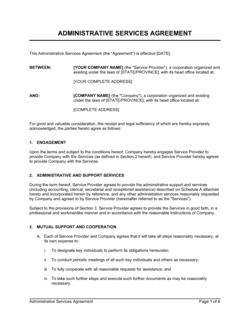
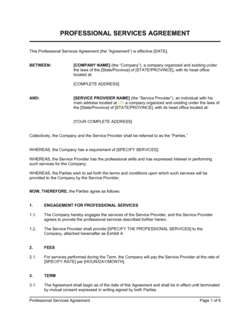
Architectural Services Agreement Template

Free Word download • Edit online • Save & share with Drive • Export to PDF

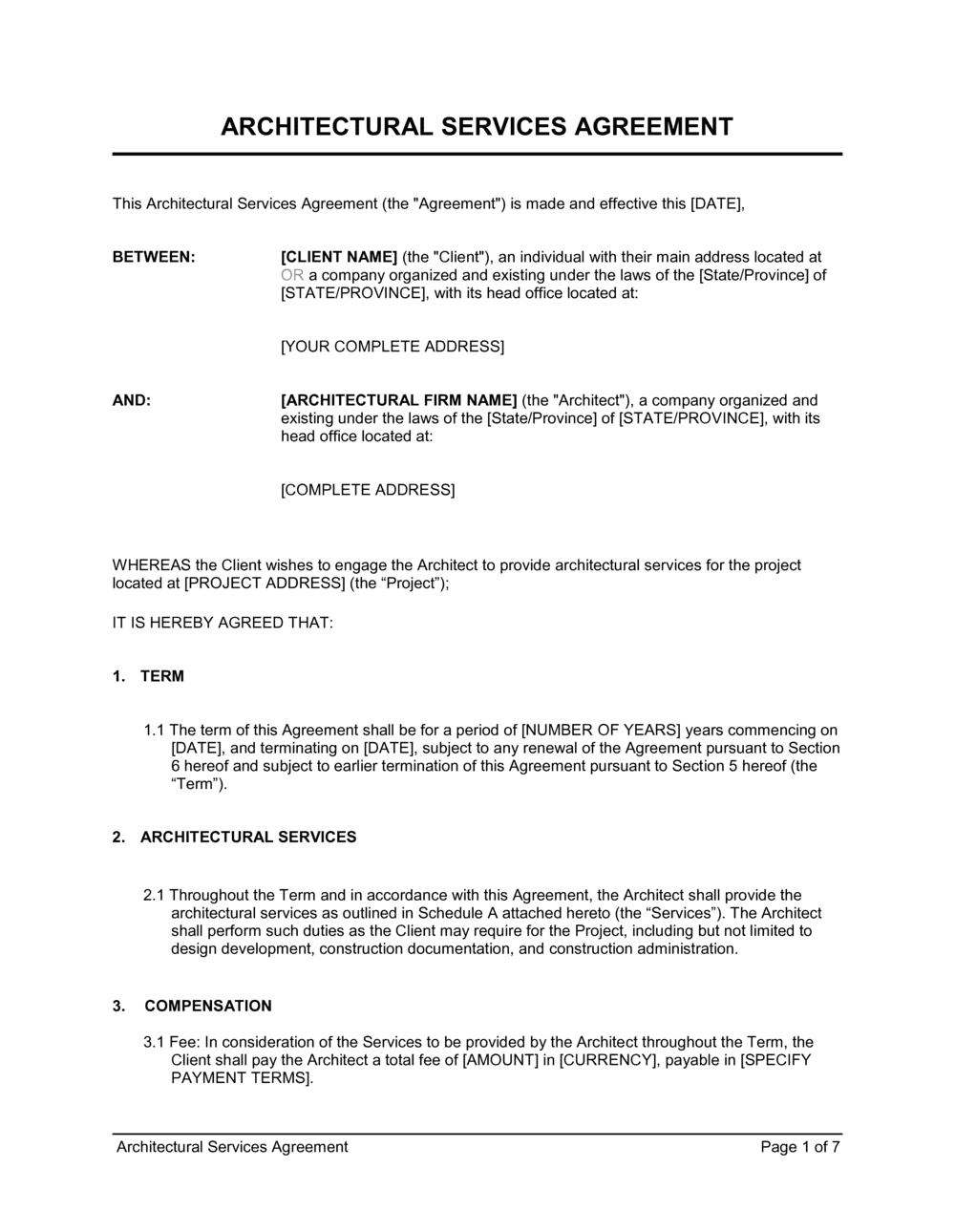
7 pages25–35 min to fillDifficulty: ComplexSignature requiredLegal review recommended
Learn more ↓
FreeArchitectural Services Agreement Template

At a glance

What it is
An Architectural Services Agreement is a legally binding contract between an architect or architectural firm and a client that defines the scope of design services, fee structure, deliverables, intellectual property ownership, liability limits, and termination rights. This free Word download gives you a professionally structured starting point you can edit online and export as PDF before any project kicks off.
When you need it
Use it before beginning any architectural engagement — new construction, renovation, interior design coordination, or permit-drawing services — where a client is paying for professional design work. It protects both parties the moment site visits, schematic drawings, or consultant coordination begin.
What's inside
Scope of services by project phase, fee schedule and payment milestones, intellectual property and copyright assignment, standard of care and liability limitation, change order procedure, client responsibilities, insurance requirements, termination and suspension rights, and governing law with dispute resolution.

What is an Architectural Services Agreement?

An Architectural Services Agreement is a legally binding contract between a licensed architect or architecture firm and a client that governs the full scope of professional design services — from preliminary schematic studies through construction administration. It defines which project phases are included, how and when the architect is paid, who owns the resulting drawings and specifications, what standard of professional care applies, and how disputes are resolved. Unlike a general services contract, an architectural agreement is specifically structured around the phased delivery model of the design profession and the unique liability profile that comes with stamping permitted drawings.

Why You Need This Document

Beginning architectural work without a signed agreement exposes both parties to serious risk from the first site visit. Without a written scope, clients assume full-service engagement while architects may have quoted only permit drawings — a gap that routinely produces five-figure disputes at construction administration. Without an IP clause, the client may believe they own the drawings outright, leaving the architect with no leverage to collect an overdue final payment. Without a liability cap, a firm earning $75,000 in fees faces uncapped exposure on a $4 million construction project if a design error contributes to a defect. This template closes all of those gaps in a single document, structured around the phased project model that every architectural engagement follows, so both parties know exactly what is owed and what is protected before a single drawing line is committed.

Which variant fits your situation?

If your situation is…Use this template
Full-service residential new construction engagementArchitectural Services Agreement (Residential)
Commercial tenant fit-out or office renovationArchitectural Services Agreement (Commercial)
Permit drawings only, no construction administrationLimited Architectural Services Agreement
Design-build where contractor and architect are the same entityDesign-Build Contract
Interior design scope without structural or permit workInterior Design Services Agreement
Architect engaged as a subconsultant to a general contractorSubconsultant Agreement
Feasibility study or pre-design services onlyConsulting Services Agreement

Common mistakes to avoid

❌ Starting work before the agreement is signed

Why it matters: Work performed before execution is typically unprotected — the architect has no contractual right to payment, no enforceable IP ownership, and no liability cap for that period.

Fix: Issue a brief letter of authorization or deposit invoice that explicitly requires signature and payment before any work begins, even for preliminary consultations.

❌ Vague scope language covering 'full architectural services'

Why it matters: Clients interpret 'full services' as including construction administration; architects interpret it as stopping at permit drawings. Disputes over CA scope are among the most common and expensive in the profession.

Fix: List every phase by name, confirm inclusion or exclusion for each, and attach a detailed service matrix as an exhibit if the project is complex.

❌ No written change order before performing additional services

Why it matters: Verbal approvals for redesign, scope additions, or owner-directed revisions are routinely disputed at invoice time, leaving the architect unpaid for hours of work.

Fix: Include a clause requiring a signed change order within 10 business days of written notification — and stop work on the additional service if no authorization arrives.

❌ No limitation of liability clause

Why it matters: Without a liability cap, a firm earning $60,000 in fees on a $3 million project faces uncapped exposure if a design error contributes to a construction defect — an outcome that can exceed professional liability policy limits.

Fix: Cap total liability at fees paid under the agreement and confirm the cap is consistent with your E&O policy's per-claim limit.

❌ Granting an unrestricted copyright license to the client

Why it matters: A client who receives an unrestricted license can reuse drawings on subsequent projects, sell the design to another developer, or modify the documents without the architect's involvement — all without additional compensation.

Fix: Limit the license to construction of the specific project described in the agreement and condition it on full payment of all fees.

❌ Omitting the client's obligation to provide survey and geotechnical data

Why it matters: Proceeding without accurate site data forces redesign when constraints are discovered — and without a written obligation, clients treat the redesign cost as the architect's problem.

Fix: List required client-provided documents by name, set a delivery deadline for each, and include language making commencement of the relevant phase contingent on receipt.

The 10 key clauses, explained

Parties, project description, and recitals

In plain language: Identifies the architect or firm and the client as legal entities, describes the project by address and type, and records the effective date of the agreement.

Sample language
This Architectural Services Agreement ('Agreement') is entered into as of [DATE] between [ARCHITECT FIRM NAME], a [STATE] [ENTITY TYPE] ('Architect'), and [CLIENT LEGAL NAME] ('Client'), for architectural services in connection with the project located at [PROJECT ADDRESS] ('Project').

Common mistake: Using a trading name instead of the registered legal entity for the architect. If the contracting entity differs from the licensed entity, professional liability coverage may not apply to the engagement.

Scope of services and project phases

In plain language: Enumerates exactly which project phases — schematic design, design development, construction documents, bidding assistance, and construction administration — the architect is engaged to perform, and explicitly lists what is excluded.

Sample language
Architect shall provide the following services: (a) Schematic Design; (b) Design Development; (c) Construction Documents; (d) Bidding and Negotiation Assistance; (e) Construction Administration. The following services are expressly excluded unless added by written amendment: [EXCLUDED SERVICES LIST].

Common mistake: Describing scope only in general terms like 'full architectural services' without specifying which phases are included. Disputes about CA services — the most labor-intensive and liability-heavy phase — almost always arise from ambiguous scope language.

Compensation, fee structure, and payment schedule

In plain language: States whether fees are fixed, percentage of construction cost, or hourly; sets the payment milestone schedule tied to phase completion; and defines the reimbursable expense policy.

Sample language
Client shall pay Architect a fixed fee of $[AMOUNT], allocated as follows: Schematic Design [X]%, Design Development [X]%, Construction Documents [X]%, Bidding [X]%, Construction Administration [X]%. Invoices are due within [30] days. Reimbursable expenses are billed at cost plus [X]%.

Common mistake: Tying the entire fee to a percentage of construction cost without a minimum or a cap. If the contractor's bid comes in significantly over or under budget, the fee can become disproportionate to actual work performed.

Client responsibilities and information

In plain language: Defines what the client must provide — site surveys, geotechnical reports, utility information, timely decisions, and access — and states that delays caused by client inaction extend the schedule without additional cost to the architect.

Sample language
Client shall provide, at Client's expense: (a) a current boundary and topographic survey; (b) geotechnical/soils report; (c) existing as-built drawings, if available; (d) timely decisions in response to Architect's requests. Client-caused delays shall extend the schedule on a day-for-day basis.

Common mistake: Omitting the client's obligation to provide a current survey and soils report. Architects who proceed without these discover site constraints mid-design, triggering expensive redesign that clients refuse to treat as a change order.

Change orders and additional services

In plain language: Establishes that any scope change, owner-directed revision, or redesign caused by factors outside the architect's control requires a written change order with an agreed fee before work proceeds.

Sample language
Services beyond the scope of this Agreement — including redesign caused by Client changes, contractor errors, or changed site conditions — are Additional Services. Architect shall notify Client in writing before performing Additional Services. Client shall execute a Change Order within [10] business days or Architect may suspend work.

Common mistake: Performing additional services without a signed change order based on verbal client approval. Clients routinely dispute verbal change authorizations when the invoice arrives, leaving the architect uncompensated for weeks of redesign work.

Intellectual property, copyright, and license

In plain language: Reserves copyright in all drawings, specifications, and design documents to the architect, grants the client a limited license to use them for the specific project only, and makes that license contingent on payment in full.

Sample language
Architect retains all copyright and intellectual property rights in the instruments of service, including drawings and specifications. Client is granted a limited, non-exclusive license to use such instruments solely for constructing the Project, contingent on full payment of all fees. The license terminates automatically on Client's default.

Common mistake: Granting the client an unrestricted license to use drawings on future projects or modifications without additional compensation. This is particularly damaging for custom residential work, where a client builds the same design on a second lot and the architect receives nothing.

Standard of care and limitation of liability

In plain language: Defines the professional standard the architect commits to — the skill of a reasonably competent architect in the same locality — and caps total liability to the client at the amount of fees paid under the agreement.

Sample language
Architect shall perform services consistent with the professional skill and care ordinarily provided by architects practicing in the same locality under similar circumstances. Architect's total liability to Client shall not exceed the total fees paid by Client under this Agreement.

Common mistake: No liability cap at all, or a cap expressed as 'total project cost' rather than 'fees paid.' An uncapped liability clause exposes a firm charging $80,000 in fees to claims on a $4 million construction project — a ratio that makes professional liability insurance unworkable.

Insurance requirements

In plain language: Specifies the types and minimum coverage amounts for professional liability (E&O), general liability, and workers' compensation insurance that each party must maintain, and requires certificates of insurance before work begins.

Sample language
Architect shall maintain: (a) Professional Liability (E&O) insurance of not less than $[AMOUNT] per claim; (b) Commercial General Liability of not less than $[AMOUNT] per occurrence; (c) Workers' Compensation as required by law. Certificates of insurance shall be provided to Client upon request.

Common mistake: Setting insurance minimums without reference to project scale. A residential addition project may warrant $500,000 E&O coverage; a $20 million commercial project typically requires $2 million or more — using a single fixed number regardless of project size creates under- or over-insurance.

Termination and suspension

In plain language: Grants either party the right to terminate with written notice after a cure period, states what fees and reimbursables are owed upon termination, and gives the architect the right to suspend services for non-payment after a defined cure period.

Sample language
Either party may terminate this Agreement upon [7] days' written notice if the other party materially breaches and fails to cure within [7] days. Upon termination, Client shall pay all fees earned and reimbursable expenses incurred through the termination date. Architect may suspend services after [15] days of non-payment.

Common mistake: No suspension-for-non-payment right. Without it, the architect must choose between continuing to work unpaid or breaching the contract — architects who suspend work without an express right to do so face counterclaims for delay damages.

Governing law, dispute resolution, and entire agreement

In plain language: Designates the jurisdiction whose law governs the agreement, specifies whether disputes go to mediation, arbitration, or litigation, and confirms the written contract supersedes all prior proposals, emails, and verbal understandings.

Sample language
This Agreement is governed by the laws of [STATE / PROVINCE / COUNTRY]. Disputes shall first be submitted to non-binding mediation before [MEDIATION PROVIDER]. This Agreement constitutes the entire agreement between the parties and supersedes all prior representations, proposals, and correspondence.

Common mistake: Relying on the entire-agreement clause without reviewing whether prior proposal documents or emails contain contradictory terms already acted upon by both parties. Courts in some jurisdictions treat partially-performed prior agreements as surviving a later integration clause.

How to fill it out

  1. 1

    Identify both parties with their legal entity names

    Enter the architect's full registered firm name — not a trade name — and the client's legal name as it appears on title or corporate registration. Include the project address and a brief project description.

    💡 Confirm that the contracting architect entity matches the entity named on the professional liability policy — a mismatch can void coverage on a claim.

  2. 2

    Define the scope by checking each project phase

    Go through schematic design, design development, construction documents, bidding assistance, and construction administration one by one. Check only the phases you are engaged for and explicitly list excluded services in the scope section.

    💡 If construction administration is excluded, add a sentence confirming the client assumes responsibility for verifying contractor conformance — this limits CA-phase liability for the architect.

  3. 3

    Set the fee structure and payment milestones

    Choose fixed fee, hourly, or percentage of construction cost. For fixed fees, allocate percentages across phases so each invoice is tied to a deliverable. Set a payment due date of 30 days or less and specify a late interest rate.

    💡 Include a minimum fee floor if using a percentage model — set it at the fixed cost to deliver the services regardless of project budget changes.

  4. 4

    List client-provided information obligations

    Specify every document and decision the client must deliver before each phase begins — surveys, soils reports, program requirements, and approval timelines. State that client delays extend the schedule day-for-day without fee adjustment.

    💡 Add a deadline for client feedback on each design submission — 'Client shall provide written comments within [14] days or the submission is deemed approved' prevents projects from stalling indefinitely.

  5. 5

    Complete the intellectual property and license clause

    Confirm that copyright remains with the architect. Define exactly what the license permits — construction of the described project only — and tie the license to payment in full.

    💡 If the client is a developer who may build the same design more than once, address repeat-use fees explicitly here rather than relying on the default license restriction.

  6. 6

    Set the liability cap and insurance minimums

    Enter a liability cap equal to total fees paid under the agreement. Set E&O and CGL insurance minimums appropriate to project scale — typically $1 million per claim for projects under $5 million in construction cost.

    💡 Check your actual E&O policy limit before entering a number — promising $2 million coverage when your policy caps at $1 million creates a contractual obligation you cannot meet.

  7. 7

    Define termination rights and cure periods

    Set the written notice period (7–14 days is standard), the cure period for material breach, and the suspension trigger for non-payment (typically 15–30 days overdue). Specify what is owed upon termination — fees earned plus reimbursables.

    💡 Include a clause requiring the client to return all original instruments of service if the license terminates due to non-payment.

  8. 8

    Execute before any billable work begins

    Both parties must sign before site visits, schematic studies, or consultant coordination start. Work performed before signing is generally unprotected by the agreement's IP, liability, and payment terms.

    💡 Use a digital signature tool with timestamped execution records — in disputes over project scope, the execution date matters as much as the content.

Frequently asked questions

What is an architectural services agreement?

An architectural services agreement is a legally binding contract between an architect or architecture firm and a client that defines the scope of design services, the fee structure, intellectual property ownership, standard of care, liability limits, and termination rights. It governs the professional relationship from the first schematic sketch through construction administration and protects both parties if scope, payment, or quality disputes arise.

What should an architectural services agreement include?

At minimum: full legal names of both parties, project address and description, specific phases of service included and excluded, fee schedule with payment milestones, client-provided information obligations, change order procedure, intellectual property and copyright terms, standard of care, limitation of liability, insurance requirements, termination and suspension rights, and governing law. Missing any of these creates gaps that courts fill with jurisdiction-specific defaults — often unfavorable to the architect.

Who owns the drawings and design documents?

In most jurisdictions, the architect retains copyright in all drawings, specifications, and instruments of service by default, even after the client pays the fee. The client typically receives a limited license to use those documents for constructing the specific project. That license is usually conditioned on full payment — if the client defaults, the license terminates and the client must stop using the drawings. If the client wants full ownership, the agreement must include an explicit written assignment, which typically commands a higher fee.

Can a client use the architect's drawings for a different project?

Not without express written permission and, typically, additional compensation. A standard architectural services agreement limits the client's license to the specific project described in the agreement. Reusing drawings for a second building — even on a different lot owned by the same client — falls outside that license and constitutes copyright infringement unless a repeat-use fee and written authorization are in place.

What is a limitation of liability clause and is it enforceable?

A limitation of liability clause caps the architect's total financial exposure to the client — typically to the amount of fees paid under the agreement. Courts in most US states and Canadian provinces enforce these clauses in commercial contracts when the cap is not unconscionably low and both parties negotiated at arm's length. Residential clients in some jurisdictions receive additional statutory protections. The clause should be prominently positioned and, ideally, separately initialed to demonstrate mutual assent.

What happens if the client requests changes to the design?

Changes to the approved design scope, program, or previously completed work constitute additional services requiring a written change order before the architect proceeds. A change order documents the new scope, additional fee, and schedule impact and must be signed by both parties. Performing changes without a signed change order leaves the architect without a contractual right to additional compensation, regardless of verbal approvals.

Do I need a lawyer to draft an architectural services agreement?

For straightforward residential or small commercial projects, a high-quality template reviewed against your jurisdiction's requirements is typically sufficient. Engage a lawyer for large commercial or institutional projects, design-build arrangements, multi-party consultant structures, projects in heavily regulated jurisdictions, or any engagement where the liability exposure is material relative to the firm's E&O coverage. A 1–2 hour template review typically costs $400–$800 and is worthwhile for any project over $1 million in construction cost.

What insurance should an architect carry on this type of engagement?

Architects typically carry professional liability (errors and omissions) insurance, commercial general liability, and workers' compensation. E&O coverage should be matched to project scale — $1 million per claim is common for projects under $5 million in construction cost, with higher limits for larger work. The agreement should specify minimum coverage amounts and require both parties to provide certificates of insurance before work begins.

What is construction administration and why does it matter in the agreement?

Construction administration is the project phase during which the architect reviews contractor submittals, responds to RFIs, conducts site visits to verify conformance with the contract documents, and certifies payment applications. It is the most labor-intensive and liability-heavy phase. Whether CA is included or excluded must be stated explicitly in the agreement — vague scope language is the single most common trigger for disputes between architects and clients on complex projects.

How this compares to alternatives

vs Interior Design Services Agreement

An interior design agreement covers finish selections, furniture, lighting, and spatial planning within an existing structure, and does not typically involve structural engineering, permit drawings, or construction administration. An architectural services agreement is required when the scope includes structural elements, building permits, or site-related design work. For projects involving both, separate agreements or a combined scope exhibit clarify each professional's liability.

vs Construction Contract

A construction contract governs the relationship between a property owner and a general contractor — labor, materials, schedule, and payment for physical building work. An architectural services agreement governs the professional design relationship that precedes and oversees construction. Both are needed on most projects; the architectural agreement is typically executed first, often months before the construction contract.

vs Consulting Services Agreement

A general consulting agreement is suitable for advisory, strategy, or technical engagements that do not involve licensed professional services, deliverable drawings, or construction-phase obligations. An architectural services agreement is specifically calibrated to the liability profile, IP structure, and phased delivery model of licensed design professionals. Using a generic consulting agreement for architectural work leaves critical protections — IP retention, standard of care, liability cap — unaddressed.

vs Design-Build Contract

A design-build contract combines design and construction responsibilities in a single agreement with a single contractor entity. An architectural services agreement separates design and construction into distinct contracts, preserving the architect's independent role as the client's representative during construction. Design-build arrangements are common for commercial and industrial projects seeking cost certainty; traditional separate-contract delivery is more common for institutional, residential, and publicly funded work.

Industry-specific considerations

Real estate development

Multi-phase project scope with phased fee milestones, developer-retained IP for reuse across sites, and construction cost percentage fees tied to GMP.

Commercial construction

Coordination of structural, MEP, and civil consultants under the architect's scope, tenant improvement allowances, and code-compliance certification obligations.

Healthcare and institutional

Regulatory and accessibility compliance (ADA, OSHPD, HHS guidelines), extended construction administration for phased occupancy, and heightened standard-of-care obligations.

Residential construction and renovation

Homeowner-client protections in consumer contract statutes, permit-drawing-only engagements, and repeat-use license restrictions for custom residential designs.

Jurisdictional notes

United States

Architectural services contracts are governed by state law — there is no federal standard. The AIA B101 form is widely used as an industry baseline but is not legally required. California, New York, and Texas each impose specific consumer contract disclosures for residential projects. Non-compete clauses in architect employment and client non-solicitation terms are subject to state-by-state enforceability rules, with California being the most restrictive.

Canada

Architectural practice is provincially regulated; the Royal Architectural Institute of Canada (RAIC) publishes model client–architect agreements used as baseline documents in most provinces. Ontario and British Columbia impose statutory lien rights that interact with payment milestone structures in the agreement. Quebec civil law governs contracts differently from common-law provinces — Quebec agreements must address the Civil Code's professional mandate provisions and should be drafted in French for provincially regulated work.

United Kingdom

The RIBA Standard Professional Services Contract is the industry-standard baseline in the UK. Architects are regulated by the Architects Registration Board (ARB), and all qualifying architects must carry professional indemnity insurance. The Construction Act 1996 (as amended) imposes mandatory adjudication rights and payment notice requirements that override contrary contract terms — payment provisions in the agreement must comply or risk being replaced by the Act's default scheme.

European Union

Architectural regulation and contract norms vary significantly by member state — Germany, France, and the Netherlands each have professional bodies with model contract terms. GDPR applies to any client personal data collected or processed during the engagement, including site photographs and homeowner contact details. Cross-border engagements within the EU must address which member state's professional licensing requirements apply to the architect of record, as automatic mutual recognition of qualifications applies under the Professional Qualifications Directive.

Template vs lawyer — what fits your deal?

PathBest forCostTime
Use the templateResidential projects, small commercial renovations, and permit-drawing-only engagements under $1 million in construction costFree30–60 minutes
Template + legal reviewCommercial projects over $1 million in construction cost, multi-phase engagements, or jurisdictions with strict consumer contract requirements$400–$8002–5 days
Custom draftedLarge institutional or mixed-use projects, design-build arrangements, multi-party consultant structures, or publicly funded work with procurement requirements$2,000–$8,000+2–4 weeks

Glossary

Schematic Design (SD)
The first project phase in which the architect produces preliminary drawings establishing overall building form, layout, and conceptual direction.
Design Development (DD)
The phase following schematic design in which drawings are refined to include structural, mechanical, and material specifications.
Construction Documents (CDs)
The final set of drawings and specifications used for permit applications, contractor bidding, and on-site construction.
Construction Administration (CA)
The phase during which the architect reviews contractor submittals, responds to RFIs, and visits the site to confirm work conforms to the contract documents.
Standard of Care
The level of skill, diligence, and judgment that a reasonably competent architect in the same community would apply under similar project conditions.
Change Order
A written amendment to the project scope or fee, signed by both parties, that formally authorizes work beyond the original agreement.
Reimbursable Expenses
Out-of-pocket costs the architect incurs on the client's behalf — printing, travel, permit fees, and third-party reports — billed at cost or with a markup.
Intellectual Property (IP) / Copyright
Legal ownership of the architect's drawings, specifications, and design documents — typically retained by the architect unless expressly assigned to the client.
License to Use
A client's right to use the architect's drawings for a specific project without owning the underlying copyright.
Limitation of Liability
A clause capping the architect's total financial exposure — typically to the amount of fees paid — protecting the firm from claims disproportionate to project fee.
Request for Information (RFI)
A formal written question from the contractor to the architect seeking clarification on drawings or specifications during construction.
Errors and Omissions Insurance (E&O)
Professional liability insurance covering claims arising from mistakes, incomplete work, or negligent services in the architect's professional output.

Part of your Business Operating System

This document is one of 3,000+ business & legal templates included in Business in a Box.

  • Fill-in-the-blanks — ready in minutes
  • 100% customizable Word document
  • Compatible with all office suites
  • Export to PDF and share electronically

Create your document in 3 simple steps.

From template to signed document — all inside one Business Operating System.
1
Download or open template

Access over 3,000+ business and legal templates for any business task, project or initiative.

2
Edit and fill in the blanks with AI

Customize your ready-made business document template and save it in the cloud.

3
Save, Share, Send, Sign

Share your files and folders with your team. Create a space of seamless collaboration.

Save time, save money, and create top-quality documents.

★★★★★

"Fantastic value! I'm not sure how I'd do without it. It's worth its weight in gold and paid back for itself many times."

Managing Director · Mall Farm
Robert Whalley
Managing Director, Mall Farm Proprietary Limited
★★★★★

"I have been using Business in a Box for years. It has been the most useful source of templates I have encountered. I recommend it to anyone."

Business Owner · 4+ years
Dr Michael John Freestone
Business Owner
★★★★★

"It has been a life saver so many times I have lost count. Business in a Box has saved me so much time and as you know, time is money."

Owner · Upstate Web
David G. Moore Jr.
Owner, Upstate Web

Run your business with a system — not scattered tools

Stop downloading documents. Start operating with clarity. Business in a Box gives you the Business Operating System used by over 250,000 companies worldwide to structure, run, and grow their business.

Start free · No credit card required