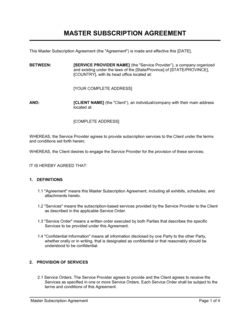
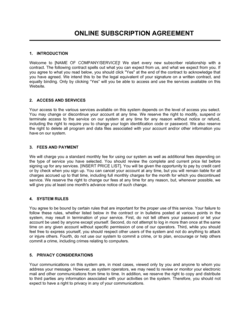
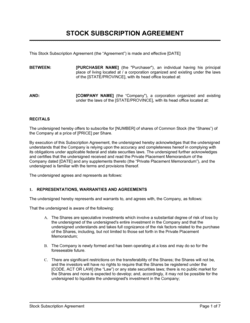
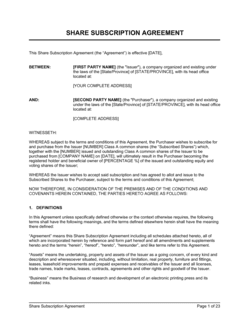
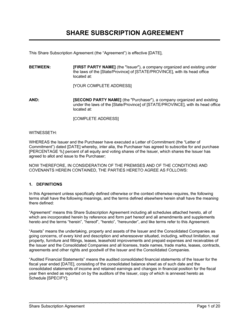
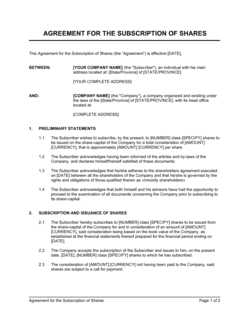
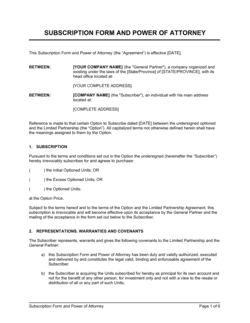
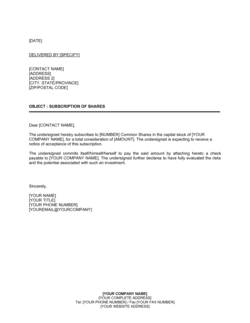
Subscription Agreement Template

Free Word download • Edit online • Save & share with Drive • Export to PDF

9 pages30–40 min to fillDifficulty: ComplexSignature requiredLegal review recommended
Learn more ↓
FreeSubscription Agreement Template

At a glance

What it is
A Subscription Agreement is a legally binding contract between a provider and a subscriber that governs access to a product, service, or platform on a recurring-fee basis. This free Word download covers pricing, billing cycles, renewal and cancellation terms, acceptable use, intellectual property, liability limitations, and termination — all in a single structured document you can edit online and export as PDF.
When you need it
Use it whenever you sell recurring access to software, digital content, a membership program, or a managed service — any arrangement where a customer pays on a monthly, quarterly, or annual cycle rather than once per transaction.
What's inside
Subscription scope and service description, fees and billing schedule, auto-renewal and cancellation rights, acceptable use restrictions, intellectual property ownership, confidentiality, limitation of liability, indemnification, termination for cause and convenience, and governing law with dispute resolution.

What is a Subscription Agreement?

A Subscription Agreement is a legally binding contract between a provider and a subscriber that governs recurring access to a product, platform, or service in exchange for periodic fees. Where a one-time sales contract closes a single transaction, a subscription agreement creates an ongoing relationship — defining the billing cycle, renewal mechanics, acceptable use restrictions, intellectual property ownership, data handling obligations, liability caps, and the conditions under which either party may end the arrangement. It is the foundational document for any business that charges customers monthly, quarterly, or annually rather than per transaction, and it protects both sides from the commercial and legal ambiguity that recurring billing relationships routinely generate.

Why You Need This Document

Without a signed subscription agreement, recurring revenue sits on an informal foundation. A subscriber who disputes an auto-renewal charge has no document to consult; a provider who discovers a customer sharing credentials across fifty users has no contractual basis to bill for the overage or suspend access. Data disputes — who owns the content uploaded to your platform, what happens to it on cancellation, whether you can use it to improve your product — become credibility contests rather than contract interpretation questions. Regulators in California, the EU, and the UK are actively enforcing auto-renewal disclosure and cancellation rules, and providers with no written agreement face the full weight of default statutory terms, which consistently favor the subscriber. This template gives your subscription business the legal structure it needs: enforceable payment terms, a clear renewal and cancellation mechanism, mutual liability protection, and data-rights language that satisfies GDPR and CCPA compliance requirements — all in a single document you can execute before the first billing cycle runs.

Which variant fits your situation?

If your situation is…Use this template
Selling cloud software on a per-seat monthly or annual planSaaS Subscription Agreement
Offering a consumer-facing digital membership or content subscriptionOnline Membership Agreement
Engaging a managed service provider on a monthly retainerManaged Services Agreement
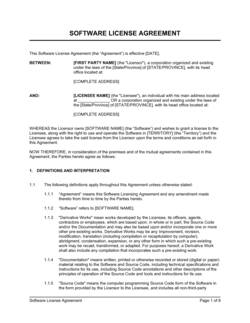
Licensing software to an enterprise under a multi-year dealSoftware License Agreement
Providing ongoing professional services billed monthlyService Retainer Agreement
Selling a subscription box or physical product on a recurring cycleProduct Subscription Agreement
Granting API access to third-party developers on a usage-based planAPI Access Agreement

Common mistakes to avoid

❌ No payment-failure suspension clause

Why it matters: Without an explicit right to suspend service after a failed payment, the provider must continue delivering the service while pursuing the subscriber for unpaid fees — incurring ongoing cost with no contractual leverage.

Fix: Add a clause granting the right to suspend access after a defined grace period (5–10 days) following a failed payment, with reinstatement upon payment of all outstanding amounts plus a reconnection fee if applicable.

❌ Auto-renewal window shorter than local statutory minimums

Why it matters: Several US states (California, New York, Illinois), the EU, and the UK require providers to notify subscribers of upcoming auto-renewals. A contract that sets a 15-day cancellation window may violate a statute requiring 30–60 days' notice, exposing the provider to regulatory fines and chargebacks.

Fix: Research the auto-renewal notice requirements in the jurisdictions where your subscribers are located and set the cancellation window to the longest applicable statutory minimum.

❌ No subscriber data ownership or export clause

Why it matters: Subscribers who cannot confirm they own their data or extract it on termination will refuse to sign or demand amendments — stalling deals and increasing legal review costs. Providers who retain ambiguous rights to subscriber data face GDPR enforcement risk.

Fix: Add two sentences: one confirming the subscriber owns all data it submits, and one specifying that the provider will make that data available for export in a standard format (CSV, JSON, or equivalent) for 30 days post-termination.

❌ One-sided limitation of liability clause

Why it matters: A cap that limits only the provider's damages while leaving the subscriber with unlimited exposure for AUP violations is frequently challenged as unconscionable, particularly in consumer contracts and B2B contracts in the UK and EU.

Fix: Make the liability cap mutual — both parties are capped at 12 months of fees paid — and carve out claims arising from gross negligence, willful misconduct, or indemnification obligations from both sides.

❌ No governing-law clause appropriate to the subscriber's location

Why it matters: Choosing a favorable governing law (e.g., Delaware) provides no protection against consumer-protection statutes in the subscriber's home jurisdiction, which typically apply regardless of the contractual choice. The mismatch creates the illusion of legal certainty while leaving real exposure unaddressed.

Fix: Consult a lawyer on applicable mandatory local consumer or data-protection laws before selecting a governing law and venue, especially for subscriptions sold to consumers in the EU, UK, or Canada.

❌ No acceptable use audit right

Why it matters: Seat-based and usage-based pricing models depend on the ability to verify compliance. Without a contractual right to audit, a subscriber can share credentials across an unlimited number of users with no practical consequence.

Fix: Include a clause granting the provider the right to audit the subscriber's usage on reasonable written notice (typically 5–10 business days) and requiring the subscriber to pay any underpaid fees identified plus interest.

The 9 key clauses, explained

Parties and subscription scope

In plain language: Identifies the provider and the subscriber as legal entities and describes exactly which product, plan, or service tier the subscriber is purchasing access to.

Sample language
This Subscription Agreement is entered into as of [DATE] between [PROVIDER LEGAL NAME], a [STATE/COUNTRY] [ENTITY TYPE] ('Provider'), and [SUBSCRIBER LEGAL NAME] ('Subscriber'). Provider grants Subscriber a non-exclusive, non-transferable subscription to [SERVICE NAME] — [PLAN TIER] — as described in Schedule A.

Common mistake: Referencing a marketing plan name instead of the specific service tier and feature set. When the provider updates its pricing page, the contract no longer maps to a defined offering, creating disputes over what is and is not included.

Fees, billing cycle, and payment terms

In plain language: States the subscription fee, billing frequency, accepted payment methods, any applicable taxes, and the consequences of late or failed payment.

Sample language
Subscriber shall pay the Subscription Fee of $[AMOUNT] per [month/year], billed [in advance / in arrears] to the payment method on file. All fees are exclusive of applicable taxes. Invoices not paid within [10] days of the due date accrue interest at [1.5]% per month.

Common mistake: Omitting what happens when a payment fails. Without an explicit grace period and suspension clause, providers either cut off paying customers who had a card decline or continue providing unpaid service with no contractual basis to suspend.

Subscription term and auto-renewal

In plain language: Defines the initial subscription period, sets out how and when auto-renewal occurs, and specifies the notice deadline to cancel before renewal.

Sample language
The initial Subscription Term commences on [START DATE] and continues for [12] months. Unless either party provides written notice of non-renewal at least [30] days prior to the end of the then-current Term, the Agreement shall automatically renew for successive [12]-month periods at the then-current list price.

Common mistake: Setting a cancellation deadline shorter than the notice period required by consumer protection laws in the subscriber's jurisdiction. Several US states, the EU, and the UK require providers to give subscribers advance notice of upcoming auto-renewals.

Acceptable use and restrictions

In plain language: Defines what the subscriber is and is not permitted to do with the service — covering prohibited activities, user seat limits, resale restrictions, and reverse-engineering prohibitions.

Sample language
Subscriber shall not: (a) sublicense, resell, or transfer access to the Service without Provider's prior written consent; (b) reverse engineer or attempt to extract the source code of the Service; (c) use the Service to store or transmit unlawful, infringing, or harmful content; or (d) exceed the number of authorized Users set out in Schedule A.

Common mistake: No seat or user limit in the acceptable use clause. Without a defined user count, a subscriber can share credentials across an entire organization — eliminating the per-seat revenue the pricing model depends on.

Intellectual property ownership

In plain language: Confirms that the provider retains all ownership rights in the service, platform, and underlying technology, while granting the subscriber a limited license to use it during the subscription term.

Sample language
Provider retains all right, title, and interest in and to the Service, including all software, algorithms, and documentation. Subscriber's access constitutes a limited, non-exclusive license for the duration of the Subscription Term only. Subscriber retains all rights in data it submits to the Service ('Subscriber Data').

Common mistake: Failing to separately address who owns subscriber data uploaded to the platform. Without explicit language confirming the subscriber owns its data, disputes arise over data portability on cancellation and the provider's rights to use that data for model training or analytics.

Confidentiality

In plain language: Restricts both parties from disclosing the other's non-public information — including pricing, technical architecture, and business data — to third parties outside the agreement.

Sample language
Each party agrees to hold in confidence and not disclose the other party's Confidential Information to any third party, using at least the same degree of care it uses for its own confidential information (but no less than reasonable care). This obligation survives termination for [3] years.

Common mistake: No carve-out for disclosure required by law or court order. Without it, a party compelled to disclose by a regulator or subpoena has no contractual protection for complying — and may face breach claims from the other party.

Limitation of liability

In plain language: Caps the maximum financial exposure of each party to the other, typically excluding certain categories of loss such as consequential or indirect damages.

Sample language
In no event shall either party's aggregate liability exceed the total Subscription Fees paid by Subscriber in the [12] months immediately preceding the claim. Neither party shall be liable for indirect, incidental, consequential, or punitive damages, even if advised of the possibility of such losses.

Common mistake: No mutual cap — only the provider's liability is limited, while the subscriber faces unlimited exposure for AUP violations or non-payment. Courts in several jurisdictions will reform or strike one-sided caps as unconscionable.

Termination and effect of termination

In plain language: States the grounds for termination by either party — for cause (material breach, non-payment, insolvency) or for convenience — and what happens to data, licenses, and outstanding fees when the agreement ends.

Sample language
Either party may terminate this Agreement for cause upon [30] days' written notice if the other party materially breaches this Agreement and fails to cure within such period. Upon termination, Subscriber's access to the Service shall cease. Provider shall make Subscriber Data available for export for [30] days post-termination, after which it may be deleted.

Common mistake: No data-return or deletion window after termination. Subscribers who cannot export their data before it is purged face operational disruption; providers who retain data indefinitely face GDPR and privacy-law liability.

Governing law and dispute resolution

In plain language: Specifies the jurisdiction whose laws govern the agreement and the mechanism for resolving disputes — arbitration, mediation, or litigation — including the venue.

Sample language
This Agreement is governed by the laws of [STATE / PROVINCE / COUNTRY], without regard to conflict-of-laws principles. Any dispute shall be resolved by binding arbitration administered by [AAA / JAMS / ICDR] in [CITY], except that either party may seek injunctive relief in any court of competent jurisdiction.

Common mistake: Choosing a governing law in a jurisdiction with no meaningful connection to where the subscriber operates. Consumer-facing businesses in particular may find that local consumer-protection law applies regardless of the governing-law clause, making the chosen forum irrelevant and the clause misleading.

How to fill it out

  1. 1

    Identify the parties and define the service

    Enter the provider's full registered legal entity name and the subscriber's legal name or entity. Attach a Schedule A that defines the specific service tier, features, and user count being purchased.

    💡 Reference the Schedule A rather than embedding plan details in the body — plan tiers and features change more often than the core contract terms, and a Schedule is easier to amend without re-executing the whole agreement.

  2. 2

    Set the fee, billing cycle, and payment failure terms

    Enter the exact dollar amount, billing frequency (monthly or annual), and whether billing is in advance or in arrears. Add a grace period for failed payments (typically 5–10 days) and a suspension right if the subscriber does not cure.

    💡 Specify the currency explicitly for any subscriber outside your home jurisdiction — USD and CAD are routinely confused on cross-border invoices.

  3. 3

    Define the subscription term and auto-renewal notice period

    Set the initial term length and the number of days' notice required to cancel before auto-renewal. Verify that the cancellation window meets the minimum statutory requirements in the subscriber's jurisdiction.

    💡 For consumer-facing subscriptions, the EU's 2022 consumer rights rules and several US state auto-renewal laws require the provider to send a renewal reminder — build this into your billing workflow, not just the contract.

  4. 4

    Tailor the acceptable use and seat restrictions

    Enter the maximum authorized user count and list any specific prohibited activities relevant to your service — for example, competing use, data scraping, or API abuse that your infrastructure pricing cannot absorb.

    💡 Add a right to audit the subscriber's user count on 5–10 days' notice. Without it, the seat restriction is unenforceable as a practical matter.

  5. 5

    Confirm IP ownership and subscriber data rights

    Ensure the clause confirms the provider owns the platform and all IP in the service, and separately confirms the subscriber owns all data it uploads. Add a data-portability provision specifying the format in which subscriber data will be exported on request.

    💡 If your platform uses subscriber data to train machine-learning models or generate analytics, add an explicit limited license from the subscriber permitting that use — otherwise you are operating on implied consent, which is insufficient under GDPR and similar laws.

  6. 6

    Set the liability cap at a defensible level

    The most common cap is 12 months of fees paid. For high-risk deployments — financial services, healthcare, or infrastructure — negotiate the cap separately rather than relying on the template default.

    💡 Exclude from the cap claims arising from a party's gross negligence, willful misconduct, or indemnification obligations — courts are more likely to enforce a cap that contains these carve-outs.

  7. 7

    Specify the post-termination data window and deletion timeline

    Enter the number of days after termination during which the subscriber can export its data (typically 30 days), and state the provider's data deletion or anonymization timeline after that window closes.

    💡 Under GDPR and Canada's PIPEDA, you are legally obligated to delete personal data upon request regardless of what the contract says — align the contractual timeline to your actual data-retention policy to avoid a conflict.

  8. 8

    Execute before the subscription start date

    Both parties must sign the agreement before the subscriber accesses the service. For online services using click-through acceptance, ensure the terms are presented on a screen that requires affirmative action — a checkbox, not just a banner.

    💡 For B2B deals above $10,000 ARR, obtain a wet or electronic signature from a person with actual authority to bind the subscriber entity. Click-through terms are harder to enforce against corporate subscribers who claim the clicking employee lacked authority.

Frequently asked questions

What is a subscription agreement?

A subscription agreement is a legally binding contract between a service provider and a subscriber that governs recurring access to a product, platform, or service in exchange for periodic fees. It defines the subscription term, billing cycle, renewal and cancellation rights, acceptable use, intellectual property ownership, liability limitations, and termination conditions. It is the governing document for any business relationship where payment recurs on a monthly, quarterly, or annual basis rather than as a one-time transaction.

What is the difference between a subscription agreement and a terms of service?

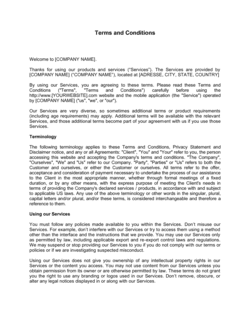
Terms of service (ToS) are a public, unilaterally posted document that governs a provider's relationship with all users — typically accepted by clicking 'agree' on a website. A subscription agreement is a negotiated, bilaterally signed contract between a specific provider and a specific subscriber, covering a defined service tier, price, and term. B2C platforms typically rely on ToS; B2B and enterprise SaaS deals use subscription agreements because the commercial terms are specific to each customer relationship.

Does a subscription agreement need to be signed?

Yes. For a subscription agreement to be fully enforceable — particularly the restrictive covenants (acceptable use, non-assignment, IP assignment) and liability caps — both parties should sign before the subscription begins. For consumer-facing services, a click-through acceptance of ToS may suffice in many jurisdictions, but for B2B deals with material annual contract values, a signed agreement is strongly preferred and often required by the subscriber's procurement process.

What auto-renewal notice is required by law?

Requirements vary by jurisdiction. California's Automatic Renewal Law requires advance disclosure of renewal terms and a reminder before annual renewals. Several other US states (New York, Illinois, Delaware, and others) have similar statutes. In the EU, the Consumer Rights Directive and its 2022 Digital Content amendments require renewal reminders and easy cancellation mechanisms. The UK has similar FCA and CMA guidance for subscription traps. For B2B subscriptions, statutory minimums are typically less prescriptive, but the contract should still set a reasonable cancellation window of at least 30 days.

Who owns subscriber data uploaded to a SaaS platform?

The subscriber owns its data in almost all well-drafted subscription agreements and under GDPR, CCPA, and similar privacy frameworks. The provider holds a limited license to process that data solely to deliver the service. Providers who want to use subscriber data for analytics, model training, or benchmarking must obtain an explicit, separate license from the subscriber. Without it, any such use is a potential breach of contract and a privacy-law violation.

What should the liability cap be set at?

The most widely accepted standard for SaaS and software subscription agreements is 12 months of fees paid by the subscriber in the period preceding the claim. Some providers negotiate a cap equal to the total fees paid under the agreement, while others set a fixed dollar ceiling. Caps are typically negotiated higher for contracts involving sensitive data processing, financial services, or healthcare. Both parties should exclude from the cap claims arising from gross negligence, willful misconduct, death or personal injury, and indemnification obligations.

Can a subscriber cancel a subscription agreement before the term ends?

That depends on the agreement. Annual contracts typically do not permit mid-term cancellation without paying the remaining fees, though some providers offer a pro-rata refund or a termination-for-convenience fee. Monthly contracts generally allow cancellation at the end of the current billing cycle with a defined notice period. Consumer subscribers may have statutory cooling-off rights — 14 days under EU and UK consumer law for digitally delivered services — regardless of what the contract says.

Is a subscription agreement the same as a software license agreement?

They overlap but serve different purposes. A software license agreement grants a right to use a defined software product — often perpetually — in exchange for a one-time or periodic license fee, and focuses heavily on the scope of permitted use and IP restrictions. A subscription agreement governs ongoing access to a service (including hosted software) with an emphasis on recurring billing, renewal mechanics, SLAs, and termination. Many modern SaaS contracts blend both: they include license grant language from a software license agreement and billing mechanics from a subscription agreement.

What happens to the subscriber's data when the subscription is terminated?

A well-drafted subscription agreement specifies a post-termination data window — typically 30 days — during which the subscriber can export its data in a standard format. After that window, the provider may delete or anonymize the data. Under GDPR, the provider must delete personal data on request regardless of the contractual timeline. Subscribers should confirm the data-export format and timeline before signing, particularly for mission-critical data held in proprietary formats.

Do I need a lawyer to draft a subscription agreement?

For straightforward monthly B2B subscriptions with annual contract values below $25,000, a high-quality template reviewed against your specific service terms is typically sufficient. Engage a lawyer when the subscription involves sensitive personal data processing, healthcare or financial services compliance, enterprise contracts above $100,000 ARR, cross-border subscribers in the EU or UK, or when the subscriber's legal team has returned a heavily marked-up redline. A 1–2 hour template review typically costs $400–$800 and is worthwhile for any recurring contract that will be executed at scale.

How this compares to alternatives

vs Software License Agreement

A software license agreement grants a right to use a defined software product — often perpetually or for a fixed term — and focuses on IP, permitted use, and installation scope. A subscription agreement governs recurring hosted or SaaS access with an emphasis on billing cycles, auto-renewal, SLAs, and data handling. Modern SaaS products increasingly use subscription agreements rather than traditional license agreements because the hosted delivery model makes perpetual licenses impractical.

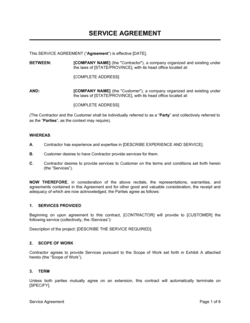
vs Service Agreement

A service agreement governs a defined scope of professional services — typically a project with a start and end date — billed per deliverable or hourly. A subscription agreement governs ongoing, recurring access to a standardized product or service for a fixed periodic fee. If the engagement involves custom work, use a service agreement; if the customer is paying for access to a platform or standardized service, use a subscription agreement.

vs Terms of Service

Terms of service are a public, unilaterally posted document accepted by all users by accessing a platform — typically enforceable through click-through. A subscription agreement is a bilaterally signed, customer-specific contract covering negotiated price, term, and service scope. Enterprise and B2B buyers almost always require a signed subscription agreement regardless of whether ToS exist, because procurement and legal teams need a document that reflects the agreed deal.

vs Managed Services Agreement

A managed services agreement governs an ongoing outsourced IT or operational function — helpdesk, infrastructure management, or cybersecurity monitoring — where the provider takes active responsibility for outcomes and performance. A subscription agreement governs self-service or semi-automated access to a platform where the subscriber configures and operates the service itself. When the provider's team is actively managing the environment on the subscriber's behalf, a managed services agreement is the more appropriate starting point.

Industry-specific considerations

SaaS / Technology

Per-seat pricing tiers, API rate limits in the acceptable use clause, uptime SLA with service credit remedies, and data processing addendum for GDPR compliance.

Media and Publishing

Content license scope, device and concurrent-stream limits, geographic access restrictions, and cooling-off period disclosures required by consumer digital-content laws.

Professional Services

Monthly retainer billing tied to a defined scope of services, deliverable schedules in a Schedule A, mid-term scope-change amendment process, and termination-for-convenience notice of 30–90 days.

Healthcare / MedTech

HIPAA Business Associate Agreement incorporated by reference, heightened data-breach notification timelines (typically 24–48 hours versus the standard 72), and limitation of liability carve-outs for patient safety incidents.

Financial Services / FinTech

Regulatory compliance obligations on the subscriber (KYC/AML pass-through), data residency requirements, audit rights aligned with SOC 2 Type II cycles, and enhanced indemnification for regulatory fines.

E-commerce / Retail

Consumer auto-renewal disclosure requirements by state and country, statutory cooling-off and refund rights for digital goods, and chargebacks addressed through payment-failure cure provisions.

Jurisdictional notes

United States

Auto-renewal laws vary by state — California (Business & Professions Code §17600), New York, Illinois, and Delaware all impose disclosure and cancellation requirements that apply regardless of governing-law choice. The FTC's 'Click-to-Cancel' rule (effective 2025) requires that cancellation be as easy as sign-up for consumer-facing subscriptions. CCPA requires data deletion on request for California subscribers, which must align with the post-termination data-return clause.

Canada

Provincial consumer protection statutes (Ontario CPA, BC BPCPA, and Quebec CPA) impose cooling-off rights for internet agreements and require plain-language disclosure of recurring charges before the subscriber is bound. Quebec's Law 25 (effective 2023) imposes GDPR-equivalent data protection obligations on any business handling Quebec residents' personal information. Contracts with Quebec-based subscribers should be available in French.

United Kingdom

The Consumer Contracts Regulations 2013 give consumers a 14-day cooling-off right for digitally delivered services contracted at a distance, though this may be waived for immediately accessed digital content with explicit consent. The CMA's 2023 subscription trap guidance requires clear cancellation mechanisms and renewal reminders for consumer subscriptions. UK GDPR mirrors EU GDPR for data processing obligations and applies to any provider processing UK residents' personal data post-Brexit.

European Union

The EU Digital Content Directive (2019/770) and the Omnibus Directive (2020/1828) impose mandatory terms for digital subscription services sold to consumers, including 14-day withdrawal rights and conformity guarantees. GDPR requires a Data Processing Agreement when the provider processes personal data on the subscriber's behalf, and data must remain within the EEA or be transferred under Standard Contractual Clauses. Several member states (Germany, France, Austria) have additional consumer auto-renewal notice requirements beyond the EU minimum.

Template vs lawyer — what fits your deal?

PathBest forCostTime
Use the templateSaaS and digital-service businesses onboarding standard B2B subscribers with ACV below $25,000Free30–45 minutes
Template + legal reviewSubscriptions involving personal data processing, regulated industries, or enterprise deals with annual values above $25,000$400–$8002–4 days
Custom draftedEnterprise SaaS with complex data processing, healthcare or financial-services compliance, or multi-jurisdiction subscriber bases requiring localized terms$2,000–$8,000+1–4 weeks

Glossary

Subscription Term
The defined period — monthly, quarterly, or annual — during which the subscriber has paid access to the service.
Auto-Renewal
A contractual mechanism that automatically extends the subscription for another term unless the subscriber cancels before the renewal date.
Recurring Fee
The periodic charge billed at a fixed interval — e.g., $99 per month or $999 per year — for continued access to the subscription.
Cancellation Window
The notice period a subscriber must give before the renewal date to stop the subscription without incurring the next billing cycle.
Acceptable Use Policy (AUP)
A set of rules defining what the subscriber may and may not do with the service, typically prohibiting illegal use, reverse engineering, or resale.
Uptime SLA
A Service Level Agreement provision specifying the minimum percentage of time the service must be available, with defined remedies for shortfalls.
Limitation of Liability
A clause capping the maximum damages one party can recover from the other, typically expressed as a multiple of fees paid in the prior 12 months.
Indemnification
An obligation by one party to cover the other's losses arising from a defined category of claims — commonly, third-party IP infringement or data breaches.
Termination for Cause
The right to end the agreement immediately, without a notice period, when the other party commits a material breach such as non-payment or AUP violation.
Termination for Convenience
The right to end the agreement by providing advance written notice without needing to cite a breach or fault by either party.
Data Processing Agreement (DPA)
A supplemental agreement governing how the provider handles personal data belonging to the subscriber's users, required under GDPR and similar privacy laws.

Part of your Business Operating System

This document is one of 3,000+ business & legal templates included in Business in a Box.

  • Fill-in-the-blanks — ready in minutes
  • 100% customizable Word document
  • Compatible with all office suites
  • Export to PDF and share electronically

Create your document in 3 simple steps.

From template to signed document — all inside one Business Operating System.
1
Download or open template

Access over 3,000+ business and legal templates for any business task, project or initiative.

2
Edit and fill in the blanks with AI

Customize your ready-made business document template and save it in the cloud.

3
Save, Share, Send, Sign

Share your files and folders with your team. Create a space of seamless collaboration.

Save time, save money, and create top-quality documents.

★★★★★

"Fantastic value! I'm not sure how I'd do without it. It's worth its weight in gold and paid back for itself many times."

Managing Director · Mall Farm
Robert Whalley
Managing Director, Mall Farm Proprietary Limited
★★★★★

"I have been using Business in a Box for years. It has been the most useful source of templates I have encountered. I recommend it to anyone."

Business Owner · 4+ years
Dr Michael John Freestone
Business Owner
★★★★★

"It has been a life saver so many times I have lost count. Business in a Box has saved me so much time and as you know, time is money."

Owner · Upstate Web
David G. Moore Jr.
Owner, Upstate Web

Run your business with a system — not scattered tools

Stop downloading documents. Start operating with clarity. Business in a Box gives you the Business Operating System used by over 250,000 companies worldwide to structure, run, and grow their business.

Start free · No credit card required