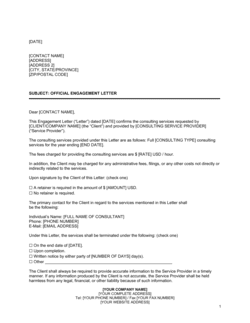
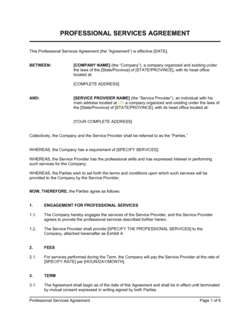
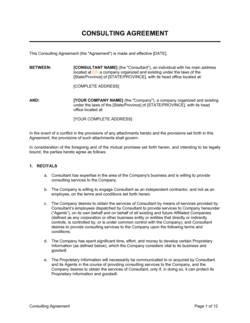
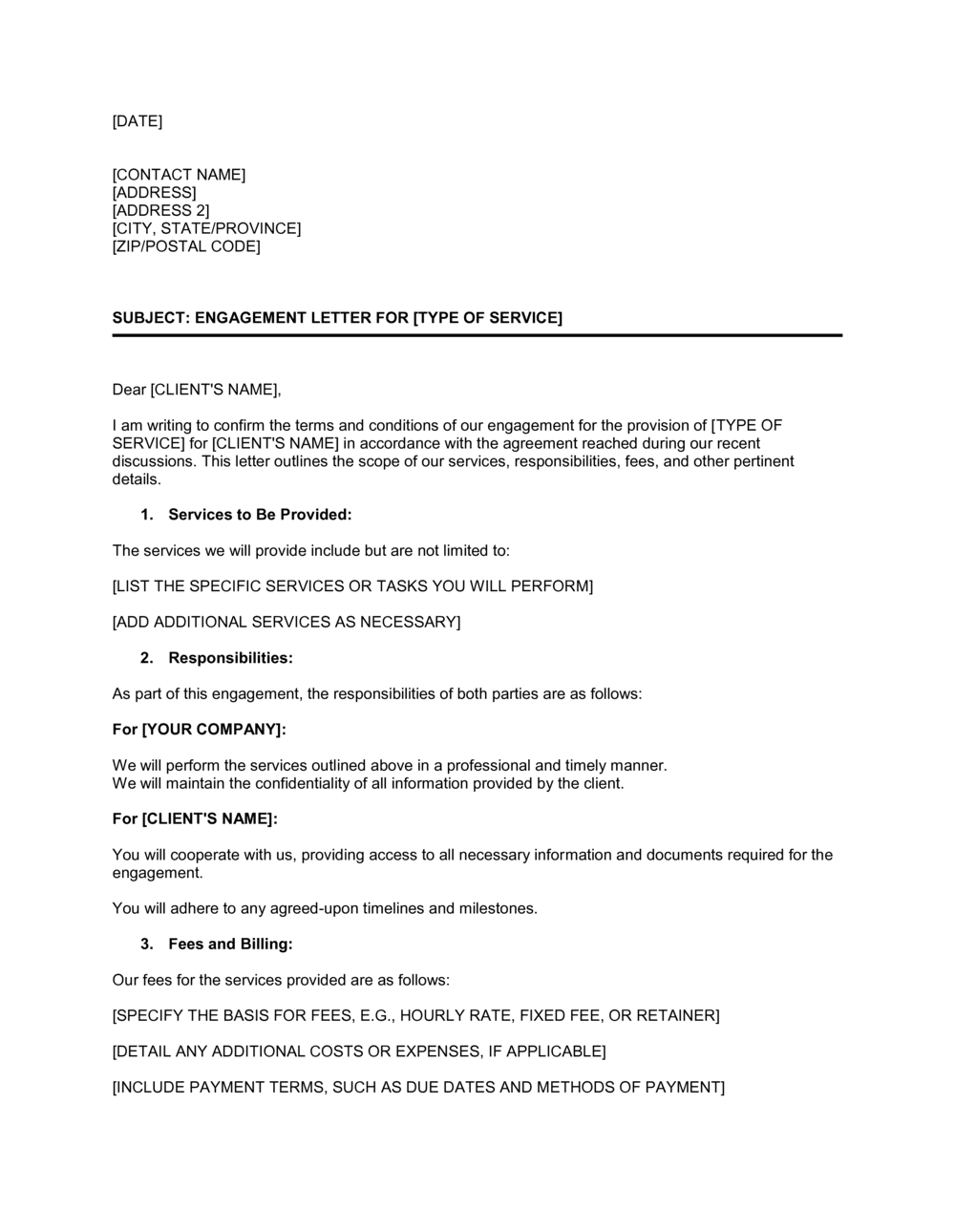
Engagement Letter Template

Free Word download β€’ Edit online β€’ Save & share with Drive β€’ Export to PDF

2 pagesβ€’20–25 min to fillβ€’Difficulty: Standard
Learn more ↓
FreeEngagement Letter Template

At a glance

What it is
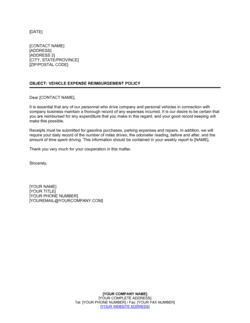
An Engagement Letter is a formal written notice a service provider sends to a client at the start of a professional relationship to confirm the agreed scope of work, fees, timelines, and mutual responsibilities. This free Word download gives you a ready-to-edit template you can tailor to your firm or practice and send to clients before any work begins.
When you need it
Use it whenever you take on a new client or project β€” before the first billable hour, before any confidential information is exchanged, and before any deliverable is produced. It is standard practice in accounting, consulting, legal services, and any professional engagement where scope creep or billing disputes are a real risk.
What's inside
Parties and engagement date, defined scope of services, fee structure and payment terms, client responsibilities, confidentiality acknowledgment, limitation of liability, and a signature or acknowledgment block. Together these components set shared expectations and give both sides a written record of what was agreed.

What is an Engagement Letter?

An Engagement Letter is a formal written document a service provider sends to a client before any work begins, confirming the agreed scope of services, fee structure, client responsibilities, and key terms of the professional relationship. Unlike a casual email exchange or verbal agreement, it creates a written record that both parties can refer to if a billing dispute or scope disagreement arises. It is standard practice across accounting, consulting, legal, financial advisory, and creative services β€” any professional context where misaligned expectations are a common and costly problem.

Why You Need This Document

Without an engagement letter, the terms of every client relationship exist only in emails, meeting notes, and memory β€” all of which are contested the moment a dispute arises. Scope creep is the most immediate risk: clients who never saw a written scope will regularly request work that falls outside what was discussed, leaving the provider in the awkward position of either absorbing the cost or damaging the relationship. Billing disputes follow the same pattern β€” an invoice that surprises a client who had no written fee estimate is far harder to collect than one that restates agreed terms. For regulated professionals such as CPAs and attorneys, most licensing bodies require or strongly recommend written engagement terms for every client matter. This template gives you a complete, professional starting point that takes 15 minutes to customize and sends a clear signal to clients that your practice operates with documented, consistent standards.

Which variant fits your situation?

If your situation is…Use this template
Accounting or tax-preparation engagementAccounting Engagement Letter
Legal matter intake for a law firm or solo attorneyLegal Services Engagement Letter
Management or strategy consulting projectConsulting Engagement Letter
Ongoing retainer for marketing or creative servicesAgency Retainer Agreement
IT or technology services projectIT Services Engagement Letter
Financial planning or wealth-management advisoryFinancial Advisory Engagement Letter
Binding service contract with milestone payments and penaltiesProfessional Services Agreement

Common mistakes to avoid

❌ Vague scope language

Why it matters: Terms like 'general advisory services' give clients unlimited grounds to request additional work at no charge. Every out-of-scope request becomes an argument.

Fix: List every deliverable explicitly and add an exclusions paragraph. Out-of-scope work should be covered by a separate change order.

❌ No fee estimate for hourly engagements

Why it matters: Clients who receive a final invoice well above their mental expectation dispute it, delay payment, or damage the relationship β€” even when the hours were legitimate.

Fix: Include an estimated hour range and note that you will notify the client before exceeding it by more than [10]%.

❌ Starting work before the letter is acknowledged

Why it matters: If the client later disputes terms, you have no signed or acknowledged document to reference β€” the letter becomes a draft, not a binding record.

Fix: Make acknowledgment a precondition to starting work. If urgency requires starting earlier, follow up immediately with a written confirmation email.

❌ Omitting client responsibilities

Why it matters: Without documented client obligations, providers absorb all delays and rework caused by late or incomplete information β€” with no contractual basis to charge for the extra time.

Fix: Add a client responsibilities clause naming exactly what the client must provide and by when, and tie timeline obligations to receipt of that information.

The 9 key clauses, explained

Parties and engagement date

In plain language: Identifies the service provider and client by legal name and states the date the engagement formally begins.

Sample language
This engagement letter confirms the terms under which [FIRM NAME] ('Provider') will provide services to [CLIENT LEGAL NAME] ('Client'), effective [DATE].

Common mistake: Using a trade name or contact name instead of the client's registered legal entity β€” if a dispute arises, it is harder to enforce the letter against the correct party.

Purpose and background

In plain language: One or two sentences summarizing why the engagement exists and what prompted the client to seek services.

Sample language
Client has engaged Provider to assist with [BRIEF DESCRIPTION OF NEED], as discussed in our meeting on [DATE].

Common mistake: Skipping this clause entirely, which leaves the letter without context and makes scope disputes harder to resolve by reference to original intent.

Scope of services

In plain language: A specific list of what the provider will do β€” and, if necessary, a short exclusions paragraph stating what is not included.

Sample language
Provider will perform the following services: (1) [SERVICE 1]; (2) [SERVICE 2]; (3) [SERVICE 3]. This engagement does not include [EXCLUDED SERVICE] unless separately agreed in writing.

Common mistake: Writing a vague scope like 'general consulting services' β€” this invites scope creep and makes it impossible to bill additional work as out-of-scope.

Fees, billing, and payment terms

In plain language: States the fee structure (fixed, hourly, retainer, or milestone-based), the billing cycle, accepted payment methods, and any late-payment charges.

Sample language
Provider's fee for this engagement is $[AMOUNT] [per hour / fixed / per month]. Invoices will be issued [monthly / upon completion] and are due within [30] days. A late fee of [1.5]% per month applies to balances unpaid after the due date.

Common mistake: Stating an hourly rate without an estimated total or budget cap β€” clients are frequently surprised by the final invoice, leading to disputes and delayed payment.

Client responsibilities

In plain language: Lists what the client must provide β€” information, access, approvals, or materials β€” and the timeline for providing them.

Sample language
Client agrees to provide [DOCUMENTS / DATA / ACCESS] within [X] business days of request. Delays caused by Client's failure to provide required information may extend agreed timelines and may result in additional fees.

Common mistake: Omitting this clause and then absorbing project delays caused by the client β€” without a documented client obligation, the provider has no basis to adjust fees or timelines.

Confidentiality

In plain language: A mutual acknowledgment that each party will protect the other's confidential information and not disclose it to third parties.

Sample language
Both parties agree to treat as confidential all non-public information received from the other party and to use it solely for the purposes of this engagement.

Common mistake: Using one-directional confidentiality that only binds the provider β€” clients may share provider methodologies, pricing, or tools with competitors if not explicitly restricted.

Limitation of liability

In plain language: Caps the provider's maximum financial liability to the fees actually paid, and disclaims consequential or indirect damages.

Sample language
Provider's total liability under this engagement shall not exceed the fees paid by Client in the [3] months preceding the claim. In no event shall Provider be liable for indirect, consequential, or punitive damages.

Common mistake: Omitting any limitation of liability β€” without it, a service provider may be exposed to damages far exceeding the value of the engagement.

Term and termination

In plain language: States when the engagement ends and how either party may terminate it early, including any required notice period.

Sample language
This engagement commences on [START DATE] and continues until [END DATE / completion of services], unless terminated earlier. Either party may terminate with [14] days' written notice. Client remains responsible for fees for work completed to the termination date.

Common mistake: No termination clause at all β€” if a client relationship sours, both parties are left without a clear process for ending the engagement cleanly.

Governing terms and acknowledgment

In plain language: States that this letter governs the engagement, supersedes any prior discussions, and asks the client to sign or acknowledge acceptance.

Sample language
This letter constitutes the entire agreement between the parties for the services described herein. Please indicate your acceptance by signing and returning a copy to [EMAIL / ADDRESS] by [DATE].

Common mistake: Sending the letter without requesting any form of acknowledgment β€” an unsigned engagement letter offers far weaker protection if the client later disputes the agreed terms.

How to fill it out

  1. 1

    Enter the parties' legal names and the engagement date

    Insert your firm's registered legal name and the client's full legal entity name β€” not a contact person's name. Set the engagement date to match when work will formally begin.

    πŸ’‘ Ask the client to confirm their registered legal name and billing address before issuing the letter; mismatches delay invoicing.

  2. 2

    Write a specific, bounded scope of services

    List each service as a numbered item. If anything discussed in initial meetings is not included, add a one-sentence exclusion paragraph to prevent scope disputes later.

    πŸ’‘ Include a maximum number of revisions or meetings where relevant β€” 'up to three rounds of revisions' is clearer than 'revisions as needed.'

  3. 3

    Define the fee structure and payment terms

    State whether fees are fixed, hourly, or retainer-based. Include the billing cycle, due date, and late-fee rate. For hourly work, add an estimated budget range.

    πŸ’‘ A budget estimate β€” even stated as 'we anticipate [X]–[Y] hours' β€” dramatically reduces invoice-shock disputes.

  4. 4

    List client responsibilities and information requirements

    Specify what documents, data, or access the client must provide and the deadline for providing them. Note that delays on the client's side may affect timelines or trigger additional fees.

    πŸ’‘ If the engagement depends on client-provided data (e.g., financial records for a tax engagement), name the exact documents in this clause.

  5. 5

    Set the engagement period and termination terms

    Enter the start and expected end date. Choose a notice period for early termination β€” 14 business days is standard for most professional engagements.

    πŸ’‘ For ongoing retainer engagements, add a renewal clause: 'This engagement auto-renews for successive 30-day periods unless either party provides written notice.'

  6. 6

    Send to the client and request acknowledgment

    Email the completed letter as a PDF with a clear call to action β€” sign and return by a specific date, or reply confirming acceptance. Keep the acknowledged copy in your client file.

    πŸ’‘ Set a calendar reminder for the acknowledgment deadline. Starting work before the letter is acknowledged weakens your position if a dispute arises.

Frequently asked questions

What is an engagement letter?

An engagement letter is a formal written document a service provider issues to a client before work begins, confirming the scope of services, fee structure, client responsibilities, and key terms of the professional relationship. It is standard practice in accounting, consulting, legal, and financial services. While typically less detailed than a full service contract, a well-drafted engagement letter establishes shared expectations and provides written evidence of agreed terms.

Is an engagement letter legally binding?

An engagement letter can function as a binding agreement when it contains the essential elements of a contract β€” offer, acceptance, and consideration β€” and is acknowledged by both parties. In most cases, a client who signs or responds accepting the terms is bound by them. However, for high-value or complex engagements, a formal service agreement drafted for your specific jurisdiction provides stronger legal protection. Consider consulting a lawyer for engagements where liability exposure is significant.

What is the difference between an engagement letter and a contract?

An engagement letter is a shorter, more conversational document that confirms the essential terms of a professional relationship β€” scope, fees, and responsibilities β€” before work begins. A contract is a more formal and detailed legal document that typically includes dispute resolution clauses, indemnification, warranties, and jurisdiction-specific provisions. For straightforward professional services engagements, a well-written engagement letter is usually sufficient; for larger or more complex projects, a full service agreement is more appropriate.

Does an engagement letter need to be signed?

Requiring a signature is best practice, but an engagement letter can also be acknowledged by the client replying to confirm acceptance in writing. The key is obtaining some form of documented acknowledgment before starting work. An unsigned, unacknowledged engagement letter is much harder to rely on if a billing dispute or scope disagreement arises later.

Who uses engagement letters?

Engagement letters are standard in accounting and CPA firms, law firms, management consulting, financial advisory, marketing and creative agencies, IT consulting, and any professional services context where scope creep and billing disputes are common risks. They are particularly important for sole practitioners and small firms that lack in-house legal counsel to manage disputes after the fact.

What should a scope of services clause include?

A well-written scope clause names each specific service as a numbered item, states any deliverables with expected formats and deadlines, and includes a short exclusions paragraph for anything discussed but not included. For time-based engagements, it should also state maximum hours or revision rounds. Vague language like 'consulting services as needed' consistently leads to disputes about what was agreed.

Can I use the same engagement letter for every client?

A standard template is an efficient starting point, but you should customize the scope, fees, client responsibilities, and timeline for each engagement. The parties section, fee structure, and deliverables are always client-specific. Using an identical letter for every client without adjustment increases the risk of a mismatch between what the letter says and what was actually agreed in client conversations.

What happens if I start work without an engagement letter?

Without an engagement letter, the terms of the engagement default to whatever was discussed verbally or implied by the circumstances β€” which is difficult to prove and easy for clients to dispute. Scope creep, fee disputes, and disagreements over who is responsible for delays are all significantly harder to resolve without a written record. Most professional licensing bodies in accounting and law also require or strongly recommend written engagement terms for every client matter.

How this compares to alternatives

vs Professional Services Agreement

A professional services agreement is a full legal contract with detailed clauses covering warranties, indemnification, dispute resolution, and jurisdiction-specific provisions. An engagement letter is a shorter, more accessible document suited to standard professional engagements where a formal contract would feel disproportionate. Use a service agreement for high-value or high-risk projects; use an engagement letter for routine professional work.

vs Statement of Work

A statement of work (SOW) is a detailed technical document describing project tasks, milestones, resources, and acceptance criteria β€” often attached as an exhibit to a master services agreement. An engagement letter is a standalone client-facing document that covers both scope and commercial terms in a single, readable letter. For complex multi-phase projects, an SOW provides more precision; for single-service engagements, an engagement letter suffices.

vs Consulting Agreement

A consulting agreement is a bilateral contract establishing the full legal framework for a consulting relationship β€” including IP ownership, non-solicitation, and termination for cause. An engagement letter confirms the practical terms of a specific engagement in letter format. The consulting agreement governs the relationship; the engagement letter governs the project.

vs Service Proposal

A service proposal is a pre-sale document designed to win the client's business β€” it describes the provider's approach, qualifications, and pricing but is not an agreement. An engagement letter is issued after the client has agreed to proceed and converts the proposal's commercial terms into a binding written record. The proposal gets you hired; the engagement letter governs the work.

Industry-specific considerations

Accounting and Tax

Engagement letters in this sector typically specify the exact returns or filings covered, the client's obligation to provide accurate records, and an explicit disclaimer that the provider relies on client-supplied information.

Legal Services

Law firms use engagement letters at client intake to define the matter scope, billing rate, retainer amount, and conflict-of-interest acknowledgment β€” many bar associations require them.

Management Consulting

Consulting engagement letters focus on project phases, milestone deliverables, and the client's obligation to provide internal data access and stakeholder time for interviews.

Marketing and Creative Agencies

Agency engagement letters define the number of deliverables, revision rounds, approval timelines, and what happens to assets and IP if the engagement is terminated early.

Template vs pro β€” what fits your needs?

PathBest forCostTime
Use the templateIndependent professionals, small firms, and anyone managing routine client engagements under $25,000Free15–20 minutes per client
Template + professional reviewFirms issuing high volumes of client letters who want a lawyer to review the standard template once$200–$500 one-time review1–3 days
Custom draftedRegulated professionals (CPAs, attorneys, financial advisors) with specific licensing body requirements or high-value engagements$500–$2,0001–2 weeks

Glossary

Engagement Letter
A formal letter from a service provider to a client confirming the scope, fees, and terms of a professional engagement before work begins.
Scope of Services
A defined list of tasks, deliverables, and activities the service provider agrees to perform β€” and, equally important, what is explicitly excluded.
Retainer
A fixed recurring fee paid in advance to secure a service provider's availability or ongoing services for a defined period.
Engagement Date
The date on which the service provider's obligations under the engagement letter formally begin.
Limitation of Liability
A clause capping the maximum financial exposure of the service provider β€” typically to fees paid β€” in the event of an error or omission.
Conflict of Interest
A situation in which a service provider's duty to one client could be compromised by their duties or interests relating to another client or party.
Deliverable
A specific, tangible output the service provider commits to producing by a stated date β€” such as a report, filing, or completed design.
Acknowledgment
Written confirmation from the client that they have received and accepted the terms of the engagement letter, typically by signing and returning a copy.
Out-of-Pocket Expenses
Costs incurred by the service provider on behalf of the client β€” such as filing fees, travel, or software subscriptions β€” that are billed separately from the service fee.
Engagement Period
The defined start and end date of the service relationship, after which the terms of the letter no longer apply unless renewed or extended in writing.

Part of your Business Operating System

This document is one of 3,000+ business & legal templates included in Business in a Box.

  • Fill-in-the-blanks β€” ready in minutes
  • 100% customizable Word document
  • Compatible with all office suites
  • Export to PDF and share electronically

Create your document in 3 simple steps.

From template to signed document β€” all inside one Business Operating System.
1
Download or open template

Access over 3,000+ business and legal templates for any business task, project or initiative.

2
Edit and fill in the blanks with AI

Customize your ready-made business document template and save it in the cloud.

3
Save, Share, Send, Sign

Share your files and folders with your team. Create a space of seamless collaboration.

Save time, save money, and create top-quality documents.

β˜…β˜…β˜…β˜…β˜…

"Fantastic value! I'm not sure how I'd do without it. It's worth its weight in gold and paid back for itself many times."

Managing Director Β· Mall Farm
Robert Whalley
Managing Director, Mall Farm Proprietary Limited
β˜…β˜…β˜…β˜…β˜…

"I have been using Business in a Box for years. It has been the most useful source of templates I have encountered. I recommend it to anyone."

Business Owner Β· 4+ years
Dr Michael John Freestone
Business Owner
β˜…β˜…β˜…β˜…β˜…

"It has been a life saver so many times I have lost count. Business in a Box has saved me so much time and as you know, time is money."

Owner Β· Upstate Web
David G. Moore Jr.
Owner, Upstate Web

Run your business with a system β€” not scattered tools

Stop downloading documents. Start operating with clarity. Business in a Box gives you the Business Operating System used by over 250,000 companies worldwide to structure, run, and grow their business.

Start freeΒ Β·Β No credit card required