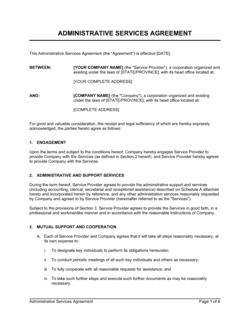
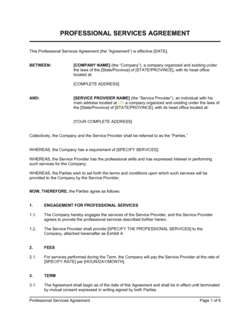
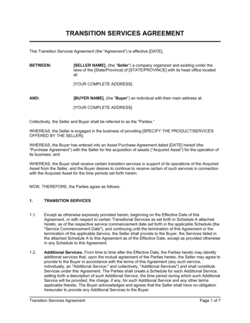
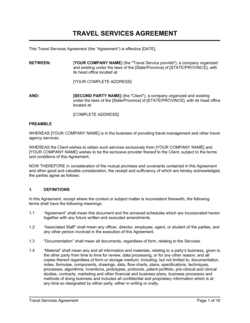
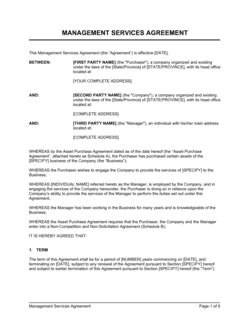
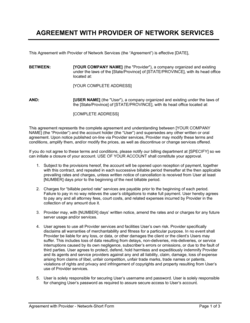
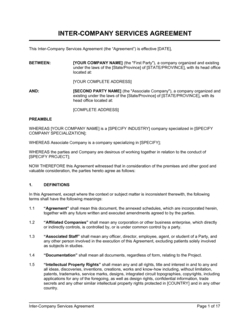
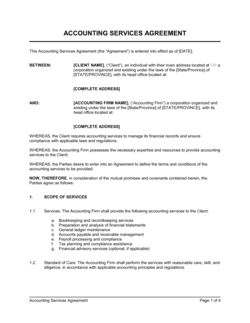
SEO Services Agreement Template

Free Word download • Edit online • Save & share with Drive • Export to PDF

12 pages30–40 min to fillDifficulty: ComplexSignature requiredLegal review recommended
Learn more ↓
FreeSEO Services Agreement Template

At a glance

What it is
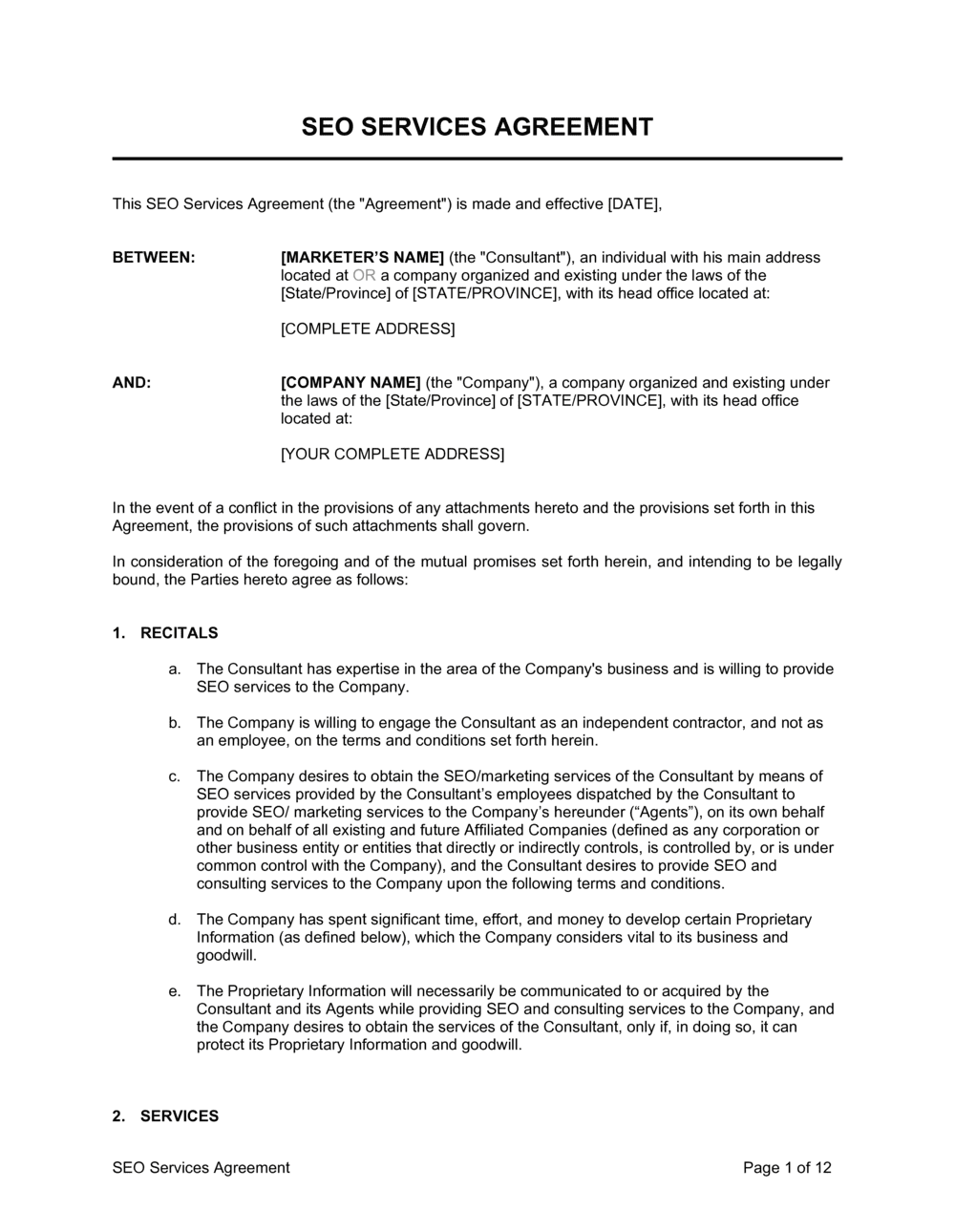
An SEO Services Agreement is a legally binding contract between an SEO provider — an agency, freelancer, or consultant — and a client that defines the scope of search engine optimization work, fees, deliverables, timelines, reporting obligations, and IP ownership. This free Word download gives you a structured, attorney-informed starting point you can edit online and export as PDF to execute with any client before work begins.
When you need it
Use it before starting any paid SEO engagement — whether a one-time audit, a monthly retainer, or a long-term campaign — where you need enforceable obligations on scope, payment, and results expectations in writing.
What's inside
Scope of services and deliverables, fee structure and payment schedule, performance disclaimers, IP assignment and license terms, confidentiality, reporting obligations, term and termination conditions, and governing law.

What is an SEO Services Agreement?

An SEO Services Agreement is a legally binding contract between an SEO provider — an agency, freelancer, or independent consultant — and a client that governs every material dimension of a search engine optimization engagement: the specific services and deliverables to be performed, the fee structure and payment schedule, performance disclaimers, intellectual property ownership, confidentiality obligations, compliance with search engine guidelines, and the conditions under which either party may end the relationship. Unlike a general service agreement, it addresses SEO-specific risks including ranking guarantee liability, algorithmic penalty allocation, and the distinct IP questions that arise when content, keyword strategies, and proprietary reporting tools are produced for a client's benefit.

Why You Need This Document

Without a signed SEO services agreement, both provider and client are exposed in ways that materialize quickly and expensively. Providers face scope creep with no contractual basis to charge for additional deliverables, non-payment with no interest or suspension rights to fall back on, and liability claims when rankings drop after an algorithm update — despite having no control over the outcome. Clients, meanwhile, have no enforceable right to the content and reports they paid for, no recourse if the provider uses black-hat link schemes that trigger a Google manual penalty, and no clear exit path without a dispute over the remaining retainer. A properly executed SEO services agreement closes all of these gaps before work begins, giving both parties a shared, written definition of success and a clear process for resolving disagreements — for the cost of 20 minutes and a template.

Which variant fits your situation?

If your situation is…Use this template
Ongoing monthly SEO work billed on a retainer basisSEO Retainer Agreement
One-time technical SEO audit with a fixed deliverable and feeSEO Audit Services Agreement
Broader digital marketing scope including paid search and socialDigital Marketing Services Agreement
Content creation and link-building as standalone deliverablesContent Marketing Agreement
White-label SEO work performed by one agency on behalf of anotherWhite-Label SEO Agreement
Local SEO campaign for a brick-and-mortar businessLocal SEO Services Agreement
Full-service agency engagement covering SEO, PPC, and web designMarketing Agency Services Agreement

Common mistakes to avoid

❌ Vague scope with no deliverable list

Why it matters: Without a specific list of deliverables, clients can demand unlimited revisions, additional reports, or entirely new service categories under the same retainer, eroding the provider's margin.

Fix: Attach a signed Schedule A listing every deliverable by name, frequency, and format. Include a Change Order clause for any work outside the schedule.

❌ Omitting the performance disclaimer

Why it matters: In some jurisdictions, a court will infer an implied warranty of fitness for purpose if no disclaimer is present — exposing the provider to claims for revenue lost from ranking drops.

Fix: Include an explicit clause stating that no specific ranking, traffic, or revenue outcome is guaranteed, and that results depend on third-party algorithm changes outside the provider's control.

❌ No IP carve-out for provider's pre-existing tools

Why it matters: An all-encompassing IP assignment clause — 'all work product is owned by client' — could transfer ownership of the provider's reusable templates, scripts, and proprietary reports to every client who signs.

Fix: Define Provider IP (pre-existing tools, templates, methodologies) explicitly and grant the client only a license to use it as embedded in their specific deliverables.

❌ Auto-renewal buried without a clear notice deadline

Why it matters: Clients who miss a buried auto-renewal deadline and then receive an invoice for another 6-month term routinely dispute the charge, leading to collection proceedings or chargebacks.

Fix: Surface the auto-renewal clause and notice deadline prominently — consider adding it to the signature page summary — and send a written reminder 45 days before the renewal date as a matter of practice.

❌ No limitation of liability clause

Why it matters: Without a liability cap, a failed campaign for a major e-commerce client can expose the provider to consequential damages — lost revenue, lost customers — that far exceed the fees earned.

Fix: Cap aggregate liability at fees paid in the prior 3 months and explicitly exclude indirect, consequential, and lost-profit damages in a standalone clause.

❌ Signing after the project has already started

Why it matters: In common-law jurisdictions, an agreement signed after work has already begun may not give enforceable effect to restrictive clauses — including non-solicitation of staff, IP assignment, and confidentiality.

Fix: Treat a signed agreement as a prerequisite to any access — including site credentials, analytics, or keyword data — and do not begin work until both parties have executed.

The 10 key clauses, explained

Parties and recitals

In plain language: Identifies the SEO provider and the client as legal entities, states their roles, and sets the effective date of the agreement.

Sample language
This SEO Services Agreement ('Agreement') is entered into as of [DATE] between [PROVIDER LEGAL NAME], a [STATE/COUNTRY] [ENTITY TYPE] ('Provider'), and [CLIENT LEGAL NAME], a [STATE/COUNTRY] [ENTITY TYPE] ('Client').

Common mistake: Using a trading name instead of the registered legal entity name for either party — this creates enforcement problems if the contract ever needs to be litigated or assigned.

Scope of services and deliverables

In plain language: Defines exactly what SEO work the provider will perform, which deliverables will be produced, and which activities are explicitly excluded from the engagement.

Sample language
Provider shall perform the SEO services described in Schedule A ('Services'), including [KEYWORD RESEARCH / ON-PAGE OPTIMIZATION / LINK BUILDING / TECHNICAL AUDIT]. Services expressly exclude [PAID SEARCH MANAGEMENT / WEB DEVELOPMENT / SOCIAL MEDIA MANAGEMENT] unless agreed in a signed Change Order.

Common mistake: Writing scope in vague terms like 'SEO optimization' with no deliverable list — this invites scope-creep disputes and gives clients grounds to demand unlimited revisions.

Fees, payment schedule, and late payment

In plain language: States the monthly retainer or project fee, the due date, accepted payment methods, and the penalty for late payment.

Sample language
Client shall pay Provider a monthly retainer of $[AMOUNT], due on the [1st] day of each calendar month. Invoices unpaid after [15] days accrue interest at [1.5]% per month. Provider may suspend Services after [30] days of non-payment.

Common mistake: No late-payment interest rate or suspension right — leaving the provider with no contractual leverage to prompt timely payment without terminating the entire agreement.

Performance disclaimer and no-guarantee clause

In plain language: Explicitly states that the provider cannot guarantee specific rankings, traffic, or revenue outcomes because search engine algorithms are outside anyone's control.

Sample language
Provider makes no warranty or guarantee of specific search engine rankings, organic traffic levels, or revenue outcomes. Search engine algorithms are controlled by third parties and subject to change at any time without notice. Client acknowledges that SEO results may take [3–6] months to materialize.

Common mistake: Omitting this clause entirely, or weakening it with language like 'we aim to achieve page-one rankings' — this creates an implied warranty that courts in some jurisdictions may treat as a binding promise.

Intellectual property ownership and license

In plain language: Determines who owns the work product — content, reports, tools, and code — created during the engagement, and when ownership transfers to the client.

Sample language
Upon receipt of all fees due, Provider assigns to Client all right, title, and interest in Deliverables produced specifically for Client ('Client IP'). Provider retains ownership of its pre-existing tools, templates, and methodologies ('Provider IP') and grants Client a non-exclusive license to use Provider IP solely as embedded in the Deliverables.

Common mistake: No carve-out for provider's pre-existing tools and methodologies — without it, the client could claim ownership of the provider's entire SEO toolkit based on an all-encompassing assignment clause.

Confidentiality

In plain language: Prohibits the provider from disclosing the client's analytics data, keyword strategy, site architecture, or business information outside the engagement — and vice versa for the provider's proprietary methods.

Sample language
Each party agrees to keep the other's Confidential Information strictly confidential and not to disclose or use it for any purpose other than performing obligations under this Agreement. This obligation survives termination for [2] years.

Common mistake: A confidentiality clause that binds only the provider — clients share provider methodology presentations with competitors, which can undermine the provider's competitive position just as much.

Compliance with search engine guidelines

In plain language: Requires the provider to use only techniques that comply with major search engine webmaster guidelines and allocates liability if a penalty results from non-compliant tactics.

Sample language
Provider agrees to use only techniques that comply with Google's Webmaster Guidelines and Bing Webmaster Guidelines as published at the time of execution. If a search engine penalty results directly from Provider's non-compliant tactics, Provider shall, at its expense, undertake reasonable remediation efforts.

Common mistake: No compliance clause at all — leaving the client with no contractual remedy if the provider uses black-hat link schemes or keyword stuffing that triggers a manual penalty.

Term, renewal, and termination

In plain language: Sets the initial contract period, the auto-renewal mechanic, the notice period required to terminate, and what happens to in-progress work and prepaid fees upon termination.

Sample language
This Agreement commences on [START DATE] and continues for an initial term of [6] months ('Initial Term'), automatically renewing for successive [1]-month periods unless either party provides [30] days' written notice of non-renewal. Client may terminate for cause upon [15] days' written notice if Provider materially breaches and fails to cure within the notice period.

Common mistake: Auto-renewal language buried in the fine print with a notice deadline shorter than a billing cycle — clients miss it, feel locked in, and dispute the resulting invoice, leading to costly disputes.

Limitation of liability

In plain language: Caps the provider's total financial exposure to the client at a defined amount — typically the fees paid in the prior 3 or 6 months — and excludes consequential or indirect damages.

Sample language
Provider's total aggregate liability under this Agreement shall not exceed the total fees paid by Client in the [3] months preceding the claim. In no event shall either party be liable for indirect, incidental, consequential, or lost-profit damages, even if advised of the possibility of such damages.

Common mistake: No liability cap at all — a failed SEO campaign on a major e-commerce site could otherwise expose the provider to claims for lost revenue that dwarf the retainer fees collected.

Governing law and dispute resolution

In plain language: Specifies which jurisdiction's law governs the agreement and how disputes are resolved — typically arbitration, mediation, or litigation in a named court.

Sample language
This Agreement is governed by the laws of [STATE/PROVINCE/COUNTRY], without regard to conflict-of-law rules. Any dispute shall first be submitted to mediation; if unresolved within [30] days, to binding arbitration administered by [AAA / JAMS / equivalent] in [CITY].

Common mistake: Choosing a governing law jurisdiction with no meaningful connection to where either party operates — several US states and EU member countries apply local law regardless of the contract's choice-of-law clause.

How to fill it out

  1. 1

    Enter the legal entity names and effective date

    Use each party's full registered legal name — not a brand or trade name — and confirm the correct entity type (LLC, Ltd, sole trader). Set the effective date to the date both parties will sign, not the date work begins.

    💡 Cross-reference the client's corporate registry entry before signing — agreements made with the wrong entity are difficult to enforce and harder to collect on.

  2. 2

    Complete Schedule A with a specific deliverable list

    List every service in concrete terms: 'Monthly keyword ranking report covering [X] tracked keywords,' 'Technical site audit delivered within 14 days of signing,' or 'Up to [X] optimized blog posts per month.' Include what is excluded.

    💡 If you offer tiered packages, attach a separate Schedule A for each tier and reference the applicable one in the main agreement body.

  3. 3

    Set the fee, billing date, and late-payment terms

    State the monthly retainer or project fee in numerals and words, specify the billing date (e.g., 1st of each month), and set an interest rate — 1.5% per month is standard in North America — for overdue invoices.

    💡 For new clients, consider billing the first month in advance before work begins — this filters out clients who delay payment from day one.

  4. 4

    Draft the performance disclaimer carefully

    State clearly that no specific ranking position, traffic volume, or revenue increase is guaranteed. Reference the typical 3–6 month lag before organic results appear. Have your legal reviewer confirm the language is strong enough under the applicable jurisdiction's consumer-protection laws.

    💡 Never use phrases like 'page-one guaranteed' in the agreement, in emails, or in proposals — even if they appear only in marketing materials, they can be incorporated into the contract by reference in a dispute.

  5. 5

    Define IP ownership and the provider IP carve-out

    Specify that client owns all custom deliverables upon full payment, and that the provider retains all pre-existing tools, reporting templates, and proprietary methodologies. List the provider IP categories explicitly in a schedule if the toolkit is substantial.

    💡 If you use licensed third-party SEO software (Semrush, Ahrefs, Screaming Frog) to generate deliverables, check each tool's terms of service for output ownership restrictions before making broad assignment promises.

  6. 6

    Set the initial term, auto-renewal, and termination notice period

    Choose an initial term of at least 3–6 months (SEO results take time), set a 30-day written notice period for non-renewal, and specify that prepaid fees for the current month are non-refundable while fees for future periods are returned upon termination without cause.

    💡 State the exact auto-renewal notice deadline as a calendar date in the executed agreement — '30 days before the renewal date' is ambiguous; 'written notice received by the 1st of the final contract month' is not.

  7. 7

    Review and sign before work begins

    Both parties must sign before the provider performs any work — including discovery calls, site access, or preliminary keyword research. Post-start-date signatures raise fresh-consideration problems in common-law jurisdictions.

    💡 Use an e-signature platform that timestamps execution and stores the fully-executed copy — this timestamps the agreement and eliminates 'I never signed that' disputes.

  8. 8

    Attach reporting and KPI schedule

    Append a Schedule B defining the monthly reporting format, the KPIs tracked (organic sessions, keyword rankings, domain authority, conversion rate), and the delivery date each month.

    💡 Agree on the KPIs before signing — clients who define success metrics after a campaign starts consistently interpret results more negatively than those who set benchmarks upfront.

Frequently asked questions

What is an SEO services agreement?

An SEO services agreement is a legally binding contract between an SEO provider — an agency, freelancer, or consultant — and a client that defines the scope of search optimization work, deliverables, fees, reporting obligations, IP ownership, and termination conditions. It protects both parties by creating enforceable obligations in writing before any work begins and eliminates the ambiguity that leads to scope disputes, non-payment, and ranking-guarantee claims.

What should an SEO contract include?

At minimum: the parties' legal entity names, scope of services with a specific deliverable list, fee and payment schedule, a performance disclaimer stating no rankings are guaranteed, IP ownership terms, confidentiality obligations, a compliance clause requiring white-hat techniques, the initial term and auto-renewal conditions, notice periods for termination, a limitation of liability cap, and governing law. Missing any of these creates gaps that courts fill using jurisdiction-specific defaults — typically unfavorable to the provider.

Can an SEO agency guarantee rankings in the contract?

No reputable SEO provider can contractually guarantee specific search engine rankings, and any agreement that does creates significant legal exposure. Google and other search engines reserve the right to change their algorithms at any time, and no third party controls ranking outcomes. A well-drafted SEO agreement includes an explicit performance disclaimer to this effect. Providers who make ranking guarantees in contracts or marketing materials risk claims for breach of warranty or misrepresentation when rankings fluctuate.

Who owns the content and reports created during an SEO engagement?

Ownership depends entirely on what the agreement says. In most SEO contracts, the client owns custom deliverables — written content, audit reports, keyword strategies — upon full payment, while the provider retains ownership of pre-existing tools, templates, and proprietary methodologies. Without a clear IP clause, ownership defaults to copyright law in the applicable jurisdiction — in the US and UK, work created by an independent contractor is generally not considered work-for-hire and belongs to the creator, not the client.

What happens if the SEO provider's tactics cause a Google penalty?

A well-drafted SEO agreement includes a compliance clause requiring the provider to use only techniques that conform to major search engine guidelines. If non-compliant tactics cause a manual action or algorithmic penalty, the clause typically requires the provider to undertake remediation at their own expense. Without such a clause, the client's remedies depend on general breach-of-contract or negligence claims, which are harder to establish and litigate.

How long should an SEO services agreement last?

An initial term of 3 to 6 months is standard for ongoing retainers — SEO results typically take 3 to 6 months to materialize, making shorter commitments commercially unrealistic. Project-based agreements for one-time audits or deliverables can be shorter. After the initial term, monthly auto-renewal with a 30-day notice period is the most common structure, giving both parties flexibility while protecting the provider's planning horizon.

Is an SEO services agreement the same as a marketing services agreement?

An SEO services agreement is narrower in scope, covering search engine optimization work specifically. A marketing services agreement typically covers a broader set of activities — paid search, social media, email marketing, content, and branding — and may reference multiple service scopes in separate schedules. If an agency provides SEO alongside other digital channels, a broader marketing services agreement with an SEO-specific scope schedule is often more practical than a standalone SEO contract.

Do I need a lawyer to draft an SEO services agreement?

For straightforward retainer engagements with domestic clients, a high-quality template is typically sufficient when the scope is clear and fees are modest. Engage a lawyer when the client is large enough that a failed campaign could generate a significant damages claim, when the agreement involves cross-border parties with conflicting jurisdiction rules, or when the client insists on their own paper — which should always be reviewed by counsel before signing. A 1–2 hour template review typically costs $250–$500 and is worthwhile for any retainer above $2,000 per month.

What is the difference between an SEO agreement and an SEO proposal?

An SEO proposal is a pre-sale document that outlines the provider's recommended approach, pricing, and expected outcomes — it is not a binding contract. An SEO services agreement is the legally binding document signed after both parties agree on scope and terms. Proposals often include optimistic outcome language that should never be carried into the agreement — the signed contract should contain clear disclaimers that supersede any representations in the proposal.

What termination rights should an SEO contract include?

A balanced SEO agreement gives both parties the right to terminate for cause — material breach uncured within 15 to 30 days — and gives the client the right to terminate for convenience with 30 days' written notice. It should also specify what happens to prepaid fees (non-refundable for the current period, returned for future periods), what access rights are revoked on termination, and how in-progress deliverables are handled. Termination without these details leads to disputes over the final invoice in most contract endings.

How this compares to alternatives

vs Marketing Consultant Agreement

A marketing consultant agreement covers a broader advisory scope — strategy, brand positioning, channel planning, and campaign management across multiple channels. An SEO services agreement is narrower, focusing specifically on search optimization deliverables, ranking disclaimers, and compliance with search engine guidelines. If an engagement is primarily advisory with SEO as one component, the marketing consultant agreement is the better fit.

vs Independent Contractor Agreement

A general independent contractor agreement establishes the working relationship and legal status of a contractor but lacks the SEO-specific clauses — performance disclaimers, compliance with search engine guidelines, keyword strategy IP, and ranking-result liability limits — that a specialized SEO agreement provides. Use the general contractor agreement only if the work is incidental SEO support within a broader role.

vs Website Design and Development Agreement

A web design and development agreement governs the creation of a website — visual design, coding, CMS integration, and launch — with IP ownership centered on the site build itself. An SEO services agreement covers the ongoing optimization of an existing site's content and technical structure. When both services are provided together, both agreements are typically executed in parallel or a combined scope schedule is attached.

vs Digital Marketing Services Agreement

A digital marketing services agreement covers the full channel mix — paid search, social media advertising, email marketing, and SEO — typically under a single retainer. An SEO services agreement is scoped exclusively to organic search. Choose the broader agreement when an agency is accountable for overall digital acquisition, and the SEO-specific agreement when organic search is the sole or primary service.

Industry-specific considerations

E-commerce and retail

Product-page and category optimization, Google Shopping visibility, and seasonal campaign timing make clearly defined deliverable schedules and KPIs especially critical.

Professional services

Local SEO and Google Business Profile optimization are often the primary deliverables, requiring precise geographic scope definitions in the contract.

SaaS and technology

Content-led SEO programs involve large volumes of written deliverables and tight IP assignment requirements, particularly for proprietary product documentation and comparison content.

Healthcare and medical

YMYL content compliance with Google's quality guidelines and applicable health advertising regulations must be addressed in the compliance clause to avoid both penalties and regulatory exposure.

Legal and financial services

Strict advertising regulations (FCA, SEC, state bar rules) govern what claims SEO content can make, requiring a compliance clause that references sector-specific regulatory standards.

Media and publishing

High-volume content production and link-building campaigns require explicit content ownership, publication rights, and white-label authorship terms to avoid post-engagement attribution disputes.

Jurisdictional notes

United States

No federal law specifically governs SEO contracts, but the FTC Act prohibits deceptive claims — including ranking guarantees in marketing materials that could be read into the agreement. Non-compete and non-solicitation clauses in SEO agreements are subject to the same state-by-state enforceability rules as employment contracts; California effectively bans them. Choice-of-law clauses are generally respected between sophisticated commercial parties across all states.

Canada

Canadian consumer protection legislation — including Ontario's Consumer Protection Act and Quebec's Consumer Protection Act — may apply if the client is a consumer rather than a business. Quebec requires that contracts with Quebec-based parties be available in French. Late-payment interest rates should comply with provincial usury rules; 1.5% per month (18% annually) is generally enforceable in most provinces.

United Kingdom

The Consumer Rights Act 2015 applies if the client is a consumer; the Unfair Contract Terms Act 1977 limits the enforceability of blanket limitation-of-liability clauses in B2B contracts to what is 'reasonable.' Post-Brexit, GDPR obligations continue under the UK GDPR — any client data processed under the agreement requires a compliant data processing addendum. IR35 rules may reclassify a freelance SEO consultant as a deemed employee if the engagement characteristics meet the IR35 criteria.

European Union

EU GDPR applies to any personal data processed in connection with the engagement — including analytics data, contact lists, and CRM exports shared by the client. A Data Processing Agreement (DPA) is legally required when the SEO provider processes personal data on behalf of the client. Limitation-of-liability clauses must not exclude liability for gross negligence or intentional misconduct to be enforceable across most EU member states. Late-payment interest is governed by the EU Late Payment Directive, which sets a minimum rate of 8 percentage points above the ECB reference rate for B2B transactions.

Template vs lawyer — what fits your deal?

PathBest forCostTime
Use the templateFreelance SEO consultants and small agencies with domestic clients on standard retainers up to $2,000 per monthFree20–30 minutes
Template + legal reviewAgencies with retainers above $2,000 per month, multi-channel scope, or clients in regulated industries such as healthcare or finance$250–$6001–3 days
Custom draftedEnterprise-level SEO engagements, cross-border clients, white-label reseller arrangements, or clients who insist on negotiating custom paper$1,000–$3,500+1–3 weeks

Glossary

Scope of Services
The specific SEO tasks, deliverables, and activities the provider agrees to perform — and by implication, what is excluded from the engagement.
Retainer
A fixed monthly fee paid in advance for an agreed set of ongoing SEO services, regardless of the number of hours actually worked.
Deliverable
A tangible output — such as an audit report, keyword strategy document, or monthly ranking report — that the provider must produce by a specified date.
Performance Disclaimer
A clause acknowledging that SEO outcomes depend on search engine algorithms outside the provider's control, limiting liability for ranking or traffic guarantees.
White-Hat SEO
Search optimization techniques that comply with search engine guidelines — as opposed to black-hat tactics that risk penalties or de-indexing.
IP Assignment
A clause transferring ownership of work product — content, reports, or custom tools — created under the agreement from the provider to the client upon full payment.
Confidential Information
Non-public business data — analytics access, keyword strategies, site architecture — shared by the client that the provider must not disclose or use outside the engagement.
Penalty Clause
A provision addressing liability if the provider's tactics result in a search engine penalty or manual action against the client's website.
Auto-Renewal
A contract term that automatically extends the agreement for a further period unless one party gives written notice of non-renewal before a stated deadline.
Indemnification
A clause requiring one party to compensate the other for losses arising from a specified act — such as the provider's use of techniques that violate a third party's intellectual property.
Governing Law
The jurisdiction whose laws apply to interpret and enforce the agreement, and where disputes must be resolved.

Part of your Business Operating System

This document is one of 3,000+ business & legal templates included in Business in a Box.

  • Fill-in-the-blanks — ready in minutes
  • 100% customizable Word document
  • Compatible with all office suites
  • Export to PDF and share electronically

Create your document in 3 simple steps.

From template to signed document — all inside one Business Operating System.
1
Download or open template

Access over 3,000+ business and legal templates for any business task, project or initiative.

2
Edit and fill in the blanks with AI

Customize your ready-made business document template and save it in the cloud.

3
Save, Share, Send, Sign

Share your files and folders with your team. Create a space of seamless collaboration.

Save time, save money, and create top-quality documents.

★★★★★

"Fantastic value! I'm not sure how I'd do without it. It's worth its weight in gold and paid back for itself many times."

Managing Director · Mall Farm
Robert Whalley
Managing Director, Mall Farm Proprietary Limited
★★★★★

"I have been using Business in a Box for years. It has been the most useful source of templates I have encountered. I recommend it to anyone."

Business Owner · 4+ years
Dr Michael John Freestone
Business Owner
★★★★★

"It has been a life saver so many times I have lost count. Business in a Box has saved me so much time and as you know, time is money."

Owner · Upstate Web
David G. Moore Jr.
Owner, Upstate Web

Run your business with a system — not scattered tools

Stop downloading documents. Start operating with clarity. Business in a Box gives you the Business Operating System used by over 250,000 companies worldwide to structure, run, and grow their business.

Start free · No credit card required