Scope Of Work Template

Free Word download β€’ Edit online β€’ Save & share with Drive β€’ Export to PDF

2 pagesβ€’20–30 min to fillβ€’Difficulty: Standardβ€’Signature requiredβ€’Legal review recommended
Learn more ↓
FreeScope Of Work Template

At a glance

What it is
A Scope of Work is a legally binding document that defines every material term of a project engagement between a client and a service provider β€” deliverables, timelines, payment schedule, acceptance criteria, and change order procedures. This free Word download is fully editable online and exports as PDF, giving you a structured, signable contract you can customize for any project type in under 30 minutes.
When you need it
Use it before any project begins where deliverables, deadlines, or costs could be disputed β€” consulting engagements, software development, creative work, construction management, or professional services retainers. A signed scope of work establishes the baseline against which all future change requests are measured.
What's inside
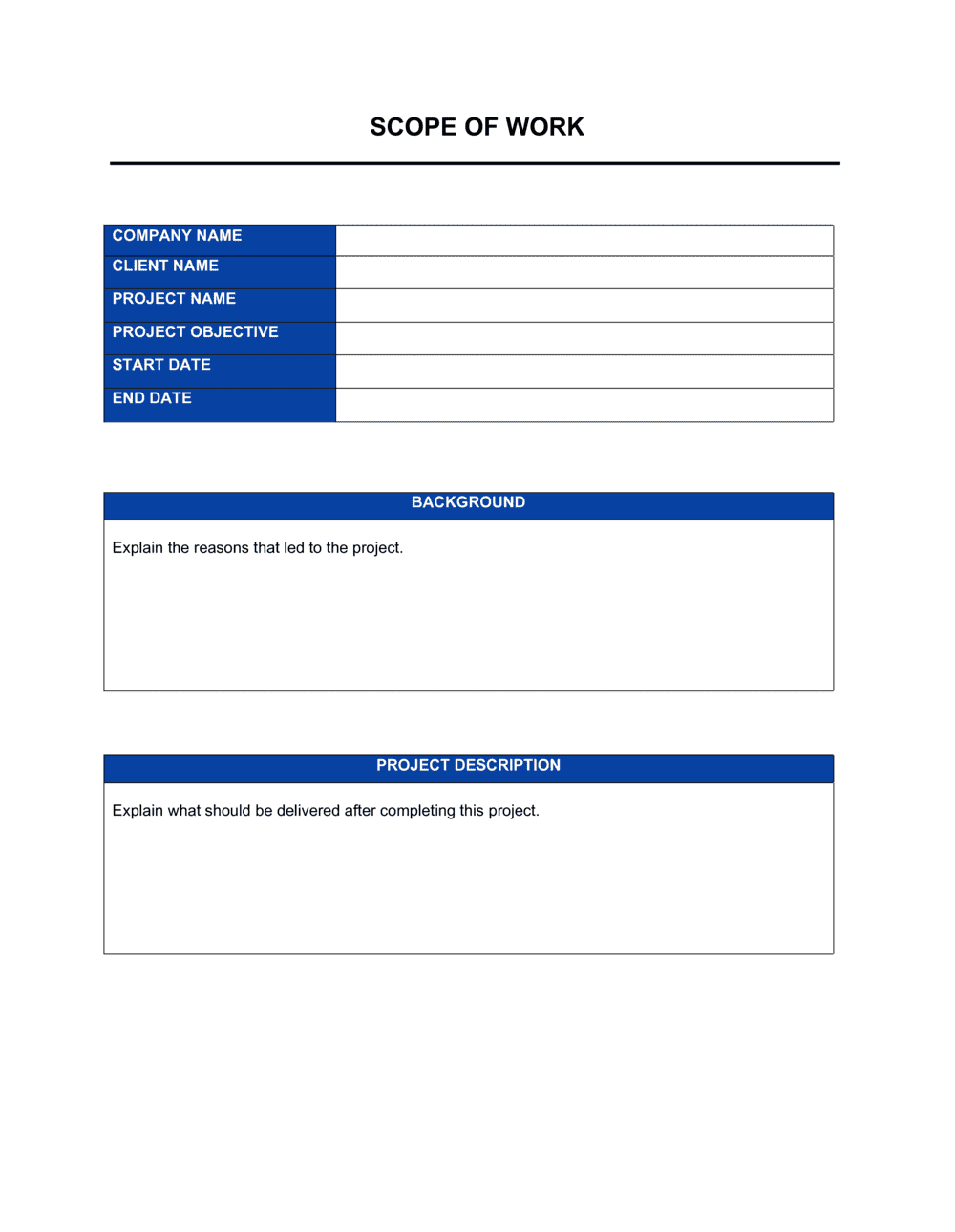
Project background and objectives, detailed deliverables list, milestones and timeline, payment schedule and rates, acceptance criteria, change order procedure, responsibilities of each party, confidentiality, and termination conditions.

What is a Scope of Work?

A Scope of Work (SOW) is a legally binding project contract that defines exactly what a service provider will deliver to a client β€” specifying deliverables, milestones, payment terms, acceptance criteria, and change order procedures in a single enforceable document. Unlike a general service agreement that governs an ongoing relationship, a scope of work is project-specific: it establishes a precise baseline against which all parties measure progress, approve outputs, and resolve disputes. When signed by both parties before work begins, it functions as the primary legal instrument governing the engagement and is routinely enforced in courts and arbitration proceedings across major jurisdictions.

Why You Need This Document

Without a signed scope of work, every project you run is a handshake agreement β€” and handshake agreements fall apart the moment a client questions whether a deliverable was complete, adds requirements without adjusting the budget, or delays approval to avoid triggering a payment milestone. The consequences are concrete: providers perform uncompensated work, clients receive deliverables that don't match their expectations, and relationships end in payment disputes that are expensive to resolve and nearly impossible to win without documentation. A properly drafted scope of work closes all of these gaps before a single hour of billable work begins β€” defining deliverables precisely enough to be self-evidently complete, building payment triggers into the project timeline, and giving both parties a written process for every change request. This template gives you that protection in under 40 minutes.

Which variant fits your situation?

If your situation is…Use this template
One-time project with fixed deliverables and a defined end dateFixed-Price Scope of Work
Ongoing retainer with monthly hours and deliverablesRetainer Agreement
Technology or software development engagementSoftware Development Agreement
Engaging an independent contractor instead of an employeeIndependent Contractor Agreement
Consulting engagement where advice is the primary deliverableConsulting Agreement
Construction or renovation project with phased milestonesConstruction Contract
Marketing or creative services engagement with campaign deliverablesMarketing Services Agreement

Common mistakes to avoid

❌ Vague deliverable descriptions

Why it matters: Descriptions like 'website design' or 'marketing strategy' give the client room to claim the deliverable was incomplete long after the provider considers the work done. This is the most common cause of non-payment disputes.

Fix: Describe every deliverable in objective, measurable terms β€” number of pages, file formats, features, word count, or defined outputs β€” so completion is self-evident.

❌ No change order clause

Why it matters: Without a formal change order process, clients add requests verbally and expect them included in the original price. Providers who comply without documentation are routinely underpaid for the additional work.

Fix: Include an explicit clause stating that all out-of-scope work requires a written, signed change order before the provider is obligated to proceed, and specify the rate at which it will be billed.

❌ Single payment on final delivery

Why it matters: A back-loaded payment structure leaves the provider with no compensation for completed phases if the client disputes the final deliverable or becomes insolvent mid-project.

Fix: Structure payment in at least three tranches β€” deposit on signing, one or more milestone payments, and final payment on acceptance β€” so completed work is paid as the project progresses.

❌ Missing client responsibility obligations

Why it matters: When a project runs late because a client failed to deliver assets, provide access, or give timely feedback, the provider has no documented basis to extend deadlines or charge delay fees if client obligations are not written into the contract.

Fix: List every client obligation β€” asset delivery dates, review turnaround windows, designated contacts, system access β€” with the same specificity as provider deliverables.

❌ No deemed-acceptance clause

Why it matters: Without a defined review period and a deemed-acceptance provision, a client can withhold approval β€” and therefore payment β€” indefinitely by simply not responding to deliverable submissions.

Fix: Add a clause stating that if the client does not provide written approval or a written list of deficiencies within a defined number of business days, the deliverable is deemed accepted and payment is triggered.

❌ Omitting IP ownership and pre-existing IP carve-out

Why it matters: Default copyright law in most common-law jurisdictions means the creator of work retains ownership unless there is a written assignment. A client who paid in full but has no IP assignment clause may not legally own the deliverables.

Fix: Include an explicit IP assignment transferring ownership to the client upon full payment, and a carve-out preserving the provider's ownership of all pre-existing tools, templates, and methodologies.

The 10 key clauses, explained

Project background and objectives

In plain language: Sets the context for the engagement β€” why the project exists, what problem it solves, and what success looks like at a high level.

Sample language
[CLIENT NAME] engaged [PROVIDER NAME] to [PROJECT OBJECTIVE]. The goal of this engagement is to [MEASURABLE OUTCOME] by [TARGET DATE].

Common mistake: Omitting this clause entirely and starting directly with deliverables. Without a stated objective, disputes over whether the work 'solved the problem' are resolved without an agreed benchmark.

Scope of services and deliverables

In plain language: The core of the document β€” lists every specific output the provider will produce, described precisely enough that a third party could determine whether each was completed.

Sample language
Provider shall deliver the following: (1) [DELIVERABLE 1] by [DATE]; (2) [DELIVERABLE 2] by [DATE]; (3) [DELIVERABLE 3] by [DATE]. Deliverables not listed are expressly excluded from this engagement.

Common mistake: Using vague output descriptions such as 'website' or 'marketing support.' Imprecise deliverable definitions are the primary driver of scope disputes and unpaid invoices.

Milestones and timeline

In plain language: Breaks the project into sequential phases with specific due dates, linking each milestone to its corresponding deliverable and, where applicable, a payment trigger.

Sample language
Phase 1: [DELIVERABLE] due [DATE]. Phase 2: [DELIVERABLE] due [DATE]. Client approval of each phase is required within [X] business days before the next phase commences.

Common mistake: Setting milestone dates without specifying client review and approval periods. Delays in client feedback cascade through the timeline, but without a defined review window the provider bears all schedule risk.

Compensation and payment schedule

In plain language: States the total contract value or hourly rate, the payment schedule tied to milestones or calendar dates, accepted payment methods, and late-payment consequences.

Sample language
Client shall pay Provider a total fee of $[AMOUNT], payable as follows: $[X] upon execution; $[X] upon completion of Phase 1; $[X] upon final delivery. Late payments accrue interest at [1.5]% per month after [10] days.

Common mistake: Front-loading all payment at project completion rather than tying payments to milestones. This leaves the provider fully exposed to non-payment for completed work if the client relationship deteriorates mid-project.

Acceptance criteria and approval process

In plain language: Defines the objective standards each deliverable must meet and the process by which the client approves or rejects it, including a deemed-acceptance clause if no response is given.

Sample language
Client shall review each deliverable within [X] business days of receipt and provide written approval or a detailed list of deficiencies. If no response is received within [X] business days, the deliverable shall be deemed accepted.

Common mistake: No deemed-acceptance clause. Without one, a client can delay approval indefinitely β€” blocking payment and extending the provider's obligations without limit.

Change order procedure

In plain language: Establishes how out-of-scope requests are handled β€” requiring a written change order signed by both parties before any additional work begins, with pricing at an agreed rate.

Sample language
Any work outside the deliverables listed herein requires a written Change Order executed by both parties. Additional work shall be billed at $[RATE]/hour or a fixed fee agreed in the Change Order. Provider is not obligated to perform out-of-scope work without an executed Change Order.

Common mistake: Verbal agreement to 'just handle' extra requests without a change order. Unwritten scope additions are the most common source of unpaid invoices and relationship breakdowns.

Responsibilities of each party

In plain language: Lists what the client must provide β€” access, materials, approvals, personnel β€” and confirms the provider's specific obligations, so neither party can claim the other caused a delay.

Sample language
Client shall provide: (a) access to [SYSTEMS / MATERIALS] within [X] business days of execution; (b) a designated point of contact available within [X] hours; (c) timely approval of deliverables per Section [X]. Provider shall maintain adequate staffing to meet milestones.

Common mistake: Only listing provider obligations. When client delays β€” late feedback, missing assets, withheld access β€” derail the timeline, the provider has no documented basis to extend deadlines or claim additional fees.

Intellectual property ownership

In plain language: Specifies who owns the work product upon completion β€” typically the client owns all deliverables once full payment is received, while the provider retains ownership of pre-existing tools, frameworks, and methodologies.

Sample language
Upon receipt of full payment, Provider assigns to Client all right, title, and interest in the deliverables. Provider retains ownership of all pre-existing tools, frameworks, and proprietary methodologies used to produce the deliverables.

Common mistake: No IP clause at all, leaving ownership governed by default copyright law β€” which in most common-law jurisdictions means the creator (provider) retains rights, not the client who paid for the work.

Confidentiality

In plain language: Prohibits both parties from disclosing the other's confidential information β€” project details, pricing, data, and trade secrets β€” during and after the engagement.

Sample language
Each party agrees to keep confidential all non-public information received from the other party and to use such information solely for the purposes of this engagement. This obligation survives termination for [2] years.

Common mistake: One-sided confidentiality that only binds the provider. Clients sharing pricing or proprietary methodology with competitors is equally damaging β€” the clause should bind both parties.

Termination and wind-down

In plain language: States the conditions under which either party may terminate early β€” with or without cause β€” the required notice period, and how compensation for completed work is calculated upon termination.

Sample language
Either party may terminate this Agreement with [30] days' written notice. Upon termination, Client shall pay for all work completed through the termination date at the pro-rata contract rate. Provider shall deliver all completed work product within [10] business days of termination.

Common mistake: No termination-for-convenience clause for the client. Without one, courts in many jurisdictions imply a right to terminate anyway β€” but without the payment-for-completed-work protection the provider needs.

How to fill it out

  1. 1

    Identify the parties and define the engagement context

    Enter the full legal names of both the client and the service provider, their registered addresses, and a one-paragraph project background explaining why the engagement exists and what it is intended to achieve.

    πŸ’‘ Use registered entity names, not trade names or individual names β€” this ensures the contract is enforceable against the correct legal person.

  2. 2

    List every deliverable with precision

    Write each deliverable as a specific, measurable output β€” file formats, page counts, feature lists, or report contents. If a deliverable has sub-components, list each one separately.

    πŸ’‘ After drafting, test each deliverable description by asking whether a neutral third party could determine with certainty whether it was delivered. If not, rewrite it.

  3. 3

    Set milestones with explicit client review windows

    Assign a due date to each deliverable and specify the number of business days the client has to review and approve. Include a deemed-acceptance clause for reviews that exceed the window without a response.

    πŸ’‘ Build 2–3 buffer days into each milestone to account for minor client delays β€” aggressive timelines with no float increase dispute risk.

  4. 4

    Structure the payment schedule around milestones

    Divide total compensation into at least three payments: a deposit on signing (typically 25–50%), one or more mid-project milestone payments, and a final payment on delivery and acceptance.

    πŸ’‘ Never structure a scope of work with 100% payment on final delivery β€” if the relationship deteriorates at the 80% mark, the provider has no leverage and no payment for completed work.

  5. 5

    Define acceptance criteria and the approval process

    For each major deliverable, write the specific objective standards it must meet. Then specify the exact approval process β€” written email confirmation, sign-off form, or platform approval β€” and the review period.

    πŸ’‘ Tie final payment release to written client acceptance, not to the provider's assertion that the work is complete.

  6. 6

    Draft the change order procedure and rate schedule

    State clearly that any work not listed in the deliverables section requires a signed change order before the provider is obligated to begin. Include the hourly or daily rate at which change order work will be billed.

    πŸ’‘ Keep a change order log from day one β€” even for changes the client requests verbally. Retroactive documentation prevents disputes from becoming he-said/she-said situations.

  7. 7

    Specify IP ownership and confidentiality obligations

    Confirm that IP transfers to the client upon full payment and that the provider retains its pre-existing tools. Draft the confidentiality clause to bind both parties symmetrically.

    πŸ’‘ If the project involves third-party licensed tools, fonts, or software libraries, list them explicitly and confirm the license terms are compatible with the client's intended use.

  8. 8

    Execute before any work begins

    Both parties must sign β€” physically or via electronic signature β€” before the provider starts any billable work. Store the fully executed copy in a shared location both parties can access.

    πŸ’‘ Send the document for signature along with the deposit invoice. Requiring the deposit and the signed contract simultaneously before work begins protects against clients who delay signing while expecting work to proceed.

Frequently asked questions

What is a scope of work?

A scope of work is a legally binding document that defines the specific tasks, deliverables, timelines, payment terms, and responsibilities agreed between a client and a service provider for a given project. It serves as the primary reference point for managing the engagement, resolving disputes, and evaluating whether the project was completed as agreed. A well-drafted scope of work eliminates the ambiguity that causes most freelance and contractor payment disputes.

What is the difference between a scope of work and a statement of work?

The terms are used interchangeably in most business contexts, and both abbreviate to SOW. In formal government and enterprise procurement, a Statement of Work is a specific document type describing services to be performed under a contract, while a Scope of Work may also cover products and outcomes. In practice, both documents serve the same function β€” defining what will be delivered, when, and for how much. Use whichever title matches your industry or client expectations.

Is a scope of work legally binding?

Yes β€” a signed scope of work is generally enforceable as a binding contract in most jurisdictions when it contains the essential elements of a valid contract: offer, acceptance, and consideration (payment). It can stand alone or be attached to a master services agreement as a project-specific addendum. Courts routinely enforce scope of work documents in payment disputes, provided the deliverables and payment terms are clearly defined.

What should a scope of work include?

A complete scope of work should include: project background and objectives, a specific list of deliverables, a milestone and timeline schedule, the payment amount and payment schedule, acceptance criteria and the approval process, a change order procedure, client and provider responsibilities, IP ownership, confidentiality obligations, and termination conditions. Missing any of these creates gaps that commonly trigger disputes.

What is a change order and why does it matter?

A change order is a written amendment to the original scope of work that documents an agreed change to deliverables, timeline, or cost. It must be signed by both parties before any additional work begins. Without a formal change order process, providers routinely perform additional work based on verbal requests and then struggle to invoice for it β€” because the client disputes that any additional scope was agreed. A signed change order eliminates that dispute entirely.

Can I use a scope of work without a separate contract?

Yes β€” a detailed scope of work that includes payment terms, IP ownership, confidentiality, and termination conditions functions as a standalone contract for most project-based engagements. For ongoing relationships with multiple projects, the more common structure is a master services agreement covering general legal terms, with individual scopes of work attached for each project. Either approach is valid; the key requirement is that the document is signed by both parties before work begins.

How detailed should the deliverables section be?

Detailed enough that a neutral third party β€” such as a mediator or judge β€” could determine with certainty whether each deliverable was completed. For software projects, this means feature-level specifications and acceptance test criteria. For creative work, it means file formats, revision rounds, and defined output dimensions. For consulting, it means named report sections, page counts, or recommendation frameworks. Vague descriptions like 'website' or 'strategy document' are the primary driver of scope disputes.

Who typically drafts the scope of work β€” the client or the provider?

In most service engagements, the provider drafts the scope of work based on the client's brief, then the client reviews and negotiates terms before signing. In enterprise and government procurement, the client often drafts the SOW and providers respond with proposals. Either approach is valid, but the party with the stronger interest in precise deliverable definitions β€” typically the provider seeking payment β€” benefits most from controlling the draft.

Do I need a lawyer to draft a scope of work?

For standard project engagements β€” freelance, agency, or consulting work under $50,000 β€” a high-quality template is generally sufficient. Consider engaging a lawyer when the engagement involves significant IP, the project value exceeds $50,000, the client is a large enterprise with procurement requirements, or when operating in a jurisdiction with specific service contract regulations. A 1–2 hour template review typically costs $300–$500 and is worthwhile for high-value or high-risk engagements.

How this compares to alternatives

vs Independent Contractor Agreement

An independent contractor agreement covers the general legal terms of a working relationship β€” worker classification, liability, insurance, and governing law β€” but rarely specifies project deliverables or timelines in detail. A scope of work defines exactly what will be delivered on a specific project. The two documents are complementary: an ICA covers the relationship; an SOW covers the project. Many businesses use both.

vs Consulting Agreement

A consulting agreement governs an ongoing advisory relationship with broader terms covering retainer fees, confidentiality, and non-solicitation. A scope of work is project-specific β€” it defines discrete deliverables, a fixed timeline, and milestone payments. Use a consulting agreement for an ongoing relationship and attach a scope of work for each defined project or phase within it.

vs Service Agreement

A service agreement is a general framework contract governing recurring or ongoing service delivery β€” defining payment cadence, service levels, liability, and termination. A scope of work is a project-specific document attached to or operating alongside a service agreement to define the specific outputs for a given engagement. A service agreement without a scope of work often lacks the deliverable specificity needed to resolve disputes.

vs Retainer Agreement

A retainer agreement commits the client to paying a recurring monthly fee for a defined number of hours or a standing availability of services, without necessarily specifying individual deliverables. A scope of work specifies exactly what will be produced, by when, and for how much on a per-project basis. Use a retainer for ongoing advisory access; use a scope of work when discrete deliverables and milestones are the primary obligation.

Industry-specific considerations

Technology and software development

Feature-level acceptance criteria, sprint-based milestone structure, third-party API and licensing dependencies, and source code IP assignment are all critical additions to a standard SOW.

Creative and marketing agencies

Revision rounds, file format specifications, usage rights for licensed assets, and campaign performance KPIs as acceptance criteria are standard elements that prevent creative scope creep.

Construction and project management

Phase-based payment tied to inspection sign-offs, materials specification lists, subcontractor obligations, lien waiver requirements, and site access conditions distinguish construction SOWs from service SOWs.

Professional services and consulting

Outcome-based deliverables (findings report, recommendations deck, implementation roadmap), hourly rate change order pricing, and data access and confidentiality obligations are the critical clauses in consulting SOWs.

Jurisdictional notes

United States

Scope of work agreements are enforceable under general contract law in all US states. California's contractor laws impose additional requirements when the provider is an individual rather than a business entity β€” particularly around worker classification under AB5. Governing law and venue clauses should specify the state, as choice-of-law provisions are generally honored. For federal government contracts, SOWs must comply with FAR (Federal Acquisition Regulation) requirements.

Canada

SOWs are enforceable as contracts across all provinces under common law, except in Quebec where the Civil Code applies. Quebec agreements should be in French for provincially regulated work and may require specific provisions under the Act respecting labour standards if the provider could be classified as a dependent contractor. IP assignment clauses are critical in Canada, as the Copyright Act vests original ownership in the creator by default.

United Kingdom

Scope of work agreements are enforceable as contracts under English, Scottish, and Northern Irish law. IR35 rules apply when a provider operates through a personal service company β€” misclassification as a contractor rather than a deemed employee carries significant tax liability for the client in the UK. Unfair contract terms legislation (UCTA 1977 and the Consumer Rights Act 2015) limits the enforceability of certain limitation of liability clauses in business-to-consumer contexts.

European Union

EU member states each apply their own contract law, but SOWs are broadly enforceable across the bloc. GDPR obligations apply whenever either party processes personal data in the course of the engagement β€” a data processing addendum may be required. Some member states, notably France and Germany, impose statutory protections for dependent self-employed workers that can override contractual terms. Governing law clauses selecting an EU member state's law are generally honored under the Rome I Regulation.

Template vs lawyer β€” what fits your deal?

PathBest forCostTime
Use the templateFreelancers, agencies, and consultants on standard project engagements under $50,000Free20–40 minutes
Template + legal reviewProjects over $50,000, engagements involving significant IP transfer, or clients with enterprise procurement requirements$300–$6001–3 days
Custom draftedComplex multi-phase engagements, government contracts, regulated industries, or cross-border projects with IP sensitivity$1,000–$3,500+1–2 weeks

Glossary

Scope of Work (SOW)
A document that defines the specific tasks, deliverables, timeline, and payment terms agreed between a client and service provider for a given project.
Deliverable
A specific, measurable output the service provider is contractually obligated to produce β€” such as a completed report, deployed software build, or design file set.
Milestone
A defined checkpoint in the project timeline at which a specific deliverable or group of deliverables is due and often tied to a payment trigger.
Change Order
A written amendment to the original scope of work that documents an agreed change to deliverables, timeline, or cost β€” requiring signatures from both parties to take effect.
Acceptance Criteria
The specific, objective standards a deliverable must meet before the client is obligated to approve it and release associated payment.
Scope Creep
The gradual expansion of project requirements beyond what was agreed in the original scope of work, typically without a corresponding change to budget or timeline.
Master Services Agreement (MSA)
A framework contract that governs the general terms of a business relationship, to which individual scopes of work are attached as project-specific addenda.
Time and Materials (T&M)
A billing structure where the client pays for actual hours worked at an agreed rate plus direct costs, rather than a fixed project price.
Fixed-Price Contract
A contract in which the total price for a defined scope is set in advance and does not change unless a formal change order is executed.
Intellectual Property Assignment
A clause transferring ownership of work product created during the engagement from the service provider to the client upon full payment.
Notice to Proceed
Formal written authorization from the client instructing the service provider to begin work under the scope of work.

Part of your Business Operating System

This document is one of 3,000+ business & legal templates included in Business in a Box.

  • Fill-in-the-blanks β€” ready in minutes
  • 100% customizable Word document
  • Compatible with all office suites
  • Export to PDF and share electronically

Create your document in 3 simple steps.

From template to signed document β€” all inside one Business Operating System.
1
Download or open template

Access over 3,000+ business and legal templates for any business task, project or initiative.

2
Edit and fill in the blanks with AI

Customize your ready-made business document template and save it in the cloud.

3
Save, Share, Send, Sign

Share your files and folders with your team. Create a space of seamless collaboration.

Save time, save money, and create top-quality documents.

β˜…β˜…β˜…β˜…β˜…

"Fantastic value! I'm not sure how I'd do without it. It's worth its weight in gold and paid back for itself many times."

Managing Director Β· Mall Farm
Robert Whalley
Managing Director, Mall Farm Proprietary Limited
β˜…β˜…β˜…β˜…β˜…

"I have been using Business in a Box for years. It has been the most useful source of templates I have encountered. I recommend it to anyone."

Business Owner Β· 4+ years
Dr Michael John Freestone
Business Owner
β˜…β˜…β˜…β˜…β˜…

"It has been a life saver so many times I have lost count. Business in a Box has saved me so much time and as you know, time is money."

Owner Β· Upstate Web
David G. Moore Jr.
Owner, Upstate Web

Run your business with a system β€” not scattered tools

Stop downloading documents. Start operating with clarity. Business in a Box gives you the Business Operating System used by over 250,000 companies worldwide to structure, run, and grow their business.

Start freeΒ Β·Β No credit card required