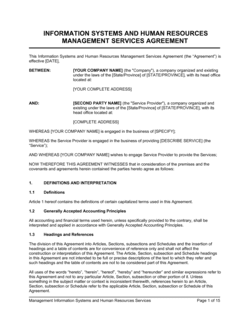
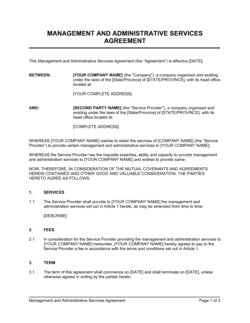
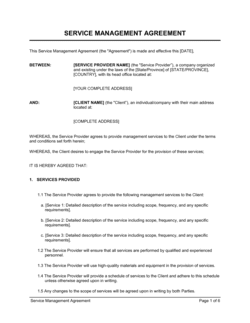
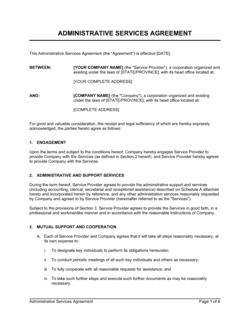
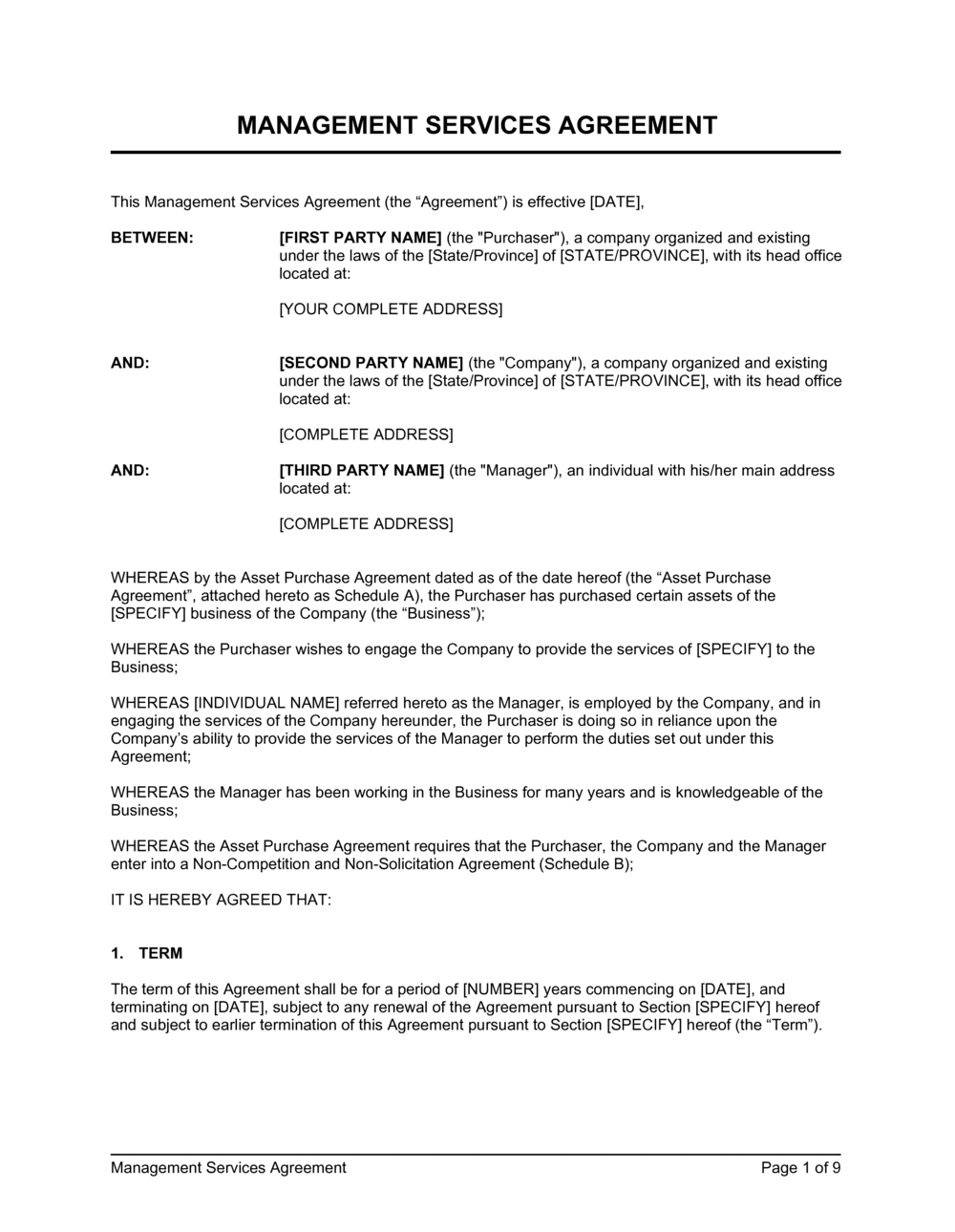
Management Services Agreement Template

Free Word download • Edit online • Save & share with Drive • Export to PDF

9 pages30–40 min to fillDifficulty: ComplexSignature requiredLegal review recommended
Learn more ↓
FreeManagement Services Agreement Template

At a glance

What it is
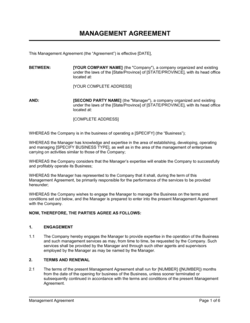
A Management Services Agreement is a legally binding contract between a company (the Client) and a management services provider that defines the scope of management, administrative, or operational services to be delivered. This free Word download covers fees, reporting obligations, confidentiality, IP ownership, liability limits, and termination in a single document you can edit online and export as PDF for execution.
When you need it
Use it when a parent company provides management or operational support to a subsidiary, when a business engages an external management firm to run day-to-day operations, or when a private equity firm formalizes a management fee arrangement with a portfolio company.
What's inside
Scope of services and deliverables, management fees and payment schedule, reporting and performance obligations, IP assignment, confidentiality and non-disclosure, limitation of liability, indemnification, termination provisions, and governing law.

What is a Management Services Agreement?

A Management Services Agreement is a legally binding contract between a client company and a management services provider that governs an outsourced or intercompany management arrangement. It defines the scope of management functions to be performed, the fees payable, reporting and performance obligations, IP ownership, confidentiality requirements, and the conditions under which either party may terminate the relationship. Unlike a general consulting agreement, a management services agreement places the provider in an ongoing operational role — managing a business, a function, or a portfolio of assets — with defined authority and accountability rather than simply delivering discrete advice or project deliverables.

Why You Need This Document

Operating a management arrangement without a signed agreement exposes both parties to serious financial, legal, and tax risk. Without a written contract, there is no enforceable basis for the management fee, no clarity on who owns the strategic plans and operational frameworks the provider creates, and no documented performance standard against which to measure or terminate the relationship. For intercompany arrangements — between a parent company and subsidiary, or a private equity firm and a portfolio company — tax authorities in every major jurisdiction require written documentation of the fee amount and service scope to accept the charge as a legitimate deductible expense; absence of that documentation invites adjustment, disallowance, and penalties. A properly drafted management services agreement closes all of these gaps before the first invoice is issued, and this template gives you a complete, professionally structured starting point you can tailor and execute in under an hour.

Which variant fits your situation?

If your situation is…Use this template
Parent company providing management support to a wholly owned subsidiaryIntercompany Management Services Agreement
Private equity firm charging a management fee to a portfolio companyManagement Fee Agreement
Engaging a third-party firm for general business management servicesManagement Services Agreement
Outsourcing a specific operational function (e.g., IT, HR, accounting)Professional Services Agreement
Hiring an individual manager rather than a firmManagement Consulting Agreement
Contracting a property management company for real estate assetsProperty Management Agreement
Outsourcing IT systems management and supportIT Services Agreement

Common mistakes to avoid

❌ Vague or undefined scope of services

Why it matters: Without a specific scope, disputes arise immediately over what the provider is obligated to do. The client pays a management fee expecting strategic direction; the provider delivers administrative support — and both believe they are performing under the contract.

Fix: Describe each management function as a concrete deliverable or activity in Schedule A, with measurable outputs where possible. Review the scope with both parties before execution.

❌ No transfer pricing documentation for intercompany fees

Why it matters: Tax authorities in the US, Canada, UK, and EU scrutinize intercompany management fees as a profit-shifting mechanism. Undocumented or non-arm's-length fees can be disallowed as a deduction and trigger penalties.

Fix: Commission a transfer pricing study or benchmarking memo before setting the fee and retain it as supporting documentation in the event of a tax audit.

❌ Liability cap set below the actual risk exposure

Why it matters: A cap equal to one month's fee on a $500K annual management arrangement leaves the client with no meaningful remedy if the provider's management decisions cause material business loss.

Fix: Set the cap at a minimum of 12 months of fees for standard management engagements. For high-stakes arrangements, consider requiring the provider to maintain professional indemnity insurance with specified coverage limits.

❌ Auto-renewal with no notice reminder mechanism

Why it matters: Clients who miss a 30- or 60-day opt-out window find themselves bound for another full term, often after the relationship has deteriorated. This is one of the most frequent sources of disputes under management services agreements.

Fix: Extend the opt-out notice window to at least 60 days and set calendar reminders 90 days before each renewal date at signing. Include the opt-out deadline in the agreement's cover page or summary sheet.

❌ No key person clause for high-dependency arrangements

Why it matters: When the value of the management services depends on a specific named individual — a managing director or turnaround specialist, for example — replacement of that person without notice can fundamentally change the nature of what was contracted for.

Fix: Identify key persons in a schedule and require the provider to give advance written notice before replacing them, with a client right to approve replacements or terminate on reasonable notice if approval is withheld.

❌ Omitting post-termination data return and deletion obligations

Why it matters: A provider who retains client data, financial records, or strategic plans after termination creates confidentiality risk and may complicate the client's transition to a new management arrangement.

Fix: Include an explicit obligation for the provider to return all client data and work product within a defined period after termination — typically 10 business days — and to certify deletion of any copies.

The 10 key clauses, explained

Parties, Recitals, and Definitions

In plain language: Identifies the client and the management services provider by their full legal names, sets out the background and purpose of the arrangement, and defines key terms used throughout the agreement.

Sample language
This Management Services Agreement ('Agreement') is entered into as of [DATE] between [CLIENT LEGAL NAME], a [STATE/COUNTRY] [ENTITY TYPE] ('Client'), and [PROVIDER LEGAL NAME], a [STATE/COUNTRY] [ENTITY TYPE] ('Provider'). The parties agree as follows.

Common mistake: Using a trade name or brand name instead of the registered legal entity name — this makes the agreement difficult to enforce and can create ambiguity about which entity is actually bound.

Scope of Services

In plain language: Defines exactly which management functions the provider will perform, the deliverables expected, any excluded services, and the standard of care to be applied.

Sample language
Provider shall perform the management services set out in Schedule A ('Services'), which include [SPECIFIC FUNCTIONS], and shall devote such time and resources as are reasonably necessary to perform the Services to the standard of a competent professional in the relevant field.

Common mistake: Describing the scope in vague terms such as 'general management support.' Ambiguous scope leads to disputes over what is and is not included, exposing the client to unanticipated additional fees.

Management Fees and Payment Terms

In plain language: States the fee structure — fixed monthly retainer, percentage of revenue, or time-and-materials — the invoicing schedule, due date, and consequences for late payment.

Sample language
Client shall pay Provider a monthly management fee of $[AMOUNT] ('Management Fee'), invoiced on the first business day of each month and due within [30] days of receipt. Overdue amounts accrue interest at [X]% per month from the due date.

Common mistake: Failing to specify whether the fee is inclusive or exclusive of expenses and taxes. Disputes over reimbursable costs are among the most common sources of conflict under management services arrangements.

Term and Renewal

In plain language: Sets the initial duration of the agreement, auto-renewal conditions, and the notice period required to prevent automatic renewal.

Sample language
This Agreement commences on [START DATE] and continues for an initial term of [X] months ('Initial Term'). Unless either party delivers written notice of non-renewal at least [60] days before the end of the Initial Term, this Agreement shall automatically renew for successive [12]-month periods.

Common mistake: Setting auto-renewal with a very short opt-out window — clients who miss a 30-day notice deadline can find themselves locked into another full year of fees.

Reporting and Performance Obligations

In plain language: Requires the provider to deliver periodic management reports, attend review meetings, and meet defined performance benchmarks or service levels.

Sample language
Provider shall deliver to Client a written management report within [10] business days after the end of each calendar month, covering [SPECIFIED METRICS]. Provider shall attend quarterly review meetings at a time mutually agreed by the parties.

Common mistake: Including no reporting obligations at all. Without defined reporting, the client has no formal mechanism to assess performance or build the documented record needed to terminate for cause.

Intellectual Property and Work Product

In plain language: Assigns ownership of all work product, reports, strategies, and materials created by the provider under the agreement to the client, while preserving any pre-existing provider IP.

Sample language
All work product, reports, analyses, and materials created by Provider specifically for Client under this Agreement ('Work Product') shall be the sole property of Client and are hereby irrevocably assigned to Client. Provider retains ownership of its pre-existing tools, methodologies, and proprietary systems ('Provider IP').

Common mistake: No IP ownership clause at all, leaving strategic plans, financial models, and operational frameworks created under the engagement potentially owned by the provider rather than the client.

Confidentiality and Non-Disclosure

In plain language: Prohibits both parties from disclosing each other's confidential information to third parties during and for a defined period after the agreement, with carve-outs for legally required disclosures.

Sample language
Each party agrees to hold the other's Confidential Information in strict confidence and not to disclose it to any third party without prior written consent. 'Confidential Information' means any non-public information relating to the disclosing party's business, finances, strategy, or customers. This obligation survives termination for [3] years.

Common mistake: Failing to define 'Confidential Information' with any specificity. Courts apply a reasonableness standard — an overbroad definition that includes all information can render the clause unenforceable.

Limitation of Liability and Indemnification

In plain language: Caps the provider's total financial liability for claims under the agreement — typically at fees paid in the prior 12 months — and sets out each party's indemnification obligations for specified loss categories.

Sample language
Provider's total aggregate liability under this Agreement shall not exceed the Management Fees paid by Client in the [12] months preceding the claim. Each party shall indemnify and hold harmless the other from third-party claims arising from its own breach, negligence, or willful misconduct.

Common mistake: Setting the liability cap at a nominal amount — such as one month's fee — when the services cover high-value operational functions. A mismatched cap can leave the client significantly undercompensated for a material management failure.

Termination and Effect of Termination

In plain language: States the grounds for termination — for cause, for convenience, and upon insolvency — along with required notice periods, cure periods for breach, and obligations that survive termination.

Sample language
Either party may terminate this Agreement for convenience on [60] days' written notice. Either party may terminate for material breach if the breach is not cured within [30] days of written notice. Upon termination, Provider shall deliver all Work Product and Client data within [10] business days and cease using any Client Confidential Information.

Common mistake: No cure period for breach before termination. Allowing immediate termination for any breach — including minor ones — exposes both parties to abrupt service disruption and potential wrongful-termination claims.

Governing Law and Dispute Resolution

In plain language: Specifies which jurisdiction's law governs the agreement and the process for resolving disputes — arbitration, mediation, or litigation — including the seat and applicable rules.

Sample language
This Agreement is governed by the laws of [STATE / PROVINCE / COUNTRY], without regard to conflict-of-law principles. Any dispute shall be resolved by binding arbitration under [AAA / JAMS / ICC] rules, with the seat of arbitration in [CITY], except that either party may seek injunctive relief in any court of competent jurisdiction.

Common mistake: Choosing a governing law jurisdiction that has no meaningful connection to either party's principal place of business. Enforcing an agreement under an unfamiliar jurisdiction's law adds cost and unpredictability to any dispute.

How to fill it out

  1. 1

    Enter the parties' full legal entity names

    Use each party's registered corporate name exactly as it appears in their corporate filings — not a trade name, brand, or DBA. Include entity type (LLC, Inc., Ltd.) and state or country of incorporation.

    💡 Cross-reference each party's name against the applicable corporate registry before execution to prevent enforceability issues.

  2. 2

    Define the scope of services in Schedule A

    List every management function the provider will perform with enough specificity that a third party could determine whether performance occurred. Include any exclusions explicitly.

    💡 Attach Schedule A as a separate exhibit so it can be updated without amending the body of the agreement — useful when the scope evolves over time.

  3. 3

    Set the management fee structure and payment mechanics

    Specify whether fees are a fixed monthly retainer, a percentage of revenue, or time-and-materials. State whether expenses are included or reimbursed separately, and whether fees are quoted excluding applicable taxes.

    💡 For intercompany arrangements, document the basis for the fee amount to satisfy transfer pricing documentation requirements — arm's-length benchmarking is often required by tax authorities.

  4. 4

    Set the term, auto-renewal, and opt-out window

    Choose an initial term appropriate to the relationship — 12 months is common. Set the auto-renewal notice window at least 60 days to give both parties adequate time to evaluate continuation.

    💡 Calendar a reminder 90 days before each renewal deadline so neither party is caught off guard by an automatic rollover.

  5. 5

    Define reporting obligations and performance benchmarks

    Specify the format, frequency, and content of management reports. If SLAs apply, attach them as a schedule with defined metrics and remedies for non-performance.

    💡 Tie at least one reporting deliverable to the payment cycle — for example, requiring a monthly management report before the next invoice is issued — to create a natural compliance checkpoint.

  6. 6

    Tailor the IP ownership and confidentiality clauses

    Confirm that all work product created specifically for the client is assigned to the client. Identify any provider IP that will be used in delivery but retained by the provider, and license it to the client for the duration of the agreement.

    💡 For management agreements that involve access to sensitive financial or customer data, add a data processing addendum to address applicable data protection law obligations.

  7. 7

    Set the liability cap and indemnification scope

    Set the liability cap at an amount proportionate to the risk the services represent — typically 12 months of fees for standard management services. Confirm that indemnification covers third-party claims arising from each party's own negligence or breach.

    💡 Check whether the provider's professional indemnity or errors-and-omissions insurance policy covers the engagement — insurers sometimes require a minimum contractual liability cap to honor claims.

  8. 8

    Execute before services commence

    Both parties must sign before the provider begins delivering services. Post-commencement signatures can raise consideration issues in some jurisdictions, and operating without a signed agreement creates IP ownership and confidentiality gaps from day one.

    💡 Use a digital signature tool to timestamp execution and store the executed copy securely — this is especially important for intercompany agreements that tax authorities may request.

Frequently asked questions

What is a management services agreement?

A management services agreement is a legally binding contract between a client company and a management services provider that defines the scope, fees, and obligations of an outsourced management arrangement. It is commonly used between parent companies and subsidiaries, between private equity firms and portfolio companies, and between businesses and external management firms engaged to run day-to-day operations. The agreement creates enforceable rights on both sides and governs everything from reporting obligations to IP ownership and termination.

What is the difference between a management services agreement and a consulting agreement?

A consulting agreement typically engages an individual or firm to provide advice, analysis, or recommendations on a defined project or question. A management services agreement goes further — it places the provider in an ongoing operational or administrative management role, often with authority to act on behalf of the client in defined functions. The management services arrangement is typically longer-term, involves broader operational responsibility, and carries a higher standard of reporting and accountability.

When should a company use a management services agreement?

Use one whenever a management function is being outsourced to an external firm or formalized between related entities. Common triggers include a private equity firm charging a portfolio company a management fee, a parent company providing shared services to a subsidiary, a business bringing in a turnaround management firm, or a real estate owner contracting a professional property manager. Operating without a written agreement in any of these situations creates IP, confidentiality, and tax documentation exposure from day one.

What should the scope of services in a management services agreement include?

The scope should identify every management function the provider will perform — such as financial reporting, strategic planning, human resources oversight, compliance management, or operational supervision — with enough specificity that non-performance is objectively measurable. It should also identify exclusions explicitly. The clearer the scope, the lower the risk of disputes over what is and is not included in the management fee.

Can a management services agreement be terminated early?

Yes, if the agreement includes termination-for-convenience and termination-for-cause provisions. Termination for convenience typically requires 30 to 90 days' written notice and may trigger a fee for the notice period. Termination for cause — such as material breach, fraud, or insolvency — can be immediate or after a short cure period. Without explicit termination provisions, the right to terminate before the end of the term depends entirely on applicable jurisdiction-specific contract law, which is unpredictable and potentially expensive to exercise.

Who owns the work product created under a management services agreement?

Ownership depends entirely on what the agreement says. Without an explicit IP assignment clause, work product created by the provider may belong to the provider under default copyright rules in many jurisdictions, even if the client paid for it. A well-drafted agreement assigns all work product created specifically for the client to the client, while preserving the provider's ownership of any pre-existing tools, systems, or methodologies it uses in delivery.

Is a management services agreement required to be in writing?

No jurisdiction typically mandates a written management services agreement as a matter of law, but operating without one is a significant risk in practice. Oral or informal management arrangements leave IP ownership, confidentiality obligations, fee entitlement, and termination rights entirely unresolved. For intercompany arrangements specifically, tax authorities require written documentation of the fee basis and service scope to accept the fee as a legitimate deductible expense.

Do I need a lawyer to draft a management services agreement?

For standard management arrangements between unrelated parties, a high-quality template reviewed by a lawyer is typically sufficient. Engage a lawyer when the arrangement is intercompany and involves transfer pricing risk, when the services include authority to bind the client in contracts with third parties, when the fee exceeds $100,000 annually, or when the arrangement is in a regulated industry. A one-to-two hour template review costs roughly $300–$600 and is worthwhile for any arrangement with meaningful financial or operational exposure.

How this compares to alternatives

vs Independent Contractor Agreement

An independent contractor agreement engages an individual for a defined project or deliverable. A management services agreement engages a firm for ongoing operational or administrative management of a business or function. The management services arrangement typically carries broader authority, longer duration, higher fees, and more extensive reporting obligations than a standard contractor engagement.

vs Professional Services Agreement

A professional services agreement is used for project-based engagements — accounting, legal, IT, or consulting work with a defined end point. A management services agreement is used for continuous operational management responsibilities. The key distinction is ongoing authority and accountability: a management services provider manages; a professional services provider advises or executes discrete tasks.

vs Management Consulting Agreement

A management consulting agreement engages an individual consultant to analyze problems and recommend solutions. A management services agreement places an entity in an operational management role with ongoing delivery obligations, authority to act, and defined reporting responsibilities. Use a consulting agreement for advisory work; use a management services agreement when the provider is running or managing a business function.

vs Service Level Agreement

A service level agreement defines performance standards and remedies for a technology or operational service — typically as a standalone document or schedule. A management services agreement is the governing contract that establishes the entire relationship, including fees, IP, confidentiality, and termination. An SLA is most commonly incorporated as a schedule to a management services agreement rather than used as a standalone contract.

Industry-specific considerations

Private Equity and Investment

Management fee structures charged to portfolio companies, monitoring agreements, transaction fee provisions, and annual fee amounts that are often benchmarked against 2% of invested capital.

Real Estate

Property management companies operating residential or commercial portfolios under fee arrangements tied to collected rents, with detailed reporting on occupancy, maintenance, and capital expenditure.

Healthcare

Management services organizations providing billing, compliance, HR, and operational support to physician practices, with strict HIPAA confidentiality overlays and state-specific corporate practice of medicine restrictions.

Manufacturing and Industrials

Parent companies providing strategic, financial, and procurement management to operating subsidiaries, with intercompany fee documentation critical to satisfy transfer pricing requirements across multiple tax jurisdictions.

Jurisdictional notes

United States

Intercompany management fees between US entities or cross-border related-party transactions are subject to IRC §482, which requires arm's-length pricing and contemporaneous documentation. State law governs the underlying contract — Delaware, New York, and California are the most commonly chosen governing-law jurisdictions for corporate agreements. Non-compete provisions attached to management agreements are subject to the same state-by-state enforceability rules that apply to employment contracts.

Canada

The Canada Revenue Agency scrutinizes intercompany management fees under the Income Tax Act's transfer pricing rules — fees must reflect the arm's-length principle and be supported by written documentation and benchmarking. Quebec-based parties require agreements to be available in French for provincially regulated entities. Canadian courts apply a reasonableness standard to limitation-of-liability and indemnification clauses, and grossly disproportionate caps may be reduced.

United Kingdom

HMRC applies the OECD Transfer Pricing Guidelines to intercompany management charges and requires documentation demonstrating that fees reflect services actually rendered at arm's length. UK contract law imposes a reasonableness test on limitation-of-liability clauses under the Unfair Contract Terms Act 1977, particularly where one party is a consumer or where the clause covers negligence. Post-Brexit, UK GDPR governs data processed under the agreement for parties handling personal data.

European Union

EU member states apply the OECD Transfer Pricing Guidelines, and several — including Germany, France, and the Netherlands — have enacted domestic transfer pricing documentation requirements with penalties for non-compliance. GDPR applies to any management services arrangement involving personal data, requiring a data processing agreement or addendum. Post-employment non-compete restrictions attached to management agreements typically require financial compensation to the restricted party to be enforceable across most EU member states.

Template vs lawyer — what fits your deal?

PathBest forCostTime
Use the templateStandard outsourced management arrangements between unrelated commercial parties with fees under $100K annuallyFree30–45 minutes
Template + legal reviewIntercompany arrangements with transfer pricing implications, regulated industries, or fees exceeding $100K annually$300–$8002–5 days
Custom draftedComplex PE portfolio management arrangements, multi-jurisdictional intercompany structures, or arrangements granting the provider authority to bind the client with third parties$2,000–$8,000+1–3 weeks

Glossary

Management Services Provider
The entity contracted to deliver management, operational, or administrative services to the client under the agreement.
Scope of Services
The specific management functions, tasks, and deliverables the provider is contractually obligated to perform.
Management Fee
The periodic compensation paid by the client to the provider for the management services rendered, typically a fixed monthly amount or a percentage of revenue.
Service Level Agreement (SLA)
A defined standard of performance — such as response times or reporting deadlines — that the provider must meet, with consequences for non-compliance.
Intercompany Agreement
A contract between two entities under common ownership — typically a parent company and its subsidiary — governing the transfer of services or funds between them.
Limitation of Liability
A clause capping the maximum financial exposure of one or both parties if the agreement is breached or a claim arises.
Indemnification
A contractual obligation by which one party agrees to compensate the other for specified losses, damages, or legal costs arising from defined events.
Intellectual Property Assignment
A clause transferring ownership of work product, materials, or innovations created by the provider during the engagement to the client.
Key Person Clause
A provision identifying specific named individuals whose continued involvement is material to the agreement, with remedies if they leave or are replaced.
Transfer Pricing
The pricing rules governing transactions between related entities — relevant to intercompany management fees to ensure compliance with tax authority arm's-length standards.
Force Majeure
A clause excusing one or both parties from performance obligations when events beyond their reasonable control — such as natural disasters or government action — prevent fulfillment.
Termination for Convenience
A provision allowing either party to end the agreement without cause by giving a specified notice period, regardless of whether any breach has occurred.

Part of your Business Operating System

This document is one of 3,000+ business & legal templates included in Business in a Box.

  • Fill-in-the-blanks — ready in minutes
  • 100% customizable Word document
  • Compatible with all office suites
  • Export to PDF and share electronically

Create your document in 3 simple steps.

From template to signed document — all inside one Business Operating System.
1
Download or open template

Access over 3,000+ business and legal templates for any business task, project or initiative.

2
Edit and fill in the blanks with AI

Customize your ready-made business document template and save it in the cloud.

3
Save, Share, Send, Sign

Share your files and folders with your team. Create a space of seamless collaboration.

Save time, save money, and create top-quality documents.

★★★★★

"Fantastic value! I'm not sure how I'd do without it. It's worth its weight in gold and paid back for itself many times."

Managing Director · Mall Farm
Robert Whalley
Managing Director, Mall Farm Proprietary Limited
★★★★★

"I have been using Business in a Box for years. It has been the most useful source of templates I have encountered. I recommend it to anyone."

Business Owner · 4+ years
Dr Michael John Freestone
Business Owner
★★★★★

"It has been a life saver so many times I have lost count. Business in a Box has saved me so much time and as you know, time is money."

Owner · Upstate Web
David G. Moore Jr.
Owner, Upstate Web

Run your business with a system — not scattered tools

Stop downloading documents. Start operating with clarity. Business in a Box gives you the Business Operating System used by over 250,000 companies worldwide to structure, run, and grow their business.

Free Forever Plan · No credit card required