Speaker Agreement Template

Free Word download β€’ Edit online β€’ Save & share with Drive β€’ Export to PDF

6 pagesβ€’25–35 min to fillβ€’Difficulty: Complexβ€’Signature requiredβ€’Legal review recommended
Learn more ↓
FreeSpeaker Agreement Template

At a glance

What it is
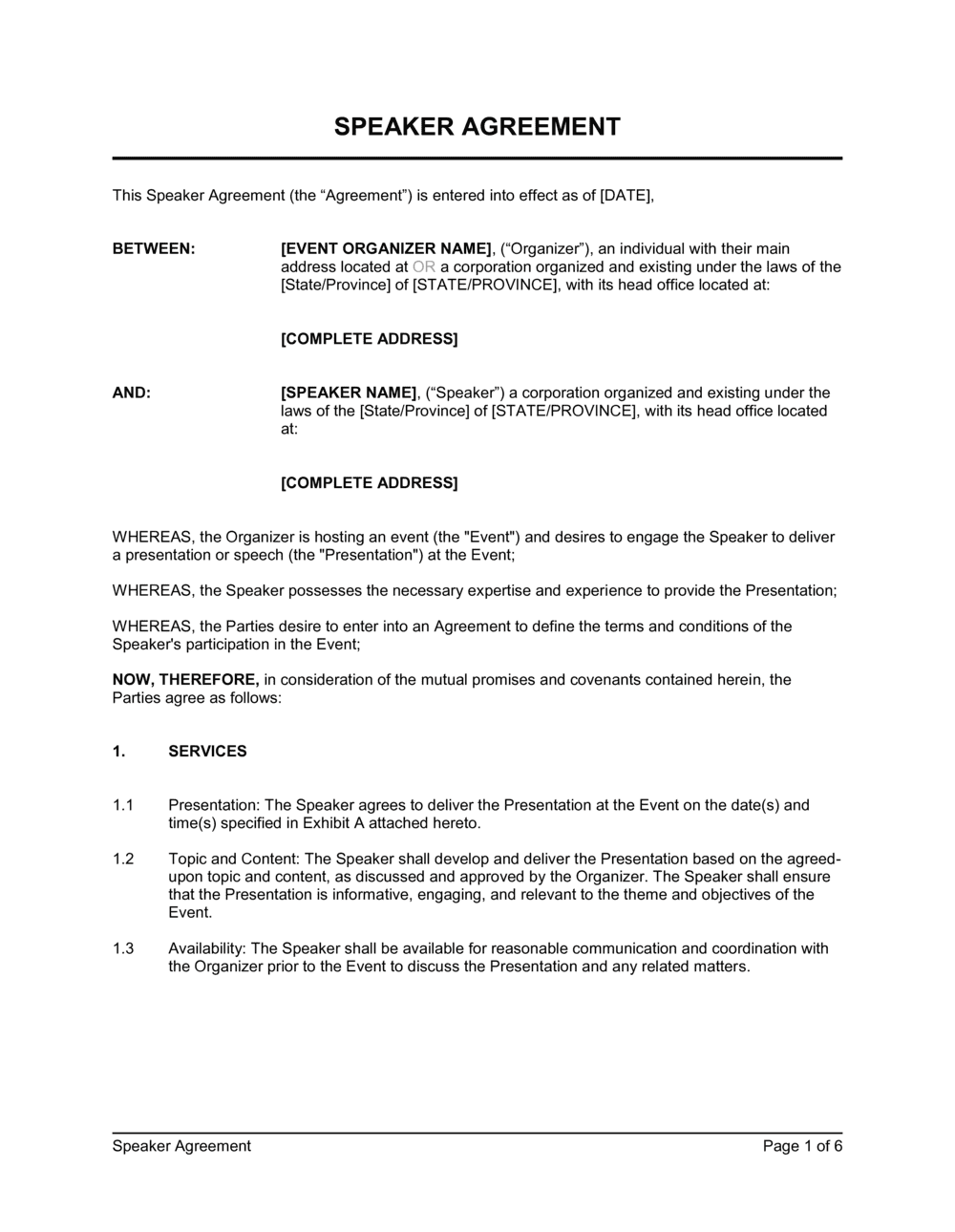
A Speaker Agreement is a legally binding contract between an event organizer and a speaker that defines the terms of a speaking engagement β€” fee, topic, date, venue, travel, intellectual property rights, recording permissions, and cancellation conditions. This free Word download is editable online and exports as PDF, giving both parties a clear, enforceable record of their obligations before the event takes place.
When you need it
Use it any time you hire a keynote speaker, panelist, workshop facilitator, or guest lecturer for a conference, corporate event, seminar, or webinar β€” regardless of whether a fee is involved. Even unpaid engagements benefit from a written agreement that covers IP ownership and cancellation rights.
What's inside
Engagement details and topic scope, speaker fee and expense reimbursement, travel and accommodation terms, intellectual property and recording rights, cancellation and postponement provisions, speaker conduct expectations, indemnification, and governing law.

What is a Speaker Agreement?

A Speaker Agreement is a legally binding contract between an event organizer and a speaker that sets out every material term of a speaking engagement β€” the fee, the topic, the date and venue, travel and accommodation arrangements, intellectual property ownership, recording and distribution rights, cancellation obligations, and governing law. Unlike a casual email confirmation or verbal handshake, a properly executed speaker agreement creates enforceable obligations on both sides and eliminates the ambiguity that routinely causes payment disputes, recording conflicts, and last-minute cancellation disagreements. It functions simultaneously as a service contract, a limited IP license, and a logistics document β€” covering the full lifecycle of an engagement from booking to post-event content use.

Why You Need This Document

Without a signed speaker agreement, both the organizer and the speaker are exposed on multiple fronts. An organizer who announces a speaker publicly before a contract is signed has created detrimental reliance β€” if the speaker withdraws, the organizer may face attendee refund demands and reputational harm with no contractual remedy. A speaker who accepts a verbal booking and declines competing engagements has no financial protection if the organizer cancels two weeks before the event. Recording a presentation without explicit written permission risks a copyright infringement claim; failing to withhold taxes on payments to non-resident speakers creates IRS or HMRC liability for the organizer. A clear, signed speaker agreement executed before any public announcement closes all of these gaps for the cost of 20 minutes and a template that both parties can review and understand.

Which variant fits your situation?

If your situation is…Use this template
Hiring a paid keynote speaker for a large conferenceSpeaker Agreement (Paid Engagement)
Inviting an unpaid guest lecturer or panelistSpeaker Agreement (No Fee)
Commissioning a virtual or webinar speakerVirtual Speaker Agreement
Engaging a facilitator or workshop trainerTraining Services Agreement
Booking a performer or entertainer for an eventEntertainment Contract
Retaining a consultant to speak and advise over multiple eventsConsulting Agreement
Licensing recorded speaker content for reuse and distributionContent Licensing Agreement

Common mistakes to avoid

❌ Announcing the speaker before the agreement is signed

Why it matters: Public announcements create detrimental reliance β€” if either party then withdraws, the aggrieved party can claim damages based on lost ticket sales, promotional costs, or reputational harm even without a signed contract.

Fix: Execute the agreement and receive the signed copy before issuing any press release, social post, or event page listing the speaker's name.

❌ No kill-fee clause for organizer cancellation

Why it matters: Without a kill fee, a speaker who declines other bookings to hold the date has no contractual remedy if the organizer cancels two weeks before the event.

Fix: Include a tiered kill-fee schedule that compensates the speaker for a percentage of the agreed fee based on how close to the event date the cancellation occurs.

❌ Omitting recording and distribution rights entirely

Why it matters: Recording a presentation without explicit contractual permission may infringe the speaker's copyright and moral rights, exposing the organizer to a takedown demand or damages claim after the event.

Fix: Address recording rights explicitly β€” even a single sentence stating 'no recording permitted' or 'organizer may record for internal use only' prevents post-event disputes.

❌ Vague scope of appearance obligations

Why it matters: A contract that says only 'Speaker will deliver a 45-minute keynote' creates disputes when the organizer expects a pre-event dinner, media interview, and post-panel participation that the speaker did not budget for.

Fix: List every activity the speaker is expected to perform β€” presentation, Q&A, breakout session, networking, meet-and-greet β€” with durations and a total time commitment cap.

❌ Failing to address tax withholding for international speakers

Why it matters: US organizers paying non-resident alien speakers must withhold 30% of the fee under IRS rules unless a valid tax treaty exemption applies. Paying gross without withholding creates IRS liability for the organizer.

Fix: Require the speaker to submit Form W-8BEN or W-8BEN-E before payment. Include a clause confirming the speaker's responsibility to provide valid tax documentation.

❌ One-sided force majeure that only protects the organizer

Why it matters: If force majeure excuses the organizer from paying any fee but does not release the speaker from their obligation to appear, courts may strike the clause as unconscionable β€” leaving neither party protected.

Fix: Draft force majeure as mutual β€” both parties are released from obligations when a qualifying event prevents performance, and both share any unrecoverable out-of-pocket costs proportionally.

The 10 key clauses, explained

Parties and engagement details

In plain language: Identifies the organizer and speaker by full legal name, states the event name, date, location or platform, and the agreed speaking topic or session title.

Sample language
This Speaker Agreement is entered into as of [DATE] between [ORGANIZER LEGAL NAME] ('Organizer') and [SPEAKER FULL NAME / ENTITY NAME] ('Speaker'). Speaker agrees to deliver a presentation titled '[PRESENTATION TITLE]' at [EVENT NAME] on [DATE(S)] at [VENUE / PLATFORM].

Common mistake: Using the speaker's public name or agency name instead of their legal entity. If the speaker operates through a corporation or LLC, the contract must name that entity to be enforceable against it.

Speaking fee and payment terms

In plain language: States the total fee, payment method, due date, and any deposit schedule β€” and specifies whether the fee is contingent on attendance numbers or other variables.

Sample language
Organizer shall pay Speaker a flat fee of $[AMOUNT] USD. A deposit of $[AMOUNT] (50%) is due upon execution of this Agreement. The remaining balance of $[AMOUNT] shall be paid no later than [X] business days prior to the engagement date.

Common mistake: Leaving the payment timeline open-ended with language like 'upon invoice receipt.' Without a specific due date, the organizer has unlimited discretion on timing, and speakers have no basis to follow up.

Travel, accommodation, and expense reimbursement

In plain language: Defines which travel costs the organizer covers, the class of travel, per diem rate, and the process for submitting and approving expenses.

Sample language
Organizer shall arrange and pay for round-trip [economy / business class] airfare from [SPEAKER CITY], two nights' hotel accommodation at or near the venue, and a per diem of $[AMOUNT]/day for meals and incidentals. Additional expenses require prior written approval.

Common mistake: Omitting a travel-booking deadline. When neither party books flights early, last-minute fares create cost disputes and logistical failures that derail the engagement.

Intellectual property and content ownership

In plain language: Clarifies that the speaker retains ownership of their original presentation materials while granting the organizer a limited license to use event-related content as specified.

Sample language
Speaker retains all intellectual property rights in the Presentation and related materials. Speaker grants Organizer a non-exclusive, non-transferable license to use the Presentation solely for [PURPOSE] during the event. No other use is permitted without Speaker's prior written consent.

Common mistake: Assuming the organizer owns all content because they paid the fee. Without an explicit IP clause, courts in most jurisdictions default to the creator retaining ownership β€” leaving the organizer with no rights to recordings or materials.

Recording, broadcast, and distribution rights

In plain language: Specifies whether the organizer may record the presentation, in what formats, and how the recording may be used β€” live stream, on-demand, internal only, or commercial distribution.

Sample language
Organizer [may / may not] record the Presentation. If recording is permitted, Organizer may use the recording solely for [PERMITTED USE β€” e.g., on-demand replay for registered attendees for 30 days]. Commercial redistribution, sale, or modification of the recording requires Speaker's separate written consent.

Common mistake: Including a blanket 'Organizer may record and use content in perpetuity' clause without the speaker's knowledge. Speakers commonly negotiate recording scope separately; a one-sided clause often triggers disputes and demand for additional compensation.

Cancellation and postponement

In plain language: Sets out each party's rights and financial obligations if the event is cancelled, postponed, or if the speaker is unable to perform β€” including kill fees and refund timelines.

Sample language
If Organizer cancels the engagement more than [60] days before the event, Organizer shall pay Speaker a kill fee of [25]% of the total fee. If cancelled within [60] days, the kill fee is [50]%. If Speaker cancels for reasons other than Force Majeure, Speaker shall refund any deposit received and use reasonable efforts to find a replacement.

Common mistake: Omitting a kill-fee schedule and relying on 'both parties may cancel with written notice.' Without a financial consequence for late cancellation, organizers face no real cost for dropping a confirmed speaker weeks before the event.

Force majeure

In plain language: Excuses both parties from performance obligations β€” without financial penalty β€” when a qualifying unforeseeable event makes the engagement impossible.

Sample language
Neither party shall be liable for failure to perform if such failure results from circumstances beyond that party's reasonable control, including natural disasters, acts of government, public health emergencies, or venue closures ('Force Majeure Event'). The affected party shall notify the other in writing within [48] hours of the Force Majeure Event.

Common mistake: Using an overly broad force majeure clause that includes foreseeable inconveniences like bad weather or ordinary travel delays. Courts scrutinize force majeure claims strictly β€” the clause should list specific qualifying events.

Exclusivity and competing engagements

In plain language: Restricts the speaker from appearing at a competing event within a defined window before or after the engagement, protecting the organizer's investment in the speaker's draw.

Sample language
Speaker agrees not to present the same topic or substantially similar content at any [competing / same-city] event within [30] days before or after the Engagement Date without prior written consent from Organizer.

Common mistake: Omitting the exclusivity window entirely for high-profile speakers headlining a paid conference. A speaker who appears at a direct competitor's event the week before loses their draw value and can undercut ticket sales.

Indemnification and liability

In plain language: Allocates legal and financial responsibility between the parties if one causes harm to the other or to a third party arising from the engagement.

Sample language
Each party shall indemnify, defend, and hold harmless the other from claims, losses, and expenses (including reasonable legal fees) arising from that party's own negligence, misconduct, or breach of this Agreement. Organizer's total liability shall not exceed the total fee paid to Speaker under this Agreement.

Common mistake: One-sided indemnification that only protects the organizer. Courts in several jurisdictions will refuse to enforce indemnity clauses that require one party to indemnify the other for that other party's own negligence.

Governing law and dispute resolution

In plain language: Specifies which jurisdiction's law governs the agreement and how disputes are resolved β€” arbitration, mediation, or litigation in a named court.

Sample language
This Agreement shall be governed by the laws of [STATE / PROVINCE / COUNTRY]. Any dispute arising under this Agreement shall first be submitted to non-binding mediation in [CITY]. If mediation fails, disputes shall be resolved by binding arbitration under [AAA / JAMS / ADR BODY] rules.

Common mistake: Choosing a governing law with no connection to where either party operates or where the event takes place. Some courts refuse to apply a foreign governing-law clause if doing so would violate the public policy of the jurisdiction where the dispute arises.

How to fill it out

  1. 1

    Identify both parties with full legal names

    Enter the organizer's registered entity name and the speaker's legal name or business entity name. Include addresses and primary contact information for each party.

    πŸ’‘ Ask the speaker upfront whether they contract through a personal service company or talent agency β€” the correct contracting entity must be named or the agreement cannot be enforced against it.

  2. 2

    Define the engagement scope precisely

    Enter the event name, date(s), venue or platform URL, session title, and agreed presentation length. If the speaker is expected to attend a networking session or dinner, list those obligations explicitly.

    πŸ’‘ Speakers commonly dispute scope creep β€” a Q&A running 30 minutes over, a mandatory panel appearance, or a press interview. List every expected obligation in this clause.

  3. 3

    Set the fee, deposit, and payment schedule

    Enter the total speaker fee, the deposit amount and due date upon signing, and the balance payment date relative to the engagement. Specify the currency and payment method β€” wire transfer, ACH, or check.

    πŸ’‘ For international speakers, state whether the fee is inclusive or exclusive of withholding tax. US organizers paying non-resident speakers typically must withhold 30% under IRS rules unless a tax treaty applies.

  4. 4

    Specify travel and accommodation terms

    Enter the class of airfare the organizer will book or reimburse, hotel check-in and check-out dates, and the per diem rate. Note who books travel β€” organizer or speaker β€” and the reimbursement submission deadline.

    πŸ’‘ Set a flight-booking deadline of at least 30 days before the event. Last-minute bookings can cost three to five times the standard fare and create budget disputes.

  5. 5

    Complete the IP and recording rights clause

    Select whether the organizer may record the presentation and specify the permitted use β€” live stream, internal archive, on-demand replay window, or no recording. Confirm that the speaker retains ownership of original materials.

    πŸ’‘ If you want to use the recording commercially, negotiate a recording license fee separately rather than burying it in the base speaking fee β€” speakers respond better to transparent scope.

  6. 6

    Insert the cancellation and kill-fee schedule

    Set tiered kill-fee percentages tied to days before the event β€” for example, 25% if cancelled more than 60 days out and 50% within 60 days. Specify the speaker's refund obligation if they cancel.

    πŸ’‘ Mirror the kill-fee tiers so the speaker faces equivalent financial consequences for cancellation as the organizer β€” courts look at mutuality when enforcing these clauses.

  7. 7

    Choose governing law and dispute resolution method

    Select the jurisdiction whose law applies and name the dispute resolution mechanism. Arbitration is faster and more private than litigation for fee disputes; mediation first is a common two-step approach.

    πŸ’‘ Use the jurisdiction where the event takes place if the parties are in different states or countries β€” this is the most defensible choice and avoids forum-shopping arguments.

  8. 8

    Sign before confirming the engagement publicly

    Both parties must sign before the organizer announces the speaker on the event website or marketing materials. Announcing first creates detrimental reliance arguments that limit the organizer's ability to cancel cleanly.

    πŸ’‘ Use electronic signature to timestamp execution and retain an audit trail. Many speaker disputes turn on whether a binding agreement existed before a public announcement.

Frequently asked questions

What is a speaker agreement?

A speaker agreement is a legally binding contract between an event organizer and a speaker that defines the terms of a speaking engagement β€” including the fee, topic, date, venue, travel arrangements, IP ownership, recording permissions, and cancellation conditions. It protects both parties by creating enforceable obligations before the event takes place and eliminates the ambiguity that causes post-event disputes over payments, recordings, and scope.

Do I need a speaker agreement for an unpaid speaker?

Yes. Even without a financial fee, a speaker agreement establishes who owns the presentation content, whether the organizer may record and redistribute the talk, and what happens if either party cancels. Without a written agreement, an unpaid speaker who cancels at short notice has no contractual obligation to find a replacement, and an organizer who records and posts the talk without permission may face a copyright claim.

Who typically pays the speaker's travel expenses?

For paid keynote speakers, the organizer typically covers economy or business-class airfare, hotel accommodation for the nights surrounding the event, and a per diem for meals and incidentals. For lower-fee or unpaid engagements, speakers sometimes cover their own travel in exchange for other benefits β€” audience access, promotion, or professional development. The agreement should specify exactly what is covered and the booking or reimbursement process to avoid disputes.

What is a kill fee in a speaker agreement?

A kill fee is a contractually agreed payment the organizer makes to the speaker if the organizer cancels the engagement after a specified date. It compensates the speaker for turning down other bookings to hold the date. A typical kill-fee schedule might be 25% of the total fee if cancelled more than 60 days before the event and 50% within 60 days. Without a kill fee, a speaker has limited financial remedy if the organizer cancels at the last minute.

Who owns the intellectual property in a speaker's presentation?

In most jurisdictions, the speaker retains copyright in original presentation content, slides, and materials β€” even if the organizer paid a fee. The speaker agreement should confirm this and grant the organizer a limited license for specific permitted uses. If the organizer wants broader rights β€” such as commercial distribution of a recording β€” those must be negotiated separately and stated explicitly in the agreement.

Can the organizer record and post the presentation online?

Only if the speaker agreement explicitly permits it. Recording and distributing a presentation without the speaker's written consent may infringe copyright and, in some jurisdictions, moral rights. The agreement should specify the permitted format, platform, and time window for any recording β€” for example, on-demand replay for registered attendees for 30 days post-event β€” and require separate consent for commercial distribution or editing.

What happens if the speaker cancels?

The agreement should include a mutual cancellation clause addressing both scenarios. If the speaker cancels for reasons other than force majeure, they typically must refund any deposit received and, in some agreements, use reasonable efforts to find an equivalent replacement. If the cancellation is due to illness, family emergency, or a qualifying force majeure event, the financial consequences are typically reduced or waived β€” but this must be stated explicitly in the contract.

Is a speaker agreement enforceable across state or country borders?

Generally yes, if the governing-law and dispute-resolution clauses are properly drafted. Courts typically honor a chosen governing-law clause when at least one party has a meaningful connection to that jurisdiction. For cross-border engagements, choose the jurisdiction where the event takes place as governing law β€” it is the most defensible choice and avoids forum-shopping arguments from either party.

Do I need a lawyer to draft a speaker agreement?

For standard domestic speaking engagements, a high-quality template is usually sufficient if both parties review it carefully. Consider engaging a lawyer when the speaker fee exceeds $25,000, the engagement involves complex IP licensing or commercial recording rights, the speaker is an international resident requiring tax analysis, or the event is a flagship conference where cancellation would cause significant financial harm. A 1–2 hour template review typically costs $200–$500 and is worthwhile for high-stakes bookings.

How this compares to alternatives

vs Independent Contractor Agreement

An independent contractor agreement covers an ongoing or project-based service relationship where the contractor performs defined tasks over time. A speaker agreement is purpose-built for a single engagement or limited series of appearances, with clauses specific to IP, recording, cancellation kill fees, and event logistics that a generic contractor agreement does not address. Use a speaker agreement whenever the deliverable is a live or recorded presentation.

vs Consulting Agreement

A consulting agreement governs advisory, analytical, or strategic services delivered over a sustained engagement β€” typically weeks or months. A speaker agreement covers a discrete performance event. If a speaker is also expected to provide strategic input, pre-event advisory calls, or post-event deliverables, a consulting agreement should supplement the speaker agreement rather than replace it.

vs Event Venue Contract

A venue contract governs the organizer's relationship with the venue β€” space rental, catering, AV equipment, and liability for the physical event. A speaker agreement governs the organizer's relationship with the individual performing at that venue. Both documents are needed for any paid speaking event; they operate in parallel and should reference each other where relevant, such as force majeure triggered by venue closure.

vs Talent Agreement

A talent agreement is used for performers β€” musicians, actors, comedians β€” and typically involves royalty structures, union rules (SAG-AFTRA, IATSE), and performance licensing terms that do not apply to speakers. A speaker agreement is designed for informational or educational presentations where the speaker retains content IP and fees are flat rather than royalty-based. Use a talent agreement only when the appearance is primarily a performance rather than a presentation.

Industry-specific considerations

Events and conferences

Multi-speaker lineups require standardized agreements across all tiers β€” keynotes, panelists, and workshop hosts β€” with tiered fee and cancellation structures.

Corporate training and HR

Internal events often involve proprietary content; IP clauses must confirm the organizer cannot redistribute the speaker's training materials outside the company.

Higher education

Universities engaging visiting lecturers must address honoraria tax treatment, campus conduct policies, and academic freedom expectations within the agreement.

Media and podcasting

Recording and distribution rights are central β€” agreements must specify episode exclusivity windows, editing consent, and revenue-sharing terms if applicable.

Jurisdictional notes

United States

US organizers paying non-resident alien speakers must withhold 30% of the speaker fee under IRS rules unless a valid tax treaty exemption applies β€” the speaker must provide Form W-8BEN or W-8BEN-E before payment. Non-compete and exclusivity clauses are generally enforceable if reasonable in scope. State laws vary on which dispute-resolution forum is required for consumer-facing contracts, though B2B arbitration clauses are broadly enforceable.

Canada

In Canada, speakers operating through personal service corporations may qualify as employees under CRA rules if the organizer controls how and when work is performed β€” misclassification triggers source deduction liability. Quebec law requires contracts to be available in French for provincially regulated organizations. Cancellation provisions that impose disproportionate penalties may be subject to Quebec's Consumer Protection Act if the speaker is considered a consumer.

United Kingdom

UK speakers may be subject to IR35 off-payroll working rules if the engagement is deemed disguised employment β€” organizers engaging personal service companies should conduct a status determination before contracting. The Unfair Contract Terms Act 1977 limits the enforceability of indemnification clauses that attempt to exclude liability for negligence. Moral rights under the Copyright, Designs and Patents Act 1988 are automatic and cannot be waived by contract without explicit acknowledgment.

European Union

GDPR applies to any personal data collected in connection with the speaker's appearance β€” including recording facial images, voice, or audience interaction data. Speakers in EU member states may retain strong moral rights in their presentations that restrict editing or derogatory use of recordings even after granting a license. Non-compete and exclusivity clauses are enforceable in most member states but may require financial compensation to the speaker in France, Germany, and Belgium to be valid.

Template vs lawyer β€” what fits your deal?

PathBest forCostTime
Use the templateStandard domestic speaking engagements with fees under $10,000 and no complex recording or IP requirementsFree15–30 minutes
Template + legal reviewHigh-profile keynotes, international speakers, commercial recording rights, or engagements where cancellation would cause significant financial harm$200–$500 for a 1–2 hour attorney review1–3 days
Custom draftedCelebrity or high-fee speakers, multi-event touring deals, complex IP licensing, or engagements with broadcast and commercial distribution rights$1,000–$3,500+1–2 weeks

Glossary

Engagement
The specific speaking appearance or set of appearances a speaker agrees to perform under the terms of the agreement.
Speaker Fee
The fixed or negotiated amount of money the organizer agrees to pay the speaker in exchange for the speaking services.
Intellectual Property (IP)
Original content, slides, materials, and ideas created by the speaker β€” ownership of which must be explicitly addressed in the agreement.
Recording Rights
The organizer's right β€” or lack thereof β€” to record, broadcast, stream, or distribute the speaker's presentation in any media format.
Kill Fee
A contractually agreed payment made to the speaker if the organizer cancels the engagement after a specified date, compensating for lost opportunity.
Force Majeure
A clause releasing both parties from obligations when performance is prevented by events outside their control, such as natural disasters, illness, or government restrictions.
Exclusivity
A restriction preventing the speaker from appearing at competing events within a defined time window before or after the contracted engagement.
Indemnification
A contractual obligation by one party to compensate the other for losses, damages, or legal costs arising from a specific act or omission.
Per Diem
A fixed daily allowance paid to the speaker to cover meals and incidental expenses during travel related to the engagement.
Rider
A supplementary document attached to the agreement specifying the speaker's technical, logistical, or hospitality requirements at the venue.
Moral Rights
Legal rights in some jurisdictions allowing creators to object to modifications of their work that harm their reputation, independent of copyright ownership.

Part of your Business Operating System

This document is one of 3,000+ business & legal templates included in Business in a Box.

  • Fill-in-the-blanks β€” ready in minutes
  • 100% customizable Word document
  • Compatible with all office suites
  • Export to PDF and share electronically

Create your document in 3 simple steps.

From template to signed document β€” all inside one Business Operating System.
1
Download or open template

Access over 3,000+ business and legal templates for any business task, project or initiative.

2
Edit and fill in the blanks with AI

Customize your ready-made business document template and save it in the cloud.

3
Save, Share, Send, Sign

Share your files and folders with your team. Create a space of seamless collaboration.

Save time, save money, and create top-quality documents.

β˜…β˜…β˜…β˜…β˜…

"Fantastic value! I'm not sure how I'd do without it. It's worth its weight in gold and paid back for itself many times."

Managing Director Β· Mall Farm
Robert Whalley
Managing Director, Mall Farm Proprietary Limited
β˜…β˜…β˜…β˜…β˜…

"I have been using Business in a Box for years. It has been the most useful source of templates I have encountered. I recommend it to anyone."

Business Owner Β· 4+ years
Dr Michael John Freestone
Business Owner
β˜…β˜…β˜…β˜…β˜…

"It has been a life saver so many times I have lost count. Business in a Box has saved me so much time and as you know, time is money."

Owner Β· Upstate Web
David G. Moore Jr.
Owner, Upstate Web

Run your business with a system β€” not scattered tools

Stop downloading documents. Start operating with clarity. Business in a Box gives you the Business Operating System used by over 250,000 companies worldwide to structure, run, and grow their business.

Start freeΒ Β·Β No credit card required