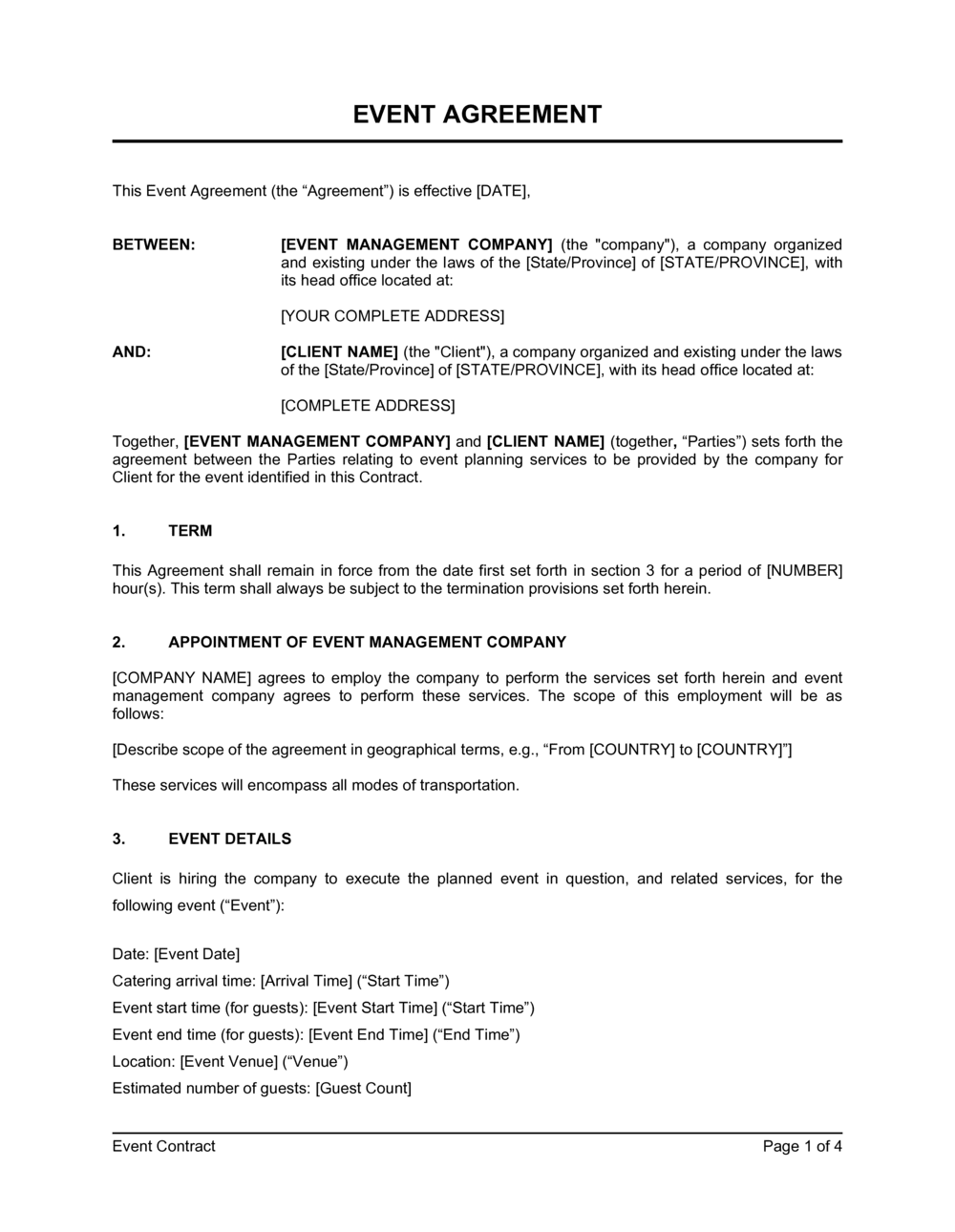
Event Contract Template

Free Word download β€’ Edit online β€’ Save & share with Drive β€’ Export to PDF

4 pagesβ€’25–35 min to fillβ€’Difficulty: Complexβ€’Signature requiredβ€’Legal review recommended
Learn more ↓
FreeEvent Contract Template

At a glance

What it is
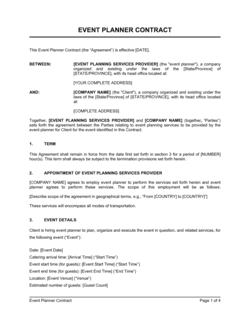
An Event Contract is a legally binding agreement between an event organizer and a service provider β€” such as a venue, caterer, AV company, or performer β€” that sets out exactly what will be delivered, when, and for how much. This free Word download covers event details, services scope, fees, deposit schedule, cancellation terms, force majeure, and liability limits in a single ready-to-edit document.
When you need it
Use it before any paid event engagement where money changes hands β€” whether you are booking a venue for a corporate conference, hiring a caterer for a wedding reception, or contracting a DJ for a private party. Once a deposit is paid or services are confirmed, a signed contract is essential.
What's inside
Event details and service description, fees and payment schedule, deposit and refund terms, cancellation and rescheduling policy, force majeure clause, liability limitation, indemnification, and governing law.

What is an Event Contract?

An Event Contract is a legally binding agreement between an event organizer and a service provider β€” such as a venue, caterer, AV company, or performer β€” that governs every material aspect of a single, date-specific engagement. It records the event details, defines the exact scope of services to be delivered, sets the total fee and payment schedule, establishes non-refundable deposit terms, and prescribes the financial consequences of cancellation or rescheduling. Unlike a general service agreement, an event contract is purpose-built for engagements where timing is irreversible, cost exposure is front-loaded, and the consequences of a last-minute cancellation are immediate and concrete.

Why You Need This Document

Without a signed event contract, you have no enforceable basis to retain a deposit when an organizer cancels two weeks before the event date, and the organizer has no documented basis to demand a refund or replacement provider when services fall short. Verbal confirmations and email threads are routinely insufficient in disputes β€” courts look for a signed agreement that specifies what was promised, when, and for how much. Cancellation disputes, last-minute scope changes, no-show vendors, and force majeure events all produce predictable, expensive conflicts when the contract is absent or vague. This template gives both sides a clear, balanced starting point that protects the provider's booked revenue and the organizer's right to defined, deliverable services β€” and closes the four most common gaps that turn event disagreements into legal claims.

Which variant fits your situation?

If your situation is…Use this template
Booking a venue for a wedding or private celebrationVenue Rental Agreement
Hiring a photographer or videographer for an eventPhotography Services Agreement
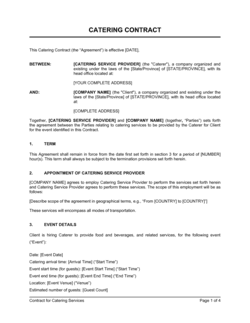
Engaging a catering company for a corporate or private eventCatering Contract
Contracting a performer, band, or DJ for a live eventEntertainment Agreement
Hiring a freelance event planner to manage the full eventEvent Planning Agreement
Renting audio-visual equipment and technical crewAV Services Agreement
Organizing a trade show booth or exhibition spaceExhibition Services Agreement

Common mistakes to avoid

❌ Vague service scope with no itemized deliverables

Why it matters: When the contract says 'full event catering' without specifying menu, staffing, and service style, every post-event disagreement becomes a credibility dispute with no paper record to resolve it.

Fix: Attach a Schedule A listing every deliverable, quantity, and specification. Have both parties initial the schedule separately at signing.

❌ No specific final-payment deadline

Why it matters: Providers who receive the balance on event day β€” or after β€” cannot cover pre-event costs and have weak legal standing to refuse service or pursue a collection claim without a documented due date.

Fix: State a specific calendar date for the final balance, typically 14 to 30 days before the event, and include a right to suspend services if payment is not received by that date.

❌ Identical cancellation terms for all time windows

Why it matters: A 100% forfeiture on a cancellation made six months in advance may be struck down as a penalty clause rather than a genuine pre-estimate of loss, rendering the entire cancellation clause unenforceable.

Fix: Use a sliding-scale schedule tied to your actual cost exposure at each stage β€” early cancellations should reflect lower sunk costs than last-minute ones.

❌ No force majeure or rescheduling mechanism

Why it matters: Without one, a government-ordered event ban or venue closure leaves both parties in a contractual standoff β€” the organizer cannot legally demand a refund and the provider cannot legally retain the deposit without risking a breach claim.

Fix: Include a force majeure clause that specifies qualifying events, what happens to payments already made, and the window within which rescheduling must occur.

❌ One-sided indemnification covering the provider's own negligence

Why it matters: Courts in many jurisdictions refuse to enforce indemnity clauses that require one party to absorb liability for the other party's own wrongful acts β€” and may void the entire indemnification provision.

Fix: Draft mutual indemnification: each party covers claims arising from their own actions, and the provider's indemnity obligation is limited to their own negligence or willful misconduct.

❌ No insurance requirement clause

Why it matters: If a guest is injured and neither party carries event liability coverage, any resulting personal injury claim can exceed the total event budget β€” with both parties exposed to unlimited out-of-pocket liability.

Fix: Require both parties to carry a minimum general liability limit β€” $1,000,000 per occurrence is a common floor β€” and mandate that the organizer obtain event-specific coverage before the date.

The 10 key clauses, explained

Parties and event details

In plain language: Identifies the event organizer and service provider as legal entities and records the core event specifics β€” name, date, venue address, and start and end times.

Sample language
This Event Contract is entered into on [DATE] between [ORGANIZER LEGAL NAME] ('Client') and [PROVIDER LEGAL NAME] ('Provider'). Provider agrees to perform services at [EVENT NAME], to be held at [VENUE ADDRESS] on [EVENT DATE] from [START TIME] to [END TIME].

Common mistake: Recording only the event date without specifying start and end times. Providers who run back-to-back events on the same day cannot plan setup and breakdown without exact time windows.

Scope of services

In plain language: Describes precisely what the provider will deliver β€” equipment, staff, deliverables, and any exclusions β€” so both parties share the same expectations.

Sample language
Provider shall furnish the following services: [DETAILED SERVICE LIST]. The following items are expressly excluded from this Agreement: [EXCLUSIONS]. Any additional services must be requested in writing and agreed upon by both parties before the Event Date.

Common mistake: Writing a vague scope such as 'full catering services.' Without itemized deliverables β€” menu, staffing ratio, service style, cleanup β€” disputes over what was promised are almost inevitable.

Fees and payment schedule

In plain language: States the total contract price, the breakdown between deposit and final balance, and the due dates for each payment.

Sample language
The total fee for services is $[TOTAL AMOUNT]. A non-refundable deposit of $[DEPOSIT AMOUNT] is due upon signing. The remaining balance of $[BALANCE AMOUNT] is due no later than [X] days before the Event Date. Payments shall be made by [ACCEPTED METHOD].

Common mistake: Omitting a specific final-payment deadline. Providers who receive the balance on the event day β€” or after β€” face cash-flow problems and have limited recourse if the organizer does not pay.

Deposit and refund terms

In plain language: Clarifies whether the deposit is non-refundable, under what conditions any portion is returned, and how deposits apply to the final balance.

Sample language
The deposit paid under this Agreement is non-refundable in the event of cancellation by Client. If cancellation occurs more than [X] days before the Event Date, [Y]% of the remaining balance, if paid, shall be refunded. No refund shall be issued for cancellations within [Z] days of the Event Date.

Common mistake: Using the same refund schedule for all cancellation windows. A flat 'no refund' policy applied to cancellations made 6 months in advance may be unenforceable as a penalty clause in several jurisdictions.

Cancellation and rescheduling

In plain language: Sets out the notice requirements and financial consequences when either party cancels or requests to move the event date.

Sample language
Client may cancel this Agreement by written notice to Provider. Cancellation fees are as follows: [X]% of total fee if cancelled more than [90] days before the Event Date; [Y]% if cancelled [30–90] days before; [100]% if cancelled within [30] days. Rescheduling requests are subject to Provider availability and a rescheduling fee of $[AMOUNT].

Common mistake: No rescheduling clause at all. When an event is postponed rather than cancelled β€” as occurred widely during 2020–2021 β€” providers and organizers had no contractual basis for resolving the dispute.

Force majeure

In plain language: Excuses performance by either party when an event is prevented by circumstances entirely beyond their control, and specifies what happens to payments already made.

Sample language
Neither party shall be liable for failure to perform its obligations under this Agreement if such failure results from a force majeure event, including but not limited to natural disasters, acts of government, pandemic, or civil unrest. In such event, Client shall be entitled to reschedule within [12] months at no additional cost, or receive a refund of all amounts paid less reasonable costs already incurred by Provider.

Common mistake: Omitting force majeure entirely or using boilerplate language that does not address what happens to the deposit. Courts have split on whether a force majeure clause excuses the organizer from paying a non-refundable deposit.

Liability limitation and indemnification

In plain language: Caps the maximum financial exposure of each party and establishes who is responsible for compensating the other in the event of property damage, injury, or third-party claims.

Sample language
Provider's total liability under this Agreement shall not exceed the total fees paid by Client. Client shall indemnify and hold harmless Provider from any claims arising from Client's or Client's guests' actions at the event. Provider shall indemnify Client from claims arising from Provider's own negligence or willful misconduct.

Common mistake: One-sided indemnification that protects only the provider. Courts increasingly scrutinize clauses that require the organizer to indemnify the provider for the provider's own negligence β€” and may strike the entire clause as unenforceable.

Insurance requirements

In plain language: Specifies what insurance coverage each party must carry before the event β€” general liability, liquor liability, and any additional insured requirements.

Sample language
Each party shall maintain general liability insurance of at least $[AMOUNT] per occurrence for the duration of this Agreement. Client shall obtain event liability insurance no later than [X] days before the Event Date and provide Provider with a certificate of insurance naming Provider as an additional insured.

Common mistake: No insurance clause at all. If a guest is injured and neither party has event liability coverage, the resulting claim can exceed the entire event budget many times over.

Substitution and subcontracting

In plain language: Addresses whether the provider may substitute personnel or subcontract any portion of the services, and what approval the organizer has over such changes.

Sample language
Provider shall not subcontract any material portion of the services without Client's prior written consent. In the event of an unavoidable personnel substitution, Provider shall notify Client as soon as practicable and ensure the substitute meets equivalent qualifications.

Common mistake: No substitution clause when contracting named talent or a specific lead planner. If the contracted person is replaced without notice, the organizer has no documented basis for a fee reduction or contract termination.

Governing law and dispute resolution

In plain language: Specifies which jurisdiction's law governs the contract and how disputes are resolved β€” through negotiation, mediation, arbitration, or court.

Sample language
This Agreement shall be governed by the laws of [STATE / PROVINCE / COUNTRY]. Any dispute arising under this Agreement shall first be submitted to non-binding mediation. If mediation fails, the dispute shall be resolved by binding arbitration in [CITY], administered by [AAA / JAMS / OTHER], except that either party may seek injunctive relief in a court of competent jurisdiction.

Common mistake: Choosing the governing law of the provider's home state when the event takes place in a different jurisdiction. Courts in the event's location may apply local consumer protection or venue licensing laws regardless of the contract's choice-of-law clause.

How to fill it out

  1. 1

    Enter the legal names of both parties and the event details

    Use the full registered legal name of both the organizer and the service provider β€” not trade names. Record the event name, venue address, and the exact date, start time, and end time.

    πŸ’‘ Confirm the venue address at the time of signing, not just the city β€” booking errors at multi-location venues are a common source of disputes.

  2. 2

    Define the scope of services in specific, itemized terms

    List every deliverable the provider is responsible for β€” equipment, staffing, setup and breakdown times, menu items, or technical riders. Add an explicit exclusions list for anything the organizer is handling separately.

    πŸ’‘ Attach a detailed scope as Schedule A rather than trying to fit every detail into the body clause β€” it makes amendments easier without redrafting the full contract.

  3. 3

    Set the total fee, deposit amount, and payment due dates

    State the total contract value, the non-refundable deposit amount due at signing, and the exact date the final balance is due β€” typically 14 to 30 days before the event.

    πŸ’‘ Specify the accepted payment methods and any processing fees for credit card payments to avoid disputes at the time of final payment.

  4. 4

    Complete the cancellation and rescheduling schedule

    Fill in the cancellation fee percentages for each time window β€” for example, 25% if cancelled more than 90 days out, 50% between 30 and 90 days, and 100% within 30 days. Add the rescheduling fee and any availability conditions.

    πŸ’‘ Calibrate the cancellation schedule to your actual cost exposure β€” a caterer with non-refundable food orders has a different breakeven point than a venue with fixed overhead.

  5. 5

    Tailor the force majeure clause to address payment treatment

    Decide whether a force majeure event triggers a full refund, a credit toward rescheduling, or a partial refund net of costs already incurred. State the rescheduling window β€” 12 months is typical.

    πŸ’‘ Add a list of specific qualifying events rather than relying solely on 'circumstances beyond our control' β€” government-ordered event bans, for example, should be explicitly named.

  6. 6

    Set the liability cap and confirm insurance requirements

    Set the liability cap at the total contract value as a starting point. Specify the minimum insurance coverage each party must carry and the deadline for the organizer to provide a certificate of insurance.

    πŸ’‘ For events with alcohol service, check whether the venue or caterer's general liability policy covers liquor liability β€” many policies exclude it, requiring a separate endorsement.

  7. 7

    Select the governing law and dispute resolution method

    Choose the jurisdiction where the event takes place as your governing law in most cases. Decide between mediation, binding arbitration, or court, and name the city where proceedings would occur.

    πŸ’‘ Arbitration is faster and cheaper than litigation for contract values under $50,000 β€” consider making it the default for all event contracts below that threshold.

  8. 8

    Sign before any deposit is paid

    Both parties must sign and date the contract before the organizer transfers any money. Retain a fully executed copy β€” including all schedules β€” in your files.

    πŸ’‘ Use a timestamped e-signature platform so there is no ambiguity about when the agreement was executed and by whom.

Frequently asked questions

What is an event contract?

An event contract is a legally binding agreement between an event organizer and a service provider β€” such as a venue, caterer, AV company, or performer β€” that defines the services to be delivered, the event date and location, fees and payment schedule, cancellation terms, and liability limits. It creates enforceable obligations on both sides and replaces informal confirmations as the authoritative record of what was agreed.

What should an event contract include?

At minimum: the legal names of both parties, event date and location, a detailed scope of services, total fees and payment schedule, deposit amount and refund terms, a cancellation and rescheduling policy, a force majeure clause, liability limits, indemnification, insurance requirements, and governing law. Missing any of these creates gaps that courts fill with jurisdiction-specific defaults β€” often unfavorable to whichever party failed to include the clause.

Is an event contract legally binding?

Yes β€” an event contract is generally enforceable when both parties have signed it, there is an exchange of value (services for fees), and the terms are sufficiently specific to enforce. Courts will typically uphold cancellation fees and deposit forfeitures when they represent a genuine pre-estimate of the provider's actual loss, rather than an arbitrary penalty. Consider consulting a lawyer for high-value events or complex multi-vendor arrangements.

Can a service provider keep the deposit if the event is cancelled?

In most cases, yes β€” if the contract clearly states the deposit is non-refundable and the cancellation policy is reasonable relative to the provider's actual cost exposure. Courts in the UK, Canada, and several US states apply a 'genuine pre-estimate of loss' test: deposits that far exceed the provider's demonstrable costs may be treated as unenforceable penalty clauses. Document your sunk costs at each cancellation window to support your policy.

What does force majeure mean in an event contract?

A force majeure clause excuses one or both parties from performing when an extraordinary, unforeseeable event β€” such as a natural disaster, government-ordered ban, or pandemic β€” makes the event impossible. The clause should specify exactly what qualifies, what happens to deposits and pre-payments already made, and whether rescheduling is offered as an alternative to a refund. Without this clause, a cancelled event due to circumstances outside anyone's control creates an unresolved contractual standoff.

Do I need a separate contract for each event vendor?

Yes β€” each vendor relationship should be governed by its own signed contract. A venue contract, a catering contract, and an AV contract each cover materially different services, risk profiles, and cancellation economics. Using a single umbrella agreement across vendors creates conflicts when one vendor's terms differ from another's, and makes partial cancellation or vendor replacement difficult to resolve.

What happens if a service provider cancels the event contract?

If the provider cancels without cause, they are typically liable to refund all amounts paid and may owe additional damages β€” including the cost of sourcing a replacement provider at higher rates. Your contract should include a provider-cancellation clause specifying the notice required, the full refund obligation, and any additional compensation for disruption. Without this clause, the organizer's remedies default to general contract law, which varies significantly by jurisdiction.

How much should an event deposit be?

Deposits typically range from 25% to 50% of the total contract value, depending on the provider's cost structure and how far in advance the event is booked. Venue and catering deposits tend to be higher β€” 50% is common β€” because providers turn away other bookings. Entertainment and AV deposits often run 25% to 33%. Whatever the amount, the contract should make clear whether the deposit is credited toward the final balance or is a separate retainer fee.

Should an event contract require insurance?

Yes β€” both parties should carry appropriate coverage. Organizers should obtain event liability insurance covering bodily injury and property damage during the event. Venues and caterers should carry commercial general liability and, where alcohol is served, liquor liability coverage. The contract should specify minimum coverage limits β€” $1,000,000 per occurrence is a common floor β€” and require each party to provide a certificate of insurance before the event date.

How this compares to alternatives

vs Venue Rental Agreement

A venue rental agreement covers only the hire of a physical space β€” access hours, capacity, permitted uses, and security deposit. An event contract is broader, covering any service provider's obligations at the event, including equipment, staff, and deliverables. When booking a venue, you typically need both: one for the space and one for each service provider.

vs Service Agreement

A general service agreement governs an ongoing or open-ended provision of services and rarely addresses event-specific terms like force majeure, headcount guarantees, or day-of logistics. An event contract is purpose-built for a single, date-specific engagement where timing is critical and cancellation risk is high. For one-off events, always use an event-specific contract.

vs Independent Contractor Agreement

An independent contractor agreement establishes an ongoing working relationship β€” classification, taxes, IP ownership, and deliverables across multiple engagements. An event contract is a one-time transaction document focused on a specific event date, fee, and cancellation consequences. Event vendors are often contractors, but they need an event contract, not an employment or contractor agreement, for each booking.

vs Photography Services Agreement

A photography services agreement is specialized for image and video deliverables β€” covering usage rights, editing timelines, image ownership, and release licensing. An event contract covers any service category but lacks the IP and licensing terms photographers require. Photographers and videographers working events need both: an event contract for logistics and fees, and a photography agreement for rights.

Industry-specific considerations

Hospitality and venues

Venue contracts typically include headcount guarantees, attrition clauses, holdover fees, and detailed setup and breakdown time windows tied to back-to-back booking schedules.

Food and beverage

Catering contracts must address minimum guest guarantees, final headcount deadlines, menu substitution rights, alcohol service liability, and the allocation of food-waste costs.

Entertainment and media

Performer and band contracts require a detailed rider covering technical specifications, sound and lighting requirements, hospitality, and a substitute-performer policy for illness or no-show.

Corporate events and conferences

Multi-vendor corporate event contracts often include data privacy terms for attendee registration, branded signage rights, exclusivity clauses preventing competing sponsors, and AV uptime guarantees.

Jurisdictional notes

United States

Contract law is state-specific, so the governing law clause matters significantly. California, New York, and Texas each have distinct case law on deposit forfeiture and penalty clauses. In states where alcohol is served, the organizer may face dram shop liability if a guest causes injury after being served β€” check whether event liability insurance covers this exposure. Force majeure clauses were heavily litigated during COVID-19 shutdowns, and courts have split on whether government-ordered closures qualify.

Canada

Canadian courts apply a strict 'genuine pre-estimate of loss' test to deposit forfeiture clauses β€” amounts that exceed demonstrable costs may be reduced or voided as penalties. Provincial consumer protection legislation in Ontario, British Columbia, and Quebec may impose mandatory refund rights for event cancellations. Quebec contracts must be in French for consumer-facing agreements. Liquor liability is provincially regulated, with strict host liability rules in Ontario under the Liquor Licence Act.

United Kingdom

UK courts have historically been willing to strike down deposit forfeiture clauses that constitute a 'penalty' rather than a liquidated damages estimate β€” the Cavendish Square v Makdessi ruling (2015) refined but did not eliminate this risk. The Consumer Rights Act 2015 gives consumers the right to challenge unfair contract terms, including one-sided cancellation clauses in B2C event contracts. Event organizers must also consider whether their contracts comply with GDPR obligations when processing attendee personal data.

European Union

The EU Unfair Contract Terms Directive prohibits standard-form terms that create a significant imbalance between the parties β€” sweeping exclusions of liability and one-sided forfeiture clauses are regularly challenged. GDPR applies to any event that collects attendee registration data, requiring a lawful basis for processing and a data retention policy. Member states differ in how they regulate liquor liability and event insurance requirements β€” Germany, France, and the Netherlands each impose distinct local obligations.

Template vs lawyer β€” what fits your deal?

PathBest forCostTime
Use the templateOrganizers and vendors handling straightforward single-vendor events with standard services and fees under $25,000Free20–30 minutes
Template + legal reviewEvents with alcohol service, large guest counts, multi-vendor logistics, or contracts between $25,000 and $100,000$300–$7002–4 days
Custom draftedHigh-value events over $100,000, celebrity talent contracts, multi-jurisdiction event series, or venues with complex indemnity exposure$1,500–$5,000+1–3 weeks

Glossary

Event Date
The specific calendar date β€” and time window β€” on which the contracted services are to be performed.
Deposit
A partial upfront payment made by the organizer to secure the service provider's availability, typically non-refundable if the event is cancelled.
Retainer
A non-refundable fee paid to reserve a service provider's time and dates, distinct from a deposit that may be applied to the final balance.
Force Majeure
A clause excusing one or both parties from performance when an extraordinary, unforeseeable event β€” such as a natural disaster, government order, or pandemic β€” makes the event impossible.
Cancellation Policy
The contractual schedule of refunds or penalties that apply if the organizer cancels the event before the contracted date.
Rescheduling
A contractual mechanism allowing the event date to be changed, typically subject to the provider's availability and a rescheduling fee.
Indemnification
A promise by one party to compensate the other for losses, damages, or legal costs arising from specified events or breaches.
Limitation of Liability
A clause capping the maximum amount one party can recover from the other β€” commonly set at the total contract value.
Headcount Guarantee
The minimum number of guests the organizer commits to pay for, regardless of actual attendance β€” common in catering and venue contracts.
Attrition
The shortfall between a guaranteed minimum guest count and actual attendance, which the organizer must still pay for under many event contracts.
Rider
A supplementary addendum to an event contract β€” commonly used by performers β€” specifying technical requirements, hospitality, and dressing-room conditions.
Holdover
An additional fee charged when an event runs beyond the contracted end time, typically billed per 30-minute increment.

Part of your Business Operating System

This document is one of 3,000+ business & legal templates included in Business in a Box.

  • Fill-in-the-blanks β€” ready in minutes
  • 100% customizable Word document
  • Compatible with all office suites
  • Export to PDF and share electronically

Create your document in 3 simple steps.

From template to signed document β€” all inside one Business Operating System.
1
Download or open template

Access over 3,000+ business and legal templates for any business task, project or initiative.

2
Edit and fill in the blanks with AI

Customize your ready-made business document template and save it in the cloud.

3
Save, Share, Send, Sign

Share your files and folders with your team. Create a space of seamless collaboration.

Save time, save money, and create top-quality documents.

β˜…β˜…β˜…β˜…β˜…

"Fantastic value! I'm not sure how I'd do without it. It's worth its weight in gold and paid back for itself many times."

Managing Director Β· Mall Farm
Robert Whalley
Managing Director, Mall Farm Proprietary Limited
β˜…β˜…β˜…β˜…β˜…

"I have been using Business in a Box for years. It has been the most useful source of templates I have encountered. I recommend it to anyone."

Business Owner Β· 4+ years
Dr Michael John Freestone
Business Owner
β˜…β˜…β˜…β˜…β˜…

"It has been a life saver so many times I have lost count. Business in a Box has saved me so much time and as you know, time is money."

Owner Β· Upstate Web
David G. Moore Jr.
Owner, Upstate Web

Run your business with a system β€” not scattered tools

Stop downloading documents. Start operating with clarity. Business in a Box gives you the Business Operating System used by over 250,000 companies worldwide to structure, run, and grow their business.

Free Forever PlanΒ Β·Β No credit card required