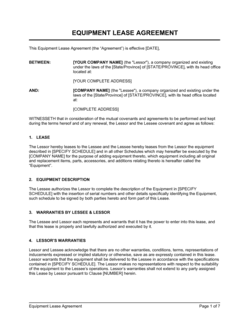
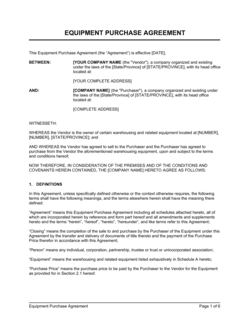
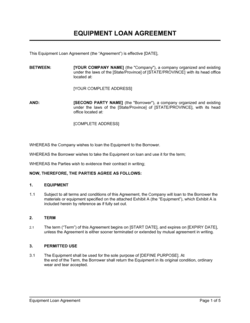
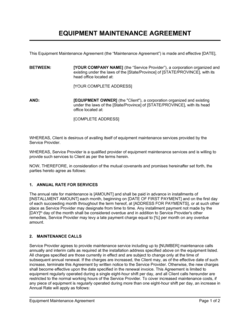
Personnel and Equipment Agreement Template

Free Word download β€’ Edit online β€’ Save & share with Drive β€’ Export to PDF

5 pagesβ€’25–35 min to fillβ€’Difficulty: Complexβ€’Signature requiredβ€’Legal review recommended
Learn more ↓
FreePersonnel and Equipment Agreement Template

At a glance

What it is
A Personnel and Equipment Agreement is a legally binding contract that governs the assignment of staff and the deployment of physical equipment to a project, client site, or third party. This free Word download covers personnel duties and conduct, equipment responsibilities, damage and loss liability, insurance requirements, and return or termination procedures β€” all in a single enforceable document you can edit online and export as PDF.
When you need it
Use it when your business provides staff, machinery, tools, or vehicles to a client or project site, or when you accept personnel and equipment from a vendor under a defined set of conditions. It is equally applicable when an employer formally assigns company-owned equipment to an employee for business use and needs written accountability.
What's inside
Definitions of personnel roles and equipment inventory, scope of permitted use, care and maintenance obligations, damage and loss allocation, insurance requirements, indemnification, confidentiality, term and termination conditions, and governing law. A schedule for itemizing specific equipment serial numbers and personnel assignments is included.

What is a Personnel and Equipment Agreement?

A Personnel and Equipment Agreement is a legally binding contract that simultaneously governs the assignment of workers and the deployment of physical assets β€” such as machinery, tools, vehicles, or devices β€” from one party to another. It establishes clear obligations for both sides: the providing party commits to delivering qualified personnel and functional equipment, while the receiving party accepts responsibility for proper use, care, and return. The agreement addresses the intersection of employment compliance and asset liability that arises whenever people and property move together under a commercial arrangement, closing the coverage gaps that neither a standalone staffing agreement nor a bare equipment rental agreement fully addresses.

Why You Need This Document

Operating without a signed personnel and equipment agreement exposes both parties to compounding legal and financial risk. When equipment is damaged or a worker is injured on a client site with no written allocation of liability, disputes default to litigation β€” with both parties claiming the other was responsible and no objective evidence to resolve it. Without a signed condition report at delivery, recovering the cost of damage from the receiving party is nearly impossible. Without clear employment-compliance language, a receiving party that exercises day-to-day control over assigned workers may be deemed a co-employer by tax authorities or labor tribunals, triggering back taxes, benefit obligations, and fines. For high-value equipment or specialized personnel, the cost of one unresolved incident can exceed the value of the entire engagement. This template gives both parties a documented framework β€” from the moment of handover to final return β€” that protects assets, clarifies responsibility, and keeps disputes out of court.

Which variant fits your situation?

If your situation is…Use this template
Assigning company laptops or phones to employees only, with no personnel deploymentEmployee Equipment Agreement
Providing staff to a client without any physical equipment componentStaffing Services Agreement
Renting equipment to a third party with no personnel includedEquipment Rental Agreement
Engaging a contractor who supplies their own staff and tools for a defined projectIndependent Contractor Agreement
Deploying staff and equipment under a broader master services frameworkMaster Services Agreement
Short-term loan of a single piece of equipment between companiesEquipment Loan Agreement
Construction subcontractor supplying both labor and materials to a general contractorSubcontractor Agreement

Common mistakes to avoid

❌ No equipment condition report at handover

Why it matters: Without a signed baseline condition report, any damage dispute at return becomes a credibility contest with no objective evidence β€” both parties face litigation costs and uncertain outcomes.

Fix: Complete and sign Schedule C (condition report) with photographs at the moment of physical handover, before the receiving party takes possession or the equipment leaves the provider's facility.

❌ Granting the recipient unlimited direction over assigned personnel

Why it matters: Unrestricted control over how assigned workers perform their duties is a primary indicator of an employment relationship in most jurisdictions, exposing the recipient to payroll tax withholding, workers' compensation, and employment benefits liability.

Fix: Limit the recipient's authority to task sequencing and site-level scheduling; expressly reserve employment terms, disciplinary authority, and safety compliance with the provider.

❌ Omitting additional-insured requirements from the insurance clause

Why it matters: If a third party sues one contracting party for an incident involving the other's personnel or equipment, the absence of additional-insured status means the other party's policy provides no defense β€” leaving a contractual indemnity obligation unfunded.

Fix: Require each party to name the other as an additional insured on its general liability and property policies, and confirm this by reviewing the certificates of insurance β€” not just the agreement language β€” before commencement.

❌ No cure period before termination for cause

Why it matters: Terminating immediately for a breach that the other party could have remedied β€” such as a missed maintenance report β€” leaves the terminating party vulnerable to a wrongful-termination counterclaim and loss of damages.

Fix: Include a written notice and cure period of at least 5–10 business days for non-safety breaches; reserve immediate termination only for willful misuse, abandonment, or safety violations that create imminent risk.

❌ Using a trade name instead of the registered legal entity name

Why it matters: If a dispute triggers indemnification or insurance claims, the contracting party's identity must match the insured entity and the corporate registry exactly β€” a mismatch can cause insurers to deny claims or make judgment enforcement impossible.

Fix: Verify both parties' registered legal names against their state or provincial corporate registry before executing, and ensure those names appear identically on the agreement and all insurance certificates.

❌ Specifying a governing law jurisdiction unconnected to where work occurs

Why it matters: Courts frequently apply the law of the jurisdiction where the work is performed on employment and safety matters, regardless of what the contract states β€” leaving the parties surprised by a legal framework they didn't plan for.

Fix: Choose the governing law of the jurisdiction where the personnel will primarily work and equipment will be deployed; if multi-jurisdictional, consider a master agreement with jurisdiction-specific addenda.

The 10 key clauses, explained

Parties, Recitals, and Definitions

In plain language: Identifies the providing party and the receiving party by full legal name, describes the commercial context for the arrangement, and defines every key term used throughout the agreement.

Sample language
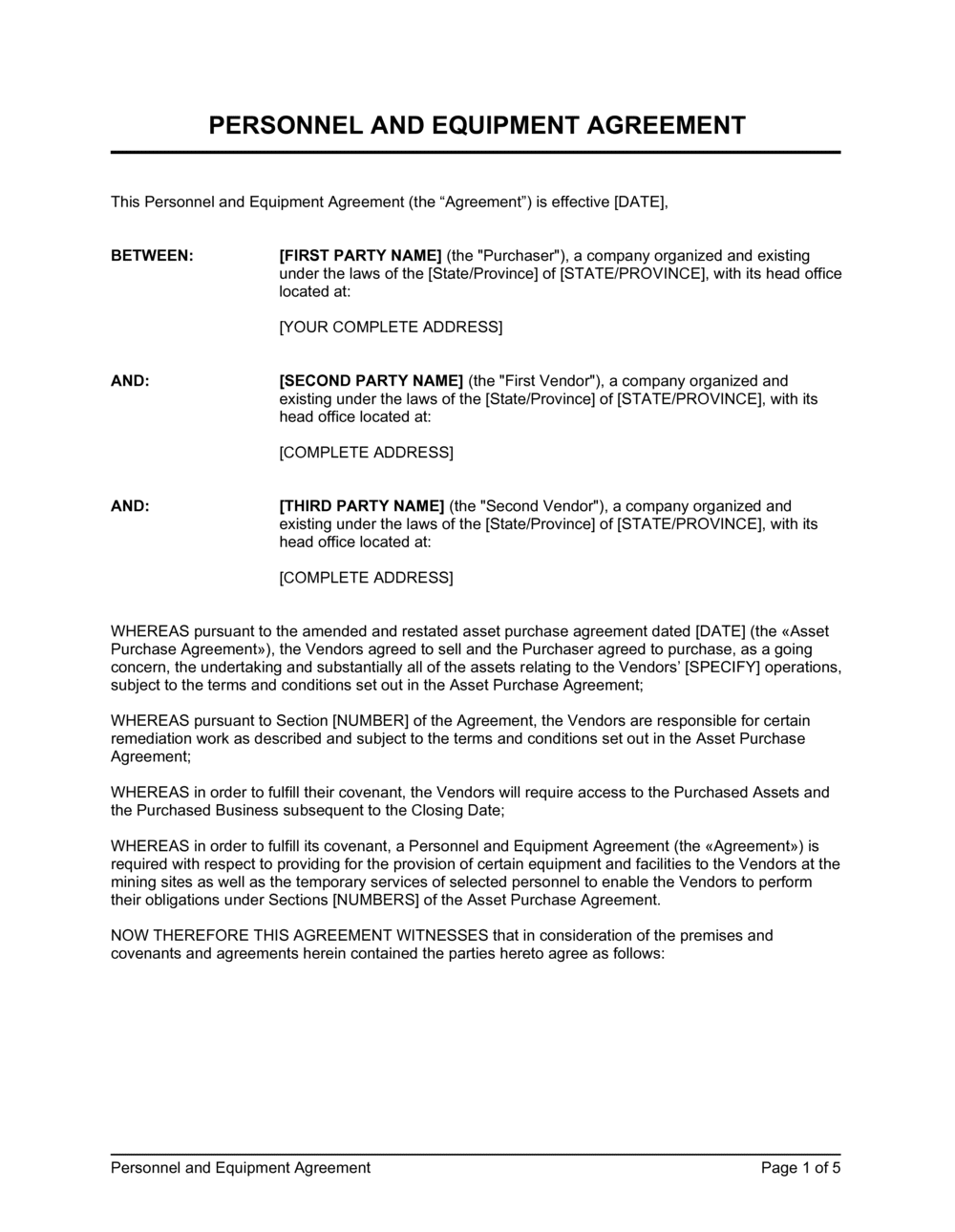
This Personnel and Equipment Agreement ('Agreement') is entered into as of [DATE] between [PROVIDER LEGAL NAME], a [STATE/PROVINCE] [ENTITY TYPE] ('Provider'), and [RECIPIENT LEGAL NAME], a [STATE/PROVINCE] [ENTITY TYPE] ('Recipient'). Provider is engaged in [BUSINESS DESCRIPTION] and Recipient wishes to engage Provider for [PURPOSE].

Common mistake: Using trade names instead of registered legal entity names. If a dispute arises, enforcing indemnification or insurance obligations against the wrong legal entity causes significant delay and may void coverage.

Scope of Personnel Assignment

In plain language: Specifies which personnel are assigned, their roles and responsibilities, reporting structure at the receiving site, and the limits of the receiving party's authority to direct their work.

Sample language
Provider shall assign the personnel listed in Schedule A ('Assigned Personnel') to perform the services described in Schedule B at [SITE ADDRESS] commencing [START DATE]. Recipient may direct Assigned Personnel on day-to-day task sequencing but may not modify their employment terms, compensation, or safety protocols.

Common mistake: Granting the receiving party unlimited direction over assigned personnel without carve-outs for safety and employment compliance. Courts in several jurisdictions treat unrestricted direction as evidence of an employment relationship, triggering payroll tax and workers' compensation liability for the receiving party.

Equipment Inventory and Condition at Delivery

In plain language: Lists the specific equipment covered, identifies each item by serial number or asset tag, and documents its condition at the time of handover to create a baseline for damage assessment at return.

Sample language
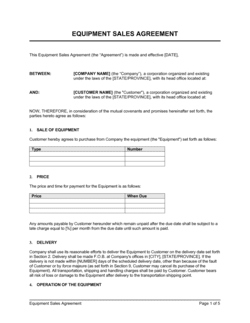
Provider shall deliver the equipment listed in Schedule C ('Equipment') to Recipient at [DELIVERY ADDRESS] on [DELIVERY DATE]. The parties shall jointly complete and sign an Equipment Condition Report at delivery. Schedule C shall include: item description, make/model, serial number, and condition rating (Excellent / Good / Fair).

Common mistake: No signed condition report at delivery. Without a documented baseline, disputes over pre-existing damage versus damage caused by the recipient are impossible to resolve objectively.

Permitted Use and Restrictions

In plain language: Defines the specific purposes, locations, and operating conditions for which the equipment may be used, and explicitly prohibits unauthorized modifications, subletting, or use by uncertified operators.

Sample language
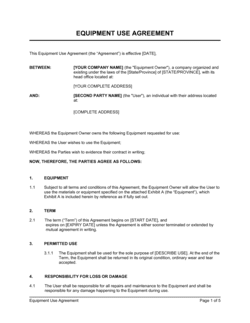
Recipient shall use the Equipment solely for [PERMITTED PURPOSE] at [SITE ADDRESS]. Recipient shall not: (a) remove the Equipment from the permitted site without prior written consent; (b) modify, alter, or repair the Equipment except as authorized; or (c) permit any person other than Assigned Personnel or [CERTIFIED OPERATOR CRITERIA] to operate the Equipment.

Common mistake: Omitting an explicit prohibition on subletting or re-deploying the equipment to a third party. Without this restriction, a recipient may transfer equipment to another site or operator β€” dramatically expanding the provider's liability exposure.

Care, Maintenance, and Reporting Obligations

In plain language: Requires the receiving party to operate equipment according to manufacturer guidelines, perform scheduled maintenance if agreed, and promptly report faults, damage, or safety incidents to the provider.

Sample language
Recipient shall operate the Equipment in accordance with the manufacturer's operating manual (attached as Schedule D) and shall promptly notify Provider in writing within [24 / 48] hours of any mechanical fault, damage, accident, or safety incident involving the Equipment or Assigned Personnel.

Common mistake: Placing full maintenance responsibility on the receiving party without specifying what 'maintenance' includes. Ambiguity leads to disputes over whether a major mechanical failure resulted from operator neglect or normal wear β€” leaving both parties underinsured.

Liability, Damage, and Loss Allocation

In plain language: Allocates financial responsibility for damage, theft, or loss of equipment and for personal injury claims arising from personnel activities, distinguishing between provider-side negligence and recipient-side misuse.

Sample language
Recipient shall be liable for all damage to or loss of Equipment caused by Recipient's negligence, misuse, or failure to comply with this Agreement, up to the replacement value stated in Schedule C. Provider shall retain liability for pre-existing defects and damage caused by Provider's own personnel acting outside Recipient's direction.

Common mistake: Making the recipient liable for all damage without a pre-existing defect carve-out. If equipment arrives with a hidden defect that causes a failure, holding the recipient fully liable is both inequitable and difficult to enforce.

Insurance Requirements

In plain language: Specifies the types and minimum limits of insurance each party must maintain β€” typically general liability, property or inland marine for equipment, and workers' compensation for personnel β€” and requires certificates of insurance before commencement.

Sample language
Provider shall maintain: (a) commercial general liability insurance with limits no less than $[AMOUNT] per occurrence; and (b) workers' compensation coverage as required by law for Assigned Personnel. Recipient shall maintain: (a) commercial general liability of no less than $[AMOUNT]; and (b) inland marine or property coverage for the Equipment at its full replacement value.

Common mistake: Requiring insurance without specifying that the other party must be named as an additional insured. Without additional-insured status, a third-party claim against the named insured does not automatically protect the other contracting party.

Indemnification

In plain language: Requires each party to defend and hold the other harmless from losses arising from its own acts or omissions β€” the provider indemnifies for personnel employment-related claims, the recipient for misuse or unauthorized operation of equipment.

Sample language
Provider shall indemnify and hold Recipient harmless from any claims arising from Provider's employment of Assigned Personnel, including wage, benefit, or workers' compensation claims. Recipient shall indemnify and hold Provider harmless from any claims arising from Recipient's misuse of Equipment or unauthorized modification of Assigned Personnel's duties.

Common mistake: Using a mutual blanket indemnity without carve-outs for each party's specific risk zone. Broad mutual indemnities are regularly narrowed by courts β€” a risk-specific, two-sided clause is both more enforceable and more clearly understood.

Term, Termination, and Equipment Return

In plain language: Sets the start and end dates of the agreement, the notice period for early termination by either party, immediate termination triggers for material breach, and the condition and timing requirements for returning equipment.

Sample language
This Agreement commences on [START DATE] and continues until [END DATE] unless earlier terminated. Either party may terminate with [X] days' written notice. Either party may terminate immediately upon written notice if the other party commits a material breach that remains uncured [X] business days after written notice. Upon termination, Recipient shall return all Equipment to Provider at [RETURN ADDRESS] within [X] business days in the condition documented at delivery, subject to normal wear and tear.

Common mistake: No cure period before immediate termination. Courts in most jurisdictions expect a reasonable opportunity to remedy a breach before termination β€” contracts without cure periods face challenges when the terminating party seeks damages.

Governing Law, Dispute Resolution, and Entire Agreement

In plain language: Specifies the jurisdiction whose law governs the contract, the mechanism for resolving disputes (arbitration, mediation, or litigation), and confirms the written agreement supersedes all prior discussions or oral promises.

Sample language
This Agreement is governed by the laws of [STATE / PROVINCE / COUNTRY]. Any dispute arising hereunder shall first be submitted to non-binding mediation; if unresolved within [30] days, disputes shall be resolved by binding arbitration under [AAA / JAMS] rules in [CITY]. This Agreement constitutes the entire agreement between the parties and supersedes all prior representations, negotiations, and understandings.

Common mistake: Choosing a governing law jurisdiction with no meaningful connection to where the personnel work or equipment is deployed. Courts often apply the law of the jurisdiction where work is performed regardless of the contractual choice, particularly on employment and safety matters.

How to fill it out

  1. 1

    Enter the full legal names and entity details of both parties

    Use each party's registered legal name β€” not a brand or trade name β€” along with entity type (LLC, corporation, partnership) and state or province of formation. Include primary contact names and addresses for each party.

    πŸ’‘ Cross-reference your corporate registry or articles of incorporation before completing this section β€” a name mismatch between the contract and insurance certificates is a common cause of coverage disputes.

  2. 2

    Complete Schedule A: personnel roster

    List each assigned individual by full name, job title or role, and any required certifications or licenses relevant to the equipment they will operate. Indicate the reporting relationship at the receiving site.

    πŸ’‘ Note any personnel substitution rights β€” whether the provider can swap a listed individual for another β€” and any advance-notice requirement for substitutions.

  3. 3

    Complete Schedule C: equipment inventory with serial numbers and condition ratings

    List every piece of equipment by description, make, model, serial number, and asset tag. Assign an agreed condition rating (Excellent / Good / Fair) and document the replacement value for each item to anchor the liability clause.

    πŸ’‘ Take timestamped photographs of each item at handover and attach them as an exhibit. This eliminates ambiguity about pre-existing damage at the time of return.

  4. 4

    Define permitted use, site restrictions, and operator qualifications

    Specify the exact purposes for which equipment may be used, the permitted site address, and the minimum operator qualifications. Explicitly list prohibited uses β€” subletting, off-site removal, unauthorized modification β€” in the restrictions clause.

    πŸ’‘ If equipment will be used on a public road or shared site, confirm that the permitted use language covers that location specifically. Vague site definitions create coverage gaps.

  5. 5

    Specify care, maintenance, and reporting timelines

    Decide which party is responsible for routine maintenance versus major mechanical servicing, and set the reporting window for faults and incidents β€” 24 hours is standard for safety incidents. Attach the manufacturer's operating manual as Schedule D.

    πŸ’‘ If the provider will perform all maintenance, include a response-time commitment β€” for example, 'Provider shall respond to fault reports within [4] business hours' β€” to avoid equipment downtime disputes.

  6. 6

    Set insurance minimums and require certificates before start date

    Fill in the minimum coverage amounts for general liability, workers' compensation, and inland marine or property insurance. Require both parties to deliver certificates of insurance β€” naming the other as additional insured β€” at least [5] business days before the agreement commences.

    πŸ’‘ Call your insurance broker before completing this section. The inland marine coverage limit should match the total replacement value of all equipment listed in Schedule C.

  7. 7

    Define the term dates, notice period, and equipment return logistics

    Enter the start date, end date (or 'until completion of [PROJECT NAME]'), and the number of days' written notice required for early termination. Specify the return address and the return deadline in business days after termination.

    πŸ’‘ For open-ended project agreements, add a milestone-based termination trigger β€” for example, 'Agreement terminates upon written acceptance of the final deliverable' β€” so the return clock starts at a defined point.

  8. 8

    Have both parties sign before any personnel or equipment is deployed

    Both authorized signatories must execute the agreement β€” and all schedules β€” before the first deployment date. Signatures on Schedule C (condition report) should be completed at the physical handover, not in advance.

    πŸ’‘ Use a timestamped e-signature platform to confirm execution occurred before deployment. Post-deployment signatures on equipment agreements create 'fresh consideration' risks that may void liability and indemnification clauses in common-law jurisdictions.

Frequently asked questions

What is a personnel and equipment agreement?

A personnel and equipment agreement is a legally binding contract that governs the simultaneous deployment of staff and physical assets β€” such as machinery, vehicles, or devices β€” from one party to another. It defines each party's responsibilities for the personnel's conduct and the equipment's care, allocates liability for damage or injury, sets insurance requirements, and establishes return and termination procedures. It is commonly used in construction, IT services, event production, and staffing industries where both labor and tools are provided as a bundled service.

When do I need a personnel and equipment agreement?

You need one any time your business provides both staff and physical assets to a client or third-party site under conditions where liability, insurance, and return obligations need to be clearly defined in writing. It is also appropriate when an employer formally assigns significant company equipment to an employee and requires signed acknowledgment of care and return obligations. Verbal or informal arrangements leave both parties exposed to disputes over damage costs, injury liability, and equipment recovery.

How does a personnel and equipment agreement differ from an equipment rental agreement?

An equipment rental agreement covers only the physical assets β€” it sets rental rates, use restrictions, maintenance duties, and return conditions for equipment alone. A personnel and equipment agreement layers in a workforce component, addressing employment compliance, personnel direction limits, workers' compensation coverage, and the interaction between staff conduct and equipment liability. When you provide an operator along with a machine, you need the combined document.

Who is liable if the equipment is damaged while in use?

Liability depends on what the agreement says and the circumstances of the damage. Typically, the receiving party is responsible for damage caused by misuse, unauthorized operation, or failure to follow maintenance and reporting obligations. The providing party generally retains liability for pre-existing defects or damage caused by its own personnel acting outside the recipient's direction. A signed condition report at delivery is the single most important document for resolving damage disputes.

Does this agreement make the receiving party the employer of the assigned personnel?

Not automatically β€” but the degree of control the receiving party exercises over assigned personnel determines whether an employment relationship is implied under applicable law. To avoid co-employment exposure, the agreement should limit the recipient's authority to day-to-day task direction and expressly reserve employment terms, discipline, compensation, and safety compliance with the providing party. In some jurisdictions, even carefully drafted agreements do not fully insulate the receiving party from statutory employment obligations for long-term placements.

What insurance coverage should both parties carry?

At minimum, the providing party should carry commercial general liability insurance and workers' compensation coverage for all assigned personnel. The receiving party should carry commercial general liability and inland marine or commercial property coverage for the equipment at its full replacement value. Both parties should be named as additional insureds on each other's general liability policies. Industry-specific risks β€” for example, professional liability for IT technicians or auto liability for deployed vehicles β€” may require additional endorsements.

Can the receiving party let a third party use the assigned personnel or equipment?

Only if the agreement expressly permits it. Most well-drafted personnel and equipment agreements prohibit the recipient from subletting, assigning, or redeploying the personnel or equipment to any third party without the provider's prior written consent. Unauthorized transfer dramatically expands the provider's liability exposure and voids most insurance coverage, so this restriction should be explicit and prominent in the permitted-use clause.

How long should the agreement term be?

The term should match the operational need β€” project-based agreements typically run from mobilization to final completion acceptance; ongoing service arrangements may use a rolling 12-month term with automatic renewal. For open-ended projects, tie termination to a defined milestone rather than a calendar date to avoid ambiguity about when equipment return obligations begin. Always include an early-termination notice period β€” 10 to 30 business days is typical β€” regardless of the primary term structure.

Is a personnel and equipment agreement enforceable without notarization?

Yes, in most jurisdictions. Notarization is not required for commercial contracts between businesses to be legally binding. What matters is that both parties have authorized signatories, the agreement is signed before deployment begins, and the contract includes the essential elements of a binding agreement β€” offer, acceptance, and consideration. Some industries and government contracts may require notarized signatures, so confirm with a local attorney if your specific context involves public procurement or regulated assets.

How this compares to alternatives

vs Equipment Rental Agreement

An equipment rental agreement covers the physical assets only β€” rental rates, use restrictions, and return conditions β€” with no personnel component. A personnel and equipment agreement adds workforce assignment, employment compliance, workers' compensation coverage, and the interaction between staff conduct and equipment liability. Use the rental agreement when you are leasing equipment alone; use the combined agreement when operators or technicians are included.

vs Independent Contractor Agreement

An independent contractor agreement engages a self-employed individual for defined deliverables β€” the contractor typically supplies their own tools. A personnel and equipment agreement governs the deployment of staff provided by one party to another, alongside provider-owned assets. The key distinction is control over equipment ownership and the employment status of the workers involved.

vs Staffing Services Agreement

A staffing services agreement governs the placement of temporary or contract workers without a physical equipment component. It addresses payroll, billing rates, and employment compliance but does not allocate liability for machinery, tools, or devices. Where your service delivery depends on both people and assets working together, the combined personnel and equipment agreement provides the necessary coverage.

vs Subcontractor Agreement

A subcontractor agreement engages a separate business entity to complete a defined scope of work β€” the subcontractor manages its own personnel and supplies its own equipment under its own direction. A personnel and equipment agreement involves the direct assignment of named individuals and specific assets from one party to another, with the recipient exercising some site-level direction. Use the subcontractor agreement when you are delegating an entire work package; use the personnel and equipment agreement when deploying specific people and assets under a shared operational arrangement.

Industry-specific considerations

Construction and Engineering

Equipment schedules cover heavy machinery with serial numbers and operator certifications; phased project terms with milestone-based termination triggers are standard.

IT and Technology Services

Device assignments require data security and return-of-data obligations; remote work deployments must address multi-jurisdiction employment compliance and equipment tracking.

Event Production and AV

Short-term agreements with tight delivery and return windows; full replacement-value liability for high-cost AV equipment is essential given rapid turnaround between events.

Manufacturing and Industrial Services

OSHA and workplace safety compliance obligations must be integrated into care and maintenance clauses; operator certification requirements for specialized equipment are often legally mandated.

Jurisdictional notes

United States

Employment law varies significantly by state β€” California, New York, and Illinois impose co-employment obligations on companies that exercise substantial control over another party's workers. OSHA regulations govern equipment safety obligations and may impose liability on the site-controlling party regardless of contract terms. Non-compete or exclusivity clauses attached to personnel assignments are subject to state-by-state enforceability rules.

Canada

Provincial employment standards legislation in each province sets minimum obligations for assigned workers that cannot be contracted away β€” including notice periods and overtime requirements. Ontario's Occupational Health and Safety Act imposes site-controller obligations on the party with primary charge of the workplace, which may be the recipient of the personnel. Quebec agreements should be prepared in French for provincially regulated employers, and Quebec civil law governs contract interpretation differently from common-law provinces.

United Kingdom

The Agency Workers Regulations 2010 grant temporary workers placed with a hirer equal treatment rights after 12 weeks on the same role. The receiving party (hirer) bears joint liability with the provider for compliance with these regulations. Health and Safety at Work Act 1974 duties apply to the site controller, typically the recipient, regardless of who employs the personnel. Equipment must comply with the Provision and Use of Work Equipment Regulations 1998.

European Union

The EU Temporary Agency Work Directive requires equal treatment for agency workers after an assignment threshold set by each member state. GDPR considerations arise when personnel records, operator certifications, or equipment usage data are shared between the parties. Machinery Directive 2006/42/EC imposes conformity and documentation requirements on equipment deployed in EU member states. Multi-country deployments require jurisdiction-specific addenda as employment and equipment safety laws vary materially across member states.

Template vs lawyer β€” what fits your deal?

PathBest forCostTime
Use the templateSmall businesses and project managers deploying standard staff and equipment to a single domestic site with straightforward liability termsFree30–60 minutes
Template + legal reviewMulti-site deployments, high-value equipment, staffing in regulated industries, or arrangements crossing state or provincial lines$400–$900 for a 1–2 hour attorney review2–5 business days
Custom draftedCross-border deployments, heavy-industry equipment with significant third-party liability, or arrangements with government or institutional clients requiring bespoke indemnification$2,000–$6,000+1–3 weeks

Glossary

Personnel
The individual employees, contractors, or workers assigned under the agreement to perform specified duties at a designated site or for a defined project.
Equipment
The physical assets β€” machinery, tools, vehicles, devices, or instruments β€” covered by the agreement, typically identified by make, model, and serial number in a schedule.
Permitted Use
The specific tasks, locations, and conditions under which the assigned personnel and equipment may be used, as expressly defined in the agreement.
Care and Maintenance Obligations
The receiving party's duty to keep equipment in good working order, follow manufacturer guidelines, and report faults promptly.
Liability Allocation
The contractual division of financial responsibility for damage, loss, injury, or third-party claims between the providing and receiving parties.
Indemnification
A clause requiring one party to compensate the other for losses, claims, or legal costs arising from specified events β€” such as negligent misuse of equipment.
Insurance Requirement
A contractual obligation for one or both parties to maintain specified types and minimum amounts of insurance coverage β€” typically general liability and property β€” throughout the agreement term.
Force Majeure
A clause excusing a party from performance obligations when events beyond reasonable control β€” such as natural disasters or government orders β€” make performance impossible.
Return Condition
The agreed physical state in which equipment must be returned at the end of the agreement, usually 'the same condition as received, subject to normal wear and tear.'
Termination for Cause
The right of either party to end the agreement immediately β€” without the standard notice period β€” when the other party commits a material breach such as unauthorized use of equipment or misuse of personnel.
Schedule / Exhibit
An attachment to the main agreement listing specific equipment inventory (with serial numbers) and named personnel, forming part of the binding contract.

Part of your Business Operating System

This document is one of 3,000+ business & legal templates included in Business in a Box.

  • Fill-in-the-blanks β€” ready in minutes
  • 100% customizable Word document
  • Compatible with all office suites
  • Export to PDF and share electronically

Create your document in 3 simple steps.

From template to signed document β€” all inside one Business Operating System.
1
Download or open template

Access over 3,000+ business and legal templates for any business task, project or initiative.

2
Edit and fill in the blanks with AI

Customize your ready-made business document template and save it in the cloud.

3
Save, Share, Send, Sign

Share your files and folders with your team. Create a space of seamless collaboration.

Save time, save money, and create top-quality documents.

β˜…β˜…β˜…β˜…β˜…

"Fantastic value! I'm not sure how I'd do without it. It's worth its weight in gold and paid back for itself many times."

Managing Director Β· Mall Farm
Robert Whalley
Managing Director, Mall Farm Proprietary Limited
β˜…β˜…β˜…β˜…β˜…

"I have been using Business in a Box for years. It has been the most useful source of templates I have encountered. I recommend it to anyone."

Business Owner Β· 4+ years
Dr Michael John Freestone
Business Owner
β˜…β˜…β˜…β˜…β˜…

"It has been a life saver so many times I have lost count. Business in a Box has saved me so much time and as you know, time is money."

Owner Β· Upstate Web
David G. Moore Jr.
Owner, Upstate Web

Run your business with a system β€” not scattered tools

Stop downloading documents. Start operating with clarity. Business in a Box gives you the Business Operating System used by over 250,000 companies worldwide to structure, run, and grow their business.

Start freeΒ Β·Β No credit card required