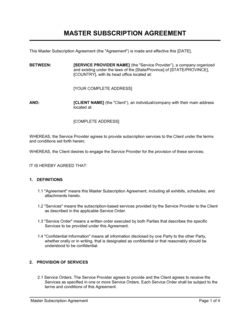
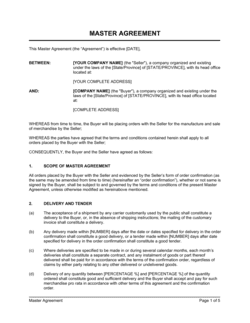
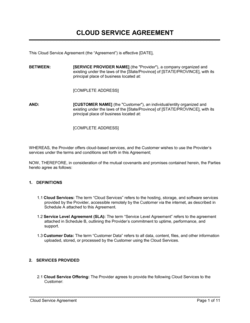
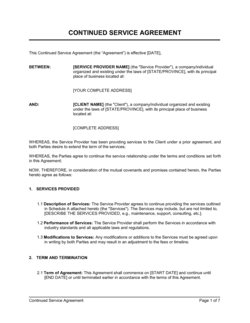
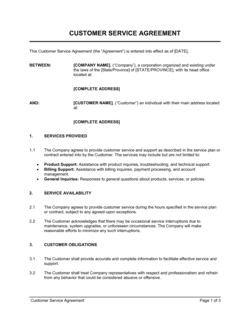
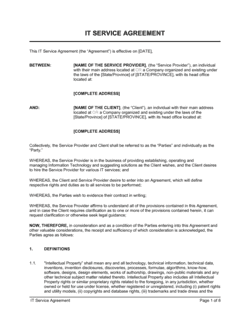
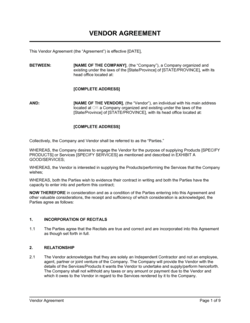
Master Service Agreement Template

Free Word download β€’ Edit online β€’ Save & share with Drive β€’ Export to PDF

7 pagesβ€’30–40 min to fillβ€’Difficulty: Complexβ€’Signature requiredβ€’Legal review recommended
Learn more ↓
FreeMaster Service Agreement Template

At a glance

What it is
A Master Service Agreement (MSA) is a binding legal contract that establishes the standard terms governing all future work between a service provider and a client. This free Word download lets you define payment terms, IP ownership, confidentiality, liability limits, and termination rights once β€” then issue lightweight Statements of Work for each new project without renegotiating the core terms every time.
When you need it
Use it before beginning any ongoing or multi-project engagement where the same client will commission multiple scopes of work over time. It is especially important when either party is taking on meaningful financial, IP, or operational risk.
What's inside
Scope and SOW mechanics, fees and payment terms, intellectual property assignment and licensing, confidentiality obligations, representations and warranties, limitation of liability and indemnification, term and termination, and governing law and dispute resolution.

What is a Master Service Agreement?

A Master Service Agreement (MSA) is a binding legal contract that establishes the standard terms governing all future services between a provider and a client β€” covering intellectual property ownership, payment obligations, confidentiality, liability limits, and termination rights in a single document. Rather than negotiating a new contract for each project, both parties sign the MSA once and then execute lightweight Statements of Work for each new engagement, referencing the MSA's framework rather than rebuilding it from scratch. This structure reduces legal overhead, accelerates project starts, and ensures both parties operate under agreed, consistent rules across the entire relationship.

Why You Need This Document

Operating without a Master Service Agreement exposes both the service provider and the client to compounding risk across every project they work on together. Without one, IP created in the first engagement may belong to the wrong party, late payments have no agreed remedy, and a client who walks mid-project faces no defined termination or wind-down obligations. When a dispute arises β€” over a deliverable, an invoice, or a departing employee β€” the absence of an MSA forces both sides to reconstruct intent from emails and proposals, which is expensive and rarely conclusive. For providers doing repeat business with the same client, an MSA also eliminates the 1-to-2 week legal review cycle that delays the start of every new SOW. This template gives you an enforceable framework you can execute in under an hour for standard engagements, and a credible starting point for negotiation with enterprise clients whose legal teams will redline any contract they receive.

Which variant fits your situation?

If your situation is…Use this template
One-time project with a single deliverable and fixed feeService Agreement
Ongoing software development with an agile delivery modelSoftware Development Agreement
Consulting engagement billed by the hour or day rateConsulting Agreement
Placing contractors or temporary staff with a clientStaffing Agency Agreement
Vendor providing goods and services under a long-term supply relationshipVendor Agreement
Marketing or creative agency retainer with monthly deliverablesMarketing Services Agreement
IT managed services or infrastructure support contractIT Services Agreement

Common mistakes to avoid

❌ Starting work before the MSA is signed

Why it matters: Work performed before execution may not be covered by the IP assignment, confidentiality, or liability clauses β€” leaving both parties exposed if a dispute arises from that early work.

Fix: Make signing the MSA a hard prerequisite to issuing the first SOW. Use an e-signature platform to remove friction and eliminate the 'we'll get to it later' delay.

❌ Assigning all IP to the client without background IP carve-outs

Why it matters: Without an explicit carve-out, the provider may inadvertently transfer ownership of reusable code, design templates, or proprietary methodologies they use across multiple client engagements.

Fix: List background IP categories in a Schedule A and include clear language stating that assignment covers only custom deliverables created specifically for the client under each SOW.

❌ One-sided limitation of liability clause

Why it matters: A cap that limits only the provider's liability β€” not the client's β€” can be challenged as unconscionable in several jurisdictions, potentially voiding the entire limitation clause.

Fix: Draft the liability cap as mutual, applying to both parties equally. Carve out fraud, gross negligence, and willful misconduct from the cap on both sides.

❌ No cure period before termination for cause

Why it matters: Allowing immediate termination for any breach β€” including minor or disputed ones β€” creates instability and may expose the terminating party to a wrongful termination counterclaim.

Fix: Include a 15-to-30-day written cure period for material breaches, reserving immediate termination only for insolvency, fraud, or repeated uncured breaches.

❌ Vague or absent payment suspension rights

Why it matters: Without an explicit right to suspend services on overdue invoices, the provider must choose between continuing unpaid work and breaching the contract themselves.

Fix: Add a clause permitting the provider to suspend all services after invoices are overdue by more than 15 days, with resumption conditioned on full payment of overdue amounts.

❌ No entire-agreement clause

Why it matters: Without one, prior emails, proposals, term sheets, and verbal representations can be introduced as contractual obligations that override the signed MSA.

Fix: Include a standard integration clause: 'This Agreement, together with all executed SOWs, constitutes the entire agreement of the parties and supersedes all prior negotiations, proposals, and representations.'

The 10 key clauses, explained

Parties, recitals, and definitions

In plain language: Identifies the legal names and addresses of both parties, describes the purpose of the agreement in plain terms, and defines capitalized terms used throughout.

Sample language
This Master Service Agreement ('Agreement') is entered into as of [EFFECTIVE DATE] by and between [SERVICE PROVIDER LEGAL NAME], a [STATE] [ENTITY TYPE] ('Provider'), and [CLIENT LEGAL NAME], a [STATE] [ENTITY TYPE] ('Client').

Common mistake: Using a trade name or DBA instead of the registered legal entity name. If the entity name on the contract doesn't match the signing party's corporate registration, enforcing the agreement or collecting a judgment becomes significantly harder.

Scope of services and Statements of Work

In plain language: Establishes that the specific work, deliverables, and fees for each engagement are governed by a signed SOW, and that each SOW is incorporated into and subject to the MSA.

Sample language
Provider shall perform the services described in each Statement of Work ('SOW') executed by both parties. Each SOW is incorporated herein by reference and governed by the terms of this Agreement. In the event of a conflict, the SOW controls for project-specific terms only.

Common mistake: Describing the scope in the MSA body rather than in SOWs. This forces a contract amendment every time the project scope changes, creating unnecessary overhead and version-control risk.

Fees, invoicing, and payment terms

In plain language: States how fees are calculated (fixed, hourly, milestone-based), when invoices are issued, the payment due date, accepted payment methods, and the consequences of late payment.

Sample language
Client shall pay Provider the fees set forth in each SOW. Invoices are due within [30] days of receipt. Amounts unpaid after the due date accrue interest at [1.5]% per month. Provider may suspend services on balances overdue by more than [15] days.

Common mistake: Omitting a late-payment interest rate and suspension right. Without them, the provider has no practical leverage to collect overdue invoices short of litigation.

Intellectual property ownership and licensing

In plain language: Defines who owns work product created under the agreement, whether background IP is licensed to the client for use, and any restrictions on how delivered materials may be used.

Sample language
Upon receipt of full payment, Provider assigns to Client all right, title, and interest in deliverables specifically created for Client under each SOW. Provider retains all rights in its pre-existing tools, methods, and background IP, and grants Client a non-exclusive, non-transferable license to use such background IP solely as incorporated into the deliverables.

Common mistake: Assigning all IP β€” including background IP and reusable tools β€” to the client without a carve-out. This prevents the provider from reusing their own frameworks, code libraries, or methodologies on future projects.

Confidentiality and non-disclosure

In plain language: Obligates both parties to protect the other's confidential information during and after the agreement, defines what qualifies as confidential, and lists standard exceptions such as publicly available information.

Sample language
Each party agrees to hold the other's Confidential Information in strict confidence, not to disclose it to third parties without prior written consent, and to use it solely for the purposes of this Agreement. This obligation survives termination for [3] years.

Common mistake: Setting the survival period to 'perpetuity' for all confidential information. Courts in many jurisdictions narrow indefinite confidentiality obligations; a defined 3-to-5-year period is more consistently enforceable and commercially realistic.

Representations and warranties

In plain language: Each party confirms that they have the authority to enter the contract, that their work will not infringe third-party rights, and that they will perform services in a professional and workmanlike manner.

Sample language
Provider warrants that: (a) it has full authority to enter this Agreement; (b) the deliverables will not infringe any third-party IP rights; and (c) services will be performed in a professional and workmanlike manner consistent with industry standards.

Common mistake: Accepting a client's broad warranty demand that deliverables will achieve specific business results. Warranties of outcome β€” rather than process and quality β€” expose the provider to open-ended liability for factors outside their control.

Limitation of liability

In plain language: Caps the maximum damages either party can recover from the other, typically at the fees paid in the prior 12 months, and excludes consequential, indirect, and punitive damages.

Sample language
In no event shall either party's total liability exceed the fees paid or payable by Client in the [12] months preceding the claim. Neither party shall be liable for any indirect, incidental, consequential, or punitive damages, even if advised of their possibility.

Common mistake: Drafting the liability cap to apply only to the provider's liability, not the client's. Courts may read an asymmetric cap as unconscionable, potentially voiding the whole clause. Make it mutual.

Indemnification

In plain language: Requires each party to defend and compensate the other for third-party claims arising from their own breach, negligence, or IP infringement β€” without extending indemnification to the indemnitee's own misconduct.

Sample language
Each party ('Indemnitor') shall defend, indemnify, and hold harmless the other party from any third-party claims, losses, or expenses arising from the Indemnitor's: (a) breach of this Agreement; (b) negligence or willful misconduct; or (c) infringement of any third-party intellectual property right.

Common mistake: Accepting an indemnification clause with no carve-out for the indemnitee's own fault. Without the carve-out, a provider can be forced to indemnify a client for losses the client's own actions caused.

Term, termination, and effect of termination

In plain language: Sets the initial term of the agreement, renewal mechanics, each party's right to terminate for cause or convenience, the notice period required, and what obligations survive termination.

Sample language
This Agreement commences on the Effective Date and continues for [1] year, renewing automatically for successive 1-year terms unless either party gives [30] days' written notice. Either party may terminate for material breach with [15] days' written notice if the breach is not cured within that period. Confidentiality, IP assignment, limitation of liability, and indemnification survive termination.

Common mistake: No automatic renewal provision or too-short a renewal notice period. If an auto-renewal triggers and neither party noticed, a client may be bound to another year of fees. Set notice periods of at least 30 days and confirm the client receives renewal reminders.

Governing law, dispute resolution, and miscellaneous

In plain language: Specifies the jurisdiction whose law governs, whether disputes go to court or arbitration, and standard boilerplate provisions β€” entire agreement, severability, amendment in writing, and no waiver.

Sample language
This Agreement is governed by the laws of [STATE/PROVINCE/COUNTRY]. Disputes shall be resolved by binding arbitration administered by [AAA/JAMS/ICDR] in [CITY], except that either party may seek injunctive relief in any court of competent jurisdiction. This Agreement constitutes the entire agreement of the parties and supersedes all prior negotiations and representations.

Common mistake: Choosing a governing law with no meaningful connection to either party's location. If a California-based client and a New York-based provider both operate there, choosing Delaware law adds confusion rather than certainty.

How to fill it out

  1. 1

    Enter the full legal names and addresses of both parties

    Use each party's registered legal entity name β€” corporation, LLC, or sole proprietor β€” and their principal business address. Avoid trade names, websites, or informal descriptions.

    πŸ’‘ Look up the exact legal name in your state's or country's corporate registry before filling in the parties block β€” a single word difference can create enforceability problems.

  2. 2

    Set the effective date and initial term

    Enter the date both parties will sign. Set a 1-year initial term with automatic annual renewal as a default. Adjust only if the engagement has a defined project horizon.

    πŸ’‘ For enterprise clients that require multi-year MSAs, negotiate a 2-year initial term with a mutual 60-day non-renewal notice period rather than a 30-day window.

  3. 3

    Define the SOW process and conflict resolution rule

    Confirm that each project will be governed by a signed SOW and add a clear rule stating that in any conflict between the MSA and an SOW, the SOW controls for project-specific matters only.

    πŸ’‘ Keep a numbered SOW log (SOW-001, SOW-002) so you can reference specific project terms in invoices, dispute correspondence, or litigation without ambiguity.

  4. 4

    Complete the fees, invoicing, and late-payment terms

    Set the invoice cycle (on delivery, monthly, or milestone-based), the payment due date (Net 15 or Net 30 is typical), the late-interest rate, and the service-suspension trigger.

    πŸ’‘ A 1.5% per month late fee (18% annualized) is the most commonly accepted commercial rate in North America β€” high enough to incentivize prompt payment without appearing punitive.

  5. 5

    Negotiate and confirm IP ownership and background IP carve-outs

    Decide whether deliverables are assigned to the client upon full payment or licensed. Explicitly carve out the provider's pre-existing tools, templates, and methodologies so they are not inadvertently transferred.

    πŸ’‘ Attach a Schedule A listing the provider's background IP by category β€” e.g., 'proprietary code libraries,' 'design system components' β€” to remove any ambiguity at dispute time.

  6. 6

    Set the liability cap and mutual indemnification

    Enter the liability cap amount β€” typically the fees paid in the prior 12 months. Confirm the limitation and indemnification clauses are mutual, not one-sided, and that both carve out fraud and willful misconduct.

    πŸ’‘ If the engagement involves sensitive data or regulated industries, consider adding a separate, higher sub-cap for data breach claims β€” standard caps are often too low to cover regulatory fines.

  7. 7

    Choose governing law and dispute resolution method

    Select the jurisdiction most relevant to where the provider operates and performs services. Choose arbitration for confidential, faster resolution; litigation for matters where you may need emergency injunctive relief quickly.

    πŸ’‘ JAMS and AAA arbitration can cost $5,000–$15,000 in filing fees alone. For smaller MSAs (under $100K in annual fees), include a small claims carve-out for disputes under $15,000.

  8. 8

    Execute before any work begins and retain executed copies

    Both parties must sign before the first SOW is issued or any work starts. File the fully executed MSA alongside each SOW in a central contract repository.

    πŸ’‘ Use Business in a Box eSign to timestamp execution and link the signed MSA to every subsequent SOW in BIB Drive β€” this makes retrieval immediate if a dispute arises.

Frequently asked questions

What is a Master Service Agreement?

A Master Service Agreement (MSA) is a contract that establishes the standard legal terms governing all future work between a service provider and a client. Instead of negotiating terms from scratch for every project, the parties sign an MSA once and then issue lightweight Statements of Work for each engagement. This structure reduces negotiation time, creates consistency, and ensures both parties operate under agreed rules from the first day of each new project.

What is the difference between an MSA and a Statement of Work?

An MSA contains the legal framework β€” IP ownership, confidentiality, liability limits, payment terms, and termination rights. A Statement of Work (SOW) is a project-specific document that references the MSA and specifies the deliverables, timeline, and fees for a single engagement. The MSA stays constant across all projects; the SOW changes with each scope. In a conflict, the SOW generally controls for project-specific terms, while the MSA governs all other legal matters.

When do I need an MSA instead of a standard service agreement?

Use an MSA when you anticipate ongoing work with the same client across multiple projects or phases. A single-project service agreement is sufficient for a one-time, well-defined engagement. The MSA structure pays off when the upfront negotiation cost of establishing standard terms is less than the cost of re-negotiating those terms on every new SOW β€” typically after the second or third project together.

Who owns the work created under an MSA?

Ownership depends entirely on how the IP clause is drafted. Typically, custom deliverables created specifically for the client are assigned to the client upon full payment. The provider retains ownership of their pre-existing tools, code libraries, and methodologies β€” called background IP β€” and grants the client a license to use them as incorporated into the deliverables. Without an explicit IP clause, default ownership rules under applicable law apply, and those defaults vary significantly by jurisdiction and work type.

What should a liability cap in an MSA be set at?

The most common commercial standard is to cap total liability at the fees paid or payable in the 12 months preceding the claim. For short engagements or low-fee projects, a minimum floor (e.g., $50,000) is sometimes negotiated. Enterprise clients often push for a higher cap β€” particularly for data-handling engagements β€” while providers push for lower caps and broader exclusions. The cap should be mutual and should carve out fraud, willful misconduct, and indemnification obligations related to IP infringement.

Is a Master Service Agreement enforceable without a Statement of Work?

An MSA standing alone without any SOW is generally enforceable as a contract, but it creates no obligation to perform or pay for specific work. It is a framework β€” the SOW activates the obligation. Courts in most jurisdictions will enforce the MSA's confidentiality, IP, and limitation-of-liability clauses regardless of whether an SOW has been executed, as long as both parties signed the MSA and there is evidence of a working relationship.

Does an MSA need to be notarized?

No. A Master Service Agreement does not require notarization to be legally binding in most jurisdictions. Signatures from authorized representatives of each party β€” electronic or wet-ink β€” are sufficient. Notarization is typically required only for real property transactions, powers of attorney, and certain government filings. An e-signature with a timestamped audit trail provides stronger evidence of execution than an unwitnessed wet signature.

Can either party terminate an MSA at any time?

Termination rights depend on what the contract says. Most MSAs include a termination-for-convenience clause allowing either party to end the agreement with 30 to 90 days' written notice, and a termination-for-cause clause allowing earlier exit after a material breach goes uncured. Ongoing SOWs at the time of termination may survive through their scheduled completion date or be wound down on an agreed schedule, depending on the contract language.

Do I need a lawyer to draft or review an MSA?

For straightforward domestic engagements under $100K annually, a well-structured template is typically sufficient. Legal review is strongly recommended when the engagement involves sensitive data or regulated industries, when the client or provider is based outside your home jurisdiction, when the fees at stake exceed $250K per year, or when the client's in-house legal team has heavily redlined the template. A 1-to-2-hour review typically costs $400–$800 and is worthwhile for any long-term, high-value engagement.

How this compares to alternatives

vs Service Agreement

A service agreement governs a single, defined engagement with one scope, one fee, and one deliverable set. An MSA is a framework contract designed to cover multiple engagements over time, with individual scopes handled by SOWs. If you are doing a one-time project, a service agreement is simpler and sufficient. If the same client will commission three or more projects, an MSA saves negotiation time on every subsequent engagement.

vs Consulting Agreement

A consulting agreement is typically used for advisory or knowledge-based engagements billed at a day or hourly rate. An MSA is a broader framework that covers any type of services β€” consulting, implementation, creative, or technical β€” and pairs with SOWs. For a single consulting mandate, a standalone consulting agreement is appropriate. For an ongoing advisory relationship with multiple mandates, an MSA is the better structure.

vs Independent Contractor Agreement

An independent contractor agreement governs the relationship between a business and an individual contractor β€” emphasizing worker classification, tax treatment, and behavioral control. An MSA governs the relationship between two business entities providing and receiving services. Using a contractor agreement with an incorporated vendor entity creates misclassification risk and leaves critical IP and liability terms unaddressed.

vs Non-Disclosure Agreement

An NDA protects confidential information exchanged during conversations, evaluations, or early negotiations β€” before any work begins. An MSA includes confidentiality provisions as one clause among many, making a standalone NDA redundant once the MSA is signed. Use an NDA during the pre-contract phase; transition to the MSA's confidentiality clause once the engagement is formalized.

Industry-specific considerations

Technology / SaaS

MSAs for SaaS companies often include data processing addenda, uptime SLA references, and source code escrow provisions not typically found in general services agreements.

Marketing and creative agencies

Agency MSAs must clearly address ownership of campaign assets, usage rights for licensed stock media, and how third-party ad spend pass-throughs are handled and invoiced.

Professional services

Consulting and advisory MSAs typically include independence representations, conflict-of-interest disclosures, and stronger non-solicit provisions covering both employees and clients.

Construction and engineering

Construction MSAs reference project-specific subcontract terms, lien waiver requirements, insurance certificate obligations, and safety compliance standards in each SOW.

Healthcare and life sciences

Healthcare MSAs require HIPAA Business Associate Agreement addenda, data security standards, breach notification timelines, and often FDA or GxP compliance representations.

Financial services

Financial services MSAs include enhanced data security obligations, regulatory audit-right clauses, and indemnification carve-outs specific to regulatory penalties and examination findings.

Jurisdictional notes

United States

MSA enforceability is governed by state contract law, which varies meaningfully β€” California, New York, and Delaware are the most common choices for governing law. California's strong worker-protection statutes affect how provider obligations are interpreted, and California courts will often apply local law regardless of a contrary governing-law clause. The Uniform Commercial Code does not apply to pure services contracts, but courts in some states apply UCC gap-filling principles by analogy. Non-solicitation and non-compete clauses in MSA addenda are unenforceable in California for individuals.

Canada

Canadian MSAs are governed by provincial contract law, with Ontario and British Columbia being the most common governing law choices for commercial agreements. Quebec-based counterparties are subject to the Civil Code of Quebec rather than common law, and contracts affecting Quebec operations should ideally be available in French under the Charter of the French Language. Limitation of liability clauses are generally enforceable but must not exclude liability for gross negligence or intentional misconduct. PIPEDA and provincial privacy laws impose data-handling obligations that should be addressed in a data processing schedule attached to the MSA.

United Kingdom

UK MSAs are subject to the Unfair Contract Terms Act 1977 and the Consumer Rights Act 2015, which restrict the ability to exclude or limit liability for negligence and breach of implied terms β€” particularly in B2C contexts. In B2B MSAs, limitation of liability and indemnification clauses must satisfy a reasonableness test. IP created by an employee during the course of employment vests in the employer by default under the Copyright, Designs and Patents Act 1988; for contractors, assignment must be explicit. Post-Brexit, data transfers from the UK to non-adequate countries require a UK International Data Transfer Agreement.

European Union

EU MSAs involving personal data must incorporate GDPR-compliant data processing agreements (Article 28 of the GDPR) β€” a standalone schedule or addendum is strongly recommended. Standard Contractual Clauses (SCCs) are required for data transfers from the EU to third countries without an adequacy decision. Limitation of liability clauses are generally enforceable between businesses but cannot exclude liability for death, personal injury, or fraud under any member state's mandatory rules. IP ownership rules for commissioned works vary by member state β€” in France and Germany, moral rights cannot be waived by contract, which may affect deliverable usage rights.

Template vs lawyer β€” what fits your deal?

PathBest forCostTime
Use the templateDomestic service engagements under $100K annually with straightforward deliverables and no sensitive data handlingFree30–60 minutes
Template + legal reviewEngagements above $100K, cross-border arrangements, data-sensitive industries, or clients whose legal teams redline contracts$400–$8002–5 business days
Custom draftedEnterprise clients with complex IP portfolios, regulated-industry requirements, multi-jurisdiction operations, or material indemnification exposure$2,000–$6,000+2–4 weeks

Glossary

Master Service Agreement (MSA)
A contract that sets the standard legal terms for all future work between two parties, with individual projects governed by separate Statements of Work.
Statement of Work (SOW)
A project-specific document attached to an MSA that defines the scope, deliverables, timeline, and fees for a single engagement.
Work for Hire
A legal doctrine under which creative or technical work produced by a contractor is owned by the commissioning party from the moment of creation.
Limitation of Liability
A clause that caps the maximum financial exposure of one or both parties β€” typically set at the total fees paid under the agreement in the prior 12 months.
Indemnification
An obligation by one party to compensate the other for specific losses, claims, or costs β€” such as third-party IP infringement claims arising from delivered work.
Confidential Information
Non-public data, trade secrets, pricing, technology, or business information shared between the parties that must not be disclosed to third parties.
Force Majeure
A clause excusing a party from performance obligations when a specified event outside their control β€” such as a natural disaster or government action β€” makes performance impossible.
Representations and Warranties
Factual statements each party makes at signing β€” such as having the authority to enter the contract and the right to license any materials they provide.
Termination for Convenience
A right allowing either party to end the agreement without cause by giving a specified notice period β€” typically 30 to 90 days.
Termination for Cause
The right to end the agreement immediately, or after a short cure period, when the other party materially breaches a contractual obligation.
Governing Law
The jurisdiction whose laws apply to interpret and enforce the contract, regardless of where either party is located.
Cure Period
A defined window β€” typically 15 to 30 days β€” given to a breaching party to fix the problem before the other party may terminate the agreement.

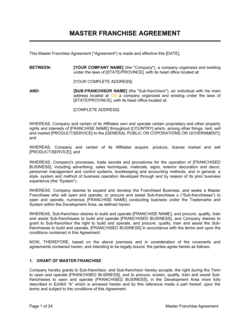
Part of your Business Operating System

This document is one of 3,000+ business & legal templates included in Business in a Box.

  • Fill-in-the-blanks β€” ready in minutes
  • 100% customizable Word document
  • Compatible with all office suites
  • Export to PDF and share electronically

Create your document in 3 simple steps.

From template to signed document β€” all inside one Business Operating System.
1
Download or open template

Access over 3,000+ business and legal templates for any business task, project or initiative.

2
Edit and fill in the blanks with AI

Customize your ready-made business document template and save it in the cloud.

3
Save, Share, Send, Sign

Share your files and folders with your team. Create a space of seamless collaboration.

Save time, save money, and create top-quality documents.

β˜…β˜…β˜…β˜…β˜…

"Fantastic value! I'm not sure how I'd do without it. It's worth its weight in gold and paid back for itself many times."

Managing Director Β· Mall Farm
Robert Whalley
Managing Director, Mall Farm Proprietary Limited
β˜…β˜…β˜…β˜…β˜…

"I have been using Business in a Box for years. It has been the most useful source of templates I have encountered. I recommend it to anyone."

Business Owner Β· 4+ years
Dr Michael John Freestone
Business Owner
β˜…β˜…β˜…β˜…β˜…

"It has been a life saver so many times I have lost count. Business in a Box has saved me so much time and as you know, time is money."

Owner Β· Upstate Web
David G. Moore Jr.
Owner, Upstate Web

Run your business with a system β€” not scattered tools

Stop downloading documents. Start operating with clarity. Business in a Box gives you the Business Operating System used by over 250,000 companies worldwide to structure, run, and grow their business.

Start freeΒ Β·Β No credit card required