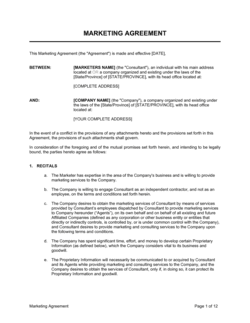
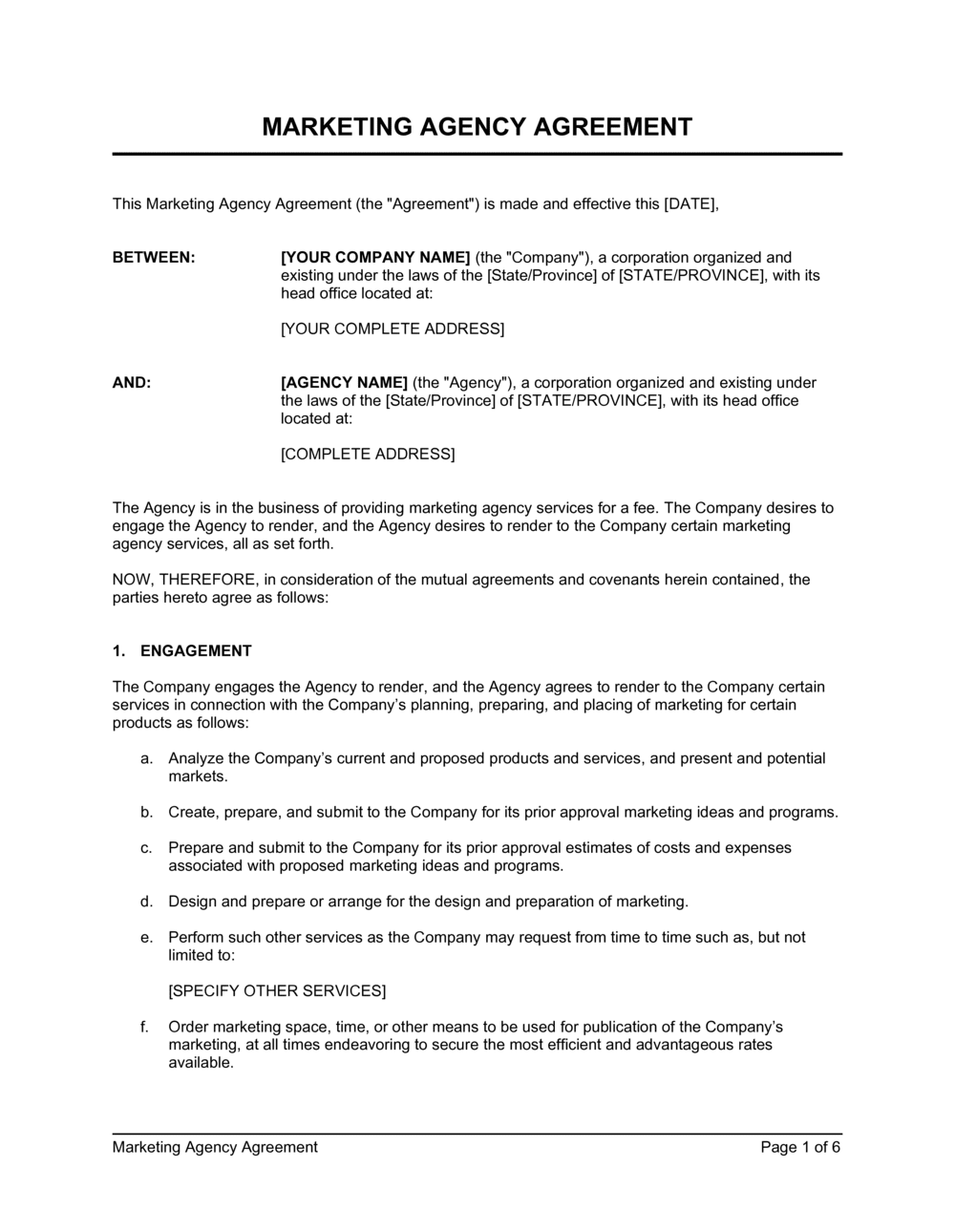
Marketing Agency Agreement Template

Free Word download • Edit online • Save & share with Drive • Export to PDF

6 pages25–35 min to fillDifficulty: ComplexSignature requiredLegal review recommended
Learn more ↓
FreeMarketing Agency Agreement Template

At a glance

What it is
A Marketing Agency Agreement is a legally binding contract between a business (the client) and a marketing agency that defines the scope of services, compensation structure, intellectual property ownership, confidentiality obligations, and termination conditions. This free Word download gives you a professionally structured starting point you can edit online and export as PDF to execute with any agency or marketing services provider.
When you need it
Use it before a marketing agency begins any paid work — whether you are engaging an agency on a project basis, a monthly retainer, or a performance-based arrangement. It is equally important when you are the agency onboarding a new client.
What's inside
Scope of services and deliverables, fee structure and payment terms, IP assignment and usage rights, confidentiality and non-disclosure obligations, representations and warranties, termination and notice provisions, and governing law.

What is a Marketing Agency Agreement?

A Marketing Agency Agreement is a legally binding contract between a client business and a marketing agency that governs the full scope of their working relationship. It defines which services the agency will deliver, how and when the client will pay, who owns the creative output and campaign assets produced, what information both parties must keep confidential, and under what conditions either party can exit the arrangement. Unlike a casual email exchange or a simple proposal acceptance, a properly executed marketing agency agreement creates enforceable obligations on both sides — giving the client a documented standard for performance and giving the agency a legal basis to collect fees and protect its proprietary methods.

Why You Need This Document

Without a signed marketing agency agreement in place before work begins, both parties operate on assumption rather than obligation. Clients assume all creative output belongs to them the moment it is delivered — in most jurisdictions, it does not: copyright vests in the creator unless explicitly transferred in writing. Agencies assume their payment terms are understood — without a signed contract, collecting on overdue invoices requires litigation rather than a demand letter citing a clear breach. If the agency manages paid media, an undocumented engagement leaves the client exposed to uncapped ad spend and the agency exposed to claims that it misused budget authorization. Regulatory risk compounds the problem: agencies handling consumer email lists or website data without a written data processing agreement can expose both parties to GDPR or CCPA penalties. This template closes all of these gaps in a single document, ready to execute before the first brief is shared.

Which variant fits your situation?

If your situation is…Use this template
Ongoing monthly relationship with a fixed retainer feeMarketing Retainer Agreement
One-time campaign or project with a defined end dateMarketing Services Agreement (Project-Based)
Engaging an individual freelance marketer rather than an agencyIndependent Contractor Agreement
Agency also creating branded content, software, or creative assetsCreative Services Agreement
Performance-based compensation tied to leads or revenueMarketing Affiliate Agreement
Agency placing paid media on behalf of client with ad spend authorizationAdvertising Agency Agreement
Engaging a PR firm for media relations and brand communicationsPublic Relations Agreement

Common mistakes to avoid

❌ Vague scope with no deliverable specifications

Why it matters: An open-ended scope like 'digital marketing support' gives the client grounds to demand unlimited work and the agency no defense against scope-creep claims.

Fix: Attach a Schedule A that lists each service, the format of each deliverable, the number of revision rounds included, and the monthly or per-project output target.

❌ No IP ownership clause or a mutual misunderstanding of who owns what

Why it matters: Without explicit language, copyright defaults to the creator — the agency — in most jurisdictions. The client may invest months in campaigns it legally cannot use after the relationship ends.

Fix: Include a work-for-hire clause for all client-specific deliverables, clearly paired with a carve-out protecting the agency's pre-existing tools and third-party licensed assets.

❌ No ad spend cap or pre-approval requirement

Why it matters: An agency authorized to 'manage paid media' without a spending cap can commit the client to tens of thousands of dollars in ad spend without additional approval.

Fix: Set a monthly ad spend ceiling in the agreement and require written client approval for any spend above a defined threshold — $500 per campaign or 110% of the monthly budget are common benchmarks.

❌ Omitting a kill fee or work-in-progress clause on early termination

Why it matters: If a client terminates for convenience mid-project, the agency may have completed 70% of the work with no contractual right to compensation beyond the last invoice.

Fix: Include a kill fee of 25–50% of the remaining project fee for termination-for-convenience before project completion, or specify that the agency invoices for work completed to date at its standard hourly rate.

❌ No data protection or data processing addendum for consumer data

Why it matters: Agencies handling customer email lists, CRM data, or website analytics on the client's behalf are data processors under GDPR, CCPA, and PIPEDA. Operating without a data processing agreement exposes both parties to regulatory fines.

Fix: Attach a data processing addendum or reference a separate DPA that specifies data handling obligations, subprocessor disclosures, breach notification timelines, and deletion obligations on termination.

❌ Signing after the agency has already started work

Why it matters: In several jurisdictions, a contract signed after work has begun lacks fresh consideration for certain restrictive clauses — particularly IP assignment and non-solicitation — making them potentially unenforceable.

Fix: Execute the agreement before issuing any brief, sharing confidential strategy documents, or beginning any billable work. If execution is delayed, provide a documented additional benefit — a bonus or reduced rate — as fresh consideration.

The 10 key clauses, explained

Parties and engagement structure

In plain language: Identifies the client and agency as legal entities, states the nature of the relationship (agency as independent contractor, not employee), and sets the effective date.

Sample language
This Marketing Agency Agreement is entered into as of [DATE] between [CLIENT LEGAL NAME], a [STATE/PROVINCE] [ENTITY TYPE] ('Client'), and [AGENCY LEGAL NAME], a [STATE/PROVINCE] [ENTITY TYPE] ('Agency'). Agency is engaged as an independent contractor and is not an employee, partner, or joint venturer of Client.

Common mistake: Using the agency's trade name instead of its registered legal entity name. If the agency is a corporation or LLC, its legal name must appear — mismatches create enforceability gaps and complicate dispute resolution.

Scope of services and deliverables

In plain language: Defines precisely which marketing services the agency will provide, what deliverables it will produce, and references any attached Statements of Work that govern specific campaigns or projects.

Sample language
Agency shall provide the marketing services described in Schedule A and any mutually executed Statements of Work ('SOWs'). Services not listed in Schedule A or an executed SOW are outside the scope of this Agreement and subject to separate negotiation.

Common mistake: Keeping the scope vague with phrases like 'digital marketing services.' Without specifics, clients expect unlimited revisions and agencies face endless scope creep — both leading to disputes.

Fees, payment terms, and expenses

In plain language: States the retainer or project fee, invoicing frequency, payment due date, late-payment interest, and which out-of-pocket expenses (ad spend, stock imagery, software) the client must reimburse.

Sample language
Client shall pay Agency a monthly retainer of $[AMOUNT], invoiced on the 1st of each month and due within [15] days of receipt. Late payments accrue interest at [1.5]% per month. Pre-approved expenses are billed at cost with supporting receipts.

Common mistake: Omitting a reimbursable-expense policy. Agencies routinely incur costs for stock photography, third-party tools, and ad spend; without a written cap or approval process, disputes over who owes what are nearly inevitable.

Intellectual property ownership and assignment

In plain language: Determines whether creative output — copy, designs, campaigns, code — is owned by the client (work-for-hire) or licensed to the client, and specifies any pre-existing agency IP that remains the agency's property.

Sample language
All work product created by Agency specifically for Client under this Agreement shall be deemed work made for hire and the exclusive property of Client upon full payment of fees. Agency retains ownership of its pre-existing tools, methodologies, and proprietary templates ('Agency IP'), and grants Client a non-exclusive license to use Agency IP embedded in deliverables solely for Client's internal business purposes.

Common mistake: Failing to carve out the agency's pre-existing IP — templates, proprietary systems, and licensed stock assets. Without this carve-out, the client may believe it owns tools the agency uses across multiple clients, which it cannot legally transfer.

Confidentiality and non-disclosure

In plain language: Requires both parties to protect each other's confidential information — including the client's marketing strategies, customer data, and the agency's proprietary methodologies — during and after the engagement.

Sample language
Each party agrees to keep the other's Confidential Information strictly confidential and not to disclose it to any third party without prior written consent. 'Confidential Information' includes, without limitation, [CLIENT NAME]'s customer lists, campaign performance data, and product roadmaps, and Agency's pricing, processes, and proprietary tools.

Common mistake: Applying confidentiality only to the client's information and not the agency's. Agencies share proprietary methodologies and pricing that competitors could exploit — mutual confidentiality protects both sides.

Representations and warranties

In plain language: Each party warrants that it has authority to enter the agreement, that deliverables will not infringe third-party IP rights, and that all claims made in advertising will be substantiated.

Sample language
Agency represents and warrants that: (a) it has full authority to enter this Agreement; (b) deliverables will be original or properly licensed and will not infringe any third-party intellectual property rights; and (c) all advertising claims will be accurate and compliant with applicable advertising laws and regulations as of the delivery date.

Common mistake: No warranty on advertising claim accuracy. If the agency creates copy with unsubstantiated claims and a regulator or competitor challenges them, the contract must clarify which party bears responsibility.

Indemnification and limitation of liability

In plain language: Allocates responsibility for third-party claims — typically the agency indemnifies the client for IP infringement in deliverables, while the client indemnifies the agency for content directions it mandated — and caps total liability.

Sample language
Agency shall indemnify Client against claims arising from Agency's breach of its IP warranties. Client shall indemnify Agency against claims arising from Client-provided content or Client's direction to include specific claims. Each party's total liability under this Agreement shall not exceed the total fees paid in the [12] months preceding the claim.

Common mistake: No liability cap at all. Without one, a disputed campaign could expose the agency to unlimited damages — damages wildly disproportionate to the fees earned.

Term, termination, and notice

In plain language: Sets the initial term of the agreement, conditions for renewal, the notice period required to terminate without cause, and grounds for immediate termination for cause.

Sample language
This Agreement commences on [START DATE] and continues for an initial term of [12] months, renewing automatically for successive [12]-month periods unless either party provides [30] days' written notice of non-renewal. Either party may terminate for cause upon [10] days' written notice if the other party materially breaches and fails to cure within the notice period.

Common mistake: No auto-renewal clause paired with no notice-of-non-renewal requirement. Clients often assume a contract ends on its anniversary date while the agency treats it as renewed — leading to billing disputes for services the client believed had ended.

Non-solicitation

In plain language: Prevents the client from directly hiring the agency's employees or contractors who worked on the engagement, for a defined period after the agreement ends.

Sample language
During the term and for [12] months following termination, Client agrees not to solicit, recruit, or employ any employee or contractor of Agency who was involved in providing services under this Agreement, without Agency's prior written consent.

Common mistake: Omitting a non-solicitation clause entirely. Agencies invest in training staff who develop deep knowledge of a client's business — losing them directly to that client is a material harm with no remedy if the contract is silent.

Governing law and dispute resolution

In plain language: Specifies which jurisdiction's law governs the agreement and the mechanism for resolving disputes — arbitration, mediation, or litigation — and the venue.

Sample language
This Agreement is governed by the laws of [STATE / PROVINCE / COUNTRY], without regard to conflict-of-law principles. Any dispute that cannot be resolved by good-faith negotiation shall be submitted to binding arbitration administered by [AAA / JAMS / applicable body] in [CITY], except that either party may seek injunctive relief in any court of competent jurisdiction.

Common mistake: Choosing a governing law with no connection to where either party operates. Several jurisdictions — California and Quebec, for example — apply local law regardless of a contrary choice-of-law clause, particularly for service contracts.

How to fill it out

  1. 1

    Identify both parties with their legal entity names

    Enter the full registered legal name, entity type (LLC, Inc., Ltd.), and principal address for both the client and the agency. Do not use trade names or DBAs as the contracting party.

    💡 Verify each party's entity name against its state or provincial corporate registry before signing — name mismatches can void specific clauses.

  2. 2

    Define the scope of services in Schedule A

    List every service the agency will perform — SEO, paid media, social content, email campaigns, analytics reporting — with measurable outputs where possible. Attach a separate Statement of Work for each distinct project or campaign phase.

    💡 A good scope statement answers: what will be delivered, in what format, by when, and how many revision rounds are included.

  3. 3

    Set the fee structure and payment schedule

    Enter the retainer amount or project fee, the invoicing cycle (monthly is standard), the payment due date (Net 15 or Net 30), the late-fee rate, and a clear policy on expense reimbursement with a pre-approval threshold.

    💡 Include a clause requiring the client to maintain a credit card on file or pay a deposit equal to the first month's retainer before work begins — this eliminates non-payment risk from the first invoice.

  4. 4

    Negotiate and document IP ownership

    Decide whether deliverables are work-for-hire (client owns all output upon payment) or licensed (agency retains copyright, client gets a usage license). Explicitly carve out the agency's pre-existing tools and proprietary systems.

    💡 If the agency uses licensed stock photography or third-party fonts, specify that the client's usage rights are limited to the license terms of those assets — the agency cannot transfer rights it does not own.

  5. 5

    Tailor the confidentiality provisions

    Define 'Confidential Information' specifically for this engagement — client customer data, campaign performance benchmarks, pricing, and agency proprietary methodologies. Set the confidentiality period to survive termination by at least 2–3 years.

    💡 If the agency handles personal data of the client's customers, add a data processing addendum or reference your Privacy Policy obligations to comply with GDPR, CCPA, or PIPEDA.

  6. 6

    Set termination notice periods and cure windows

    Choose a termination-for-convenience notice period (30 days is standard for monthly retainers; 60 days for longer engagements) and a cure period for material breaches (10–14 days is typical). State what happens to work in progress and prepaid fees upon early termination.

    💡 Include a 'kill fee' clause — if the client terminates for convenience before a project deliverable is complete, the agency retains a percentage of the remaining project fee to cover work already invested.

  7. 7

    Confirm governing law and dispute resolution mechanism

    Select the jurisdiction whose law will govern the agreement — ideally the state or province where the agency is incorporated or where services are primarily performed. Choose arbitration for faster, lower-cost resolution or litigation if court precedent matters.

    💡 For cross-border engagements, specify the currency of payment, the dispute resolution seat, and the language of the proceedings explicitly — courts will not fill these gaps favorably.

  8. 8

    Execute before work begins and store the signed copy

    Both parties must sign the agreement before any deliverables are produced or fees are charged. Use electronic signature to timestamp execution and store the countersigned copy in a centralized document system accessible to both parties.

    💡 Send the agreement for signature at the same time as the first invoice or SOW — this removes the common friction point of 'we'll sort out the paperwork later.'

Frequently asked questions

What is a marketing agency agreement?

A marketing agency agreement is a legally binding contract between a business and a marketing agency that governs their working relationship. It defines the scope of services, compensation structure, intellectual property ownership, confidentiality obligations, and termination conditions. It protects both parties — the client has a clear record of what the agency is obligated to deliver, and the agency has enforceable payment and IP terms.

What should a marketing agency agreement include?

At minimum: the legal names of both parties, a detailed scope of services and deliverables (in a Schedule A or SOW), fee structure and payment terms, IP ownership and assignment, confidentiality obligations, representations and warranties, indemnification and liability limits, termination notice periods, a non-solicitation clause, and governing law. Missing any of these creates gaps that courts or arbitrators fill with jurisdiction-specific defaults, which rarely favor the drafting party.

Who owns the creative work produced by a marketing agency?

By default in most jurisdictions, copyright vests in the creator — the agency. The client owns the deliverables only if the agreement contains an explicit work-for-hire clause or an IP assignment provision. Without it, the client typically receives a license to use the work rather than outright ownership. This distinction matters critically if the client switches agencies and wants to hand off existing assets to a new provider.

What is the difference between a marketing agency agreement and a statement of work?

The marketing agency agreement is the master contract that governs the entire relationship — IP, confidentiality, liability, termination, and payment mechanics. A statement of work (SOW) is an attachment that describes a specific project or campaign phase: deliverables, timelines, fees, and KPIs. The master agreement applies to every SOW; a new SOW does not require renegotiating the master agreement terms. Both documents together form the complete contractual framework.

How much notice is standard for terminating a marketing agency agreement?

Thirty days written notice is the most common standard for monthly retainer arrangements. Sixty to ninety days is typical for longer-term engagements or where the agency manages significant ongoing campaigns that require transition time. Project-based agreements usually terminate on delivery and acceptance of the final deliverable. The notice period should be long enough to allow an orderly handover of assets, access credentials, and campaign data.

Does a marketing agency agreement need to be reviewed by a lawyer?

For routine retainer arrangements under $50,000 per year between domestic parties, a high-quality template is typically sufficient. Legal review is worth the investment when the engagement involves significant ad spend authorization, complex IP — such as software, proprietary data, or branded content — cross-border parties, or performance-based compensation with clawback provisions. A one-hour review typically costs $200–$500 and is worthwhile whenever the annual contract value exceeds $50,000.

What happens to work in progress if the agreement is terminated early?

The contract should specify this explicitly. Common approaches are: the agency invoices for work completed to date at its standard hourly rate; the client pays a kill fee equal to 25–50% of the remaining project fee; or the client forfeits the deposit. Without a written provision, both parties have claims that are difficult to resolve without litigation. Always include a work-in-progress clause before signing.

Can the client use a marketing agency agreement to hire freelancers directly?

A marketing agency agreement is structured for an agency entity delivering a bundle of services. For a solo freelance marketer, an independent contractor agreement is more appropriate — it covers the same core terms but is calibrated to individual service providers. If the client uses a marketing agency agreement with a freelancer, courts in some jurisdictions may treat the engagement as employment rather than a contractor relationship, triggering payroll tax and benefit obligations.

How does GDPR affect a marketing agency agreement in Europe?

Under the GDPR, when a marketing agency processes personal data on behalf of the client — managing email lists, running retargeting campaigns, or accessing CRM data — the agency is a data processor and the client is a data controller. The GDPR requires a written data processing agreement (DPA) between them, specifying the nature of processing, data categories, subprocessors, security measures, and breach notification timelines. Operating without a DPA exposes both parties to regulatory fines of up to 4% of global annual turnover.

How this compares to alternatives

vs Independent Contractor Agreement

An independent contractor agreement governs a single freelancer providing a defined service, with simpler IP and payment structures. A marketing agency agreement covers an agency entity delivering a bundle of services — often involving multiple staff, subcontractors, and third-party platforms — requiring more detailed scope, ad spend, and subcontractor provisions. Using a contractor agreement with an agency leaves critical gaps around SOW management, expense reimbursement, and liability allocation.

vs Non-Disclosure Agreement

An NDA protects confidential information exchanged during early discussions before a formal engagement is agreed. A marketing agency agreement contains confidentiality provisions as one of many clauses and governs the full working relationship. Once both parties have agreed to proceed and signed the marketing agreement, a standalone NDA is typically superseded by the confidentiality section of the agency agreement.

vs Service Agreement

A general service agreement is a broad template for any service provider relationship. A marketing agency agreement is purpose-built for marketing engagements — it addresses advertising claim warranties, ad spend authorization, KPI-based performance review, and creative IP assignment in ways a generic service agreement does not. For any agency engagement involving media buying, content creation, or campaign management, the specialized template provides substantially better protection.

vs Consulting Agreement

A consulting agreement is designed for advisory relationships where the consultant provides expertise and recommendations but typically does not produce creative deliverables or manage third-party platforms. A marketing agency agreement is appropriate when the agency executes campaigns, owns media relationships, produces creative assets, or manages ad spend — all of which require specific IP, liability, and authorization clauses a consulting agreement does not address.

Industry-specific considerations

E-commerce and retail

Ad spend authorization clauses are critical — agencies managing paid search and social campaigns can commit significant budgets without per-campaign approvals unless the contract sets explicit monthly caps.

SaaS and technology

IP assignment for content assets, product landing pages, and SEO-optimized copy requires careful carve-outs distinguishing client-owned deliverables from the agency's reusable frameworks and templates.

Professional services

Non-solicitation clauses carry extra weight — client-facing marketing staff develop relationships that represent direct competitive risk if they are hired away mid-engagement.

Healthcare and life sciences

Advertising claim warranties and regulatory compliance representations are essential — marketing for healthcare providers and pharmaceutical products is subject to FTC, FDA, and TGA guidelines that the agency must warrant compliance with.

Financial services

All advertising must comply with FINRA, FCA, or equivalent regulatory standards — the agreement should require the agency to obtain client approval for all client-facing materials before publication.

Consumer brands and FMCG

Influencer and co-marketing campaigns require explicit provisions on endorsement disclosures, exclusivity windows, and usage rights for user-generated content the agency commissions on the client's behalf.

Jurisdictional notes

United States

Work-for-hire doctrine under the US Copyright Act requires explicit written agreement — verbal or implied arrangements do not transfer ownership. Non-solicitation enforceability varies by state; California severely restricts post-engagement employee non-solicitation clauses. FTC guidelines require the agency to warrant that all advertising claims are truthful and substantiated. For engagements involving consumer data, confirm whether California's CCPA or state privacy laws impose data processing obligations.

Canada

Canadian copyright law similarly requires an explicit written assignment for work-for-hire ownership to vest in the client. Quebec's Consumer Protection Act imposes specific requirements on advertising directed at consumers, and contracts with Quebec-based parties must be available in French under the Charter of the French Language. PIPEDA (federally) and provincial equivalents govern the handling of personal data — a data processing schedule is required if the agency accesses customer data.

United Kingdom

Under the Copyright, Designs and Patents Act 1988, copyright in commissioned works does not automatically transfer to the client — an explicit assignment clause is required. The UK GDPR (post-Brexit) mirrors the EU GDPR's data processor obligations, requiring a written DPA for any agency accessing personal data. The Advertising Standards Authority (ASA) and CAP Code govern advertising content standards; the agency's compliance warranty should reference these specifically.

European Union

GDPR Article 28 mandates a written data processing agreement whenever an agency processes personal data on a client's behalf — this is not optional and must specify processing purposes, subprocessors, security standards, and breach notification timelines. Moral rights of creators are strongly protected in France, Germany, and other civil law member states, meaning even an IP assignment clause may not prevent the creator from objecting to distortions of their work. National advertising laws vary significantly — confirm local requirements before the agency publishes campaigns in individual EU markets.

Template vs lawyer — what fits your deal?

PathBest forCostTime
Use the templateStandard retainer or project engagements between domestic parties with a clearly defined scope and fees under $50,000 per yearFree30–45 minutes
Template + legal reviewCross-border engagements, contracts involving significant ad spend authorization, complex IP, or personal data processing subject to GDPR or CCPA$300–$7002–4 days
Custom draftedHigh-value agency relationships exceeding $100,000 per year, regulated industries (healthcare, financial services), or multi-jurisdiction engagements with performance-based compensation and clawback provisions$1,500–$4,000+1–3 weeks

Glossary

Scope of Services
The specific marketing tasks, deliverables, and activities the agency is contracted to perform, which defines what is — and is not — included in the engagement.
Retainer Fee
A fixed monthly fee paid to the agency regardless of hours worked, securing their availability and a defined set of ongoing services.
Work for Hire
A legal doctrine under which creative output produced by the agency becomes the property of the client, not the agency, provided the agreement explicitly states this.
White-Label Services
Services the agency delivers under the client's brand without disclosing the agency's involvement, often requiring a specific confidentiality clause.
Performance Metrics (KPIs)
Agreed measurable benchmarks — such as cost per lead, ROAS, or monthly organic traffic — used to evaluate whether the agency is meeting its obligations.
Ad Spend Authorization
A clause specifying the maximum amount the agency may commit on the client's behalf for paid media, without seeking additional approval.
Indemnification
A contractual obligation for one party to compensate the other for losses arising from a specified act — for example, the agency indemnifying the client for copyright infringement in creative assets.
Limitation of Liability
A clause capping the maximum financial exposure of one or both parties under the agreement, typically expressed as a multiple of fees paid.
Non-Solicitation Clause
A restriction preventing the client from directly hiring the agency's employees or contractors for a defined period after the agreement ends.
Termination for Convenience
A right allowing either party to end the agreement without cause by giving a specified notice period, typically 30 to 60 days.
Moral Rights
Statutory rights of creators in many jurisdictions to be credited for their work and to object to its distortion — distinct from copyright and not automatically waived by a work-for-hire clause.
SOW (Statement of Work)
A detailed attachment to the main agreement describing the specific deliverables, timelines, and fees for a particular project or campaign phase.

Part of your Business Operating System

This document is one of 3,000+ business & legal templates included in Business in a Box.

  • Fill-in-the-blanks — ready in minutes
  • 100% customizable Word document
  • Compatible with all office suites
  • Export to PDF and share electronically

Create your document in 3 simple steps.

From template to signed document — all inside one Business Operating System.
1
Download or open template

Access over 3,000+ business and legal templates for any business task, project or initiative.

2
Edit and fill in the blanks with AI

Customize your ready-made business document template and save it in the cloud.

3
Save, Share, Send, Sign

Share your files and folders with your team. Create a space of seamless collaboration.

Save time, save money, and create top-quality documents.

★★★★★

"Fantastic value! I'm not sure how I'd do without it. It's worth its weight in gold and paid back for itself many times."

Managing Director · Mall Farm
Robert Whalley
Managing Director, Mall Farm Proprietary Limited
★★★★★

"I have been using Business in a Box for years. It has been the most useful source of templates I have encountered. I recommend it to anyone."

Business Owner · 4+ years
Dr Michael John Freestone
Business Owner
★★★★★

"It has been a life saver so many times I have lost count. Business in a Box has saved me so much time and as you know, time is money."

Owner · Upstate Web
David G. Moore Jr.
Owner, Upstate Web

Run your business with a system — not scattered tools

Stop downloading documents. Start operating with clarity. Business in a Box gives you the Business Operating System used by over 250,000 companies worldwide to structure, run, and grow their business.

Start free · No credit card required