Social Media Management Contract Template

Free Word download β€’ Edit online β€’ Save & share with Drive β€’ Export to PDF

5 pagesβ€’25–35 min to fillβ€’Difficulty: Complexβ€’Signature requiredβ€’Legal review recommended
Learn more ↓
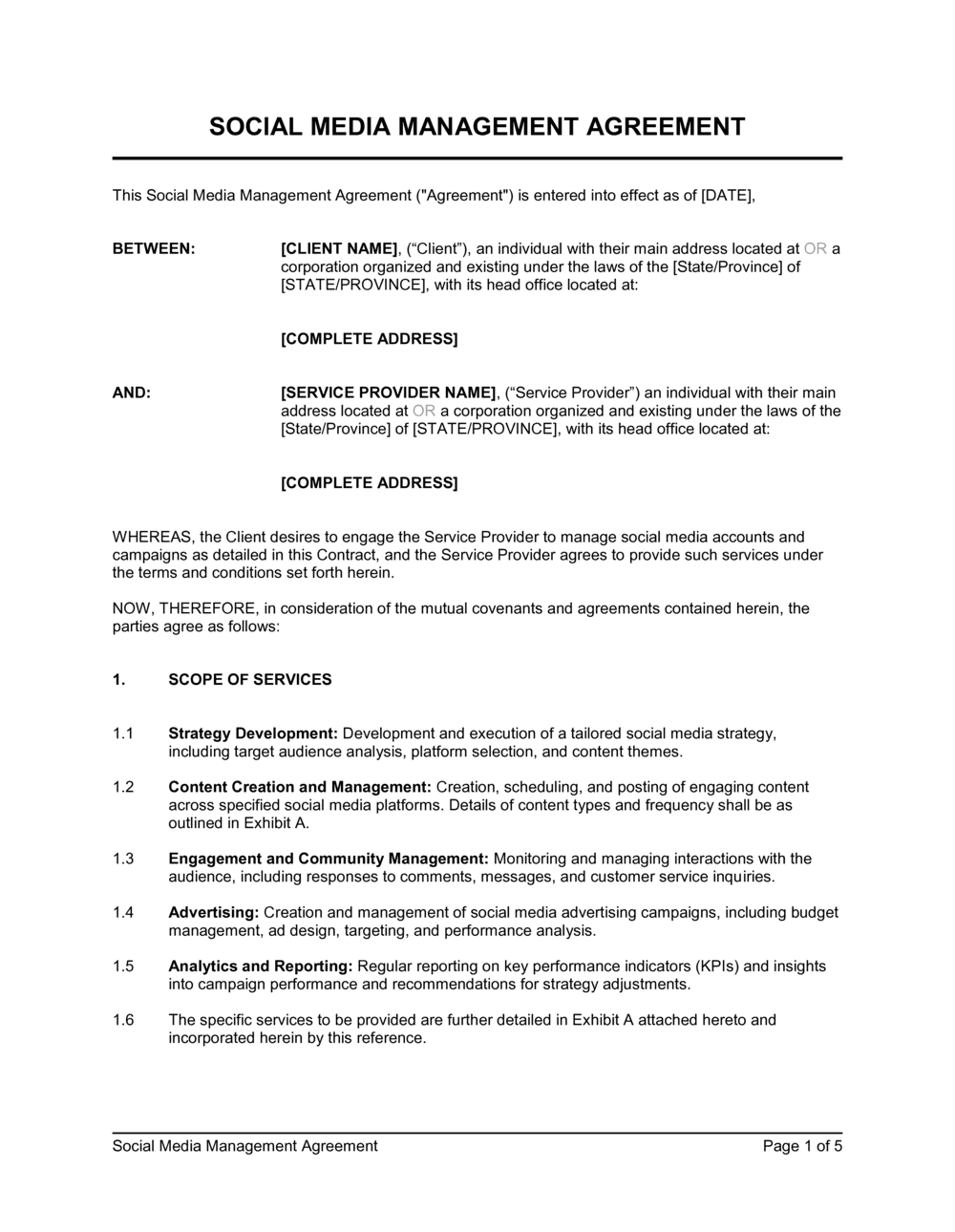
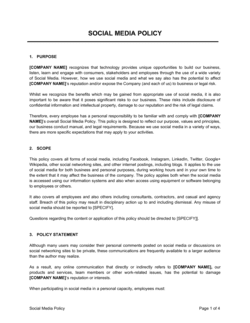
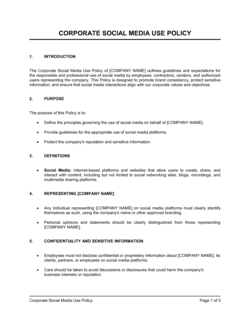
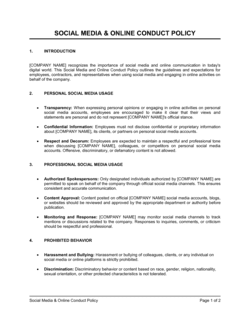
FreeSocial Media Management Contract Template

At a glance

What it is
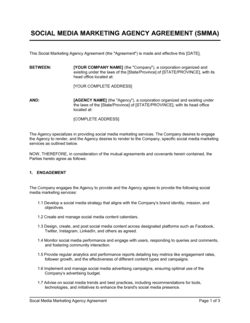
A Social Media Management Contract is a legally binding agreement between a business or individual client and a social media manager or agency that defines the scope of services, fees, content ownership, approval workflows, and termination rights. This free Word download lets you edit every clause online and export as PDF β€” ready for signature before any content goes live on your client's channels.
When you need it
Use it before taking over a client's social media accounts, launching a paid campaign, or beginning any recurring content creation engagement. It protects both parties from disputes over deliverables, ownership of content, and payment if the relationship ends unexpectedly.
What's inside
Scope of services and deliverables, monthly fees and payment terms, content approval process, intellectual property assignment, confidentiality obligations, account access and credentials handling, performance disclaimers, and termination and offboarding procedures.

What is a Social Media Management Contract?

A Social Media Management Contract is a legally binding agreement between a client and a social media manager or agency that governs every material dimension of the working relationship: the platforms and services in scope, posting cadence, monthly fees, content approval process, intellectual property ownership, account credential handling, confidentiality obligations, and the steps required to exit the engagement cleanly. Unlike a casual email exchange or a vague proposal, a properly drafted contract creates enforceable obligations on both sides and eliminates the ambiguity that leads to the most common disputes in social media engagements β€” scope creep, unpaid invoices, contested content ownership, and locked-out accounts after termination.

Why You Need This Document

Without a written social media management contract, both parties are exposed from the first post. A manager who posts content without a signed agreement has no enforceable right to their retainer if the client disputes the invoice mid-month. A client who hands over account credentials without credential-security and return clauses may find a former manager still logged into their accounts weeks after the relationship ends. Content created without an IP assignment clause may legally belong to the manager β€” not the client β€” even after it has been published to the client's feed. And without a performance disclaimer, a client who expected 10,000 new followers in 90 days has a much stronger basis to demand a refund. This template closes all four gaps before any content goes live, giving managers a professional foundation for client relationships and giving clients the account control and content ownership they expect from day one.

Which variant fits your situation?

If your situation is…Use this template
Ongoing monthly retainer for full account managementSocial Media Management Contract (Retainer)
One-time campaign or product launch onlySocial Media Marketing Services Agreement
Engaging a freelance content creator rather than a managerIndependent Contractor Agreement
Agency subcontracting social tasks to a white-label providerSubcontractor Agreement
Managing influencer partnership and sponsored postsInfluencer Marketing Agreement
Consulting on strategy only, no hands-on managementSocial Media Consulting Agreement
Client needs a separate NDA before sharing brand assets and loginsNon-Disclosure Agreement

Common mistakes to avoid

❌ No scope definition beyond platform names

Why it matters: Without a defined posting cadence and content type list, clients expect daily posts and managers deliver three per week β€” the gap creates disputes that end retainers early and damage relationships.

Fix: List every platform, post type, weekly frequency, and task explicitly in a Schedule A. State that anything not listed requires a written change order and additional fee.

❌ Omitting the performance disclaimer

Why it matters: Clients who expect guaranteed follower growth or sales lift and do not receive them invoke the absence of a disclaimer to demand refunds or pursue claims for misrepresentation.

Fix: Add a clear disclaimer stating that results depend on platform algorithms, ad budget, content quality, and market conditions β€” all outside the manager's control β€” and that no specific metric is guaranteed.

❌ Sharing credentials by email with no revocation clause

Why it matters: When the relationship ends, a manager with no contractual obligation to return credentials may retain access indefinitely, exposing the client to unauthorized content, data extraction, or account misuse.

Fix: Require credential sharing through a named secure method and add a clause requiring return or deletion within three to five business days of termination, with a written confirmation.

❌ No content approval timeline or silent-approval clause

Why it matters: A client who takes ten days to approve a post scheduled for Tuesday disrupts the entire content calendar, and without a clause, the manager has no authority to publish β€” or any protection if they do.

Fix: Set a defined review window of two to three business days and include a silent-approval clause authorizing publication if the client does not respond within that window.

❌ Lumping ad spend into the management retainer

Why it matters: When campaigns are paused, scaled, or shifted mid-month, neither party can determine what the manager earned versus what was passed through to the platform β€” triggering billing disputes.

Fix: Separate ad spend as a distinct pass-through line item billed at cost plus a stated handling fee percentage, invoiced on actual spend rather than a fixed monthly estimate.

❌ No offboarding obligations at termination

Why it matters: A manager who departs without transferring scheduled content, analytics data, and credentials leaves the client unable to maintain their accounts β€” gaps of days or weeks in posting can significantly harm organic reach.

Fix: List specific offboarding deliverables β€” credentials, content calendar, analytics export, brand asset files β€” and set a firm handover deadline of three to five business days after the effective termination date.

The 10 key clauses, explained

Parties and engagement date

In plain language: Identifies the client and the social media manager or agency as legal entities and records the date the agreement takes effect.

Sample language
This Social Media Management Contract is entered into as of [DATE] between [CLIENT LEGAL NAME], a [STATE/ENTITY TYPE] ('Client'), and [MANAGER/AGENCY LEGAL NAME], a [STATE/ENTITY TYPE] ('Manager').

Common mistake: Using a trading name or Instagram handle instead of the manager's registered legal entity name β€” this makes enforcement against the correct party difficult if a dispute arises.

Scope of services and deliverables

In plain language: Lists the exact platforms managed, the posting cadence per platform, content types (reels, static posts, stories, ads), community management tasks, and any reporting obligations.

Sample language
Manager shall provide the following services for Client's accounts on [PLATFORMS]: [X] feed posts per week, [Y] stories per day, monthly analytics report, and community management response within [Z] business hours. Services on platforms not listed require a signed Change Order.

Common mistake: Listing only platforms without specifying posting frequency or content types β€” clients and managers then disagree on what 'managing the account' actually means, leading to scope creep or under-delivery disputes.

Fees, payment terms, and ad spend

In plain language: States the monthly retainer or project fee, the invoicing date, payment due date, late-payment interest, and how ad spend budget is handled and billed separately.

Sample language
Client shall pay Manager a monthly retainer of $[AMOUNT], invoiced on the 1st of each month and due within [15] days. Ad spend is billed separately at cost plus [X]% handling fee. Late payments accrue interest at [1.5]% per month on balances overdue by more than [10] days.

Common mistake: Lumping ad spend into the management fee β€” when campaigns scale or are paused, both parties lose clarity on what the manager earned versus what was passed through to the platform.

Content approval and posting authorization

In plain language: Defines the review window the client has to approve content before it goes live, what happens if approval is not received within that window, and who has final publishing authority.

Sample language
Manager shall submit content for approval at least [3] business days before the scheduled publish date. If Client does not respond within [2] business days, Manager may publish as submitted. Client may request one round of revisions per piece of content within the approval window.

Common mistake: No defined approval window or escalation path β€” clients who go silent for days then object to posted content create disputes that a clear timeline prevents entirely.

Intellectual property and content ownership

In plain language: Assigns ownership of all content created under the contract to the client upon full payment, while allowing the manager to use the work in their portfolio unless the client opts out.

Sample language
Upon receipt of full payment, Manager assigns to Client all right, title, and interest in original content created under this Agreement. Manager retains the right to display the work in its portfolio unless Client provides written opt-out notice within [30] days of delivery.

Common mistake: No IP clause at all β€” without one, the manager may retain copyright in content posted to the client's accounts, creating legal risk if the relationship ends and the manager objects to continued use.

Account access and credential security

In plain language: Governs how the manager receives and stores login credentials, prohibits sharing access with unauthorized third parties, and requires prompt return of all credentials at contract end.

Sample language
Client shall provide Manager with access credentials via [SECURE METHOD, e.g., a password manager shared vault]. Manager shall not share credentials with any third party without prior written consent. Manager shall return or destroy all credentials within [3] business days of contract termination.

Common mistake: Credentials shared by email or text with no revocation clause β€” when the relationship ends, the manager may retain access for weeks or indefinitely, exposing the client to unauthorized posting or data access.

Performance disclaimer

In plain language: Clarifies that the manager cannot guarantee specific follower growth, engagement rates, reach, or revenue outcomes, as results depend on platform algorithms, ad spend, and market conditions outside the manager's control.

Sample language
Manager does not guarantee any specific follower count, engagement rate, reach, conversion rate, or revenue outcome. Social media results are subject to platform algorithm changes, ad spend levels, content quality, and market factors beyond Manager's control.

Common mistake: Omitting any disclaimer β€” clients who expect guaranteed follower growth or sales and do not receive them have a much stronger basis for a refund claim or dispute without this clause.

Confidentiality

In plain language: Prohibits the manager from disclosing the client's business information, marketing strategy, customer data, and internal communications during and after the engagement.

Sample language
Manager shall keep confidential all non-public information disclosed by Client in connection with this Agreement, including but not limited to business strategies, customer lists, analytics data, and campaign performance. This obligation survives termination for [2] years.

Common mistake: A confidentiality clause that covers only the contract term and expires on the termination date β€” competitors can benefit from disclosed strategy and customer data long after the manager leaves.

Termination and offboarding

In plain language: States the notice period required for either party to terminate, conditions allowing immediate termination for cause, and the manager's obligations to hand off accounts, content calendars, and analytics upon exit.

Sample language
Either party may terminate this Agreement with [30] days' written notice. Client may terminate immediately for cause, including non-payment of fees or material breach. Upon termination, Manager shall deliver all account credentials, scheduled content, and analytics exports to Client within [5] business days.

Common mistake: No offboarding obligations β€” managers who leave abruptly take scheduled content, audience data, and login access with them, leaving the client unable to maintain their accounts during the transition.

Governing law and dispute resolution

In plain language: Specifies which jurisdiction's law governs the agreement and how disputes are resolved β€” typically mediation first, then arbitration or litigation in a named court.

Sample language
This Agreement is governed by the laws of [STATE / PROVINCE / COUNTRY]. Any dispute arising under this Agreement shall first be submitted to non-binding mediation. If unresolved within [30] days, the dispute shall be settled by binding arbitration in [CITY] under [AAA / JAMS] rules.

Common mistake: Choosing a governing law state that has no connection to where either party operates β€” in cross-state or international engagements this creates venue disputes that can delay resolution for months.

How to fill it out

  1. 1

    Enter both parties' legal entity names and the effective date

    Use the full registered business name for the agency or freelancer and the client's legal entity name β€” not a brand name or social handle. Enter the date the contract takes effect, which should be on or before work begins.

    πŸ’‘ Confirm entity names against a business registry or invoicing record before signature β€” mismatches can complicate enforcement.

  2. 2

    Define the scope of services with platform-level specificity

    List every platform covered (Instagram, LinkedIn, TikTok, Facebook, X), the weekly or monthly post count per platform, content formats (feed posts, reels, stories, ads), and any community management tasks included.

    πŸ’‘ Add a change-order clause stating that any platform or task not listed requires a written amendment β€” this prevents scope creep on platforms the client adds mid-engagement.

  3. 3

    Set the fee structure and separate ad spend

    Enter the retainer amount, the invoicing date, and the payment due date. State ad spend as a separate pass-through line item. Add a late-payment interest rate β€” typically 1.5% per month β€” on overdue balances.

    πŸ’‘ Invoice on the 1st with Net 15 terms so payment arrives before the next content calendar is due, protecting cash flow for freelancers and small agencies.

  4. 4

    Establish the content approval workflow

    Enter the number of business days the client has to review each piece of content, the number of revision rounds included, and what happens if the client does not respond within the review window.

    πŸ’‘ A silent-approval clause β€” content goes live if the client does not respond within 48 hours β€” prevents indefinite holds on scheduled posts.

  5. 5

    Complete the IP assignment and portfolio rights

    Confirm that ownership of all original content transfers to the client upon full payment. Decide whether to include a portfolio usage right and add an opt-out window β€” typically 30 days after delivery β€” for clients who prefer exclusivity.

    πŸ’‘ If the manager uses licensed stock images or music in content, clarify that the platform license β€” not ownership β€” transfers to the client, to avoid downstream infringement claims.

  6. 6

    Specify credential access and security requirements

    Name the secure method for credential sharing (e.g., a shared password manager vault or direct platform role assignment), prohibit third-party sharing, and add a return-or-delete obligation within three to five business days of termination.

    πŸ’‘ Use platform-native role access (Instagram Business Manager, LinkedIn Page Admin) where possible instead of sharing master passwords β€” roles can be revoked instantly without changing the underlying account password.

  7. 7

    Set the termination notice period and offboarding obligations

    Enter the notice period β€” 30 days is standard for monthly retainers β€” and list the specific items the manager must return: credentials, content calendars, analytics exports, and any brand assets.

    πŸ’‘ Include a pro-rated fee refund clause for notice periods shorter than the billing cycle β€” this removes the incentive for clients to terminate mid-month without notice.

  8. 8

    Choose the governing law and dispute resolution method

    Select the jurisdiction where the manager primarily operates or where the client is registered. Specify mediation before arbitration to reduce the cost of minor disputes.

    πŸ’‘ For remote engagements spanning multiple states or countries, choose the manager's home jurisdiction as governing law β€” it is typically easier for the manager to pursue unpaid fees locally.

Frequently asked questions

What is a social media management contract?

A social media management contract is a legally binding agreement between a client and a social media manager or agency that defines the services to be performed, the fees, content ownership, approval processes, and termination rights. It protects both parties from disputes over deliverables, payment, and account access and serves as the governing document for the entire engagement.

What should a social media management contract include?

At minimum, the contract should cover the parties' legal names, the platforms and services in scope, posting frequency, monthly fees and payment terms, how ad spend is handled, the content approval workflow, IP assignment, credential security, a performance disclaimer, confidentiality obligations, and termination notice requirements with offboarding steps. Missing any of these creates gaps that typically surface as billing or ownership disputes.

Who owns the content created by a social media manager?

Without an explicit IP assignment clause, the creator β€” the manager or agency β€” typically retains copyright in original content under the laws of most jurisdictions. A well-drafted contract transfers ownership to the client upon full payment of fees. If content includes licensed stock images or music, the license terms (not ownership) transfer, so clarifying this distinction in the contract prevents downstream infringement claims.

Can a social media manager guarantee follower growth or engagement?

No ethical or legally defensible contract should guarantee specific follower counts, engagement rates, or revenue outcomes. Social media results depend on platform algorithms, ad budget, content quality, competitive dynamics, and audience behavior β€” all outside the manager's direct control. A performance disclaimer clause in the contract protects the manager from refund claims when results fall short of a client's expectations.

How much notice is standard for terminating a social media management contract?

Thirty days is the most common notice period for monthly retainer agreements. This gives the manager time to complete the current content calendar and prepare offboarding materials, and gives the client time to find a replacement. For project-based contracts with a defined end date, no additional notice is required unless either party wants to exit early.

What happens to scheduled content and account access when the contract ends?

The contract should require the manager to return all credentials, deliver the content calendar, export analytics data, and transfer any brand asset files within a defined window β€” typically three to five business days after the effective termination date. Without this clause, clients often find themselves locked out of accounts or missing weeks of pre-planned content.

Do I need a separate NDA for a social media management contract?

A standalone confidentiality clause within the social media management contract is usually sufficient for most engagements. However, if the client shares particularly sensitive pre-launch campaign strategies, unreleased product information, or detailed financial data before the main contract is signed, a separate NDA provides protection during the pre-contract period. Many agencies use both documents together for enterprise clients.

Is a social media management contract the same as an independent contractor agreement?

They overlap but are not the same. An independent contractor agreement establishes the legal classification of the relationship β€” confirming the manager is not an employee β€” but typically does not cover social-media- specific terms like platform scope, content approval workflows, or credential handling. A social media management contract is service-specific and should incorporate or reference the contractor classification to cover both needs.

Can I use the same contract template for an agency and a freelancer?

Yes, with minor adjustments. The core clauses β€” scope, fees, IP, approval, credentials, termination β€” apply equally to both. For an agency, add a clause addressing subcontractor use and confirming the agency remains responsible for subcontractors' work. For a freelancer, the contractor classification language becomes more important to prevent employee misclassification risk.

How this compares to alternatives

vs Independent Contractor Agreement

An independent contractor agreement establishes that the manager is not an employee and sets general engagement terms β€” payment, work-for-hire, and termination. It does not address social-media-specific needs like platform scope, content approval workflows, credential handling, or performance disclaimers. For social media engagements, use both together or use a purpose-built social media management contract that incorporates contractor classification language.

vs Non-Disclosure Agreement

An NDA covers only the confidentiality of shared information and is typically signed before substantive discussions begin. A social media management contract includes a confidentiality clause but goes much further β€” defining services, fees, IP ownership, and termination. The NDA is a pre-contract protective measure; the management contract is the governing document for the entire engagement.

vs Marketing Services Agreement

A marketing services agreement covers a broad range of marketing activities β€” SEO, email, paid search, events, and content β€” at a general level. A social media management contract is purpose-built for platform-specific social media work, including posting cadence, community management, account access, and platform-specific IP and credential provisions. Use the marketing services agreement for multi-channel engagements and this contract when social media is the primary or sole service.

vs Service Agreement

A general service agreement establishes the basic commercial relationship between a service provider and client but omits the social-media-specific clauses that make this contract effective β€” content approval workflows, platform scope definitions, credential security, and performance disclaimers. A social media management contract is the appropriate choice whenever access to a client's live social accounts is part of the scope.

Industry-specific considerations

Retail and e-commerce

High posting cadence across multiple platforms, social commerce integration, and seasonal campaign planning require detailed scope definitions and change-order provisions.

Professional services

Regulated industries such as legal, financial, and medical services require content approval clauses with compliance sign-off before any post is published to managed accounts.

Food and beverage

Franchise and multi-location brands need platform-level scope clarity distinguishing corporate account management from individual location pages, with separate fee schedules per account.

SaaS and technology

Product launch campaigns, developer community management, and B2B LinkedIn strategy require milestone-based deliverables and clear performance metric definitions without guarantee language.

Healthcare

HIPAA-compliant content handling, patient privacy obligations referenced in the confidentiality clause, and mandatory clinical review steps in the content approval workflow distinguish healthcare contracts.

Creative and media agencies

White-label subcontracting arrangements require a clause confirming the agency's liability for subcontractor performance and restricting the subcontractor from contacting the end client directly.

Jurisdictional notes

United States

US contracts generally give parties wide freedom to set terms, but IP assignment language should comply with work-for-hire provisions under 17 U.S.C. Β§ 101 β€” content created by an independent contractor is not automatically a work-for-hire without an explicit written agreement. Non-compete clauses in service contracts are increasingly restricted in California, Minnesota, and other states; omit or limit them accordingly. State consumer protection laws may also affect how performance disclaimers must be worded.

Canada

Canadian contract law follows common law principles in all provinces except Quebec, which applies civil law under the Civil Code of Quebec. PIPEDA and provincial privacy laws β€” notably PIPA in Alberta and BC β€” govern how client customer data accessed through social accounts may be collected, stored, and used by the manager. Quebec contracts should be made available in French for provincially regulated entities. Contractor classification is closely scrutinized by the CRA; ensure the agreement reflects genuine independence.

United Kingdom

UK contracts must comply with the Unfair Contract Terms Act 1977 and the Consumer Rights Act 2015 for any business-to-consumer element. The UK GDPR and Data Protection Act 2018 impose data processing obligations if the manager handles any personal data belonging to the client's followers or customers β€” a data processing addendum is advisable. IR35 rules may reclassify the engagement as employment if the manager works exclusively for one client under close supervision; review the substitution and control clauses carefully.

European Union

EU contracts involving personal data β€” including social media analytics or audience data β€” trigger GDPR compliance obligations. If the manager processes personal data on behalf of the client, a Data Processing Agreement under GDPR Article 28 is required in addition to this contract. Platform-specific terms in the EU Digital Services Act may impose additional content moderation obligations on managers of large-audience accounts. Member states vary in their treatment of freelancer classification and mandatory minimum terms.

Template vs lawyer β€” what fits your deal?

PathBest forCostTime
Use the templateFreelancers and small agencies engaging clients on standard monthly retainers in a single jurisdictionFree20–30 minutes
Template + legal reviewAgencies handling enterprise clients, regulated industries, or multi-platform engagements with significant ad spend$300–$7002–4 days
Custom draftedWhite-label agency networks, international clients, or engagements involving sensitive data, influencer partnerships, and complex IP arrangements$1,500–$4,000+1–3 weeks

Glossary

Retainer
A fixed monthly fee paid in advance to secure an agreed scope of services for a defined period.
Scope of Services
The specific deliverables, platforms, posting frequency, and tasks the manager is contracted to perform β€” anything outside this scope requires a change order.
Content Approval Workflow
The documented process by which the client reviews and approves posts, graphics, or ad copy before they are published to any channel.
Intellectual Property (IP) Assignment
A clause that transfers ownership of content created under the contract β€” copy, images, graphics, and videos β€” from the creator to the client upon full payment.
White-Label Services
Social media management work performed by a subcontractor or agency but delivered to the end client under the contracting party's brand name.
Performance Disclaimer
A clause clarifying that the manager cannot guarantee specific follower counts, engagement rates, or revenue outcomes from social media activity.
Offboarding
The process of transferring account access, scheduled content, analytics data, and credentials back to the client at the end of the contract.
Change Order
A written amendment to the original contract authorizing additional work outside the defined scope, typically at an additional agreed fee.
Posting Cadence
The agreed minimum or fixed number of posts, stories, or reels the manager will publish per week or month on each contracted platform.
Ad Spend
Budget paid directly to a social media platform for paid promotion β€” typically billed separately from the management fee and passed through to the client.

Part of your Business Operating System

This document is one of 3,000+ business & legal templates included in Business in a Box.

  • Fill-in-the-blanks β€” ready in minutes
  • 100% customizable Word document
  • Compatible with all office suites
  • Export to PDF and share electronically

Create your document in 3 simple steps.

From template to signed document β€” all inside one Business Operating System.
1
Download or open template

Access over 3,000+ business and legal templates for any business task, project or initiative.

2
Edit and fill in the blanks with AI

Customize your ready-made business document template and save it in the cloud.

3
Save, Share, Send, Sign

Share your files and folders with your team. Create a space of seamless collaboration.

Save time, save money, and create top-quality documents.

β˜…β˜…β˜…β˜…β˜…

"Fantastic value! I'm not sure how I'd do without it. It's worth its weight in gold and paid back for itself many times."

Managing Director Β· Mall Farm
Robert Whalley
Managing Director, Mall Farm Proprietary Limited
β˜…β˜…β˜…β˜…β˜…

"I have been using Business in a Box for years. It has been the most useful source of templates I have encountered. I recommend it to anyone."

Business Owner Β· 4+ years
Dr Michael John Freestone
Business Owner
β˜…β˜…β˜…β˜…β˜…

"It has been a life saver so many times I have lost count. Business in a Box has saved me so much time and as you know, time is money."

Owner Β· Upstate Web
David G. Moore Jr.
Owner, Upstate Web

Run your business with a system β€” not scattered tools

Stop downloading documents. Start operating with clarity. Business in a Box gives you the Business Operating System used by over 250,000 companies worldwide to structure, run, and grow their business.

Start freeΒ Β·Β No credit card required