Social Media Marketing Agency Agreement Template

Free Word download β€’ Edit online β€’ Save & share with Drive β€’ Export to PDF

3 pagesβ€’25–30 min to fillβ€’Difficulty: Complexβ€’Signature requiredβ€’Legal review recommended
Learn more ↓
FreeSocial Media Marketing Agency Agreement Template

At a glance

What it is
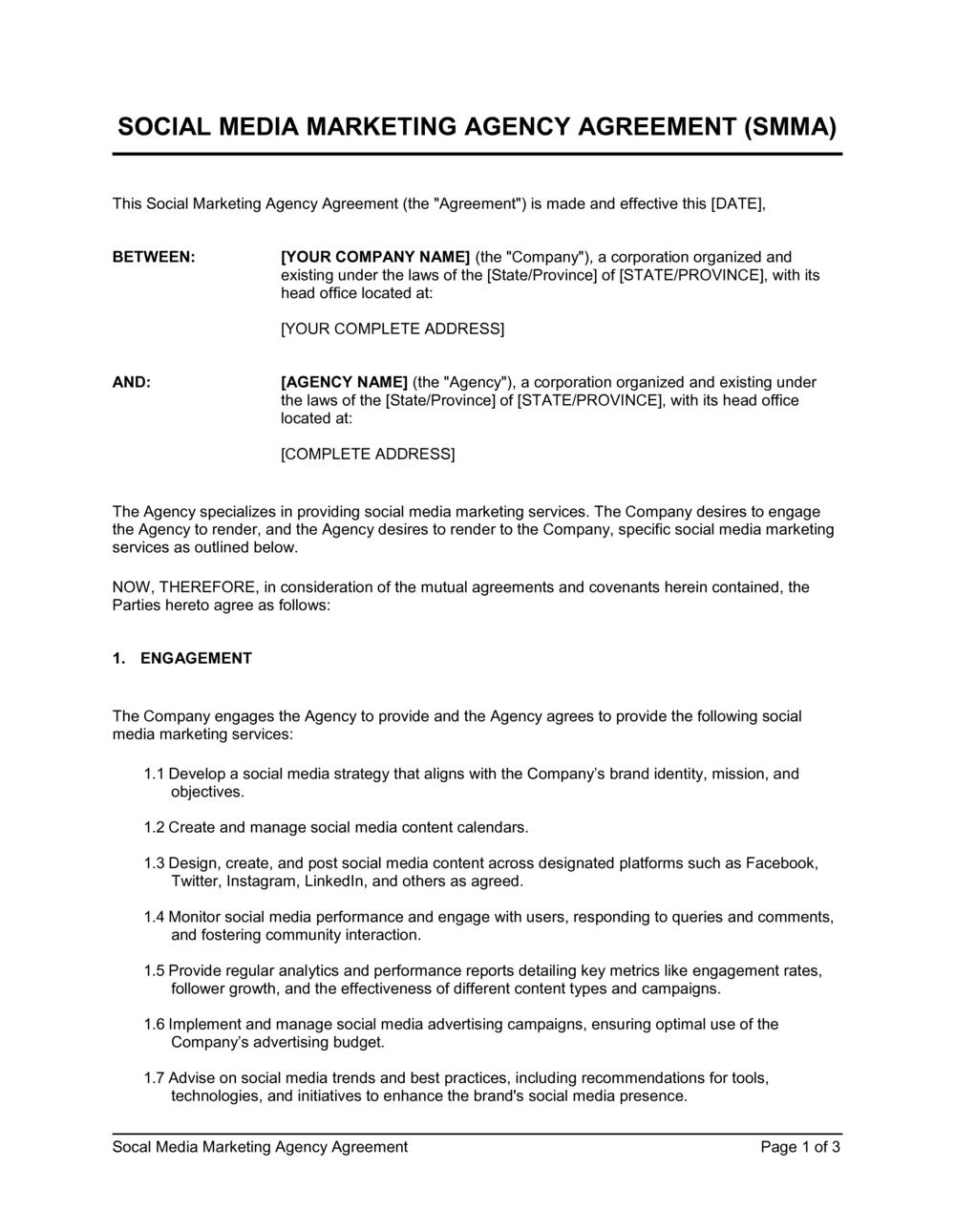
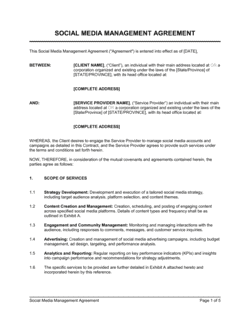
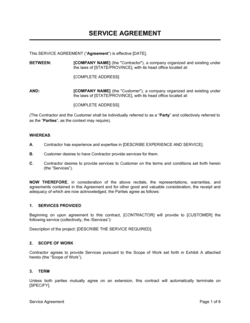
A Social Media Marketing Agency Agreement is a legally binding contract between a brand or business (the Client) and a social media agency (the Agency) that governs the full scope of the Agency's services, deliverables, fees, content approval rights, IP ownership, and termination conditions. This free Word download covers all standard provisions in a single document you can edit online and export as PDF for signature.
When you need it
Use it before an agency begins any paid or organic social media work on your behalf β€” including account management, content creation, paid advertising, influencer coordination, or community management. Signing before the engagement starts protects both parties from disputes over deliverables, ownership of creative assets, and fee obligations.
What's inside
Scope of services and platform coverage, content creation and approval workflow, fees and payment schedule, performance reporting obligations, intellectual property assignment, confidentiality, non-solicitation, representations and warranties, limitation of liability, and termination with transition obligations.

What is a Social Media Marketing Agency Agreement?

A Social Media Marketing Agency Agreement is a legally binding contract between a business or brand (the Client) and a social media agency (the Agency) that defines every material dimension of their working relationship: which platforms and services are covered, how content is created and approved, what the Agency is paid and how ad spend is managed separately, who owns the content produced, how confidential information is protected, and how either party can exit the engagement. Unlike a casual scope document or email exchange, a properly drafted agreement creates enforceable obligations on both sides, establishes a clear record of agreed deliverables and fees, and provides specific remedies when either party fails to perform.

Why You Need This Document

Starting a social media agency engagement without a signed agreement exposes both parties to four concrete categories of risk. First, content ownership is legally ambiguous β€” under US and Canadian copyright law, an agency owns what it creates unless a written assignment says otherwise, meaning a client who ends the relationship may have no right to the content library built on their behalf. Second, account access disputes are common: agencies that hold social accounts in their own Business Manager can effectively hold a brand's audience and ad history hostage when the relationship sours. Third, scope creep is endemic in social media work β€” without a Schedule A defining exactly what is included, every new request is an implicit obligation with no billing mechanism. Fourth, auto-renewing contracts trap clients in unwanted terms because notice deadlines go untracked. This template closes all four gaps before a single post goes live, protecting the Agency's fee expectations and the Client's brand assets equally.

Which variant fits your situation?

If your situation is…Use this template
Monthly retainer for ongoing social media management and content creationSocial Media Marketing Agency Agreement
Short-term campaign for a product launch or brand eventDigital Marketing Services Agreement
Engaging an individual influencer rather than an agencyInfluencer Marketing Agreement
Agency managing only paid social advertising with no organic contentPaid Advertising Services Agreement
Full-service digital marketing including SEO, email, and socialDigital Marketing Retainer Agreement
Freelance consultant providing part-time social media supportIndependent Contractor Agreement
White-label agency reselling social services to its own clientsWhite-Label Marketing Services Agreement

Common mistakes to avoid

❌ No deemed-approval clause in the content workflow

Why it matters: Without it, a slow-to-respond Client can block an entire month's publishing schedule and then hold the Agency responsible for missed targets. The Agency has no contractual protection.

Fix: Add a clause stating that Client approval is assumed if no feedback is provided within a specified number of business days after submission.

❌ Letting the Agency own the social media accounts

Why it matters: If the Agency creates or holds the account in its Business Manager and the relationship ends, the Client can lose years of audience data, ad history, page followers, and verified status with no legal recourse.

Fix: Require in the contract that all platform accounts be owned by the Client from day one, with the Agency receiving only role-based access that can be revoked at any time.

❌ Bundling ad spend into the monthly retainer

Why it matters: When actual spend deviates from the planned budget, neither party knows what is owed. Overages and underspending create billing disputes that are difficult to resolve after the fact.

Fix: Bill ad spend separately with monthly receipts or platform statements, and define the management markup percentage explicitly in the fee schedule.

❌ Omitting a platform compliance warranty

Why it matters: If the Agency uses tactics that violate Meta, TikTok, or LinkedIn terms of service and the Client's account is suspended or banned, the Client has no contractual claim without an express warranty.

Fix: Include an Agency warranty that all services comply with each applicable platform's current terms of service and advertising policies.

❌ Auto-renewal with no calendar trigger or notice obligation

Why it matters: A 30-day notice requirement on a 12-month auto-renewing contract can trap a Client in another full year simply because they missed the window by a few days.

Fix: Add a clause requiring the Agency to send a written renewal reminder no later than 45 days before the notice deadline, and calendar the termination window immediately after signing.

❌ No transition-assistance obligation

Why it matters: Without a written handover clause, a departing Agency has no contractual obligation to return content libraries, transfer analytics access, or assist with campaign continuity β€” leaving the Client's operations in limbo.

Fix: Include a transition clause requiring the Agency to deliver all content assets, account credentials, and analytics reports within a specific number of business days after termination notice.

The 10 key clauses, explained

Parties, recitals, and effective date

In plain language: Identifies the Client and Agency by full legal name, states each party's role, and sets the date the agreement takes effect.

Sample language
This Social Media Marketing Agency Agreement ('Agreement') is entered into as of [DATE] ('Effective Date') between [CLIENT LEGAL NAME], a [STATE] [ENTITY TYPE] ('Client'), and [AGENCY LEGAL NAME], a [STATE] [ENTITY TYPE] ('Agency').

Common mistake: Using a trade name or DBA instead of the registered legal entity name. If the entity named in the agreement doesn't match the business's legal registration, enforcement becomes complicated.

Scope of services and platforms

In plain language: Lists every platform, content format, and deliverable the Agency is responsible for β€” and explicitly excludes everything else to prevent scope creep.

Sample language
Agency shall provide the services described in Schedule A ('Services'), including management of Client's accounts on [PLATFORMS]. Services exclude paid advertising management, influencer outreach, and website content unless expressly added by written amendment.

Common mistake: Listing services in the contract body without a Schedule A. When scope expands informally, there is no baseline to measure against β€” and billing disputes follow.

Content creation and approval workflow

In plain language: Establishes how content is proposed, reviewed, revised, and approved before publication, including the Client's response window and what happens if the Client does not respond.

Sample language
Agency shall submit a Content Calendar to Client no later than [X] business days before the scheduled publication date. Client shall approve or provide revision requests within [Y] business days. Failure to respond within [Y] business days constitutes approval.

Common mistake: No deemed-approval clause. Without it, a non-responsive client can hold up an entire month's content and then claim the Agency missed deadlines.

Fees, payment schedule, and ad spend

In plain language: States the monthly retainer or project fee, payment due date, late-fee rate, and how ad spend is billed and reconciled separately from Agency fees.

Sample language
Client shall pay Agency a monthly retainer of $[AMOUNT], due on the [DAY] of each month. Ad spend is billed separately at cost plus [X]% management fee, invoiced monthly with receipts. Late payments accrue interest at [1.5]% per month.

Common mistake: Bundling ad spend into the retainer without a reconciliation mechanism. When actual ad spend deviates from budget, neither party knows what is owed.

Intellectual property ownership and license

In plain language: Specifies whether content produced by the Agency is owned by the Client (work for hire) or licensed, and what rights survive termination.

Sample language
All original content created by Agency exclusively for Client under this Agreement shall be considered work made for hire and shall be owned by Client upon full payment of all invoices. Agency retains ownership of pre-existing tools, templates, and proprietary methodologies.

Common mistake: No carve-out for the Agency's pre-existing tools and templates. Without one, a broadly drafted work-for-hire clause could transfer ownership of the Agency's internal systems to the Client.

Account access and credentials

In plain language: Governs how the Agency receives and manages access to the Client's social media accounts, and requires the Agency to use the Client's own credentials rather than creating separate access that the Client cannot recover.

Sample language
Client shall grant Agency admin or editor access to each Platform account via [platform-native role assignment / shared credential method]. Agency shall not transfer account ownership to Agency-owned assets. Upon termination, Agency shall revoke all access within [2] business days.

Common mistake: Letting the Agency create platform accounts in the Agency's name or Business Manager. The Client can lose access to their own audience data, ad history, and page equity if the relationship ends badly.

Confidentiality

In plain language: Restricts both parties from disclosing the other's non-public business information β€” including campaign strategies, pricing, client lists, and performance data β€” during and after the engagement.

Sample language
Each party agrees to hold the other's Confidential Information in strict confidence and not to disclose it to any third party without prior written consent. This obligation survives termination for a period of [3] years.

Common mistake: One-sided confidentiality that only restricts the Agency. Agencies share sensitive campaign performance data with Clients β€” that data can be competitively sensitive too.

Representations, warranties, and compliance

In plain language: Each party warrants that the content they contribute does not infringe third-party IP, that the Agency's services comply with platform terms of service, and that paid advertising complies with applicable advertising law.

Sample language
Agency warrants that (a) content created by Agency does not infringe any third-party intellectual property rights, (b) Agency's services comply with the applicable terms of service of each Platform, and (c) paid advertising campaigns comply with FTC Endorsement Guides and applicable consumer protection laws.

Common mistake: No platform-compliance warranty. If the Agency's tactics violate Meta or TikTok policies and the Client's account is suspended, the Client has no contractual recourse without this clause.

Limitation of liability and indemnification

In plain language: Caps each party's maximum financial exposure and defines who is responsible for indemnifying the other against third-party claims arising from their respective contributions.

Sample language
Agency's total liability under this Agreement shall not exceed the total fees paid by Client in the [3] months immediately preceding the claim. Client shall indemnify Agency against claims arising from Client-provided content. Agency shall indemnify Client against claims arising from Agency-created content.

Common mistake: No mutual indemnification split. If the Client provides infringing images and a third party sues, the Agency needs contractual protection β€” and vice versa.

Term, termination, and transition

In plain language: Sets the initial contract term, notice period for either party to terminate, conditions for immediate termination for cause, and the Agency's transition obligations to hand over assets and access.

Sample language
This Agreement commences on the Effective Date and continues for an initial term of [12] months, renewing automatically for successive [30]-day periods unless either party provides [30] days' written notice. Either party may terminate immediately for material breach uncured within [15] days of written notice. Upon termination, Agency shall deliver all content assets, analytics data, and account credentials to Client within [5] business days.

Common mistake: Auto-renewal with no notice obligation. Clients can find themselves locked into another 12-month term because they missed a notice deadline buried in the contract.

How to fill it out

  1. 1

    Enter the legal entity names and effective date

    Insert the full registered legal name and entity type (LLC, Inc., etc.) for both the Client and the Agency. Set the effective date to the day both parties sign β€” not the first day of service.

    πŸ’‘ Cross-check both entity names against state/provincial business registries before execution. A mismatch is the most common cause of unenforceable contracts.

  2. 2

    Draft Schedule A β€” scope of services and platforms

    List every platform, content type, and deliverable the Agency will manage β€” number of posts per week, platform list, ad management yes/no, reporting cadence. Attach it as Schedule A rather than writing it into the contract body.

    πŸ’‘ Be explicit about what is excluded. Writing 'TikTok management excluded unless added by amendment' prevents scope-creep disputes six months in.

  3. 3

    Define the content approval workflow and deadlines

    Set the number of business days the Agency will submit content in advance, the number of days the Client has to respond, and a clear deemed-approval clause for non-response.

    πŸ’‘ A 5-business-day submission window with a 2-business-day Client response window is a common and workable standard for most monthly retainers.

  4. 4

    Complete the fee schedule and ad spend billing method

    Enter the monthly retainer amount, payment due date, late-fee rate, and the method for billing ad spend separately. Specify whether ad spend is billed at cost or cost-plus and at what percentage.

    πŸ’‘ State the currency explicitly β€” especially for cross-border engagements β€” and confirm which party's bank covers wire fees.

  5. 5

    Specify IP ownership and any Agency carve-outs

    Confirm that all custom content created for the Client is work for hire and owned by the Client upon full payment. Add a carve-out protecting the Agency's pre-existing tools, stock assets, and proprietary processes.

    πŸ’‘ If the Agency uses licensed stock photography or music, state that the Client receives the sublicense β€” not assignment β€” of those third-party assets.

  6. 6

    Address account access and credential security

    Specify that the Agency receives role-based access (admin or editor) through the platform's native user management β€” not via a shared password. Include a transition clause requiring access revocation within 2 business days of termination.

    πŸ’‘ For Meta, use Business Manager access roles rather than sharing personal login credentials. This is enforceable and auditable.

  7. 7

    Set the term, notice period, and auto-renewal terms

    Choose an initial term (12 months is standard for retainers), a rolling auto-renewal period (30 days is common), and the notice period required to cancel. Add a clear transition-assistance obligation covering content libraries, analytics access, and credential handover.

    πŸ’‘ Calendar the termination notice deadline immediately after signing. Missing an auto-renewal window is one of the most common and preventable contract disputes in agency relationships.

  8. 8

    Have both parties sign before work begins

    Obtain signatures from authorized representatives of both entities before any work is performed or access is granted. Use a timestamped eSign tool to establish the execution date.

    πŸ’‘ In agency relationships, 'we'll sort the paperwork later' routinely results in ownership disputes over content created in the interim period.

Frequently asked questions

What is a social media marketing agency agreement?

A social media marketing agency agreement is a binding contract between a client and an agency that governs the full terms of the agency's social media work β€” what platforms are covered, what content will be created, how it gets approved, who owns it, what the agency is paid, and how either party can exit the relationship. It replaces informal arrangements and provides clear recourse when expectations aren't met.

What should a social media agency contract include?

At minimum: scope of services and platform list, content creation and approval workflow, fees and payment schedule with ad spend billed separately, intellectual property ownership, account access and credential terms, confidentiality, platform compliance warranties, limitation of liability, and a termination clause with transition obligations. Missing any of these creates gaps that almost always surface as disputes once the relationship is underway.

Who owns the content created by a social media agency?

Ownership depends entirely on what the contract says. Under US copyright law, the default is that the agency owns content it creates unless it is expressly assigned to the client or qualifies as work for hire. A well-drafted agreement should include a work-for-hire clause transferring ownership to the client upon full payment, with an Agency carve-out for pre-existing tools, stock assets, and proprietary templates.

Can a client terminate a social media agency agreement early?

Yes, if the contract includes a termination-for-convenience clause with a notice period β€” typically 30 to 60 days. Without one, the client may owe the full remaining contract value. Most agency agreements also allow immediate termination for cause if either party materially breaches the contract and fails to cure within 15 days of written notice. Always review the auto-renewal clause to understand when the next termination window opens.

What happens to social media accounts when an agency relationship ends?

The outcome depends entirely on the contract. If accounts are held under the Agency's Business Manager or created by the Agency without a clear ownership clause, the client may have no legal right to demand access. A properly drafted agreement requires that all accounts be owned by the Client from day one, that the Agency hold only role-based access, and that access be revoked and credentials transferred within a specified period after termination.

Is a social media marketing agency agreement legally binding?

Yes, when properly executed by authorized representatives of both parties, the agreement is generally enforceable as a commercial contract in most jurisdictions. The specific enforceability of individual clauses β€” such as non-solicitation, limitation of liability, or auto-renewal terms β€” depends on the governing law and the reasonableness of the terms. Consider having an attorney review the agreement before signing for engagements with significant fee commitments.

How is ad spend typically handled in an agency agreement?

Ad spend is almost always billed separately from the Agency's service retainer, either at cost (passed through with receipts) or at cost plus a management markup β€” typically 10–20% of monthly spend. The contract should specify how budgets are approved, how overages are handled, and how the Agency accounts for spend with platform statements or invoices. Bundling ad spend into a flat retainer without a reconciliation mechanism consistently leads to billing disputes.

What FTC disclosure requirements apply to social media marketing?

The FTC Endorsement Guides require clear and conspicuous disclosure when there is a material connection between an endorser (including an Agency posting on behalf of a brand) and the advertised product or service. Paid social ads on platforms like Meta and TikTok trigger built-in disclosure labels, but organic influencer posts and paid partnerships require explicit hashtags or labels such as #ad or #sponsored. The Agency's compliance warranty in the contract should cover adherence to current FTC guidance.

Do I need a lawyer to draft a social media agency agreement?

For most standard retainer engagements with a reputable agency, a high-quality template reviewed internally is sufficient. Legal review is worthwhile when the engagement involves significant ad spend (over $10K per month), sensitive brand IP, influencer coordination, or cross-border parties subject to different advertising laws. A one-hour attorney review typically costs $200–$400 and is a reasonable investment for agreements running six figures annually.

How this compares to alternatives

vs Independent Contractor Agreement

An independent contractor agreement governs a self-employed individual performing defined tasks without employment entitlements. A social media agency agreement is designed for an entity delivering ongoing, multi-person services at scale. The agency agreement includes content approval workflows, ad spend billing, platform compliance warranties, and transition obligations that a standard contractor agreement does not address.

vs Digital Marketing Services Agreement

A digital marketing services agreement covers the full spectrum of digital channels β€” SEO, email, PPC, content marketing, and social media. A social media agency agreement is purpose-built for social platforms, addressing platform-specific account access, content calendar workflows, and FTC disclosure compliance that a generic digital marketing agreement treats only superficially.

vs Influencer Marketing Agreement

An influencer marketing agreement governs a single creator's post, story, or campaign in exchange for payment or gifting. A social media agency agreement governs an ongoing, multi-deliverable relationship with an entity managing the brand's owned channels. The two documents are complementary β€” a brand may need both if its agency also coordinates influencer partnerships.

vs Service Level Agreement (SLA)

An SLA defines performance standards, uptime commitments, and remedies for service failures β€” it is a technical performance document, not a commercial contract. A social media agency agreement establishes the legal and commercial framework of the relationship, including IP, payment, and termination. An SLA can be attached as a schedule to the agency agreement but does not replace it.

Industry-specific considerations

E-commerce and retail

Paid social advertising on Meta and TikTok drives direct revenue, making ad spend reconciliation, ROAS reporting obligations, and platform compliance warranties especially critical clauses.

SaaS and technology

LinkedIn and Twitter/X B2B campaigns require detailed content approval workflows and strict confidentiality around product roadmaps and pricing shared with the Agency.

Food and beverage

Influencer and UGC coordination, platform-specific content restrictions on alcohol and health claims, and high-frequency posting schedules require granular scope definitions and compliance warranties.

Healthcare and wellness

FTC and FDA restrictions on health claims, HIPAA considerations for any patient-facing content, and platform advertising policy restrictions make compliance representations and indemnification splits especially important.

Professional services

Thought leadership content on LinkedIn often includes proprietary methodology β€” the IP carve-out protecting Agency templates while assigning client-specific content to the Client is critical.

Retail and hospitality

Seasonal campaign cadence, time-sensitive content approvals, and coordination with in-store promotions require tight content calendar deadlines and deemed-approval clauses with short response windows.

Jurisdictional notes

United States

Copyright ownership defaults to the creator under US law unless a written work-for-hire clause or assignment is included. FTC Endorsement Guides require clear disclosure of paid relationships in social media content, including posts managed by agencies on behalf of brands. Non-solicitation enforceability varies by state β€” California limits these clauses significantly. State commercial law governs payment terms and late-fee validity.

Canada

Canada's Anti-Spam Legislation (CASL) applies to commercial electronic messages, including some forms of social media outreach. Copyright in agency-created work belongs to the author by default β€” a written assignment or work-for-hire clause is required to transfer ownership to the client. Quebec contracts may need to be available in French for provincially regulated entities. Competition Bureau guidelines govern misleading advertising claims on social platforms.

United Kingdom

The Advertising Standards Authority (ASA) and CAP Code require clear labeling of paid social media content, including posts by agencies managing brand accounts. UK copyright law does not recognize work for hire in the same way as US law β€” ownership transfers require an explicit written assignment. GDPR (UK GDPR post-Brexit) applies to any personal data processed through social media campaigns, including retargeting audiences and lead generation forms.

European Union

GDPR applies broadly to social media marketing involving EU residents β€” consent mechanisms, data processing agreements, and data transfer safeguards must be addressed if the Agency processes personal data on the Client's behalf. The EU's Digital Services Act imposes additional transparency requirements for targeted advertising. Copyright assignment requires express written agreement in most member states, and several countries impose mandatory author moral rights that cannot be contractually waived.

Template vs lawyer β€” what fits your deal?

PathBest forCostTime
Use the templateAgencies and clients entering standard monthly retainer engagements with clear scope and fees below $5,000/monthFree30–45 minutes
Template + legal reviewEngagements involving significant ad spend, multi-platform campaigns, sensitive brand IP, or influencer coordination$200–$5001–3 days
Custom draftedEnterprise brand contracts, cross-border engagements with non-US agencies, or agreements with complex revenue-share or performance-bonus structures$1,500–$4,000+1–3 weeks

Glossary

Scope of Services
The defined list of tasks, platforms, deliverables, and activities the Agency is contracted to perform β€” anything outside this list requires a written change order.
Content Calendar
A scheduled plan showing planned posts, formats, platforms, and publication dates over a defined period, typically submitted weekly or monthly for client approval.
Content Approval Workflow
The agreed process by which the Client reviews and approves posts, graphics, or videos before the Agency publishes them on the Client's accounts.
Retainer Fee
A fixed monthly amount paid to the Agency for an agreed set of recurring services, regardless of how many hours are actually worked.
Ad Spend
Budget allocated directly to social media advertising platforms (Meta, TikTok, LinkedIn) that flows through the Agency but is billed separately from Agency service fees.
Work for Hire
A legal doctrine under which creative work produced by the Agency in the course of the engagement is owned by the Client from the moment of creation β€” applicable when expressly stated in the contract.
KPI (Key Performance Indicator)
Measurable targets agreed between the parties β€” such as follower growth rate, engagement rate, or cost per lead β€” against which the Agency's performance is evaluated.
White-Labeling
An arrangement where the Agency produces content or manages accounts under the Client's brand without disclosing the Agency's involvement to end audiences.
Non-Solicitation
A contractual restriction preventing one party from directly recruiting or hiring the other party's employees or contractors during and after the engagement.
Transition Assistance
The Agency's obligation upon termination to transfer account credentials, content libraries, analytics access, and ongoing campaigns to the Client or a successor agency.
Limitation of Liability
A clause capping the maximum financial exposure of either party β€” typically set at the total fees paid in the preceding three to twelve months.

Part of your Business Operating System

This document is one of 3,000+ business & legal templates included in Business in a Box.

  • Fill-in-the-blanks β€” ready in minutes
  • 100% customizable Word document
  • Compatible with all office suites
  • Export to PDF and share electronically

Create your document in 3 simple steps.

From template to signed document β€” all inside one Business Operating System.
1
Download or open template

Access over 3,000+ business and legal templates for any business task, project or initiative.

2
Edit and fill in the blanks with AI

Customize your ready-made business document template and save it in the cloud.

3
Save, Share, Send, Sign

Share your files and folders with your team. Create a space of seamless collaboration.

Save time, save money, and create top-quality documents.

β˜…β˜…β˜…β˜…β˜…

"Fantastic value! I'm not sure how I'd do without it. It's worth its weight in gold and paid back for itself many times."

Managing Director Β· Mall Farm
Robert Whalley
Managing Director, Mall Farm Proprietary Limited
β˜…β˜…β˜…β˜…β˜…

"I have been using Business in a Box for years. It has been the most useful source of templates I have encountered. I recommend it to anyone."

Business Owner Β· 4+ years
Dr Michael John Freestone
Business Owner
β˜…β˜…β˜…β˜…β˜…

"It has been a life saver so many times I have lost count. Business in a Box has saved me so much time and as you know, time is money."

Owner Β· Upstate Web
David G. Moore Jr.
Owner, Upstate Web

Run your business with a system β€” not scattered tools

Stop downloading documents. Start operating with clarity. Business in a Box gives you the Business Operating System used by over 250,000 companies worldwide to structure, run, and grow their business.

Start freeΒ Β·Β No credit card required