Volunteer Agreement Template

Free Word download • Edit online • Save & share with Drive • Export to PDF

6 pages25–35 min to fillDifficulty: ComplexSignature requiredLegal review recommended
Learn more ↓
FreeVolunteer Agreement Template

At a glance

What it is
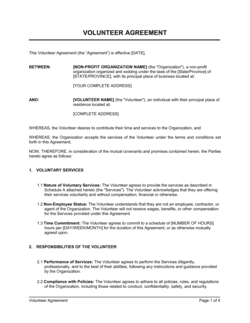
A Volunteer Agreement is a written document that defines the terms under which an individual provides unpaid services to an organization — typically a nonprofit, charity, community group, or event organizer. This free Word download sets out the volunteer's role and duties, the organization's obligations, liability limitations, confidentiality requirements, and the conditions under which either party may end the arrangement. It is not an employment contract and does not create an employer-employee relationship.
When you need it
Use it before any volunteer begins work — whether for a recurring program role, a one-time event, or a short-term project. It is especially critical when volunteers will handle confidential data, interact with vulnerable populations, or perform activities that carry physical or financial risk to themselves or the organization.
What's inside
The agreement covers the volunteer's role description and schedule, the organization's duties (training, supervision, insurance), confidentiality and data protection obligations, intellectual property ownership, liability limitation and indemnification, a health and safety acknowledgment, and termination provisions for both parties.

What is a Volunteer Agreement?

A Volunteer Agreement is a written legal document that establishes the terms under which an individual provides unpaid services to an organization — most commonly a nonprofit, charity, educational institution, healthcare provider, or event organizer. It identifies both parties, describes the volunteer's role and duties, sets out the organization's obligations (training, supervision, and a safe working environment), and defines critical protections including confidentiality, intellectual property ownership, liability limitation, and termination procedures. Unlike an employment contract, a properly drafted volunteer agreement explicitly states that no employer-employee relationship is created — but it remains a binding civil contract enforceable where adequate consideration exists on both sides.

Why You Need This Document

Operating a volunteer program without signed agreements exposes your organization to four categories of risk simultaneously. First, any work product a volunteer creates — a logo, a curriculum, a fundraising database — may legally belong to the volunteer rather than your organization, giving them leverage to demand payment or restrict use after the engagement ends. Second, without a signed confidentiality clause, a departing volunteer faces no enforceable restriction on disclosing donor records, client data, or sensitive program information. Third, an undocumented volunteer who is injured during service can pursue an uncapped negligence claim with no record of having acknowledged the risks involved. Fourth, misclassification — treating paid work as volunteering — triggers minimum-wage liability, back taxes, and penalties that are expensive to defend regardless of outcome. A signed volunteer agreement, executed before the first day of service, closes all four gaps and signals to funders, regulators, and insurers that your organization manages its volunteer program with the same rigor it applies to paid staff.

Which variant fits your situation?

If your situation is…Use this template
Recurring weekly volunteer role in a nonprofit programVolunteer Agreement
Single-day event with large numbers of unpaid helpersEvent Volunteer Agreement
Student completing a mandatory community-service placementCommunity Service Agreement
Unpaid intern at a for-profit businessInternship Agreement
Volunteer who will also serve as an independent contractor for some tasksIndependent Contractor Agreement
Volunteer director or board member at a nonprofitBoard Member Agreement
Volunteer handling sensitive personal data under GDPR or HIPAAConfidentiality Agreement (NDA)

Common mistakes to avoid

❌ Omitting the no-employment-relationship clause

Why it matters: Without explicit language, a volunteer who later claims they were effectively an employee can argue entitlement to back wages, benefits, and workers' compensation — particularly if the organization exercised significant control over their work.

Fix: Include a clear, standalone clause stating that the engagement is not employment and that no wages, benefits, or employment entitlements are created. Pair it with actual management practices that don't look like employment.

❌ Using a blanket all-risks liability waiver

Why it matters: Courts in the US, Canada, and UK routinely void waivers that are so broad they provide no notice of the actual risks involved. A voided waiver exposes the organization to the full liability it intended to limit.

Fix: Identify the specific activities and foreseeable risks covered by the waiver. Named risks — lifting, driving, working at heights — are far more defensible than 'any and all claims of any nature.'

❌ No intellectual property assignment clause

Why it matters: A volunteer who designs a logo, writes curriculum, builds a website, or develops a fundraising tool may retain copyright ownership of that work product if no assignment exists — giving them leverage to demand payment or restrict use later.

Fix: Include a clear IP assignment clause transferring all work product created in connection with the volunteer role to the organization, with no further compensation required.

❌ Signing the agreement after the volunteer has already started

Why it matters: In common-law jurisdictions, clauses added after work has begun — particularly IP assignment and confidentiality — may be unenforceable for lack of fresh consideration. Any incident that occurs before signing is also outside the agreement's coverage.

Fix: Make execution of the volunteer agreement a mandatory step in the onboarding checklist, completed on or before the volunteer's first day of service.

The 9 key clauses, explained

Parties, Role, and Commencement

In plain language: Identifies the organization and volunteer by legal name, describes the volunteer role, and states when the engagement begins.

Sample language
This Volunteer Agreement is entered into between [ORGANIZATION LEGAL NAME], a [ENTITY TYPE] ('Organization'), and [VOLUNTEER FULL NAME] ('Volunteer'), effective [START DATE]. Volunteer agrees to perform the role of [ROLE TITLE] as described in Schedule A.

Common mistake: Using a program or brand name instead of the organization's registered legal entity name — if a liability dispute arises, the contracting party must match the insured entity exactly.

Duties and Schedule

In plain language: Describes the specific tasks the volunteer will perform, the expected time commitment, and the location of service.

Sample language
Volunteer shall perform the duties set out in Schedule A at [LOCATION / REMOTELY], approximately [X] hours per [week/month], on a schedule mutually agreed with [SUPERVISOR NAME / TITLE].

Common mistake: Listing duties so vaguely that the organization cannot manage performance or discipline — or so rigidly that any schedule change requires a formal amendment.

No Employment Relationship

In plain language: Expressly states that the volunteer is not an employee, agent, or contractor, and is not entitled to wages, benefits, or workers' compensation as an employee.

Sample language
Volunteer acknowledges that this Agreement does not create an employment relationship. Volunteer is not entitled to wages, salary, employee benefits, workers' compensation, or unemployment insurance in their capacity as a volunteer under this Agreement.

Common mistake: Omitting this clause entirely, or including it but then exercising the degree of control — mandatory hours, performance reviews, disciplinary procedures — that courts use to find an employment relationship regardless of what the contract says.

Confidentiality and Data Protection

In plain language: Prohibits the volunteer from disclosing or misusing the organization's confidential information — including client, donor, patient, or beneficiary data — during and after the engagement.

Sample language
Volunteer agrees to hold all Confidential Information in strict confidence and not to disclose or use it for any purpose other than performing their volunteer duties. This obligation survives termination of this Agreement for a period of [X] years / indefinitely.

Common mistake: Failing to define 'Confidential Information' specifically enough. A list that includes 'client records, donor information, financial data, and operational procedures' is far more defensible than 'all information relating to the Organization.'

Intellectual Property Assignment

In plain language: Transfers ownership of all content, materials, or work product the volunteer creates in connection with their role to the organization.

Sample language
All work product, materials, content, and developments created by Volunteer in the course of their volunteer duties are the sole property of the Organization and are hereby assigned to the Organization without further compensation.

Common mistake: No IP assignment clause at all — leaving a volunteer who created a logo, curriculum, or software tool with a credible ownership claim the organization must later negotiate away.

Liability Limitation and Waiver of Claims

In plain language: Limits the organization's liability for injuries, losses, or damages the volunteer sustains during volunteer activities, and in some jurisdictions partially releases the organization from such claims.

Sample language
Volunteer acknowledges the risks inherent in the volunteer activities and, to the fullest extent permitted by law, releases and holds harmless [ORGANIZATION LEGAL NAME], its officers, directors, employees, and agents from any claim arising from Volunteer's participation in volunteer activities.

Common mistake: Using a blanket all-risks waiver without specifying the activities covered. Courts narrow or void waivers that are too broad or that fail to identify the specific risk the volunteer is acknowledging.

Health, Safety, and Background Checks

In plain language: Confirms the volunteer will comply with the organization's health and safety policies, and grants consent for any required background or reference checks.

Sample language
Volunteer agrees to comply with all health, safety, and conduct policies of the Organization. Volunteer consents to a criminal background check and reference verification as a condition of this Agreement, the results of which the Organization may consider in its sole discretion.

Common mistake: Requiring a background check in the agreement but not actually running one — if an incident occurs involving a volunteer with a disqualifying history, the clause creates evidence that the organization knew a check was warranted but failed to act.

Termination

In plain language: States that either party may end the volunteer engagement at any time, with or without notice, and describes what happens to confidential information and organizational property upon termination.

Sample language
Either party may terminate this Agreement at any time, with or without cause, by providing [X days'] written notice. Upon termination, Volunteer shall promptly return all organizational property and materials and continue to be bound by the confidentiality obligations of this Agreement.

Common mistake: No termination clause at all, leaving the organization without a clear mechanism to remove a volunteer who becomes problematic — and potentially creating an implied contract of continued engagement.

Governing Law and Entire Agreement

In plain language: Specifies which jurisdiction's law governs the agreement and confirms that this document supersedes any prior understandings or informal arrangements.

Sample language
This Agreement is governed by the laws of [STATE / PROVINCE / COUNTRY]. This Agreement constitutes the entire agreement between the parties regarding the volunteer engagement and supersedes all prior representations, oral or written.

Common mistake: Choosing a governing law with no connection to where the volunteer actually works — several jurisdictions apply local law regardless of the contract's choice-of-law clause.

How to fill it out

  1. 1

    Enter the organization's legal name and the volunteer's details

    Use the full registered name of the organization — not a program name or trade name. Enter the volunteer's legal name as it appears on their government-issued ID. Confirm the effective date matches the volunteer's actual start date.

    💡 Cross-reference your corporate or charity registration to confirm the exact legal entity name before every signing — mismatches create insurance and enforcement gaps.

  2. 2

    Define the role and schedule in Schedule A

    Move the detailed duty list to a separate Schedule A rather than embedding it in the main body. Describe what the volunteer will do, where, and approximately how many hours per week or month are expected.

    💡 Have the volunteer initial Schedule A separately at signing so there is no dispute later about whether they reviewed the full scope of their role.

  3. 3

    Confirm the no-employment-relationship clause applies to your situation

    Review the degree of control your organization will exercise over the volunteer. If you set mandatory hours, require performance reviews, or treat the volunteer the same as paid staff, consult a lawyer before relying on the volunteer classification.

    💡 In Canada and the UK, 'no employment relationship' clauses are tested against the actual working relationship — the clause alone does not prevent a reclassification finding.

  4. 4

    Specify the confidential information categories

    List every category of information the volunteer will access — client records, donor lists, patient data, financial reports — and include them in the confidentiality definition. Tailor the survival period (typically 2–5 years, or indefinite for trade secrets).

    💡 If the volunteer will handle personal data regulated under GDPR or HIPAA, attach a separate data processing annex or addendum referencing the applicable regulation.

  5. 5

    Tailor the liability waiver to the specific activities

    Name the specific volunteer activities covered by the waiver — physical labor, food handling, driving, working with minors. Avoid blanket all-risks language that courts routinely narrow or void.

    💡 Check with your liability insurer before finalizing the waiver language — some policies require specific waiver wording to trigger coverage.

  6. 6

    Set termination notice and return-of-property obligations

    Enter the notice period (typically 7–14 days for most roles, or none for at-will arrangements). List all organizational property the volunteer holds — access cards, equipment, documents — and require return within a specific timeframe after termination.

    💡 Add a step in your volunteer offboarding checklist that mirrors this clause — a signed agreement means nothing if the offboarding process doesn't enforce it.

  7. 7

    Sign before the volunteer's first day

    Both parties should sign the agreement before the volunteer performs any work. Post-commencement signatures weaken the enforceability of IP assignment, confidentiality, and liability waiver clauses in common-law jurisdictions.

    💡 Use an e-signature tool to timestamp execution and store a fully executed copy in a centralized volunteer management file.

  8. 8

    Confirm insurance coverage includes volunteers

    After signing, verify with your insurer that your general liability and, where applicable, directors and officers or professional indemnity policies extend to volunteer activities. Update your policy if needed.

    💡 Many nonprofit package policies include volunteer coverage by default — but confirm the geographic scope if volunteers operate across state or provincial lines.

Frequently asked questions

What is a volunteer agreement?

A volunteer agreement is a written document that defines the terms under which an individual provides unpaid services to an organization. It identifies the volunteer's role and duties, the organization's responsibilities, confidentiality and IP obligations, liability limitations, and the conditions for ending the arrangement. It is not an employment contract and does not create an employer-employee relationship, but it is generally enforceable as a civil contract where supported by adequate consideration — typically the organization's commitment to provide training, supervision, and a safe environment.

Are volunteer agreements legally binding?

A volunteer agreement is generally enforceable as a civil contract in most jurisdictions when it contains adequate consideration on both sides — the volunteer's promise to serve and the organization's promise to provide training, a safe environment, or other concrete benefits. Liability waivers within volunteer agreements are subject to jurisdiction-specific limits: courts will not enforce waivers of gross negligence or intentional misconduct, and some states and provinces restrict or void certain waiver language regardless of what the parties agreed. Consult a lawyer if enforceability of specific clauses — particularly waivers and IP assignment — is critical to your organization.

Does a volunteer agreement create an employment relationship?

A properly drafted volunteer agreement expressly states that no employment relationship is created and that the volunteer is not entitled to wages, benefits, or workers' compensation as an employee. However, the clause alone is not decisive — courts in the US, Canada, UK, and EU look at the actual working relationship to determine classification. If the organization sets mandatory hours, conducts formal performance reviews, disciplines volunteers like employees, or integrates them fully into daily operations, a misclassification finding is possible regardless of what the agreement says.

What is the difference between a volunteer agreement and an internship agreement?

A volunteer agreement governs unpaid service provided freely, typically to a nonprofit, charity, or community organization. An internship agreement covers an unpaid or paid placement where the primary purpose is the intern's educational development — typically at a for-profit company. For-profit businesses generally cannot use a volunteer agreement in place of an internship agreement without risking misclassification under minimum-wage laws, since the legal tests for unpaid internships at for-profit employers are far stricter than for genuine volunteers.

Should a volunteer agreement include a liability waiver?

Yes, for most organizations — especially those involving physical activities, driving, working with vulnerable populations, or handling financial assets. A liability waiver, properly scoped to the specific activities involved, limits the organization's exposure to claims from injured volunteers. However, waivers cannot eliminate liability for gross negligence, willful misconduct, or injuries caused by a failure to maintain a reasonably safe environment. Review your jurisdiction's rules on waiver enforceability before finalizing the language.

Do nonprofits need volunteer agreements?

Yes. While no law universally mandates volunteer agreements for nonprofits, operating without one exposes the organization to IP ownership disputes, confidentiality breaches, misclassification claims, and unlimited tort liability for volunteer injuries. Many nonprofit insurers and grant funders also require documented volunteer agreements as a condition of coverage or funding. A signed agreement is one of the lowest-cost risk management tools available to a nonprofit of any size.

What happens if a volunteer is injured and there is no agreement?

Without a signed agreement containing a liability waiver and health and safety acknowledgment, the organization faces the injured volunteer's full common-law claim with no documented assumption of risk on the volunteer's part. Depending on the jurisdiction, the organization may also face claims under occupier's liability or negligence statutes. Workers' compensation coverage typically does not extend to unpaid volunteers unless the policy specifically includes them or the jurisdiction mandates it — leaving a gap that a well-drafted agreement and a reviewed insurance policy together address.

How long should confidentiality obligations last in a volunteer agreement?

For most volunteer roles, a confidentiality obligation of 2–5 years after the engagement ends is standard and courts find it reasonable. For roles involving trade secrets, donor strategy, or proprietary program methodologies, an indefinite obligation is defensible and common. Obligations covering personal data regulated under GDPR or HIPAA must comply with those frameworks regardless of what the contract says — typically meaning the obligation continues as long as the data exists.

Can a for-profit business use a volunteer agreement?

Only in limited circumstances. For-profit businesses may use volunteer agreements for genuine civic or charitable programs they sponsor — such as community clean-up events — where the volunteer receives no benefit and the work does not displace paid employees. Using a volunteer agreement to avoid paying workers who perform core business functions is misclassification and exposes the business to minimum wage liability, back taxes, and penalties. When in doubt, use an internship agreement or independent contractor agreement instead, and consult an employment lawyer.

How this compares to alternatives

vs Employment Contract

An employment contract governs a paid, legally classified employee — creating obligations around wages, benefits, overtime, and statutory notice. A volunteer agreement explicitly disclaims the employment relationship and covers unpaid service. Using an employment contract for a volunteer, or a volunteer agreement for a paid worker, creates misclassification risk in both directions. The distinction matters most for tax withholding, workers' compensation, and minimum-wage liability.

vs Independent Contractor Agreement

An independent contractor agreement covers a self-employed individual paid for specific deliverables or services. A volunteer agreement covers unpaid service provided freely. For-profit businesses that try to use a volunteer agreement instead of a contractor agreement to avoid paying for work face minimum-wage and tax exposure. Use a contractor agreement whenever compensation — even deferred or in-kind — is involved.

vs Internship Agreement

An internship agreement governs a structured placement — typically for a student — where the primary purpose is the intern's learning and development. Internship agreements at for-profit companies must meet specific legal tests (primary benefit to the intern, no displacement of paid employees) to justify unpaid status. Volunteer agreements are appropriate only for nonprofits or genuine civic programs, not for unpaid placements at for-profit employers.

vs Non-Disclosure Agreement

A standalone NDA focuses exclusively on confidentiality obligations and is often used when a volunteer's primary sensitivity is access to proprietary data or donor strategy. A volunteer agreement includes confidentiality as one clause among many — covering duties, liability, IP, and termination. For high-risk data roles, organizations sometimes use both: a volunteer agreement for the engagement terms and a separate NDA for heightened confidentiality obligations.

Industry-specific considerations

Nonprofits and Charities

Volunteer agreements are a core governance document for charities, covering donor-record confidentiality, safeguarding obligations for programs serving vulnerable populations, and IP ownership of materials created by program volunteers.

Healthcare and Social Services

Hospitals, hospices, and social service agencies require agreements that incorporate HIPAA or equivalent data protection obligations, background check consent, and specific liability waivers for clinical or care environments.

Education

Schools and universities use volunteer agreements for parent helpers, mentors, and student placement participants — with mandatory background check, safeguarding policy acknowledgment, and minor-protection provisions.

Events and Entertainment

Festival, sporting event, and community event organizers use short-form volunteer agreements that emphasize physical liability waivers, media release consent, and role-specific health and safety briefings.

Jurisdictional notes

United States

Volunteer classification is governed at the state level; there is no uniform federal volunteer statute. The FLSA exempts genuine volunteers of public agencies and nonprofits from minimum-wage requirements, but for-profit employers face strict scrutiny. Liability waiver enforceability varies significantly by state — California, Louisiana, and Virginia impose tighter restrictions than most. Some states require specific language for minor volunteers. Workers' compensation coverage for volunteers is optional in most states but mandatory in a few, including Oregon.

Canada

Provincial employment standards legislation — such as Ontario's Employment Standards Act and BC's Employment Standards Act — excludes genuine volunteers from minimum-wage and benefit protections, but courts apply a functional test based on the actual working relationship. Quebec's Civil Code governs contract interpretation differently from common-law provinces. Background check requirements for volunteers working with children or vulnerable adults are mandatory in most provinces. Liability waivers are generally enforceable in common-law provinces but may be narrowed by courts for unreasonable scope.

United Kingdom

UK law does not classify genuine volunteers as workers or employees, provided the agreement does not create a legally enforceable obligation to attend or perform. Volunteer agreements should avoid language that implies a mutuality of obligation — the hallmark of a worker relationship. The Equality Act 2010 protects volunteers from discrimination in some circumstances. Organizations working with children or vulnerable adults must comply with Disclosure and Barring Service (DBS) check requirements. GDPR compliance is mandatory for volunteers handling personal data of UK residents.

European Union

EU member states vary significantly in how they classify and protect volunteers. France, Germany, and Spain have specific volunteer statutes that grant certain protections — including accident insurance entitlements — regardless of contractual waiver. The EU's Transparent and Predictable Working Conditions Directive does not apply to genuine volunteers, but misclassification risk is real in jurisdictions with broad worker definitions. GDPR applies to all processing of EU residents' personal data by volunteers, and the agreement should reference the organization's data processing obligations explicitly.

Template vs lawyer — what fits your deal?

PathBest forCostTime
Use the templateNonprofits and community organizations onboarding standard program volunteers with low liability exposureFree15–30 minutes per volunteer
Template + legal reviewOrganizations engaging volunteers in high-risk activities, sensitive data environments, or jurisdictions with strict volunteer-classification rules$300–$7002–5 days
Custom draftedHealthcare organizations, large-scale events with significant physical liability, or for-profit businesses with complex volunteer program structures$1,000–$3,500+1–2 weeks

Glossary

Volunteer
An individual who provides services to an organization freely and without expectation of financial compensation, and who is not classified as an employee or contractor.
Liability Waiver
A clause in which the volunteer acknowledges known risks and releases the organization from claims arising from injuries or losses sustained during volunteer activities.
Indemnification
A provision requiring one party to cover the legal costs and damages incurred by the other party as a result of the indemnifying party's actions or negligence.
Confidential Information
Non-public information belonging to the organization — including donor records, client data, financial details, and operational processes — that the volunteer agrees not to disclose.
Intellectual Property Assignment
A clause transferring ownership of any work product, materials, or content created by the volunteer in the course of their role to the organization.
At-Will Termination
A provision allowing either the organization or the volunteer to end the arrangement at any time, for any reason, without liability — applicable in jurisdictions that recognize this concept.
Duty of Care
The legal obligation an organization owes to its volunteers to provide a reasonably safe environment, adequate training, and appropriate supervision.
Misclassification
The error of treating a worker who legally qualifies as an employee as a volunteer or independent contractor, exposing the organization to back taxes, penalties, and benefit claims.
Background Check Consent
A clause in which the volunteer authorizes the organization to conduct a criminal background or reference check as a condition of their engagement.
Governing Law
The jurisdiction whose laws determine how the agreement is interpreted and enforced, typically the state, province, or country where the organization is based.

Part of your Business Operating System

This document is one of 3,000+ business & legal templates included in Business in a Box.

  • Fill-in-the-blanks — ready in minutes
  • 100% customizable Word document
  • Compatible with all office suites
  • Export to PDF and share electronically

Create your document in 3 simple steps.

From template to signed document — all inside one Business Operating System.
1
Download or open template

Access over 3,000+ business and legal templates for any business task, project or initiative.

2
Edit and fill in the blanks with AI

Customize your ready-made business document template and save it in the cloud.

3
Save, Share, Send, Sign

Share your files and folders with your team. Create a space of seamless collaboration.

Save time, save money, and create top-quality documents.

★★★★★

"Fantastic value! I'm not sure how I'd do without it. It's worth its weight in gold and paid back for itself many times."

Managing Director · Mall Farm
Robert Whalley
Managing Director, Mall Farm Proprietary Limited
★★★★★

"I have been using Business in a Box for years. It has been the most useful source of templates I have encountered. I recommend it to anyone."

Business Owner · 4+ years
Dr Michael John Freestone
Business Owner
★★★★★

"It has been a life saver so many times I have lost count. Business in a Box has saved me so much time and as you know, time is money."

Owner · Upstate Web
David G. Moore Jr.
Owner, Upstate Web

Run your business with a system — not scattered tools

Stop downloading documents. Start operating with clarity. Business in a Box gives you the Business Operating System used by over 250,000 companies worldwide to structure, run, and grow their business.

Start free · No credit card required