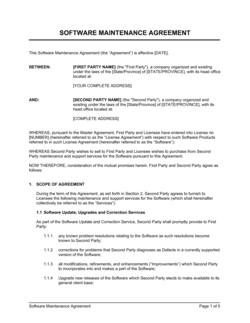
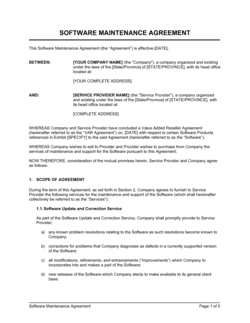
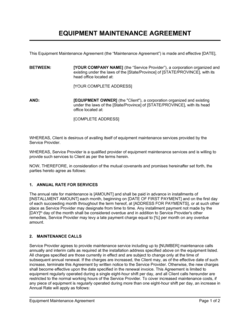
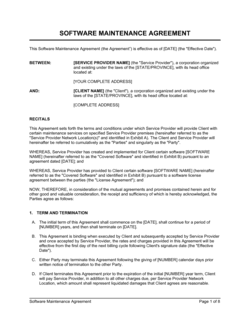
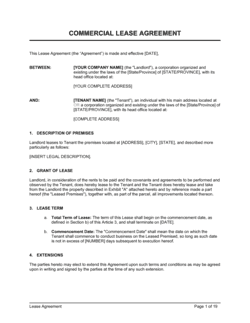
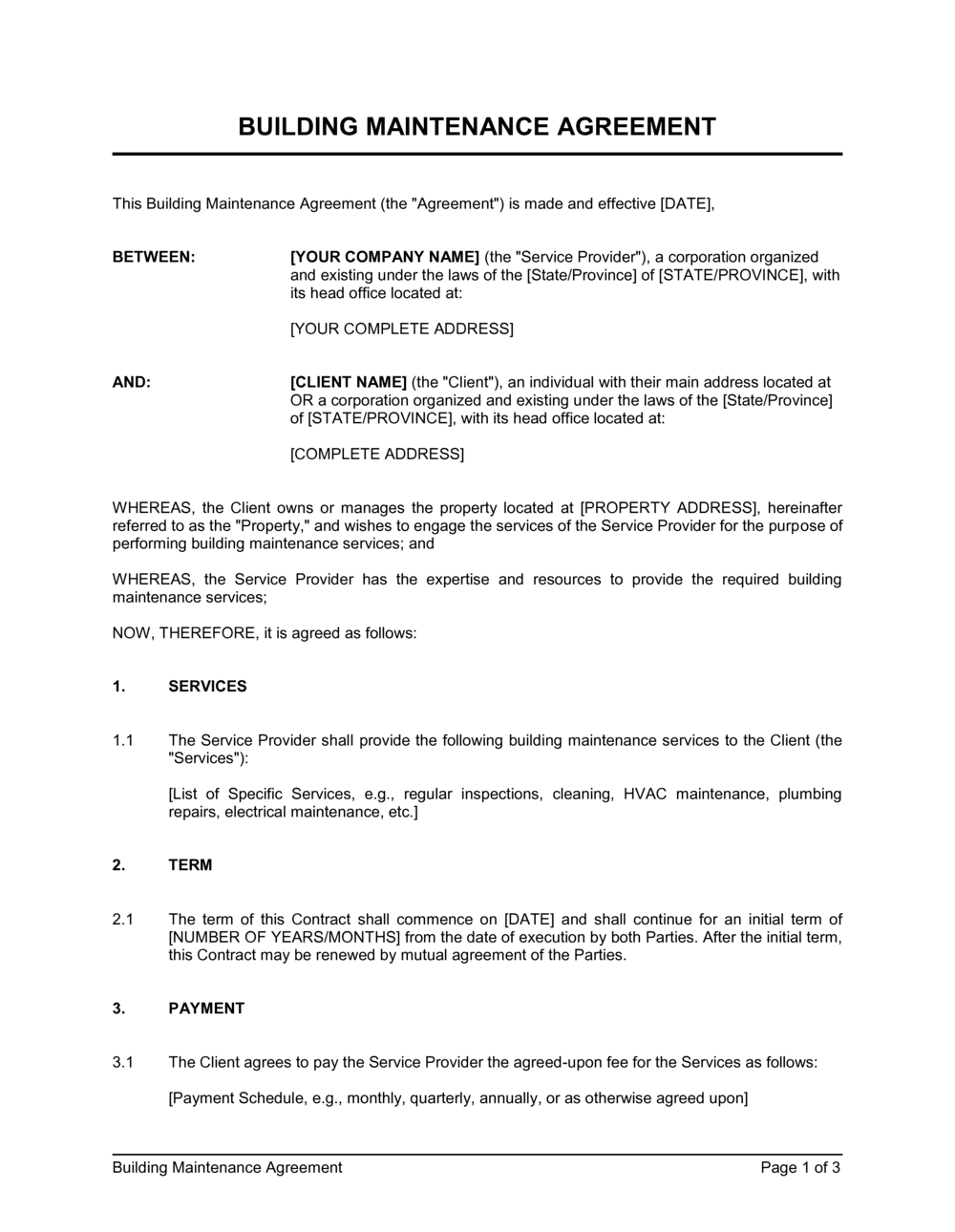
Building Maintenance Agreement Template

Free Word download • Edit online • Save & share with Drive • Export to PDF

3 pages25–30 min to fillDifficulty: StandardSignature requiredLegal review recommended
Learn more ↓
FreeBuilding Maintenance Agreement Template

At a glance

What it is
A Building Maintenance Agreement is a legally binding contract between a building owner or property manager and a maintenance services provider that governs the ongoing care of a commercial or residential property. This free Word download covers scope of services (HVAC, plumbing, electrical, janitorial, and grounds), service levels, response times, fees, and term — ready to edit online and export as PDF.
When you need it
Use it when engaging a vendor or in-house maintenance team to service a property on a recurring basis, or when formalizing an existing informal arrangement before a dispute arises. It is equally appropriate for a single-building owner and a property management company overseeing a commercial portfolio.
What's inside
Scope of services with system-level detail, scheduled and emergency response time commitments, fee structure and payment terms, liability and insurance requirements, termination provisions, and governing law. A schedule of included and excluded work prevents billing disputes after every service call.

What is a Building Maintenance Agreement?

A Building Maintenance Agreement is a legally binding contract between a building owner or property manager and a maintenance services provider that defines the terms under which the contractor will maintain the physical systems and common areas of a property. It covers the scope of covered systems — HVAC, plumbing, electrical, janitorial, and grounds — alongside scheduled and emergency service commitments, fee structures, insurance requirements, liability allocation, and termination rights. Unlike a one-off repair contract, a maintenance agreement governs an ongoing relationship and creates enforceable obligations for the full contract term, giving both parties a clear and predictable framework for every service call, invoice, and escalation.

Why You Need This Document

Without a written maintenance agreement, the scope of what the contractor is responsible for exists only in emails, phone calls, and assumptions — and those break down the moment a $3,000 HVAC repair is disputed or a subcontractor files a lien against your property for unpaid wages. A vague or absent contract leaves the owner unable to enforce response time standards, cap materials markups, or terminate a non-performing vendor without paying out the remaining term. It also exposes the property to mechanic's lien claims from subcontractors and suppliers the owner never hired directly. A properly drafted maintenance agreement closes all of these gaps: it locks in the service scope before the first work order, defines emergency response in minutes rather than good intentions, limits markup on parts, and requires lien waivers with every payment — turning a trust-based arrangement into an enforceable business relationship.

Which variant fits your situation?

If your situation is…Use this template
Ongoing multi-system maintenance for a commercial buildingBuilding Maintenance Agreement
Single-trade service contract for HVAC onlyHVAC Maintenance Agreement
Janitorial and cleaning services onlyJanitorial Services Agreement
One-time repair or renovation projectConstruction Contract
General property services including landscaping and snow removalProperty Management Agreement
Residential home warranty or repair servicesHome Repair Service Agreement
Engaging an independent handyperson for periodic tasksIndependent Contractor Agreement

Common mistakes to avoid

❌ Vague scope descriptions without a service schedule

Why it matters: A contract that says 'general building maintenance' gives the contractor discretion to decide what is included — and they will consistently decide borderline items are extra. Every service call becomes a negotiation.

Fix: Attach a Schedule A listing each system, the specific tasks covered, and frequency. Flag excluded work explicitly. Review and sign Schedule A separately at execution.

❌ Defining response time as a callback rather than on-site arrival

Why it matters: A contractor who calls back within 4 hours but arrives 18 hours later has technically met a 'response' SLA while your HVAC system fails mid-summer — leaving you without a contractual remedy.

Fix: Define response for each tier as 'a qualified technician physically on-site at the Premises' and specify the clock starts on written or verbal notification, not business hours.

❌ No materials markup cap

Why it matters: Without a stated maximum, contractors can mark up parts at 50–100% or more, turning a $200 repair into a $500 invoice. This is a leading cause of maintenance contract disputes.

Fix: Cap materials markup at 15–20% over contractor invoice cost and require the contractor to provide supplier invoices for any parts exceeding a set dollar threshold (e.g., $250).

❌ Failing to require additional insured status

Why it matters: A contractor's general liability policy covers the contractor's losses — not the owner's. If a maintenance worker causes property damage or bodily injury, the owner is exposed unless specifically added as additional insured.

Fix: Require additional insured endorsements in the insurance clause and verify the COI reflects this status before the first service visit — not after a claim has been filed.

❌ Auto-renewal with a 30-day non-renewal window

Why it matters: A 30-day window frequently falls inside a busy period — end of fiscal year, property transition, or management change — making it easy to miss and locking the owner into another full contract year.

Fix: Set the non-renewal notice period at 60–90 days and calendar the deadline immediately upon signing. Many owners set two calendar reminders: one at 90 days and one at 65 days.

❌ No lien waiver requirement for periodic payments

Why it matters: A subcontractor or supplier unpaid by the contractor can file a mechanic's lien against the property even after the owner has paid the contractor in full — the owner can be forced to pay twice.

Fix: Require conditional lien waivers from the contractor and all subcontractors with every payment, not just at project completion. File them with your property records for the term of the agreement.

The 10 key clauses, explained

Parties, property description, and effective date

In plain language: Identifies the building owner or property manager and the maintenance contractor as legal entities, describes the property by address and type, and records when the agreement takes effect.

Sample language
This Building Maintenance Agreement is entered into as of [DATE] between [OWNER LEGAL NAME], a [STATE/PROVINCE] [ENTITY TYPE] ('Owner'), and [CONTRACTOR LEGAL NAME], a [STATE/PROVINCE] [ENTITY TYPE] ('Contractor'), for the property located at [FULL ADDRESS] ('Premises').

Common mistake: Using a trade name or DBA instead of the contractor's registered legal entity. If the contractor is an LLC or corporation, the legal name must match their registration — mismatches create enforcement problems if the relationship sours.

Scope of services and included systems

In plain language: Defines exactly which building systems and tasks the contractor will service — HVAC, plumbing, electrical, janitorial, grounds — and attaches a schedule listing included and excluded work.

Sample language
Contractor shall perform the services described in Schedule A ('Services'), which includes [HVAC preventive maintenance / plumbing inspections / electrical panel checks / janitorial services / grounds care] for the Premises. Services not listed in Schedule A are excluded and subject to a separate written change order.

Common mistake: Describing scope in vague terms like 'general maintenance.' Without a system-by-system schedule, every service call becomes a negotiation over whether it is included — the most common source of billing disputes in maintenance contracts.

Service levels and response times

In plain language: Sets the performance standards the contractor must meet: how quickly they respond to routine requests, urgent issues, and true emergencies — and what constitutes each category.

Sample language
Contractor shall respond to Emergency Requests (defined as life-safety or total system failure) within [4] hours of notification. Urgent Requests shall receive a response within [1] business day. Routine Requests shall be scheduled within [5] business days. 'Response' means a qualified technician on-site.

Common mistake: Defining response as a phone call or acknowledgment rather than on-site arrival. If an HVAC system fails in July, a callback within 4 hours is not the same as a technician on-site within 4 hours — specify on-site.

Fees, invoicing, and payment terms

In plain language: States the fixed monthly or annual fee covering included services, the rate structure for excluded or additional work, invoicing frequency, and the payment due date with late-fee terms.

Sample language
Owner shall pay Contractor a monthly fee of $[AMOUNT] ('Base Fee') due within [15] days of invoice, covering all Services in Schedule A. Additional work authorized by Owner in writing shall be invoiced separately at $[RATE]/hour for labor plus material cost plus [X]%. Invoices unpaid after [30] days accrue interest at [1.5]% per month.

Common mistake: No markup cap on materials. Without a stated markup limit, a contractor can bill materials at any premium. Specify a maximum markup percentage (e.g., 15–20%) for all parts and materials.

Insurance and certificates of insurance

In plain language: Requires the contractor to maintain specified coverage levels, name the owner as additional insured, and provide a certificate of insurance before starting work and on each renewal.

Sample language
Contractor shall maintain, at its own expense: (a) Commercial General Liability insurance with limits of no less than $[1,000,000] per occurrence and $[2,000,000] aggregate; (b) Workers' Compensation as required by law; and (c) Umbrella/Excess Liability of no less than $[1,000,000]. Owner shall be named as additional insured on all policies. Contractor shall provide a COI upon execution and at each policy renewal.

Common mistake: Not requiring the owner to be listed as additional insured. A contractor's general liability policy does not protect the owner unless the owner is specifically added — an omission that regularly surfaces after a slip-and-fall or property damage claim.

Indemnification and liability

In plain language: Allocates risk between the parties — the contractor indemnifies the owner for losses caused by the contractor's negligence or employee conduct; the owner indemnifies the contractor for pre-existing property conditions.

Sample language
Contractor shall indemnify, defend, and hold harmless Owner from and against any claims, losses, or damages arising out of Contractor's negligence, willful misconduct, or breach of this Agreement. Owner shall indemnify Contractor for claims arising from pre-existing defects in the Premises known to Owner and not disclosed to Contractor.

Common mistake: A mutual indemnification clause that is perfectly symmetrical regardless of fault. Standard practice allocates indemnification to the party whose conduct caused the loss — symmetric clauses can make the owner liable for contractor negligence.

Term, renewal, and termination

In plain language: States the initial contract term, whether it auto-renews, the notice period required to cancel or non-renew, and the conditions for immediate termination for cause.

Sample language
This Agreement commences on [START DATE] and continues for an initial term of [1] year ('Initial Term'), renewing automatically for successive [1]-year periods unless either party provides [60] days' written notice of non-renewal. Either party may terminate for Cause immediately upon written notice if the other party fails to cure a material breach within [30] days of written notice.

Common mistake: Auto-renewal with only a 30-day non-renewal window. Most property owners operate on annual budget cycles — a 30-day window is easy to miss, locking the owner into another full year of fees under a contractor they want to replace.

Subcontractors and key personnel

In plain language: Governs whether the contractor may delegate work to subcontractors, requires owner approval for material changes in personnel, and ensures subcontractors are bound to the same insurance and conduct standards.

Sample language
Contractor may engage subcontractors to perform portions of the Services, provided that: (a) Owner's prior written consent is obtained for any subcontractor performing work valued above $[AMOUNT]; (b) each subcontractor carries the minimum insurance required under Section [X]; and (c) Contractor remains fully liable for subcontractor performance.

Common mistake: No subcontractor approval right for the owner. Without it, the contractor can substitute unvetted workers for the trained technicians the owner selected — a particular risk for security-sensitive or regulated properties.

Lien waivers and mechanic's liens

In plain language: Requires the contractor to provide lien waivers from itself and all subcontractors and suppliers with each payment, protecting the owner from lien claims against the property for unpaid downstream bills.

Sample language
As a condition of each payment, Contractor shall deliver to Owner a conditional lien waiver from Contractor and each subcontractor and material supplier who performed work or supplied materials during the applicable payment period, in the form attached as Schedule B.

Common mistake: Collecting lien waivers only at final payment. Subcontractors and suppliers can file liens for work performed many months earlier — getting waivers with each periodic payment eliminates accumulated lien exposure.

Governing law, dispute resolution, and entire agreement

In plain language: Specifies which jurisdiction's law governs, how disputes are resolved (arbitration, mediation, or court), and confirms the written contract supersedes all prior negotiations and representations.

Sample language
This Agreement is governed by the laws of [STATE/PROVINCE/COUNTRY]. Disputes not resolved by good-faith negotiation within [30] days shall be submitted to binding arbitration in [CITY] under [AAA / applicable rules]. This Agreement, together with its Schedules, constitutes the entire agreement between the parties and supersedes all prior representations.

Common mistake: No dispute-resolution mechanism at all. Without one, even minor billing disagreements default to expensive court litigation — a mediation-first clause resolves most maintenance contract disputes for under $2,000.

How to fill it out

  1. 1

    Identify both parties using legal entity names

    Enter the owner's or property management company's full registered legal name, the contractor's registered legal name, and the property address. Confirm entity names against state or provincial business registry records.

    💡 If the property is owned by an LLC or trust, use that entity's legal name as 'Owner' — not the individual owner's personal name — to preserve liability protection.

  2. 2

    Build Schedule A: scope of services

    List every system and task the contractor will service, organized by category — HVAC, plumbing, electrical, janitorial, grounds. For each, specify frequency (monthly, quarterly, annual) and what a standard service visit includes.

    💡 Add an 'Excluded Work' column to Schedule A for each system. Explicitly excluded items (e.g., full system replacements, structural repairs) prevent disputes over borderline service calls.

  3. 3

    Set response time tiers

    Define Emergency, Urgent, and Routine request categories with clear examples for each. Set on-site arrival times — not callback times — for each tier. Confirm the contractor can realistically meet the emergency window before execution.

    💡 For properties with refrigeration, server rooms, or medical equipment, set an emergency response time of 2–4 hours and confirm the contractor has 24/7 dispatch capability.

  4. 4

    Agree on the fee structure and materials markup

    Enter the monthly base fee, the hourly labor rate for out-of-scope work, and the maximum markup on materials. Confirm whether the base fee covers labor only or labor and parts for routine maintenance items.

    💡 Negotiate a not-to-exceed amount for out-of-scope jobs below a set threshold (e.g., $500) that the contractor can proceed without a separate written change order — this avoids administrative delays for small repairs.

  5. 5

    Verify insurance requirements and collect the COI

    Set minimum coverage amounts appropriate to the property's size and risk profile. Collect the certificate of insurance before work begins, confirm the owner is listed as additional insured, and calendar the policy renewal date for re-verification.

    💡 For properties with more than 50,000 sq ft or heavy foot traffic, require a $5M umbrella policy — the $1M general liability floor is often insufficient for a single serious incident.

  6. 6

    Set the term, renewal notice period, and termination-for-cause cure period

    Choose an initial term of 1 or 2 years. Set the auto-renewal notice period at 60–90 days to align with budget cycles. Set a 30-day cure period for material breaches before termination for cause takes effect.

    💡 Calendar the non-renewal deadline in your property management system the day you sign — a missed 60-day window can lock you into another year of fees.

  7. 7

    Attach Schedule B: lien waiver forms

    Include a conditional lien waiver template as Schedule B and require it with every payment. Confirm your jurisdiction's required lien waiver language — some states mandate specific statutory forms.

    💡 In California, Texas, and several other states, unconditional lien waivers signed before payment clears are not enforceable — always use conditional waivers tied to payment receipt.

  8. 8

    Execute before work begins and store the signed copy

    Both parties must sign before the first service visit. Use electronic signatures with a timestamp for the clearest record. File the fully executed agreement, all schedules, and the COI together in your property records.

    💡 Send the contractor a copy of the signed agreement with Schedule A highlighted — disputes most often arise because the contractor claims they never received the scope schedule.

Frequently asked questions

What is a building maintenance agreement?

A building maintenance agreement is a contract between a property owner or manager and a maintenance services provider that governs the ongoing care of a building's systems and common areas. It defines exactly which systems are covered — HVAC, plumbing, electrical, janitorial, grounds — how quickly the contractor must respond to issues, what fees apply, and how the relationship can be terminated. Without one, service expectations and billing disputes are resolved by negotiation rather than enforceable written terms.

What should a building maintenance agreement include?

At minimum: legal names of both parties and property address, a detailed scope-of-services schedule with included and excluded work, service-level response times by request category, fee structure and materials markup cap, insurance requirements with additional insured status, indemnification allocation, term and auto-renewal notice period, lien waiver requirements, and governing law with a dispute-resolution mechanism.

What is the difference between a building maintenance agreement and a property management agreement?

A building maintenance agreement covers the physical upkeep of a building's systems and common areas — HVAC, plumbing, electrical, and grounds. A property management agreement covers broader operational responsibilities: tenant relations, rent collection, lease enforcement, accounting, and vendor management. Large properties often use both — the property manager oversees the relationship, while the maintenance contractor executes the physical work under a separate agreement.

How are building maintenance fees typically structured?

Most agreements combine a fixed monthly or annual base fee covering all scheduled preventive maintenance with a separate hourly or per-job rate for corrective or out-of-scope work. Materials are typically billed at cost plus a negotiated markup, commonly 15–20%. Some contracts use a flat all-inclusive fee for properties where work volume is predictable — this is simpler to administer but requires accurate historical data to price fairly for both parties.

Is a building maintenance agreement legally required?

No federal or provincial law in the US or Canada mandates a written building maintenance contract for private commercial properties, though some local regulations governing multi-family residential buildings or government-owned facilities may require formal service documentation. Despite the absence of a legal mandate, a written agreement is strongly advisable — verbal maintenance arrangements routinely end in billing disputes, lien filings, and liability gaps that a one-page contract would have resolved.

How long should a building maintenance agreement be?

Initial terms of one or two years are standard for commercial properties. One-year terms give owners flexibility to renegotiate pricing or switch vendors after an evaluation period; two-year terms typically attract lower per-year fees because the contractor can amortize mobilization costs. For large or complex facilities, three-year terms with annual CPI-linked fee escalators are common. Always pair the term length with an auto-renewal notice period of at least 60 days.

What insurance should a building maintenance contractor carry?

At minimum: Commercial General Liability with limits of $1M per occurrence and $2M aggregate, Workers' Compensation at statutory limits, and an Umbrella or Excess Liability policy of at least $1M. For larger properties, HVAC or electrical specialists, or contractors using heavy equipment, higher limits and additional lines — contractor's pollution liability, professional liability — may be appropriate. The owner should always be named as additional insured on the CGL and umbrella policies.

Can a building maintenance agreement be terminated early?

Termination rights depend entirely on the contract terms. Most agreements allow immediate termination for cause — material breach uncured after a notice period, typically 30 days. Termination without cause typically requires 60–90 days' written notice and may carry an early termination fee equal to one to three months of the base fee. Contracts that allow termination without cause on short notice with no penalty are generally more favorable to owners but harder to negotiate with established vendors.

Do I need a lawyer to draft a building maintenance agreement?

For straightforward single-property arrangements with a local contractor, a well-drafted template is typically sufficient with basic customization. Consider engaging a lawyer when the contract covers a high-value commercial portfolio, involves complex multi-trade SLAs with liquidated damages, includes government-regulated facilities, or when the contractor proposes substantial modifications to the standard indemnification or insurance clauses. A 1–2 hour legal review typically costs $300–$700 and is worthwhile before signing any agreement over $50,000 per year.

How this compares to alternatives

vs Property Management Agreement

A property management agreement delegates broad operational authority — tenant relations, rent collection, lease enforcement, and vendor oversight — to a management company. A building maintenance agreement is narrower: it governs only the physical upkeep of the building's systems. Most commercial properties need both, with the property manager overseeing the maintenance contractor relationship.

vs Construction Contract

A construction contract governs a defined project with a fixed scope, timeline, and completion milestone — building an addition, replacing a roof, or renovating a floor. A maintenance agreement governs ongoing, recurring services with no defined end. Use a construction contract for capital improvements and a maintenance agreement for routine and emergency upkeep.

vs Independent Contractor Agreement

An independent contractor agreement is a general-purpose document for engaging a self-employed individual on a project or ongoing basis. It lacks the property-specific provisions of a maintenance agreement — no scope schedule, no response time SLAs, no lien waiver requirements, and no insurance minimums calibrated to building risk. Use a maintenance agreement whenever a vendor is servicing physical building systems.

vs Service Level Agreement (SLA)

A standalone SLA defines performance metrics — response times, uptime targets, and remedies for non-performance — but is not a complete contract. A building maintenance agreement incorporates SLA-style commitments alongside fee terms, insurance, liability allocation, and termination rights in a single enforceable document. For most building maintenance relationships, the full agreement is preferable to a standalone SLA.

Industry-specific considerations

Commercial Real Estate

Multi-system SLAs across office, retail, and mixed-use portfolios; portfolio-wide pricing tiers and quarterly performance reviews are standard.

Healthcare Facilities

HVAC and air-handling systems subject to infection-control standards; response time SLAs must account for 24/7 operations and accreditation requirements.

Retail and Hospitality

Customer-facing common areas require same-day response to visible defects; janitorial frequency is typically daily and tied to occupancy hours.

Manufacturing and Industrial

Production-critical systems (compressed air, electrical distribution) carry emergency response SLAs of 2 hours or less; contractor must hold relevant trade licenses and safety certifications.

Jurisdictional notes

United States

Mechanic's lien laws vary significantly by state — California, Texas, and Florida have strict preliminary notice requirements that must be met before a lien can be filed or waived. Several states prescribe mandatory lien waiver forms. Contractor licensing requirements for HVAC, electrical, and plumbing work are state-specific; verify that service technicians hold the required trade licenses for the property's jurisdiction before execution.

Canada

Construction lien (or builder's lien) legislation is provincial — Ontario's Construction Act, Alberta's Builders' Lien Act, and BC's Builders Lien Act each have different holdback, notice, and waiver requirements. In Ontario, a 10% statutory holdback on each payment is required for contracts over a defined threshold. Quebec civil law governs contracts differently from common-law provinces; hypothec (lien) provisions and contract interpretation rules require Quebec-specific drafting.

United Kingdom

The Construction Act (Housing Grants, Construction and Regeneration Act 1996, as amended) applies to most building maintenance contracts and imposes mandatory payment notice, pay-less notice, and adjudication rights that cannot be contracted out of. Contractors have a statutory right to suspend services for non-payment after proper notice. Health and Safety at Work obligations require both parties to cooperate on risk assessments and method statements for higher-risk activities.

European Union

No single EU-wide framework governs building maintenance contracts; national civil and commercial codes apply. Late Payment Directive (2011/7/EU) sets maximum 60-day payment terms for commercial contracts and entitles contractors to statutory interest on late payments without a contractual provision. GDPR applies if the maintenance contractor accesses building management systems that log occupant movement or identity data — a data processing addendum may be required.

Template vs lawyer — what fits your deal?

PathBest forCostTime
Use the templateSingle-property owners or small property managers engaging a local maintenance contractor for standard multi-trade servicesFree30–60 minutes
Template + legal reviewContracts above $50,000/year, portfolios of three or more buildings, or agreements with non-standard indemnification or SLA terms proposed by the contractor$300–$7002–4 days
Custom draftedGovernment-regulated facilities, healthcare properties with accreditation requirements, or large portfolios with liquidated-damages provisions and multi-trade performance bonds$1,500–$5,000+1–3 weeks

Glossary

Scope of Services
The specific systems, tasks, and locations the maintenance provider is contractually obligated to service, as listed in a schedule attached to the agreement.
Service Level Agreement (SLA)
A commitment to measurable performance standards — such as responding to an emergency within 4 hours or completing routine inspections on a set schedule.
Emergency Response Time
The maximum time within which the contractor must arrive on-site after receiving an emergency call, typically defined separately from routine-request response times.
Preventive Maintenance
Scheduled, proactive servicing of building systems — filter changes, belt inspections, lubrication — intended to prevent breakdowns before they occur.
Corrective Maintenance
Reactive work performed to restore a system or component to operating condition after a failure or reported defect.
Excluded Work
Tasks, systems, or conditions explicitly outside the contract scope, typically listed in a schedule, for which additional charges apply if the owner requests service.
Liquidated Damages
A pre-agreed dollar amount the contractor pays the owner for each day or incident of SLA non-compliance, specified in the contract rather than left to a court to calculate.
Indemnification
A clause requiring one party to compensate the other for losses, claims, or damages arising from specified events — typically the contractor's negligence or employee conduct.
Certificate of Insurance (COI)
A document from the contractor's insurer confirming that required coverage — general liability, workers' compensation, and umbrella — is in force and names the owner as additional insured.
Lien Waiver
A document signed by the contractor (and subcontractors) confirming they have been paid and waiving the right to file a mechanic's lien against the property for that payment period.
Term and Renewal
The contract's initial duration and whether it auto-renews for successive periods unless one party provides advance written notice of non-renewal.

Part of your Business Operating System

This document is one of 3,000+ business & legal templates included in Business in a Box.

  • Fill-in-the-blanks — ready in minutes
  • 100% customizable Word document
  • Compatible with all office suites
  • Export to PDF and share electronically

Create your document in 3 simple steps.

From template to signed document — all inside one Business Operating System.
1
Download or open template

Access over 3,000+ business and legal templates for any business task, project or initiative.

2
Edit and fill in the blanks with AI

Customize your ready-made business document template and save it in the cloud.

3
Save, Share, Send, Sign

Share your files and folders with your team. Create a space of seamless collaboration.

Save time, save money, and create top-quality documents.

★★★★★

"Fantastic value! I'm not sure how I'd do without it. It's worth its weight in gold and paid back for itself many times."

Managing Director · Mall Farm
Robert Whalley
Managing Director, Mall Farm Proprietary Limited
★★★★★

"I have been using Business in a Box for years. It has been the most useful source of templates I have encountered. I recommend it to anyone."

Business Owner · 4+ years
Dr Michael John Freestone
Business Owner
★★★★★

"It has been a life saver so many times I have lost count. Business in a Box has saved me so much time and as you know, time is money."

Owner · Upstate Web
David G. Moore Jr.
Owner, Upstate Web

Run your business with a system — not scattered tools

Stop downloading documents. Start operating with clarity. Business in a Box gives you the Business Operating System used by over 250,000 companies worldwide to structure, run, and grow their business.

Free Forever Plan · No credit card required