Musician Contract Template

Free Word download β€’ Edit online β€’ Save & share with Drive β€’ Export to PDF

3 pagesβ€’25–30 min to fillβ€’Difficulty: Standardβ€’Signature requiredβ€’Legal review recommended
Learn more ↓
FreeMusician Contract Template

At a glance

What it is
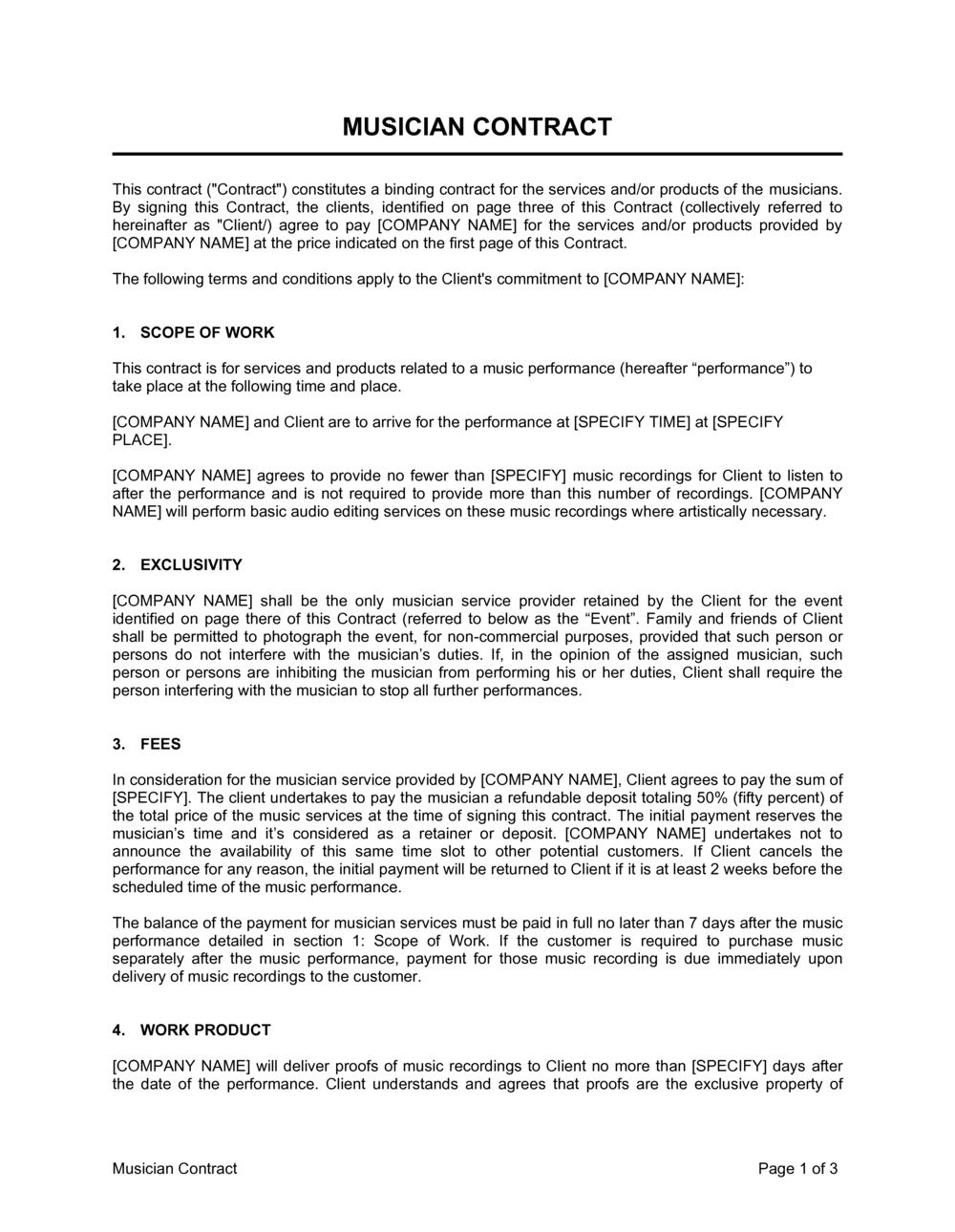
A Musician Contract is a legally binding agreement between a music act β€” a solo artist, band, or session musician β€” and the person or organization hiring them for a performance or recording engagement. This free Word download covers performance fees, set times, technical riders, cancellation terms, and intellectual property rights in a single document you can edit online and export as PDF.
When you need it
Use it any time you book a live performer, commission a session recording, or engage a musician as part of an event production β€” whether the fee is $500 or $50,000. Both the hiring party and the musician need a signed agreement before the engagement date to protect against cancellations, fee disputes, and equipment conflicts.
What's inside
Engagement details, performance fee and payment schedule, technical and hospitality riders, cancellation and force majeure terms, IP and recording rights, representations and warranties, and governing law. A Schedule A attaches the full technical rider separately so the body of the contract stays clean.

What is a Musician Contract?

A Musician Contract is a legally binding agreement between a musician or band and the party hiring them β€” a venue, event promoter, wedding planner, or private client β€” that defines the complete terms of a live performance or studio recording engagement. It sets the performance fee and payment schedule, specifies set times and sound check requirements, incorporates a technical and hospitality rider, governs cancellation rights and penalties for both parties, and determines who owns any recordings or broadcasts made during the performance. Unlike a verbal booking or a simple exchange of emails, a properly executed musician contract gives both sides enforceable rights and a clear framework for resolving disputes before they escalate.

Why You Need This Document

Without a written musician contract, both the artist and the hiring party are exposed to disputes that are difficult and expensive to resolve. Artists who perform without a signed agreement have no documented right to demand the agreed fee if the venue disputes the amount after the show β€” and no leverage to prevent the event from being livestreamed, recorded, and monetized without consent. Hiring parties who book verbally have no grounds to recover their deposit if the act cancels a week before a high-stakes corporate event or wedding. Technical riders that exist only in an email chain are routinely ignored, leaving artists to perform on inadequate equipment with no contractual remedy. A signed musician contract, executed before the deposit clears, closes all of these gaps and protects the performance, the payment, and the recording rights for every party involved.

Which variant fits your situation?

If your situation is…Use this template
Booking a live band or solo artist for a one-time eventMusician Contract (Live Performance)
Hiring session musicians for a studio recordingSession Musician Agreement
Engaging a DJ instead of a live actDJ Services Contract
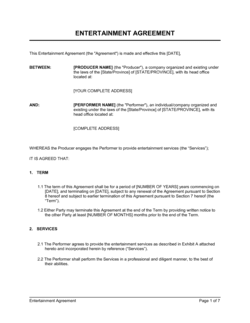
Booking an entertainer or performer who is not a musicianEntertainment Contract
Signing an artist to a record label for multiple releasesRecord Label Contract
Licensing a musical composition or master recording for commercial useMusic License Agreement
Engaging a musician as a long-term touring band memberBand Member Agreement

Common mistakes to avoid

❌ No rider incorporated by reference

Why it matters: Without a signed technical rider, the venue has no documented obligation to provide specific equipment, and the artist may arrive to find an inadequate PA system or missing backline β€” with no contractual remedy.

Fix: Attach the full technical and hospitality rider as Schedule A, have the venue manager sign it at booking, and include a remediation clause stating what happens if material items are missing on event day.

❌ Balance due 'after the performance'

Why it matters: Venues and promoters routinely dispute payment after the fact β€” citing sound quality, set length, or crowd reaction as grounds to withhold the balance. Once the artist has performed, leverage is gone.

Fix: Require the balance to be paid before the sound check or before the performance begins, and state this explicitly in the payment clause.

❌ No cancellation sliding scale for the client

Why it matters: A flat 'deposit is non-refundable regardless of when cancellation occurs' provision is difficult to enforce in many jurisdictions and may be voided as a penalty clause rather than a genuine pre-estimate of loss.

Fix: Use a graduated cancellation schedule tied to days before the event β€” for example, 25% of total fee if cancelled more than 90 days out, 50% within 90 days, 100% within 30 days.

❌ Silent on recording and livestreaming rights

Why it matters: Modern events are routinely filmed and posted on social media or monetized on YouTube. An absent clause means the artist has no documented right to object to commercial exploitation of their performance.

Fix: Include an explicit recording clause that defaults to 'no recording without prior written consent' and specifies the permitted uses if consent is granted.

❌ Using the band's stage name as the contracting party

Why it matters: A stage name has no legal standing β€” it cannot sue or be sued. If the band is an LLC or partnership, the contract must name the legal entity; otherwise, enforcing payment or cancellation terms requires identifying the responsible individual.

Fix: Ask for the band's legal business name and entity type at the time of booking. If they operate as individuals, use all members' legal names or designate a single contracting member.

❌ No independent contractor clause for recurring bookings

Why it matters: A venue that books the same musician every weekend without a clear independent-contractor clause risks an employment misclassification claim, which can trigger back payroll taxes, penalties, and claims for employment benefits.

Fix: Include an explicit independent-contractor clause in every booking agreement regardless of how frequently the musician performs at the venue.

The 9 key clauses, explained

Parties, engagement description, and event details

In plain language: Identifies the hiring party and the musician as legal entities, names the event, and records the confirmed date, set time, and venue address.

Sample language
This Musician Contract is entered into as of [DATE] between [HIRING PARTY LEGAL NAME] ('Client') and [MUSICIAN / BAND LEGAL NAME] ('Artist'). Artist is engaged to perform at [EVENT NAME] at [VENUE NAME AND ADDRESS] on [EVENT DATE], commencing at [START TIME] and concluding no later than [END TIME].

Common mistake: Using a band's stage name instead of its legal business entity. If the band is an LLC or partnership, the contract must name the entity β€” otherwise enforcement against members individually becomes legally complicated.

Performance fee, deposit, and payment schedule

In plain language: States the total agreed fee, the deposit amount and due date, and when the balance must be paid β€” typically on the day of the event before the performance begins.

Sample language
Client shall pay Artist a total performance fee of $[AMOUNT]. A non-refundable deposit of $[DEPOSIT AMOUNT] is due upon execution of this Agreement. The remaining balance of $[BALANCE] is due no later than [PAYMENT DATE / 'the day of the event prior to sound check'].

Common mistake: Not specifying when the balance is due. 'After the event' creates leverage for the hiring party to withhold payment over perceived performance issues. Requiring payment before the performance begins protects the artist.

Performance schedule and sound check

In plain language: Sets the exact set length and number of sets, the sound check time, and any scheduled breaks β€” giving both parties a clear shared expectation of the timeline.

Sample language
Artist shall perform [NUMBER] set(s) of approximately [X] minutes each, with a [X]-minute break between sets. Artist shall have access to the venue for sound check from [TIME] to [TIME] on the event date.

Common mistake: Omitting the sound check time entirely. When the venue is unavailable for the agreed window or overbooks the space, the musician has no documented entitlement to claim the time β€” and performance quality suffers as a result.

Technical and hospitality rider

In plain language: Incorporates the musician's technical requirements (PA system, microphones, monitors, backline) and hospitality requirements (dressing room, meals, parking) by reference to an attached Schedule A.

Sample language
Client shall provide the equipment and accommodations set out in Schedule A (Technical and Hospitality Rider), attached hereto and incorporated herein. Failure to provide any material item in Schedule A shall entitle Artist to [terminate the Agreement without liability / adjust the performance accordingly].

Common mistake: Embedding the full rider in the body of the contract. Riders change across venues β€” attaching it as a Schedule A means you can update it without amending the main agreement.

Cancellation, rescheduling, and force majeure

In plain language: Defines what happens to the deposit and fee if either party cancels, the conditions under which rescheduling is permitted without penalty, and the force majeure events that excuse performance without liability.

Sample language
Cancellation by Client within [90] days of the event date: Client forfeits 100% of the deposit. Cancellation within [30] days: Client owes [50]% of the total fee. Cancellation by Artist within [30] days: Artist shall refund the deposit in full. Neither party is liable for cancellation due to [acts of God, government orders, venue closure, or declared state of emergency].

Common mistake: A flat 'deposit is non-refundable' clause with no sliding scale or artist-cancellation remedy. Courts in several jurisdictions have voided one-sided forfeiture clauses as penalties. A graduated scale tied to proximity to the event date is more consistently enforced.

Intellectual property and recording rights

In plain language: Specifies whether the Client may record, livestream, photograph, or broadcast the performance, and who owns the resulting content β€” typically the artist retains rights unless a specific license or buyout is granted.

Sample language
Client [may / may not] record or broadcast the performance without the prior written consent of Artist. Any permitted recording is licensed to Client solely for [personal / promotional] use and may not be sold, sublicensed, or distributed commercially. Artist retains all rights in the underlying compositions and master recordings.

Common mistake: No recording clause at all. Event photos and videos are routinely posted online and monetized on social media without the artist's knowledge. An absent clause means no clear right to object, and the artist's master recordings may be exploited without compensation.

Representations, warranties, and independent contractor status

In plain language: Both parties confirm they have the authority to enter the contract. The clause also clarifies that the musician is an independent contractor, not an employee β€” preserving the hiring party from payroll tax and employment law obligations.

Sample language
Each party represents that it has full authority to enter into this Agreement. Artist is engaged as an independent contractor and not as an employee of Client. Client shall not withhold income taxes, Social Security, or Medicare from Artist's fee; Artist is solely responsible for all applicable self-employment taxes.

Common mistake: Omitting the independent-contractor clause for recurring bookings. A venue that books the same band every Friday night for months without a contractor clause risks an employment misclassification claim, triggering back payroll taxes and potential benefits liability.

Indemnification and liability

In plain language: Each party agrees to defend and compensate the other for losses arising from their own negligence or breach β€” limiting cross-exposure when equipment damages a venue or a venue's infrastructure injures a performer.

Sample language
Each party ('Indemnifying Party') shall indemnify and hold harmless the other party from any claims, damages, or losses arising out of the Indemnifying Party's negligence, willful misconduct, or breach of this Agreement.

Common mistake: A one-sided indemnification that only protects the venue. Courts scrutinize unfair indemnity provisions, and a musician who signs a clause indemnifying the venue for the venue's own negligence may be bound by it in jurisdictions that permit such waivers.

Governing law and dispute resolution

In plain language: Specifies which jurisdiction's law governs the agreement and whether disputes are resolved by arbitration, mediation, or litigation β€” and in which city.

Sample language
This Agreement is governed by the laws of [STATE / PROVINCE / COUNTRY]. Any dispute shall be resolved by [binding arbitration / mediation before litigation] administered by [AAA / applicable body] in [CITY], except that either party may seek injunctive relief in any court of competent jurisdiction.

Common mistake: Choosing a governing law that has no connection to the event location or either party's domicile. Several states and countries apply local law regardless of what the contract specifies, creating a conflict that invalidates the chosen forum.

How to fill it out

  1. 1

    Identify the parties using their legal names

    Enter the hiring party's full legal entity name and the musician's legal name or registered business entity. For a band, use the LLC, partnership, or sole-proprietor name β€” not just the stage name.

    πŸ’‘ Ask for a W-9 (US) or equivalent tax form at signing so you have the artist's legal name and tax ID on file before the event date.

  2. 2

    Confirm and enter all event logistics

    Record the venue's full address, the confirmed event date, the performance start and end times, and the sound check window. Be specific β€” '7:00 PM to 10:00 PM, three sets of 50 minutes each with 10-minute breaks' leaves no room for dispute.

    πŸ’‘ Add a clause allowing the schedule to shift by up to 30 minutes in either direction with mutual written consent β€” live events rarely run exactly on time.

  3. 3

    State the total fee and payment schedule

    Enter the total performance fee, the deposit amount (25–50% is standard), the deposit due date, and the balance due date. Specify the payment method β€” check, bank transfer, or platform β€” and include wire or ACH details if applicable.

    πŸ’‘ Require the balance to be paid before the sound check begins, not after the performance. Once the set is over, the artist's negotiating leverage disappears.

  4. 4

    Attach and reference the technical and hospitality rider

    Complete Schedule A with the full list of equipment the venue must supply β€” PA system, microphones, monitor mix, backline, and any special lighting. Add hospitality items: meals, parking passes, dressing room access, and temperature requirements.

    πŸ’‘ Have the venue manager sign Schedule A separately at the time of contracting to confirm they have read and accepted the rider β€” not just the body of the contract.

  5. 5

    Set the cancellation and rescheduling terms

    Write in the sliding-scale cancellation fees for the client and the artist's refund obligations if the artist cancels. Define which events trigger the force majeure clause and confirm those events excuse performance without further liability.

    πŸ’‘ Include a rescheduling window β€” e.g., 'Client may reschedule once within 90 days of the original date without forfeiting the deposit' β€” to give both parties flexibility without voiding the agreement.

  6. 6

    Define recording and broadcast permissions

    Decide explicitly whether the client may record, photograph, or stream the performance. If permitted, specify the permitted uses (personal, promotional, commercial) and whether the artist receives attribution or a separate licensing fee.

    πŸ’‘ If the event will be livestreamed, address the platform separately β€” streaming a performance that includes cover songs requires a separate license from the performing rights organization (PRO) in most jurisdictions.

  7. 7

    Execute before the event date

    Both parties must sign β€” and the deposit must clear β€” before the performance date. Digital signatures are valid in most jurisdictions. Store the fully executed copy in a location both parties can access.

    πŸ’‘ Send a countersigned copy to the artist within 24 hours of execution. Delays in returning signed contracts are the single most common reason bookings fall apart at the last minute.

Frequently asked questions

What is a musician contract?

A musician contract is a legally binding agreement between a musician or band and the party hiring them β€” a venue, promoter, event planner, or private client β€” that defines the terms of a performance or recording engagement. It covers the performance fee, set time and duration, technical requirements, cancellation terms, and intellectual property rights. A signed contract protects both parties if a dispute arises over payment, scheduling, or the use of recordings after the event.

Do I need a contract for a small local gig?

Yes. Even for low-fee local bookings, a written agreement protects both parties. Common disputes β€” a venue refusing to pay the full fee, an artist cancelling at the last minute, or an unauthorized recording appearing online β€” are far easier to resolve when the terms are documented. A basic one-page musician contract takes less time to complete than a verbal negotiation and eliminates ambiguity entirely.

Who provides the musician contract β€” the artist or the client?

Either party can initiate the contract. Established artists and their managers typically provide their own rider-backed agreement. For smaller bookings β€” corporate events, weddings, or private parties β€” the hiring party often provides the contract. Regardless of who drafts it, both parties should review every clause before signing. The party who provides the template tends to include terms more favorable to their position.

What should a musician contract include?

At minimum: the legal names of both parties, the event date, venue address, and set time; the total performance fee and payment schedule; the deposit amount and non-refundability; the technical and hospitality rider by reference; cancellation terms for both parties; recording and livestreaming permissions; independent contractor status; indemnification; and governing law. Missing any of these creates gaps that are filled by jurisdiction-specific defaults β€” usually less favorable to whichever party did not raise the issue.

How much deposit should a musician require?

A deposit of 25–50% of the total performance fee is standard practice. High-demand artists for peak-season events β€” weddings on summer Saturdays, New Year's Eve bookings β€” often require 50% upfront because the cost of a last-minute cancellation is highest for those dates. The deposit should be clearly marked non-refundable in the contract and should be collected at the time of signing, not later.

What happens if the musician cancels?

The contract should require the musician to refund the deposit in full if they cancel, and may require additional compensation if cancellation occurs close to the event date. In practice, a force majeure clause β€” covering illness, family emergency, or natural disaster β€” typically excuses the artist from the penalty if the cancellation is genuinely beyond their control. Without a written cancellation clause, the client's remedy depends entirely on local contract law, which varies significantly by jurisdiction.

Can the venue record the performance without permission?

Not without the artist's consent, in most jurisdictions. The performer typically holds recording rights in their live performance under copyright law. A venue that records, livestreams, or posts a performance without authorization may be liable for copyright infringement. The musician contract should explicitly state whether recording is permitted, for what purposes, and whether the artist receives a separate fee or credit for licensed use.

Is a musician an employee or an independent contractor?

For most one-time or occasional performance bookings, a musician is an independent contractor. The contract should state this explicitly and confirm that the hiring party is not responsible for withholding income tax, Social Security, or Medicare. However, classification depends on the actual working relationship β€” not just the label in the contract. A musician who works exclusively for one venue on a fixed weekly schedule may be reclassified as an employee by a tax authority regardless of what the contract says.

Do I need a lawyer to draft a musician contract?

For standard live performance bookings, a high-quality template is typically sufficient. Consider engaging a music or entertainment lawyer when the performance fee exceeds $10,000, the booking involves a recording or broadcast deal, the event is a multi-date tour, or you are operating in a jurisdiction with complex employment or IP rules. A one-hour legal review for a high-value booking typically costs $200–$500 and is worthwhile when the stakes justify it.

How this compares to alternatives

vs DJ Services Contract

A DJ contract covers many of the same terms β€” fee, set time, equipment, and cancellation β€” but addresses DJ-specific considerations like track licensing, playlist control, and the use of pre-recorded media. A musician contract applies to live performers and typically includes a more detailed technical rider covering live instrument backline and monitors. Use the DJ contract when hiring a DJ and this template when booking a live act.

vs Entertainment Contract

An entertainment contract covers a broad range of performers β€” comedians, magicians, speakers, and dancers β€” with general performance terms. A musician contract is specifically structured for musical acts and includes IP and recording-rights language tied to copyright law, a detailed technical rider framework, and session musician considerations that a generic entertainment contract does not address.

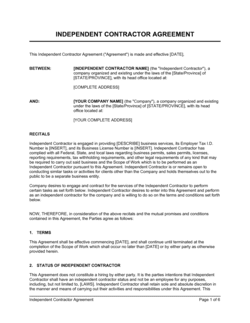
vs Independent Contractor Agreement

An independent contractor agreement governs a wide range of project-based working relationships. It lacks the musician-specific provisions β€” technical riders, set times, recording rights, and sound check clauses β€” that a proper musician contract addresses. Use a musician contract for any performance booking; the contractor agreement is appropriate for ongoing service relationships like music production consulting or management.

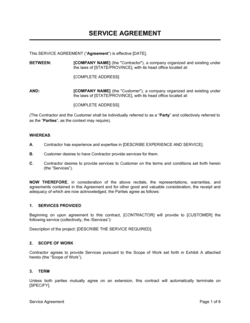
vs Service Agreement

A service agreement is a general-purpose document for ongoing or project-based service delivery and does not address the live-event logistics, performance IP, or cancellation dynamics specific to music bookings. A musician contract uses the service delivery framework but layers in entertainment-industry-standard clauses that a generic service agreement omits β€” including rider incorporation, recording permissions, and AFM union references where applicable.

Industry-specific considerations

Events and entertainment

Live performance bookings for concerts, festivals, and private events require detailed cancellation ladders, full technical riders, and explicit recording-rights clauses given the high volume and value of bookings.

Hospitality and venues

Restaurants, bars, and nightclubs booking recurring or one-off live acts need independent-contractor language in every agreement to avoid payroll misclassification risk on high-frequency bookings.

Wedding and corporate events

High-stakes single-date events demand firm deposit and cancellation terms, hospitality rider compliance, and clear liability allocation for equipment damage or scheduling overruns.

Music production and recording

Session musician agreements for studio work center on IP ownership and work-for-hire classification β€” the hiring party must secure a written assignment of rights or a buyout to own the master recording without future royalty obligations.

Jurisdictional notes

United States

In the US, live performance contracts are governed by state contract law, so enforceability of cancellation clauses and non-compete provisions varies by state. Musicians engaged through the American Federation of Musicians (AFM) union must use AFM-approved contracts with minimum scale pay and pension contributions. Recording rights in live performances are protected under federal copyright law β€” venues that stream performances containing cover songs must obtain a separate synchronization license from the relevant performing rights organization (ASCAP, BMI, or SESAC).

Canada

Canadian musician contracts must comply with provincial employment standards where a musician could be classified as a dependent contractor. The Canadian Federation of Musicians (CFM) sets minimum fees and contract requirements for union engagements. In Quebec, contracts must be provided in French for provincially-regulated events. Recording and broadcasting rights are governed by the Copyright Act and administered through SOCAN and Re:Sound β€” venues must hold valid public performance licenses.

United Kingdom

UK performance contracts are governed by the Contracts (Rights of Third Parties) Act 1999 and general contract law principles. Musicians' Union (MU) members are entitled to minimum session rates under collective agreements. Live recordings and broadcasts require licenses from PRS for Music and PPL. Cancellation clauses that impose disproportionate penalties may be challenged under the Unfair Contract Terms Act 1977 and the Consumer Rights Act 2015 if the client is a consumer rather than a business.

European Union

EU member states each apply local labor and copyright law to musician engagements, but the EU Copyright Directive (2019/790) strengthens performers' rights to fair remuneration and requires transparency from venues and promoters. Germany, France, and the Netherlands have strong collective bargaining frameworks that set minimum rates for professional musicians. GDPR applies to any personal data β€” including artist images and contact information β€” collected or processed in connection with the booking. Multi-country touring agreements should specify governing law carefully to avoid jurisdictional conflict.

Template vs lawyer β€” what fits your deal?

PathBest forCostTime
Use the templateStandard live performance bookings for weddings, corporate events, and local venues with fees under $10,000Free20–30 minutes
Template + legal reviewFestival bookings, multi-date engagements, or bookings that include a recording or broadcast component$200–$500 for a one-hour entertainment lawyer review1–3 days
Custom draftedMajor touring agreements, record label-backed performances, international bookings, or engagements involving union (AFM) musicians$1,500–$5,000+1–3 weeks

Glossary

Technical Rider
A document attached to a performance contract specifying the musician's equipment, sound, and staging requirements the venue must provide.
Hospitality Rider
A list of backstage accommodations β€” food, beverages, dressing room conditions, and transportation β€” that the hiring party must supply.
Performance Fee
The total agreed compensation payable to the musician for the engagement, typically split between a deposit and a balance due on or before the event.
Deposit
A non-refundable upfront payment β€” commonly 25–50% of the performance fee β€” made at signing to secure the date and reserve the artist.
Force Majeure
A contract clause that excuses non-performance when an event outside either party's control β€” natural disaster, government order, or venue closure β€” makes the engagement impossible.
Cancellation Fee
The amount owed to the musician if the hiring party cancels the engagement after signing, typically expressed as a percentage of the total fee on a sliding scale based on how close to the event date cancellation occurs.
Intellectual Property (IP) Rights
The ownership of compositions, recordings, and likenesses produced during or in connection with the performance β€” specifying whether the venue, promoter, or artist retains rights.
Sound Check
A pre-performance session at the venue during which the musician tests and adjusts audio levels, equipment, and acoustics β€” the contract should specify the time allotted.
Buyout
A flat fee arrangement in which the musician receives a single payment for the engagement with no further royalty or revenue-share entitlement.
Indemnification
A clause requiring one party to compensate the other for specified losses, claims, or damages β€” for example, the musician indemnifying the venue against claims arising from the musician's own negligence.
Mechanical Rights
The right to reproduce a musical composition in a fixed format β€” such as a recording β€” governed separately from performance rights.

Part of your Business Operating System

This document is one of 3,000+ business & legal templates included in Business in a Box.

  • Fill-in-the-blanks β€” ready in minutes
  • 100% customizable Word document
  • Compatible with all office suites
  • Export to PDF and share electronically

Create your document in 3 simple steps.

From template to signed document β€” all inside one Business Operating System.
1
Download or open template

Access over 3,000+ business and legal templates for any business task, project or initiative.

2
Edit and fill in the blanks with AI

Customize your ready-made business document template and save it in the cloud.

3
Save, Share, Send, Sign

Share your files and folders with your team. Create a space of seamless collaboration.

Save time, save money, and create top-quality documents.

β˜…β˜…β˜…β˜…β˜…

"Fantastic value! I'm not sure how I'd do without it. It's worth its weight in gold and paid back for itself many times."

Managing Director Β· Mall Farm
Robert Whalley
Managing Director, Mall Farm Proprietary Limited
β˜…β˜…β˜…β˜…β˜…

"I have been using Business in a Box for years. It has been the most useful source of templates I have encountered. I recommend it to anyone."

Business Owner Β· 4+ years
Dr Michael John Freestone
Business Owner
β˜…β˜…β˜…β˜…β˜…

"It has been a life saver so many times I have lost count. Business in a Box has saved me so much time and as you know, time is money."

Owner Β· Upstate Web
David G. Moore Jr.
Owner, Upstate Web

Run your business with a system β€” not scattered tools

Stop downloading documents. Start operating with clarity. Business in a Box gives you the Business Operating System used by over 250,000 companies worldwide to structure, run, and grow their business.

Free Forever PlanΒ Β·Β No credit card required