Retainer for Attorney Template

Free Word download • Edit online • Save & share with Drive • Export to PDF

1 page20–30 min to fillDifficulty: StandardSignature requiredLegal review recommended
Learn more ↓
FreeRetainer for Attorney Template

At a glance

What it is
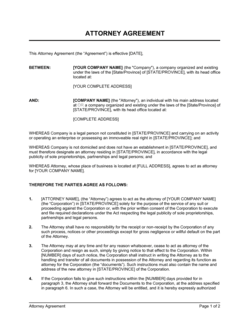
A Retainer for Attorney is a binding contract between a client and a lawyer or law firm that formalizes the terms of legal representation before any work begins. This free Word download covers scope of services, retainer fee, billing rates, cost advances, confidentiality, and termination — giving both parties a clear, enforceable record of their arrangement from day one.
When you need it
Use it whenever you engage an attorney for ongoing legal work, a defined project, or litigation. It is the document that converts an informal agreement to hire a lawyer into an enforceable engagement with clear financial and professional obligations on both sides.
What's inside
Identification of parties and scope of representation, retainer fee and replenishment terms, hourly or flat-fee billing rates, expense reimbursement, billing cycle and payment terms, confidentiality, file handling, conflict-of-interest acknowledgment, and termination procedures.

What is a Retainer for Attorney?

A Retainer for Attorney is a binding legal contract between a client and a licensed attorney or law firm that establishes the complete terms of the legal representation before any work begins or any money changes hands. It identifies the parties, defines the precise scope of services being engaged, sets the retainer deposit amount and the trust account mechanics for holding it, specifies billing rates and cost reimbursement terms, and provides a clear process for ending the relationship and returning unearned funds. Unlike an informal offer to hire a lawyer, a properly executed retainer creates enforceable obligations on both sides and satisfies the written fee agreement requirements imposed by bar rules in most jurisdictions.

Why You Need This Document

Without a signed retainer agreement, both attorney and client are exposed to preventable disputes from the first billing cycle. Clients who never agreed to a specific hourly rate or replenishment threshold dispute invoices; attorneys who began work without a signed agreement face bar complaints over fee arrangements they cannot prove were disclosed. The retainer's trust account clause protects client funds from commingling — an ethics violation that can end a legal career — while the scope clause prevents the attorney from being held responsible for work that was never part of the engagement. For clients, the termination clause guarantees that any unearned portion of the deposit is returned promptly, regardless of why the relationship ends. This template gives attorneys a bar-compliant, professionally structured starting point and gives clients a transparent record of exactly what they are paying for and what they can expect in return.

Which variant fits your situation?

If your situation is…Use this template
Hiring an attorney for a specific, defined project with a fixed feeFlat-Fee Legal Services Agreement
Engaging ongoing general counsel services billed monthlyGeneral Counsel Retainer Agreement
Hiring a litigation attorney for a court proceedingLitigation Retainer Agreement
Retaining an attorney on a contingency-fee basisContingency Fee Agreement
Engaging a law firm for a real estate closing onlyReal Estate Attorney Engagement Letter
Hiring outside counsel as a fractional general counselFractional General Counsel Agreement
Engaging an attorney for employment law compliance workEmployment Law Retainer Agreement

Common mistakes to avoid

❌ Commingling retainer funds with the firm's operating account

Why it matters: Depositing client retainer funds into an operating account rather than an IOLTA trust account is an ethical violation in every US jurisdiction, every Canadian province, and most common-law countries — it can result in suspension or disbarment.

Fix: Confirm your trust account details before issuing the retainer, and update the template's trust account section with the correct bank and account number. Never accept a retainer payment into an operating account.

❌ Drafting a vague or unlimited scope of representation

Why it matters: A scope defined as 'general legal services' or 'all legal matters' exposes the attorney to unlimited demands and makes it impossible to determine when the engagement is complete or what is out of scope.

Fix: Name the specific matter, transaction, or legal question being handled. If the scope is genuinely ongoing, define it by subject area (e.g., 'employment law compliance') with an explicit carve-out for litigation, which requires a separate engagement.

❌ No replenishment clause or an inadequate replenishment threshold

Why it matters: Without a replenishment mechanism, the retainer runs out mid-matter and the attorney must either work without compensation or withdraw at a critical time, potentially harming the client.

Fix: Set the replenishment threshold at a level that gives at least 10 business days of buffer — typically 20–30% of the original retainer — and specify the exact replenishment timeframe in the agreement.

❌ Omitting the obligation to return unearned retainer funds on termination

Why it matters: A retainer deposit is client property until earned. Failing to return unearned funds is grounds for a bar complaint and potential disciplinary action in every jurisdiction that regulates attorney trust accounting.

Fix: Include an explicit clause stating that unearned retainer funds will be returned within a defined period (10 business days is standard) after the engagement ends, regardless of the reason for termination.

❌ Using a mandatory arbitration clause for malpractice claims without required disclosure

Why it matters: Several US states and Canadian law societies require specific, separately acknowledged consent before malpractice claims can be sent to mandatory arbitration. A blanket arbitration clause can be invalidated — and may itself constitute an ethics violation.

Fix: Limit mandatory arbitration to fee disputes only, and check your jurisdiction's bar rules before including any arbitration provision covering malpractice. Add a separate initialed acknowledgment if the rules require one.

❌ Signing the retainer after work has already begun

Why it matters: Billing time before a signed retainer is in place creates ambiguity about agreed rates, scope, and payment terms — and leaves the attorney without an enforceable written fee agreement, which bar rules typically require.

Fix: Make execution of the retainer a condition precedent to opening the file. If a genuine emergency requires same-day work, follow up with a signed agreement the same day and document that both parties agreed to terms orally before signing.

The 10 key clauses, explained

Parties and engagement identification

In plain language: Names the attorney or law firm and the client as legal entities, identifies the matter name or file number, and establishes the date the engagement begins.

Sample language
This Retainer Agreement is entered into as of [DATE] between [LAW FIRM NAME], a [STATE] [ENTITY TYPE] ('Attorney'), and [CLIENT FULL LEGAL NAME] ('Client'). Attorney agrees to represent Client in connection with [MATTER DESCRIPTION] ('the Matter').

Common mistake: Using a personal name for a law firm entity or vice versa. Misidentifying the contracting party creates enforcement and liability ambiguity, particularly when the firm — not an individual attorney — carries the malpractice insurance.

Scope of representation

In plain language: Defines precisely which legal services are included and explicitly excludes anything outside that scope, preventing scope-creep disputes and uncompensated work.

Sample language
Attorney's representation is limited to [SPECIFIC SERVICES — e.g., 'negotiation and drafting of the Asset Purchase Agreement dated [DATE] and related transaction documents']. Attorney is not engaged to provide advice on tax matters, employment law, or any matter not expressly listed above.

Common mistake: Defining scope as 'general legal advice.' An undefined scope leaves the attorney exposed to demands for services never agreed to and leaves the client uncertain about what they have actually retained.

Retainer fee and trust account

In plain language: States the upfront retainer amount, confirms it will be held in a client trust account, and explains how it is applied against earned fees and costs.

Sample language
Upon signing, Client shall pay a retainer of $[AMOUNT], which Attorney will deposit into a client trust account (IOLTA). Fees and costs earned will be drawn from this account and itemized on each invoice. The retainer is not a flat fee — unearned funds will be returned upon termination.

Common mistake: Treating the retainer as a flat fee rather than a deposit. Commingling retainer funds with operating accounts is an ethical violation in all US jurisdictions and most common-law countries.

Fee structure and billing rates

In plain language: Sets out the hourly rate for each timekeeper (partner, associate, paralegal), or states the flat fee if applicable, and specifies the minimum billing increment.

Sample language
Attorney's fees are billed at $[RATE]/hour for partner time, $[RATE]/hour for associate time, and $[RATE]/hour for paralegal time, in minimum increments of 0.1 hours. Rates are subject to adjustment on [30] days' written notice.

Common mistake: Omitting paralegal rates or listing only one rate for all timekeepers. Clients who later see multiple rate tiers on an invoice — without prior disclosure — frequently dispute charges and damage the relationship.

Costs, expenses, and disbursements

In plain language: Lists the categories of out-of-pocket expenses billed to the client in addition to fees — court filing fees, expert fees, travel, copying, and courier costs — and how they are invoiced.

Sample language
Client shall reimburse Attorney for all reasonable costs and disbursements incurred on Client's behalf, including court filing fees, deposition costs, expert witness fees, travel at $[RATE] per mile, and copying at $[RATE] per page. Costs exceeding $[THRESHOLD] require Client's prior written approval.

Common mistake: No pre-approval threshold for large disbursements. Without one, clients receive surprise invoices for expert witness or travel costs that they expected to authorize in advance, creating payment disputes.

Billing cycle and payment terms

In plain language: States how often invoices are issued, when they are due, the late-payment interest rate, and the consequences of non-payment including suspension of services.

Sample language
Attorney shall invoice Client [monthly / bi-monthly] for fees and costs. Invoices are due within [15] days of issuance. Balances unpaid after [30] days accrue interest at [1.5]% per month. Attorney may suspend services if an invoice remains unpaid for more than [30] days after the due date.

Common mistake: No late-payment interest or suspension clause. Without consequences for non-payment, collection becomes a legal matter against a former client — expensive and relationship-ending.

Replenishment of retainer

In plain language: Specifies the threshold balance at which the client must replenish the trust account and the timeframe for doing so, ensuring uninterrupted representation.

Sample language
When the retainer balance falls below $[THRESHOLD], Attorney will notify Client in writing. Client shall replenish the account to $[FULL AMOUNT] within [10] business days of notice. Attorney may suspend services if replenishment is not received within that period.

Common mistake: Setting a replenishment threshold too low — for example, $500 on a $5,000 retainer. By the time the threshold is hit and notice is given, the account may be exhausted before replenishment arrives, forcing the attorney to work uncompensated.

Confidentiality and attorney-client privilege

In plain language: Confirms that all client communications and information are subject to attorney-client privilege and the attorney's ethical duty of confidentiality, with standard exceptions for mandatory disclosure.

Sample language
Attorney shall maintain the confidentiality of all information relating to the representation of Client in accordance with applicable rules of professional conduct. Disclosure may be made only as required by law or court order, or with Client's informed written consent.

Common mistake: Omitting this clause on the assumption that privilege is automatic. While privilege exists at law, explicitly stating it in the retainer signals professionalism and gives the client a clear reference point if confidentiality is ever disputed.

Termination and file handling

In plain language: Defines how either party may end the engagement — notice period, conditions for immediate termination, and the attorney's obligations to return the file and unearned retainer funds.

Sample language
Either party may terminate this Agreement on [14] days' written notice. Attorney may withdraw immediately if Client fails to pay fees, provides false information, or instructs Attorney to act unethically. Upon termination, Attorney shall promptly return Client's file and any unearned retainer balance within [10] business days.

Common mistake: No obligation to return the unearned retainer balance on termination. Clients who prepaid for services not yet rendered have a legal right to the unearned portion — omitting this clause invites a bar complaint.

Governing law and dispute resolution

In plain language: Identifies which jurisdiction's law governs the agreement and how fee disputes are resolved — typically through state bar arbitration, mediation, or court.

Sample language
This Agreement is governed by the laws of [STATE / PROVINCE]. Any dispute regarding fees or the scope of representation shall be submitted to non-binding fee arbitration through the [STATE] Bar Association before either party may initiate litigation.

Common mistake: Choosing arbitration for all disputes including malpractice claims without complying with bar rules on mandatory disclosure. Many jurisdictions require explicit, separately initialed consent for mandatory arbitration of malpractice claims — a blanket clause can be struck.

How to fill it out

  1. 1

    Identify both parties with their legal names

    Enter the law firm's full registered name and the client's full legal name — individual or entity. For businesses, use the registered corporate name, not a trade name.

    💡 Confirm the exact entity name against a state or provincial registry filing before signing — a mismatch creates enforcement problems if the retainer ever needs to be litigated.

  2. 2

    Define the scope of representation in specific terms

    Describe exactly which matter or matters are included — by transaction name, case type, or specific legal question — and explicitly state what is excluded.

    💡 If the scope may expand (e.g., litigation that could include appeals), add a sentence noting that any extension of scope requires a written amendment to this agreement.

  3. 3

    Set the retainer amount and trust account details

    Enter the upfront retainer deposit amount. Confirm the firm's IOLTA or trust account details and state that unearned funds will be returned on termination.

    💡 Size the retainer to cover at least one full billing cycle — for hourly engagements, multiply your estimated monthly hours by the applicable rate.

  4. 4

    Enter all billing rates and timekeepers

    List every timekeeper who may bill to the matter — partners, associates, paralegals, law clerks — with their individual hourly rates and the minimum billing increment (typically 0.1 hours).

    💡 If rates will be adjusted annually, state the notice period for rate changes so the client is never surprised by a mid-engagement increase.

  5. 5

    List reimbursable costs and set approval thresholds

    Enumerate every cost category the attorney may bill — filing fees, expert fees, travel, copying — and set a dollar threshold above which client pre-approval is required.

    💡 A $500–$1,000 pre-approval threshold covers most routine disbursements while protecting the client from unexpected large expenses.

  6. 6

    Define billing cycle, due date, and late-payment terms

    Select a billing frequency (monthly is standard), set a due date (Net 15 or Net 30 from invoice date), and enter the late-payment interest rate and the suspension-of-services trigger.

    💡 Net 15 with a 30-day suspension trigger is tighter than most clients expect — consider whether your jurisdiction's bar rules require additional notice before suspension.

  7. 7

    Confirm termination notice and file return obligations

    Set the notice period for voluntary termination (14 days is common), list the conditions for immediate withdrawal, and specify the timeframe for returning the file and unearned funds.

    💡 Include a clause confirming that the client's file belongs to the client — not the attorney — regardless of any unpaid balance, which is the ethical rule in most jurisdictions.

  8. 8

    Sign before any work begins

    Both attorney and client must sign before any billable time is recorded or any retainer deposit is accepted. Dating the agreement at signing protects both parties from retroactive scope disputes.

    💡 Use a timestamped e-signature platform so the executed copy is automatically stored with an audit trail — critical if a fee dispute goes to bar arbitration.

Frequently asked questions

What is a retainer for an attorney?

A retainer for an attorney is a written contract between a client and a lawyer or law firm that establishes the terms of legal representation before any work begins. It defines the scope of services, the fee structure, billing terms, retainer deposit amount, and how the engagement ends. It protects both parties by creating a clear, enforceable record of what was agreed before any money changes hands or legal work starts.

How does an attorney retainer fee work?

A retainer fee is an upfront deposit the client pays to secure the attorney's services. The attorney holds it in a client trust account (IOLTA) and draws from it as fees are earned and costs are incurred. The client receives itemized invoices showing how the retainer is being consumed. When the balance drops below a defined threshold, the client replenishes it. Any unearned balance is returned to the client when the engagement ends.

Is an attorney retainer agreement required by law?

In many jurisdictions, attorneys are ethically required to have a written fee agreement for any engagement where fees are expected to exceed a threshold — $1,000 in California, for example. In the UK, solicitors must provide a client care letter setting out costs and terms before work begins. Even where not strictly required by law, a signed retainer is considered standard professional practice and is strongly recommended to prevent fee disputes and bar complaints.

What is the difference between a retainer and an engagement letter?

An engagement letter is a simplified version of a retainer — typically one to two pages — used for short, transactional matters with a defined scope and a flat fee. A retainer agreement is more comprehensive, covering ongoing trust account mechanics, replenishment terms, billing rates for multiple timekeepers, and detailed termination procedures. For any matter expected to involve hourly billing or multiple billing cycles, a full retainer agreement is more appropriate than an engagement letter.

Can a client get their retainer back if they fire the attorney?

Yes, in most jurisdictions — the unearned portion of the retainer must be returned to the client when the engagement ends, regardless of who terminates and why. The attorney is entitled to keep only the fees already earned and costs already incurred as of the termination date. A properly drafted retainer agreement states this obligation explicitly and sets a specific timeframe for the return — typically within 10 business days of termination.

What should a retainer agreement include?

A complete retainer agreement should cover: full identification of both parties, specific scope of representation, retainer fee amount and trust account details, billing rates for each timekeeper, minimum billing increment, cost and expense reimbursement terms, billing cycle and payment due date, late-payment interest and suspension terms, replenishment threshold and procedure, confidentiality, termination notice and file return obligations, and governing law with a dispute resolution mechanism.

How much is a typical attorney retainer?

Retainer amounts vary widely by matter type, jurisdiction, and attorney seniority. For routine business matters, retainers typically range from $1,500 to $5,000. Litigation retainers commonly start at $5,000 to $10,000 and may be replenished multiple times over a case. For complex commercial disputes or regulatory matters, initial retainers of $25,000 or more are not unusual. The retainer amount should be sized to cover at least one full billing cycle based on estimated hours.

Can a paralegal or non-attorney sign a retainer agreement?

The retainer agreement must be signed by a licensed attorney or an authorized representative of the law firm on behalf of the firm. A paralegal or legal assistant may prepare or circulate the document but cannot sign as the attorney of record. On the client side, an authorized officer or signatory may sign on behalf of a business entity.

What happens if an attorney withdraws mid-matter?

An attorney who withdraws mid-matter is generally required to give adequate notice, take reasonable steps to protect the client's interests (such as providing the file and referring other counsel), and return any unearned retainer balance. Most bar rules permit immediate withdrawal for non-payment, client fraud, or conflict of interest, but still require the attorney to minimize harm to the client. The retainer agreement should specify the conditions for immediate withdrawal and the file-return procedure.

How this compares to alternatives

vs Engagement Letter

An engagement letter is a simplified one-to-two-page document used for short, transactional matters with a flat fee and a defined deliverable. A retainer agreement is more comprehensive, covering trust account mechanics, hourly rates for multiple timekeepers, replenishment terms, and ongoing billing procedures. For any matter expected to span multiple billing cycles or involve hourly fees, a full retainer agreement provides significantly more protection.

vs Independent Contractor Agreement

An independent contractor agreement engages a self-employed individual for project-based work outside an employment relationship. A retainer for an attorney is a specialized legal services agreement that must comply with bar rules on fee handling, trust accounting, and professional conduct — neither party can substitute one document for the other. Attorneys are not independent contractors in the commercial sense; they are licensed professionals with ethical obligations that the retainer must address.

vs Service Agreement

A general service agreement governs the delivery of professional services without the trust accounting, privilege, or bar-rule requirements that apply to legal representation. Using a standard service agreement for an attorney engagement omits IOLTA trust account terms, mandatory confidentiality language, and bar-required fee dispute provisions. Legal engagements require a purpose-built retainer that incorporates these jurisdiction-specific ethical obligations.

vs Contingency Fee Agreement

A contingency fee agreement structures attorney compensation as a percentage of the client's recovery — no recovery, no fee — rather than an upfront retainer deposit and hourly billing. Contingency arrangements are common in personal injury, class action, and certain commercial disputes but are prohibited for criminal defense and family law matters in most jurisdictions. The choice between a retainer and a contingency agreement depends entirely on matter type and the client's risk tolerance.

Industry-specific considerations

Technology / SaaS

Outside counsel retained for IP portfolio management, SaaS customer agreement drafting, and regulatory compliance — often billed on a monthly flat-fee retainer with hourly overages.

Real Estate

Transaction-specific retainers covering purchase and sale agreements, title reviews, and closing coordination, with disbursements for title insurance, recording fees, and survey costs.

Professional Services

Ongoing retainers for employment law advice, contract review, and commercial dispute resolution, where consistent access to a single attorney matters more than per-transaction pricing.

Healthcare

Retainers covering HIPAA compliance, licensure matters, and payor contract negotiations — with confidentiality provisions that reinforce rather than replace statutory patient-data protections.

Manufacturing

Commercial litigation retainers for supply chain disputes, product liability defense, and international trade compliance, requiring pre-approval thresholds for expert witness and travel costs.

Financial Services

Regulatory retainers covering SEC, FINRA, or FCA compliance matters, with enhanced confidentiality clauses protecting trading data and client financial information.

Jurisdictional notes

United States

ABA Model Rule 1.5 requires fee agreements to be communicated to the client, preferably in writing. California Business & Professions Code §6148 mandates a written fee agreement for engagements expected to exceed $1,000. Most states require retainer funds to be held in an IOLTA account separate from operating funds, and the attorney must provide an accounting on request. Non-refundable retainers are prohibited or heavily restricted in several states including New York.

Canada

Each provincial law society governs retainer requirements independently. The Law Society of Ontario requires a written retainer for most matters and mandates that client funds be held in a mixed trust account with proper accounting. In Quebec, civil law principles apply alongside the Barreau du Québec's Code of Professional Conduct, and retainer agreements must be available in French for clients who request it. Non-refundable retainers are generally not permitted.

United Kingdom

Solicitors Regulation Authority (SRA) Code of Conduct requires solicitors to provide a client care letter before or at the start of representation, setting out costs, billing arrangements, and complaints procedures. Barristers in England and Wales typically operate under the Bar Standards Board's rules, which have separate engagement and fee requirements. Solicitors must hold client money in a designated client account under SRA Accounts Rules, and any interest earned on client funds must be paid to the client above a de minimis threshold.

European Union

Attorney engagement requirements vary significantly by member state. German attorneys (Rechtsanwälte) must disclose fees in writing and are bound by the Rechtsanwaltsvergütungsgesetz (RVG) statutory fee schedule unless a higher fee is expressly agreed in writing. French avocats are governed by the Règlement Intérieur National, which requires a written fee agreement (convention d'honoraires) for most matters. GDPR applies to client personal data processed under the retainer, requiring a brief data processing disclosure in the engagement documentation.

Template vs lawyer — what fits your deal?

PathBest forCostTime
Use the templateSolo attorneys and small firms formalizing standard hourly or flat-fee engagements for routine business or transactional mattersFree15–30 minutes
Template + legal reviewAttorneys handling complex litigation, multi-jurisdiction matters, or clients with significant assets where fee disputes are higher risk$200–$500 for a peer or ethics counsel review1–2 days
Custom draftedLarge law firms standardizing retainer agreements across practice groups, or engagements involving class actions, regulatory investigations, or international representation$1,000–$3,000 for a custom ethics-compliant template reviewed by bar counsel1–2 weeks

Glossary

Retainer Fee
An upfront deposit paid by the client to secure an attorney's availability, held in a trust account and drawn down as fees are earned.
Trust Account (IOLTA)
A segregated bank account maintained by attorneys to hold client funds — retainer deposits and settlement proceeds — separately from the firm's operating funds.
Scope of Representation
The specific legal matters, tasks, or proceedings the attorney agrees to handle under the engagement — anything outside this scope requires a separate agreement.
Replenishment Threshold
The balance level at which the client must top up the retainer trust account so the attorney can continue working without interruption.
Hourly Rate
The fee charged per hour of attorney or paralegal time, typically billed in 0.1-hour (6-minute) increments.
Flat Fee
A fixed, all-in price for a defined legal service regardless of actual time spent — common for document drafting, closings, and incorporations.
Conflict of Interest
A situation where an attorney's duties to one client are materially adverse to another current or former client, potentially requiring disclosure or disqualification.
Engagement Letter
A simplified version of a retainer agreement — typically one to two pages — commonly used for transactional or short-scope matters.
Costs and Disbursements
Out-of-pocket expenses the attorney incurs on the client's behalf — filing fees, court reporter fees, expert witness costs, and travel — billed in addition to attorney fees.
Contingency Fee
A fee arrangement where the attorney receives a percentage of the client's recovery rather than an hourly or flat fee — prohibited for certain matter types in most jurisdictions.
Termination for Cause
Either party's right to end the attorney-client relationship immediately for specific reasons — non-payment, conflict of interest, or ethical violations — without the standard notice period.

Part of your Business Operating System

This document is one of 3,000+ business & legal templates included in Business in a Box.

  • Fill-in-the-blanks — ready in minutes
  • 100% customizable Word document
  • Compatible with all office suites
  • Export to PDF and share electronically

Create your document in 3 simple steps.

From template to signed document — all inside one Business Operating System.
1
Download or open template

Access over 3,000+ business and legal templates for any business task, project or initiative.

2
Edit and fill in the blanks with AI

Customize your ready-made business document template and save it in the cloud.

3
Save, Share, Send, Sign

Share your files and folders with your team. Create a space of seamless collaboration.

Save time, save money, and create top-quality documents.

★★★★★

"Fantastic value! I'm not sure how I'd do without it. It's worth its weight in gold and paid back for itself many times."

Managing Director · Mall Farm
Robert Whalley
Managing Director, Mall Farm Proprietary Limited
★★★★★

"I have been using Business in a Box for years. It has been the most useful source of templates I have encountered. I recommend it to anyone."

Business Owner · 4+ years
Dr Michael John Freestone
Business Owner
★★★★★

"It has been a life saver so many times I have lost count. Business in a Box has saved me so much time and as you know, time is money."

Owner · Upstate Web
David G. Moore Jr.
Owner, Upstate Web

Run your business with a system — not scattered tools

Stop downloading documents. Start operating with clarity. Business in a Box gives you the Business Operating System used by over 250,000 companies worldwide to structure, run, and grow their business.

Free Forever Plan · No credit card required