Purchasing Agents Agreement Template

Free Word download β€’ Edit online β€’ Save & share with Drive β€’ Export to PDF

7 pagesβ€’25–35 min to fillβ€’Difficulty: Complexβ€’Signature requiredβ€’Legal review recommended
Learn more ↓
FreePurchasing Agents Agreement Template

At a glance

What it is
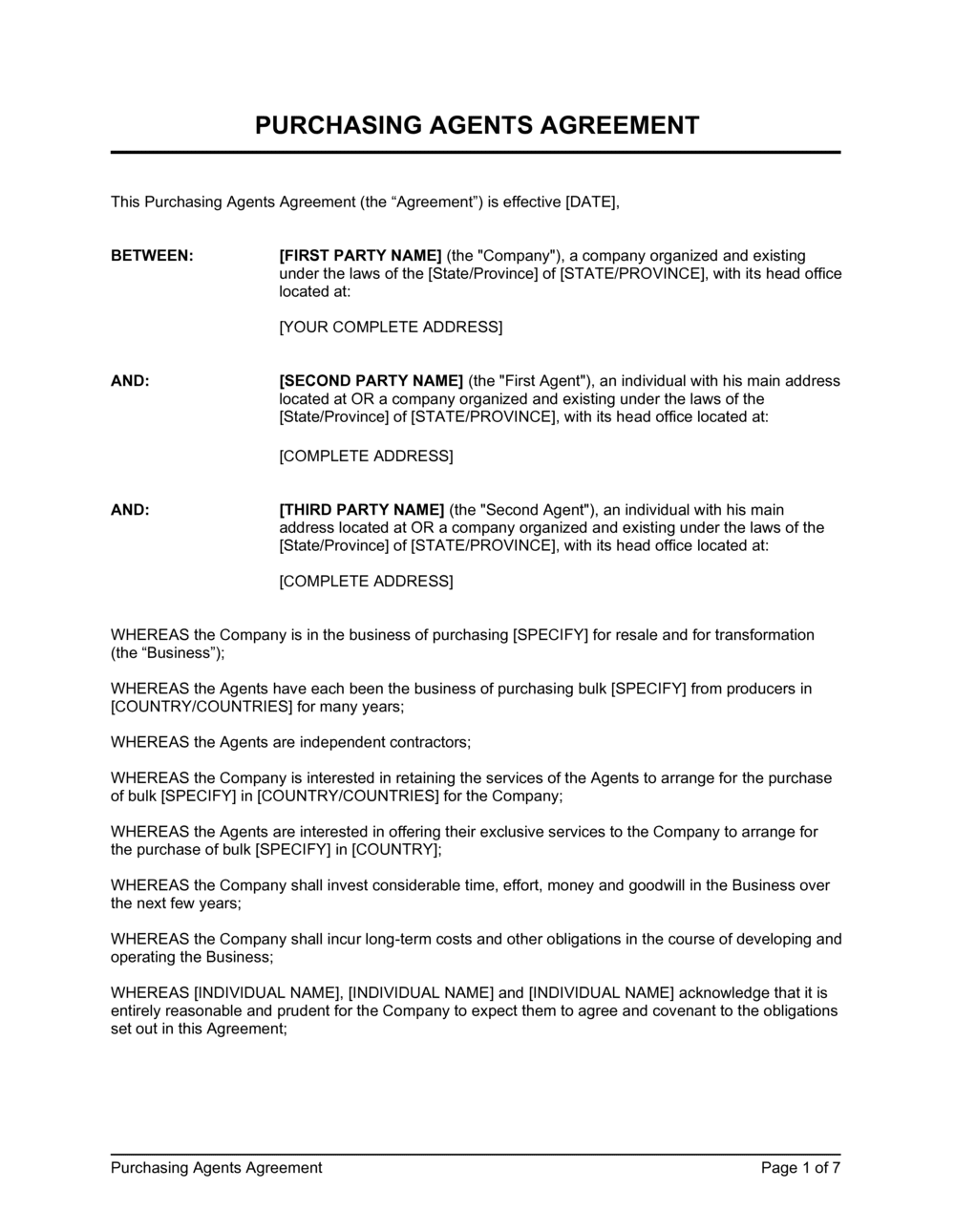
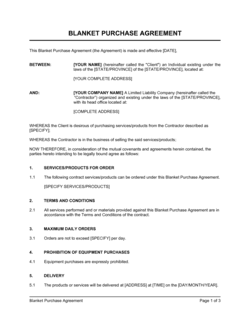
A Purchasing Agents Agreement is a legally binding contract between a principal (a company or individual) and a purchasing agent (an individual or firm) that authorizes the agent to source, negotiate, and procure goods or services on the principal's behalf. This free Word download covers scope of authority, commission structure, procurement procedures, confidentiality, and termination in a single ready-to-use document.
When you need it
Use it whenever you engage an external agent or representative to handle procurement activities β€” sourcing suppliers, negotiating pricing, or placing purchase orders β€” on behalf of your business. It is particularly critical before the agent places any binding order or enters any supplier negotiation that could obligate your company financially.
What's inside
Defined scope of procurement authority, commission or fee structure, approved supplier categories, reporting obligations, confidentiality restrictions, conflict-of-interest disclosures, indemnification, and termination procedures β€” all in a structured agreement that protects both the principal and the agent.

What is a Purchasing Agents Agreement?

A Purchasing Agents Agreement is a legally binding contract between a principal β€” a business or individual buyer β€” and a purchasing agent β€” an individual or firm authorized to procure goods or services on that principal's behalf. The agreement defines the agent's scope of authority, the categories of goods they may source, the spend limits they must observe, their commission or fee entitlement, and the confidentiality and conflict-of-interest obligations that govern their conduct throughout the procurement relationship. Unlike a simple letter of engagement, a properly drafted purchasing agents agreement creates enforceable obligations on both sides and clearly delimits how far the agent's authority extends when binding the principal to supplier contracts.

Why You Need This Document

Without a written purchasing agents agreement, your business is exposed on multiple fronts simultaneously. An agent operating without a defined spend limit can commit your company to supplier contracts worth far more than you authorized β€” and in most jurisdictions, suppliers dealing in good faith can hold you liable for those orders under apparent authority principles. An undisclosed relationship between your agent and a preferred supplier can quietly inflate your procurement costs for months before you detect it. If the agent departs and takes your supplier list, pricing data, and negotiation strategies with them, you have no contractual basis to prevent it. And if the relationship sours mid-procurement, outstanding purchase orders, earned commissions, and confidential materials all become subjects of costly dispute without a clear termination framework. This template gives you a complete, professionally structured agreement that establishes authority, controls spend, protects confidential information, and provides a clean exit path β€” all before the agent places their first order.

Which variant fits your situation?

If your situation is…Use this template
Engaging an agent to source goods from overseas suppliersInternational Purchasing Agent Agreement
Appointing an agent to sell on behalf of the company rather than buySales Agent Agreement
Engaging a third-party broker for one-off purchasing transactionsProcurement Broker Agreement
Authorizing an employee rather than an external party to handle purchasingProcurement Policy and Authority Matrix
Sourcing services rather than physical goods through the agentServices Procurement Agreement
Granting a broader mandate including distribution and resaleDistribution Agreement

Common mistakes to avoid

❌ Granting exclusive authority unintentionally

Why it matters: An agreement that does not specify 'non-exclusive' may be read as granting the agent sole procurement rights, preventing the principal from buying directly or appointing other agents in the same category.

Fix: State explicitly whether the appointment is exclusive or non-exclusive in the parties and appointment clause, and describe any carve-outs for direct purchases.

❌ Vague scope of authority covering all company purchases

Why it matters: A broadly worded scope clause can bind the principal to commitments in product categories they intended to manage internally, including high-value or strategically sensitive purchases.

Fix: List approved product and service categories in a Schedule A and include an express exclusion for any categories the agent is not authorized to touch.

❌ No spend limit or an unenforced one

Why it matters: Without a meaningful spend limit, a purchasing agent can commit the principal to contracts worth hundreds of thousands of dollars β€” and third-party suppliers dealing in good faith may hold the principal liable even for unauthorized orders.

Fix: Set a per-order spend limit calibrated to routine procurement needs, name the specific approver for larger orders, and confirm the approval method in writing.

❌ Commission trigger left undefined

Why it matters: If the agreement does not state whether commission is earned at order placement or on delivery and acceptance, cancelled orders and returned goods generate payment disputes that are expensive to resolve.

Fix: State explicitly that commission accrues on delivery and acceptance by the principal, and specify how commissions are handled on partial deliveries or cancelled orders.

❌ No conflict-of-interest disclosure obligation

Why it matters: An agent with an undisclosed ownership stake or referral arrangement with a preferred supplier can steer procurement decisions to the principal's financial detriment without any contractual basis to challenge it.

Fix: Require written disclosure of all existing and future supplier relationships at signing and throughout the term, and prohibit acceptance of rebates or kickbacks without express written consent.

❌ Signing after procurement activities have begun

Why it matters: Purchase orders placed before the agreement is signed may not be covered by its spend limits, confidentiality protections, or indemnification clauses β€” creating gaps in the principal's protection.

Fix: Execute the agreement before the agent makes first contact with any supplier or reviews any confidential pricing or procurement data.

The 10 key clauses, explained

Parties, appointment, and term

In plain language: Identifies the principal and the purchasing agent as legal entities, formally appoints the agent in the purchasing role, and sets the agreement's start date and duration.

Sample language
This Purchasing Agents Agreement is entered into as of [DATE] between [PRINCIPAL LEGAL NAME], a [STATE/COUNTRY] [ENTITY TYPE] ('Principal'), and [AGENT LEGAL NAME], a [STATE/COUNTRY] [ENTITY TYPE] ('Agent'). Principal hereby appoints Agent as its non-exclusive purchasing agent for a term of [X] months commencing [START DATE], unless earlier terminated in accordance with this Agreement.

Common mistake: Appointing the agent on an exclusive basis without intending to β€” failing to specify 'non-exclusive' may restrict the principal from engaging other agents or procuring directly from certain suppliers.

Scope of authority and territory

In plain language: Defines exactly what categories of goods or services the agent is authorized to procure, the geographic territory in which they may operate, and any product or supplier exclusions.

Sample language
Agent is authorized to source and procure [PRODUCT/SERVICE CATEGORIES] from suppliers located in [TERRITORY]. Agent shall not procure any goods or services outside these categories or territory without prior written approval from Principal.

Common mistake: Drafting scope of authority too broadly β€” a vague 'all goods required by the business' clause can inadvertently bind the principal to commitments in categories they intended to manage internally.

Spend limits and approval thresholds

In plain language: Sets the maximum value of individual purchase orders the agent may authorize unilaterally and the escalation process for orders that exceed the threshold.

Sample language
Agent may execute purchase orders with a value not exceeding [CURRENCY][AMOUNT] per order without prior written approval. Orders exceeding [CURRENCY][AMOUNT] require written authorization from [AUTHORIZED PRINCIPAL REPRESENTATIVE] before execution.

Common mistake: Setting spend limits but failing to specify the approval process β€” an agent who exceeds the limit without a clear escalation path creates ambiguity about whether the principal is bound by the resulting order.

Commission and fees

In plain language: States how the agent is compensated β€” percentage of procurement value, flat fee, or retainer β€” when payment is due, and whether commissions are earned on orders placed or goods delivered.

Sample language
Principal shall pay Agent a commission of [X]% of the total invoiced value of all goods procured under this Agreement, payable within [30] days of Principal's receipt and acceptance of the relevant supplier invoice. No commission is earned on orders cancelled prior to delivery.

Common mistake: Not specifying whether commissions are earned at order placement or upon delivery and acceptance β€” if goods are returned or orders are cancelled, an undefined trigger creates payment disputes.

Agent obligations and procurement procedures

In plain language: Sets out the agent's duties β€” following the approved supplier list, seeking competitive quotes, maintaining records, and reporting to the principal β€” and the procedures the agent must follow when placing orders.

Sample language
Agent shall: (a) procure only from suppliers on the Approved Supplier List or suppliers pre-approved in writing by Principal; (b) obtain at least [THREE] competitive quotes for orders exceeding [CURRENCY][AMOUNT]; (c) maintain records of all procurement activities for a minimum of [X] years; and (d) provide Principal with a monthly procurement report by the [DATE] of each month.

Common mistake: Omitting competitive-quote requirements β€” without them, an agent can place orders with preferred suppliers at above-market prices, costing the principal more than a direct procurement arrangement would.

Conflict of interest and disclosure

In plain language: Requires the agent to disclose any financial interest, ownership stake, or personal relationship with a supplier before procuring from them, and prohibits unauthorized kickbacks or rebates.

Sample language
Agent shall promptly disclose to Principal in writing any financial interest, directorship, employment, or personal relationship Agent (or any affiliate of Agent) has with any actual or prospective supplier. Agent shall not accept any rebate, kickback, gift, or benefit from any supplier without Principal's prior written consent.

Common mistake: Limiting disclosure obligations to existing relationships only β€” agents should also disclose conflicts that arise after the agreement is signed, not just those in place at execution.

Confidentiality and data protection

In plain language: Prohibits the agent from disclosing the principal's pricing, supplier relationships, procurement strategy, or other confidential business information to third parties during and after the agreement.

Sample language
Agent shall hold all Confidential Information of Principal in strict confidence and shall not disclose it to any third party without Principal's prior written consent. 'Confidential Information' includes supplier lists, pricing data, procurement strategies, and any non-public business information. This obligation survives termination for a period of [X] years.

Common mistake: Failing to define the survival period for confidentiality obligations β€” without a post-termination timeframe, the clause may expire with the agreement itself, leaving supplier lists and pricing data unprotected.

Indemnification and liability

In plain language: Allocates risk between the parties β€” typically requiring the agent to indemnify the principal for losses arising from the agent's unauthorized acts, negligence, or breach β€” and caps the agent's total liability.

Sample language
Agent shall indemnify and hold harmless Principal from any claims, losses, or liabilities arising from Agent's breach of this Agreement, unauthorized procurement, or negligent acts. Agent's total liability under this Agreement shall not exceed the total commissions paid by Principal in the [X] months preceding the claim.

Common mistake: No liability cap for the agent β€” without one, a single unauthorized purchase order could expose the agent to unlimited liability, making the agreement commercially unattractive to any professional procurement firm.

Termination and post-termination obligations

In plain language: States how either party may end the agreement β€” with or without cause β€” the required notice period, and what happens to pending orders, commissions, and confidential materials after termination.

Sample language
Either party may terminate this Agreement for convenience upon [30] days' written notice. Principal may terminate immediately for cause upon Agent's material breach, insolvency, or fraud. Upon termination, Agent shall: (a) immediately cease placing new orders; (b) transfer all procurement records to Principal; and (c) return or destroy all Confidential Information.

Common mistake: Not addressing the fate of purchase orders placed before termination β€” without a clause confirming they remain binding, suppliers may dispute whether outstanding orders survive the agreement's end.

Governing law and dispute resolution

In plain language: Specifies which jurisdiction's laws govern the agreement and the mechanism for resolving disputes β€” litigation, arbitration, or mediation β€” including the venue.

Sample language
This Agreement is governed by the laws of [STATE/PROVINCE/COUNTRY]. Any dispute arising under this Agreement shall first be submitted to mediation administered by [MEDIATION BODY] in [CITY]. If unresolved within [30] days, the dispute shall be resolved by binding arbitration under the rules of [ARBITRATION BODY].

Common mistake: Choosing a governing law jurisdiction with no connection to either party's operations β€” courts in some jurisdictions will refuse to enforce such a choice, defaulting to the law where the agent primarily operates.

How to fill it out

  1. 1

    Identify and name both parties correctly

    Enter the full registered legal name of the principal and the purchasing agent β€” not trade names or abbreviations. Include entity type (LLC, Inc., Ltd.) and the state or country of formation for each.

    πŸ’‘ Verify the agent's legal entity name against their business registration before signing β€” an individual operating as a sole trader binds them personally, while an LLC limits individual liability.

  2. 2

    Define the scope of authority and territory precisely

    List the specific product or service categories the agent is authorized to procure. Name the geographic territory explicitly β€” 'North America' is less precise than 'the United States and Canada excluding Quebec.'

    πŸ’‘ Attach a Schedule A listing approved product categories and excluded categories to keep the body of the agreement clean and easy to amend as your procurement needs evolve.

  3. 3

    Set spend limits and the approval process

    Enter the per-order spend limit in the agreement's currency and name the specific person or role at the principal organization who must approve orders above the threshold. Define the approval method β€” email, purchase order signature, or formal written authorization.

    πŸ’‘ Set spend limits at a level that covers routine orders without escalation. If the limit is too low, the agent will spend more time seeking approvals than sourcing β€” eroding the value of the arrangement.

  4. 4

    Specify the commission structure and payment terms

    Choose between a percentage commission, flat fee per order, or monthly retainer. State whether commissions are earned when orders are placed or when goods are received and accepted. Set the payment due date β€” Net 30 from supplier invoice receipt is standard.

    πŸ’‘ If the agent will source in a foreign currency, specify which currency commissions are calculated and paid in to avoid exchange-rate disputes.

  5. 5

    Build the approved supplier list and quote requirements

    Attach your current approved supplier list as an exhibit. Specify the minimum number of competitive quotes required for orders above defined thresholds β€” three quotes for orders above $5,000 is a common benchmark.

    πŸ’‘ Include a process for the agent to propose new suppliers β€” requiring a written submission and principal approval before first use keeps your supplier base controlled.

  6. 6

    Complete the conflict-of-interest and confidentiality clauses

    Confirm the post-termination survival period for confidentiality obligations β€” typically 2 to 5 years. Review the conflict-of-interest disclosure obligation to ensure it covers both pre-existing and future relationships with suppliers.

    πŸ’‘ Add a representation at signing where the agent confirms they have no current undisclosed conflicts β€” this creates a clean baseline and shifts liability if a conflict emerges later.

  7. 7

    Set termination notice periods and post-termination procedures

    Enter the notice period for convenience termination β€” 30 to 60 days is standard for most procurement relationships. Confirm that the agreement addresses pending orders, outstanding commissions, and the return of confidential materials.

    πŸ’‘ Include a 'wind-down' clause obligating the agent to assist with transitioning open purchase orders and supplier relationships for up to 30 days after notice β€” without this, an abrupt termination can disrupt your supply chain.

  8. 8

    Execute before any procurement activity begins

    Both parties must sign before the agent places any purchase orders, enters supplier negotiations, or discloses any confidential information. Post-commencement signatures weaken the enforceability of spend limits, conflict-of-interest restrictions, and confidentiality obligations.

    πŸ’‘ Use a timestamped electronic signature tool to document exact execution time β€” this matters if a dispute arises about whether an early purchase order was authorized under the agreement.

Frequently asked questions

What is a purchasing agents agreement?

A purchasing agents agreement is a legally binding contract between a principal and a purchasing agent that authorizes the agent to source suppliers, negotiate pricing, and place purchase orders on the principal's behalf. It defines the agent's authority, spend limits, commission structure, confidentiality obligations, and termination procedures β€” creating a clear legal framework for the procurement relationship and protecting both parties from disputes over scope and liability.

When do I need a purchasing agents agreement?

You need one before engaging any external party to procure goods or services on your behalf β€” whether that is an overseas buying agent sourcing inventory, a procurement consultant managing vendor relationships, or a representative attending trade shows to place orders. The agreement should be signed before the agent contacts any supplier, reviews any pricing data, or enters any negotiation that could bind your company.

What is the difference between a purchasing agent and a sales agent?

A purchasing agent acts on behalf of the buyer β€” sourcing suppliers, negotiating prices, and placing purchase orders to acquire goods or services for the principal. A sales agent acts on behalf of the seller β€” finding customers and closing sales. The agreements governing each role differ significantly: a purchasing agents agreement focuses on spend authority and procurement controls, while a sales agency agreement focuses on sales territory, commissions on sales generated, and customer relationship ownership.

Can a purchasing agent legally bind my company to a contract?

Yes, within the limits of their actual authority as defined in the agreement. If the agent has actual authority to place purchase orders up to a specified spend limit, suppliers dealing in good faith can hold your company to those orders. In most jurisdictions, principals can also be bound by an agent's apparent authority β€” where the agent appears authorized even if they have exceeded their actual limits. This is why clearly communicated spend limits and approval processes are critical.

How is a purchasing agent typically compensated?

Compensation structures vary by industry and relationship. The most common model is a commission calculated as a percentage of the total invoiced value of goods procured β€” typically 3% to 10% depending on order volume, product complexity, and territory. Some arrangements use a flat fee per order, a monthly retainer, or a combination of retainer plus a reduced commission. For high-volume commodity procurement, flat-fee or retainer models are often preferred because they align the agent's incentives with procurement efficiency rather than order value.

What spend limits should I set in a purchasing agents agreement?

Spend limits should reflect the agent's role and the typical value of routine purchase orders in your procurement cycle. A common approach is to set a per-order limit β€” for example, $10,000 for a regional inventory agent β€” and require principal approval for anything above that threshold. The limit should be high enough to avoid bottlenecks on routine orders but low enough to retain meaningful financial control over significant commitments.

Is a purchasing agents agreement enforceable internationally?

Generally yes, provided it includes a governing law clause specifying which jurisdiction's law applies and a dispute resolution mechanism. For cross-border procurement relationships β€” particularly with agents operating in Asia, Latin America, or the EU β€” it is important to confirm that the governing law and dispute venue are enforceable in the agent's home jurisdiction. Some countries require local-language versions or impose agency law requirements that affect commission entitlement on termination.

What happens to pending orders if the agreement is terminated?

Unless the agreement specifies otherwise, purchase orders placed by the agent before termination that have been accepted by the supplier typically remain binding on the principal. A well-drafted termination clause should address whether outstanding orders are honoured, whether commissions are owed on goods delivered after the termination date, and how the agent assists with transitioning open supplier relationships during a wind-down period.

Do I need a lawyer to prepare a purchasing agents agreement?

For straightforward domestic purchasing arrangements with clear scope and standard commission terms, a high-quality template is typically sufficient. Engaging a lawyer is advisable when the agent will operate internationally, when procurement involves regulated goods (food, pharmaceuticals, aerospace components), when the agent will have authority to commit significant sums, or when the relationship involves complex IP or data-sharing arrangements. A 1–2 hour template review typically costs $300–$600 and is worthwhile for any arrangement where the agent's spending authority exceeds $50,000 per order.

How this compares to alternatives

vs Sales Agency Agreement

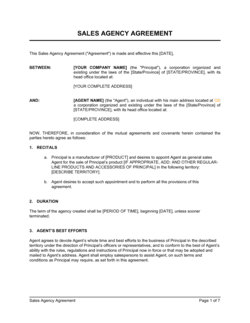
A sales agency agreement authorizes an agent to find customers and generate sales on the principal's behalf. A purchasing agents agreement authorizes the agent to find suppliers and procure goods or services for the principal. The direction of the commercial relationship is opposite β€” one faces the market to sell; the other faces the market to buy. The two documents share structural similarities but differ fundamentally on commission triggers, authority scope, and conflict-of-interest controls.

vs Distribution Agreement

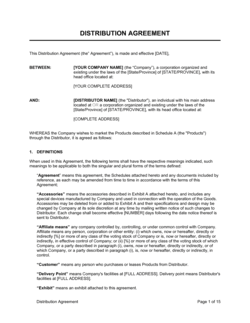
A distribution agreement appoints a distributor to purchase goods from the principal and resell them to end customers in a territory β€” the distributor takes title and bears inventory risk. A purchasing agents agreement does not transfer title to the agent; the agent procures on behalf of the principal, who remains the buyer of record. Distributors earn a margin on resale; purchasing agents earn a commission on procurement value.

vs Independent Contractor Agreement

An independent contractor agreement governs a services relationship where the contractor completes defined tasks for a fee. A purchasing agents agreement specifically governs the authority to bind the principal in commercial transactions with third-party suppliers β€” a significantly higher-stakes legal relationship. An independent contractor agreement alone does not grant procurement authority or address spend limits, approved supplier lists, or commission structures.

vs Non-Disclosure Agreement

An NDA protects confidential information shared between parties but does not govern authority, duties, or compensation. A purchasing agents agreement includes confidentiality provisions as one clause within a comprehensive framework that also covers scope of authority, spend limits, commissions, and termination. An NDA alone is insufficient to govern an active procurement relationship β€” but an NDA may be appropriate before negotiations begin, prior to signing the full purchasing agents agreement.

Industry-specific considerations

Retail and wholesale

Agents source seasonal inventory across multiple supplier markets; spend limits by product category and approval thresholds tied to open-to-buy budgets are standard.

Manufacturing

Raw material and component procurement agents require strict conflict-of-interest controls given the financial materiality of supply contracts and long-term supplier relationships.

Import and international trade

Overseas buying agents operate under the agreement across multiple supplier jurisdictions; the agreement must address currency, customs compliance obligations, and applicable trade law.

Construction and real estate

Procurement agents sourcing materials and subcontractors need defined authority limits aligned with project budgets and milestone-based approval gates.

Jurisdictional notes

United States

Purchasing agents in the US operate under common-law agency principles, with the principal potentially liable for an agent's actions within apparent authority. The Uniform Commercial Code governs purchase orders for goods and can override contract terms if the agent's authority is ambiguous. Some states impose specific disclosure requirements for purchasing agents in regulated industries such as food distribution and pharmaceuticals. Non-compete clauses restricting post-termination procurement activities are subject to the same state-by-state enforceability rules as employment non-competes.

Canada

Canadian agency law is governed provincially and follows common-law principles similar to those in the US. Quebec applies civil law under the Civil Code of Quebec, which contains specific rules on mandate and authority that differ from common-law provinces. Principals should confirm that the agreement's governing law clause is valid in the province where the agent operates. Agents who qualify as employees rather than independent contractors trigger provincial employment standards obligations β€” the agreement should include a clear independent contractor classification clause.

United Kingdom

Purchasing agents operating in the UK may be subject to the Commercial Agents (Council Directive) Regulations 1993 if their role falls within the definition of a commercial agent β€” which the Regulations extend beyond sales to include procurement activities in some interpretations. These Regulations confer statutory rights including mandatory compensation or indemnity on termination that cannot be contracted out of. Principals should take legal advice on whether the Regulations apply to their specific arrangement and, if so, structure the agreement accordingly.

European Union

The EU Commercial Agents Directive (86/653/EEC), implemented in all member states, grants commercial agents β€” including procurement agents depending on national implementation β€” mandatory termination compensation rights of up to one year's average commission. These rights cannot be waived in the contract. GDPR applies where the agent handles personal data of suppliers or contacts in the procurement process, requiring a data processing or controller-to-controller arrangement to be documented alongside the purchasing agents agreement. Member state implementation varies, and the governing law clause should reflect the agent's primary operating jurisdiction.

Template vs lawyer β€” what fits your deal?

PathBest forCostTime
Use the templateDomestic purchasing arrangements with clearly defined product categories, standard commission terms, and spend limits below $50,000 per orderFree30 minutes
Template + legal reviewCross-border procurement agents, regulated product categories, or spend authority above $50,000 per order$300–$7002–4 days
Custom draftedComplex multi-territory procurement mandates, agents with authority over strategic supplier relationships, or arrangements involving regulated goods such as pharmaceuticals or aerospace components$1,500–$4,000+1–3 weeks

Glossary

Principal
The company or individual who engages the purchasing agent and on whose behalf purchases are made.
Purchasing Agent
The individual or firm authorized by the principal to source suppliers, negotiate terms, and place purchase orders within defined limits.
Scope of Authority
The specific categories of goods or services the agent is permitted to procure, the geographic territory covered, and any spend limits that apply.
Commission
Compensation paid to the purchasing agent, typically calculated as a percentage of the total value of goods procured on the principal's behalf.
Spend Limit
The maximum value of a single purchase order or total procurement commitment the agent may authorize without prior written approval from the principal.
Conflict of Interest
A situation in which the agent has a personal, financial, or business relationship with a supplier that could influence procurement decisions to the principal's detriment.
Indemnification
A contractual obligation by one party to compensate the other for losses, liabilities, or costs arising from specified events β€” such as the agent exceeding their authorized spend limit.
Approved Supplier List
A list of pre-vetted suppliers from which the agent is authorized to procure, maintained and updated by the principal.
Purchase Order
A formal commercial document issued by the agent on behalf of the principal to a supplier, authorizing the supply of goods or services at agreed prices and terms.
Termination for Convenience
A clause allowing either party to end the agreement without cause by giving a specified period of written notice, typically 30 to 90 days.
Actual Authority
The real, expressly granted power an agent has to act on behalf of the principal, as distinguished from apparent authority perceived by third parties.
Apparent Authority
The power an agent appears to have in the eyes of a third party, even if not explicitly granted β€” creating potential liability for the principal if the agent acts beyond their actual authority.

Part of your Business Operating System

This document is one of 3,000+ business & legal templates included in Business in a Box.

  • Fill-in-the-blanks β€” ready in minutes
  • 100% customizable Word document
  • Compatible with all office suites
  • Export to PDF and share electronically

Create your document in 3 simple steps.

From template to signed document β€” all inside one Business Operating System.
1
Download or open template

Access over 3,000+ business and legal templates for any business task, project or initiative.

2
Edit and fill in the blanks with AI

Customize your ready-made business document template and save it in the cloud.

3
Save, Share, Send, Sign

Share your files and folders with your team. Create a space of seamless collaboration.

Save time, save money, and create top-quality documents.

β˜…β˜…β˜…β˜…β˜…

"Fantastic value! I'm not sure how I'd do without it. It's worth its weight in gold and paid back for itself many times."

Managing Director Β· Mall Farm
Robert Whalley
Managing Director, Mall Farm Proprietary Limited
β˜…β˜…β˜…β˜…β˜…

"I have been using Business in a Box for years. It has been the most useful source of templates I have encountered. I recommend it to anyone."

Business Owner Β· 4+ years
Dr Michael John Freestone
Business Owner
β˜…β˜…β˜…β˜…β˜…

"It has been a life saver so many times I have lost count. Business in a Box has saved me so much time and as you know, time is money."

Owner Β· Upstate Web
David G. Moore Jr.
Owner, Upstate Web

Run your business with a system β€” not scattered tools

Stop downloading documents. Start operating with clarity. Business in a Box gives you the Business Operating System used by over 250,000 companies worldwide to structure, run, and grow their business.

Start freeΒ Β·Β No credit card required