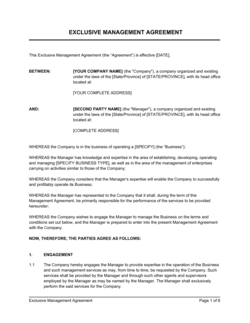
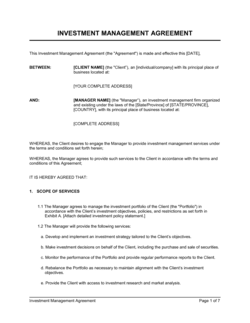
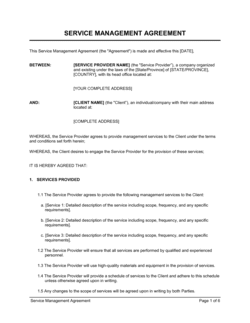
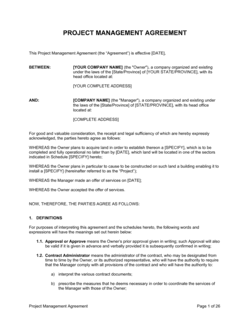
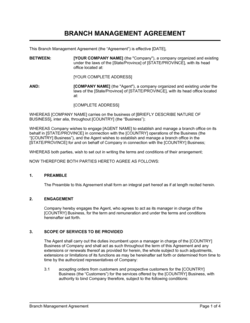
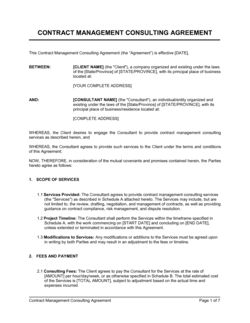
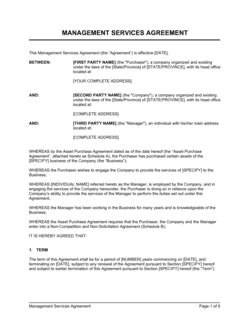
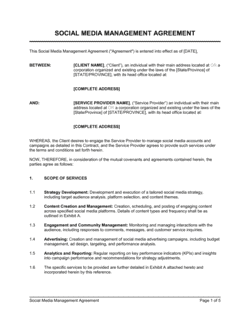
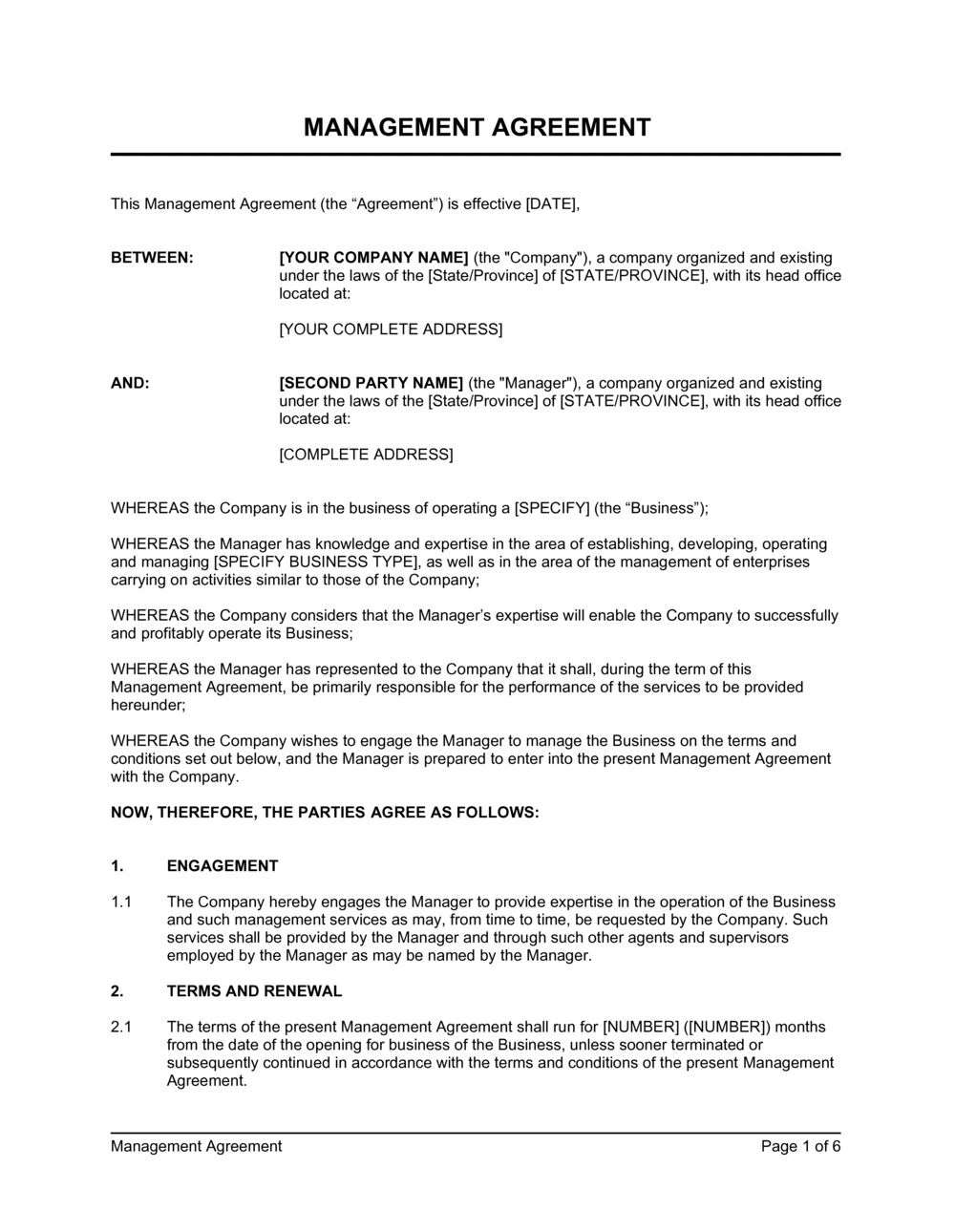
Management Agreement Template

Free Word download • Edit online • Save & share with Drive • Export to PDF

6 pages25–35 min to fillDifficulty: ComplexSignature requiredLegal review recommended
Learn more ↓
FreeManagement Agreement Template

At a glance

What it is
A Management Agreement is a legally binding contract under which one party (the manager) is engaged to operate or manage a business, asset, or property on behalf of another (the owner). This free Word download covers scope of authority, management fees, performance benchmarks, decision rights, reporting obligations, term, and termination in a single document you can edit online and export as PDF.
When you need it
Use it when an owner delegates day-to-day operational control to a professional manager — whether for a rental property, hotel, investment portfolio, or operating business — and needs enforceable boundaries on authority, fees, and performance.
What's inside
Defined scope of management duties and decision rights, fee structure (base, incentive, and reimbursable expenses), reporting and audit obligations, performance standards, intellectual property and brand usage, confidentiality, liability and indemnification, and termination triggers with transition obligations.

What is a Management Agreement?

A Management Agreement is a legally binding contract under which one party — the manager — is appointed to operate or manage a business, property, or asset on behalf of another — the owner — who retains title and ultimate control. It defines precisely how much authority the manager holds, how they are compensated, what performance they must deliver, and how either party can exit the arrangement. Unlike a simple service contract, a management agreement typically grants the manager broad operational decision-making rights, including the power to bind the owner to third-party contracts, employ staff, and spend against an approved budget — making the allocation of authority and liability the document's most critical function.

Why You Need This Document

Without a written management agreement, operational disputes are almost inevitable. Managers act on what they believe they are authorized to do; owners discover commitments they never approved. Fee disagreements arise when the basis for calculating management fees was never precisely defined. A manager who underperforms has no contractual benchmark to be measured against, and an owner who wants to exit faces no clear mechanism or cost. The financial consequences of an undocumented or poorly drafted management arrangement can be severe: unauthorized contracts that bind the owner, termination disputes running to months of unpaid fees, and a departing manager with no legal obligation to return records or assist with transition. This template gives owners a structured, enforceable framework — covering scope, fees, performance, reserved matters, and exit — before the manager takes a single operational step.

Which variant fits your situation?

If your situation is…Use this template
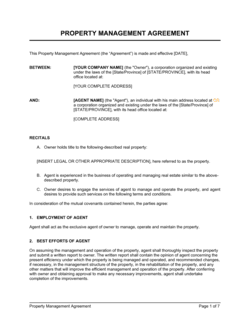
Managing a residential or commercial rental propertyProperty Management Agreement
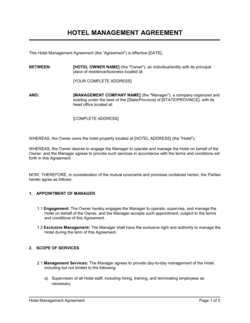
Operating a hotel or resort on behalf of the property ownerHotel Management Agreement
Managing an investment fund or client portfolioInvestment Management Agreement
Running a business while the owner retains equityBusiness Management Agreement
Short-term or interim management during a transition periodInterim Management Agreement
Managing a homeowners' or condo associationHOA Management Agreement
Providing management services as a contractor rather than an employeeManagement Services Agreement

Common mistakes to avoid

❌ Undefined 'ordinary course of business' standard

Why it matters: Managers and owners consistently disagree on what this phrase covers — one party thinks a $30,000 maintenance contract is routine; the other does not. Disputes over unauthorized actions are the most common source of management agreement litigation.

Fix: Replace the phrase with a specific list of permitted actions and a financial threshold. Anything above the threshold requires written owner approval.

❌ No performance benchmarks or cure period

Why it matters: Without measurable targets and a defined underperformance remedy, the owner has no contractual basis to terminate a consistently poor manager without paying a full termination fee.

Fix: Insert at least two objective benchmarks — occupancy rate and NOI, for example — with a 90-day cure period and a performance-trigger termination right if targets are missed for two consecutive periods.

❌ Termination fee equal to the full remaining term

Why it matters: Courts in several jurisdictions have treated excessively high termination fees as penalty clauses and voided them, leaving the owner with no clear exit right and extended litigation.

Fix: Cap the convenience termination fee at 3–6 months of base management fees and document the commercial rationale for that amount in the agreement recitals.

❌ No transition obligations or timeline

Why it matters: A departing manager who is not contractually required to hand over records, accounts, and access credentials can delay the transition for months, causing operational disruption and revenue loss.

Fix: Add a transition clause specifying a 30-day handover deadline, a detailed list of items to be returned, and a daily fee for transition assistance that incentivizes the outgoing manager to cooperate.

❌ Omitting insurance requirements

Why it matters: An indemnification clause is only enforceable to the extent the indemnifying party can pay. An uninsured manager who causes a major loss leaves the owner holding the liability.

Fix: Require the manager to maintain minimum coverage levels — general liability, errors and omissions, and workers' compensation — and to name the owner as an additional insured. Request proof of coverage annually.

❌ No owner audit right

Why it matters: Without a contractual right to inspect books and records, owners have no practical mechanism to verify that fee calculations, expense reimbursements, and revenue figures are accurate.

Fix: Include a clause granting the owner the right to commission an independent audit of management accounts once per calendar year at the owner's cost, with the manager bearing audit costs if material discrepancies are found.

The 10 key clauses, explained

Appointment and scope of authority

In plain language: Formally appoints the manager and defines the full scope of their operational authority — what they can do independently and what requires owner sign-off.

Sample language
Owner hereby appoints Manager as the exclusive manager of [PROPERTY / BUSINESS NAME] commencing [START DATE]. Manager shall have authority to take all actions reasonably necessary to operate the [ASSET] in the ordinary course of business, except for Reserved Matters set out in Schedule A.

Common mistake: Leaving 'ordinary course of business' undefined — managers and owners disagree on what it covers, leading to disputes over unauthorized spending or contracts.

Management fees and expenses

In plain language: States the base management fee (fixed or percentage), any incentive fee formula, and which operating expenses the manager can incur and seek reimbursement for.

Sample language
Owner shall pay Manager a base management fee of [X]% of Gross Revenue per month, payable within [15] days of month-end. Manager is eligible for an incentive fee of [X]% of GOP above $[THRESHOLD] per operating year. Reimbursable expenses are limited to those pre-approved in the Operating Budget.

Common mistake: Omitting a cap on reimbursable expenses. Without a ceiling, managers can pass through costs the owner did not anticipate and has no contractual basis to refuse.

Operating budget and reporting

In plain language: Requires the manager to prepare an annual operating budget for owner approval and to deliver regular financial and operational reports.

Sample language
Manager shall submit a proposed Operating Budget for each calendar year no later than [DATE] for Owner's approval. Manager shall deliver monthly management reports within [10] business days of month-end, including a P&L, occupancy report, and variance analysis against budget.

Common mistake: No consequence if the manager fails to deliver reports on time. Add a cure period and a right to withhold the management fee until reporting is current.

Reserved matters and owner approval rights

In plain language: Lists the specific decisions that are outside the manager's authority and must be escalated to the owner — protecting the owner from material commitments made without consent.

Sample language
Manager shall not, without prior written Owner approval: (a) enter any contract with a value exceeding $[AMOUNT]; (b) incur capital expenditures above $[AMOUNT] per item; (c) hire or terminate senior staff above [TITLE LEVEL]; or (d) commence, settle, or abandon any litigation.

Common mistake: Setting the reserved-matters threshold too high for small assets. A $50,000 contract approval threshold that makes sense for a hotel is excessive for a single-family rental.

Performance standards and benchmarks

In plain language: Sets measurable targets the manager must meet and specifies what happens — cure period, fee reduction, or termination right — if performance falls short.

Sample language
Manager shall maintain an average annual occupancy rate of not less than [X]% and a GOP margin of not less than [X]%. If Manager fails to meet either benchmark for [2] consecutive operating years, Owner may terminate this Agreement on [90] days' written notice without payment of a termination fee.

Common mistake: Using benchmarks without defining how they are measured. Specify the data source (STR report, audited accounts) and the measurement period to prevent disputes over the numbers.

Intellectual property and brand usage

In plain language: Governs the manager's right to use the owner's trademarks, branding, and systems — and the owner's right to use the manager's brand and operating systems if the manager is a branded operator.

Sample language
Owner grants Manager a limited, non-exclusive license to use Owner's marks solely in connection with operating [ASSET] during the Term. All goodwill arising from such use accrues to Owner. Manager's proprietary operating systems and brand standards remain the sole property of Manager.

Common mistake: No clause addressing what happens to brand-related digital assets (domain names, social accounts) on termination — they should revert to the owner automatically.

Confidentiality

In plain language: Prevents the manager from disclosing the owner's financial data, tenant information, operating results, and business strategy to third parties during and after the agreement.

Sample language
Manager shall not disclose or use any Confidential Information of Owner except as necessary to perform Manager's obligations under this Agreement. 'Confidential Information' includes financial statements, tenant or client data, operating strategies, and any information designated as confidential in writing.

Common mistake: No carve-out for disclosures required by law or regulation. Without it, the confidentiality clause can conflict with the manager's statutory reporting obligations.

Liability limitation and indemnification

In plain language: Allocates liability between owner and manager — typically the manager is not liable for ordinary business losses but is liable for gross negligence, fraud, or willful misconduct.

Sample language
Manager shall not be liable to Owner for any loss, damage, or expense arising from the management of [ASSET] except to the extent caused by Manager's gross negligence, fraud, or willful misconduct. Owner shall indemnify Manager against third-party claims arising from the condition of [ASSET] or Owner's instructions, except where Manager is at fault.

Common mistake: Omitting minimum insurance requirements alongside the indemnity. If the manager is uninsured and causes a major loss, the indemnity is only as good as the manager's balance sheet.

Term and termination

In plain language: Sets the initial term, renewal mechanics, and the conditions under which either party can terminate — including termination for cause, for convenience, and on a performance trigger.

Sample language
This Agreement commences on [START DATE] and continues for an initial term of [X] years, renewing automatically for successive [1]-year periods unless either party gives [90] days' written notice of non-renewal. Owner may terminate for Cause immediately on written notice. Owner may terminate for convenience on [180] days' written notice, subject to payment of a termination fee equal to [X] months' base management fees.

Common mistake: No termination-for-convenience right for the owner, or a termination fee so high it functions as a lock-in. Courts in some jurisdictions will void unconscionable lock-in provisions — a fee equivalent to the remaining term's fees is routinely challenged.

Transition and handover obligations

In plain language: Requires the outgoing manager to cooperate with the owner or successor manager during the transition period — transferring records, accounts, contracts, keys, and access credentials.

Sample language
Upon expiry or termination of this Agreement, Manager shall, within [30] days, deliver to Owner all books, records, contracts, keys, access codes, and software licenses relating to [ASSET]. Manager shall provide reasonable transition assistance for up to [60] days at Owner's reasonable request, at Manager's standard daily rate.

Common mistake: No defined timeline for the transition. Without a deadline, a departing manager can delay handover indefinitely, disrupting operations and new management onboarding.

How to fill it out

  1. 1

    Identify the parties and the managed asset

    Enter the owner's and manager's full legal entity names, registered addresses, and the precise legal description or name of the business, property, or asset being managed.

    💡 Use the manager's registered corporate name — not a trading name — to ensure any non-compete or confidentiality obligations bind the right legal entity.

  2. 2

    Define the scope of management authority

    List every category of action the manager is authorized to take independently — staffing, vendor contracts, marketing spend, maintenance — and attach a Schedule A detailing reserved matters that require owner approval.

    💡 Set reserved-matter financial thresholds proportionate to the asset size. A threshold of $5,000 per item works for a single rental unit; $50,000 is more appropriate for a commercial property.

  3. 3

    Set the fee structure with explicit formulas

    Enter the base management fee as a percentage of gross revenue or a fixed monthly amount, define the incentive fee formula and the performance threshold it applies above, and list all expense categories eligible for reimbursement.

    💡 Cap total reimbursable expenses as a percentage of the operating budget to prevent cost overruns from eroding the owner's return.

  4. 4

    Specify operating budget and reporting requirements

    State the date by which the manager must submit the annual operating budget for owner approval, and the frequency and content of management reports — monthly P&L, occupancy, variance, and capital expenditure tracking.

    💡 Include a provision allowing the owner to commission an independent audit no more than once per year at owner's cost. Audit rights deter misreporting and give you a remedy if numbers look off.

  5. 5

    Insert measurable performance benchmarks

    Define at least two objective performance metrics — occupancy rate, NOI, GOP margin, or return on assets — and specify the data source, measurement period, and consequence for sustained underperformance.

    💡 Tie the performance trigger to two consecutive periods rather than one — a single bad year may be market-driven, not manager-driven.

  6. 6

    Calibrate the term and termination provisions

    Set the initial term, auto-renewal period, notice period for non-renewal, termination-for-cause triggers, and the termination-for-convenience fee. Confirm the fee is proportionate — typically 3–6 months of base fees, not the full remaining term.

    💡 In jurisdictions where branded management agreements are common (hotels, serviced apartments), review whether the brand operator's standard form overrides your termination-for-convenience right — this is a frequent and costly surprise.

  7. 7

    Complete the transition and handover schedule

    Specify the exact timeline for return of records, keys, accounts, and access credentials on termination, and the duration and rate for post-termination transition assistance.

    💡 Require the manager to maintain a live asset register of all software accounts, login credentials, and third-party contracts throughout the term — not just at handover.

  8. 8

    Execute before the manager takes operational control

    Both parties must sign the agreement before the manager begins operating the asset. Post-commencement signatures may weaken enforceability of restrictive provisions in common-law jurisdictions.

    💡 For hotel or large-scale commercial management agreements, use a conditions-precedent clause — the agreement takes effect only when the owner has obtained financing approval, regulatory permits, or other specified conditions.

Frequently asked questions

What is a management agreement?

A management agreement is a legally binding contract under which one party (the manager) is engaged to operate or manage a business, property, or asset on behalf of another (the owner). It defines the manager's scope of authority, fee structure, performance obligations, reporting requirements, and the conditions under which either party may terminate the arrangement. It is distinct from an employment contract because the manager typically operates as an independent entity rather than an employee.

What should a management agreement include?

A complete management agreement covers the appointment and scope of authority, management fees (base and incentive), reimbursable expenses, operating budget and reporting obligations, reserved matters requiring owner approval, performance benchmarks, intellectual property and brand usage, confidentiality, liability and indemnification, insurance requirements, term and termination provisions, and transition obligations. Missing any of these creates gaps that courts fill with jurisdiction-specific defaults, often unfavorable to the owner.

What is the difference between a management agreement and an employment contract?

An employment contract engages an individual as an employee, with all the statutory entitlements that follow — notice, benefits, tax withholding, and labor law protections. A management agreement engages a separate legal entity or self-employed individual to manage an asset or business, typically on a principal-to-principal basis. Misclassifying a managed relationship as independent when it functions as employment can trigger significant tax and labor liability in most jurisdictions.

How are management fees typically structured?

Most management agreements combine a base fee — commonly 3–10% of gross revenue for real estate and 1–2% of assets under management for investment mandates — with an incentive fee tied to performance above a benchmark. Hotel management agreements often use a two-tier structure: a base fee of 2–4% of gross revenue plus an incentive fee of 8–12% of GOP above an owner's priority return. The exact structure depends heavily on the asset type, market norms, and the manager's track record.

Can an owner terminate a management agreement early?

Yes, but the right and its cost depend on what the agreement says. Most agreements include a termination-for-cause right (immediate, no fee) and a termination-for-convenience right (advance notice plus a termination fee, typically 3–6 months of base fees). Some branded hotel management agreements restrict or eliminate the owner's convenience termination right entirely — a significant risk that owners should negotiate before signing. Courts in several jurisdictions will void termination fees that function as penalties rather than genuine pre-estimates of loss.

What are 'reserved matters' in a management agreement?

Reserved matters are decisions that fall outside the manager's delegated authority and require explicit owner approval before the manager can act. Typical reserved matters include capital expenditures above a specified threshold, contracts above a specified value, hiring or terminating senior staff, commencing or settling litigation, and disposing of or encumbering assets. A well-drafted reserved-matters schedule is one of the most important protections for the owner against unauthorized commitments.

What performance benchmarks are common in management agreements?

Real estate agreements commonly use occupancy rate, net operating income (NOI), and gross rent collected versus projected. Hotel agreements use revenue per available room (RevPAR), GOP margin, and owner's priority return. Investment management agreements use return on assets, tracking error against a benchmark index, or IRR targets. The choice of benchmark and measurement period should be negotiated carefully — benchmarks that are too easily met provide no protection; benchmarks that are impossible to meet in a down market can expose the owner to wrongful-termination claims.

Is a management agreement enforceable without a lawyer?

A well-structured template is generally enforceable when properly executed by both parties before the management relationship begins. However, management agreements for large-scale assets — hotels, commercial portfolios, or regulated investment funds — involve significant financial exposure and jurisdiction-specific regulations that make professional legal review worthwhile. At minimum, consider a lawyer review before signing any agreement with a term exceeding two years, a termination fee above $50,000, or a manager with its own standard-form contract.

What happens to the management agreement if the owner sells the asset?

The answer depends on the agreement's assignment clause. Most management agreements bind a buyer if the manager does not consent to termination on sale — a significant encumbrance that can reduce the asset's value or complicate a transaction. Owners should negotiate a change-of-control termination right that allows the agreement to be ended on asset sale, subject to a reasonable notice period or fee. Branded hotel management agreements are particularly notorious for running with the property and binding new owners.

What governing law should a management agreement use?

Typically, the law of the jurisdiction where the managed asset or business is located. For real estate management, use the law of the state or province where the property sits — local courts are more familiar with local property and landlord-tenant law. For investment management, the domicile of the fund or investment vehicle is usually the governing jurisdiction. Choosing a governing law with no connection to the asset or the parties can result in courts applying local law regardless of the contractual choice.

How this compares to alternatives

vs Property Management Agreement

A property management agreement is a specialized form of management agreement focused exclusively on real estate — residential, commercial, or mixed-use. It adds landlord-tenant law compliance, rent collection mechanics, and maintenance vendor management. Use a property management agreement for pure real estate mandates; use a general management agreement when the scope extends beyond property operations to include business management or asset portfolio oversight.

vs Independent Contractor Agreement

An independent contractor agreement engages an individual or firm for defined project-based or ongoing services without operational control over an asset or business. A management agreement delegates broad operational authority, including the power to bind the owner to contracts and employ staff. If the manager has authority to act on the owner's behalf in commercial dealings, a management agreement is the appropriate document.

vs Employment Contract

An employment contract governs the relationship between employer and individual employee, with statutory entitlements including notice, benefits, and labor law protections. A management agreement governs a principal-to-principal commercial relationship between two entities. Using a management agreement to disguise what is functionally an employment relationship risks misclassification liability — back taxes, benefit obligations, and penalties in most jurisdictions.

vs Joint Venture Agreement

A joint venture agreement creates a shared enterprise in which both parties contribute capital or resources and share profits, losses, and decision-making. A management agreement preserves a clear owner-manager hierarchy — the owner retains title and residual control; the manager earns fees. When the manager is also taking an equity stake or sharing in profits beyond a performance fee, a joint venture or partnership agreement may be more appropriate.

Industry-specific considerations

Real Estate

Property managers operate rental income assets on behalf of investors; fee structures tied to gross rents collected, with strict reserved-matter thresholds for capital expenditure and lease approvals.

Hospitality and Hotels

Branded operators manage hotels under two-tier fee structures tied to gross revenue and GOP; brand standards and IP licensing require dedicated clauses, and change-of-control termination rights are heavily negotiated.

Financial Services and Asset Management

Investment managers require regulatory authorization under applicable securities law (SEC, FCA, IIROC); fee disclosure, fiduciary duty, and conflicts-of-interest provisions are mandatory and closely scrutinized by regulators.

Private Equity and Business Ownership

Management agreements between sponsors and portfolio company management teams govern operational authority, reporting to the board, incentive arrangements, and removal rights tied to performance or change of control.

Jurisdictional notes

United States

Management agreements for real estate are primarily governed by state law; several states require property managers to hold a real estate broker's license. Investment management mandates require SEC registration as an investment adviser above specified AUM thresholds. Non-compete and non-solicit enforceability varies by state — California restricts post-agreement restraints significantly. Termination-fee clauses that function as penalties rather than liquidated damages are increasingly scrutinized by courts.

Canada

Real estate management is provincially regulated; property managers in Ontario, BC, and Alberta require licensing under provincial real estate or condominium management legislation. Investment management requires registration with applicable provincial securities regulators (e.g., OSC, BCSC) or IIROC. Quebec-based agreements must be in French for provincially regulated entities. Common-law notice obligations apply if the agreement resembles an employment relationship despite its label.

United Kingdom

Investment management firms must be authorized by the FCA under FSMA 2000; unauthorized investment management is a criminal offence. Property managers handling client money must comply with the RICS Code of Practice and maintain client money protection schemes. Post-termination restrictive covenants are enforceable if reasonable in scope and duration but are scrutinized carefully where the manager is a key individual rather than a corporate entity.

European Union

Investment management within the EU is regulated under AIFMD for alternative funds and MiFID II for portfolio management services; passporting rights facilitate cross-border mandates. GDPR requires data processing agreements to be in place where the manager handles personal data of tenants, clients, or employees on the owner's behalf. Member states vary significantly on implied agency duties and the extent to which management fee structures must be disclosed to end investors or beneficiaries.

Template vs lawyer — what fits your deal?

PathBest forCostTime
Use the templateStandard residential property management, small business management, or asset mandates with straightforward fee structures and terms under two yearsFree30–60 minutes
Template + legal reviewCommercial property, multi-asset portfolios, hotel management, or any agreement with a termination fee above $25,000 or a term exceeding three years$500–$1,5003–5 days
Custom draftedBranded hotel management agreements, regulated investment management mandates, cross-border management structures, or private equity management arrangements with equity components$3,000–$10,000+2–6 weeks

Glossary

Manager
The party appointed under the agreement to operate or manage the business, property, or asset on the owner's behalf.
Owner
The party that retains title or beneficial ownership and delegates operational control to the manager.
Scope of Authority
The defined range of decisions and actions the manager is permitted to take independently, without requiring owner approval.
Base Management Fee
A fixed or percentage-based recurring fee paid to the manager for ongoing operational services, regardless of financial performance.
Incentive Fee
Additional compensation paid to the manager when performance exceeds agreed benchmarks — typically expressed as a percentage of profit or revenue above a threshold.
Operating Budget
A forward-looking schedule of projected revenues and expenses for the managed asset, typically prepared by the manager and approved by the owner annually.
Reserved Matters
Decisions that fall outside the manager's authority and require explicit owner approval — such as capital expenditures above a threshold, major contracts, or disposal of assets.
Performance Benchmark
A measurable target — occupancy rate, NOI, revenue per available room, or return on assets — against which the manager's performance is evaluated.
Gross Operating Profit (GOP)
Total revenue from the managed asset minus direct operating expenses, before management fees, financing costs, and depreciation — a common basis for incentive fee calculations.
Termination for Cause
The owner's right to end the agreement immediately, without payment of a termination fee, upon specified manager defaults — such as fraud, gross negligence, or material breach.
Transition Assistance
The outgoing manager's contractual obligation to cooperate with the owner or a successor manager during the handover period, including transferring records, contracts, and access.
Indemnification
A clause under which one party agrees to compensate the other for specified losses, claims, or liabilities arising from the indemnifying party's acts or omissions.

Part of your Business Operating System

This document is one of 3,000+ business & legal templates included in Business in a Box.

  • Fill-in-the-blanks — ready in minutes
  • 100% customizable Word document
  • Compatible with all office suites
  • Export to PDF and share electronically

Create your document in 3 simple steps.

From template to signed document — all inside one Business Operating System.
1
Download or open template

Access over 3,000+ business and legal templates for any business task, project or initiative.

2
Edit and fill in the blanks with AI

Customize your ready-made business document template and save it in the cloud.

3
Save, Share, Send, Sign

Share your files and folders with your team. Create a space of seamless collaboration.

Save time, save money, and create top-quality documents.

★★★★★

"Fantastic value! I'm not sure how I'd do without it. It's worth its weight in gold and paid back for itself many times."

Managing Director · Mall Farm
Robert Whalley
Managing Director, Mall Farm Proprietary Limited
★★★★★

"I have been using Business in a Box for years. It has been the most useful source of templates I have encountered. I recommend it to anyone."

Business Owner · 4+ years
Dr Michael John Freestone
Business Owner
★★★★★

"It has been a life saver so many times I have lost count. Business in a Box has saved me so much time and as you know, time is money."

Owner · Upstate Web
David G. Moore Jr.
Owner, Upstate Web

Run your business with a system — not scattered tools

Stop downloading documents. Start operating with clarity. Business in a Box gives you the Business Operating System used by over 250,000 companies worldwide to structure, run, and grow their business.

Start free · No credit card required