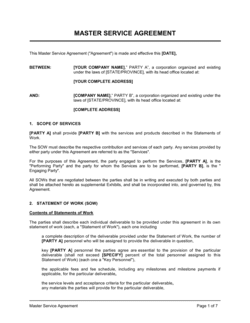
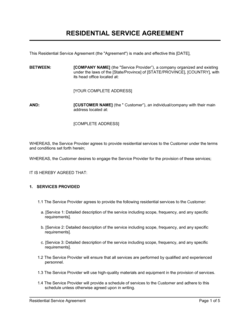
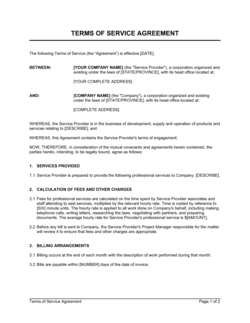
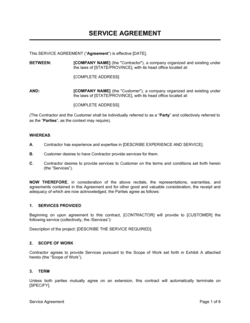
Vehicle Service Agreement Template

Free Word download • Edit online • Save & share with Drive • Export to PDF

6 pages25–35 min to fillDifficulty: ComplexSignature requiredLegal review recommended
Learn more ↓
FreeVehicle Service Agreement Template

At a glance

What it is
A Vehicle Service Agreement is a legally binding contract between a vehicle owner and a service provider — such as a dealership, independent repair shop, fleet management company, or extended-warranty issuer — that defines covered maintenance and repair services, exclusions, cost limits, deductibles, and the term of coverage. This free Word download gives you a structured, professionally formatted agreement you can edit online and export as PDF for immediate use.
When you need it
Use it when a service provider agrees to maintain or repair a vehicle over a defined period, whenever you need to document exactly which services are covered and which are not, or when a fleet operator engages a vendor to manage scheduled maintenance across multiple vehicles.
What's inside
Covered services and scheduled maintenance intervals, parts and labor terms, exclusions and limitations, deductible amounts, claim procedures, transfer rights, cancellation and refund terms, dispute resolution, and governing law.

What is a Vehicle Service Agreement?

A Vehicle Service Agreement is a legally binding contract between a vehicle owner and a service provider — a dealership, independent repair shop, fleet management vendor, or extended-warranty issuer — that defines which maintenance tasks and repairs will be performed on a specific vehicle over a defined term, how costs and deductibles are allocated, and what is excluded from coverage. Unlike a manufacturer's warranty, which is issued automatically at the point of sale, a vehicle service agreement is privately negotiated and can be tailored to cover scheduled maintenance, mechanical breakdown, or both. The covered vehicle is identified by its VIN, and the agreement runs until a specified date or mileage limit — whichever arrives first.

Why You Need This Document

Without a written vehicle service agreement, disputes about what was promised, what is covered, and who pays for unexpected repairs are almost inevitable. A verbal commitment to "take care of the car" provides no basis for a claim when a transmission fails, and an informal exchange of emails rarely addresses deductibles, benefit caps, or the authorization steps required before a repair can begin. For service providers, an unsigned arrangement exposes them to open-ended repair liability with no documented exclusions and no benefit cap. For vehicle owners — especially fleet operators and lessees — an unwritten maintenance arrangement offers no enforceable recourse when services are missed or parts quality falls short. This template gives both parties a clear, signed record of exactly what is covered, what is not, and what each party must do when a service or claim event occurs — closing the gaps that generate the most common and costly automotive service disputes.

Which variant fits your situation?

If your situation is…Use this template
Covering scheduled oil changes, filters, and tire rotations onlyPrepaid Maintenance Plan Agreement
Protecting mechanical and electrical components against breakdownExtended Warranty Agreement
Managing maintenance across a company fleet of 5 or more vehiclesFleet Maintenance Agreement
Hiring a mobile mechanic for on-call repair servicesMobile Mechanic Service Agreement
One-time repair authorization for a specific vehicle repair jobAuto Repair Authorization Form
Leasing a vehicle with maintenance obligations built into the leaseVehicle Lease Agreement with Maintenance Addendum
Engaging a roadside assistance provider under a service contractRoadside Assistance Service Agreement

Common mistakes to avoid

❌ No VIN in the vehicle description

Why it matters: Without a VIN, the agreement is not unambiguously tied to a specific vehicle. If the owner sells the car and wants to apply remaining coverage to a new vehicle, or if coverage is disputed after an accident, there is no definitive record of which vehicle was covered.

Fix: Always include the 17-character VIN, and cross-reference it against the vehicle title and registration before both parties sign.

❌ Vague exclusion language without examples

Why it matters: Courts and arbitrators apply contra proferentem — ambiguous contract language is interpreted against the party that drafted it. A vague exclusion clause is more likely to be held unenforceable, leaving the provider liable for repairs it intended to exclude.

Fix: List each exclusion category with at least one concrete example and a brief explanation, so the owner understands exactly what is not covered before signing.

❌ No total benefit cap

Why it matters: Without a dollar cap on the provider's total obligation, a single major mechanical failure — engine replacement, transmission rebuild — can generate a claim that exceeds the total premium collected and creates an unquantified financial liability.

Fix: Set an explicit per-visit and total-term benefit cap proportionate to the services covered and the premium charged.

❌ Omitting a mandatory free-look cancellation period

Why it matters: Most US states and Canadian provinces require service contracts to offer a minimum cancellation window — typically 10–30 days — for a full or near-full refund. A contract without one may be void or subject to regulatory penalties.

Fix: Research the service-contract statute in the owner's home jurisdiction before finalizing the cancellation clause, and include a free-look period that meets or exceeds the statutory minimum.

❌ No prior-authorization emergency carve-out

Why it matters: An absolute prior-authorization requirement denies coverage for legitimate after-hours breakdowns when the administrator is unreachable — the most common scenario where a service agreement claim actually matters.

Fix: Include an emergency-repair carve-out allowing repairs below a defined dollar threshold to proceed without prior authorization, provided the owner notifies the administrator within a defined number of business days.

❌ Governing law with no connection to the owner's location

Why it matters: Consumer protection statutes in the owner's home state or province typically apply regardless of a governing-law clause selecting a different jurisdiction. An unenforceable forum selection clause can expose the provider to litigation in a venue it never anticipated.

Fix: Use the jurisdiction where services are primarily performed as the governing law, and confirm that the selected forum aligns with applicable consumer-protection requirements.

The 10 key clauses, explained

Parties, vehicle identification, and term

In plain language: Identifies the service provider and vehicle owner as legal entities, describes the covered vehicle by VIN, make, model, and year, and states the agreement's start date and expiration — expressed as a date, mileage limit, or both.

Sample language
This Vehicle Service Agreement is entered into on [DATE] between [SERVICE PROVIDER LEGAL NAME] ('Provider') and [OWNER FULL NAME / ENTITY NAME] ('Owner'). The covered vehicle is a [YEAR] [MAKE] [MODEL], VIN [VIN NUMBER]. This Agreement commences on [START DATE] and expires on [END DATE] or upon the vehicle reaching [MILEAGE LIMIT] miles, whichever occurs first.

Common mistake: Describing the vehicle by make and model only without the VIN. A VIN-less agreement can be applied to any vehicle of the same model, creating disputes over which vehicle is actually covered.

Covered services and maintenance schedule

In plain language: Lists exactly which services the provider will perform — oil changes, filter replacements, brake inspections, tire rotations, fluid top-ups — and at what mileage or time intervals each service is due.

Sample language
Provider shall perform the following services at the intervals specified in Schedule A: engine oil and filter change (every [X] miles or [X] months), tire rotation (every [X] miles), brake inspection (every [X] miles), and [OTHER SERVICES]. Schedule A is incorporated by reference and forms part of this Agreement.

Common mistake: Listing services in the body of the agreement without attaching a Schedule A. When service intervals are embedded in running text, updates require full contract amendments instead of a simple schedule revision.

Covered parts and replacement standards

In plain language: Specifies whether replacement parts must be OEM, remanufactured, or aftermarket, and what quality standard applies — protecting both parties from disputes over part quality or warranty on replaced components.

Sample language
All replacement parts shall be [OEM / remanufactured / aftermarket parts meeting OEM specifications]. Provider warrants replaced parts against defect for [X] days or [X] miles from installation, whichever occurs first.

Common mistake: Leaving parts quality unspecified. A vehicle owner expects OEM parts; the provider installs aftermarket alternatives. Without express language, the resulting dispute is purely a credibility contest.

Exclusions and limitations

In plain language: Defines what the agreement does not cover — pre-existing conditions, damage from misuse, wear items, cosmetic components, non-covered drivetrain parts — so the provider is not liable for repairs outside the defined scope.

Sample language
This Agreement does not cover: (a) pre-existing conditions present at execution; (b) damage caused by accident, misuse, flood, or off-road operation; (c) wear items including tires, wiper blades, and brake pads unless expressly listed in Schedule A; (d) cosmetic components; or (e) [ADDITIONAL EXCLUSIONS].

Common mistake: Writing exclusions as a catch-all — 'any damage not caused by normal use' — without examples. Vague exclusion language is regularly held against the drafter by courts applying contra proferentem, meaning ambiguity resolves in the owner's favor.

Deductible and owner payment obligations

In plain language: States the flat deductible amount the owner pays per visit or claim, any caps on total annual benefit, and how costs exceeding covered limits are allocated between the parties.

Sample language
Owner shall pay a deductible of $[AMOUNT] per authorized service visit. Provider's total obligation under this Agreement shall not exceed $[CAP AMOUNT] per [YEAR / TERM]. Any repair cost exceeding the per-visit coverage limit shall be Owner's sole responsibility.

Common mistake: Omitting a total benefit cap. Without one, a single major mechanical failure can generate a claim far exceeding the premium collected — creating an unquantified financial exposure for the provider.

Claim authorization procedure

In plain language: Requires the vehicle owner to obtain prior written or electronic authorization from the administrator before any covered repair begins, and voids coverage for unauthorized work.

Sample language
Owner must contact [ADMINISTRATOR NAME / CONTACT] for prior authorization before authorizing any covered repair. Provider and Owner acknowledge that unauthorized repairs shall not be reimbursed under this Agreement. Emergency repairs costing less than $[AMOUNT] may proceed without prior authorization provided Owner notifies Administrator within [X] business days.

Common mistake: No emergency-repair carve-out. An absolute prior-authorization requirement creates a gap for after-hours breakdowns where reaching the administrator is impossible — leading to disputes when legitimate emergency repairs are denied.

Transfer rights

In plain language: Allows the remaining coverage to be assigned to a new vehicle owner upon sale, subject to any transfer fee and administrative requirements — making the agreement a value-add when the covered vehicle is sold.

Sample language
Owner may transfer this Agreement to a subsequent purchaser of the covered vehicle by notifying Provider in writing within [X] days of the sale and paying a transfer fee of $[AMOUNT]. Transferred coverage runs for the unexpired term only. Provider's prior written consent is required for any other assignment.

Common mistake: Allowing transfer without a defined notice window or fee. Without these controls, providers cannot update their records or collect the transfer fee — and coverage gaps caused by unnotified ownership changes become the provider's liability.

Cancellation, refund, and termination

In plain language: Defines each party's right to cancel the agreement, the notice required, and how any unearned prepaid fee is calculated — typically on a pro-rata or earned-premium basis minus a cancellation fee.

Sample language
Owner may cancel this Agreement within [X] days of execution for a full refund less $[ADMIN FEE]. After [X] days, Owner is entitled to a pro-rata refund of the unearned fee based on time elapsed or mileage used, whichever is greater, less a $[CANCELLATION FEE] processing charge. Provider may cancel for non-payment upon [X] days' written notice.

Common mistake: No full-refund window. Many US states and Canadian provinces require a minimum free-look period — typically 10–30 days — for service contracts. Omitting it can make the cancellation clause unenforceable.

Limitation of liability and disclaimers

In plain language: Caps the provider's total liability to the value of the agreement, excludes consequential and incidental damages, and disclaims implied warranties beyond those expressly stated — limiting exposure from secondary losses like rental costs or lost income.

Sample language
Provider's total liability under this Agreement shall not exceed the total fees paid by Owner. In no event shall Provider be liable for incidental, consequential, or indirect damages including loss of use, rental costs, or lost income. All implied warranties are disclaimed to the fullest extent permitted by applicable law.

Common mistake: Excluding consequential damages without checking state or provincial law. Several jurisdictions limit or prohibit exclusion of consequential damages in consumer contracts — an unenforceable exclusion clause may void the entire limitation.

Governing law and dispute resolution

In plain language: Specifies which jurisdiction's law governs the agreement, the venue for disputes, and whether disputes are resolved by arbitration, mediation, or litigation — including any class-action waiver where permitted.

Sample language
This Agreement shall be governed by the laws of [STATE / PROVINCE]. Any dispute arising hereunder shall be resolved by binding arbitration administered by [AAA / JAMS / NAMED BODY] in [CITY], except that either party may seek injunctive relief in a court of competent jurisdiction. Owner waives any right to participate in a class action to the extent permitted by law.

Common mistake: Choosing a governing state with no connection to where services are performed. Consumer protection statutes in the owner's home state often apply regardless of the governing law clause, and courts in that state may refuse to enforce the chosen forum.

How to fill it out

  1. 1

    Enter the parties' legal names and vehicle identification

    Use the service provider's registered legal entity name — not a trade name — and the owner's full legal name or corporate name. Enter the vehicle's 17-character VIN, year, make, and model. Confirm the VIN against the vehicle registration before signing.

    💡 Cross-check the VIN on the physical vehicle (dashboard plate and door jamb) against the title and registration — a one-character VIN error can void coverage.

  2. 2

    Set the term using both a date and a mileage limit

    Enter a specific expiration date and a maximum mileage threshold. Whichever limit is reached first ends the agreement. Record the vehicle's current odometer reading at signing to establish the baseline.

    💡 Photograph the odometer at signing and attach the image to the signed agreement — this eliminates disputes about starting mileage if the vehicle changes hands.

  3. 3

    Draft Schedule A with specific services and intervals

    List every covered service by name and the exact interval — mileage or months — at which it falls due. Attach Schedule A as a separate page so intervals can be updated without redrafting the main agreement body.

    💡 Use the manufacturer's recommended maintenance schedule as the baseline for Schedule A — deviating significantly from it gives the provider grounds to deny coverage for consequential damage.

  4. 4

    Define covered parts and quality standard

    Specify whether replacement parts will be OEM, remanufactured, or aftermarket, and document any warranty on installed parts. If OEM is not required, state the minimum quality standard — e.g., 'meeting OEM specifications.'

    💡 If the vehicle is still under manufacturer warranty, confirm that using non-OEM parts will not void that warranty before selecting the parts standard.

  5. 5

    Write the exclusions with concrete examples

    List every excluded category — pre-existing conditions, misuse damage, wear items, cosmetic parts — with at least one example for each category. Avoid relying on a single catch-all exclusion clause.

    💡 Have someone unfamiliar with the vehicle read the exclusions section and flag anything they find ambiguous — ambiguity is read against the drafter in most jurisdictions.

  6. 6

    Set the deductible, benefit cap, and claim procedure

    Enter the per-visit deductible amount and the total annual or term benefit cap. Then write the claim authorization procedure clearly, including the administrator's phone number, email, and hours, and the emergency-repair threshold if you include a carve-out.

    💡 State the emergency-repair threshold in dollars, not in terms of urgency — 'emergency' is subjective and creates disputes.

  7. 7

    Complete transfer, cancellation, and refund terms

    Enter the transfer fee, the notice window for transfer (typically 30 days from sale), the free-look cancellation period, and the pro-rata refund formula. Confirm the free-look period meets the minimum required in the jurisdiction where the owner resides.

    💡 Check your state's or province's service-contract statute for the mandatory free-look period before finalizing this section — non-compliance can void the entire cancellation clause.

  8. 8

    Execute before the service relationship begins

    Both parties must sign before the first covered service is performed. Date the agreement and retain a fully executed copy. For consumer agreements, provide the owner with a copy at signing as required in most jurisdictions.

    💡 If using eSign, ensure the platform captures a timestamp and IP address — both are useful evidence if a claim dispute escalates to arbitration.

Frequently asked questions

What is a vehicle service agreement?

A vehicle service agreement is a contract between a vehicle owner and a service provider that defines which maintenance tasks and repairs will be performed over a specified period or mileage, how costs are shared, and what is excluded from coverage. It differs from a manufacturer warranty in that it is privately issued, negotiated between the parties, and can be customized to cover specific services or components. Both dealerships and independent repair shops use them to offer prepaid maintenance packages or extended-coverage plans.

What is the difference between a vehicle service agreement and an extended warranty?

An extended warranty typically covers mechanical breakdown of specific components — engine, transmission, drivetrain — beyond the manufacturer's original warranty period. A vehicle service agreement is broader and can cover scheduled maintenance (oil changes, filters, tire rotations) in addition to or instead of breakdown coverage. Extended warranties are commonly issued by third-party administrators; service agreements are more often offered directly by dealerships or repair shops. Both should be documented with a signed written contract.

Is a vehicle service agreement legally binding?

Yes, a vehicle service agreement is generally enforceable as a binding contract when it contains an offer, acceptance, and consideration — for example, the provider agrees to perform services in exchange for the owner's prepaid fee. To be enforceable, the agreement must identify the covered vehicle clearly, define the services and exclusions with sufficient specificity, and comply with any applicable service-contract statutes in the jurisdiction. Consider having a lawyer review the agreement if the contract value is significant or the jurisdiction has specific consumer-contract requirements.

What should be included in a vehicle service agreement?

At minimum: the parties' legal names, the covered vehicle's VIN and description, the agreement term (start date, end date, and mileage cap), a detailed list of covered services and intervals, parts quality standards, exclusions and limitations, deductible and benefit cap amounts, the claim authorization procedure, transfer rights, cancellation and refund terms, a limitation of liability, and governing law. Missing any of these creates ambiguity that typically resolves in favor of the vehicle owner under consumer-protection principles.

Can a vehicle service agreement be transferred to a new owner?

It can if the agreement expressly permits transfer — typically requiring written notice within a defined window (often 30 days from the sale date) and payment of a transfer fee. Transferability can increase a vehicle's resale value because the buyer inherits remaining coverage. Without a transfer clause, the agreement is personal to the original owner and terminates when the vehicle is sold.

How do vehicle service agreement deductibles work?

A deductible is the fixed amount the vehicle owner pays at the time of each authorized service visit before the agreement's coverage applies. For example, a $100 deductible on a $450 repair means the owner pays $100 and the provider covers the remaining $350 up to the benefit cap. Some agreements charge a deductible per visit; others charge per covered component. The deductible amount and structure should be clearly stated in the agreement to avoid disputes at the time of service.

What exclusions are typical in a vehicle service agreement?

Common exclusions include pre-existing conditions present at signing, damage from accidents, flood, fire, or misuse, cosmetic components, routine wear items such as tires and wiper blades (unless expressly covered), and components not listed in the covered-parts schedule. Extended-warranty-style agreements also typically exclude maintenance services like oil changes. The specific exclusion list varies by agreement — reading Schedule A and the exclusions clause before signing is critical.

Do I need a lawyer to create a vehicle service agreement?

For straightforward single-vehicle maintenance plans, a well-drafted template is typically sufficient. Engage a lawyer when the agreement will be offered as a consumer product to a large number of customers (which may trigger service-contract licensing requirements), when the covered vehicle is a high-value commercial asset, when the agreement crosses state or provincial lines, or when the exclusion and limitation clauses need to be stress-tested against local consumer-protection law. A one-hour legal review typically costs $200–$400 and is worthwhile for any template used at scale.

Are vehicle service agreements regulated?

In many US states, companies that sell vehicle service contracts to consumers must comply with state service-contract statutes — which may require licensing, a financial reserve or insurance backing, mandatory cancellation rights, and specific contract disclosures. In Canada, provincial consumer-protection legislation applies similar requirements. The UK's Financial Conduct Authority regulates some forms of vehicle warranty products. Providers issuing agreements at commercial scale should confirm whether they need a service-contract license in their operating states or provinces.

How this compares to alternatives

vs Auto Repair Authorization Form

An auto repair authorization form is a one-time document authorizing a specific repair job — it covers a single visit with no ongoing obligation. A vehicle service agreement governs a relationship over a defined term and mileage, covering multiple future services. Use a repair authorization for a one-off job; use a service agreement for any arrangement where the provider commits to future maintenance or coverage.

vs Vehicle Lease Agreement

A vehicle lease agreement governs the right to use a vehicle for a defined period in exchange for periodic payments — it is primarily a possession and payment contract. A vehicle service agreement governs the maintenance and repair obligations associated with a vehicle, regardless of who owns or leases it. The two documents are complementary and are often executed together for leased vehicles.

vs Independent Contractor Agreement

An independent contractor agreement engages a self-employed mechanic or technician for labor on a project or time basis without the specific coverage, exclusion, deductible, and claim-procedure structure that vehicle service agreements require. If you are hiring a mobile mechanic for a series of jobs rather than purchasing coverage for a vehicle, a contractor agreement is the appropriate document.

vs Service Level Agreement (SLA)

A general service level agreement defines performance standards — response times, uptime guarantees, escalation procedures — across any type of service relationship. A vehicle service agreement is a purpose-built contract with vehicle-specific elements: VIN, mileage limits, parts standards, claim procedures, and transfer rights. Use an SLA when the focus is service quality metrics; use a vehicle service agreement when the subject matter is vehicle maintenance or repair coverage.

Industry-specific considerations

Automotive dealerships

Dealerships use vehicle service agreements to monetize the post-sale relationship, offering manufacturer-schedule maintenance packages or extended drivetrain coverage that keeps customers returning to the service department.

Fleet and logistics

Fleet operators contract vendors to maintain entire vehicle pools under a single agreement, tying service intervals to odometer readings logged through telematics systems and capping per-vehicle annual spend.

Vehicle leasing and rental

Leasing companies embed maintenance obligations into vehicle service agreements to protect residual values, requiring lessees to follow OEM service schedules through approved providers and documenting compliance for end-of-lease audits.

Independent repair and service shops

Independent shops use prepaid service agreements to build recurring revenue and lock in customer relationships, offering bundled oil-change and inspection packages priced below retail to drive consistent bay traffic.

Jurisdictional notes

United States

Most US states regulate vehicle service contracts under service-contract statutes that may require the issuer to obtain a license, maintain a financial reserve or insurance policy backing coverage obligations, and provide mandatory consumer disclosures. Cancellation rights vary by state but commonly require a 10–30 day free-look period. California, Texas, and Florida have particularly detailed statutory requirements. Excluding consequential damages in consumer contracts is restricted in some states.

Canada

Provincial consumer-protection legislation — including Ontario's Consumer Protection Act, Alberta's Fair Trading Act, and British Columbia's Business Practices and Consumer Protection Act — applies to vehicle service contracts sold to consumers and typically requires disclosure of cancellation rights, a minimum free-look period, and fair claim procedures. Quebec requires all consumer contracts to be in French. Federal competition law prohibits deceptive warranty representations regardless of province.

United Kingdom

Vehicle warranty and service contract products sold in the UK may be regulated by the Financial Conduct Authority as insurance contracts if they provide indemnity against breakdown costs. The Consumer Rights Act 2015 implies terms of satisfactory quality and fitness for purpose into services contracts and limits the enforceability of exclusion clauses in consumer dealings. Unfair contract terms under the Consumer Rights Act can render exclusions and limitation clauses void.

European Union

EU Directive 2019/2161 (the Omnibus Directive) and national consumer-protection laws impose strict requirements on service contracts sold to consumers, including mandatory cancellation rights, clear disclosure of exclusions, and prohibition of unfair terms. Vehicle warranty products may be classified as insurance in several member states, requiring regulatory authorization. GDPR applies to any processing of personal data — including vehicle and claims data — recorded in connection with the agreement.

Template vs lawyer — what fits your deal?

PathBest forCostTime
Use the templateSingle-vehicle owners entering a prepaid maintenance plan with a local service providerFree20–30 minutes
Template + legal reviewDealerships or repair shops issuing the same agreement to multiple consumer customers, or fleet operators with high-value vehicles$200–$500 for a one-hour attorney review2–5 business days
Custom draftedExtended-warranty issuers operating across multiple states or provinces, or fleet operators with 20+ vehicles requiring custom benefit structures$1,000–$4,000+1–3 weeks

Glossary

Covered Services
The specific maintenance tasks and repairs listed in the agreement that the service provider is obligated to perform within the contract term.
Exclusions
Components, failure types, or circumstances explicitly removed from coverage — such as wear items, pre-existing conditions, or damage from misuse.
Deductible
A fixed dollar amount the vehicle owner pays per service visit or claim before the agreement's coverage applies to the remaining cost.
Service Interval
The mileage or time threshold at which a specific maintenance task — such as an oil change or transmission service — must be performed under the agreement.
Covered Parts
The list of vehicle components the agreement covers for replacement if they fail or wear beyond a specified threshold during the contract term.
Claim Procedure
The steps the vehicle owner must follow to authorize a covered repair — typically including prior approval from the administrator before work begins.
Transferability
A provision allowing the remaining coverage under the agreement to be assigned to a subsequent owner if the covered vehicle is sold before the contract term ends.
Cancellation and Refund
Terms governing how either party may terminate the agreement early and how any unearned portion of a prepaid fee is calculated and returned.
Wear Item
A component expected to wear with normal use — such as brake pads, wiper blades, or tires — typically excluded from extended warranty coverage but may be included in maintenance plans.
Administrator
The company responsible for processing claims, authorizing repairs, and managing the financial obligations of the service agreement — which may be the service provider itself or a third-party warranty company.
OEM Parts
Original Equipment Manufacturer parts — components made by or to the specifications of the vehicle's original manufacturer, as opposed to aftermarket alternatives.
Pre-Existing Condition
A mechanical defect or wear condition present in the vehicle at the time the service agreement is signed, typically excluded from coverage.

Part of your Business Operating System

This document is one of 3,000+ business & legal templates included in Business in a Box.

  • Fill-in-the-blanks — ready in minutes
  • 100% customizable Word document
  • Compatible with all office suites
  • Export to PDF and share electronically

Create your document in 3 simple steps.

From template to signed document — all inside one Business Operating System.
1
Download or open template

Access over 3,000+ business and legal templates for any business task, project or initiative.

2
Edit and fill in the blanks with AI

Customize your ready-made business document template and save it in the cloud.

3
Save, Share, Send, Sign

Share your files and folders with your team. Create a space of seamless collaboration.

Save time, save money, and create top-quality documents.

★★★★★

"Fantastic value! I'm not sure how I'd do without it. It's worth its weight in gold and paid back for itself many times."

Managing Director · Mall Farm
Robert Whalley
Managing Director, Mall Farm Proprietary Limited
★★★★★

"I have been using Business in a Box for years. It has been the most useful source of templates I have encountered. I recommend it to anyone."

Business Owner · 4+ years
Dr Michael John Freestone
Business Owner
★★★★★

"It has been a life saver so many times I have lost count. Business in a Box has saved me so much time and as you know, time is money."

Owner · Upstate Web
David G. Moore Jr.
Owner, Upstate Web

Run your business with a system — not scattered tools

Stop downloading documents. Start operating with clarity. Business in a Box gives you the Business Operating System used by over 250,000 companies worldwide to structure, run, and grow their business.

Free Forever Plan · No credit card required