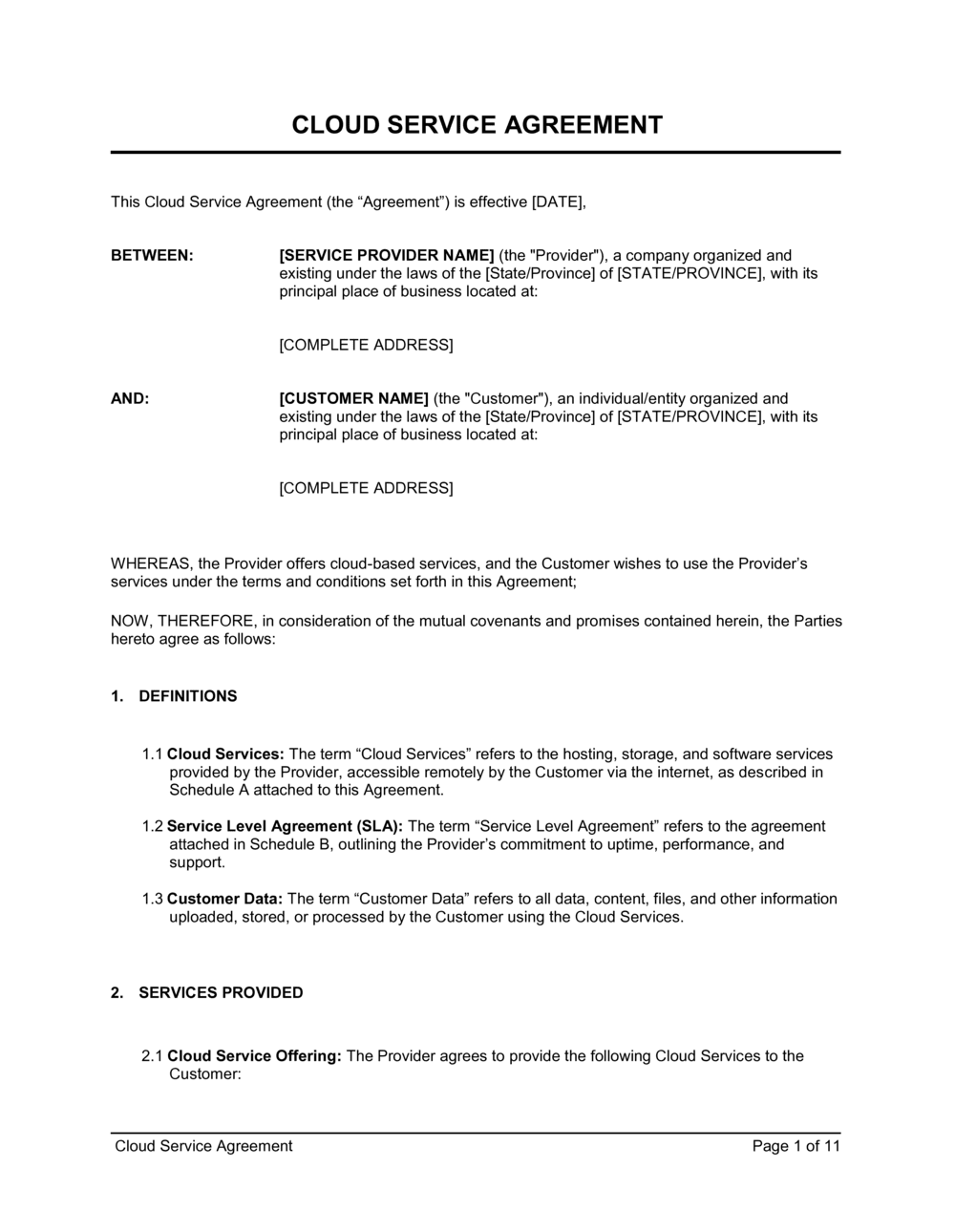
Cloud Service Agreement Template

Free Word download • Edit online • Save & share with Drive • Export to PDF

11 pages30–40 min to fillDifficulty: ComplexSignature requiredLegal review recommended
Learn more ↓
FreeCloud Service Agreement Template

At a glance

What it is
A Cloud Service Agreement is a legally binding contract between a cloud service provider and a customer that governs access to, and use of, hosted infrastructure, platforms, or software delivered over the internet. This free Word download covers service scope, SLAs, data security, intellectual property, liability caps, and termination in a single professionally structured document you can edit online and export as PDF.
When you need it
Use it whenever a business agrees to deliver or receive cloud-hosted services — including IaaS, PaaS, or SaaS — where uptime commitments, data handling obligations, and liability exposure need to be clearly defined in writing before services go live.
What's inside
Service description and scope, service level agreement with uptime targets and credits, data security and privacy obligations, intellectual property ownership, fees and payment terms, confidentiality, liability cap and indemnification, term and termination, and governing law.

What is a Cloud Service Agreement?

A Cloud Service Agreement is a legally binding contract between a cloud service provider and a customer that governs the delivery of hosted infrastructure, platforms, or software over the internet. It defines the scope of services being delivered, commits the provider to specific uptime and performance levels through a service level agreement, allocates ownership of data and intellectual property, establishes the fee structure, and sets out the rights and obligations of both parties when the relationship ends. Unlike a consumer click-through terms of service, a B2B cloud service agreement is a negotiated instrument that creates enforceable obligations — including liability caps, data security requirements, and breach notification timelines — tailored to the specific arrangement.

Why You Need This Document

Operating without a written cloud service agreement leaves both the provider and the customer exposed to consequences that are entirely preventable. A provider with no SLA is legally free to experience unlimited downtime without consequence. A customer with no data-return clause may find their data deleted — or held hostage — the moment they try to switch vendors. When a breach occurs and no breach-notification timeline is specified, regulators do not accept "we had no written agreement" as a defense under GDPR, HIPAA, or state breach notification laws. On the commercial side, disputes over what services were actually promised, whether a custom integration belongs to the provider or the customer, and whether auto-renewal pricing changes were properly communicated all become credibility contests rather than contract interpretation exercises. A signed cloud service agreement, in place before the first API call or data migration, closes every one of these gaps — and does so for the cost of 30 minutes and a targeted legal review where the data sensitivity or contract value warrants it.

Which variant fits your situation?

If your situation is…Use this template
Delivering software to customers on a subscription basisSaaS Subscription Agreement
Providing managed IT services including cloud infrastructure supportManaged Services Agreement
Engaging a third-party vendor to process personal data in the cloudData Processing Agreement
Reselling or white-labeling a cloud platform to end customersReseller Agreement
Short-term or project-based cloud consulting with no ongoing hostingIT Consulting Agreement
Bilateral sharing of confidential cloud architecture or product dataNon-Disclosure Agreement
Enterprise procurement requiring a master agreement with order formsMaster Service Agreement

Common mistakes to avoid

❌ No explicit definition of 'downtime'

Why it matters: Without a precise definition, providers classify slow responses or partial failures as 'degraded performance' rather than outages, effectively avoiding SLA credits on most incidents.

Fix: Define downtime as any period during which the service is unavailable or response times exceed a specified threshold — e.g., more than 5 seconds per request — and make the definition binary rather than interpretive.

❌ Vague security obligations without specified controls

Why it matters: A promise to use 'commercially reasonable security' is unenforceable in practice — both parties will interpret reasonableness differently after a breach, and regulators will not accept it as evidence of compliance.

Fix: Enumerate specific controls: encryption standard, authentication requirements, penetration testing frequency, and the security frameworks (SOC 2, ISO 27001) the provider must maintain and evidence annually.

❌ No data-return or deletion obligation at termination

Why it matters: If the agreement is silent on post-termination data handling, the provider may delete customer data immediately upon contract end or retain it indefinitely without the customer's knowledge.

Fix: Include a 30-day post-termination export window with a specified portable format, followed by documented deletion and written confirmation from the provider within 10 business days.

❌ Auto-renewal with no advance notice requirement for price changes

Why it matters: Customers discover significant fee increases only at the point of renewal, when migration timelines make switching impractical — resulting in being locked into higher pricing.

Fix: Require at least 60–90 days' written notice of any fee adjustment prior to a renewal term, with the customer's right to terminate without penalty if they reject the new pricing.

❌ Applying the liability cap to data breaches and regulatory fines

Why it matters: A GDPR or HIPAA fine can reach tens of millions of dollars — capping the provider's liability at 12 months of a $500/month SaaS fee means the customer absorbs nearly all regulatory exposure.

Fix: Carve data breaches, confidentiality violations, and third-party regulatory penalties out of the standard liability cap, and negotiate a separate, higher limit specifically for data incidents.

❌ No IP ownership clause for custom development

Why it matters: When a provider builds customer-specific features or integrations without a written ownership clause, the default legal position in most common-law jurisdictions vests IP in the creator — the provider.

Fix: Add a clause in the main agreement or accompanying SOW explicitly assigning ownership of all custom-developed work product to the customer upon payment in full.

The 9 key clauses, explained

Parties and service description

In plain language: Identifies the provider and customer as legal entities and defines the specific cloud services being delivered — infrastructure, platform, software, or a combination.

Sample language
This Cloud Service Agreement is entered into on [DATE] between [PROVIDER LEGAL NAME], a [STATE/COUNTRY] [ENTITY TYPE] ('Provider'), and [CUSTOMER LEGAL NAME], a [STATE/COUNTRY] [ENTITY TYPE] ('Customer'). Provider agrees to deliver the cloud services described in Schedule A ('Services').

Common mistake: Describing services in vague terms like 'cloud hosting' rather than referencing a detailed Schedule A. Without a specific scope, disputes over what is included are almost inevitable.

Service levels and uptime commitment

In plain language: States the minimum monthly uptime percentage, defines how downtime is calculated (excluding scheduled maintenance), and specifies the service credit formula for SLA failures.

Sample language
Provider guarantees [99.9]% monthly uptime for the Services, excluding scheduled maintenance windows communicated at least [48] hours in advance. For each full hour of downtime below the SLA, Customer shall receive a service credit equal to [X]% of that month's fees, up to a maximum of [30]% of the monthly fee.

Common mistake: Omitting a definition of 'downtime.' If the agreement does not specify what constitutes a service outage versus degraded performance, providers routinely contest credit claims.

Fees, invoicing, and payment terms

In plain language: Sets out the subscription or usage fees, billing frequency, invoicing process, late-payment interest, and any auto-renewal pricing changes.

Sample language
Customer shall pay Provider a monthly fee of $[AMOUNT] (or as set out in Schedule B), due within [30] days of invoice date. Overdue amounts accrue interest at [1.5]% per month. Provider may adjust fees on [90] days' written notice prior to any renewal term.

Common mistake: No fee-adjustment notice period for renewals. Customers discover a 20–30% price increase only at auto-renewal, triggering disputes and exits that damage the provider-customer relationship.

Data ownership and security

In plain language: Confirms the customer owns all data they upload or generate on the platform, and obligates the provider to implement specified security controls — encryption, access controls, and incident notification timelines.

Sample language
Customer retains all right, title, and interest in Customer Data. Provider shall implement and maintain commercially reasonable security measures including [AES-256 encryption at rest, TLS 1.2+ in transit, annual penetration testing]. Provider shall notify Customer of any confirmed data breach within [72] hours of discovery.

Common mistake: Using 'commercially reasonable security' without specifying any concrete controls. This standard is too vague to enforce and shifts all interpretive risk to litigation.

Intellectual property

In plain language: Allocates ownership of the platform, pre-existing IP, and any customer-specific customizations, and grants each party the licenses needed to perform under the agreement.

Sample language
Provider retains all ownership of the Services, platform, and underlying technology. Customer grants Provider a limited, non-exclusive license to process Customer Data solely to deliver the Services. Any custom development performed for Customer under a separate SOW is owned as specified in that SOW.

Common mistake: Failing to address custom-development ownership in the main agreement. When a provider builds customer-specific features, the default may vest IP in the provider — locking the customer into the platform.

Confidentiality

In plain language: Obligates both parties to protect each other's non-public information — including pricing, architecture, and customer data — with defined exclusions for publicly available information.

Sample language
Each party shall hold the other's Confidential Information in strict confidence and not disclose it to third parties without prior written consent. Confidential Information excludes information that is publicly known, independently developed, or disclosed under legal compulsion.

Common mistake: No survival clause specifying how long confidentiality obligations outlast termination. Without one, the duty to protect sensitive data may expire the moment the agreement ends.

Liability cap and exclusions

In plain language: Caps each party's total liability at a defined dollar amount — typically 12 months of fees paid — and excludes indirect, consequential, and lost-profit damages, with carve-outs for willful misconduct and IP indemnity.

Sample language
Each party's aggregate liability under this Agreement shall not exceed the total fees paid by Customer in the [12] months preceding the claim. Neither party shall be liable for indirect, incidental, special, or consequential damages. These limitations do not apply to breaches of confidentiality, IP indemnification obligations, or gross negligence.

Common mistake: Applying the liability cap equally to both parties without carve-outs for data breaches or willful misconduct. Courts may reduce or strike caps that are unreasonably one-sided in the provider's favor.

Term, termination, and data return

In plain language: Sets the initial contract term, auto-renewal conditions, termination rights for cause and convenience, notice periods, and the provider's obligation to return or delete customer data within a specified period after termination.

Sample language
This Agreement commences on [START DATE] and continues for [12] months, renewing automatically for successive [12]-month terms unless either party provides [60] days' written notice. Either party may terminate for material breach upon [30] days' written notice if the breach remains uncured. Upon termination, Provider shall make Customer Data available for export for [30] days, then permanently delete it.

Common mistake: No data-return window after termination. If the agreement is silent, the provider may delete data immediately upon contract end, leaving the customer with no recovery option.

Governing law and dispute resolution

In plain language: Specifies the jurisdiction whose laws govern the agreement and the mechanism for resolving disputes — arbitration, mediation, or court — along with the venue.

Sample language
This Agreement is governed by the laws of [STATE / PROVINCE / COUNTRY]. Any dispute shall be resolved by binding arbitration under [AAA / JAMS / ICC] rules in [CITY], except that either party may seek injunctive relief in any court of competent jurisdiction to protect IP or confidential information.

Common mistake: Choosing a governing law with no connection to where either party operates. Some jurisdictions invalidate choice-of-law clauses that are purely forum-shopping and have no legitimate nexus to the agreement.

How to fill it out

  1. 1

    Identify both parties with their full legal entity names

    Enter the provider's and customer's registered legal names, entity types, and states or countries of incorporation. Avoid using trade names or DBA names as the contracting party.

    💡 Cross-check the customer's legal name against their company registry filing — mismatched names create enforcement problems if you ever need to pursue payment or damages.

  2. 2

    Draft a detailed service description in Schedule A

    List every service component being delivered — compute, storage, software modules, support tiers, and API access limits. Attach this as Schedule A and reference it from the main agreement body.

    💡 Overly broad service descriptions are the single most common source of cloud contract disputes — be specific about what is in scope and what requires a separate order form.

  3. 3

    Set SLA targets and the credit formula

    Enter the monthly uptime percentage commitment, define 'downtime' explicitly (excluding scheduled maintenance), and specify the service credit percentage and monthly cap.

    💡 Tier your credits — a 5-minute outage and a 4-hour outage warrant different remedies. Credits capped at 10–30% of monthly fees are standard for IaaS and SaaS providers.

  4. 4

    Specify security controls and breach notification timing

    List the concrete security measures the provider must maintain — encryption standards, access controls, certifications (SOC 2, ISO 27001), and penetration testing frequency. Set a 72-hour breach notification obligation.

    💡 If the customer is subject to HIPAA, PCI DSS, or GDPR, call out those specific compliance obligations explicitly and require evidence of the provider's corresponding certifications.

  5. 5

    Define fees, billing cycle, and renewal price-change notice

    Enter the base monthly or annual fee, payment terms (Net 30 is standard), late-payment interest rate, and the advance notice period required before the provider can adjust fees on renewal.

    💡 Require a minimum of 60–90 days' written notice for any fee increase. A 30-day notice period rarely gives enterprise customers enough lead time to renegotiate or migrate.

  6. 6

    Configure the liability cap and carve-outs

    Set the aggregate liability cap — typically 12 months of fees paid — and confirm the carve-out list covers data breaches, confidentiality violations, IP indemnification, and gross negligence.

    💡 If you are the customer, negotiate a separate, higher cap for data breach liability — standard caps were designed to limit platform downtime claims, not the cost of a regulatory fine.

  7. 7

    Set the term, renewal, and data-return window

    Enter the initial contract term and auto-renewal period. Set a 60-day non-renewal notice window and a 30-day post-termination data-export window before the provider deletes customer data.

    💡 Require data return in a standard, portable format (CSV, JSON, SQL dump) rather than a proprietary export. This is critical leverage — an unusable export is functionally no export.

  8. 8

    Select governing law and sign before services go live

    Choose a governing jurisdiction with a real nexus to one or both parties' operations. Both parties must sign — and signatures must precede the service start date to ensure all clauses, including IP and confidentiality, are fully effective from day one.

    💡 Use a timestamped e-signature platform so the executed date is auditable. A dispute about when the agreement was signed can undermine the entire contract.

Frequently asked questions

What is a cloud service agreement?

A cloud service agreement is a legally binding contract between a cloud provider and a customer that governs the delivery and use of hosted services — infrastructure, platforms, or software — over the internet. It defines service scope, SLA commitments, data security obligations, fees, intellectual property ownership, liability limits, and termination rights. It replaces informal understandings with enforceable obligations on both sides before services go live.

What should a cloud service agreement include?

At minimum: a detailed service description, SLA with uptime targets and credit formula, data ownership and security controls, breach notification timelines, IP allocation, fees and billing terms, confidentiality obligations, a liability cap with appropriate carve-outs, term and termination conditions including a data-return window, and governing law. Missing any of these creates gaps that regulators and courts fill unfavorably for the party that failed to address them.

Is a cloud service agreement the same as a SaaS agreement?

They overlap significantly but are not identical. A SaaS agreement specifically governs access to a software application hosted in the cloud on a subscription basis. A cloud service agreement is broader — it can also cover infrastructure-as-a-service (IaaS) and platform-as-a-service (PaaS) arrangements where the customer builds on top of the provider's environment rather than simply using a finished application. The core clauses are similar; the service description and SLA metrics differ.

Who needs to sign a cloud service agreement?

Both the cloud service provider and the customer must sign. For corporate parties, the signatory should be an authorized officer or representative — typically a CEO, CFO, or VP with contractual signing authority. Clicking an online 'I agree' checkbox on standard click-through terms may be enforceable for consumer services but is generally insufficient for enterprise B2B arrangements where negotiated terms, liability caps, and custom SLAs are in play.

What is a service level agreement (SLA) in a cloud contract?

An SLA is the section of the cloud service agreement that commits the provider to a specific uptime percentage — commonly 99.9% (about 8.7 hours of downtime per year) or 99.99% (about 52 minutes per year). It also defines how downtime is measured, excludes scheduled maintenance, and specifies the remedy — typically a service credit — when the commitment is missed. Providers that do not meet SLA targets without a written credit formula effectively bear no contractual consequence.

How does GDPR affect a cloud service agreement?

If the customer is subject to GDPR and the provider processes personal data of EU residents on the customer's behalf, GDPR Article 28 requires a Data Processing Agreement (DPA) — either as a standalone document or incorporated into the cloud service agreement. The DPA must specify the nature of processing, data subject categories, retention periods, and the provider's obligations regarding sub-processors, data subject rights, and breach notification. A cloud agreement that lacks a DPA exposes both parties to regulatory enforcement.

What is a reasonable liability cap for a cloud service agreement?

The most common standard for SaaS and cloud agreements caps each party's total aggregate liability at the fees paid in the prior 12 months. For a $1,000/month service, this means a $12,000 cap — workable for minor platform issues but wholly inadequate for a data breach or regulatory fine. Enterprise customers typically negotiate a higher, separate cap for data security incidents — often 2–3× annual fees — and exclude confidentiality violations and IP indemnification from the cap entirely.

Can I use a cloud service agreement template without a lawyer?

For straightforward agreements between domestic parties where the data involved is not sensitive and the contract value is under $50K/year, a well-structured template is generally sufficient. Engage a lawyer when personal data is being processed (HIPAA, GDPR, or CCPA exposure), when the contract value or liability exposure exceeds $100K/year, when you are operating in multiple jurisdictions with conflicting data residency requirements, or when custom IP development is part of the engagement.

What happens to customer data when a cloud service agreement ends?

Under a well-drafted agreement, the provider must make customer data available for export in a standard portable format for a defined period — typically 30 days — following termination, and then permanently delete all copies with written confirmation. Without this clause, providers may delete data immediately on contract end, retain it for their own purposes, or export it only in proprietary formats that make migration impractical. Data portability is one of the most frequently omitted and most consequential clauses in cloud contracts.

What is the difference between a cloud service agreement and a master service agreement?

A master service agreement (MSA) is a framework contract covering general terms — liability, confidentiality, IP, dispute resolution — across all future engagements between two parties. Individual services, projects, and pricing are then governed by statements of work or order forms issued under the MSA. A cloud service agreement is a self-contained contract for a specific cloud service arrangement. Enterprise customers often prefer an MSA with cloud-specific schedules because it avoids renegotiating boilerplate on every new service order.

How this compares to alternatives

vs Master Service Agreement

A master service agreement is a framework contract that governs the general terms for all current and future engagements between two parties, with individual services added via statements of work or order forms. A cloud service agreement is self-contained for a specific cloud engagement. Organizations with multiple ongoing services from the same vendor typically benefit from an MSA with cloud-specific schedules rather than standalone per-service agreements.

vs Managed Services Agreement

A managed services agreement covers ongoing IT services — monitoring, helpdesk, infrastructure management — delivered by a third party, which may or may not involve cloud hosting. A cloud service agreement is specifically scoped to the delivery of hosted cloud resources, SLA guarantees, and data responsibilities. Organizations receiving cloud hosting plus active management often need both documents — or a single agreement that incorporates both scopes.

vs Non-Disclosure Agreement

An NDA protects confidential information shared during negotiations or a business relationship before a full agreement is in place. A cloud service agreement contains its own confidentiality clause but also governs service delivery, pricing, SLAs, and data security. An NDA is appropriate at the evaluation stage; once services are contracted, the cloud service agreement's confidentiality clause takes precedence — though the NDA may survive for pre-contract disclosures.

vs IT Consulting Agreement

An IT consulting agreement governs project-based advisory or implementation work — analysis, architecture design, migration planning — where the consultant does not operate or host any ongoing service. A cloud service agreement applies when the provider is responsible for running live infrastructure or software on an ongoing basis. If a consultant both designs and hosts a solution, a cloud service agreement is the correct primary instrument, potentially supplemented by a consulting SOW.

Industry-specific considerations

SaaS and technology

Multi-tenant architecture requires explicit data isolation obligations, uptime SLAs differentiated by service tier, and IP clauses covering API integrations and white-label arrangements.

Financial services

Regulatory requirements — SOC 2 Type II, PCI DSS, and OCC third-party guidance — mandate specific security certifications, data residency restrictions, and audit-right provisions in every cloud contract.

Healthcare

HIPAA requires a Business Associate Agreement incorporated into or alongside the cloud service agreement, with specific data safeguard obligations, breach notification within 60 days, and PHI deletion on termination.

Professional services

Client confidentiality obligations require the cloud provider to contractually mirror the firm's own data protection duties, with particular attention to subprocessor restrictions and cross-border data transfer controls.

Jurisdictional notes

United States

No single federal cloud-specific statute governs these agreements, but sector-specific laws apply: HIPAA for healthcare data, GLBA for financial data, FERPA for education, and CCPA/CPRA for California consumer data. Data breach notification laws exist in all 50 states with varying timelines — the most stringent require notification within 30 days. Courts generally enforce limitation-of-liability clauses in B2B agreements, though gross negligence and intentional misconduct carve-outs are commonly upheld.

Canada

PIPEDA (federal) and provincial privacy laws — notably Quebec's Law 25, which imposes GDPR-level obligations including mandatory privacy impact assessments for cross-border transfers — govern personal data in cloud arrangements. Quebec Law 25 requires explicit consent for transfers outside Quebec and mandates publication of data governance policies. Canada's Breach of Security Safeguards Regulations require notification to the Office of the Privacy Commissioner and affected individuals when a breach poses a real risk of significant harm.

United Kingdom

The UK GDPR and Data Protection Act 2018 require a written data processing agreement for any cloud provider processing personal data on a controller's behalf — mirroring EU requirements with post-Brexit UK-specific amendments. The ICO has issued sector-specific guidance on cloud procurement. Standard contractual clauses for international data transfers must reference UK-approved transfer mechanisms (IDTA) rather than EU SCCs. Cloud contracts for regulated financial services firms must also comply with FCA third-party outsourcing rules.

European Union

GDPR Article 28 mandates a Data Processing Agreement for any controller-processor cloud relationship, covering subprocessor management, data subject rights facilitation, and breach notification within 72 hours. Data transfers outside the EEA require Standard Contractual Clauses (SCCs) or an adequacy decision. The EU Data Act (effective 2025) introduces new obligations around data portability, switching facilitation between cloud providers, and limits on international government data access. The NIS2 Directive imposes cybersecurity incident reporting obligations on cloud providers operating as essential or important entities.

Template vs lawyer — what fits your deal?

PathBest forCostTime
Use the templateDomestic B2B cloud service arrangements with no personal data processing, contract value under $50K/year, and standard SaaS or IaaS scopeFree30–60 minutes
Template + legal reviewAgreements involving personal data (GDPR, HIPAA, CCPA), contract values of $50K–$250K/year, or cross-border data residency requirements$400–$900 for a 1–2 hour legal review2–5 days
Custom draftedEnterprise cloud agreements above $250K/year, regulated industries (financial services, healthcare), multi-jurisdiction deployments, or arrangements with material IP development$2,000–$8,000+2–4 weeks

Glossary

Service Level Agreement (SLA)
A contractual commitment specifying the minimum uptime, performance targets, and remedies — such as service credits — when those targets are not met.
Uptime Guarantee
The percentage of time per month the cloud service must be available, typically expressed as 99.9% (8.7 hours downtime/year) or 99.99% (52 minutes downtime/year).
Service Credit
A billing reduction or credit applied to the customer's account as the contractual remedy when the provider fails to meet a committed SLA.
Data Processing Agreement (DPA)
A supplemental contract — often required by GDPR and similar laws — governing how a service provider processes personal data on behalf of the customer.
Liability Cap
A contractual ceiling on the total damages either party can recover, typically set at the fees paid in the prior 12 months.
Force Majeure
A clause excusing a party from performance obligations caused by events outside its reasonable control, such as natural disasters or internet backbone failures.
Data Portability
The customer's contractual right to export or retrieve their data in a usable format upon termination of the service agreement.
Acceptable Use Policy (AUP)
A referenced document defining prohibited uses of the cloud service — such as distributing malware or violating applicable law — incorporated into the main agreement.
Indemnification
A promise by one party to cover the other's losses arising from specified events, such as a third-party IP infringement claim caused by the provider's platform.
Multi-Tenancy
A cloud architecture where multiple customers share the same underlying infrastructure while their data and workloads remain logically isolated from one another.
Escrow (Source Code)
An arrangement where a provider deposits source code with a neutral third party, released to the customer if the provider ceases operations or materially breaches the agreement.

Part of your Business Operating System

This document is one of 3,000+ business & legal templates included in Business in a Box.

  • Fill-in-the-blanks — ready in minutes
  • 100% customizable Word document
  • Compatible with all office suites
  • Export to PDF and share electronically

Create your document in 3 simple steps.

From template to signed document — all inside one Business Operating System.
1
Download or open template

Access over 3,000+ business and legal templates for any business task, project or initiative.

2
Edit and fill in the blanks with AI

Customize your ready-made business document template and save it in the cloud.

3
Save, Share, Send, Sign

Share your files and folders with your team. Create a space of seamless collaboration.

Save time, save money, and create top-quality documents.

★★★★★

"Fantastic value! I'm not sure how I'd do without it. It's worth its weight in gold and paid back for itself many times."

Managing Director · Mall Farm
Robert Whalley
Managing Director, Mall Farm Proprietary Limited
★★★★★

"I have been using Business in a Box for years. It has been the most useful source of templates I have encountered. I recommend it to anyone."

Business Owner · 4+ years
Dr Michael John Freestone
Business Owner
★★★★★

"It has been a life saver so many times I have lost count. Business in a Box has saved me so much time and as you know, time is money."

Owner · Upstate Web
David G. Moore Jr.
Owner, Upstate Web

Run your business with a system — not scattered tools

Stop downloading documents. Start operating with clarity. Business in a Box gives you the Business Operating System used by over 250,000 companies worldwide to structure, run, and grow their business.

Free Forever Plan · No credit card required