Would You Be our Keynote Speaker Template

Free Word download β€’ Edit online β€’ Save & share with Drive β€’ Export to PDF

1 pageβ€’20–30 min to fillβ€’Difficulty: Standardβ€’Signature requiredβ€’Legal review recommended
Learn more ↓
FreeWould You Be our Keynote Speaker Template

At a glance

What it is
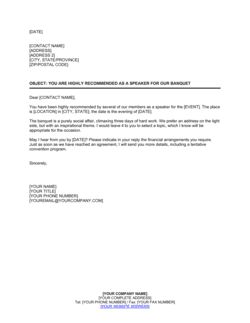
A Keynote Speaker Invitation Letter is a formal written request from an event organizer to a proposed speaker, outlining the event details, speaking scope, compensation, travel arrangements, and intellectual property terms in a single binding document. This free Word download gives you a ready-to-edit template you can customize and send β€” or convert to PDF β€” in under 30 minutes.
When you need it
Use it whenever you are inviting a guest speaker to a conference, corporate event, industry summit, or awards gala and need a written record of the agreed terms before the event date. It is especially important when compensation, travel reimbursement, or recording rights are involved.
What's inside
Event details and logistics, speaker role and session scope, honorarium and expense reimbursement terms, intellectual property and recording rights, cancellation and rescheduling provisions, and a signature block for both parties to confirm acceptance.

What is a Keynote Speaker Invitation Letter?

A Keynote Speaker Invitation Letter is a formal written request from an event organizer to a proposed speaker, setting out the terms under which the speaker is invited to present at a specific event. When signed by both parties, it functions as a binding contract covering the speaking role and session scope, honorarium and payment timeline, travel and accommodation arrangements, intellectual property ownership, recording and media rights, and cancellation obligations. Unlike an informal email request, a properly drafted invitation letter creates enforceable obligations on both sides β€” protecting the organizer's investment in event programming and giving the speaker written certainty about compensation and how their content will be used.

Why You Need This Document

Without a signed invitation letter, you are exposed to four concrete risks simultaneously. First, a speaker who cancels five days before your event has no contractual obligation to compensate you or find a replacement β€” and your program has a gap you must fill under public pressure. Second, recording and posting the keynote to YouTube without written permission may infringe the speaker's copyright, triggering a takedown notice or demand for royalties after you have already invested in production. Third, without a written expense cap, travel costs can exceed the honorarium itself β€” with no basis to dispute them. Fourth, using an event brand name instead of your registered legal entity as the contracting party means any rights you think you secured may be legally unenforceable. A signed keynote speaker invitation letter closes all four gaps in under 30 minutes, giving both you and your speaker a clear, shared record of every material term before anyone books a flight.

Which variant fits your situation?

If your situation is…Use this template
Inviting a paid professional speaker with an agent or bureauKeynote Speaker Agreement
Requesting a panelist rather than a solo keynote presenterPanel Speaker Invitation Letter
Inviting a speaker to present virtually or via webinarVirtual Speaker Invitation Letter
Engaging a speaker who will also provide a workshop sessionWorkshop Facilitator Agreement
Asking an internal executive to present at an external eventInternal Speaker Authorization Memo
Confirming a pro bono or volunteer speaker for a nonprofit eventVolunteer Speaker Confirmation Letter
Booking a celebrity or entertainment figure as a keynoteCelebrity Appearance Agreement

Common mistakes to avoid

❌ Sending an unsigned courtesy letter instead of a formal agreement

Why it matters: An invitation letter without a signature block creates no enforceable obligations. If the speaker cancels the week before the event, you have no written basis to recover kill fees or sunk costs.

Fix: Always include a signature block and an acceptance deadline. Both parties must sign before any travel is booked or event marketing features the speaker's name.

❌ No cap on travel and expense reimbursement

Why it matters: Without a written ceiling, a speaker who books a business-class upgrade, extends their stay, and charges premium hotel minibar costs can submit expenses that dwarf the original honorarium.

Fix: State a specific dollar cap for reimbursable expenses β€” separate from the honorarium β€” and require receipts for all items above a de minimis threshold such as $25.

❌ Omitting recording and media rights entirely

Why it matters: Recording a session without the speaker's written consent may infringe their copyright and right of publicity. Speakers have successfully demanded removal of event recordings from YouTube and conference platforms.

Fix: Address recording rights explicitly in the letter β€” even if the answer is 'no recording permitted.' Both parties should know the position before the speaker takes the stage.

❌ Vague topic description that allows scope drift

Why it matters: A speaker who pivots to an off-brand, controversial, or promotional topic at the event can damage your audience's experience and your organization's reputation, with no written basis to object.

Fix: Include the agreed topic title and a one-sentence description of the key message. For paid keynotes, require the speaker to submit a final presentation outline at least 14 days before the event.

❌ No cancellation clause for speaker-initiated cancellations

Why it matters: Organizers routinely include kill fees for their own cancellations but leave speaker-side cancellations unaddressed. A high-profile speaker who cancels 10 days out with no contractual obligation leaves you with a program gap and no recourse.

Fix: Require the speaker to provide written notice of at least 30 days and make reasonable efforts to suggest a replacement of comparable stature. Tie this obligation symmetrically to the organizer's own cancellation terms.

❌ Using the event brand name rather than the legal entity as the contracting party

Why it matters: An unregistered event brand has no legal standing to sue for breach or to enforce IP and exclusivity clauses. If the organizer needs to recover a kill fee, the contract must name the registered entity.

Fix: Identify the organizing party by its full registered legal name and entity type in the opening clause. The event name can appear as a descriptor but should not be the named party.

The 10 key clauses, explained

Parties and event identification

In plain language: Names the inviting organization and the proposed speaker as the two parties, and identifies the specific event for which the invitation is extended.

Sample language
This letter constitutes a formal invitation from [ORGANIZATION NAME] ('Organizer') to [SPEAKER FULL NAME] ('Speaker') to deliver a keynote address at [EVENT NAME], to be held on [DATE] at [VENUE NAME AND ADDRESS].

Common mistake: Using a department name or event brand instead of the organizing legal entity. If a dispute arises over payment or recording rights, an unregistered brand name cannot be a party to an enforceable agreement.

Speaking role, session scope, and duration

In plain language: Defines exactly what the speaker is being asked to do β€” keynote, panel moderator, or workshop leader β€” and specifies the session length and topic.

Sample language
Speaker agrees to deliver a keynote address of approximately [X] minutes on the topic of '[TOPIC TITLE]' during the [SESSION NAME] session on [DATE] at [TIME]. The presentation may include a Q&A period of up to [X] minutes.

Common mistake: Leaving topic and duration vague in the invitation. A speaker who presents on a tangential topic or runs significantly over time disrupts the event program and creates program liability the organizer has no written basis to address.

Honorarium and payment terms

In plain language: States the speaker fee or honorarium amount, the currency, and the timeline and method for payment.

Sample language
In consideration for the above, Organizer agrees to pay Speaker an honorarium of [CURRENCY SYMBOL][AMOUNT], payable by [PAYMENT METHOD] within [X] days of the event date. Payment will be made to [PAYEE NAME / ENTITY].

Common mistake: Omitting the payment timeline and leaving it as 'after the event.' Speakers regularly follow up for months on vague post-event payment commitments; a specific date eliminates the ambiguity and protects both parties.

Travel, accommodation, and expense reimbursement

In plain language: Outlines what travel costs the organizer will cover β€” flights, hotel, ground transport, and per diem β€” and how the speaker submits expenses.

Sample language
Organizer shall arrange and cover [economy / business class] airfare, [X] nights' accommodation at [HOTEL NAME or 'a hotel of equivalent standard'], and ground transportation between the airport and venue. Additional expenses up to $[AMOUNT] will be reimbursed within [X] days upon submission of receipts.

Common mistake: Agreeing verbally to cover 'reasonable expenses' without a written cap. Without a ceiling, disputes about flight class upgrades, extended stays, or meal costs become difficult to resolve and can exceed the honorarium itself.

Intellectual property and presentation content

In plain language: Clarifies who owns the speaker's presentation materials and whether the organizer may use, adapt, or distribute them after the event.

Sample language
Speaker retains all intellectual property rights in the presentation and related materials. Organizer is granted a non-exclusive, non-transferable license to display the presentation at the Event only. No further reproduction or distribution is permitted without Speaker's prior written consent.

Common mistake: Assuming the organizer automatically owns the slides or content because they are paying for the appearance. Without an explicit license or assignment, publishing the speaker's slides on the event website may infringe their copyright.

Recording, broadcast, and media rights

In plain language: States whether the organizer may record, live-stream, or subsequently distribute audio or video of the speaker's presentation, and under what conditions.

Sample language
Organizer [may / may not] record the Speaker's presentation. If recording is permitted, Organizer is granted a non-exclusive license to distribute the recording for [internal use only / public distribution] for a period of [X] [months / years] following the Event. Speaker's name and likeness may be used in promotional materials related to the recording.

Common mistake: Recording a session without addressing rights in the invitation letter. A speaker who has not agreed to recording retains full control over the footage β€” including the right to demand it be deleted β€” regardless of the organizer's investment in production.

Cancellation, rescheduling, and kill fee

In plain language: Defines the notice periods and financial consequences if the organizer or the speaker cancels or requests a rescheduling of the engagement.

Sample language
Either party may cancel by providing written notice no fewer than [X] days prior to the Event. If Organizer cancels with fewer than [X] days' notice, Organizer shall pay Speaker a kill fee of [X]% of the honorarium plus any non-refundable expenses incurred. If Speaker cancels, Speaker shall make reasonable efforts to suggest a replacement.

Common mistake: No cancellation clause at all. Without one, an organizer who cancels a week before the event owes the speaker their full fee and all sunk travel costs β€” with no written limit on their exposure.

Force majeure

In plain language: Excuses both parties from obligations if the event is prevented or materially disrupted by circumstances outside their reasonable control.

Sample language
Neither party shall be in breach of this Agreement if performance is prevented or delayed by circumstances beyond their reasonable control, including but not limited to acts of God, pandemic, government restrictions, or natural disaster. In such an event, both parties shall be released from their obligations, and any pre-paid expenses shall be refunded within [X] days.

Common mistake: Omitting force majeure entirely, or copying a manufacturing-oriented clause that does not reference pandemic or public health orders. The COVID-19 experience demonstrated that event force majeure clauses must explicitly address government-mandated cancellations.

Exclusivity and competing engagements

In plain language: Restricts the speaker from appearing at a directly competing event within a defined window, protecting the organizer's investment in securing an exclusive draw.

Sample language
Speaker agrees not to deliver a materially similar presentation to a directly competing event within [X] days before or after the Event without prior written consent from Organizer. 'Competing event' means an event targeting the same primary audience in the same geographic market.

Common mistake: Defining 'competing event' so broadly that it covers any conference in the same industry. An overly broad exclusivity clause is likely to be rejected by the speaker's agent and, even if signed, may be unenforceable as an unreasonable restraint of trade.

Governing law and acceptance

In plain language: States which jurisdiction's law governs the agreement and provides a signature block for both parties to confirm acceptance of the terms.

Sample language
This Agreement is governed by the laws of [STATE / PROVINCE / COUNTRY]. Speaker's signature below constitutes acceptance of the terms set out in this letter. Please return a signed copy to [CONTACT NAME] at [EMAIL] by [ACCEPTANCE DEADLINE].

Common mistake: Sending the invitation without a signature block or acceptance deadline. An unsigned, open-ended invitation is a courtesy letter β€” it creates no enforceable obligations on either side until both parties sign.

How to fill it out

  1. 1

    Enter the organizing entity's legal name and event details

    Use the registered legal name of the organizing company or association β€” not a brand name or event title. Fill in the event name, date, venue, and city in the opening clause.

    πŸ’‘ Check your corporate registry to confirm the exact legal entity name before sending. Using a trade name that does not match the paying entity can complicate payment processing and contract enforcement.

  2. 2

    Define the speaking role, topic, and session duration

    Specify whether this is a keynote, panel appearance, or workshop. State the confirmed topic title and agreed session length in minutes, including any Q&A time.

    πŸ’‘ Get the speaker's topic title in writing at this stage β€” even a working title. It gives both parties a reference point if scope creep becomes an issue closer to the event.

  3. 3

    Complete the honorarium and payment terms

    Enter the agreed fee amount, currency, payment method (wire, check, or ACH), payee name, and the specific date by which payment will be made.

    πŸ’‘ If the speaker is represented by a bureau, confirm the payee entity with the bureau before sending β€” fees often route through the agency rather than directly to the speaker.

  4. 4

    Specify travel, hotel, and expense coverage

    State the class of airfare, the number of hotel nights covered, and the per diem or expense cap. Confirm whether the organizer books travel directly or reimburses the speaker.

    πŸ’‘ Set a dollar cap on reimbursable expenses β€” 20–30% of the honorarium is a common ceiling. Document the cap in the letter so both parties have the same expectation before any bookings are made.

  5. 5

    Address intellectual property and recording rights

    Decide whether the organizer will record the session. If yes, specify the permitted uses (internal distribution, public posting, archival) and the duration of the license. If no recording is planned, state that explicitly.

    πŸ’‘ Speakers increasingly retain a media rider stating where recordings may be published. Resolve this before signing β€” changing recording terms after the event is exponentially harder.

  6. 6

    Set cancellation notice periods and the kill fee

    Agree on the notice period (typically 30–60 days) and the kill fee percentage (commonly 25–50% of the honorarium) that applies if the organizer cancels inside that window.

    πŸ’‘ Mirror the kill fee structure: if the organizer owes 50% for a late cancellation, the speaker should owe a comparable obligation β€” such as finding a suitable replacement. Symmetry makes the clause easier for speakers to accept.

  7. 7

    Review the exclusivity and force majeure clauses

    Confirm the competing-event exclusivity window is proportionate to the event's market position. Confirm the force majeure clause references government orders and public health emergencies specifically.

    πŸ’‘ For events with a geographic footprint smaller than national, limit the exclusivity to the same city or metro area rather than the entire country β€” speakers with national calendars routinely reject broader restrictions.

  8. 8

    Set an acceptance deadline and obtain signatures

    Include a specific date by which the speaker must return a signed copy. Obtain countersignatures from both the authorized representative of the organizing entity and the speaker before any travel is booked.

    πŸ’‘ Use Business in a Box eSign to timestamp acceptance and store the fully executed copy. Do not book flights or hotel until a countersigned copy is in hand.

Frequently asked questions

What is a keynote speaker invitation letter?

A keynote speaker invitation letter is a formal written document sent by an event organizer to a prospective speaker, outlining the event details, speaking role, honorarium, travel arrangements, and intellectual property terms. When signed by both parties, it becomes a binding agreement governing the engagement. It differs from a casual email invitation in that it creates enforceable obligations β€” including payment, cancellation fees, and recording rights β€” before either party commits resources.

Is a keynote speaker invitation letter legally binding?

Yes, when it contains the essential elements of a contract β€” offer, acceptance, consideration, and mutual intent β€” and is signed by both parties, a keynote speaker invitation letter is generally enforceable as a binding agreement. Consideration is typically the honorarium paid by the organizer in exchange for the speaker's performance. As with any contract, enforceability depends on jurisdiction-specific requirements, so legal review is advisable for high-value or cross-border engagements.

Does a keynote speaker need a separate speaker agreement?

For professional speakers represented by a bureau, a separate, more detailed speaker agreement drafted by the bureau is standard and will typically supersede this letter. For independent speakers, academics, or executives invited to speak without an agent, a well-drafted invitation letter that both parties sign is generally sufficient. The key distinction is whether recording rights, exclusivity, and IP ownership are addressed β€” if they are, the letter functions as a complete agreement.

What should a keynote speaker honorarium cover?

An honorarium compensates the speaker for their time, expertise, and preparation β€” not just the time on stage. A 45-minute keynote typically requires 5–20 hours of preparation, travel time, and post-event availability for media or networking. Standard honoraria range from $1,000–$5,000 for emerging speakers and academics, $5,000–$25,000 for established thought leaders, and $50,000–$200,000+ for celebrity or A-list executive keynotes. Travel and accommodation are almost always covered separately.

Can the organizer record and publish the keynote presentation?

Only if the speaker has granted that right in writing. Speakers retain copyright in their original presentation content and the right of publicity over their name and likeness. Without a written license, even a recording made on the organizer's own equipment may not be legally distributed. The invitation letter should specify permitted uses β€” internal archive, public YouTube posting, conference app, or paid on-demand access β€” and the duration of the license.

What happens if the speaker cancels close to the event date?

Without a cancellation clause, the speaker has no contractual obligation to the organizer beyond reputational consequences. With a well-drafted clause, the speaker may owe written notice within a specified period and a good-faith obligation to suggest a qualified replacement. Organizers rarely recover financial compensation from speakers who cancel, which is why many event planners purchase event cancellation insurance to cover speaker withdrawal for covered reasons.

What is a kill fee in a speaker contract?

A kill fee is a predetermined partial payment the organizer owes the speaker if the organizer cancels the engagement after a defined notice deadline. It compensates the speaker for opportunity cost β€” turning down other bookings during the same dates. Kill fees are typically 25–50% of the honorarium and apply when cancellation occurs inside a 30–60 day window. They should be specified as a fixed percentage rather than a subjective "reasonable amount" to avoid disputes.

Does the speaker own their presentation slides?

In most jurisdictions, yes β€” the speaker retains copyright in original presentation materials they created. The organizer's payment of an honorarium does not transfer IP ownership unless the agreement explicitly says so. If the organizer needs to distribute slides to attendees or post them online, the invitation letter must include a written license granting those specific rights. Absent that, distributing the slides without permission is copyright infringement.

Should the invitation letter address exclusivity?

For major conferences investing significantly in a keynote as a draw, an exclusivity clause preventing the speaker from appearing at a directly competing event in the same market window is reasonable and common. The clause should define 'competing event' narrowly β€” same primary audience, same geographic market, and same timeframe β€” to be enforceable. Broad exclusivity restrictions covering an entire industry for 12 months are routinely rejected by professional speakers and their agents.

How this compares to alternatives

vs Speaker agreement

A speaker agreement is a comprehensive bilateral contract typically drafted by or for a professional speaker bureau, covering IP assignment, merchandising rights, and detailed liability provisions. A keynote speaker invitation letter is an organizer-initiated document that confirms the invitation and sets core terms. For speakers without representation, the invitation letter functions as the agreement; for bureau-represented speakers, both documents may coexist with the bureau's agreement taking precedence.

vs Event planning checklist

An event planning checklist is an operational tool for managing logistics β€” venue booking, catering, A/V setup, and run-of-show. It creates no legal obligations between the organizer and the speaker. The invitation letter is the contractual layer that sits on top of operational planning, capturing agreed terms that are enforceable if either party fails to perform.

vs Independent contractor agreement

An independent contractor agreement governs an ongoing service relationship with deliverables, timelines, and payment milestones over weeks or months. A keynote speaker invitation letter covers a single, defined engagement β€” typically one appearance of a few hours. Misusing a general contractor agreement for speaker bookings introduces unnecessary complexity around scope and IP that a purpose-built invitation letter handles more cleanly.

vs Letter of intent

A letter of intent signals interest and outlines deal points but is typically non-binding pending a formal agreement. A keynote speaker invitation letter, when signed by both parties, is intended to be the final binding document β€” not a precursor to a separate agreement. Using a letter of intent for speaker engagements introduces ambiguity about enforceability that benefits neither party.

Industry-specific considerations

Professional associations and trade groups

Annual conferences rely on keynotes as the primary membership draw; recording rights and exclusive-to-members streaming clauses are especially important.

Technology and SaaS

Product launches and developer summits frequently feature industry analysts and executives as keynotes; IP and slide-sharing restrictions require careful drafting.

Healthcare and life sciences

Pharma and medical device companies face strict regulations on speaker fees and disclosures; honorarium payments may require transparency reporting under the Sunshine Act.

Higher education

Commencement speakers are often unpaid but require formal agreements covering travel, security, and recording rights for archival and alumni distribution.

Financial services

Compliance-sensitive content restrictions and pre-approval of speaker materials are standard; exclusivity clauses protecting proprietary insights are common.

Nonprofit and philanthropic sector

Pro bono and reduced-fee speakers are common; even unpaid engagements require written confirmation of scope, travel coverage, and recording terms to avoid misunderstandings.

Jurisdictional notes

United States

Honorarium payments to speakers who are not US persons may be subject to withholding tax under IRS rules β€” Form 1042-S applies for non-resident aliens. Pharmaceutical and medical device companies must report speaker fees above de minimis thresholds under the Physician Payments Sunshine Act. Non-compete and exclusivity clauses are subject to state-level reasonableness standards; California's strong anti-restraint of trade policy may limit enforceability of broad exclusivity provisions.

Canada

Honoraria paid to non-resident speakers are typically subject to a 15% withholding tax under Part XIII of the Income Tax Act, which may be reduced by tax treaty. Quebec events may require French-language materials and communications under the Charter of the French Language. Speaker agreements for provincially regulated sectors β€” notably healthcare β€” may require additional disclosure obligations.

United Kingdom

Speaker fees paid to UK residents are subject to income tax and potentially National Insurance contributions; the organizer must determine whether IR35 off-payroll working rules apply if the speaker operates through a personal service company. Recording and distribution rights are governed by the Copyright, Designs and Patents Act 1988 β€” the speaker retains copyright unless explicitly assigned in writing. GDPR considerations apply if the recording will be publicly distributed and includes audience footage.

European Union

GDPR requires explicit consent for recording and distributing presentations that capture attendee images or voices, not just the speaker. Speaker fees paid across EU member state borders may trigger VAT registration obligations depending on the nature of the service and the parties' VAT status. In several EU jurisdictions β€” particularly Germany and France β€” exclusivity clauses that restrict a speaker's professional activity without compensation may be challenged as anti-competitive restraints.

Template vs lawyer β€” what fits your deal?

PathBest forCostTime
Use the templateStandard domestic speaker invitations with honoraria under $10,000 and straightforward travel arrangementsFree20–30 minutes
Template + legal reviewHigh-profile keynotes, speakers represented by a bureau, cross-border engagements, or sessions involving recording and distribution rights$200–$500 for a 1-hour attorney review1–3 days
Custom draftedCelebrity or A-list keynotes with honoraria above $50,000, complex IP licensing, or events governed by industry-specific regulations such as pharmaceutical Sunshine Act compliance$1,000–$3,000+1–2 weeks

Glossary

Honorarium
A voluntary payment made to a speaker in recognition of their expertise and time, distinct from a contracted fee because it is not tied to a formal service obligation.
Speaker Bureau
An agency that represents professional speakers, negotiates their fees, and manages booking logistics on their behalf.
Intellectual Property (IP) Rights
The legal ownership of the speaker's presentation content, including slides, scripts, and any original material delivered during the event.
Recording Rights
The organizer's right β€” or lack thereof β€” to record, broadcast, stream, or distribute the speaker's presentation in audio or video format.
Cancellation Clause
A provision stating what happens if either party cancels the engagement, including notice periods, kill fees, and expense reimbursement obligations.
Kill Fee
A predetermined partial payment made to the speaker if the organizer cancels the engagement after a certain point β€” compensating for the speaker's lost time and opportunity cost.
Force Majeure
A clause releasing both parties from obligations if the event is prevented by circumstances beyond their control, such as natural disasters, government orders, or pandemics.
Run of Show
A detailed schedule of the event program showing exact timing, session order, speaker slots, and technical cue points.
Green Room
A private backstage or pre-stage area reserved for speakers to prepare, rest, or conduct media interviews before and after their session.
A/V Requirements
The audiovisual equipment and technical setup a speaker needs to deliver their presentation β€” microphone type, screen resolution, clicker, and internet access.
Exclusivity Clause
A provision restricting the speaker from presenting for direct competitors of the event organizer within a defined period before or after the event.

Part of your Business Operating System

This document is one of 3,000+ business & legal templates included in Business in a Box.

  • Fill-in-the-blanks β€” ready in minutes
  • 100% customizable Word document
  • Compatible with all office suites
  • Export to PDF and share electronically

Create your document in 3 simple steps.

From template to signed document β€” all inside one Business Operating System.
1
Download or open template

Access over 3,000+ business and legal templates for any business task, project or initiative.

2
Edit and fill in the blanks with AI

Customize your ready-made business document template and save it in the cloud.

3
Save, Share, Send, Sign

Share your files and folders with your team. Create a space of seamless collaboration.

Save time, save money, and create top-quality documents.

β˜…β˜…β˜…β˜…β˜…

"Fantastic value! I'm not sure how I'd do without it. It's worth its weight in gold and paid back for itself many times."

Managing Director Β· Mall Farm
Robert Whalley
Managing Director, Mall Farm Proprietary Limited
β˜…β˜…β˜…β˜…β˜…

"I have been using Business in a Box for years. It has been the most useful source of templates I have encountered. I recommend it to anyone."

Business Owner Β· 4+ years
Dr Michael John Freestone
Business Owner
β˜…β˜…β˜…β˜…β˜…

"It has been a life saver so many times I have lost count. Business in a Box has saved me so much time and as you know, time is money."

Owner Β· Upstate Web
David G. Moore Jr.
Owner, Upstate Web

Run your business with a system β€” not scattered tools

Stop downloading documents. Start operating with clarity. Business in a Box gives you the Business Operating System used by over 250,000 companies worldwide to structure, run, and grow their business.

Start freeΒ Β·Β No credit card required