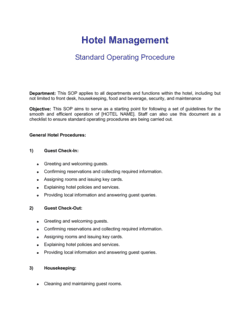
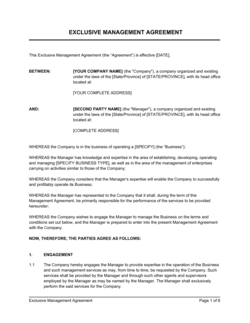
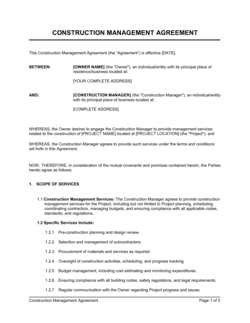
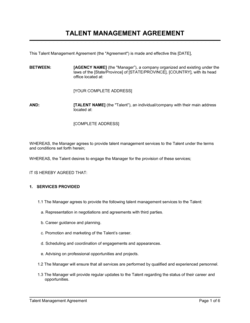
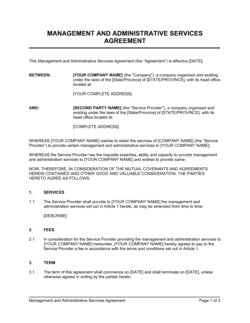
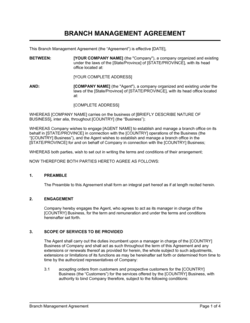
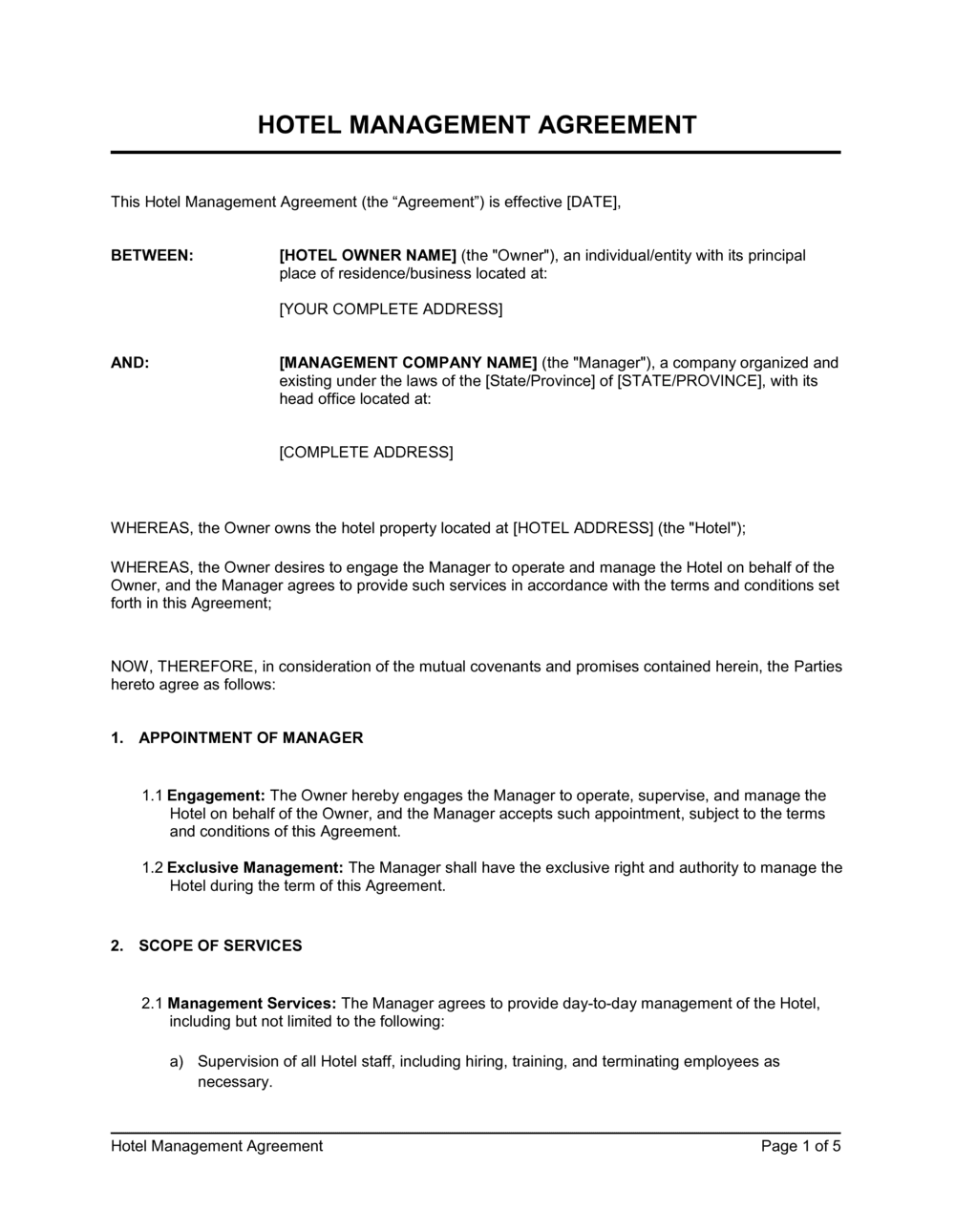
Hotel Management Agreement Template

Free Word download • Edit online • Save & share with Drive • Export to PDF

5 pages25–35 min to fillDifficulty: ComplexSignature requiredLegal review recommended
Learn more ↓
FreeHotel Management Agreement Template

At a glance

What it is
A Hotel Management Agreement is a long-term legal contract between a hotel property owner and a professional operator — typically a global hospitality brand or independent management company — under which the operator runs the hotel's day-to-day operations in exchange for a base management fee and an incentive fee tied to performance. This free Word download gives you a structured, professionally drafted starting point covering brand standards, fee structures, performance tests, owner approval rights, and termination — ready to edit online and export as PDF.
When you need it
Use it when a property owner is engaging a brand or management company to operate a hotel on their behalf, when restructuring an existing operator relationship ahead of a refinancing or sale, or when negotiating the terms of affiliation with a major hospitality brand.
What's inside
Parties and property description, appointment and authority of the operator, brand standards and system obligations, base and incentive fee calculations, operating budgets and owner approval thresholds, performance tests and cure rights, term and renewal options, termination triggers, non-disturbance and lender protections, and governing law.

What is a Hotel Management Agreement?

A Hotel Management Agreement (HMA) is a long-term legal contract between a hotel property owner and a professional operator — typically a global hospitality brand or an independent management company — under which the operator assumes full responsibility for running the hotel's day-to-day operations in exchange for a base management fee and an incentive fee tied to financial performance. The owner retains title to the property and all its assets; the operator provides brand affiliation, a reservations platform, a loyalty program, trained staff, and operational expertise. Unlike a lease arrangement where the operator takes on all economic risk, an HMA preserves the owner's exposure to both the upside and downside of hotel performance, making the fee structure, performance benchmarks, and termination rights the most heavily negotiated elements of the deal.

Why You Need This Document

Operating a hotel without a signed management agreement — or with one that lacks enforceable performance tests, clear owner approval rights, and a defined transition mechanism — creates compounding legal and financial risk for every year of the relationship. Owners who accept uncapped brand standards update rights have faced mandatory property improvement plans costing $5–15 million with no contractual basis to refuse or delay. Operators who agree to broad unilateral termination clauses have lost decades-long management contracts overnight with no compensation. Without a non-disturbance agreement in place, a lender enforcement event can eliminate the operator's position entirely. This template provides the structural framework — clauses, schedules, and negotiating checkpoints — that hospitality lawyers use as the starting point for any management agreement negotiation, giving both owners and operators a credible, professionally organized document from which to begin the process of securing expert counsel and finalizing binding terms.

Which variant fits your situation?

If your situation is…Use this template
Owner engaging a globally branded operator (Marriott, Hilton, IHG)Hotel Management Agreement (Branded)
Owner engaging an independent management company without a brand flagHotel Management Agreement (Independent Operator)
Short-term interim management while a permanent operator is selectedInterim Hotel Management Agreement
Owner wants brand affiliation without operator control of the hotelHotel Franchise Agreement
Revenue-sharing arrangement rather than a fee-based management structureHotel Lease Agreement
Owner delegating food-and-beverage operations only to a third partyRestaurant Management Agreement
Short-term rental property managed by a professional host or co-hostProperty Management Agreement

Common mistakes to avoid

❌ Accepting an uncapped unilateral brand standards update right

Why it matters: Operators can issue property improvement plans requiring multi-million-dollar renovations. Without a consent right or capital expenditure cap, owners have no leverage to push back on the timing or scope of mandatory upgrades.

Fix: Negotiate a clause requiring operator written notice of any brand standards change that would increase owner capital obligations by more than $[THRESHOLD], with owner consent rights or a right to terminate without a termination fee if the cost exceeds an agreed ceiling.

❌ Leaving the competitive set definition open-ended

Why it matters: If the operator controls the competitive set or can change it unilaterally, they can select hotels that underperform the market to make the managed property look strong by comparison — defeating the purpose of the performance test.

Fix: Name each competitive set hotel explicitly in a schedule at signing. Require mutual written consent for any substitution and specify the criteria (chain scale, location, number of keys) that qualify a replacement hotel.

❌ No owner termination right on sale of the hotel

Why it matters: A long-term management agreement that runs with the land can reduce the pool of buyers, depress sale price, and in some cases block a transaction entirely if the buyer cannot or will not assume the agreement.

Fix: Negotiate an explicit right for the owner to terminate the management agreement upon a bona fide sale of the hotel to an unaffiliated third party, with either no termination fee or a capped fee that steps down over time.

❌ Omitting transition cooperation obligations

Why it matters: Without a contractual duty to cooperate, departing operators can delay handover of reservation system credentials, guest data, vendor contracts, and accounting records — disrupting operations for months and creating breach-of-contract claims.

Fix: Include a detailed transition clause requiring the operator to deliver all hotel records, contracts, passwords, and system access within a fixed period (30–90 days) of termination or expiry, and to train successor management for a defined handover period.

❌ Using percentage-of-revenue approval thresholds instead of fixed dollar amounts

Why it matters: A threshold expressed as a percentage of gross revenue grows automatically as the hotel scales, quietly reducing the owner's approval rights without any renegotiation.

Fix: Express all owner approval thresholds as fixed dollar amounts, with a defined CPI adjustment mechanism reviewed at each renewal option rather than a percentage of revenue.

❌ No non-disturbance agreement from the construction or permanent lender

Why it matters: Without an NDA, a lender who forecloses on the property can terminate the management agreement — exposing the operator to loss of the management contract and the owner to a termination fee claim on top of a foreclosure.

Fix: Make delivery of an NDA in an agreed form a condition precedent to the operator's obligation to open the hotel, and include a reasonable-efforts obligation to obtain NDA coverage from all future lenders.

The 10 key clauses, explained

Appointment and authority of the operator

In plain language: Grants the operator the exclusive right and authority to manage the hotel on the owner's behalf, defines the scope of that authority, and confirms the owner retains ownership of the property at all times.

Sample language
Owner hereby appoints [OPERATOR NAME] as the exclusive manager of the Hotel located at [PROPERTY ADDRESS] ('Hotel') for the Term, with full authority to manage, operate, and maintain the Hotel in accordance with this Agreement and [OPERATOR]'s Brand Standards. Owner retains fee simple ownership of the Hotel and all assets used in its operation.

Common mistake: Failing to define the boundary between operator authority and owner reserved rights. Without explicit carve-outs, operators may treat their authority as absolute — committing the owner to contracts, hires, or capital expenditures that require owner approval.

Brand standards and system obligations

In plain language: Requires the hotel to comply with the operator's brand standards — physical product, service levels, technology, and loyalty program — and specifies how and when standards can be updated.

Sample language
Operator shall operate the Hotel in accordance with [BRAND] Brand Standards as amended from time to time, provided that any amendment materially increasing Owner's capital expenditure obligations shall require Owner's prior written consent, not to be unreasonably withheld.

Common mistake: Accepting an uncapped unilateral right for the operator to update brand standards. Owners who do not cap or consent to capital-intensive upgrades can face multi-million-dollar PIP (property improvement plan) obligations with no termination right if they refuse.

Base management fee

In plain language: Sets the base fee as a fixed percentage of gross revenue, defines what is included in gross revenue, and establishes the payment frequency and priority relative to other deductions.

Sample language
Owner shall pay Operator a Base Management Fee equal to [X]% of Gross Revenue per calendar month, payable within [15] days after month-end. 'Gross Revenue' means all revenue from Hotel operations as defined in Schedule [X], excluding [EXCLUSIONS].

Common mistake: Leaving the definition of 'gross revenue' to the operator's standard form without scrutiny. Broad gross revenue definitions can pull in atypical items — insurance proceeds, asset sale proceeds, or FF&E liquidation — inflating the fee base beyond operating income.

Incentive management fee and priority return

In plain language: Defines the owner's priority return — the profit floor the owner receives before any incentive fee accrues — and sets the incentive fee as a percentage of GOP above that threshold.

Sample language
Operator shall earn an Incentive Management Fee equal to [Y]% of Adjusted GOP in excess of the Owner Priority Return of $[AMOUNT] per year (or [Z]% of Total Investment). No Incentive Fee shall accrue until the Owner Priority Return has been paid in full for the relevant period.

Common mistake: Agreeing to a 'subordinated' incentive fee structure where the owner waives the right to withhold incentive fees in loss years. Operators collecting incentive fees during periods when the owner has not received their priority return are a persistent source of disputes.

Operating budget and owner approval rights

In plain language: Requires the operator to prepare and submit annual operating and capital budgets for owner approval, and sets the thresholds above which the operator must seek owner consent for individual expenditures.

Sample language
Operator shall prepare and submit to Owner for approval an Annual Operating Budget and Capital Budget no later than [60] days prior to each fiscal year-end. Operator may not incur any single unbudgeted expenditure exceeding $[AMOUNT] without Owner's prior written approval.

Common mistake: Setting approval thresholds too high or indexing them to gross revenue rather than a fixed dollar amount. Operators can interpret a percentage-based threshold as carte blanche as revenue grows, reducing owner oversight over time.

Performance test and cure rights

In plain language: Sets the annual RevPAR and/or GOP benchmarks the operator must meet, defines the competitive set for comparison, and gives the operator a cure period before the owner can terminate for underperformance.

Sample language
If the Hotel's RevPAR Index falls below [X]% of the Competitive Set average for any two consecutive fiscal years ('Performance Failure'), Owner may deliver written notice of Performance Failure. Operator shall have [24] months from such notice to cure. If uncured, Owner may terminate this Agreement without payment of a termination fee.

Common mistake: Accepting an operator-defined competitive set with no mechanism for the owner to contest it. Operators sometimes propose a competitive set skewed to make their own performance look stronger than the market warrants.

Term, renewal, and early termination

In plain language: Sets the initial contract term, renewal options and conditions, and the circumstances under which either party may terminate early — including for cause, performance failure, sale of the property, or mutual agreement.

Sample language
The initial Term shall be [20] years commencing on [DATE]. Operator shall have [two] options to renew for [5] years each, exercisable by written notice no later than [18] months prior to expiration, provided no uncured Event of Default exists. Either party may terminate for cause on [30] days' written notice following an uncured material breach.

Common mistake: Agreeing to a long initial term with renewal options but no owner termination right on sale. An owner who sells the property may be unable to deliver clear title if the buyer cannot or will not assume the management agreement.

Non-disturbance and lender protections

In plain language: Requires the owner to use reasonable efforts to obtain a non-disturbance agreement from current and future lenders, ensuring the operator's rights survive a foreclosure or lender enforcement action.

Sample language
Owner shall use commercially reasonable efforts to obtain from each Mortgagee a Non-Disturbance Agreement in a form reasonably acceptable to Operator, pursuant to which Mortgagee agrees that Operator's rights under this Agreement shall not be disturbed so long as no Event of Default by Operator exists.

Common mistake: Treating the NDA obligation as absolute rather than 'commercially reasonable efforts.' If the owner cannot obtain an NDA, a strict obligation to do so constitutes a breach — reasonable efforts language protects the owner when lenders decline to grant an NDA.

FF&E reserve and capital expenditure

In plain language: Requires both parties to fund a reserve account for ongoing capital maintenance and replacement, sets the contribution rate as a percentage of gross revenue, and defines the process for approving capital projects funded from the reserve.

Sample language
Owner shall fund an FF&E Reserve Account at a rate of [4]% of Gross Revenue per month, increasing to [5]% commencing in Year [6]. Withdrawals from the FF&E Reserve for projects exceeding $[AMOUNT] require Owner's prior written approval.

Common mistake: Setting the FF&E reserve contribution rate below 3% of gross revenue in the early years. Underfunded reserves accumulate deferred maintenance that, when it surfaces as a brand-mandated PIP, costs far more than the missed contributions.

Termination fee and transition obligations

In plain language: Sets the fee payable to the operator if the owner terminates the agreement without cause before expiry, and defines the operator's obligations to cooperate in a smooth transition to a successor manager.

Sample language
In the event of Owner's termination without cause, Owner shall pay Operator a Termination Fee equal to [X] times the trailing 12-month Base Management Fee. Upon expiration or termination, Operator shall cooperate fully in transitioning Hotel operations to Owner or a successor operator within [90] days, including delivery of all books, records, contracts, and software access credentials.

Common mistake: Omitting transition obligations entirely. Operators who have no contractual duty to cooperate in a handover can create substantial disruption — withholding reservation system access, guest data, and vendor contracts until disputes are resolved.

How to fill it out

  1. 1

    Identify the owner entity and property details

    Enter the hotel owner's full legal entity name — not a trade name — and confirm it matches the entity holding title to the property. Include the property's legal address, brand flag (if applicable), and number of keys.

    💡 If the property is held in an SPE or PropCo structure, use the SPE's legal name as the contracting party, not the parent investor.

  2. 2

    Define the operator's scope of authority

    Specify the operator's management authority in detail, including hiring and firing hotel staff, entering vendor contracts, setting rates, and managing brand standards. Then enumerate the categories of decision that require owner prior approval.

    💡 List at least six specific owner-reserved rights — capital expenditures, senior management hires, litigation settlements, insurance placements, union agreements, and brand standard waivers — to avoid disputes over implied authority.

  3. 3

    Negotiate and enter the fee structure

    Set the base fee percentage, define gross revenue precisely, establish the owner's priority return, and set the incentive fee percentage. Confirm whether the incentive fee is fully subordinated or partially subordinated to debt service.

    💡 For first-time owners, a fully subordinated incentive fee — where the operator collects nothing until the owner has received 100% of priority return — is standard in owner-favorable markets.

  4. 4

    Define the competitive set and performance benchmarks

    Name the specific hotels that will form the competitive set for RevPAR benchmarking. Set the minimum RevPAR index and/or GOP threshold the operator must achieve, and the number of consecutive years of failure that triggers an owner termination right.

    💡 Lock the competitive set at signing and require mutual written consent to change it — this prevents the operator from substituting weaker competitors to inflate the relative index.

  5. 5

    Set owner approval thresholds and budget timelines

    Enter specific dollar thresholds for unbudgeted expenditures requiring owner consent. Set the deadline by which the operator must submit annual operating and capital budgets for owner review and approval.

    💡 Index approval thresholds to a fixed dollar amount, not a percentage of revenue — a percentage threshold erodes owner control as the hotel grows.

  6. 6

    Complete the term, renewal, and termination provisions

    Enter the initial term length, number and duration of renewal options, the cure period for performance failures, and the termination fee formula. Confirm whether there is an owner right to terminate on sale of the property without a termination fee.

    💡 A sale-of-hotel termination right without a fee — or with a capped fee — is one of the most valuable owner protections and is worth conceding other points to secure.

  7. 7

    Address lender protections and NDA obligations

    Insert the non-disturbance and attornment language, and confirm whether the obligation to obtain an NDA from current and future lenders is absolute or commercially reasonable efforts. Attach any existing NDA from the current lender as a schedule.

    💡 If refinancing is anticipated in the near term, negotiate the NDA form with your lender before signing the management agreement — lenders are harder to move once the HMA is already executed.

  8. 8

    Attach schedules and have both parties sign before opening

    Attach the competitive set definition, brand standards reference, FF&E reserve schedule, approved annual budget, and technical services agreement (if applicable) as signed schedules. Both parties must execute before the hotel opens or management transitions.

    💡 Use a countersigned execution copy rather than separate signature pages to avoid any argument that the schedules were not incorporated at the time of signing.

Frequently asked questions

What is a hotel management agreement?

A hotel management agreement is a long-term contract between a hotel property owner and an operator — typically a branded hospitality company or independent management firm — under which the operator runs day-to-day hotel operations in exchange for a base fee and an incentive fee. The owner retains title to the property and its assets; the operator provides management expertise, brand affiliation, reservation systems, and trained staff. These agreements typically run 15–30 years for branded operators and 5–10 years for independents.

What is the difference between a hotel management agreement and a franchise agreement?

Under a management agreement, the operator controls day-to-day hotel operations and employs or directs the hotel's staff. Under a franchise agreement, the owner licenses the brand and its systems but operates the hotel independently using their own management team. Management agreements give the owner less day-to-day control but access to an experienced operator; franchise agreements give the owner full operational control at the cost of managing the property themselves.

What fees does an operator typically charge under a hotel management agreement?

The two primary fees are the base management fee — typically 2–4% of gross revenue — and the incentive management fee, typically 8–12% of gross operating profit above an owner priority return. Operators also charge system fees for reservations, loyalty programs, and technology — commonly an additional 2–4% of gross revenue in aggregate. Technical services fees for pre-opening support are billed separately under a companion TSA.

What is a performance test in a hotel management agreement?

A performance test is a contractual benchmark — typically based on RevPAR index relative to a defined competitive set, or GOP compared to a budget — that the operator must meet each year to retain the management contract. If the hotel falls below the benchmark for two consecutive years and the operator fails to cure the shortfall within the cure period (typically 12–24 months), the owner gains the right to terminate the agreement without paying a termination fee. Performance tests are one of the most heavily negotiated provisions in any HMA.

How long does a hotel management agreement typically last?

Initial terms range from 10 to 30 years depending on the operator's brand tier and the owner's leverage. Global luxury brands (Four Seasons, Ritz-Carlton) typically require 20–30-year initial terms. Select-service and soft-brand operators are more flexible at 10–15 years. Initial terms are typically followed by one or two renewal options of 5 years each at the operator's election. Shorter terms are possible for independent operators without a brand flag.

Can an owner terminate a hotel management agreement early?

Early termination rights for owners are limited and heavily negotiated. Owners typically have the right to terminate for operator cause (material breach, insolvency, or loss of license), on performance test failure after a cure period, and — if successfully negotiated — on sale of the hotel. Termination without cause triggers a termination fee, typically equal to 1–3 years of management fees. Operators rarely accept broad owner termination rights without commensurate compensation.

What is a non-disturbance agreement and why does it matter?

A non-disturbance agreement (NDA) is a commitment from the hotel's lender that it will honor the management agreement and continue recognizing the operator's rights in the event of a foreclosure or enforcement action. Without an NDA, a lender who takes possession of the hotel can immediately terminate the management agreement — eliminating the operator's long-term contract and potentially triggering a termination fee claim against the owner. Most major operators require an NDA as a condition of executing a management agreement.

Who owns the hotel's employees under a management agreement?

In most hotel management agreements, the operator employs the hotel's staff as the employer of record — though costs are borne by the hotel's operating account as an operating expense. Some structures use a staffing subsidiary or a dual employment model. The employment structure has significant tax, liability, and labor law implications that vary by jurisdiction and should be addressed explicitly in the agreement, particularly in the UK and EU where worker protections are stronger.

Do I need a lawyer to draft or review a hotel management agreement?

Yes, for any meaningful hotel asset. Hotel management agreements run 50–150 pages with complex fee waterfalls, performance tests, brand standards obligations, and termination provisions worth millions of dollars over the life of the contract. A high-quality template establishes the structural framework and negotiating checklist, but the specific fee percentages, competitive set composition, owner approval thresholds, and termination fee calculations require legal and financial analysis specific to the asset, the operator, and the financing structure.

How this compares to alternatives

vs Hotel Franchise Agreement

A franchise agreement licenses the brand flag and reservation system to an owner-operator who manages the hotel independently. A management agreement transfers operational control to the brand or operator entirely. Franchise agreements give owners full management autonomy but require them to build or hire their own operational team. Management agreements are appropriate when the owner wants the operator's expertise rather than just the brand name.

vs Property Management Agreement

A property management agreement typically covers residential or commercial real estate, with the manager handling leasing, tenant relations, and maintenance. A hotel management agreement is substantially more complex, covering brand standards, reservation systems, daily rate pricing, F&B operations, and a two-tier fee structure. The operational scope, term length, and fee complexity of an HMA are fundamentally different from a residential or commercial property management engagement.

vs Operating Lease Agreement

Under a hotel lease, the operator pays a fixed or variable rent to the owner and takes on all operational risk and reward. Under a management agreement, the operator earns fees regardless of profitability, and the owner retains the economic upside and downside of the hotel's performance. Hotel leases are common in European markets; management agreements dominate North American and Asian hotel transactions.

vs Service Agreement

A general service agreement covers a defined scope of services for a fixed fee or time-and-materials basis. A hotel management agreement is a long-term governance instrument that transfers operational authority over a complex asset, involves performance-linked compensation, and creates obligations running for decades. A service agreement cannot substitute for the brand standards, fee waterfall, performance test, and non-disturbance provisions required in a hotel management context.

Industry-specific considerations

Full-service and luxury hotels

Long initial terms of 20–30 years, brand standard provisions covering physical product and service delivery, luxury-brand NDA requirements, and technical services agreements covering multi-year pre-opening periods.

Select-service and limited-service hotels

Shorter terms of 10–15 years, higher FF&E reserve contribution rates due to faster asset depreciation, and streamlined operating budgets with fewer discretionary departments.

Resort and mixed-use developments

Integration with residential, spa, and F&B components under shared services agreements, complex revenue allocation between hotel and non-hotel uses, and owner approval rights covering amenity operations.

Private equity and institutional real estate

Hold-period-aligned termination rights, sale-of-hotel termination provisions, waterfall structures coordinating management fees with debt service and investor returns, and cure period mechanics tied to fund exit timelines.

Jurisdictional notes

United States

US hotel management agreements are primarily governed by state contract law with no federal statute specifically regulating HMAs. Courts in states such as New York, Delaware, and California have developed substantial case law on operator authority, termination fee enforceability, and performance test disputes. Some states — particularly California — apply additional scrutiny to non-compete and exclusivity provisions in management agreements. Lender NDA requirements are heavily influenced by the practices of CMBS servicers.

Canada

Canadian hotel management agreements are governed by provincial contract law, with Ontario and British Columbia hosting most institutional hotel transactions. Unlike US markets, Canadian employment law requires attention to ESA minimum standards for hotel employees — the operator-as-employer-of-record structure must comply with provincial employment standards in each province where the hotel operates. Quebec properties require French-language compliance for guest-facing materials and employment documents.

United Kingdom

UK hotel management agreements must address TUPE (Transfer of Undertakings, Protection of Employment Regulations 2006), which can require the incoming operator to assume existing staff on their current terms upon a management transition. UK courts apply strict reasonableness tests to termination fee provisions and may not enforce penalties that are not genuine pre-estimates of loss. The UK Bribery Act 2010 imposes anti-bribery compliance obligations on operators managing hotels on behalf of UK-connected owners.

European Union

EU hotel management agreements must address the Working Time Directive and national employment transfer rules equivalent to TUPE in member states (the Acquired Rights Directive). GDPR applies to the processing of guest data by the operator using the owner's systems — the agreement should specify whether the operator acts as data processor or independent data controller. French and German courts in particular apply public policy limits on operator liability caps and may override contractual choice-of-law clauses for locally located hotel assets.

Template vs lawyer — what fits your deal?

PathBest forCostTime
Use the templateOwners structuring a preliminary term sheet or negotiating framework with a prospective operator before engaging legal counselFree1–3 days to draft a working negotiation draft
Template + legal reviewIndependent hotel operators or smaller owners engaging a non-branded management company for a single asset under $20M in value$2,000–$8,000 for hospitality legal counsel review1–3 weeks
Custom draftedBranded operator engagements, assets above $20M, portfolio management agreements, or any deal involving complex lender NDA requirements or equity waterfall structures$15,000–$75,000+ depending on asset scale and negotiation complexity6–16 weeks

Glossary

Base Management Fee
A recurring fee paid to the operator calculated as a percentage of gross revenue — typically 2–4% — regardless of profitability.
Incentive Management Fee
An additional fee earned by the operator when the hotel's financial performance exceeds an agreed profit threshold, typically expressed as a percentage of gross operating profit above a priority return.
Gross Operating Profit (GOP)
Hotel revenue minus all departmental and undistributed operating expenses, before debt service, capital reserves, and management fees.
Priority Return
The minimum cash return an owner must receive from hotel operations before the operator can collect an incentive fee — functions as a performance floor protecting the owner's investment.
Performance Test
A contractual benchmark — typically comparing the hotel's RevPAR or GOP against a competitive set — that the operator must meet or exceed to avoid a termination trigger.
RevPAR
Revenue Per Available Room, calculated as average daily rate multiplied by occupancy rate — the primary metric used to benchmark hotel performance against a competitive set.
FF&E Reserve
Furniture, Fixtures, and Equipment reserve — a fund, typically 3–5% of gross revenue, set aside annually for capital maintenance and replacement of physical assets.
Non-Disturbance Agreement (NDA)
A commitment from the owner's lender that, upon foreclosure, the lender will honor the management agreement and not terminate the operator — critical for operators accepting branded flags.
Operator's System
The proprietary reservations platform, loyalty program, brand standards, training systems, and technology infrastructure the operator provides and charges the hotel to access.
Owner Approval Threshold
The maximum expenditure or commitment amount the operator may authorize without seeking written owner consent — typically $[X] per single item or $[Y] in aggregate within a budget period.
Cure Period
The defined time window — typically 12–24 months — within which an operator may remediate a performance test failure before the owner exercises a termination right.
Technical Services Agreement (TSA)
A companion agreement under which the operator provides pre-opening design, construction oversight, and brand integration services to the owner for a separate fee.

Part of your Business Operating System

This document is one of 3,000+ business & legal templates included in Business in a Box.

  • Fill-in-the-blanks — ready in minutes
  • 100% customizable Word document
  • Compatible with all office suites
  • Export to PDF and share electronically

Create your document in 3 simple steps.

From template to signed document — all inside one Business Operating System.
1
Download or open template

Access over 3,000+ business and legal templates for any business task, project or initiative.

2
Edit and fill in the blanks with AI

Customize your ready-made business document template and save it in the cloud.

3
Save, Share, Send, Sign

Share your files and folders with your team. Create a space of seamless collaboration.

Save time, save money, and create top-quality documents.

★★★★★

"Fantastic value! I'm not sure how I'd do without it. It's worth its weight in gold and paid back for itself many times."

Managing Director · Mall Farm
Robert Whalley
Managing Director, Mall Farm Proprietary Limited
★★★★★

"I have been using Business in a Box for years. It has been the most useful source of templates I have encountered. I recommend it to anyone."

Business Owner · 4+ years
Dr Michael John Freestone
Business Owner
★★★★★

"It has been a life saver so many times I have lost count. Business in a Box has saved me so much time and as you know, time is money."

Owner · Upstate Web
David G. Moore Jr.
Owner, Upstate Web

Run your business with a system — not scattered tools

Stop downloading documents. Start operating with clarity. Business in a Box gives you the Business Operating System used by over 250,000 companies worldwide to structure, run, and grow their business.

Start free · No credit card required