Booking Contract Template

Free Word download β€’ Edit online β€’ Save & share with Drive β€’ Export to PDF

15 pagesβ€’30–45 min to fillβ€’Difficulty: Complexβ€’Signature requiredβ€’Legal review recommended
Learn more ↓
FreeBooking Contract Template

At a glance

What it is
A Booking Contract is a legally binding agreement between a client and a service provider β€” such as a performer, speaker, DJ, band, photographer, or venue β€” that confirms the engagement, locks in the date and fee, and defines what happens if either party cancels or fails to deliver. This template is a free Word download you can edit online and export as PDF, covering every essential clause in a single document ready for both parties to sign before the event date.
When you need it
Use it any time you hire or are hired to perform, appear, or provide a service at a specific date, time, and location. If money is changing hands and a date is confirmed, a signed booking contract protects both sides before any deposit is paid or preparation begins.
What's inside
Party identification, event details, performance or service scope, fee schedule and deposit terms, cancellation and rescheduling policy, force majeure, technical and rider requirements, indemnification, and governing law β€” all in a single structured document.

What is a Booking Contract?

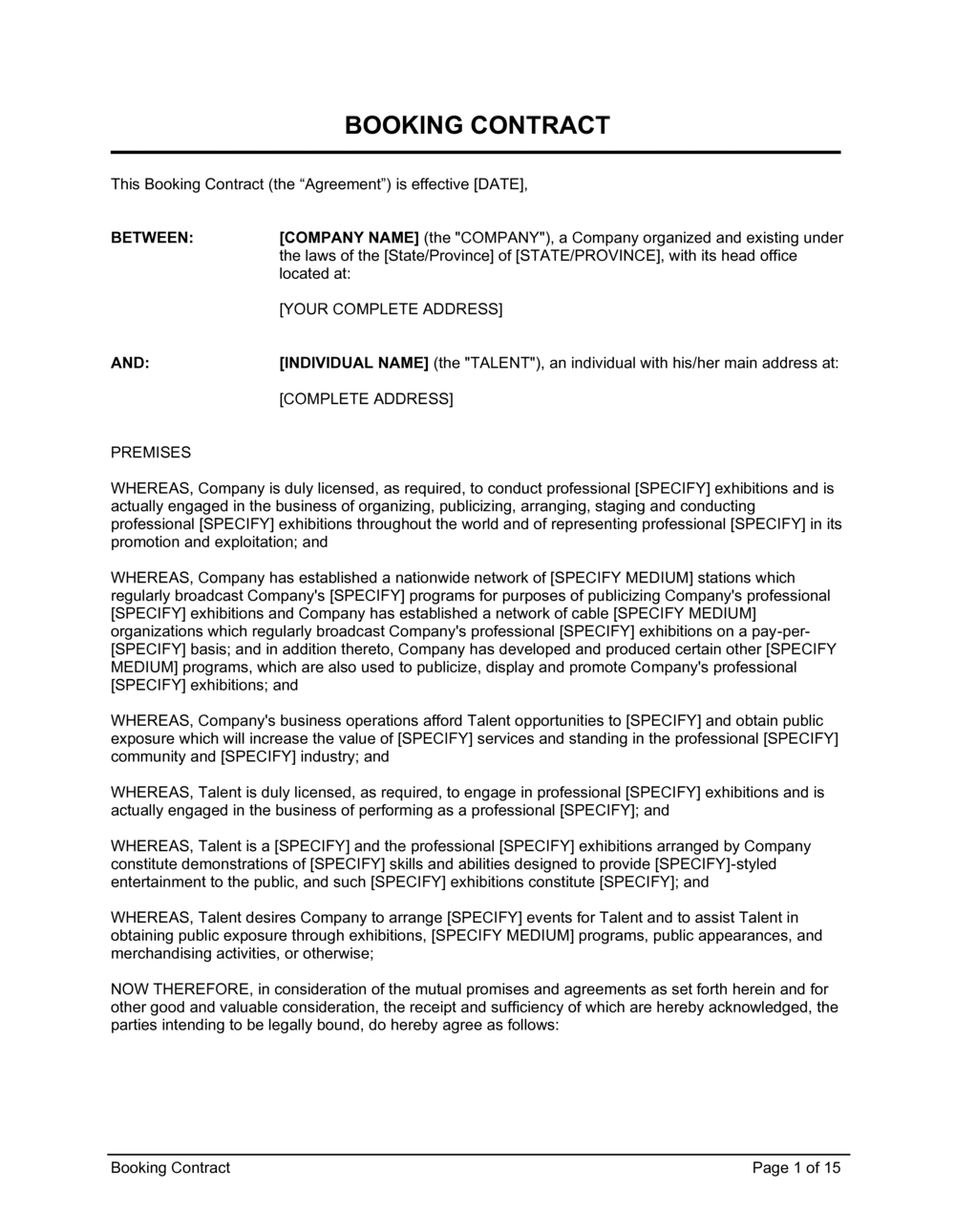
A Booking Contract is a legally binding agreement between a client and a service provider β€” such as a performer, DJ, photographer, keynote speaker, or venue β€” that confirms a specific engagement on a defined date, at an agreed fee, and under clearly stated conditions. It transforms a verbal or informal understanding into an enforceable document that specifies exactly what each party is expected to deliver, what happens if either side cancels, who owns any recordings made, and which jurisdiction's law governs a dispute. Unlike a casual email exchange or a hold date, a signed booking contract creates mutual legal obligations the moment both parties execute it.

Why You Need This Document

Without a signed booking contract, every booking is an informal arrangement that dissolves the moment circumstances become inconvenient for either side. Performers who cancel without a contractual obligation face no financial consequence; clients who cancel after preparation is underway owe nothing unless a non-refundable deposit clause exists in writing. In the absence of a force majeure clause, a pandemic, flood, or government order can leave both parties arguing over who bears the loss of a cancelled event. Recording rights, rider obligations, and overtime expectations β€” all of them sources of real disputes β€” exist only as assumptions without a written agreement to define them. A properly executed booking contract eliminates that ambiguity, gives both sides a clear framework for resolving problems, and provides the documentary foundation needed to pursue remedies if the engagement goes wrong.

Which variant fits your situation?

If your situation is…Use this template
Booking a live music act or DJ for a ticketed eventEntertainment Booking Contract
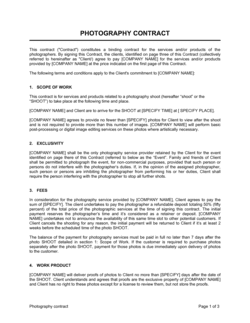
Hiring a photographer or videographer for a wedding or corporate shootPhotography Services Agreement
Engaging a keynote speaker for a conference or corporate eventSpeaker Agreement
Reserving a venue or event space for a private or corporate functionVenue Rental Agreement
Hiring a DJ, band, or performer for a private party or weddingWedding Entertainment Booking Contract
Booking a model or talent for a commercial or editorial campaignTalent Agreement
Engaging a freelance service provider for a one-time event-adjacent taskIndependent Contractor Agreement

Common mistakes to avoid

❌ Using a stage name or brand name instead of the legal entity name

Why it matters: A contract signed under a name that does not correspond to a legal person or registered entity may be unenforceable because there is no identifiable legal party to sue.

Fix: Confirm the full legal name of each party before drafting. If a performer operates under a stage name, include both: '[STAGE NAME], professionally known as [STAGE NAME], whose legal name is [FULL LEGAL NAME].'

❌ Non-refundable deposit language is absent or ambiguous

Why it matters: Without a clear statement that the deposit is non-refundable upon signing, clients may demand it back on cancellation, and small claims courts will often side with the client if the language is unclear.

Fix: Use the exact phrase 'non-refundable upon execution of this Agreement' in the deposit clause and repeat it in the cancellation clause so there is no ambiguity about the deposit's status.

❌ One-sided cancellation clause covering only the client

Why it matters: A clause that imposes forfeiture on client cancellation but says nothing about performer cancellation leaves the client without a legal remedy if the act fails to show up.

Fix: Add a reciprocal obligation: if the service provider cancels without force majeure, they must refund all amounts received and pay a stated kill fee to the client within a defined number of days.

❌ Rider attached but not incorporated by reference in the contract body

Why it matters: A rider that exists only as an attachment with no reference in the signed contract body is a wish list, not a contractual obligation. Courts may treat it as mere correspondence rather than binding terms.

Fix: Add a sentence in the technical requirements clause explicitly stating: 'Schedule A (Rider) is attached hereto and incorporated into this Agreement by reference as if fully set forth herein.'

❌ No force majeure clause

Why it matters: The COVID-19 pandemic alone generated thousands of booking contract disputes in venues worldwide that had no force majeure language β€” many resulted in full fee liability for unavoidable cancellations.

Fix: Include a force majeure clause covering at minimum: natural disasters, government orders, declared public health emergencies, and venue destruction. Specify the notice period and whether the date may be rescheduled.

❌ Leaving recording and livestream rights unaddressed

Why it matters: Clients increasingly record or livestream events as a matter of course. Without a clause addressing this, neither party has clarity on rights, and the performer may unknowingly lose commercial control of their performance.

Fix: Add an explicit IP clause β€” even a single sentence β€” confirming whether recording is permitted, for what purpose, and for how long. Default to requiring written consent if no recording is desired.

The 10 key clauses, explained

Parties and Engagement Details

In plain language: Identifies the client and the service provider by their full legal names and confirms the nature of the engagement β€” who is hiring whom and for what.

Sample language
This Booking Contract is entered into on [DATE] between [CLIENT LEGAL NAME] ('Client') and [PERFORMER / PROVIDER LEGAL NAME] ('Artist/Provider') for the provision of [DESCRIPTION OF SERVICES] at [EVENT NAME].

Common mistake: Using a stage name or trade name instead of the registered legal entity or individual's full legal name. If a dispute arises, enforcing a contract against a name that doesn't appear on any government record is far more difficult.

Event Details (Date, Time, Location)

In plain language: Specifies the exact date, start and end times, and venue address for the engagement, removing any ambiguity about where and when performance is expected.

Sample language
The engagement shall take place on [DATE] from [START TIME] to [END TIME] at [VENUE NAME], located at [FULL ADDRESS]. Load-in time: [TIME]. Soundcheck: [TIME].

Common mistake: Listing only the event date without specifying load-in, soundcheck, or performance end times. Disputes over overtime or setup delays almost always trace back to a contract that only stated a single time.

Scope of Services

In plain language: Describes exactly what the service provider is expected to deliver β€” set length, number of sets, specific duties, deliverables, or performance format.

Sample language
Artist shall perform [NUMBER] set(s) of approximately [X] minutes each, performing [DESCRIPTION OF ACT]. Artist shall not be required to perform for more than [TOTAL HOURS] in aggregate without written agreement to extend.

Common mistake: Describing the scope in general terms like 'live performance' with no duration or format detail. Without specifics, the client may expect a full evening show while the artist plans a 30-minute set.

Fee, Deposit, and Payment Schedule

In plain language: States the total booking fee, the deposit amount due to secure the date, when the balance is due, and the accepted payment methods.

Sample language
The total fee for services is $[AMOUNT]. A non-refundable deposit of $[DEPOSIT AMOUNT] is due upon signing. The remaining balance of $[BALANCE] is due no later than [DATE / 'day of event']. Accepted payment methods: [WIRE TRANSFER / CHEQUE / OTHER].

Common mistake: Describing the deposit as 'refundable' without specifying the conditions under which it is returned. An ambiguous deposit term turns every cancellation into a dispute.

Cancellation and Rescheduling Policy

In plain language: Sets out what each party owes the other if the engagement is cancelled or postponed β€” including kill fees, deposit forfeiture, and any notice requirements.

Sample language
If Client cancels with more than [30] days' notice: [X]% of total fee is forfeited. If Client cancels within [30] days of the event: [100]% of total fee is due. If Artist cancels for any reason other than force majeure: Artist shall refund all amounts paid and pay a cancellation fee of $[AMOUNT].

Common mistake: A one-sided cancellation clause that only addresses client cancellations. If the performer cancels and no reciprocal obligation is stated, the client may be left with a deposit forfeited and no legal remedy.

Technical Requirements and Rider

In plain language: Incorporates the performer's or provider's technical and hospitality requirements as a binding obligation of the client, and clarifies who bears the cost of meeting them.

Sample language
Client agrees to provide, at its own expense, the technical requirements specified in Schedule A ('Rider') attached hereto and incorporated by reference. Failure to meet any material Rider requirement by [TIME] on the day of the event shall entitle Artist to cancel without penalty.

Common mistake: Attaching a rider but failing to state it is 'incorporated by reference' in the main contract body. A rider that is not contractually incorporated is an informal wish list, not an enforceable obligation.

Force Majeure

In plain language: Excuses both parties from performance obligations when an event beyond anyone's control β€” pandemic, natural disaster, government prohibition β€” makes the engagement impossible.

Sample language
Neither party shall be in breach of this Agreement if performance is prevented by circumstances beyond their reasonable control, including but not limited to acts of God, government orders, declared states of emergency, fire, flood, or strike. The affected party shall notify the other in writing within [48] hours of the triggering event.

Common mistake: Omitting a force majeure clause entirely. Without it, a party unable to perform due to a genuine emergency may still be liable for breach β€” an outcome courts in many jurisdictions will still enforce if the clause is absent.

Intellectual Property and Recording Rights

In plain language: Defines whether the client may record, livestream, photograph, or broadcast the performance, and who owns any recordings made.

Sample language
Client [may / may not] record, photograph, livestream, or broadcast the performance without the prior written consent of Artist. Any authorized recording shall be for [PERSONAL / PROMOTIONAL] use only and shall not be commercially exploited. All IP rights in the performance remain with Artist.

Common mistake: Saying nothing about recording rights and assuming the default is 'no recording allowed.' Clients often record events as a matter of course β€” without a clause addressing this, enforcement is difficult and disputes are common.

Indemnification and Liability Limitation

In plain language: Each party agrees to cover the other's losses caused by their own negligence or breach, and caps the maximum financial exposure of the service provider to the total fee paid.

Sample language
Each party shall indemnify and hold harmless the other from claims, losses, or damages arising from their own acts or omissions. Provider's total liability under this Agreement shall not exceed the total fee paid by Client.

Common mistake: No liability cap for the service provider. Without one, a performer could theoretically be held liable for consequential damages β€” lost ticket sales, venue fees β€” that far exceed the booking fee.

Governing Law and Dispute Resolution

In plain language: Specifies which jurisdiction's law governs the contract and how disputes are resolved β€” court, arbitration, or mediation β€” and where proceedings must take place.

Sample language
This Agreement shall be governed by the laws of [STATE / PROVINCE / COUNTRY]. Any dispute arising hereunder shall be resolved by [binding arbitration / mediation / the courts of [JURISDICTION]], and the parties consent to exclusive jurisdiction in [CITY / COUNTY].

Common mistake: Leaving governing law blank or using a jurisdiction that has no connection to either party's location. A mismatched governing law clause forces one party into a foreign legal system to enforce basic terms.

How to fill it out

  1. 1

    Enter the full legal names of both parties

    Use the registered legal name of each party β€” individual full name or incorporated entity name β€” not a trade name or stage name. Confirm the client's legal entity type (individual, LLC, corporation).

    πŸ’‘ Ask for a business card or registration number if you are unsure of the client's legal entity name. A mismatch between the contract name and the payer on the cheque can complicate enforcement.

  2. 2

    Specify the event details precisely

    Enter the exact date, venue address, load-in time, soundcheck time, performance start, and hard end time. Add any agreed-upon breaks or extensions in writing.

    πŸ’‘ If there is a possibility of overtime, include an overtime rate in this section β€” e.g., '$[X] per hour beyond [END TIME]' β€” so there is no ambiguity at the venue.

  3. 3

    Define the scope of services with measurable terms

    Describe the number of sets, total performance duration, format, any specific songs or topics to be covered, and anything explicitly excluded from the engagement.

    πŸ’‘ If the client has a specific setlist, playlist, or topic list in mind, attach it as a Schedule B rather than embedding it in the body. This makes future changes easier to document.

  4. 4

    Complete the fee, deposit, and payment schedule

    Enter the total fee, the non-refundable deposit amount, the balance due date, and every accepted payment method. State the currency explicitly for any cross-border engagement.

    πŸ’‘ Set the balance due date at least 24–48 hours before the event, not on the day of performance. Chasing payment on event day is a distraction neither party needs.

  5. 5

    Set cancellation terms for both parties

    Write a tiered cancellation schedule for the client (e.g., full refund beyond 60 days, 50% forfeited inside 30 days, 100% forfeited inside 14 days) and a reciprocal obligation for the service provider if they cancel.

    πŸ’‘ A symmetric cancellation clause β€” where both parties face proportionate consequences β€” is less likely to be contested as unconscionable by a court.

  6. 6

    Attach and reference the technical rider

    Complete the rider or Schedule A with all technical, staging, and hospitality requirements. In the contract body, state explicitly that Schedule A is incorporated by reference and that unmet material requirements give the artist the right to cancel.

    πŸ’‘ Keep the rider realistic β€” overloaded riders for smaller venues often go unmet, leaving the performer to choose between cancelling and performing under substandard conditions.

  7. 7

    Confirm IP and recording terms

    Decide explicitly whether recording, photography, or livestreaming is permitted, and if so, under what conditions and for what uses. State who owns any recordings made.

    πŸ’‘ If promotional use by the client is acceptable, limit it to a defined period β€” e.g., 'for marketing purposes for 12 months following the event' β€” to prevent indefinite commercial exploitation.

  8. 8

    Sign before any deposit changes hands

    Both parties should sign the contract before the deposit is paid. Receiving a deposit without a signed contract creates an informal obligation that is difficult to enforce in the event of a dispute.

    πŸ’‘ Use a dated e-signature service to create a timestamped record of execution. Store the fully executed copy in a cloud location accessible to both parties.

Frequently asked questions

What is a booking contract?

A booking contract is a legally binding agreement between a client and a service provider β€” such as a performer, speaker, DJ, photographer, or venue β€” that confirms a specific engagement on a defined date, at an agreed fee, and under stated conditions. It protects both parties by establishing what is owed if either side cancels, fails to perform, or delivers something different from what was agreed.

Who needs a booking contract?

Any individual or business that pays for or provides a time-specific service tied to a particular event date should use a booking contract. This includes musicians, DJs, bands, keynote speakers, photographers, videographers, event planners, venue managers, corporate event coordinators, and entertainment agencies. If a date is confirmed and money is changing hands, a signed contract is essential before any deposit is paid.

What should a booking contract include?

At minimum: the full legal names of both parties, event date and location, performance or service scope, total fee and deposit amount, payment schedule and accepted methods, cancellation and rescheduling policy, force majeure clause, technical rider (if applicable), intellectual property and recording rights, indemnification, and governing law. Missing any of these creates gaps that disputes will fall into.

Is a booking contract legally binding?

Yes β€” a booking contract is generally enforceable as a binding agreement when it contains the essential elements of a valid contract: an offer, acceptance, consideration (the fee), and mutual intent to be bound. Both parties must sign before it becomes fully binding. Courts in most jurisdictions will enforce clear written booking contracts, including non-refundable deposit clauses and cancellation penalties.

Can I use a booking contract without a lawyer?

For standard engagements β€” a local band at a corporate event, a photographer at a wedding, a speaker at a conference β€” a well-drafted template is typically sufficient. Consider engaging a lawyer for high-value bookings (fees above $10,000), touring agreements across multiple jurisdictions, talent engaged through a union or guild, or where IP rights in recordings have significant commercial value.

What happens if the performer cancels after signing?

If the contract includes a reciprocal cancellation clause, the performer is typically obligated to refund the deposit and pay a kill fee to the client. Without such a clause, the client may have a general breach of contract claim but no pre-agreed remedy. This is why a symmetric cancellation clause β€” covering both sides β€” is one of the most important terms to include. Force majeure cancellations are typically handled separately, with neither party owing the other a penalty.

What is the difference between a booking contract and an event contract?

A booking contract focuses specifically on engaging a performer, speaker, or service provider for a defined date β€” covering their fee, scope, and obligations. An event contract is broader and may govern the entire event operation, including venue, catering, AV, and multiple vendors under one agreement. For multi-vendor events, separate booking contracts with each provider are more common and easier to manage than a single omnibus event contract.

Should the deposit be refundable or non-refundable?

In most booking arrangements, the deposit is non-refundable upon signing because the service provider turns down other engagements on that date as soon as the contract is executed. The deposit compensates for that opportunity cost. The contract should state this explicitly β€” 'the deposit is non-refundable upon execution of this Agreement' β€” and the cancellation clause should confirm what happens to the deposit under each cancellation scenario.

Do booking contracts need to be notarized?

Notarization is not required for a booking contract to be enforceable in most jurisdictions. A signed (including e-signed) contract with dated execution is legally sufficient. Notarization may be prudent for very high-value engagements or where one party is overseas and the document may need to be enforced through a foreign court, but it is not the standard practice for ordinary booking agreements.

How this compares to alternatives

vs Independent Contractor Agreement

An independent contractor agreement governs an ongoing or project-based service relationship with no specific single event date. A booking contract is event-specific β€” it locks in a single date, time, and location and is defined by that engagement. Use an independent contractor agreement for recurring or open-ended engagements and a booking contract for any date-specific performance or appearance.

vs Venue Rental Agreement

A venue rental agreement is between a venue owner and the party renting the space for an event β€” it governs the use of the property. A booking contract engages a performer or service provider to appear at that venue. Both documents are typically required for a full event: the venue agreement with the landlord and a separate booking contract with each act or service provider.

vs Photography Services Agreement

A photography services agreement is a specialized booking contract tailored to photographers β€” it adds deliverable specifications, editing timelines, licensing terms, and digital file rights that a generic booking contract does not address in depth. Use the photography agreement when the deliverable is photographs; use the booking contract for other performance or appearance-based engagements.

vs Talent Release Form

A talent release form grants permission to use someone's image, likeness, or performance in media β€” it is a consent document, not an engagement contract. A booking contract creates the commercial relationship and confirms the fee and duties. Both are often used together: the booking contract governs the engagement, and the release form governs post-event use of recordings or images.

Industry-specific considerations

Entertainment and Live Events

Multi-set performance schedules, union or guild minimums, merchandise revenue splits, and backstage rider requirements are standard terms in this industry.

Hospitality and Venues

Venue booking contracts address capacity limits, noise curfews, liability for property damage, liquor licensing conditions, and security staffing obligations.

Professional Services

Speaker and consultant booking contracts typically address IP ownership of presentation materials, recording consent, and exclusivity within the conference or event program.

Creative and Marketing Agencies

Photographer and videographer bookings require clear deliverable timelines, raw file ownership terms, usage rights for commercial exploitation, and reshooting obligations if the client is dissatisfied.

Jurisdictional notes

United States

Booking contracts are governed by state contract law; there is no federal statute specific to the industry. Union members (AFM for musicians, SAG-AFTRA for on-camera talent) may be subject to minimum fee schedules, working condition rules, and pension contributions under collective bargaining agreements. Non-compete and exclusivity clauses are subject to state enforceability standards β€” California applies particular scrutiny to restraints on trade even in entertainment contexts.

Canada

Quebec-based engagements may require contracts in French under the Charter of the French Language for provincially regulated employers. The Canadian Federation of Musicians and ACTRA set minimum fees and working conditions for their members. Consumer protection legislation in certain provinces may limit the enforceability of non-refundable deposit clauses for consumer-facing bookings; B2B bookings are generally exempt.

United Kingdom

The Performing Right Society (PRS) and Phonographic Performance Limited (PPL) licensing requirements apply to venues hosting live or recorded music β€” these obligations typically fall on the venue, not the performer, but booking contracts should clarify responsibility. Post-Brexit, bookings involving EU touring may require additional visa and work permit documentation that the contract should reference. The Unfair Contract Terms Act 1977 may limit the enforceability of one-sided cancellation clauses.

European Union

EU member states have their own contract law, but the Unfair Terms in Consumer Contracts Directive provides a baseline standard β€” booking contracts with consumers must not contain terms that create a significant imbalance in the parties' rights. GDPR applies where the contract involves processing personal data of EU residents (e.g., ticket holder data shared with performers). Cross-border bookings within the EU may require work permits for non-EU nationals even after the post-pandemic reopening of touring routes.

Template vs lawyer β€” what fits your deal?

PathBest forCostTime
Use the templateLocal or regional bookings with fees under $5,000, standard performance or service engagements, and no union or guild involvementFree15–30 minutes
Template + legal reviewBookings with fees of $5,000–$25,000, cross-provincial or cross-state engagements, or where IP and recording rights have commercial significance$200–$5001–2 days
Custom draftedHigh-value touring agreements, union talent, international engagements, or complex multi-party event contracts with revenue sharing$1,000–$5,000+1–3 weeks

Glossary

Booking Fee
The total agreed compensation payable to the service provider or performer for fulfilling the engagement.
Deposit
A portion of the total fee β€” typically 25–50% β€” paid upfront by the client to secure the date and confirm the booking.
Cancellation Clause
A provision specifying what compensation, if any, is owed to each party if the engagement is cancelled before the event date.
Force Majeure
A clause that excuses both parties from their obligations when an event beyond their control β€” such as a natural disaster, strike, or government order β€” makes performance impossible.
Rider
An attachment to a booking contract listing the performer's or service provider's specific technical, hospitality, or logistical requirements as a condition of the engagement.
Hold Date
An informal arrangement where a date is provisionally reserved for a client without a signed contract, typically subject to release on short notice if another confirmed booking arises.
Indemnification
A contractual obligation by one party to compensate the other for losses, claims, or damages arising from specific events or the indemnifying party's conduct.
Exclusivity Clause
A term preventing the performer or provider from accepting another engagement within a defined geographic area or time window around the contracted event.
Act of God
An unforeseeable natural event β€” flood, earthquake, severe storm β€” used in force majeure clauses to excuse non-performance without liability.
Liquidated Damages
A pre-agreed sum specified in the contract as the remedy for a particular breach, such as a no-show by the performer, intended to reflect a genuine estimate of the loss.
Kill Fee
A cancellation fee paid to a service provider when the client cancels after the contract is signed, compensating the provider for lost opportunity and preparation costs.

Part of your Business Operating System

This document is one of 3,000+ business & legal templates included in Business in a Box.

  • Fill-in-the-blanks β€” ready in minutes
  • 100% customizable Word document
  • Compatible with all office suites
  • Export to PDF and share electronically

Create your document in 3 simple steps.

From template to signed document β€” all inside one Business Operating System.
1
Download or open template

Access over 3,000+ business and legal templates for any business task, project or initiative.

2
Edit and fill in the blanks with AI

Customize your ready-made business document template and save it in the cloud.

3
Save, Share, Send, Sign

Share your files and folders with your team. Create a space of seamless collaboration.

Save time, save money, and create top-quality documents.

β˜…β˜…β˜…β˜…β˜…

"Fantastic value! I'm not sure how I'd do without it. It's worth its weight in gold and paid back for itself many times."

Managing Director Β· Mall Farm
Robert Whalley
Managing Director, Mall Farm Proprietary Limited
β˜…β˜…β˜…β˜…β˜…

"I have been using Business in a Box for years. It has been the most useful source of templates I have encountered. I recommend it to anyone."

Business Owner Β· 4+ years
Dr Michael John Freestone
Business Owner
β˜…β˜…β˜…β˜…β˜…

"It has been a life saver so many times I have lost count. Business in a Box has saved me so much time and as you know, time is money."

Owner Β· Upstate Web
David G. Moore Jr.
Owner, Upstate Web

Run your business with a system β€” not scattered tools

Stop downloading documents. Start operating with clarity. Business in a Box gives you the Business Operating System used by over 250,000 companies worldwide to structure, run, and grow their business.

Start freeΒ Β·Β No credit card required