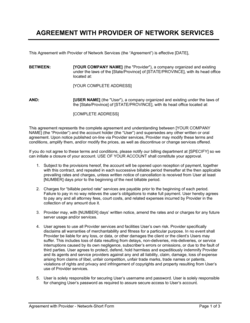
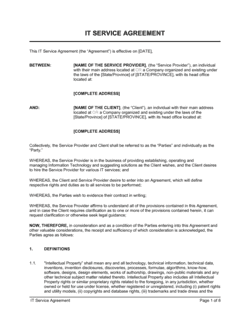
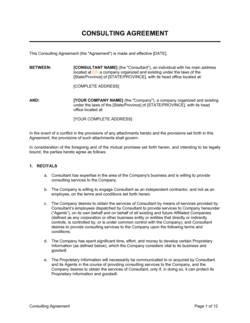
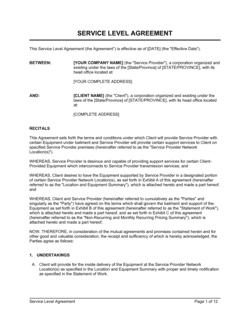
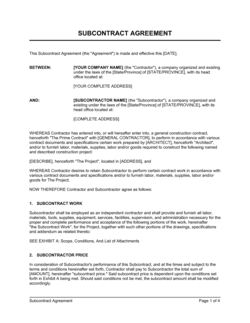
Agreement with Provider of Network Services Template

Free Word download • Edit online • Save & share with Drive • Export to PDF

3 pages25–30 min to fillDifficulty: StandardSignature requiredLegal review recommended
Learn more ↓
FreeAgreement with Provider of Network Services Template

At a glance

What it is
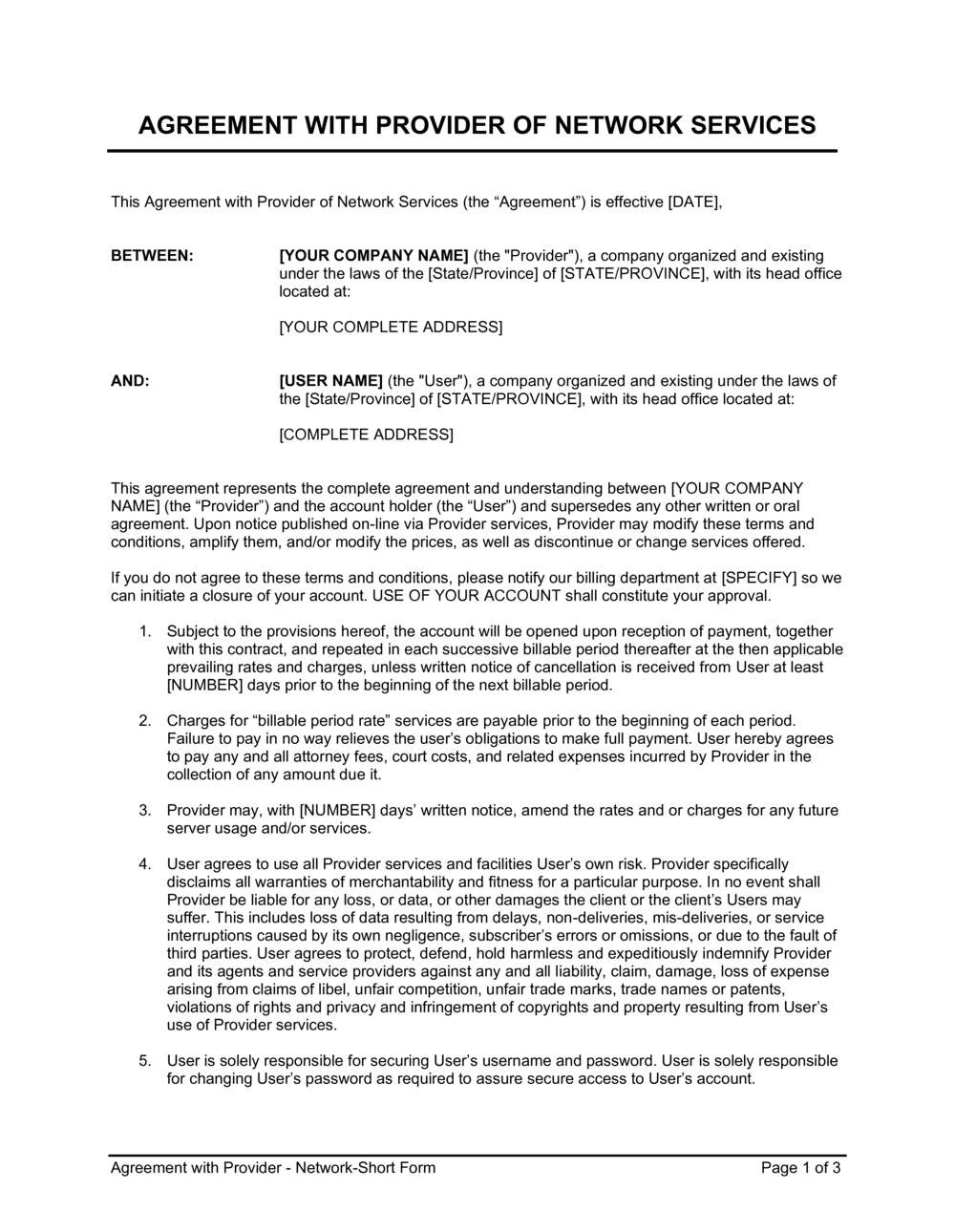
An Agreement With Provider Of Network Services is a legally binding contract between a business (the client) and a network services provider — such as an ISP, managed network services firm, or telecommunications vendor — that defines the scope of services, performance standards, data security obligations, fees, and remedies for non-performance. This free Word download gives you a structured, professionally drafted starting point you can edit online and export as PDF before execution.
When you need it
Use it whenever your business engages an external provider to deliver, manage, or maintain network infrastructure — including broadband connectivity, WAN links, VPN services, managed firewalls, or cloud-based network management. It is essential before any provider gains access to your systems or data.
What's inside
Scope of services and technical specifications, service level agreements with uptime guarantees and response times, fees and payment schedules, data security and confidentiality obligations, intellectual property ownership, liability limitations, dispute resolution, and termination rights including cure periods.

What is an Agreement With Provider Of Network Services?

An Agreement With Provider Of Network Services is a legally binding contract between a business (the client) and an external vendor responsible for delivering, managing, or maintaining network infrastructure — including internet connectivity, WAN links, VPN services, managed firewalls, and related components. It translates the commercial and technical expectations of the relationship into enforceable obligations: scope of services, measurable uptime commitments, data security standards, fees, liability limits, and the conditions under which either party can exit. Unlike a generic service contract, this agreement addresses network-specific risks such as outage credits, breach notification timelines, and bandwidth guarantees that general templates do not capture.

Why You Need This Document

Operating without a signed network services agreement means your provider has no contractual obligation to meet any specific uptime standard, notify you of a security incident within any defined window, or return your configurations when the relationship ends. A network outage without an SLA leaves you with a general breach-of-contract claim and no automatic credit mechanism — expensive and slow to pursue. For businesses in regulated industries, the absence of a written vendor agreement with security provisions can itself constitute a compliance violation under HIPAA, GDPR, or PCI-DSS, independent of whether a breach actually occurs. This template gives you a professionally structured starting point that covers the clauses network service engagements consistently require, so you spend your negotiation time on the numbers that matter — uptime thresholds, liability caps, and fee escalators — rather than building the framework from scratch.

Which variant fits your situation?

If your situation is…Use this template
Engaging a managed service provider for full network infrastructure managementManaged Services Agreement
Contracting an ISP for business broadband or dedicated internet accessAgreement With Provider Of Network Services
Hiring a cloud provider to host network functions virtuallyCloud Services Agreement
Engaging a vendor specifically for cybersecurity monitoringIT Services Agreement
Outsourcing general IT support alongside network servicesIT Consulting Agreement
Purchasing hardware alongside network installation and support servicesService and Maintenance Agreement
Subcontracting network services to a third-party specialistSubcontractor Agreement

Common mistakes to avoid

❌ Accepting 'best efforts' uptime language with no SLA benchmarks

Why it matters: Without a numerical uptime guarantee and a defined credit schedule, the client has no contractual basis to demand remedies during outages — the provider can cite 'best efforts' and face no financial consequence.

Fix: Replace all 'best efforts' uptime language with a specific percentage (e.g., 99.9% monthly availability) and a tiered credit schedule that activates automatically when the threshold is breached.

❌ Missing a breach notification deadline for security incidents

Why it matters: Without a contractual notification timeline, a provider who discovers a data breach affecting your network has no obligation to tell you within any defined window — delaying your incident response and potentially breaching your own regulatory obligations downstream.

Fix: Specify a 72-hour notification window from the provider's discovery of any security incident affecting client data or network components, aligned with GDPR and most state breach notification laws.

❌ Setting the liability cap at one month of fees

Why it matters: A single month's fee is rarely enough to cover the cost of a serious network outage or data breach — remediation, lost business, and regulatory fines routinely exceed this amount by multiples.

Fix: Negotiate a liability cap equal to the total fees paid in the preceding 12 months, and consider carving out data breaches and gross negligence from the consequential-damages exclusion.

❌ Overlooking the auto-renewal notice window

Why it matters: A 15-day or 30-day cancellation window on a 12-month contract is easy to miss — the contract renews automatically and the client faces early termination penalties to exit.

Fix: Negotiate a minimum 60-day notice window, calendar the deadline on execution day, and include a right to terminate for convenience with 90 days' notice after the initial term.

❌ No IP ownership clause for custom configurations

Why it matters: If the provider builds custom network configurations, scripts, or integrations during the engagement and there is no IP clause, ownership defaults to the provider — meaning you cannot take those assets to a new vendor when the contract ends.

Fix: Include an explicit clause confirming that all client data, configurations, and work product created specifically for the client's environment are client property and will be returned or transferred at contract end.

❌ Describing services in marketing terms rather than technical specifications

Why it matters: Vague service descriptions like 'reliable internet access' or 'managed network support' give the provider wide latitude to define what they owe — making it nearly impossible to prove a breach when performance falls short.

Fix: Attach a detailed technical Schedule A specifying bandwidth (Mbps/Gbps), protocols, hardware, monitoring cadence, locations, and response-time tiers for each incident priority level.

The 9 key clauses, explained

Parties, recitals, and effective date

In plain language: Identifies the client and the provider by their full legal entity names, states the effective date of the agreement, and describes the general purpose of the relationship.

Sample language
This Agreement is entered into as of [DATE] between [CLIENT LEGAL NAME], a [STATE/PROVINCE] [ENTITY TYPE] ('Client'), and [PROVIDER LEGAL NAME], a [STATE/PROVINCE] [ENTITY TYPE] ('Provider').

Common mistake: Using a trade name or brand name instead of the registered legal entity name for either party — making the contract difficult to enforce against the correct legal entity in a dispute.

Scope of network services

In plain language: Defines exactly which services the provider will deliver, including technical specifications, geographic coverage, bandwidth commitments, and any exclusions.

Sample language
Provider shall deliver the following services to Client at the locations listed in Schedule A: [SERVICE TYPE] at a committed bandwidth of [X] Mbps/Gbps, including [SPECIFIC COMPONENTS]. Services expressly exclude [EXCLUSIONS].

Common mistake: Describing services in marketing language rather than technical specifications — leaving disputes about whether a service was actually delivered unresolvable without a baseline benchmark.

Service level agreement (SLA) and performance standards

In plain language: Sets measurable uptime guarantees, response and restoration time commitments, monitoring obligations, and the credits or remedies that apply when standards are not met.

Sample language
Provider guarantees monthly network availability of [99.9]% ('Uptime Commitment'). In the event of availability below the Uptime Commitment in any calendar month, Client shall receive a service credit equal to [X]% of monthly fees for each [Y] hours of excess downtime.

Common mistake: Accepting vague 'best efforts' uptime language without numerical benchmarks or credit triggers — leaving the client with no measurable remedy when the network underperforms.

Fees, invoicing, and payment terms

In plain language: States the recurring and one-time fees, invoicing schedule, payment due date, late-payment interest, and any fee adjustment mechanisms such as annual CPI escalators.

Sample language
Client shall pay Provider a monthly recurring fee of $[AMOUNT], invoiced on the [FIRST] day of each calendar month and due within [30] days of invoice date. Late payments accrue interest at [1.5]% per month. Provider may adjust fees annually by no more than [X]% upon [60] days' written notice.

Common mistake: Omitting a cap on annual fee increases — allowing the provider to raise rates significantly mid-term without giving the client a meaningful exit right.

Data security and confidentiality

In plain language: Requires the provider to implement and maintain specified security controls, restricts use of client data, obligates prompt breach notification, and addresses compliance with applicable data protection laws.

Sample language
Provider shall maintain security measures no less rigorous than [ISO 27001 / SOC 2 Type II] standards and shall notify Client within [72] hours of discovering any security incident affecting Client data or network. Provider shall not use Client data for any purpose other than delivering the Services.

Common mistake: No breach notification timeline and no specified security standard — meaning the provider faces no contractual deadline to inform you of an incident that may have exposed your data or systems.

Intellectual property ownership

In plain language: Clarifies that the client retains ownership of its data and configurations, and that neither party acquires IP rights in the other's pre-existing materials through the agreement.

Sample language
All data, network configurations, and content transmitted over or stored on Provider's network by Client remain the exclusive property of Client. Provider's software, tools, and systems used to deliver Services remain the exclusive property of Provider.

Common mistake: No IP clause at all — leaving ambiguity about whether custom configurations or integrations built by the provider belong to the client when the contract ends.

Limitation of liability and indemnification

In plain language: Caps the total damages either party can recover, excludes consequential and indirect damages, and allocates responsibility for third-party claims arising from each party's conduct.

Sample language
Each party's aggregate liability under this Agreement shall not exceed the total fees paid by Client in the [12] months preceding the claim. Neither party shall be liable for indirect, consequential, or punitive damages. Provider shall indemnify Client against third-party claims arising from Provider's gross negligence or wilful misconduct.

Common mistake: Accepting a liability cap equal to only one month of fees — leaving the client with a nominal remedy for a major outage or data breach that costs far more to remediate.

Term, renewal, and termination

In plain language: States the initial contract term, auto-renewal mechanics and notice window to cancel, grounds for termination for cause with cure periods, and rights to terminate for convenience.

Sample language
This Agreement commences on the Effective Date and continues for an initial term of [12] months ('Initial Term'). It shall automatically renew for successive [12]-month periods unless either party provides written notice of non-renewal at least [60] days before expiry. Either party may terminate for material breach upon [30] days' written notice if the breach remains uncured.

Common mistake: A short auto-renewal notice window — such as 15 days — combined with a long contract term, leaving clients locked in for another full year if they miss the narrow cancellation window.

Dispute resolution and governing law

In plain language: Specifies which jurisdiction's law governs the agreement, the mandatory process for escalating disputes (escalation → mediation → arbitration or litigation), and the venue for any proceedings.

Sample language
This Agreement is governed by the laws of [STATE / PROVINCE / COUNTRY]. Any dispute not resolved by senior management escalation within [30] days shall be submitted to binding arbitration administered by [AAA / JAMS / LCIA] in [CITY], except either party may seek injunctive relief in any court of competent jurisdiction.

Common mistake: Choosing a governing law state or country that neither party operates in, creating procedural complications and additional legal costs if a dispute actually arises.

How to fill it out

  1. 1

    Identify both parties with full legal entity names

    Enter the client's and provider's registered legal entity names exactly as they appear on incorporation documents. Add each party's principal address and a designated notice contact.

    💡 Request a copy of the provider's certificate of incorporation or business registration to verify the exact legal name before execution.

  2. 2

    Define the scope of services in technical detail

    Populate Schedule A with every service component — bandwidth, protocols, geographic locations, hardware supplied, monitoring tools, and explicit exclusions. The more specific this section, the fewer disputes arise later.

    💡 Attach the provider's technical proposal or statement of work as Schedule A rather than retyping it — this ensures the agreed specifications are contractually binding.

  3. 3

    Set measurable SLA benchmarks and credit triggers

    Enter the uptime percentage (e.g., 99.9%), MTTR for priority incidents, and the credit schedule that applies when benchmarks are missed. Tie credits to a percentage of monthly fees, not a fixed dollar cap.

    💡 Request the provider's historical uptime data for comparable clients before agreeing to the uptime threshold — this tests whether the commitment is realistic.

  4. 4

    Complete the fees and payment schedule

    Enter monthly recurring fees, one-time setup fees, any volume-based pricing tiers, the invoicing date, payment due date, and the late-payment interest rate. Add the maximum annual fee adjustment percentage.

    💡 Negotiate the fee escalator cap before signing — providers often propose CPI-plus adjustments that can compound significantly over a multi-year term.

  5. 5

    Specify data security standards and breach notification timing

    Name the security framework the provider must maintain (e.g., ISO 27001, SOC 2 Type II, NIST CSF), enter the breach notification window (72 hours is the EU GDPR standard and a reasonable baseline globally), and list any industry-specific compliance requirements.

    💡 Ask the provider for their most recent audit report (SOC 2, ISO certification) before finalizing this section — if they cannot produce one, the security clause needs to be more prescriptive.

  6. 6

    Set the term, auto-renewal notice window, and termination triggers

    Enter the initial term length, the auto-renewal period, and — critically — the advance notice window required to cancel before auto-renewal. Include a 30-day cure period for material breaches before termination rights activate.

    💡 Calendar the renewal notice deadline the day you sign the contract. Missing a 60-day window on a 12-month auto-renewal locks you in for another full term.

  7. 7

    Review the liability cap and indemnification allocation

    Confirm the liability cap is expressed as a multiple of monthly fees paid over the preceding 12 months — not a single month's fee. Ensure the indemnification clause covers third-party claims from the provider's negligence or security failures.

    💡 If you operate in a regulated industry (healthcare, finance), negotiate an exception to the consequential-damages exclusion for data breaches — standard caps rarely cover the actual cost of a major incident.

  8. 8

    Sign before the service activation date

    Both authorized signatories must execute the agreement before the provider activates any services or gains access to your network. Post-activation signatures create gaps in protection for the period the provider was already operating.

    💡 Use an e-signature platform that timestamps execution and stores the fully executed copy automatically — this creates an unambiguous record if the start date or signing sequence is ever disputed.

Frequently asked questions

What is an Agreement With Provider Of Network Services?

An Agreement With Provider Of Network Services is a legally binding contract between a business and an external vendor that delivers, manages, or maintains network infrastructure — such as internet connectivity, WAN links, VPN services, or managed firewalls. It defines the scope of services, performance standards, fees, data security obligations, liability limits, and termination rights. Without it, the client has no enforceable basis to hold the provider accountable for outages, security failures, or service shortfalls.

What should a network services agreement include?

At minimum it should cover the scope of services with technical specifications, a measurable SLA with uptime guarantees and credit triggers, fees and payment terms, data security and breach notification obligations, intellectual property ownership, a liability cap and indemnification structure, auto-renewal and termination rights, and governing law. Missing the SLA benchmarks or the security clause are the two omissions most likely to cause costly disputes.

What is a service level agreement (SLA) in a network services contract?

An SLA is the section of the contract that translates service quality into measurable, enforceable numbers — typically a monthly uptime percentage (e.g., 99.9%), a mean time to respond to incidents by priority level, and a mean time to restore service. It also defines the credits or fee reductions the provider must issue automatically when those benchmarks are not met. Without numerical SLA benchmarks, a client has no contractual trigger for remedies.

Is a network services agreement legally required?

No law in most jurisdictions mandates a formal written agreement for network services, but operating without one exposes you to significant risk. Without a signed contract, there are no enforceable SLA commitments, no data security obligations on the provider, no defined liability cap, and no agreed termination process. Many regulated industries — healthcare, financial services, and government contractors — require written vendor agreements as a compliance condition regardless.

How does a network services agreement differ from a managed services agreement?

A network services agreement focuses specifically on the delivery and performance of network infrastructure — connectivity, bandwidth, routing, and related components. A managed services agreement (MSA) is broader, typically covering end-to-end IT management including servers, endpoints, helpdesk support, and network together. If your provider is managing your full IT environment, an MSA is more appropriate; if they are delivering only network connectivity or WAN services, a network services agreement is the right instrument.

What liability cap should I negotiate in a network services contract?

A liability cap equal to the total fees paid in the preceding 12 months is a reasonable standard for most business engagements. Some providers push for a cap of one month's fees — this is almost always insufficient given the potential cost of a serious outage or data breach. For regulated industries handling sensitive data, negotiate a separate, higher cap (or no cap) for data breach events, and ensure the consequential-damages exclusion does not apply to the provider's gross negligence or wilful misconduct.

What happens when a network provider fails to meet the SLA?

If the contract includes a defined credit schedule, the provider is contractually obligated to issue service credits automatically — typically a percentage of monthly fees for each threshold breach. If the underperformance is persistent or constitutes a material breach, the client may have grounds to terminate with notice after the cure period expires. Without a written SLA and credit mechanism, the client's only remedy is a general breach-of-contract claim, which is far harder and more expensive to pursue.

How long should a network services agreement last?

Initial terms of 12 to 36 months are most common, with auto-renewal for successive 12-month periods. Longer terms (3–5 years) sometimes come with discounted pricing but reduce the client's ability to exit if the provider underperforms or better options emerge. Whatever the term, negotiate a right to terminate for convenience after the initial term with 60–90 days' notice, and ensure the auto-renewal notice window is at least 60 days.

Do I need a lawyer to review a network services agreement?

For standard business broadband or routine managed network services engagements, a well-drafted template with careful customization is often sufficient. Legal review is recommended when the contract involves sensitive or regulated data (healthcare, financial services), when the annual contract value exceeds $50,000, when the provider is operating in multiple jurisdictions, or when the SLA and liability terms differ significantly from the template defaults. A 1–2 hour review by a technology lawyer typically costs $300–$800 and is worthwhile for any mission-critical network dependency.

How this compares to alternatives

vs Managed Services Agreement

A managed services agreement covers the full scope of outsourced IT operations — servers, endpoints, helpdesk, and network — under a single contract. An Agreement With Provider Of Network Services is narrower, governing only network infrastructure delivery and performance. Use the managed services agreement when a single vendor is responsible for your entire IT environment; use this template when the network engagement is standalone or the provider operates only at the network layer.

vs IT Services Agreement

An IT services agreement governs the delivery of broader IT support and consulting services, including software, hardware, and helpdesk. An Agreement With Provider Of Network Services is specific to network infrastructure — connectivity, routing, and related components — and includes network-specific terms like bandwidth commitments and uptime SLAs. Use this template when the vendor's scope is exclusively network-layer services.

vs IT Consulting Agreement

An IT consulting agreement engages an individual consultant or firm for advisory or project-based work — design, implementation, or strategy — rather than ongoing service delivery. An Agreement With Provider Of Network Services creates a continuing operational relationship with measurable performance obligations and recurring fees. If the engagement is a one-time network design project, an IT consulting agreement is more appropriate.

vs Service Level Agreement (Standalone)

A standalone SLA document defines performance standards and remedies but typically relies on a master services agreement for the broader contractual framework — parties, fees, liability, and termination. An Agreement With Provider Of Network Services combines the SLA with the full contract in a single document, which is simpler for straightforward engagements. Use a standalone SLA when you already have a master agreement in place and only need to document performance standards for a new service.

Industry-specific considerations

Healthcare

HIPAA Business Associate Agreement obligations must be incorporated or referenced; breach notification windows align with the 60-day HIPAA maximum; network providers accessing PHI require explicit security control specifications.

Financial Services

PCI-DSS compliance requirements flow down to network providers handling cardholder data environments; financial regulators in most jurisdictions require written vendor agreements with security and audit-access provisions.

Retail and E-commerce

High-availability requirements during peak trading periods (Black Friday, seasonal events) warrant enhanced SLA commitments and escalated credit tiers; PCI-DSS scope includes network segments processing payment data.

Manufacturing

OT (operational technology) network segments controlling production equipment require stricter security isolation clauses; unplanned downtime has direct production-cost consequences that should inform the liability cap negotiation.

Professional Services

Client confidentiality obligations require the network provider's data handling and security commitments to be strong enough to satisfy professional regulatory standards (legal, accounting, consulting).

SaaS and Technology

Network uptime directly affects product availability and customer SLA commitments downstream; contracts should include provider audit rights, penetration-testing cooperation clauses, and incident-response coordination obligations.

Jurisdictional notes

United States

No single federal statute governs network services contracts, but HIPAA (healthcare), PCI-DSS (payment data), and the CCPA (California consumer data) impose vendor agreement requirements on clients in regulated sectors. State contract law applies to enforceability; California courts have applied a reasonableness standard to liability caps that may affect enforceability of extremely low caps. The FCC's open internet rules affect ISP conduct but do not override private contractual terms between businesses.

Canada

PIPEDA (federally) and provincial privacy laws (notably Quebec's Law 25) impose obligations on businesses that share personal data with third-party network providers, requiring written contracts with specified security commitments. Quebec's Law 25 requires privacy impact assessments for cross-border data transfers. CASL (Canada's Anti-Spam Legislation) intersects when the network is used for electronic messaging. Contracts subject to Quebec civil law must be available in French for provincially regulated entities.

United Kingdom

The UK GDPR (retained post-Brexit) requires written data processing agreements with network vendors that handle personal data, including mandatory breach notification within 72 hours. The Network and Information Systems (NIS) Regulations impose security obligations on essential service operators and their network providers. Unfair contract terms legislation (UCTA 1977 and the Consumer Rights Act 2015) may limit the enforceability of very broad liability exclusions in business-to-business contracts.

European Union

GDPR Article 28 mandates a written data processing agreement whenever a network provider processes personal data on behalf of a client — this is a strict legal requirement, not optional. The EU NIS2 Directive (effective October 2024) expands security obligations to a wider range of entities and their network suppliers. Cross-border data transfers outside the EEA require additional safeguards (Standard Contractual Clauses or adequacy decision). Member states such as Germany and France have additional sector-specific telecom and data protection requirements.

Template vs lawyer — what fits your deal?

PathBest forCostTime
Use the templateSmall businesses engaging a local ISP or managed network provider for standard connectivity services with contract values under $25,000 per yearFree1–2 hours
Template + legal reviewMid-sized businesses, regulated industries, or contracts involving sensitive data where SLA, liability, and security terms require calibration$300–$800 for a 1–2 hour technology lawyer review2–5 days
Custom draftedEnterprise network contracts exceeding $100,000 annually, multi-jurisdiction providers, or highly regulated sectors such as healthcare, financial services, or government$2,000–$8,000+2–4 weeks

Glossary

Service Level Agreement (SLA)
A contractual commitment defining the minimum performance standards a provider must meet, such as 99.9% uptime or a 4-hour response time for critical outages.
Uptime Guarantee
The percentage of time, measured monthly or annually, during which the network service must be available — e.g., 99.9% uptime equals no more than 8.7 hours of downtime per year.
Mean Time to Repair (MTTR)
The average time the provider commits to restoring service after a failure is reported, used as a performance benchmark in the SLA.
Bandwidth
The maximum data transfer rate available on a network connection, typically expressed in Mbps or Gbps, as specified in the service scope.
Managed Network Services
An arrangement in which a third-party provider remotely monitors, manages, and maintains a client's network infrastructure under a contractual service scope.
Acceptable Use Policy (AUP)
A document, often incorporated by reference, that defines permitted and prohibited uses of the provider's network and infrastructure.
Liability Cap
A contractual ceiling on the total damages one party can recover from the other, typically expressed as a multiple of monthly fees paid in the preceding 12 months.
Force Majeure
A clause excusing a party from performance obligations when failure is caused by events outside its reasonable control, such as natural disasters, government actions, or power grid failures.
Cure Period
A defined number of days a party in breach is given to remedy the breach before the non-breaching party may terminate the agreement — commonly 15 to 30 days for material breaches.
Confidential Information
Non-public data, network configurations, security credentials, and business information exchanged between the parties that is subject to confidentiality obligations under the agreement.
Auto-Renewal Clause
A provision that automatically extends the contract term for a successive period unless one party provides written notice of non-renewal within a specified window before expiry.

Part of your Business Operating System

This document is one of 3,000+ business & legal templates included in Business in a Box.

  • Fill-in-the-blanks — ready in minutes
  • 100% customizable Word document
  • Compatible with all office suites
  • Export to PDF and share electronically

Create your document in 3 simple steps.

From template to signed document — all inside one Business Operating System.
1
Download or open template

Access over 3,000+ business and legal templates for any business task, project or initiative.

2
Edit and fill in the blanks with AI

Customize your ready-made business document template and save it in the cloud.

3
Save, Share, Send, Sign

Share your files and folders with your team. Create a space of seamless collaboration.

Save time, save money, and create top-quality documents.

★★★★★

"Fantastic value! I'm not sure how I'd do without it. It's worth its weight in gold and paid back for itself many times."

Managing Director · Mall Farm
Robert Whalley
Managing Director, Mall Farm Proprietary Limited
★★★★★

"I have been using Business in a Box for years. It has been the most useful source of templates I have encountered. I recommend it to anyone."

Business Owner · 4+ years
Dr Michael John Freestone
Business Owner
★★★★★

"It has been a life saver so many times I have lost count. Business in a Box has saved me so much time and as you know, time is money."

Owner · Upstate Web
David G. Moore Jr.
Owner, Upstate Web

Run your business with a system — not scattered tools

Stop downloading documents. Start operating with clarity. Business in a Box gives you the Business Operating System used by over 250,000 companies worldwide to structure, run, and grow their business.

Free Forever Plan · No credit card required