Support Agreement Template

Free Word download • Edit online • Save & share with Drive • Export to PDF

6 pages25–35 min to fillDifficulty: ComplexSignature requiredLegal review recommended
Learn more ↓
FreeSupport Agreement Template

At a glance

What it is
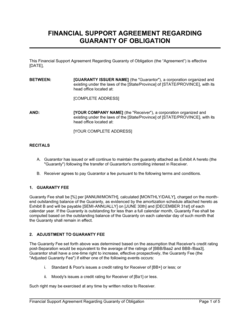
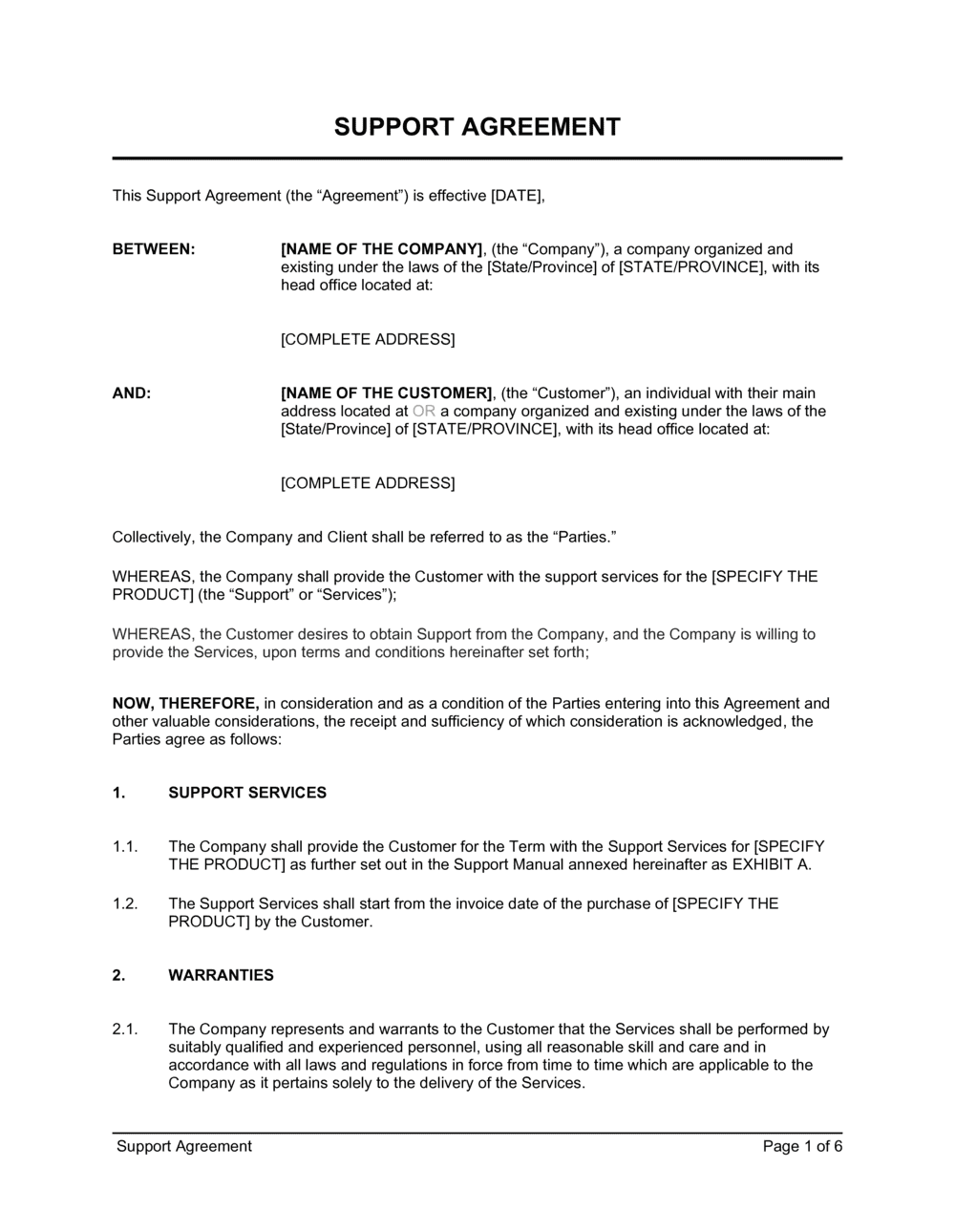
A Support Agreement is a legally binding contract between a service provider and a client that defines the scope, terms, and conditions under which technical or operational support will be delivered. This free Word download lets you edit scope, service levels, fees, and escalation procedures online and export as PDF for immediate execution.
When you need it
Use it whenever you sell or purchase ongoing support services — whether for software, IT infrastructure, hardware, or managed services — and need enforceable obligations around response times, availability, and remedies for service failures.
What's inside
Scope of support services, service level commitments (response and resolution times), fees and billing terms, escalation procedures, exclusions and limitations of liability, term and termination rights, and confidentiality obligations — all in a single structured document.

What is a Support Agreement?

A Support Agreement is a legally binding contract between a service provider and a client that defines the terms, standards, and conditions under which ongoing technical or operational support will be delivered. It identifies the specific products or systems covered, sets measurable performance obligations — response times, resolution targets, and support availability windows — and establishes the commercial framework including fees, service credits, liability limits, and termination rights. Unlike a general services contract, a support agreement is built around recurring performance obligations rather than discrete deliverables, making it the foundational document for any ongoing support relationship in software, IT infrastructure, hardware, or managed services.

Why You Need This Document

Without a signed support agreement, both provider and client are exposed to the same four risks simultaneously. The provider has no defined scope boundary — clients escalate issues for unsupported products, legacy versions, or third-party integrations with no contractual basis to decline. The client has no enforceable performance standard — response times and availability commitments exist only as informal expectations, leaving no remedy when the provider fails to respond. Neither party has agreed on liability — a prolonged outage or data exposure during a support session can generate uncapped damages claims that dwarf the contract value. And the commercial relationship has no defined endpoint — auto-renewal disputes, early-termination fee conflicts, and prepaid-fee refund arguments become credibility contests rather than contract interpretation. A properly executed support agreement closes all four gaps for the cost of 30 minutes and a legal review where the stakes warrant it.

Which variant fits your situation?

If your situation is…Use this template
Providing tiered support levels (bronze, silver, gold) to multiple customer segmentsTiered Support Agreement
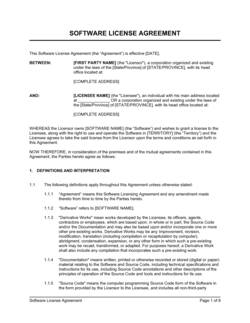
Bundling software maintenance updates with technical supportMaintenance and Support Agreement
Delivering fully managed IT services including monitoring and administrationManaged Services Agreement
Providing hardware break-fix and on-site repair servicesHardware Support and Maintenance Agreement
Defining uptime, availability, and credit remedies for cloud softwareService Level Agreement (SLA)
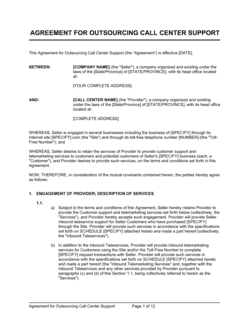
Engaging a third party to provide helpdesk or end-user support on your behalfOutsourced Support Services Agreement
Providing post-warranty support for a specific software product after initial license termSoftware Support and Maintenance Agreement

Common mistakes to avoid

❌ Committing to hard resolution times for all priority levels

Why it matters: Complex P1 issues may require code changes, vendor escalation, or infrastructure repairs that cannot be completed within a fixed window — a hard commitment creates automatic breach and unlimited credit exposure.

Fix: Distinguish between response time (a hard commitment) and resolution target (a best-efforts benchmark). Reserve hard resolution SLAs for workaround delivery, not root-cause fixes.

❌ No version support policy in the scope clause

Why it matters: Clients running legacy versions create disproportionate support load. Without an explicit supported-version range, providers inherit unlimited obligation for every historical release.

Fix: State that support covers only the current major release and one prior major release. Provide 90 days' notice before dropping support for an older version.

❌ Missing a service credit cap

Why it matters: Without a monthly or annual ceiling on service credits, a prolonged outage or repeated SLA misses can generate credits that exceed total annual contract value, effectively providing free service.

Fix: Cap service credits at 30% of the monthly fee per month and 10% of total annual fees in any contract year. State that credits are the client's sole remedy for SLA failures.

❌ Auto-renewal notice window shorter than 45 days

Why it matters: Short auto-renewal windows — 15 or 30 days — are routinely missed by clients, generating disputes, chargebacks, and in some jurisdictions regulatory scrutiny over automatic renewal practices.

Fix: Use a 60-day written notice window for annual contracts. Several US states (California, New York) and EU consumer protection rules require adequate notice for automatic renewal of service contracts.

❌ Liability cap inconsistent with the master agreement

Why it matters: If the support agreement caps liability at 6 months of fees but the master services agreement caps at 12 months, courts may apply the lower cap to all related claims, reducing the provider's exposure beyond what was intended.

Fix: Cross-reference and align the liability cap in the support agreement with every related contract the client has signed. Include an order-of-precedence clause stating which document governs in case of conflict.

❌ No client responsibility clause for maintaining authorized contacts

Why it matters: Without a named-contact requirement, any employee can open tickets, volume becomes unmanageable, and the provider loses audit trail of who authorized escalations or accepted workarounds.

Fix: Require the client to designate a maximum number of authorized support contacts (typically 2–5 depending on tier) and include a process for updating the contact list with 5 business days' notice.

The 10 key clauses, explained

Scope of support services

In plain language: Defines precisely what the provider will and will not support — specific products, versions, systems, and types of issues covered — so both parties share a common understanding of entitlement.

Sample language
Provider shall provide support services for [PRODUCT NAME] versions [VERSION RANGE] as described in Schedule A ('Supported Products'). Support does not include [EXCLUDED ITEMS — e.g., third-party integrations, custom modifications, or hardware not supplied by Provider].

Common mistake: Defining scope too broadly with language like 'all issues related to the software.' This captures bugs outside the provider's control and creates liability for problems the provider cannot reasonably resolve.

Service levels and response times

In plain language: Sets measurable performance standards — response and resolution time targets tied to priority classification — that create enforceable obligations and a basis for remedy when missed.

Sample language
Priority 1 (System Down): Response within [1] hour, Target Resolution within [4] hours. Priority 2 (Major Function Impaired): Response within [4] hours, Target Resolution within [1] business day. Priority 3 (Minor Issue): Response within [1] business day, Target Resolution within [5] business days.

Common mistake: Promising resolution times rather than target resolution times for complex issues. If a P1 resolution requires a code fix, committing to a hard 4-hour resolution time creates breach exposure the provider cannot control.

Support channels and hours

In plain language: Specifies how clients submit requests (phone, email, portal, chat) and the hours during which the provider is obligated to respond — distinguishing business-hours coverage from 24/7 emergency support.

Sample language
Support requests must be submitted via [SUPPORT PORTAL URL] or [EMAIL ADDRESS]. Standard support hours are [9:00 a.m.–6:00 p.m. CLIENT LOCAL TIME], Monday through Friday, excluding [PROVIDER] public holidays. Priority 1 issues may be reported via [EMERGENCY PHONE NUMBER] at any time.

Common mistake: Committing to 24/7 coverage in the contract without a staffing model to back it up. Clients will hold providers to the literal terms, and after-hours breaches generate service credit liability.

Escalation procedure

In plain language: Maps the path an unresolved issue follows through successively senior technical and management tiers, including the timeframes that trigger each escalation and the named contacts at each level.

Sample language
If a Priority 1 issue is not resolved within [2] hours of acknowledgment, it shall be escalated to [TIER 2 CONTACT / ROLE]. If unresolved after [4] hours, it shall be escalated to [MANAGER NAME / TITLE] and a written status update provided to Client every [30] minutes.

Common mistake: Listing escalation contacts by name rather than role. Named individuals change roles or leave — update obligations lapse and the escalation chain breaks without a formal amendment.

Fees and payment terms

In plain language: States the support fee structure (annual, monthly, per-incident, or tiered), billing frequency, payment due dates, and consequences of late payment including service suspension rights.

Sample language
Client shall pay an annual support fee of $[AMOUNT], invoiced [annually in advance / quarterly]. Payment is due within [30] days of invoice. Provider reserves the right to suspend support services for balances overdue by more than [15] days after written notice.

Common mistake: Failing to address what happens to prepaid fees if the client terminates early. Without a refund or pro-rata clause, disputes over unused support periods are common.

Exclusions and client responsibilities

In plain language: Lists scenarios the provider is not required to support and the obligations the client must meet — like maintaining current software versions, providing access, or designating authorized contacts — to keep support valid.

Sample language
Provider has no obligation to support issues arising from: (a) Client's modifications to the Supported Product; (b) use of the Supported Product with third-party software not approved by Provider; (c) Client's failure to implement recommended updates within [90] days of release; or (d) hardware or network infrastructure not supplied by Provider.

Common mistake: Omitting the requirement that clients stay within a supported version range. Clients running two or three major versions behind create disproportionate support burden and expose the provider to unlimited legacy support obligations.

Service credits and remedies

In plain language: Defines the credit or remedy the client receives when the provider misses a service level commitment — typically a percentage of monthly fees — and establishes that credits are the client's sole remedy for service level failures.

Sample language
If Provider fails to meet the Priority 1 response time in any calendar month, Client shall receive a service credit equal to [5]% of the monthly support fee for that month, up to a maximum of [30]% of the monthly fee. Service credits are Client's sole and exclusive remedy for service level failures.

Common mistake: No cap on service credits. Without a monthly or annual ceiling, a prolonged outage can generate credits that exceed total contract value — effectively providing free service indefinitely.

Limitation of liability

In plain language: Caps the provider's total financial exposure for all claims under the agreement and excludes indirect, consequential, and punitive damages — protecting the provider from claims that dwarf the contract value.

Sample language
Provider's total aggregate liability under this Agreement shall not exceed the total fees paid by Client in the [12] months preceding the event giving rise to the claim. In no event shall either party be liable for indirect, incidental, consequential, or punitive damages.

Common mistake: Using a limitation of liability clause that is inconsistent with the main software license or master services agreement. Conflicting liability caps across related contracts create enforcement ambiguity that courts resolve unpredictably.

Term, renewal, and termination

In plain language: Sets the initial agreement period, automatic renewal conditions and notice requirements to prevent renewal, and the grounds and process for termination — including termination for cause and for convenience.

Sample language
This Agreement commences on [START DATE] and continues for [12] months ('Initial Term'), renewing automatically for successive [12]-month periods unless either party provides [60] days' written notice of non-renewal. Either party may terminate for material breach upon [30] days' written notice if the breach is not cured within that period.

Common mistake: Short auto-renewal notice windows — 15 or 30 days — that clients miss, locking them into another annual term they did not intend to renew. Courts in several jurisdictions scrutinize short auto-renewal windows for consumer and small-business contracts.

Confidentiality

In plain language: Obliges both parties to protect confidential information exchanged during support — including technical documentation, system architecture, and client data — and restricts its use to fulfilling the agreement.

Sample language
Each party agrees to hold the other's Confidential Information in strict confidence and not to disclose it to any third party without prior written consent. 'Confidential Information' includes all non-public technical, business, or operational information disclosed in connection with this Agreement.

Common mistake: No carve-out for information the receiving party already knew or that is independently developed. Without standard exclusions, the confidentiality clause can be challenged as overbroad and unenforceable.

How to fill it out

  1. 1

    Identify the parties and supported products

    Enter the provider's full legal entity name and the client's legal entity name. List the specific products, software versions, or systems covered in Schedule A — be precise about version ranges and named modules.

    💡 Cross-reference the supported product list against your actual release support policy before signing. Promising support for all versions creates an open-ended legacy obligation.

  2. 2

    Define priority classifications and service levels

    Create a priority matrix (P1–P4 or equivalent) with a plain-language description of each severity level, the corresponding response time, and the target resolution time. Distinguish between response commitments (hard) and resolution targets (aspirational for complex issues).

    💡 Anchor priority definitions to business impact — 'system completely unavailable' for P1, 'major function impaired' for P2 — rather than technical symptoms, which are easier for clients to verify.

  3. 3

    Set support channels and hours

    Specify each accepted submission channel (portal, email, phone) and the hours during which each is monitored. If 24/7 coverage applies only to P1 issues, state that explicitly rather than implying blanket coverage.

    💡 Include an emergency phone number for P1 issues even if your primary channel is a portal — clients under system outages need a direct escalation path.

  4. 4

    Complete the fees and payment terms

    Enter the annual or monthly support fee, billing schedule, payment due date (Net 30 is standard), and the late-payment remedy — typically a right to suspend service after 15 days' written notice.

    💡 Add a pro-rata refund clause for early termination without cause. It reduces disputes and is increasingly expected by enterprise procurement teams.

  5. 5

    Draft the exclusions and client responsibilities

    List every category of issue you will not support — unauthorized modifications, unsupported versions, third-party integrations, client network problems. Then list what the client must do to maintain support eligibility, such as designating authorized contacts and applying updates within 90 days.

    💡 Require the client to designate a named technical contact for support submissions. This prevents every employee from opening tickets independently and reduces volume by 20–40% in practice.

  6. 6

    Insert service credit terms and the liability cap

    Set the credit formula (percentage of monthly fee per missed SLA event), the monthly credit ceiling, and confirm that credits are the sole remedy. Then set the aggregate liability cap — typically 12 months of fees paid.

    💡 Ensure the liability cap in this agreement matches the cap in the master license or services agreement. Conflicting caps in related contracts create unpredictable enforcement outcomes.

  7. 7

    Confirm term, auto-renewal notice, and termination rights

    Set the initial term (typically 12 months), the auto-renewal period, and the notice window required to prevent renewal — 60 days is the standard for annual contracts. Add a termination-for-cause clause with a 30-day cure period.

    💡 If your client base includes consumers or small businesses, use a 60-day auto-renewal notice window rather than 30 days — shorter windows are subject to regulatory scrutiny in several US states and EU member states.

  8. 8

    Execute before the support period begins

    Both parties must sign the agreement before the support start date. Ensure the effective date in the agreement matches the billing start date to avoid gaps or overlaps with any prior arrangement.

    💡 Use Business in a Box eSign to timestamp execution and attach the fully signed document to the billing system record so that support entitlement and payment history are linked.

Frequently asked questions

What is a support agreement?

A support agreement is a legally binding contract between a service provider and a client that defines the scope, terms, and standards for technical or operational support. It specifies what systems or products are covered, how quickly the provider must respond to issues, what remedies apply when service levels are missed, how fees are structured, and when the agreement can be terminated. It is distinct from a service level agreement in that it covers the full commercial and legal relationship, not just the performance metrics.

What is the difference between a support agreement and a service level agreement?

A service level agreement (SLA) is a technical appendix that specifies performance metrics — uptime percentages, response times, and credit formulas. A support agreement is the overarching legal contract that incorporates the SLA alongside commercial terms, liability limits, confidentiality, and termination rights. In practice, many support agreements embed SLA terms directly rather than attaching a separate document, but for complex engagements the two are kept separate so the SLA can be updated without amending the main contract.

Do I need a support agreement if I already have a master services agreement?

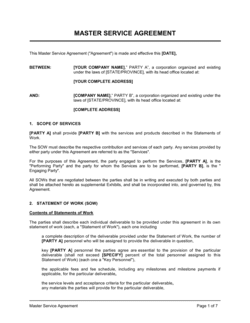
Yes, in most cases. A master services agreement governs the general commercial relationship — payment terms, liability, confidentiality, and dispute resolution. A support agreement defines the specific performance obligations for ongoing support services, which the MSA typically does not cover in sufficient detail. Where there is an MSA, the support agreement should include an order-of-precedence clause confirming which document governs in case of conflict.

What response times should a support agreement include?

Industry standard response times vary by priority level and support tier. For a typical B2B software support agreement, P1 (system down) response within 1–2 hours is standard; P2 (major function impaired) within 4 business hours; P3 (minor issue) within 1 business day; P4 (cosmetic or low-impact) within 3–5 business days. Enterprise agreements with premium support tiers often require 30-minute P1 response and 24/7 coverage. Always distinguish response commitments from resolution targets — resolution timelines for complex issues should be described as targets, not hard obligations.

Are support agreements legally enforceable?

A support agreement is generally enforceable when properly executed by authorized signatories of both parties, supported by adequate consideration (typically the support fee), and drafted with sufficiently specific obligations. Vague scope language, undefined priority classifications, or unlimited liability clauses can make specific provisions difficult to enforce. Courts will generally uphold well-drafted limitation of liability and sole-remedy clauses in commercial B2B contracts, though consumer agreements face additional scrutiny in most jurisdictions.

What should be excluded from the scope of a support agreement?

Standard exclusions include issues caused by the client's unauthorized modifications to the supported product, use with unapproved third-party software, failure to apply recommended updates within a defined period, hardware or network infrastructure not supplied by the provider, and issues attributable to force majeure events. Exclusions should be listed exhaustively in the agreement — courts construe ambiguous scope language against the drafter, which is typically the provider.

Can a support agreement be terminated early?

Most support agreements allow termination for material breach after a cure period (typically 30 days' written notice). Termination for convenience — ending the agreement without cause — is less common in provider-side agreements but is often negotiated by enterprise clients. If the agreement is terminated early, the contract should address whether prepaid fees are refunded on a pro-rata basis or forfeited, as this is a frequent source of post-termination disputes.

How are service credits calculated in a support agreement?

Service credits are typically calculated as a percentage of the monthly support fee for each SLA event missed — for example, 5% of the monthly fee for each missed P1 response time. Credits are usually capped at 25–30% of the monthly fee per billing period and 10% of total annual fees per year. The credit mechanism should explicitly state that credits are the client's sole and exclusive remedy for SLA failures, preventing the client from claiming damages on top of received credits.

Does a support agreement need to be reviewed by a lawyer?

For straightforward support arrangements with standard scope, a high-quality template is typically sufficient. Legal review is recommended when the agreement covers critical infrastructure with significant downtime exposure, the contract value exceeds $50,000 annually, the client is a large enterprise with its own heavily negotiated paper, or the services cross international jurisdictions with different consumer or commercial law requirements. A 1–2 hour review typically costs $300–$600 and is worthwhile for any engagement where a service failure could trigger material liability.

What happens to a support agreement when the underlying product is discontinued?

Most support agreements do not automatically address product discontinuation. Best practice is to include a clause allowing the provider to terminate support for a product upon 6–12 months' written notice of end-of-life, with a pro-rata refund of prepaid fees for the unsupported period. Without such a clause, the provider may remain contractually obligated to support a product it has formally discontinued, creating significant operational and cost exposure.

How this compares to alternatives

vs Service Level Agreement

A service level agreement is a performance-metrics document specifying uptime, response times, and credit formulas. A support agreement is the overarching legal contract that gives those metrics binding effect alongside commercial terms, liability limits, and termination rights. For complex engagements, use both — the SLA as a Schedule to the support agreement — so metrics can be updated without amending the main contract.

vs Managed Services Agreement

A managed services agreement covers broad ongoing operational management — monitoring, administration, infrastructure — and typically includes support as one component of a larger service bundle. A support agreement is narrower, focused specifically on issue response and resolution for a defined product or system. If the provider is running the client's IT environment end-to-end, the managed services agreement is more appropriate.

vs Software License Agreement

A software license agreement grants the right to use the software and defines the terms of that use — it does not cover post-sale support obligations. A support agreement is the companion document that defines what help the client receives after the license is granted. Many vendors charge for support separately and require a signed support agreement to receive patches, updates, and technical assistance.

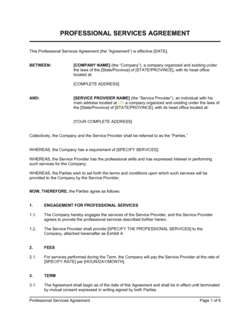
vs Professional Services Agreement

A professional services agreement governs discrete, project-based engagements with defined deliverables and a defined end date — such as an implementation or integration project. A support agreement governs ongoing, recurring services with no defined project deliverable. The two are often paired: a professional services agreement for the initial deployment and a support agreement for everything that follows.

Industry-specific considerations

SaaS / Technology

Tiered support plans (standard, premium, enterprise) with uptime commitments, 24/7 P1 coverage, and credit remedies tied to monthly recurring revenue.

IT Managed Services

On-site and remote support obligations, network monitoring scope, patch management responsibilities, and named-technician requirements for sensitive environments.

Manufacturing

Equipment and machinery support with on-site response time commitments, spare-parts availability obligations, and production-downtime liability caps.

Healthcare / MedTech

HIPAA-compliant support procedures, system availability requirements tied to patient safety obligations, and FDA-regulated change management processes for software updates.

Financial Services

Regulatory data-handling requirements during support sessions, audit-log retention for all support interactions, and enhanced SLAs for trading-critical systems.

Professional Services

Software platform support bundled with consulting retainers, client-portal access management, and named-account support contacts for high-value relationships.

Jurisdictional notes

United States

Support agreements are governed by state commercial law, which varies in how it treats limitation of liability clauses and service credit remedies. California, New York, and several other states have automatic renewal laws requiring prominent disclosure of auto-renewal terms and adequate notice windows — typically 30–60 days — for annual contracts. Healthcare-adjacent support agreements must address HIPAA Business Associate obligations if the provider accesses protected health information during support sessions.

Canada

Canadian commercial law is provincially governed. Ontario and British Columbia courts generally enforce limitation of liability and sole-remedy clauses in commercial B2B agreements, but consumer-facing support contracts face additional scrutiny under consumer protection legislation. PIPEDA and provincial privacy laws (including Quebec's Law 25) impose strict requirements on how support providers handle personal data accessed during support sessions, including data residency and breach notification obligations.

United Kingdom

The Unfair Contract Terms Act 1977 and the Consumer Rights Act 2015 impose reasonableness requirements on limitation of liability clauses, particularly in consumer-facing agreements. In B2B support contracts, courts generally uphold well-drafted liability caps if they were negotiated at arm's length. Post-Brexit, UK GDPR applies independently from EU GDPR — support providers handling personal data must have a UK-specific data processing basis and comply with ICO requirements for data access during support activities.

European Union

EU GDPR imposes strict requirements on support providers that access personal data during service delivery — a Data Processing Agreement (DPA) must accompany any support agreement where personal data is processed. The EU Unfair Terms Directive restricts the use of unreasonable limitation of liability clauses in consumer contracts, and several member states (Germany, France) apply this standard to small-business contracts as well. Automatic renewal provisions require clear, prominent disclosure under consumer protection directives applicable in most member states.

Template vs lawyer — what fits your deal?

PathBest forCostTime
Use the templateSmall to mid-sized providers offering standard support tiers for a single product or serviceFree30–45 minutes
Template + legal reviewEnterprise clients, cross-border engagements, or support for regulated industries such as healthcare or financial services$300–$7002–4 days
Custom draftedMission-critical infrastructure support, contracts exceeding $100K annually, or complex multi-party support arrangements with subcontractors$1,500–$5,000+1–3 weeks

Glossary

Service Level
A defined performance standard for support delivery, typically expressed as a maximum response time or resolution time for a given priority category.
Response Time
The maximum time from when a support request is submitted to when the provider acknowledges it and begins working on a resolution.
Resolution Time
The maximum time from acknowledgment of a support request to delivery of a fix, workaround, or other agreed remedy.
Priority Classification
A system for categorizing support issues by severity — typically P1 (critical system down) through P4 (minor or cosmetic) — which determines the applicable response and resolution targets.
Escalation Procedure
The defined process for routing an unresolved or critical issue to a higher tier of support personnel or management when initial response fails to meet agreed timelines.
Exclusions
Specific conditions, activities, or scenarios explicitly removed from the scope of support — such as issues caused by unauthorized modifications or third-party software.
Uptime Commitment
A contractual guarantee that a system or service will be available and operational for a defined percentage of time, typically expressed as 99.9% or 99.99% per month.
Service Credit
A monetary or account credit issued to the client as a remedy when the provider fails to meet a defined service level, typically expressed as a percentage of monthly fees.
Support Window
The hours and days during which the provider is obligated to receive and respond to support requests — for example, 9 a.m. to 6 p.m. local time, Monday through Friday, excluding public holidays.
Limitation of Liability
A clause capping the provider's total financial exposure for claims arising under the agreement, typically limited to fees paid in the prior 12 months.
Term and Renewal
The initial duration of the agreement and the conditions under which it renews — automatically, upon written notice, or by mutual agreement — and any notice requirements to prevent renewal.

Part of your Business Operating System

This document is one of 3,000+ business & legal templates included in Business in a Box.

  • Fill-in-the-blanks — ready in minutes
  • 100% customizable Word document
  • Compatible with all office suites
  • Export to PDF and share electronically

Create your document in 3 simple steps.

From template to signed document — all inside one Business Operating System.
1
Download or open template

Access over 3,000+ business and legal templates for any business task, project or initiative.

2
Edit and fill in the blanks with AI

Customize your ready-made business document template and save it in the cloud.

3
Save, Share, Send, Sign

Share your files and folders with your team. Create a space of seamless collaboration.

Save time, save money, and create top-quality documents.

★★★★★

"Fantastic value! I'm not sure how I'd do without it. It's worth its weight in gold and paid back for itself many times."

Managing Director · Mall Farm
Robert Whalley
Managing Director, Mall Farm Proprietary Limited
★★★★★

"I have been using Business in a Box for years. It has been the most useful source of templates I have encountered. I recommend it to anyone."

Business Owner · 4+ years
Dr Michael John Freestone
Business Owner
★★★★★

"It has been a life saver so many times I have lost count. Business in a Box has saved me so much time and as you know, time is money."

Owner · Upstate Web
David G. Moore Jr.
Owner, Upstate Web

Run your business with a system — not scattered tools

Stop downloading documents. Start operating with clarity. Business in a Box gives you the Business Operating System used by over 250,000 companies worldwide to structure, run, and grow their business.

Start free · No credit card required