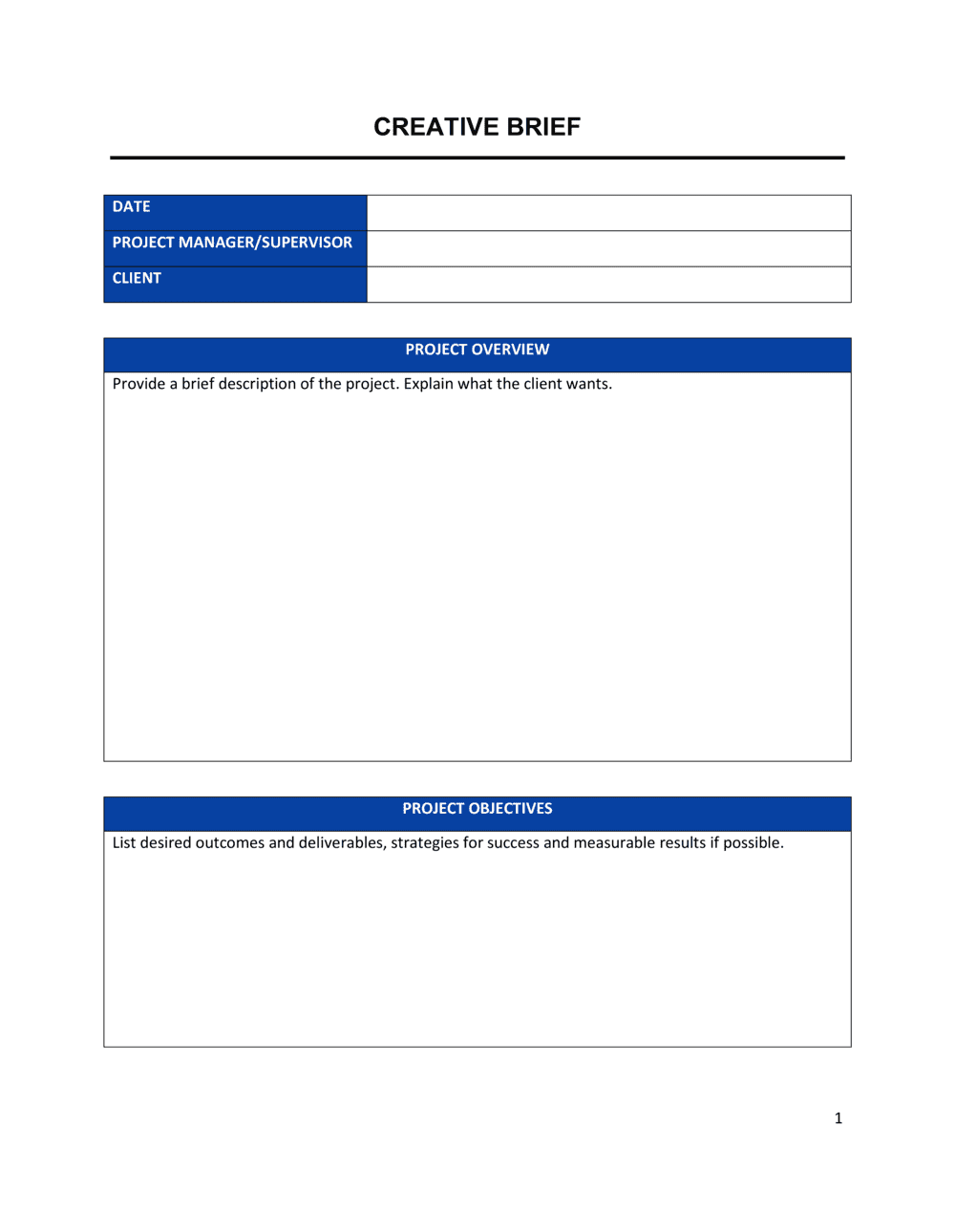
Creative Brief Template

Free Word download β€’ Edit online β€’ Save & share with Drive β€’ Export to PDF

4 pagesβ€’25–30 min to fillβ€’Difficulty: Standardβ€’Signature requiredβ€’Legal review recommended
Learn more ↓
FreeCreative Brief Template

At a glance

What it is
A Creative Brief is a binding document between a client and a creative service provider β€” agency, designer, copywriter, or production company β€” that defines the project's objectives, target audience, deliverables, timeline, budget, approval process, and ownership of produced work. This free Word download gives you a structured, signable starting point you can edit online and export as PDF to govern any creative engagement.
When you need it
Use it before any paid creative project begins β€” brand campaigns, website redesigns, product packaging, video productions, or advertising creative β€” where scope creep, revision disputes, or IP ownership conflicts could arise without written alignment between the parties.
What's inside
Project background and objectives, target audience definition, mandatory messaging and brand guidelines, deliverable specifications with formats and quantities, timeline with milestone dates, budget and payment terms, approval and revision rights, intellectual property assignment, and governing law.

What is a Creative Brief?

A Creative Brief is a binding agreement between a client and a creative service provider β€” agency, design studio, copywriter, or production company β€” that defines the strategic direction, deliverable specifications, timeline, budget, revision rights, and intellectual property terms of a creative project. It functions simultaneously as a strategic alignment document and an enforceable contract: the creative direction clauses ensure both parties interpret the project objective the same way, while the legal clauses β€” IP assignment, kill fee, confidentiality, and governing law β€” protect both sides if the engagement goes off course. Unlike an informal project brief sent by email, a signed creative brief creates specific, documented obligations that hold up in a payment dispute or IP challenge.

Why You Need This Document

Without a signed creative brief, scope creep, revision disputes, and IP ownership conflicts are not risks β€” they are near certainties. A client who has not formally agreed to what constitutes a "revision" will request twelve rounds and consider each one included. A provider who has not secured an IP assignment clause may retain copyright over the logo or campaign creative you have been using for two years. A project cancelled mid-production with no kill fee provision leaves the agency or freelancer with no contractual remedy for weeks of strategic and production work already delivered. A properly executed creative brief eliminates each of these failure modes before the first concept is presented, giving both parties a single document to return to when expectations diverge β€” which they always do on creative projects without one.

Which variant fits your situation?

If your situation is…Use this template
Commissioning a full brand identity from an agencyBrand Identity Creative Brief
Briefing a copywriter for website or ad copy onlyCopywriting Brief
Engaging a video production company for a commercialVideo Production Brief
Scoping a digital advertising campaign across paid channelsDigital Marketing Campaign Brief
Issuing a formal contract for ongoing agency retainer servicesAgency Services Agreement
Hiring a freelance designer for a single projectGraphic Design Contract
Defining scope for a website redesign projectWeb Design Brief

Common mistakes to avoid

❌ Vague deliverable descriptions

Why it matters: Listing 'social media assets' without specifying platform, dimensions, quantity, or format leaves every production decision open to interpretation β€” generating scope disputes on delivery.

Fix: Replace every category-level deliverable with a numbered line specifying platform, dimensions, file type, quantity, and language. Review the list with the production team before signing.

❌ No client feedback deadlines

Why it matters: A brief that sets provider deadlines but not client response windows makes it contractually impossible for the provider to meet final delivery dates when the client takes two weeks to review.

Fix: Add a client feedback deadline of three to five business days at each milestone and include an automatic timeline extension clause for client delays.

❌ IP assignment not tied to full payment

Why it matters: If IP transfers upon delivery rather than upon full payment, the client legally owns the work before paying the final invoice β€” removing all contractual leverage for the provider.

Fix: Write the assignment clause as: 'IP transfers upon receipt of final payment in full.' Until then, the client has a limited license to use the deliverables for internal review only.

❌ No kill fee provision

Why it matters: Without a kill fee, a client who cancels after concept development or mid-production owes nothing beyond hours already billed β€” leaving the provider with no compensation for strategic and planning work.

Fix: Set a kill fee of 25–50% of the remaining contract value, triggered if the client terminates after the kickoff or first draft stage, due within 30 days of termination notice.

❌ No definition of what counts as a revision

Why it matters: Agencies and freelancers report that unlimited revisions on fixed-fee projects are the single largest cause of project losses. Without a definition, every client request is a revision by default.

Fix: Add one sentence defining revisions as refinements to an approved concept direction, and state that changes to strategy, audience, or core concept after approval constitute a new scope billable separately.

❌ Omitting confidentiality obligations

Why it matters: Agencies routinely serve competing brands. Without a confidentiality clause, there is no contractual restriction on the creative provider sharing your unreleased campaign concepts with a competitor.

Fix: Include a confidentiality clause covering all project materials, unreleased creative, product information, and audience strategy, surviving termination for at least two years.

The 10 key clauses, explained

Parties and project identification

In plain language: Identifies the client and the creative service provider by their full legal names and defines the project being commissioned.

Sample language
This Creative Brief is entered into on [DATE] between [CLIENT LEGAL NAME] ('Client') and [AGENCY / FREELANCER LEGAL NAME] ('Creative Provider') for the project known as [PROJECT NAME] ('Project').

Common mistake: Using a trade name or personal name instead of the registered legal entity. If the contracting party and the paying entity differ, invoice disputes and IP ownership gaps arise immediately.

Project background and objectives

In plain language: Explains the business context, the problem being solved, and the measurable outcomes the creative work must achieve.

Sample language
Client is launching [PRODUCT / SERVICE] in [MARKET] in [QUARTER/YEAR]. The Project objective is to [SPECIFIC GOAL β€” e.g., increase brand awareness among 25–34-year-old professionals by 20% within 6 months of campaign launch].

Common mistake: Stating objectives in vague terms like 'improve brand awareness' without a measurable target. Without a benchmark, neither party can determine whether the creative achieved its purpose β€” making approval disputes inevitable.

Target audience definition

In plain language: Describes the specific consumer or business segment the creative work must reach and resonate with, including demographic, psychographic, and behavioral attributes.

Sample language
Primary audience: [DEMOGRAPHIC β€” e.g., B2B procurement managers at manufacturing companies with 50–500 employees in North America]. Key insight: [INSIGHT]. Tone must reflect [TONE DESCRIPTOR].

Common mistake: Omitting audience definition entirely and deferring to the agency's judgment. Without a documented audience, the client cannot reject creative on the grounds that it misses the target, eliminating a key approval right.

Deliverable specifications

In plain language: Lists every output required with exact format, dimensions, file types, quantities, and language versions β€” creating the binding scope of work.

Sample language
Provider shall deliver: (a) [3] hero banner images at [1200 Γ— 628 px], JPEG and PNG, RGB; (b) [1] 30-second video ad in H.264 MP4 at 1920 Γ— 1080; (c) [2] social media copy variants per platform for [PLATFORM LIST]. All files delivered via [PLATFORM] by [DATE].

Common mistake: Listing deliverables at the category level ('social assets') without specifying dimensions, quantities, and file formats. Each unspecified variable becomes a scope negotiation after the contract is signed.

Timeline and milestone dates

In plain language: Sets the project schedule with specific dates for kickoff, draft delivery, revision rounds, approval gates, and final delivery.

Sample language
Kickoff: [DATE]. First draft delivery: [DATE]. Client feedback due: within [5] business days of draft receipt. Revision delivery: [DATE]. Final approval: [DATE]. Final file delivery: [DATE].

Common mistake: Specifying provider deadlines without corresponding client response deadlines. If the client takes three weeks to review, the provider's final delivery date becomes impossible β€” but the contract holds only the provider liable.

Budget, fees, and payment terms

In plain language: States the total project fee, payment schedule (deposit, milestones, final), accepted payment methods, and any out-of-pocket expense policy.

Sample language
Total Project Fee: $[AMOUNT]. Payment schedule: [50]% deposit on signing, [25]% on first draft approval, [25]% on final delivery. Expenses: third-party costs (stock photography, licensed fonts) require prior written approval and are billed at cost plus [X]%.

Common mistake: No deposit requirement. Without a deposit, the creative provider bears all financial risk for early-stage work β€” and clients who cancel after concept development owe nothing unless a kill fee is also included.

Revision rights and approval process

In plain language: Defines how many rounds of revisions are included, what constitutes a revision versus a new direction, and the process for client approval at each stage.

Sample language
Included revisions: [2] rounds per deliverable. A revision round is defined as consolidated feedback submitted within [5] business days per stage. Requests that materially change the creative direction after [STAGE] constitute a new scope and will be quoted separately.

Common mistake: Not defining what counts as a 'revision' versus a 'new direction.' Agencies routinely absorb six or more unbounded revision rounds on fixed-fee projects because the contract never drew the line.

Intellectual property ownership and usage rights

In plain language: Specifies who owns the delivered work product β€” full IP assignment to the client or a licensed right to use β€” and under what conditions ownership transfers.

Sample language
Upon receipt of full payment, Provider assigns to Client all right, title, and interest in the final deliverables, including all copyright. Provider retains the right to display the work in a professional portfolio. Preliminary concepts, rejected drafts, and source files remain Provider's property unless separately purchased.

Common mistake: No IP clause at all, or an assignment that triggers on signing rather than on full payment. If the client receives IP before paying, they have no contractual incentive to issue the final payment.

Confidentiality

In plain language: Prohibits the creative provider from disclosing the client's unreleased campaign concepts, product information, or brand strategy to third parties during and after the engagement.

Sample language
Provider shall keep all Project information, including unreleased creative, product strategy, and audience insights, strictly confidential and shall not disclose or use such information for any purpose other than fulfilling the Project without Client's prior written consent.

Common mistake: Excluding confidentiality from a creative brief on the assumption it's 'just a project document.' Agencies often work with competing brands β€” without a confidentiality clause, there is no contractual bar to a competitor seeing your unreleased campaign.

Termination, kill fee, and governing law

In plain language: States the conditions under which either party may end the engagement, the kill fee owed if the client terminates after work begins, and the jurisdiction whose law governs disputes.

Sample language
Client may terminate this Brief with [14] days' written notice. If Client terminates after [MILESTONE], a kill fee of [X]% of the outstanding balance is due within [30] days. This Brief is governed by the laws of [STATE / PROVINCE / COUNTRY]. Disputes shall be resolved by [binding arbitration / mediation / courts of competent jurisdiction] in [CITY].

Common mistake: No kill fee provision. When a campaign is cancelled after creative development is underway, the provider has no contractual remedy for time already spent, and small agencies or freelancers absorb the full loss.

How to fill it out

  1. 1

    Enter the parties' legal names and project title

    Use the full registered legal name for both the client and the creative provider. Include the project name and the date of the agreement.

    πŸ’‘ If the client is a business unit of a larger corporation, confirm which legal entity is the contracting party β€” procurement and AP often belong to different entities.

  2. 2

    Write a specific, measurable project objective

    State what the creative must accomplish in business terms β€” a specific metric, a launch date, or a market outcome. Avoid adjectives like 'impactful' or 'compelling' that cannot be measured.

    πŸ’‘ A useful format: 'Increase [metric] by [X]% among [audience] within [timeframe] of [campaign launch / product release].'

  3. 3

    Define the target audience with precision

    Describe the primary audience by demographic, psychographic, and behavioral attributes. Include any audience segments that should explicitly be excluded from the creative's tone or imagery.

    πŸ’‘ Attach a customer persona document as Exhibit A if one exists β€” it becomes binding context for the creative provider's decisions.

  4. 4

    List every deliverable with full technical specifications

    For each output, specify format, dimensions, file type, quantity, language version, and delivery method. Do not group deliverables β€” one row per distinct output.

    πŸ’‘ Run the deliverable list past the production team before signing. Missing a required file format after signing means a change-order conversation.

  5. 5

    Set client response deadlines alongside provider deadlines

    For every provider milestone, add a corresponding client feedback deadline β€” typically three to five business days. Without client deadlines, the provider carries all schedule risk.

    πŸ’‘ Add an automatic timeline extension clause: 'Each day of client delay beyond the feedback deadline extends the provider's subsequent milestone by one business day.'

  6. 6

    Define revision rounds and what constitutes a new direction

    State the number of included revision rounds per deliverable. Write one sentence defining the boundary between a revision (refinement of the approved direction) and a new direction (change to concept, audience, or tone).

    πŸ’‘ Require feedback to be submitted as a single consolidated document per round. Multiple partial feedback threads reset the revision count in practice even if not in contract.

  7. 7

    Specify IP ownership and the payment trigger

    Decide whether the client receives full IP assignment or a usage license. If full assignment, state that it is conditional on receipt of final payment β€” not on delivery of final files.

    πŸ’‘ If the provider wants portfolio rights, include a specific carve-out: 'Provider may display final deliverables in a professional portfolio no earlier than [DATE] or public campaign launch, whichever is later.'

  8. 8

    Sign before creative work begins

    Both parties must sign before the provider begins any paid work. A brief approved by email but not formally executed creates enforceability gaps on the revision, IP, and kill-fee clauses.

    πŸ’‘ Use an eSign platform to timestamp execution and store the signed copy in a shared project folder accessible to both parties.

Frequently asked questions

What is a creative brief?

A creative brief is a binding document between a client and a creative service provider β€” such as an agency, designer, or copywriter β€” that defines the project's objectives, target audience, deliverables, timeline, budget, revision rights, IP ownership, and governing law. It functions as both a strategic alignment tool and an enforceable contract that protects both parties if disputes arise over scope, ownership, or payment.

Is a creative brief legally binding?

Yes, when signed by both parties, a creative brief that includes an offer, acceptance, consideration (payment), and defined obligations is generally enforceable as a contract in most jurisdictions. The key elements β€” deliverable specifications, payment terms, IP assignment, and termination conditions β€” create binding obligations on both sides. A brief that is approved by email but never formally signed may still be enforceable in some jurisdictions, but enforcement is more difficult and uncertain.

What should a creative brief include?

At minimum: the parties' legal names, project background and measurable objectives, target audience definition, itemized deliverable specifications with formats and quantities, a milestone timeline with client response deadlines, total fee and payment schedule, defined revision rounds, IP ownership terms with a payment trigger, confidentiality obligations, a kill fee, and a governing law clause. Missing deliverable specifications or IP terms are the most common gaps that generate disputes.

Who owns the creative work β€” the client or the agency?

Ownership depends entirely on what the brief says. Without an explicit IP assignment clause, copyright in most jurisdictions defaults to the creator β€” the agency or freelancer β€” not the client. A well-drafted brief assigns full IP to the client upon receipt of final payment. Usage-license arrangements are an alternative when the provider wants to retain underlying assets like typefaces or stock imagery that are incorporated into the final deliverable.

How many revision rounds should a creative brief include?

Two to three rounds per deliverable is standard for most agency-client engagements. One round is common for simpler executions like single social assets; three rounds are appropriate for complex multi-channel campaigns. The more important variable is the definition of a revision β€” the brief should explicitly state that a revision is a refinement to an approved direction, and that a change in strategy, audience, or concept after approval constitutes a new scope requiring a separate quote.

What is a kill fee and how should it be set?

A kill fee is a contractual payment owed by the client if they cancel the project after creative work has commenced. It compensates the provider for strategy, research, and production time already invested. Standard kill fees range from 25% to 50% of the outstanding project balance, triggered after kickoff or first-draft delivery. The kill fee should be stated as a percentage of the remaining unpaid balance, not a flat amount, so it scales appropriately with project size.

Can a creative brief replace a full agency contract?

For project-based engagements, a comprehensive creative brief that covers scope, payment, IP, confidentiality, revisions, and termination can serve as a standalone contract. For ongoing retainer relationships, a services agreement governing the overall relationship should be in place, with individual creative briefs attached as project-specific statements of work. Using a brief alone for a retainer arrangement leaves governing terms β€” like liability caps and dispute resolution β€” undefined.

What happens if the client doesn't approve work on time?

Without client feedback deadlines in the brief, the provider typically bears all schedule risk. A best-practice creative brief sets a specific client response window β€” typically three to five business days β€” at each milestone, and includes an automatic timeline extension clause stating that each day of client delay extends the provider's subsequent deadline by one business day. This clause is frequently omitted and is the most common cause of timeline disputes on fixed-fee creative projects.

Does a creative brief need to be signed before work begins?

Yes. Both parties should sign before the provider commits any paid creative resources. Starting work under an unsigned brief creates enforceability gaps: revision limits, kill fees, and IP assignment clauses may be challenged as not yet agreed. Courts in some jurisdictions will imply contract terms from conduct, but the specific protections a signed brief provides β€” especially IP ownership and kill fees β€” are far harder to enforce without a dated, executed document.

How this compares to alternatives

vs Agency Services Agreement

An agency services agreement governs the overall ongoing relationship between a client and an agency β€” payment terms, liability, indemnification, and dispute resolution. A creative brief defines the scope of a single campaign or project within that relationship. For retainer engagements, you need both: the services agreement as the master contract and the creative brief as a project-level statement of work attached to it.

vs Independent Contractor Agreement

An independent contractor agreement governs the overall engagement terms with a freelancer β€” tax classification, payment, and general IP provisions. A creative brief defines the specific deliverables, timeline, and approval rights for a single project. Using a contractor agreement alone without a brief leaves deliverable scope, revision limits, and project-specific IP terms undefined.

vs Graphic Design Contract

A graphic design contract is a specialized agreement for design-only engagements covering usage rights, file ownership, and print specifications. A creative brief is broader β€” it covers strategy, messaging, audience, and cross-format deliverables in addition to design outputs. Use a graphic design contract for design-only work; use a creative brief when the engagement involves strategic direction alongside visual execution.

vs Statement of Work

A statement of work defines deliverables, timelines, and fees for a professional services project but is typically neutral on creative strategy, audience, and brand guidelines. A creative brief incorporates strategic context β€” objectives, audience, messaging hierarchy β€” making it both a project contract and a creative direction document. Agencies prefer creative briefs over generic SOWs because the strategic clauses reduce direction disputes during production.

Industry-specific considerations

Advertising and Marketing Agencies

Agencies use the brief as the primary scope control document per campaign, attaching it as a statement of work to a master agency services agreement to govern each discrete engagement.

Consumer Packaged Goods

CPG brands commission packaging redesigns, in-store display materials, and product launch campaigns simultaneously β€” a brief per workstream prevents scope and IP from commingling across projects.

Technology / SaaS

Tech companies use creative briefs for brand identity, app store creative, and demand-generation campaigns, with deliverable specs requiring precise technical formats for digital and programmatic channels.

Entertainment and Media

Film and streaming studios use production briefs for title sequences, promotional materials, and theatrical one-sheets, with strict confidentiality terms covering unreleased titles and talent likenesses.

Healthcare and Pharmaceuticals

Healthcare creative briefs must reference regulatory compliance requirements β€” FDA promotional guidelines, fair balance obligations, and medical-legal review gates β€” as mandatory approval conditions embedded in the milestone timeline.

Professional Services

Law firms, consultancies, and financial services firms use creative briefs for thought-leadership content, website redesigns, and event materials, with brand guideline compliance and confidentiality provisions being the highest-priority clauses.

Jurisdictional notes

United States

Under US copyright law (17 U.S.C. Β§ 101), work created by an independent contractor is only 'work for hire' if it falls into one of nine statutory categories and there is a written agreement designating it as such β€” otherwise copyright stays with the creator. Agencies and freelancers are not employees, so explicit IP assignment language in the brief is essential. Non-compete clauses in creative service agreements are increasingly restricted in California, Minnesota, and other states.

Canada

Canadian copyright law (Copyright Act, R.S.C. 1985, c. C-42) grants first ownership to the author unless they are an employee creating in the course of employment. Independent contractors retain copyright by default, making an explicit written assignment clause in the brief critical. Quebec's Civil Code adds additional formality requirements for certain contracts β€” bilingual briefs are advisable for engagements with Quebec-based providers. Provincial consumer protection laws may affect payment term enforcement for consumer-facing creative.

United Kingdom

Under the Copyright, Designs and Patents Act 1988, copyright in work created by a freelancer belongs to the freelancer unless a written assignment is in place. The brief must include an explicit, signed assignment to transfer ownership to the client. Post-Brexit, UK and EU IP assignments operate under separate regimes. Restrictive clauses in service contracts are subject to reasonableness review under the Unfair Contract Terms Act 1977 as applied to B2B agreements.

European Union

EU member states generally grant moral rights to creators that cannot be fully waived β€” the creator retains the right of attribution and the right to object to derogatory treatment of their work even after IP assignment. The GDPR applies to any creative brief that references personal data of identified consumers or includes consumer research data. IP assignment provisions must comply with local copyright law in the member state where the provider is located, as EU copyright is not fully harmonized across all assignment rules.

Template vs lawyer β€” what fits your deal?

PathBest forCostTime
Use the templateProject-based creative engagements under $25,000 with a single agency or freelancerFree30–60 minutes
Template + legal reviewCampaigns involving licensed talent, celebrity likenesses, multi-channel media buys, or international distribution$300–$800 for a one-hour IP or contract attorney review1–3 days
Custom draftedMajor brand campaigns over $100,000, entertainment productions, pharma promotional materials, or engagements with complex regulatory compliance requirements$1,500–$5,000+1–2 weeks

Glossary

Creative Brief
A binding document that defines the objectives, deliverables, timeline, and terms of a creative project between a client and a creative service provider.
Deliverable
A specific, measurable output the creative provider must produce β€” defined by format, dimensions, file type, quantity, and due date.
Scope Creep
The gradual expansion of project requirements beyond what was originally agreed, typically without corresponding increases in budget or timeline.
IP Assignment
A contractual clause transferring ownership of creative work product from the creator to the client upon delivery and full payment.
Usage Rights
The licensed permission to use a creative asset in specific channels, geographies, and for a defined duration β€” distinct from full ownership.
Revision Round
A defined cycle in which the client may request changes to delivered work; creative briefs typically specify the number of included rounds.
Approval Gate
A formal sign-off point in the production timeline at which the client must approve work before the provider proceeds to the next stage.
Kill Fee
A contractual payment owed to the creative provider if the client cancels a project after work has commenced, compensating for time already invested.
Brand Guidelines
A documented set of rules governing the use of logos, typography, color palettes, tone of voice, and imagery β€” referenced in the brief to constrain creative output.
Work for Hire
A legal doctrine under which creative work produced by an employee or a specifically contracted freelancer is owned by the commissioning party from creation, not upon assignment.
Force Majeure
A clause excusing a party from performance obligations due to unforeseen events outside their control, such as natural disasters or government-mandated shutdowns.

Part of your Business Operating System

This document is one of 3,000+ business & legal templates included in Business in a Box.

  • Fill-in-the-blanks β€” ready in minutes
  • 100% customizable Word document
  • Compatible with all office suites
  • Export to PDF and share electronically

Create your document in 3 simple steps.

From template to signed document β€” all inside one Business Operating System.
1
Download or open template

Access over 3,000+ business and legal templates for any business task, project or initiative.

2
Edit and fill in the blanks with AI

Customize your ready-made business document template and save it in the cloud.

3
Save, Share, Send, Sign

Share your files and folders with your team. Create a space of seamless collaboration.

Save time, save money, and create top-quality documents.

β˜…β˜…β˜…β˜…β˜…

"Fantastic value! I'm not sure how I'd do without it. It's worth its weight in gold and paid back for itself many times."

Managing Director Β· Mall Farm
Robert Whalley
Managing Director, Mall Farm Proprietary Limited
β˜…β˜…β˜…β˜…β˜…

"I have been using Business in a Box for years. It has been the most useful source of templates I have encountered. I recommend it to anyone."

Business Owner Β· 4+ years
Dr Michael John Freestone
Business Owner
β˜…β˜…β˜…β˜…β˜…

"It has been a life saver so many times I have lost count. Business in a Box has saved me so much time and as you know, time is money."

Owner Β· Upstate Web
David G. Moore Jr.
Owner, Upstate Web

Run your business with a system β€” not scattered tools

Stop downloading documents. Start operating with clarity. Business in a Box gives you the Business Operating System used by over 250,000 companies worldwide to structure, run, and grow their business.

Free Forever PlanΒ Β·Β No credit card required