1
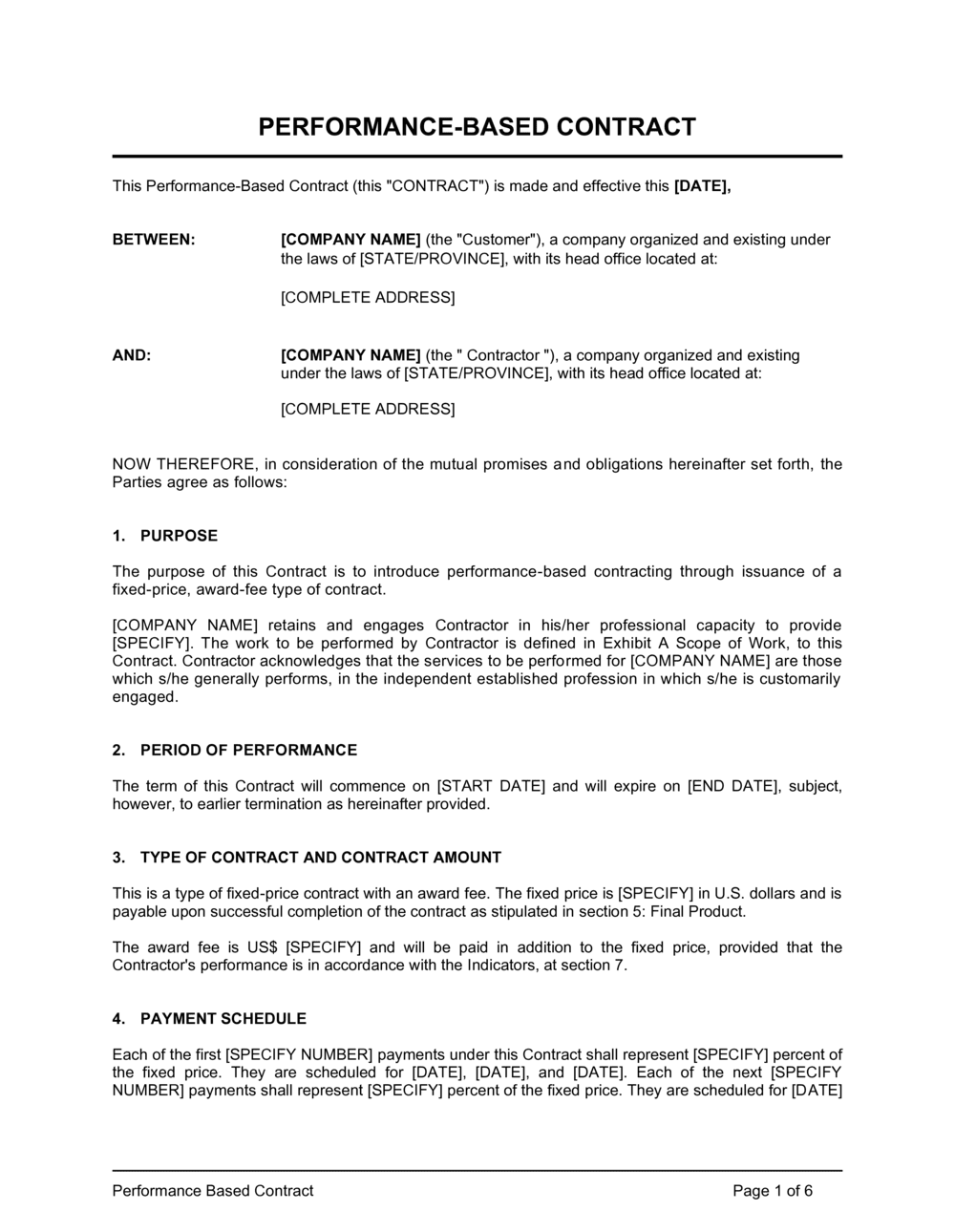
Identify and define each KPI precisely
List every metric that will drive payment. For each one, write a one-sentence definition that specifies what is being measured, how it is calculated, and what the unit of measurement is. Avoid shorthand like 'sales' — use 'net new monthly recurring revenue from new logo customers, excluding upsells and renewals.'
💡 Limit the agreement to three to five KPIs. More than five creates measurement overhead and attribution confusion that neither party can manage operationally.
2
Document baselines at contract execution
Pull current KPI values from the agreed data source on or before the contract's effective date and attach the exported report as Exhibit 1. Both parties should sign or initial the baseline data to prevent later disputes about the starting point.
💡 If the data source has not been set up yet, delay the contract's effective date until it is operational — never agree to a baseline 'to be determined later.'
3
Write the payment formula with a cap and floor
Draft the formula so any moderately numerate person can calculate the payment from the reported KPI values without ambiguity. Add a performance threshold below which no variable payment is earned, and a per-period cap above which no additional payment accrues regardless of overperformance.
💡 Run the formula through at least three hypothetical scenarios — baseline, 50% of target, and 150% of target — before finalizing. If the outputs feel wrong at any scenario, revise the formula.
4
Specify the measurement methodology in Schedule B
Name the exact platform, report, and any filters used to generate each KPI. State who pulls the data, when, and in what format it is shared. If a third-party analytics tool is used, confirm both parties have access before signing.
💡 Screenshot the exact report configuration and attach it to the schedule. Platform dashboards change — a screenshot anchors the agreed methodology if the vendor updates their UI.
5
Define attribution rules and exclusions
List every category of KPI movement that will be excluded from the performance calculation — client-initiated price changes, seasonality adjustments, unrelated marketing spend, or acquired revenue. Be specific: 'any month where Client runs paid advertising exceeding $[X]' is more enforceable than 'external factors.'
💡 Have both parties brainstorm five scenarios where the KPI moves for reasons unrelated to the contractor's work, then write exclusions to cover each one.
6
Set the reporting cadence and access permissions
State the exact day each measurement period closes, the number of business days the client has to deliver the KPI report, and the contractor's access level to the underlying data platform. Grant read-only dashboard access where possible.
💡 Monthly measurement periods are the most operationally manageable. Quarterly periods reduce reporting overhead but delay identification of underperformance until significant time has been lost.
7
Draft the remediation and termination triggers
Define what constitutes an underperformance event — for example, missing any KPI by more than 20% for two consecutive periods — and the exact steps and timeline for the remediation process before any termination right arises.
💡 Mirror the remediation period length to the measurement period. A 30-day remediation window for a monthly KPI gives the contractor one full cycle to demonstrate improvement.
8
Execute before the measurement period begins
Both parties must sign the contract, and baseline data must be attached and initialed, before the first measurement period opens. A retroactive execution after work has begun creates disputes about whether the agreed KPIs apply to the already-elapsed period.
💡 Use an e-signature platform that timestamps execution and stores the signed copy with the baseline data attachment in a shared, immutable location accessible to both parties.