1
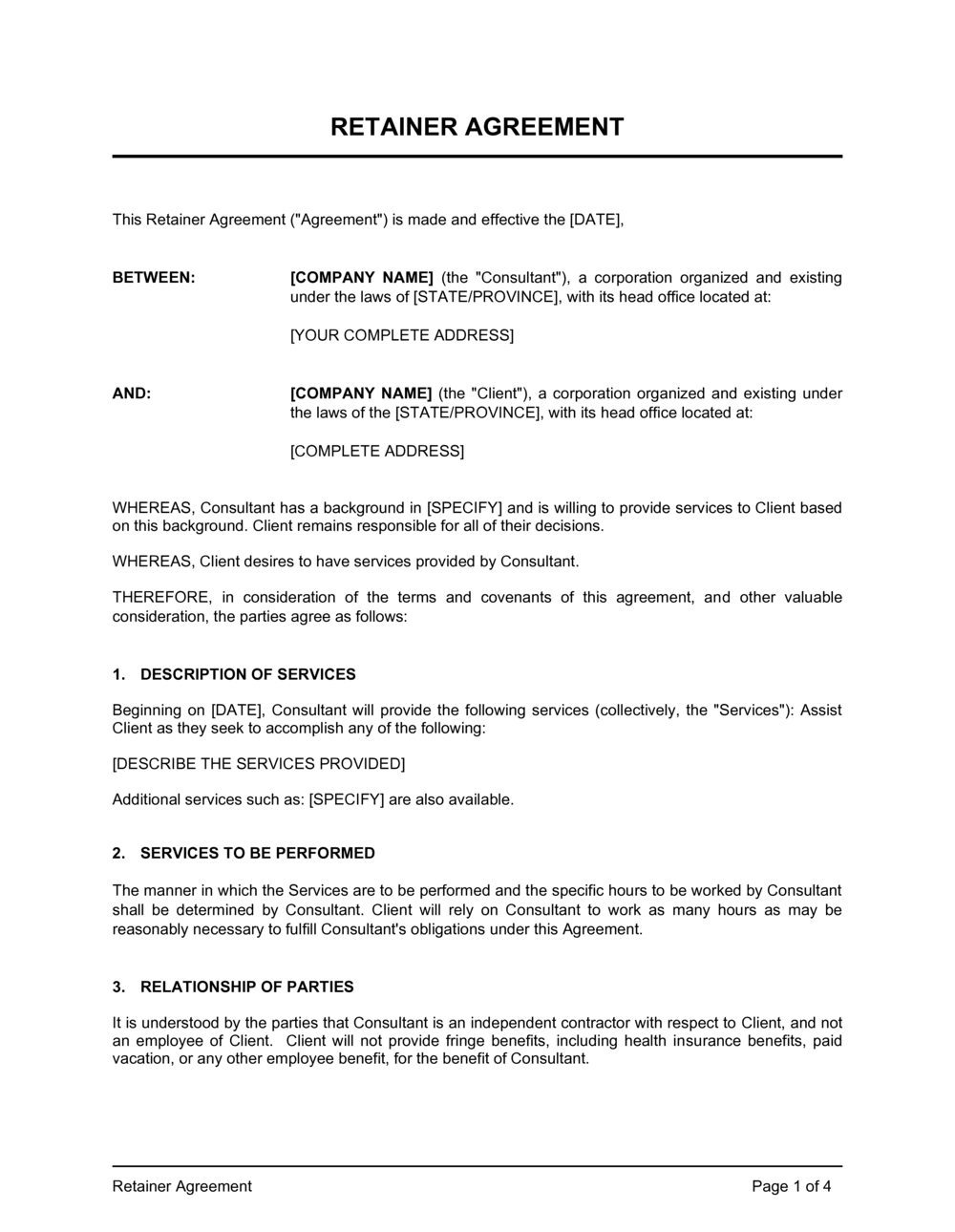
Enter both parties' legal entity names and contact details
Use the full registered legal name of the provider entity and the client entity — not trade names or personal names. Include the jurisdiction of incorporation or registration for each party.
💡 Cross-check the client's legal name against their most recent invoice or corporate registry search before signing — billing the wrong entity creates collection problems.
2
Define the scope of services in Schedule A
List specific service categories the retainer covers and explicitly name at least two categories of work that are excluded. The more specific the list, the less room for scope-creep disputes later.
💡 If the scope is likely to evolve, add a sentence giving the provider the right to issue a written change order for out-of-scope requests rather than refusing them entirely.
3
Set the retainer fee, due date, and payment method
Enter the monthly retainer amount, the specific day of the month it is due, and the accepted payment method. State clearly that payment is due in advance at the start of each billing period.
💡 Add a late-payment clause — 1.5% per month is standard — so you have a contractual basis to charge interest without a separate invoice dispute.
4
Specify the hours bank and overage rate
Enter the number of hours included in the monthly fee, the hourly rate for overages, and whether unused hours roll over or are forfeited at month end. If offering a pure-retainer structure with no hours bank, state explicitly that the fee is earned upon receipt regardless of hours worked.
💡 Cap rollovers at two to three months of accumulated hours to prevent a large balance that the client can spend during a quiet period without additional payment.
5
Set the expense pre-approval threshold
Enter the dollar amount above which the client must pre-approve expenses in writing. Below that threshold, the provider may incur and invoice reasonable expenses without prior sign-off.
💡 For legal retainers, always list court filing fees, process server fees, and travel as pre-approved categories regardless of amount to avoid disputes on routine disbursements.
6
Confirm IP ownership and licensing terms
Decide whether work product is assigned to the client (most common for deliverable-based retainers) or licensed (more common for platform or tool access). Carve out pre-existing provider IP and frameworks from the assignment clause.
💡 If you use proprietary templates, methodologies, or software in your work, name them specifically in the carve-out — a generic 'pre-existing IP' exception is harder to enforce.
7
Choose the governing law and dispute mechanism
Select the jurisdiction where both parties primarily operate. Arbitration is faster and more confidential than litigation — preferred for most professional-service retainers. Add a carve-out allowing either party to seek injunctive relief in court without going through arbitration first.
💡 If the client is in California, confirm that your non-compete or non-solicit clauses (if any) comply with California law regardless of the governing-law clause.
8
Sign before work begins
Both parties must sign before any services are rendered. Work performed before signing can undermine enforceability of the retainer's restrictions — particularly IP assignment and confidentiality — in common-law jurisdictions.
💡 Use a digital signature tool to timestamp execution and retain a fully executed copy with both signatures in your records system.