1
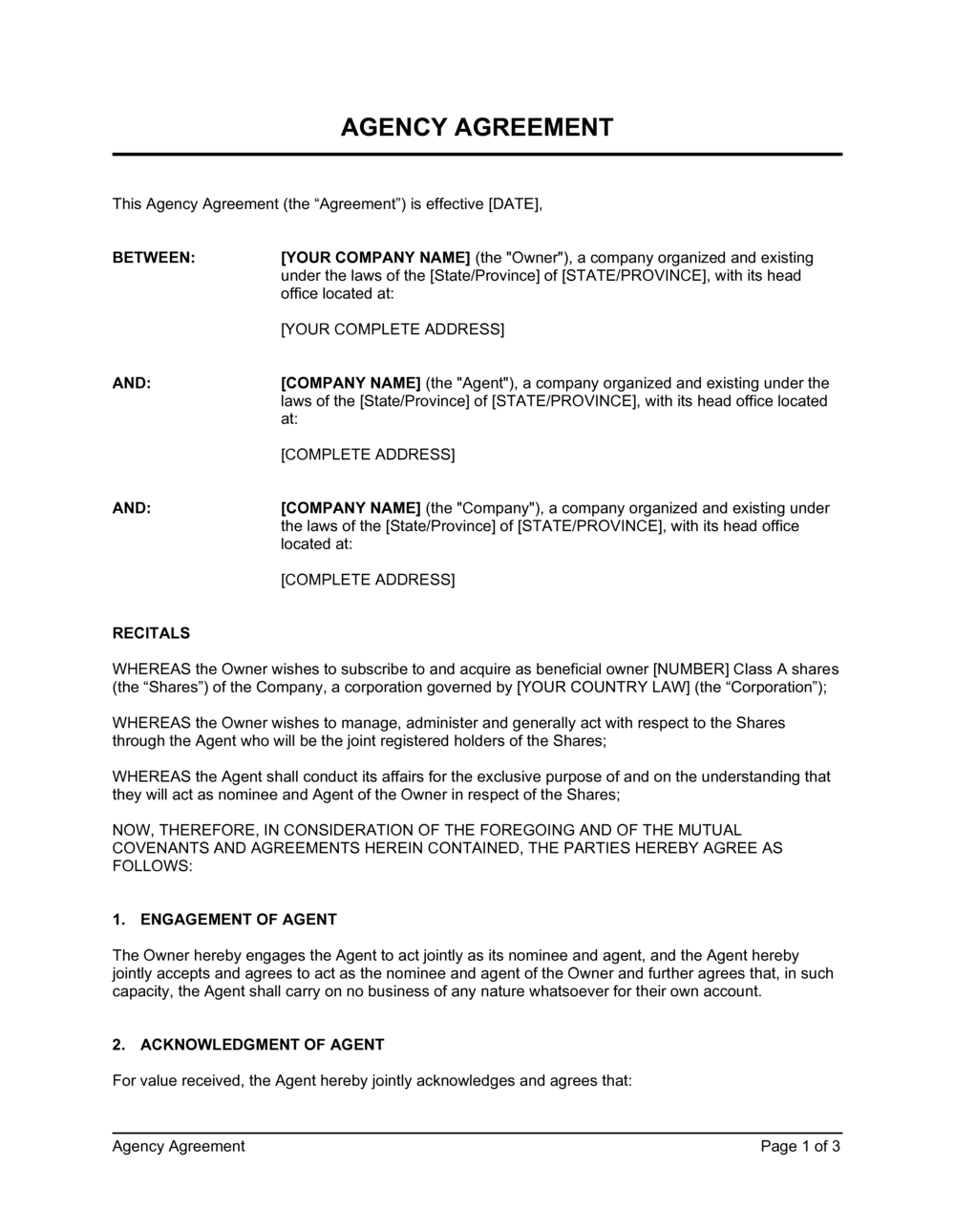
Identify the parties with their full legal names
Enter the principal's registered corporate name — not a trade name — and the agent's full legal name or registered entity name. Include each party's registered address and, for corporations, the state or country of incorporation.
💡 Cross-check the agent's entity name against a business registry before signing — acting as agent for an unregistered entity creates personal liability risk.
2
Define the scope of authority precisely
List the specific transactions, territories, product lines, and counterparty types the agent is authorized to handle. If the agent can bind the principal contractually, state the maximum transaction value they may commit to without prior approval.
💡 Attach a Schedule A with a detailed authority matrix — transaction type, dollar threshold, and approval required — rather than embedding it in the body clause.
3
Set the compensation and commission terms
Enter the commission rate or fixed fee, the calculation basis (net invoice value, gross margin, or contract value), the trigger event for earning a commission, and the payment timeline.
💡 Define 'earned commission' to include a clawback provision for transactions that are cancelled, disputed, or unpaid within 90 days of invoicing — this prevents disputes on failed deals.
4
Tailor the non-compete and non-solicitation scope
Set geographic scope, restricted activities, and duration proportionate to the agent's seniority and market access. Typical durations are 6–12 months post-termination for most agents.
💡 In EU member states and several Canadian provinces, post-contractual non-competes for commercial agents require financial compensation to be enforceable — budget for this before including a restriction.
5
Confirm the indemnification allocation
Review the liability clause to ensure both parties are covered: the agent for liabilities arising from authorized acts within scope, and the principal for losses caused by the agent's unauthorized or negligent acts.
💡 Consider requiring the agent to maintain professional liability or errors and omissions insurance as a condition of the agreement — add this as a representation in the agreement.
6
Set the term, notice period, and renewal mechanism
Enter the initial term, the renewal period, and the minimum notice required for non-renewal or termination without cause. Verify the notice period meets or exceeds any statutory minimum in the agent's jurisdiction.
💡 In the UK and EU, minimum statutory notice for commercial agents starts at 1 month in the first year, rising to 3 months after 3 years — a shorter contractual notice period is void.
7
Address termination compensation obligations
Include a clause specifying commissions due on transactions in progress at termination and whether the agent has any indemnity or goodwill compensation rights under applicable law.
💡 If operating under EU law, consult a local lawyer before finalizing this clause — the Commercial Agents Directive creates mandatory compensation rights that cannot be contracted away.
8
Execute before the agent takes any action on the principal's behalf
Both parties must sign before the agent begins any activity — apparent authority can arise from conduct even without a signed agreement, creating unintended principal liability.
💡 Use a timestamped e-signature to create a clear record of execution date — any agent act that predates the signed agreement may fall outside the contractual indemnity.