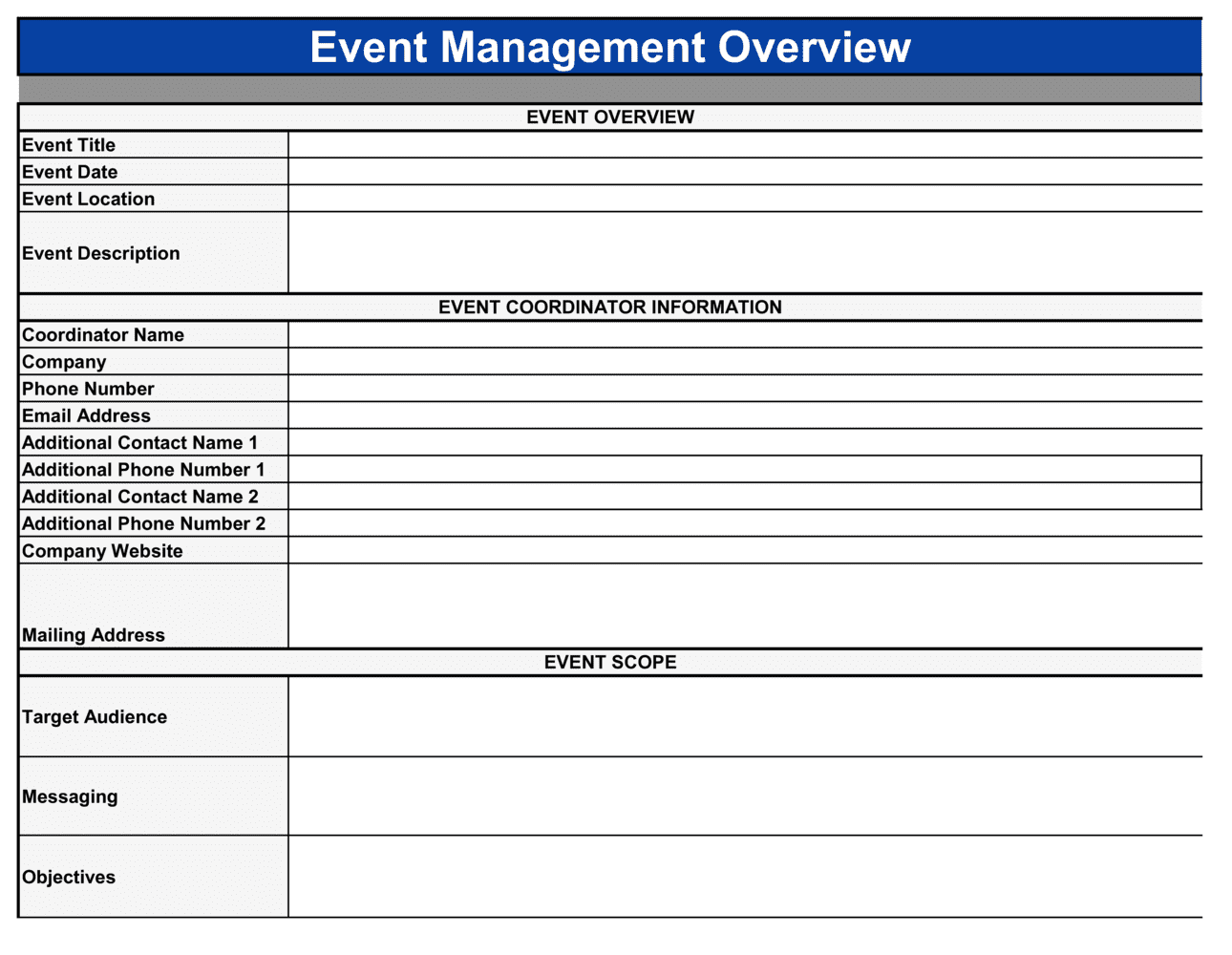
Event Management Template

Free Excel download β€’ Edit online β€’ Save & share with Drive β€’ Export to PDF

2 pagesβ€’20–30 min to fillβ€’Difficulty: Standardβ€’Signature requiredβ€’Legal review recommended
Learn more ↓
FreeXLSEvent Management Template

At a glance

What it is
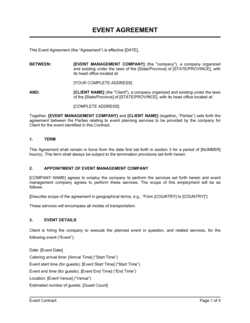
An Event Management Template is a legally binding contract between an event management company or planner and a client that defines every material term of the engagement β€” scope of services, fees, timelines, vendor responsibilities, liability limits, and cancellation conditions. This free Word download is editable online and exportable as PDF, covering corporate conferences, weddings, product launches, and private events in a single structured document.
When you need it
Use it before committing any resources to an event β€” as soon as a client has approved a proposal and both parties are ready to formalize the arrangement. It should be signed before deposits are collected, venues are booked, or vendors are engaged on the client's behalf.
What's inside
Scope of services and event details, fee structure and payment schedule, vendor management responsibilities, cancellation and rescheduling terms, liability limitations, force majeure provisions, intellectual property rights over event materials, confidentiality obligations, and governing law.

What is an Event Management Template?

An Event Management Template is a legally binding contract between an event management company or independent planner and a client that governs every material aspect of a planned event engagement. It defines the precise scope of services to be provided, the fee structure and payment milestones, the planner's authority over third-party vendors, cancellation and rescheduling fee schedules, force majeure provisions, limitations on the planner's liability, and ownership of creative materials produced for the event. Unlike a proposal or informal email confirmation, a properly executed event management agreement creates enforceable obligations on both sides β€” protecting the planner's fees and the client's investment from the moment the retainer is collected through the final post-event settlement.

Why You Need This Document

Without a signed event management agreement, every assumption about scope, fees, and responsibility exists only in email threads and verbal conversations β€” none of which are enforceable when a dispute arises. Clients who cancel six weeks before the event can walk away without paying for the months of planning work already completed. Vendor failures that expose the planner to liability claims have no contractual ceiling. Force majeure events β€” a government-ordered gathering ban, a venue fire, or a pandemic β€” leave deposit allocation entirely unresolved, generating litigation that costs more than the event itself. The absence of client approval deadlines means a single delayed decision cascades into rushed vendor bookings, expedited fees, and a planner absorbing costs with no legal basis to recover them. This template closes all of those gaps: it locks in cancellation protections, caps liability at the total fees paid, allocates force majeure risk explicitly, and establishes the written record that transforms every verbal agreement into an enforceable contract β€” before a single deposit clears.

Which variant fits your situation?

If your situation is…Use this template
Full-service corporate conference or trade show managementCorporate Event Management Agreement
Wedding planning engagement with full vendor coordinationWedding Planner Contract
Day-of coordination only, no vendor sourcingEvent Coordination Agreement (Day-Of)
Venue hire with optional add-on event servicesVenue Rental Agreement
Virtual or hybrid event production and managementVirtual Event Services Agreement
One-time product launch or brand activation eventEvent Services Contract (Single Event)
Annual retainer for recurring corporate eventsEvent Management Retainer Agreement

Common mistakes to avoid

❌ No exclusions list in the scope clause

Why it matters: Clients interpret a broad scope description as covering everything they imagined β€” photography, printing, and post-event reporting are common surprise additions that generate heated disputes and unpaid extras.

Fix: Write an explicit exclusions paragraph identifying every service that is out of scope. If you add it later, both parties must sign an amendment acknowledging the exclusion.

❌ Vague force majeure language that ignores fees already paid

Why it matters: A clause that simply says 'neither party shall be liable' leaves the status of retainers, milestone payments, and vendor deposits entirely unresolved β€” which is exactly the scenario that generates protracted litigation.

Fix: Specify that the planner retains fees for completed work, that uncommitted fees are credited toward rescheduling within a defined window, and that non-recoverable vendor deposits are the client's liability regardless.

❌ No liability cap on the planner's exposure

Why it matters: A single vendor failure at a large event can generate a loss claim that dwarfs the planner's fee β€” without a cap, the planner's personal and business assets are exposed to uncapped damages.

Fix: Insert a limitation-of-liability clause capping exposure at the total management fees paid and confirm the cap is supported by your professional liability insurance policy.

❌ Collecting a deposit before the contract is signed

Why it matters: A deposit accepted before a signed contract can be construed as creating an implied agreement on the client's terms, undermining your cancellation schedule and other protective clauses.

Fix: Issue the contract first and collect the retainer simultaneously upon execution β€” use e-signature with integrated payment to make this a single step.

❌ Omitting client decision deadlines

Why it matters: When clients delay approvals for venues, vendors, or designs, planners absorb the cost of expedited bookings and replanning work with no contractual basis to recover it.

Fix: Insert specific business-day approval windows for every client decision point and include a consequence clause stating what happens β€” and who pays β€” if a deadline is missed.

❌ Leaving vendor contract ownership undefined

Why it matters: If the planner signs vendor contracts in their own name and the client refuses to pay, the planner is personally liable to vendors for amounts that may significantly exceed their management fee.

Fix: Specify in the contract that all third-party vendor agreements are entered into in the client's name, or include a back-to-back indemnification provision requiring the client to reimburse the planner for all vendor commitments made on the client's behalf.

The 10 key clauses, explained

Parties, event details, and engagement scope

In plain language: Identifies the event management company and client as legal entities, names the specific event, and summarizes the high-level scope of services engaged.

Sample language
This Event Management Agreement is entered into on [DATE] between [EVENT MANAGEMENT COMPANY LEGAL NAME] ('Planner') and [CLIENT LEGAL NAME] ('Client') for event management services in connection with [EVENT NAME] scheduled for [EVENT DATE] at [VENUE NAME AND ADDRESS].

Common mistake: Using trading names instead of registered legal entity names. If the entity name on the contract does not match the party collecting payment or holding insurance, enforcing fee and liability clauses becomes complicated.

Scope of services and deliverables

In plain language: Lists every service the planner will provide β€” venue sourcing, vendor coordination, on-site management, budget tracking β€” and explicitly states what is excluded.

Sample language
Planner shall provide the following services: [LIST OF SERVICES]. The following are expressly excluded from scope and are the Client's sole responsibility: [EXCLUSIONS]. Any changes to scope must be documented in a written Change Order signed by both parties.

Common mistake: Omitting an exclusions list. Without specifying what the planner is not doing, clients routinely assume unlimited scope and raise disputes when tasks outside the original brief are declined or charged as extras.

Fees, payment schedule, and expenses

In plain language: States the total management fee, the payment schedule (retainer, milestone payments, and final balance), the treatment of out-of-pocket vendor expenses, and the markup policy if applicable.

Sample language
Client shall pay Planner a total management fee of $[AMOUNT], payable as follows: $[RETAINER AMOUNT] due upon signing (non-refundable), $[MILESTONE PAYMENT] due [DATE], and the remaining balance of $[FINAL PAYMENT] due [X] days before the event. Planner shall invoice third-party expenses at cost plus [X]% handling fee.

Common mistake: No handling-fee or expense-markup disclosure. Clients who discover undisclosed markups on vendor invoices often refuse to pay them, leading to disputes and reputational damage for the planner.

Client responsibilities and approvals

In plain language: Defines what the client must provide or decide β€” budget approvals, design sign-offs, guest list delivery, and access to the venue β€” and the timelines for each.

Sample language
Client shall: (a) provide final guest count no later than [X] days before the event; (b) approve all vendor selections within [X] business days of Planner's recommendation; (c) ensure venue access for setup beginning [TIME] on [DATE].

Common mistake: No approval timeline for client decisions. When clients delay design approvals or vendor confirmations, costs escalate β€” without contractual deadlines, the planner has no basis to recover the resulting losses.

Vendor management and third-party contracts

In plain language: Establishes whether vendors are contracted in the planner's name or the client's name, who bears financial liability for vendor commitments, and the planner's standard of care in vendor selection.

Sample language
All third-party vendor contracts shall be entered into in the Client's name unless otherwise agreed in writing. Planner shall use reasonable care in selecting vendors but shall not be liable for vendor failures, delays, or substandard performance beyond costs directly and demonstrably caused by Planner's negligent selection.

Common mistake: Leaving vendor contract ownership undefined. If vendors are contracted in the planner's name and the client disputes fees, the planner is personally liable for vendor invoices the client refuses to reimburse.

Cancellation, postponement, and rescheduling

In plain language: Defines the fee schedule if the client cancels or postpones the event, distinguishes full cancellation from rescheduling, and addresses non-recoverable vendor deposits.

Sample language
If Client cancels the event more than [X] days before the event date, Client shall owe [X]% of the total management fee. If cancellation occurs within [X] days, Client shall owe [X]% of the total fee. All non-recoverable third-party deposits are payable by Client regardless of cancellation timing.

Common mistake: Treating postponement the same as rescheduling at no cost. A postponed event requires replanning work; treating it as free accommodation erodes profitability and sets a precedent for repeat rescheduling.

Force majeure

In plain language: Excuses both parties from performance when an unforeseeable event beyond their control makes the event impossible, and specifies what happens to fees and deposits already paid.

Sample language
Neither party shall be liable for failure to perform where such failure is caused by acts of God, government orders, pandemic conditions, terrorism, or other events beyond the affected party's reasonable control ('Force Majeure Event'). In such event, Planner shall retain fees for work already performed; all other fees shall be credited toward a rescheduled date within [X] months.

Common mistake: A force majeure clause that is entirely silent on deposits and fees already collected. The COVID-19 pandemic demonstrated that vague force majeure language generates prolonged disputes β€” specify exactly what is retained, credited, and refunded.

Limitation of liability and indemnification

In plain language: Caps the planner's maximum financial exposure to the total fees paid under the contract and sets out mutual indemnification obligations for each party's own acts or negligence.

Sample language
In no event shall Planner's total liability to Client exceed the total management fees paid by Client under this Agreement. Each party shall indemnify and hold harmless the other from claims, losses, and costs arising from that party's own negligent acts, omissions, or breach of this Agreement.

Common mistake: No cap on the planner's liability at all. An event with 500 guests where a vendor failure causes significant loss could generate a claim that vastly exceeds the planner's fee β€” an uncapped liability clause can destroy a small event management business.

Intellectual property and confidentiality

In plain language: Assigns ownership of event materials (branding, programs, content) to the client upon full payment, while allowing the planner to use images for portfolio purposes, and restricts disclosure of event details and client information.

Sample language
Upon receipt of full payment, Planner assigns to Client all rights to event-specific materials produced under this Agreement. Planner retains the right to use photographs and video of the event for portfolio and marketing purposes unless Client provides written objection within [X] days. Both parties agree to keep the other's confidential information private for [X] years following the event.

Common mistake: No portfolio-use clause in high-profile or confidential corporate events. Posting event photos without client consent can breach NDAs with the client's own stakeholders and result in damages claims against the planner.

Governing law, dispute resolution, and entire agreement

In plain language: States which jurisdiction's law governs the contract, the process for resolving disputes (mediation before litigation or arbitration), and confirms the written contract supersedes all prior proposals and verbal agreements.

Sample language
This Agreement is governed by the laws of [STATE/PROVINCE/COUNTRY]. Any dispute shall first be submitted to non-binding mediation in [CITY] before either party may pursue litigation or arbitration. This Agreement constitutes the entire agreement of the parties and supersedes all prior proposals, emails, and verbal representations.

Common mistake: No entire-agreement clause. Without it, earlier proposal emails, verbal promises about included services, or prior drafts can be introduced as contractual terms β€” overriding the signed document.

How to fill it out

  1. 1

    Enter legal entity names and event details

    Use each party's full registered legal name β€” not a trading or brand name. Specify the event name, date, and venue address precisely in the opening clause.

    πŸ’‘ Confirm the client's legal entity name against their business registration or the name on their purchase order before execution.

  2. 2

    Define the scope of services with an exclusions list

    List every service you will provide in specific, actionable terms. Then write a separate exclusions paragraph for anything the client might reasonably assume is included but is not β€” photography, printing, RSVP management, etc.

    πŸ’‘ Attach a detailed Schedule of Services as an exhibit and reference it in the body of the contract β€” this keeps the main agreement readable while creating an enforceable deliverables record.

  3. 3

    Set the fee structure and payment milestones

    State the total management fee, the non-refundable retainer amount, each milestone payment date, and the final balance due date. Disclose any expense markup percentage clearly.

    πŸ’‘ Tie the final balance payment date to at least 14 days before the event β€” collecting after the event day dramatically increases non-payment risk.

  4. 4

    Define client approval deadlines

    Insert specific business-day deadlines for each client decision β€” guest count confirmation, vendor approvals, design sign-offs, and venue access arrangements.

    πŸ’‘ Add a clause stating that if the client misses a deadline, the planner may proceed with the most cost-effective available option and the resulting costs are the client's responsibility.

  5. 5

    Complete the cancellation and rescheduling schedule

    Enter tiered cancellation fee percentages keyed to days before the event. Distinguish full cancellation from postponement and address non-recoverable vendor deposits separately.

    πŸ’‘ Mirror the cancellation tiers to your real cost exposure β€” the closer to the event, the higher the percentage, since your time and vendor commitments are already consumed.

  6. 6

    Draft the force majeure provisions

    Specify what events qualify, what the planner retains for work already performed, and whether fees are credited to a rescheduled date or partially refunded.

    πŸ’‘ Name specific qualifying events β€” government-ordered event bans, venue destruction, and pandemic-related restrictions β€” rather than relying solely on 'acts of God' language.

  7. 7

    Set the liability cap and indemnification scope

    Insert the liability cap as the total management fees paid. Define each party's indemnification obligation covering only their own negligent acts or breaches β€” avoid one-sided indemnification.

    πŸ’‘ Confirm your professional liability (errors and omissions) insurance policy limit aligns with the cap β€” an uncovered gap between your cap and your insurance limit is your personal exposure.

  8. 8

    Execute before collecting any deposits or engaging vendors

    Both parties must sign the agreement before any money changes hands or any vendor is contacted on the client's behalf. Collect the signed contract and the retainer simultaneously.

    πŸ’‘ Use a timestamped e-signature tool to create an audit trail β€” this is especially important if a force majeure or cancellation dispute arises months later.

Frequently asked questions

What is an event management agreement?

An event management agreement is a legally binding contract between an event planner or management company and a client that defines every material term of the engagement β€” the scope of services, fees and payment schedule, cancellation and rescheduling terms, vendor management responsibilities, liability limits, and force majeure provisions. It protects both parties and replaces informal email confirmations as the governing document for the event.

What should an event management contract include?

A complete event management contract covers: parties and event details, scope of services with an explicit exclusions list, fee structure and payment milestones, client approval deadlines, vendor management and contract ownership, cancellation and rescheduling fee schedules, force majeure provisions specifying treatment of deposits, liability cap and indemnification, intellectual property ownership over event materials, confidentiality obligations, and governing law with a dispute resolution process. Missing any of these sections creates gaps that become disputes.

When should an event management agreement be signed?

The contract should be signed before any deposit is collected, any vendor is contacted on the client's behalf, or any venue is placed on hold. In practice, this means executing the agreement and collecting the retainer simultaneously β€” typically within 24 to 72 hours of the client's verbal commitment. Waiting until later exposes the planner to scope creep and leaves deposits in a legally ambiguous position.

Is an event management contract legally enforceable?

An event management agreement is generally enforceable as a standard services contract when it meets the basic requirements of offer, acceptance, and consideration β€” a defined scope, a fee, and signatures from both parties. Courts in most jurisdictions enforce cancellation fees and liability caps if they are clearly stated and not unconscionable. Jurisdictions with consumer protection laws may impose additional requirements for contracts with individual (non-business) clients. Consider having a lawyer review the template if you operate in a highly regulated jurisdiction or regularly contract with consumers.

How should cancellation fees be structured?

Cancellation fees should be tiered based on how far in advance the client cancels, reflecting the planner's real cost exposure at each stage. A common structure is: non-refundable retainer on signing, 50% of the total fee if cancelled more than 90 days out, 75% between 30 and 90 days, and 100% within 30 days. Non-recoverable third-party vendor deposits should be treated as a separate line β€” payable by the client regardless of when cancellation occurs.

Who should sign third-party vendor contracts β€” the planner or the client?

In most event management arrangements, third-party vendor contracts are entered into in the client's name, with the planner acting as authorized agent. This structure means the client bears direct financial liability for vendor commitments. If the planner signs in their own name, the contract must include a back-to-back indemnification clause requiring the client to reimburse all vendor costs β€” otherwise the planner is exposed to vendor invoices the client refuses to pay.

What is a force majeure clause in an event contract?

A force majeure clause excuses both parties from performance when an unforeseeable event beyond their control β€” government-ordered event bans, natural disasters, pandemics, or venue destruction β€” makes the event impossible to hold. A well-drafted clause specifies exactly what qualifying events look like, what fees the planner retains for work already performed, and whether remaining fees are credited toward a rescheduled date or partially refunded. Vague force majeure language was the leading cause of event contract disputes during the COVID-19 pandemic.

Does an event management contract need to be reviewed by a lawyer?

For standard engagements with business clients, a well-structured template is typically sufficient. Legal review is worth the investment when: the event budget exceeds $100,000 and personal liability exposure is material; the client is a government body or publicly listed company with specific contracting requirements; the event involves international travel or cross-border vendor relationships; or you are operating in a jurisdiction with mandatory consumer contract disclosures. A 1–2 hour lawyer review typically costs $300–$600 and can prevent significantly larger disputes.

Can an event management agreement cover recurring events?

Yes β€” for clients who require event management services on an ongoing basis, such as annual conferences or quarterly corporate dinners, a retainer-based event management agreement can govern all engagements within a defined period. The agreement specifies the retainer fee, the number and type of events covered, a rate card for additional services, and annual renewal terms. Each individual event is typically confirmed by a short work order or scope addendum referencing the master agreement.

How this compares to alternatives

vs Venue Rental Agreement

A venue rental agreement covers the hire of a physical space β€” access times, capacity, permitted uses, and damage deposits. An event management agreement governs the planner's services in coordinating the entire event across that space and multiple vendors. The two documents operate in parallel; having one does not replace the other.

vs Service Agreement

A general service agreement covers the provision of professional services in broad terms β€” scope, fees, and IP. An event management agreement adds event-specific provisions β€” cancellation schedules, force majeure tied to event dates, vendor management authority, and attrition clauses β€” that a standard service agreement does not contemplate. Use the event-specific template for any engagement centered on a fixed event date.

vs Independent Contractor Agreement

An independent contractor agreement defines the working relationship between a business and a self-employed individual β€” classification, IP ownership, and payment terms. An event management agreement governs the client-facing commercial relationship, not the planner's employment classification. An event management company may use both: an event management agreement with the client and contractor agreements with its own event staff.

vs Proposal or Statement of Work

A proposal or statement of work describes the services, timeline, and fees a planner intends to provide β€” but is typically not a binding contract. It generates agreement in principle. An event management agreement is the enforceable document that follows and governs the engagement. Using only a proposal without a formal contract leaves cancellation terms, liability limits, and force majeure provisions entirely unenforceable.

Industry-specific considerations

Corporate and Professional Services

Conferences, board retreats, and client appreciation events require precise scope definitions, NDA provisions covering executive attendees, and liability clauses protecting the planner from AV or catering vendor failures at high-profile gatherings.

Hospitality and Hotels

Hotel event managers need contracts that integrate with venue hire agreements, address attrition clauses for room blocks and F&B minimums, and clearly allocate liability between in-house services and external vendors.

Nonprofit and Fundraising

Fundraising gala contracts must address donor confidentiality, auction item handling liability, and reduced-fee or pro-bono engagement terms without sacrificing cancellation and expense recovery protections.

Entertainment and Media

Product launches, brand activations, and music events require IP ownership clauses covering content created at the event, media access protocols, and liability provisions for performer or attendee incidents.

Jurisdictional notes

United States

Event management contracts are governed by state contract law with no single federal statute. Consumer protection requirements vary β€” several states require specific cancellation disclosure language for contracts with individual (non-business) clients. Force majeure enforceability was extensively litigated after COVID-19; courts in California and New York generally required the event to be literally impossible, not merely impractical, to excuse performance. Liability waivers may be unenforceable for gross negligence in many states.

Canada

Event contracts are governed by provincial contract law. Quebec's Consumer Protection Act imposes mandatory cancellation and refund rights for contracts with consumers that cannot be waived by agreement. In other provinces, courts apply a reasonableness standard to cancellation fees β€” grossly disproportionate fees may be treated as unenforceable penalties. Force majeure clauses should reference provincial emergency orders specifically to address pandemic-era disputes.

United Kingdom

The Consumer Rights Act 2015 applies when contracting with individual consumers and requires cancellation terms to be fair and transparent. Unfair Terms in Consumer Contracts Regulations may void limitation-of-liability clauses that are considered unreasonable for consumer engagements. For B2B contracts, the Unfair Contract Terms Act 1977 applies a reasonableness test to exclusion clauses. Post-Brexit, UK and EU data protection requirements diverge β€” confirm GDPR compliance for any cross-border attendee data.

European Union

EU consumer contracts are subject to the Consumer Rights Directive, which grants 14-day withdrawal rights for distance contracts β€” though this right typically does not apply to event services where a specific date is agreed. GDPR applies to any processing of attendee personal data, requiring a lawful basis and appropriate data processing disclosures. Member state variations are significant: French law imposes strict obligations around event cancellation refunds, while German law requires particularly clear liability limitation language to be enforceable.

Template vs lawyer β€” what fits your deal?

PathBest forCostTime
Use the templateIndependent event planners and small agencies handling standard corporate or private events under $100,000 in total event budgetFree30–45 minutes per engagement
Template + legal reviewPlanners managing high-profile events over $100,000, government clients, or international vendor arrangements$300–$600 for a 1–2 hour lawyer review2–4 days
Custom draftedLarge event management companies standardizing master service agreements, festival operators, or planners working regularly in regulated or international markets$1,500–$5,000+1–3 weeks

Glossary

Scope of Services
The defined list of tasks, deliverables, and responsibilities the event manager agrees to provide under the contract.
Force Majeure
A clause that excuses either party from performance when an event outside their control β€” such as a natural disaster, pandemic, or government prohibition β€” makes it impossible to proceed.
Cancellation Fee
A pre-agreed charge owed by the client if they cancel the event within a specified window before the event date, compensating the planner for committed time and non-recoverable costs.
Vendor Management
The event manager's authority and responsibility to source, negotiate with, and oversee third-party suppliers such as caterers, AV companies, and florists on the client's behalf.
Run of Show
A minute-by-minute schedule of every element of the event, typically prepared by the event manager and approved by the client in advance.
Indemnification
A contractual obligation by one party to cover losses, costs, or liabilities incurred by the other party arising from specified actions or failures.
Limitation of Liability
A clause that caps the maximum financial exposure of the event manager to a defined amount β€” typically the total fees paid β€” regardless of the scale of loss.
Retainer
An upfront, non-refundable payment that secures the event manager's time and availability for the engagement period.
Attrition
A contractual minimum β€” typically expressed as a percentage of confirmed attendees or room blocks β€” below which the client owes a penalty to cover guaranteed supplier commitments.
Intellectual Property (Event Materials)
Ownership rights over creative assets produced for the event β€” branding, signage, programs, and content β€” which may remain with the planner or transfer to the client depending on the contract terms.
Rescheduling Clause
A provision allowing either party to move the event to a new date under specified conditions without triggering the full cancellation fee.

Part of your Business Operating System

This document is one of 3,000+ business & legal templates included in Business in a Box.

  • Fill-in-the-blanks β€” ready in minutes
  • 100% customizable Word document
  • Compatible with all office suites
  • Export to PDF and share electronically

Create your document in 3 simple steps.

From template to signed document β€” all inside one Business Operating System.
1
Download or open template

Access over 3,000+ business and legal templates for any business task, project or initiative.

2
Edit and fill in the blanks with AI

Customize your ready-made business document template and save it in the cloud.

3
Save, Share, Send, Sign

Share your files and folders with your team. Create a space of seamless collaboration.

Save time, save money, and create top-quality documents.

β˜…β˜…β˜…β˜…β˜…

"Fantastic value! I'm not sure how I'd do without it. It's worth its weight in gold and paid back for itself many times."

Managing Director Β· Mall Farm
Robert Whalley
Managing Director, Mall Farm Proprietary Limited
β˜…β˜…β˜…β˜…β˜…

"I have been using Business in a Box for years. It has been the most useful source of templates I have encountered. I recommend it to anyone."

Business Owner Β· 4+ years
Dr Michael John Freestone
Business Owner
β˜…β˜…β˜…β˜…β˜…

"It has been a life saver so many times I have lost count. Business in a Box has saved me so much time and as you know, time is money."

Owner Β· Upstate Web
David G. Moore Jr.
Owner, Upstate Web

Run your business with a system β€” not scattered tools

Stop downloading documents. Start operating with clarity. Business in a Box gives you the Business Operating System used by over 250,000 companies worldwide to structure, run, and grow their business.

Start freeΒ Β·Β No credit card required