Agreement with Accountant Template

Free Word download • Edit online • Save & share with Drive • Export to PDF

3 pages25–30 min to fillDifficulty: ComplexSignature requiredLegal review recommended
Learn more ↓
FreeAgreement with Accountant Template

At a glance

What it is
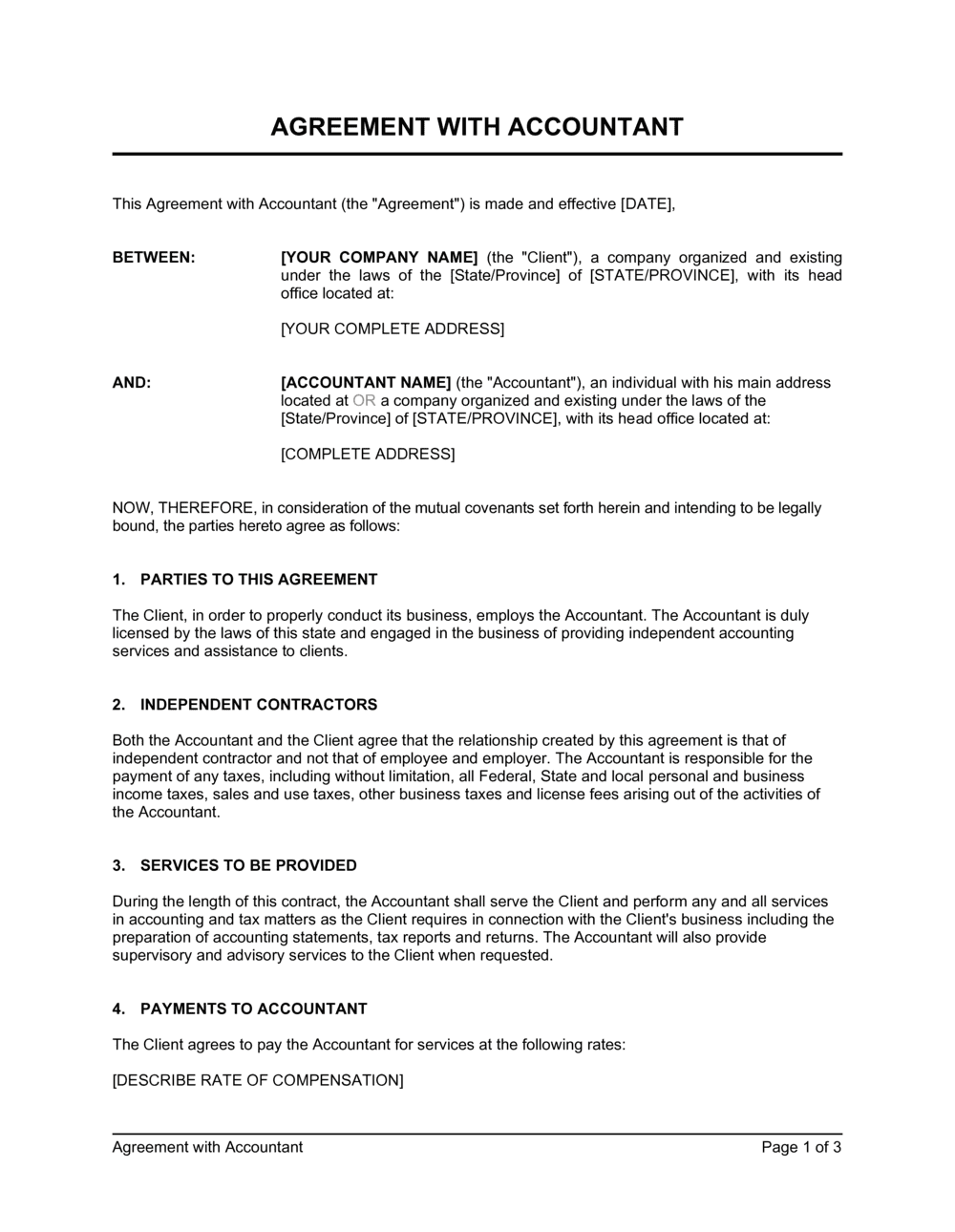
An Agreement With Accountant is a legally binding contract between a business or individual client and an accounting professional that defines the scope of services, fees, payment schedule, confidentiality obligations, and liability limits for the engagement. This free Word download gives you a structured, professional starting point you can edit online and export as PDF to sign before any accounting work begins.
When you need it
Use it whenever you engage an external accountant, CPA, or bookkeeping firm for services such as tax preparation, audit, financial statement preparation, payroll processing, or ongoing bookkeeping. It protects both parties from scope creep, fee disputes, and data-handling disagreements before they arise.
What's inside
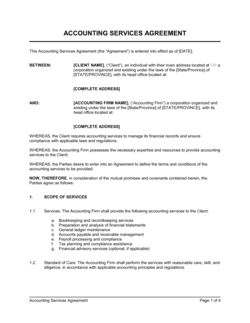
The agreement covers the parties and engagement details, a defined scope of services, fee structure and payment terms, confidentiality and data-handling obligations, limitation of liability, professional standards, term and termination provisions, and governing law — everything needed to establish a clear, enforceable working relationship.

What is an Agreement With Accountant?

An Agreement With Accountant is a legally binding contract between a client — whether a business, nonprofit, or individual — and an accounting professional or firm that defines every material term of the engagement: scope of services, fees, payment schedule, client responsibilities, confidentiality and data-handling obligations, liability limits, professional standards, and termination conditions. Unlike a casual email exchange or verbal handshake, a properly drafted agreement creates enforceable obligations on both sides and establishes a written record of exactly what was agreed before any work begins. It functions as both an engagement letter in the professional-standards sense and a full commercial contract in the legal sense.

Why You Need This Document

Without a signed Agreement With Accountant, both parties are exposed in ways that compound quickly. The accountant has no contractual basis to enforce fee rates, suspend services for non-payment, or cap liability when a client supplies inaccurate records that lead to a filing error. The client has no written record of what deliverables were promised, by when, and at what cost — making scope disputes impossible to resolve cleanly. Tax penalties, audit findings, and data breaches each generate liability questions that an unsigned engagement resolves only through expensive litigation. For the accountant, one disputed engagement without a liability cap can exceed an entire year of fees in damages. For the client, an accountant who walks away mid-filing season without a notice obligation can leave returns unfiled and penalties accruing. A signed agreement, executed in 30 minutes before any work starts, eliminates all four risks — and this template gives you the structure to do it correctly the first time.

Which variant fits your situation?

If your situation is…Use this template
Ongoing monthly bookkeeping and general ledger maintenanceBookkeeping Services Agreement
One-time annual tax return preparation onlyTax Preparation Agreement
Audit or financial statement review engagementAudit Engagement Letter
Engaging a self-employed CPA rather than a firmIndependent Contractor Agreement
Hiring an in-house accountant or controller as an employeeEmployment Contract
Payroll processing services onlyPayroll Services Agreement
CFO or fractional finance leadership servicesConsulting Services Agreement

Common mistakes to avoid

❌ Vague scope of services

Why it matters: When the agreement says 'accounting services' without specifics, the client expects unlimited support and the accountant bills only for what they quoted. Fee disputes and relationship breakdowns follow within the first engagement cycle.

Fix: List every deliverable by name and period — 'federal Form 1120S for fiscal year [YEAR]' rather than 'tax work' — and add two or three explicit exclusions so both parties know where the engagement ends.

❌ No liability cap

Why it matters: Without a contractual liability cap, a single error on a high-revenue client's filing can expose the accountant to damages that dwarf the engagement fee, making professional-indemnity insurance the only line of defense.

Fix: Include a limitation-of-liability clause capping exposure at 12 months of fees paid and excluding indirect and consequential damages. Review the cap against your E&O policy limits annually.

❌ Omitting the client-responsibility and reliance clause

Why it matters: When a filing error traces back to inaccurate records the client supplied, the accountant has no contractual protection without an explicit clause stating that the accountant relies on client-provided data without independent verification.

Fix: Add a client-representations clause stating that all information provided is accurate and complete, and that the accountant is entitled to rely on it. Pair it with a missed-deadline provision shifting liability for late penalties to the client.

❌ No suspension-of-services clause for non-payment

Why it matters: Without the right to suspend work, the accountant continues performing services through a tax deadline while invoices go unpaid — accumulating unrecoverable time with no leverage to compel payment.

Fix: Include a clause allowing the accountant to suspend services on 10 days' written notice after an invoice is 30 days overdue, and state that the accountant is not liable for any filing penalties or deadlines missed during the suspension period.

❌ Signing after work has already started

Why it matters: An agreement signed after the accountant has already provided services creates enforceability questions about terms added after the fact, particularly liability caps and confidentiality obligations.

Fix: Execute the agreement before any billable work begins. If circumstances require a delayed signature, document the pre-signature work in a written change order that references the forthcoming agreement.

❌ Using the individual CPA's name instead of the firm entity

Why it matters: Professional-indemnity insurance is typically held by the firm entity, not the individual practitioner. A contract naming only the individual may create a coverage gap if a claim is filed against the firm.

Fix: Confirm whether the engagement is with the individual or the firm and name the correct legal entity. Include the firm's professional-corporation registration number or CPA license number in the parties block.

The 10 key clauses, explained

Parties and engagement details

In plain language: Identifies the client and the accounting professional or firm by full legal name and describes the nature of the engagement at a high level.

Sample language
This Agreement is entered into on [DATE] between [CLIENT LEGAL NAME] ('Client') and [ACCOUNTANT / FIRM LEGAL NAME], a [STATE/PROVINCE] [ENTITY TYPE] ('Accountant'). Accountant agrees to provide accounting services to Client as described herein.

Common mistake: Naming the individual CPA instead of the licensed firm entity. If the firm holds the errors-and-omissions insurance, a contract that names only the individual may leave coverage gaps in a dispute.

Scope of services

In plain language: Lists the specific tasks the accountant will perform — tax filing, bookkeeping, payroll, audit — and explicitly states what is excluded from the engagement.

Sample language
Accountant shall provide the following services: [LIST OF SERVICES]. Services not listed above, including [EXCLUDED SERVICES], are outside the scope of this Agreement and require a separate written change order.

Common mistake: Using a vague scope like 'general accounting services.' Without a specific list, the client expects everything and the accountant delivers what they quoted — disputes follow within the first billing cycle.

Fees, payment schedule, and expenses

In plain language: States the fee structure — fixed fee, hourly rate, or monthly retainer — payment due dates, accepted payment methods, and how out-of-pocket expenses are handled.

Sample language
Client shall pay Accountant a monthly retainer of $[AMOUNT], due on the [DAY] of each month. Hourly work outside the retainer is billed at $[RATE]/hour. Reasonable out-of-pocket expenses are reimbursed within [30] days of submission with receipts.

Common mistake: Agreeing on fees verbally and omitting them from the written agreement. When a client disputes an invoice, the absence of a signed fee schedule leaves the accountant with no contractual basis to enforce payment.

Late payment and interest

In plain language: Defines the grace period after a due date, the interest rate applied to overdue balances, and the accountant's right to suspend services for non-payment.

Sample language
Invoices unpaid after [15] days accrue interest at [1.5]% per month. Accountant may suspend services on [10] days' written notice if any invoice remains unpaid for more than [30] days.

Common mistake: No suspension-of-services clause. Without it, the accountant continues working and accumulating unbillable time while the client ignores invoices — often through a tax deadline.

Client responsibilities and representations

In plain language: Sets out what the client must provide — accurate records, timely document delivery, and honest representations — and states that the accountant relies on client-supplied information.

Sample language
Client shall provide Accountant with accurate and complete records, documents, and information necessary to perform the services. Client represents that all information provided is true and correct. Accountant is entitled to rely on Client-supplied information without independent verification.

Common mistake: Omitting this clause entirely. When a filing error arises from inaccurate records supplied by the client, the accountant has no contractual protection without an explicit reliance-on-client-data provision.

Confidentiality and data handling

In plain language: Obligates the accountant to keep client financial data confidential and describes how records are stored, transmitted, and destroyed at the end of the engagement.

Sample language
Accountant shall maintain the confidentiality of all Client financial information and shall not disclose it to any third party without Client's prior written consent, except as required by law or professional regulatory obligations. Client data shall be stored using [ENCRYPTION/SECURITY STANDARD] and destroyed within [90] days of engagement termination.

Common mistake: No reference to data security standards or destruction timelines. Financial records contain personal and tax identification data — a breach with no contractual security standard leaves the accountant exposed to regulatory and civil liability.

Limitation of liability

In plain language: Caps the accountant's maximum liability to the client at a defined amount — typically total fees paid — and excludes liability for indirect or consequential losses.

Sample language
Accountant's aggregate liability to Client for any claim arising under this Agreement shall not exceed the total fees paid by Client in the [12] months preceding the claim. In no event shall Accountant be liable for indirect, incidental, or consequential damages.

Common mistake: No liability cap at all. Without one, a single filing error on a large client's tax return could expose the accountant to damages far exceeding the engagement fee, making professional-indemnity insurance alone an insufficient protection.

Professional standards and independence

In plain language: States the professional standards governing the engagement (GAAP, GAAS, AICPA, CPA provincial body) and, for audit engagements, affirms the accountant's independence from the client.

Sample language
Services under this Agreement shall be performed in accordance with [GAAP / GAAS / APPLICABLE PROFESSIONAL STANDARDS]. For audit engagements, Accountant represents that it meets independence requirements under [APPLICABLE STANDARDS] as of the engagement date.

Common mistake: Omitting the professional standards reference. In a dispute, the applicable standard of care is established by the governing body's rules — referencing it in the contract prevents arguments about what 'good work' means.

Term and termination

In plain language: States the start and end date (or evergreen renewal), the notice period required for either party to terminate, and the effect of termination on work in progress and fees owed.

Sample language
This Agreement commences on [DATE] and continues for [12 months / until terminated]. Either party may terminate on [30] days' written notice. Upon termination, Client shall pay all fees and expenses accrued through the termination date. Accountant shall deliver completed work product within [15] days of receiving final payment.

Common mistake: No provision for work-in-progress on termination. When a client terminates mid-tax-season, both parties need clarity on what deliverables are owed, what fees are due, and who holds the working papers.

Governing law and dispute resolution

In plain language: Specifies which jurisdiction's law governs the agreement and how disputes are resolved — arbitration, mediation, or litigation — and where proceedings take place.

Sample language
This Agreement is governed by the laws of [STATE / PROVINCE / COUNTRY]. Any dispute arising under this Agreement shall first be submitted to non-binding mediation. If mediation fails within [60] days, disputes shall be resolved by binding arbitration in [CITY] under the rules of [AAA / APPLICABLE ARBITRATION BODY].

Common mistake: Defaulting to litigation without a mediation or arbitration clause. Fee disputes between accountants and clients are typically low-stakes matters — arbitration is faster and cheaper than court, and most professional associations recommend it.

How to fill it out

  1. 1

    Identify the parties correctly

    Enter the client's full legal entity name and the accountant's or firm's full registered legal name. Confirm whether the accountant is engaged as an individual or through a professional corporation, as this affects which entity holds the liability and insurance.

    💡 Ask for the accountant's professional corporation number or CPA license number and include it in the parties block — it confirms you engaged a licensed professional, which matters in a dispute.

  2. 2

    Define the scope of services in detail

    List every specific task included in the engagement — for example, 'preparation of federal and state income tax returns for the fiscal year ending December 31, [YEAR]' — and explicitly list two or three common exclusions such as audit representation or payroll processing.

    💡 A scope defined by deliverable (e.g., 'one set of reviewed financial statements') is more enforceable than a scope defined by task (e.g., 'general accounting support').

  3. 3

    Set the fee structure and payment terms

    Choose fixed fee, hourly rate, or monthly retainer and enter the agreed amount. Add the billing cycle, due date, accepted payment methods, and a late-payment interest rate. If expenses are reimbursable, state which categories and set a pre-approval threshold.

    💡 For ongoing engagements, add an annual fee adjustment clause — for example, 'fees may be adjusted by up to [CPI + 2]% on each anniversary' — so you avoid renegotiating the contract every year.

  4. 4

    Complete the client responsibilities clause

    Specify the documents and records the client must deliver and the deadline for delivery — for example, 'all bank statements, receipts, and prior-year returns by [DATE].' This creates a documented record if a filing delay results from late client delivery.

    💡 Add a missed-deadline provision: if the client fails to deliver records by the agreed date, the filing deadline shifts and the accountant is not liable for penalties arising from the delay.

  5. 5

    Tailor the confidentiality and data-handling terms

    Reference any specific data-security standards your firm uses (e.g., 256-bit encryption, SOC 2 compliant storage) and state the retention and destruction timeline for client records after the engagement ends.

    💡 If the client is subject to HIPAA, GDPR, or state privacy laws, add a reference to those obligations and confirm the accountant's compliance — failure to do so can expose both parties to regulatory penalties.

  6. 6

    Set the liability cap

    Enter the maximum liability amount — typically 12 months of fees paid — and confirm that indirect and consequential damages are excluded. Review this cap against your professional-indemnity insurance policy limits for consistency.

    💡 Set the cap at no more than one year of fees. Courts in most jurisdictions enforce reasonable caps in professional-services agreements; caps set too high offer no real protection.

  7. 7

    State the term, notice period, and termination effects

    Enter the engagement start date and either a fixed end date or an evergreen term with a renewal clause. Set the notice period for termination (30 days is standard) and add a clause confirming that fees through the termination date are payable regardless of who initiates termination.

    💡 For tax-season engagements, add a blackout clause prohibiting termination between January 1 and April 30 — this prevents a client from switching accountants mid-filing and leaving the accountant with uncompensated in-progress work.

  8. 8

    Sign before any work begins

    Both parties must sign the agreement before the accountant starts any billable work. An unsigned agreement is unenforceable, and work performed without a signed contract relies entirely on implied terms — typically unfavorable to the service provider.

    💡 Use an electronic signature platform to timestamp execution and send an executed copy to both parties automatically. Store the signed agreement with the engagement file for the full retention period.

Frequently asked questions

What is an Agreement With Accountant?

An Agreement With Accountant is a legally binding contract between a client and an accounting professional or firm that defines the scope of accounting services, fees, payment terms, confidentiality obligations, liability limits, and termination conditions. It functions as the governing document for the engagement and protects both parties from disputes over what was agreed, what was delivered, and who is liable if something goes wrong.

Is an Agreement With Accountant the same as an engagement letter?

They serve the same purpose and are often used interchangeably. An engagement letter is the term used by accounting professional bodies (AICPA, CPA Canada, ICAEW) for the written agreement issued before an engagement begins. A formal agreement with accountant is a more comprehensive contract that may include additional terms — such as arbitration clauses, IP ownership, and detailed liability caps — beyond what a standard engagement letter covers. For larger or more complex engagements, the full agreement is preferable.

When should I use an Agreement With Accountant?

Use it before any accounting engagement begins — tax preparation, audit, financial statement review, monthly bookkeeping, payroll processing, or fractional CFO services. It is especially important when engaging a new accountant for the first time, when the engagement involves access to sensitive financial or payroll data, and when the engagement fee exceeds a few hundred dollars. The cost of a dispute without a written agreement almost always exceeds the time it takes to execute one.

What happens if I don't have a written agreement with my accountant?

Without a written agreement, the scope of services, fee terms, and liability limits are governed by implied terms and local professional standards — which courts interpret differently depending on jurisdiction. Fee disputes become credibility contests; scope disagreements have no written resolution mechanism; and the accountant has no contractual limitation on liability. Both parties are exposed to significantly more risk than a signed agreement would create.

Who owns the working papers prepared during an accounting engagement?

In most jurisdictions, working papers — the accountant's internal notes, analysis, and documentation prepared during the engagement — are owned by the accountant, not the client. The client owns the final deliverables (tax returns, financial statements) that were prepared using those working papers. The agreement should state this explicitly to avoid disputes when a client requests all documents upon termination.

Can an accountant limit their liability in a contract?

Yes, in most jurisdictions accountants can contractually cap their liability to a defined amount — typically the fees paid in the prior 12 months — and exclude indirect or consequential damages. Courts generally enforce reasonable limitation-of-liability clauses in professional-services agreements, provided the cap is not so low as to be unconscionable. Some jurisdictions and professional regulatory bodies impose restrictions on the extent of liability limitation for audit engagements specifically — consider consulting a lawyer when drafting for audit work.

Does the agreement need to address GDPR or data privacy laws?

If the client or accountant is located in the EU, UK, or a jurisdiction with data-protection legislation, the agreement should reference applicable privacy obligations. Under GDPR, an accountant processing personal data on behalf of a client may qualify as a data processor, which requires a Data Processing Agreement (DPA) either embedded in or attached to the main engagement agreement. US state privacy laws (CCPA, VCDPA) impose similar requirements for businesses above certain thresholds.

What notice period is standard for terminating an accounting agreement?

Thirty days is the most common notice period for professional-services agreements of this type. For ongoing engagements that include tax preparation, many accountants add a blackout period prohibiting termination between January 1 and April 30 (US tax season), ensuring neither party can exit mid-filing and leave the other with uncompensated in-progress work. The appropriate notice period should reflect the complexity of the engagement and how long it would take the client to find a replacement.

Should I use an Agreement With Accountant or an Independent Contractor Agreement?

Use an Agreement With Accountant when engaging a CPA, accounting firm, or bookkeeper specifically for financial, tax, or audit services — this document includes profession-specific terms like professional standards references, working-paper ownership, and reliance-on-client-data clauses that a generic contractor agreement lacks. Use an Independent Contractor Agreement when the engagement is general consulting or when the accountant is providing operational rather than licensed professional services.

Is the agreement enforceable if fees are not specified in writing?

An agreement without a stated fee is generally enforceable on a quantum meruit basis — the accountant is entitled to reasonable compensation for services rendered. However, without a written fee schedule, the client can dispute what 'reasonable' means, and the accountant loses the ability to enforce specific rates, retainer amounts, or late-payment interest. Always specify the exact fee structure in the written agreement.

How this compares to alternatives

vs Independent Contractor Agreement

An Independent Contractor Agreement is a general-purpose contract for engaging any self-employed service provider. An Agreement With Accountant is profession-specific — it adds working-paper ownership, reliance-on-client-data protections, professional-standards references, and accounting-specific liability caps that a generic contractor agreement omits. Use the accountant-specific agreement for any licensed accounting engagement.

vs Consulting Agreement

A Consulting Agreement governs advisory or strategic services and focuses on deliverable ownership and confidentiality. It does not address professional standards compliance, audit independence, or the accountant's right to rely on client-supplied financial data. When the engagement involves licensed accounting services — tax filing, audit, financial statement preparation — use the accountant-specific agreement instead.

vs Employment Contract

An Employment Contract is used when the accountant is hired as a full-time or part-time employee, creating payroll, benefits, and statutory obligations. An Agreement With Accountant governs an external, independent professional relationship with no employment entitlements. Misclassifying an accountant as a contractor when they function as an employee triggers back-tax liability and employment-standards penalties.

vs Non-Disclosure Agreement

An NDA covers confidentiality only and creates no obligation to perform services or pay fees. An Agreement With Accountant includes confidentiality as one clause among many governing the full engagement. If you need to share financial information with an accountant before executing the full agreement — for example, during a scoping conversation — an NDA can bridge the gap, but it must be replaced by the full agreement before work begins.

Industry-specific considerations

Professional Services

Law firms, consulting practices, and advisory firms use accountant agreements to govern annual audits, partner-draw reconciliations, and trust account reporting required by professional regulators.

Retail and E-commerce

Multi-channel retailers require detailed scope definitions covering sales-tax nexus filings across states, inventory accounting method elections, and merchant-platform reconciliation that must be listed explicitly to avoid fee disputes.

SaaS and Technology

SaaS companies engaging accountants for revenue recognition under ASC 606 or IFRS 15 need the agreement to reference the applicable standard and confirm the accountant's familiarity with subscription-model accounting.

Healthcare

Healthcare practices must include HIPAA compliance obligations in the data-handling clause, as accountants accessing patient billing records are considered business associates under federal law and require a Business Associate Agreement alongside the main contract.

Real Estate

Property investors and developers need the scope to specify depreciation schedule preparation, cost segregation studies, passive activity loss tracking, and 1031 exchange documentation — each a distinct deliverable with its own fee.

Nonprofit Organizations

Nonprofits require the agreement to cover Form 990 preparation, grant-required financial compilations or reviews, and fund accounting standards (ASC 958), and should reference any funder-mandated audit requirements that may trigger additional scope.

Jurisdictional notes

United States

CPA licensing is state-specific; confirm the accountant holds a valid license in the state where services are provided or where the client is domiciled. For engagements involving personal data, applicable state privacy laws (California CCPA, Virginia VCDPA) may require a data processing addendum. Limitation-of-liability clauses are generally enforceable in professional-services contracts, though some states limit caps in cases involving gross negligence or willful misconduct.

Canada

CPAs in Canada are regulated provincially by CPA Canada's member bodies. Engagement letters are required by CPA Canada's professional standards before most assurance and tax engagements. In Quebec, the agreement should be in French for provincially regulated entities and must comply with Quebec's privacy law (Law 25) for data-handling obligations. Limitation-of-liability clauses are enforceable but may be subject to provincial consumer protection restrictions for individuals.

United Kingdom

Accountants regulated by ICAEW, ACCA, or CIMA are required to issue an engagement letter before commencing work under their respective professional standards. UK GDPR and the Data Protection Act 2018 apply when the accountant processes personal data on behalf of the client, requiring a Data Processing Agreement. Limitation-of-liability clauses are subject to the Unfair Contract Terms Act 1977 and must be reasonable to be enforceable.

European Union

GDPR requires that any accountant processing personal data on behalf of a client execute a Data Processing Agreement under Article 28 — this should be attached to or embedded in the main engagement agreement. Engagement letter requirements vary by member state: Germany, France, and the Netherlands have professional-body rules mandating written agreements before assurance work. Liability caps must comply with national consumer and professional-services law, which varies significantly across EU member states.

Template vs lawyer — what fits your deal?

PathBest forCostTime
Use the templateSmall businesses and individuals engaging a local accountant for standard tax preparation, bookkeeping, or payroll servicesFree15–30 minutes
Template + legal reviewEngagements involving audit work, GDPR or HIPAA data obligations, multi-jurisdiction filings, or fees exceeding $10,000 per year$200–$500 for a one-hour lawyer review1–3 days
Custom draftedLarge accounting firm engagements, publicly traded or regulated-entity audits, or complex liability and indemnification negotiations$1,000–$3,500+1–2 weeks

Glossary

Engagement Letter
A written agreement between an accounting professional and a client that defines the scope, terms, and conditions of a specific accounting engagement — functionally equivalent to this agreement.
Scope of Services
The explicit list of tasks the accountant agrees to perform, used to distinguish included work from out-of-scope requests that require a change order or additional fee.
Retainer
A fixed fee paid in advance — typically monthly — to secure the accountant's availability and cover a defined bundle of recurring services.
Confidential Information
Non-public financial data, tax records, payroll figures, and business information shared by the client with the accountant for the purpose of the engagement.
Limitation of Liability
A contractual cap on the maximum damages the accountant can owe the client, typically expressed as a multiple of fees paid for the engagement.
Professional Standards
The accounting and ethical rules the accountant is bound by — such as GAAP, GAAS, IFRS, or the AICPA Code of Professional Conduct — referenced in the agreement.
Change Order
A written amendment to the original agreement authorizing additional work outside the defined scope, typically at an agreed additional fee.
Working Papers
The accountant's internal records, notes, and documentation prepared during the engagement — typically owned by the accountant, not the client.
Termination for Cause
A provision allowing either party to end the agreement immediately upon a specific material breach — such as non-payment, conflict of interest, or professional misconduct.
Indemnification
A contractual obligation by one party to compensate the other for losses arising from specific events — such as the client providing materially inaccurate records that lead to a filing error.

Part of your Business Operating System

This document is one of 3,000+ business & legal templates included in Business in a Box.

  • Fill-in-the-blanks — ready in minutes
  • 100% customizable Word document
  • Compatible with all office suites
  • Export to PDF and share electronically

Create your document in 3 simple steps.

From template to signed document — all inside one Business Operating System.
1
Download or open template

Access over 3,000+ business and legal templates for any business task, project or initiative.

2
Edit and fill in the blanks with AI

Customize your ready-made business document template and save it in the cloud.

3
Save, Share, Send, Sign

Share your files and folders with your team. Create a space of seamless collaboration.

Save time, save money, and create top-quality documents.

★★★★★

"Fantastic value! I'm not sure how I'd do without it. It's worth its weight in gold and paid back for itself many times."

Managing Director · Mall Farm
Robert Whalley
Managing Director, Mall Farm Proprietary Limited
★★★★★

"I have been using Business in a Box for years. It has been the most useful source of templates I have encountered. I recommend it to anyone."

Business Owner · 4+ years
Dr Michael John Freestone
Business Owner
★★★★★

"It has been a life saver so many times I have lost count. Business in a Box has saved me so much time and as you know, time is money."

Owner · Upstate Web
David G. Moore Jr.
Owner, Upstate Web

Run your business with a system — not scattered tools

Stop downloading documents. Start operating with clarity. Business in a Box gives you the Business Operating System used by over 250,000 companies worldwide to structure, run, and grow their business.

Start free · No credit card required