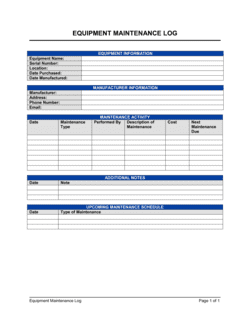
Equipment Maintenance Agreement Template

Free Word download • Edit online • Save & share with Drive • Export to PDF

2 pages25–30 min to fillDifficulty: StandardSignature requiredLegal review recommended
Learn more ↓
FreeEquipment Maintenance Agreement Template

At a glance

What it is
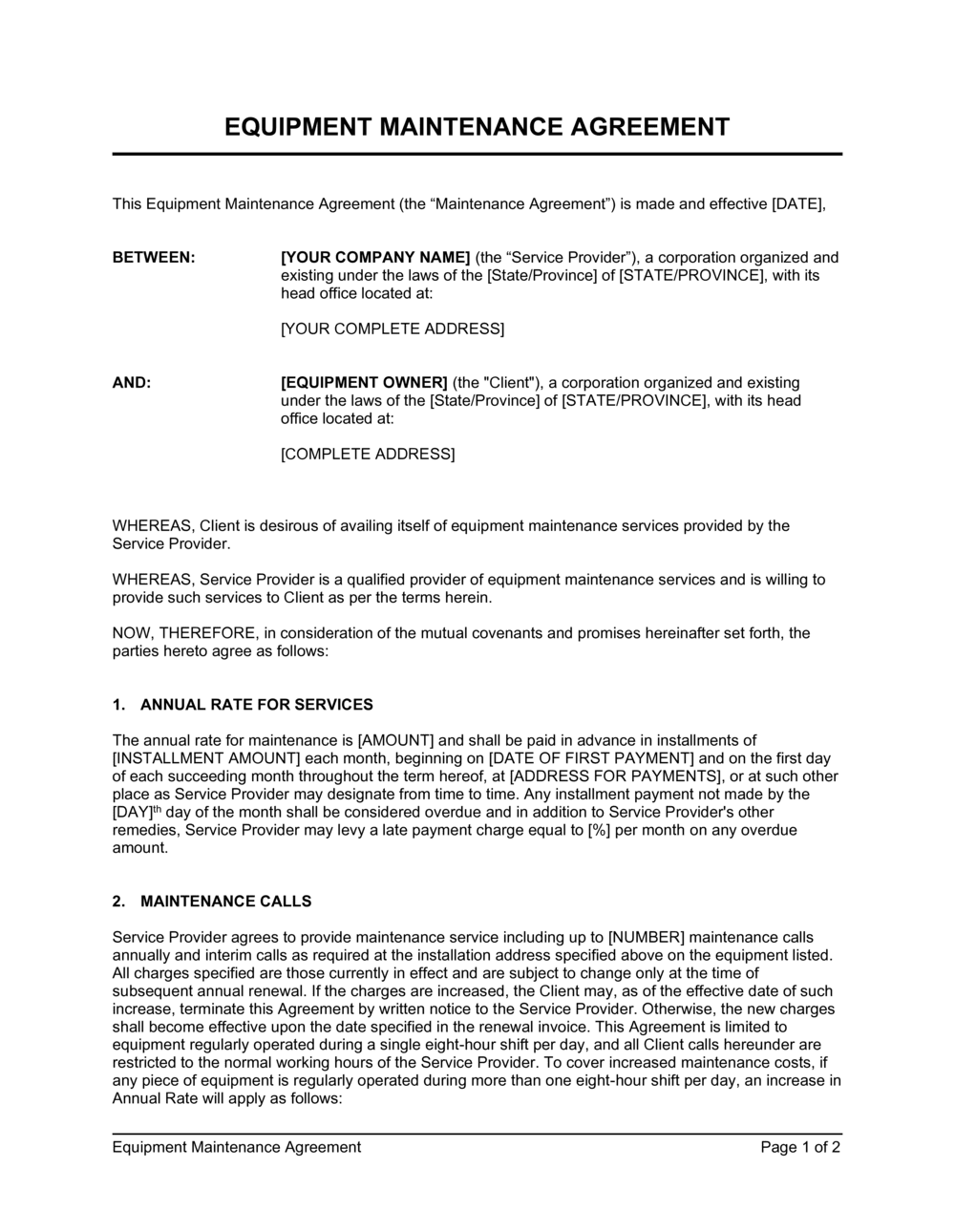
An Equipment Maintenance Agreement is a legally binding contract between a service provider and an equipment owner that defines the terms under which the provider will inspect, service, repair, or maintain specified machinery or equipment. This free Word download covers service scope, response time commitments, fees, liability limits, and termination — ready to edit online and export as PDF.
When you need it
Use it whenever a business engages a third-party technician, vendor, or in-house service team to perform scheduled or on-call maintenance on equipment it owns or leases. It is especially important when equipment downtime would disrupt operations or trigger financial losses.
What's inside
Equipment identification and service scope, preventive and corrective maintenance schedules, response time and uptime commitments, fees and payment terms, parts and labor warranties, liability limitations, confidentiality, and termination provisions.

What is an Equipment Maintenance Agreement?

An Equipment Maintenance Agreement is a legally binding contract between a service provider and an equipment owner that establishes the terms under which the provider will inspect, service, repair, and maintain specified machinery or equipment. It identifies the covered assets by make, model, and serial number; defines the scope of both preventive and corrective maintenance; sets response time and uptime commitments; states fees, invoicing cycles, and parts-and-labor warranty terms; and caps each party's financial exposure in the event of a service failure. Unlike an informal service arrangement or a vendor's standard purchase order, a properly drafted maintenance agreement gives both parties enforceable obligations and a clear framework for resolving disputes without litigation.

Why You Need This Document

Operating without a written equipment maintenance agreement exposes you to four concrete risks. First, if a critical asset fails and there is no documented response-time commitment, you have no contractual basis to demand prompt repair — or to recover losses caused by delayed service. Second, without a liability cap and consequential-damages exclusion, a vendor whose negligent repair causes a production shutdown can face unlimited damages, making them unwilling to perform high-risk work or requiring them to price that risk into every service contract. Third, regulated industries — healthcare, food processing, aviation, construction — often require documented maintenance records as a condition of operating licenses or safety certifications; an unsigned informal arrangement rarely satisfies an auditor. Fourth, without a parts and labor warranty clause, a repair that fails within days becomes a billing dispute with no written standard to apply. This template provides a complete, attorney-reviewed starting point that closes all four gaps in under an hour, with the flexibility to tailor scope, fees, and SLA targets to any equipment type or industry.

Which variant fits your situation?

If your situation is…Use this template
Ongoing scheduled preventive maintenance with no on-demand repairsPreventive Maintenance Agreement
Full-coverage parts, labor, and emergency repairs includedFull-Service Equipment Maintenance Contract
On-call repair only — no scheduled visitsEquipment Repair Service Agreement
Software or firmware updates for connected or smart equipmentSoftware Maintenance Agreement
Single one-time service visit with no ongoing obligationService Order / Work Order Form
Maintenance bundled into an equipment leaseEquipment Lease Agreement
Third-party contractor performing maintenance on client premisesIndependent Contractor Agreement

Common mistakes to avoid

❌ Vague equipment descriptions in the schedule

Why it matters: If the schedule lists 'compressors' rather than specific serial numbers, the provider can argue a failed unit is not covered, leaving the client to pay for repairs out of pocket.

Fix: List every covered asset with make, model, serial number, and physical location. Update the schedule by written amendment whenever equipment is added or retired.

❌ No defined response-time trigger

Why it matters: A 4-hour response commitment is unenforceable if the contract doesn't specify what constitutes notification — a voicemail left at midnight versus a confirmed ticket submission are very different starting points.

Fix: State the exact notification method (e.g., email to dispatch@provider.com or call to a 24/7 line), confirm receipt acknowledgment requirements, and define when the clock starts.

❌ Omitting a liability cap

Why it matters: Without a cap, a service provider whose negligent repair causes a three-day production shutdown faces unlimited damages — far exceeding any fee they would have earned — creating an uninsurable risk that causes disputes and contract failures.

Fix: Set a liability cap equal to fees paid in the prior 12 months, and exclude consequential and indirect damages including lost profits and lost production.

❌ Auto-renewal with a short notice window

Why it matters: A 30-day cancellation window means clients who miss the renewal date are committed to another full contract year at the existing rate, with no opportunity to rebid or renegotiate.

Fix: Use a 60–90 day notice period and consider adding a fee-escalation cap (e.g., no more than CPI + 3% on renewal) so renewal terms remain predictable.

❌ No exclusions clause for operator misuse

Why it matters: Without explicit exclusions, a service provider may be required to repair equipment damaged by the client's employees — at the flat-rate contract price — for failures entirely outside the provider's control.

Fix: List specific exclusions: damage from unauthorized modifications, use outside rated capacity, consumable wear items (belts, filters, lubricants unless stated), and acts of nature.

❌ Signing after the first service visit has occurred

Why it matters: A contract signed after work has already begun may lack the consideration or mutual assent required in some jurisdictions, potentially voiding key provisions like liability caps and non-disclosure obligations.

Fix: Execute the agreement before the provider's first site visit. If an emergency repair precedes the contract, document the service in writing and execute the formal agreement immediately after.

The 10 key clauses, explained

Parties and recitals

In plain language: Identifies the service provider and the equipment owner as legal entities, states the effective date, and sets out the commercial purpose of the agreement.

Sample language
This Equipment Maintenance Agreement ('Agreement') is entered into as of [DATE] by and between [SERVICE PROVIDER LEGAL NAME], a [STATE/PROVINCE] [ENTITY TYPE] ('Provider'), and [CLIENT LEGAL NAME], a [STATE/PROVINCE] [ENTITY TYPE] ('Client').

Common mistake: Using a trade name or DBA instead of the registered legal entity — if the Provider's entity name doesn't match their insurance policy, the Client may face gaps in coverage when making a claim.

Covered equipment schedule

In plain language: Lists every piece of equipment covered by the contract by make, model, serial number, and physical location, and specifies what is expressly excluded.

Sample language
Provider shall maintain the equipment identified in Schedule A ('Covered Equipment'). Equipment not listed in Schedule A, and any equipment modified without Provider's written consent, is excluded from this Agreement.

Common mistake: Leaving the schedule blank or using generic descriptions like 'all HVAC units.' Vague equipment lists cause disputes over whether a specific asset is covered when it fails.

Scope of services

In plain language: Defines the maintenance activities the provider will perform — preventive inspections, corrective repairs, calibrations, software updates — and what falls outside the scope.

Sample language
Provider shall perform the services described in Schedule B, including [PREVENTIVE MAINTENANCE TASKS] at [INTERVAL] intervals and corrective repairs for failures caused by normal wear. Services do not include repair of damage caused by [OPERATOR MISUSE / UNAUTHORIZED MODIFICATIONS / CONSUMABLE PARTS].

Common mistake: Describing only preventive maintenance while omitting corrective repair terms — leaving both parties uncertain whether the contract covers breakdown response or only scheduled visits.

Service schedule and response time

In plain language: Sets the frequency of scheduled visits, the maximum time the provider has to respond to a fault notification, and the target resolution time for different severity levels.

Sample language
Preventive maintenance visits shall occur [QUARTERLY / MONTHLY / ANNUALLY]. For Priority 1 failures rendering equipment inoperable, Provider shall respond within [4] hours and restore operation within [24] hours of notification. For Priority 2 faults, response is within [8] business hours.

Common mistake: Stating response time without defining what triggers the clock — 'notification' is ambiguous unless the agreement specifies the accepted notification method (phone, email, ticketing system).

Fees, invoicing, and payment terms

In plain language: States the annual or monthly service fee, what is included in the flat fee versus billed separately, the invoicing cycle, and the consequences of late payment.

Sample language
Client shall pay Provider a monthly service fee of $[AMOUNT], invoiced on the first business day of each month, due within [30] days. Parts required for corrective repairs beyond the included [PARTS ALLOWANCE] are billed at Provider's standard rates plus [X]%. Late payments accrue interest at [1.5]% per month.

Common mistake: Bundling all fees into a single annual number without specifying what parts, travel, or after-hours calls are excluded — creating disputes when the first repair invoice arrives with line items the client didn't expect.

Warranty on parts and labor

In plain language: Guarantees the quality of repair work and replacement parts for a defined period, and clarifies whether OEM or equivalent parts are used.

Sample language
Provider warrants all labor performed under this Agreement for [90] days from the date of service. Replacement parts are warranted per the original manufacturer's warranty or for [30] days, whichever is longer. Provider will use OEM parts unless Client approves equivalent alternatives in writing.

Common mistake: No warranty clause at all — if a repair fails within days and the contract is silent, the Client has no contractual basis to demand a no-charge return visit.

Liability limitation and indemnification

In plain language: Caps the provider's financial exposure for service failures, excludes consequential and indirect damages, and states which party bears responsibility for third-party claims.

Sample language
Provider's aggregate liability for any claims under this Agreement shall not exceed the total fees paid by Client in the [12] months preceding the claim. In no event shall Provider be liable for indirect, incidental, or consequential damages including lost production or lost profits. Each party shall indemnify the other against third-party claims arising from its own negligence.

Common mistake: No liability cap at all — a service vendor whose error causes a production line to shut down for three days could face damages many times larger than the annual service fee.

Confidentiality

In plain language: Prevents the provider from disclosing the client's operational data, equipment configurations, or maintenance records to third parties outside the scope of the service.

Sample language
Provider shall treat all Client information obtained during performance of services — including equipment specifications, failure histories, and facility layouts — as confidential and shall not disclose it to any third party without Client's prior written consent, except as required by law.

Common mistake: Omitting confidentiality provisions entirely — service technicians with access to a facility routinely encounter operational data, competitive configurations, or security layouts that a client has a legitimate interest in protecting.

Term, renewal, and termination

In plain language: States the initial contract duration, whether it auto-renews, the notice period required to cancel or modify at renewal, and grounds for early termination with or without cause.

Sample language
This Agreement commences on [START DATE] and continues for [1 YEAR], renewing automatically for successive [1-YEAR] terms unless either party provides [60] days' written notice before the renewal date. Either party may terminate for cause upon [30] days' written notice if the other party fails to cure a material breach within that period.

Common mistake: Auto-renewal with only 30 days' notice — clients who miss the window get locked into another full year at a fee that may no longer reflect the market rate. Use 60–90 days to give both parties meaningful time to renegotiate.

Governing law and dispute resolution

In plain language: Specifies which jurisdiction's law governs the agreement and the mechanism for resolving disputes — negotiation, mediation, arbitration, or litigation.

Sample language
This Agreement is governed by the laws of [STATE / PROVINCE / COUNTRY] without regard to conflict-of-law principles. Any dispute not resolved by good-faith negotiation within [30] days shall be submitted to binding arbitration administered by [AAA / JAMS / ADR body] in [CITY].

Common mistake: Choosing a governing law with no meaningful connection to where services are performed — some jurisdictions impose mandatory consumer or contractor protection rules that override the contract regardless of the chosen law.

How to fill it out

  1. 1

    Identify both parties with full legal entity names

    Enter the service provider's and client's registered legal names, entity types, and principal addresses. Confirm the entity names match insurance certificates and any existing vendor agreements.

    💡 Request a current certificate of insurance from the provider before signing — verify the named insured matches the contracting entity exactly.

  2. 2

    Complete Schedule A with precise equipment details

    List every covered asset with make, model, serial number, location, and installation date. Photograph each asset's serial number plate and attach the images as an exhibit.

    💡 Number each row in Schedule A — if equipment is added or removed mid-contract, a numbered row makes amendments unambiguous.

  3. 3

    Define the scope of services in Schedule B

    Specify which tasks fall within the flat-rate fee — lubrication, filter replacement, calibration, firmware updates — and which are billed separately. List exclusions explicitly: consumable parts, damage from misuse, third-party modifications.

    💡 Use a checklist format in Schedule B so both parties can initial each line. It eliminates scope disputes faster than prose paragraphs.

  4. 4

    Set response-time tiers and notification methods

    Define at least two severity tiers (e.g., Priority 1: complete failure; Priority 2: degraded performance) with separate response and resolution windows for each. Specify the exact notification channel — email to a named address, phone to a 24/7 dispatch line — that starts the clock.

    💡 Include an escalation path: if the assigned technician has not responded within 2 hours of a Priority 1 notification, name the next contact and their phone number in the agreement.

  5. 5

    Fill in the fee structure and parts allowance

    Enter the monthly or annual service fee, the included parts allowance (if any), the markup rate for parts above the allowance, and the overtime or after-hours call rate. Set a specific due date rather than 'net 30 from receipt.'

    💡 Cap the parts markup at a stated percentage — 15–20% over provider's cost is typical — rather than leaving it at 'standard rates,' which are undefined and disputed.

  6. 6

    Set the term, notice period, and renewal conditions

    Enter the start and end dates, choose auto-renewal or affirmative-renewal, and set the cancellation notice period. Note any fee escalation caps that apply on renewal.

    💡 Add a calendar reminder 90 days before the contract end date so you have time to renegotiate fees before the notice window closes.

  7. 7

    Review liability cap and insurance requirements

    Set the liability cap at a reasonable multiple of the annual fee — commonly 1× to 2× the fees paid in the prior 12 months. Specify minimum insurance coverage levels the provider must maintain (general liability, errors and omissions, workers' compensation).

    💡 Require the provider to name the client as an additional insured on their general liability policy — this allows the client to file a direct claim if a technician causes property damage.

  8. 8

    Execute before any service work begins

    Both authorized signatories must sign and date the agreement before the first maintenance visit. Confirm each party retains a fully executed copy.

    💡 Use a digital signature platform to timestamp execution — this eliminates disputes about which version was signed and creates an audit trail if the agreement is ever litigated.

Frequently asked questions

What is an equipment maintenance agreement?

An equipment maintenance agreement is a legally binding contract between a service provider and an equipment owner that defines the scope, schedule, fees, and performance standards for maintaining specified machinery or systems. It covers both preventive maintenance (scheduled servicing) and corrective maintenance (breakdown repairs), and sets out each party's obligations, liability limits, and remedies if service commitments are missed.

What should be included in an equipment maintenance agreement?

At minimum: a covered equipment schedule with serial numbers, a detailed scope of services listing included and excluded tasks, response time and uptime commitments, fee structure with a parts and labor breakdown, a warranty on repairs, a liability cap, confidentiality obligations, term and auto-renewal terms, and governing law. Missing any of these creates gaps that courts fill with jurisdiction-specific defaults — typically less favorable to the service provider.

What is the difference between a preventive maintenance agreement and a corrective maintenance agreement?

A preventive maintenance agreement covers scheduled, proactive servicing at defined intervals — inspections, lubrication, calibration — designed to prevent failures. A corrective maintenance agreement covers repair work after a breakdown has occurred. Most commercial equipment maintenance agreements combine both, defining a scheduled service calendar and response time commitments for on-demand repairs. Knowing which type you need determines which fee model is appropriate: flat-rate retainer for preventive-only versus time-and-materials for corrective-only.

Do I need a lawyer to draft an equipment maintenance agreement?

For standard commercial equipment with a straightforward scope, a well-prepared template is usually sufficient. Legal review is worth the investment when the equipment is critical to regulated operations (medical devices, aviation, food processing), when the service fee exceeds $50,000 per year, or when the liability and indemnification terms need to be negotiated with a large vendor who has their own standard form. A 1–2 hour review typically costs $300–$600 and can prevent six-figure disputes.

How is an equipment maintenance agreement different from an equipment lease?

An equipment lease transfers the right to use equipment from the owner to the lessee for a fee — ownership stays with the lessor. A maintenance agreement does not transfer any ownership or usage rights; it simply documents who is responsible for keeping equipment in working condition and on what terms. The two contracts are often used together: a lease may require the lessee to maintain a separate maintenance agreement with an approved vendor.

What response time should I require in an equipment maintenance agreement?

Response time depends on how critical the equipment is to operations. For production-critical machinery where downtime costs thousands of dollars per hour, 2–4 hours for a Priority 1 response is common. For non-critical equipment, 8–24 business hours is standard. The agreement should define at least two severity tiers with separate response windows, name the notification method that starts the clock, and include an escalation contact if the primary technician does not respond within the window.

Can a maintenance agreement limit the service provider's liability?

Yes, and in most jurisdictions limitation-of-liability clauses in commercial contracts are generally enforceable when both parties are businesses and the clause is clearly stated. The cap is typically set at the fees paid in the prior 12 months. Consequential damages — lost production, lost profits — are routinely excluded. However, courts in some jurisdictions will not enforce limitations for gross negligence or willful misconduct, and consumer protection laws may impose additional constraints outside pure B2B contexts.

What happens if the service provider misses a response time commitment?

The agreement should specify a remedy for missed SLA targets — service credits (e.g., 5% of the monthly fee per missed Priority 1 response), the right to terminate for repeated breaches, or the right to engage an alternative vendor at the provider's cost. Without a stated remedy, the client is technically entitled to damages for breach of contract, but proving the financial loss attributable to a delayed response rather than the underlying failure itself is difficult and costly in litigation.

Is an equipment maintenance agreement required by law?

No general law requires one for most commercial equipment, but several regulatory regimes effectively mandate documented maintenance programs. FDA-regulated medical devices, FAA-certified aircraft, elevator safety codes, fire suppression systems, and pressure vessels under ASME standards all require documented maintenance records. A signed agreement with a qualified provider creates the paper trail needed to satisfy those regulatory requirements and demonstrates due diligence in the event of an incident investigation.

How this compares to alternatives

vs Service Level Agreement (SLA)

An SLA is a performance standards document — response times, uptime targets, and remedies — that is typically embedded in or attached to a broader service contract. A maintenance agreement is the standalone governing contract that sets out scope, fees, liability, and term, with an SLA as a schedule. You typically need both: the maintenance agreement as the binding contract and the SLA exhibit to define measurable performance benchmarks.

vs Equipment Lease Agreement

An equipment lease grants a lessee the right to use equipment owned by the lessor for a defined period and fee. A maintenance agreement does not transfer any usage rights — it solely governs servicing obligations. The two are often paired: the lease specifies that the lessee must maintain a service contract with an approved vendor, while the maintenance agreement governs that vendor relationship separately.

vs Independent Contractor Agreement

An independent contractor agreement governs the overall working relationship with a self-employed individual or firm, including deliverables, IP, and termination. A maintenance agreement is a purpose-specific contract that adds equipment schedules, uptime commitments, parts warranties, and liability caps specific to physical asset servicing. Use a contractor agreement when the engagement is broad; use a maintenance agreement when the work is specifically recurring equipment servicing.

vs Software Maintenance Agreement

A software maintenance agreement covers updates, bug fixes, patches, and support for a software product — intangible deliverables with no physical components or on-site visits. An equipment maintenance agreement governs physical machinery and involves technician dispatch, parts replacement, safety compliance, and on-site access. The two documents share structural similarities but differ materially in scope, liability, and regulatory considerations.

Industry-specific considerations

Manufacturing

Production-line uptime SLAs, preventive maintenance on CNC machines and conveyor systems, and mandatory OSHA equipment inspection documentation.

Healthcare

FDA and Joint Commission requirements for calibration records on medical devices, strict response times for life-critical equipment, and HIPAA-aware confidentiality provisions.

Construction and Facilities

Elevator, generator, HVAC, and fire suppression system maintenance mandated by local building codes, with licensed contractor requirements and inspection certificate obligations.

Logistics and Transportation

Fleet preventive maintenance schedules tied to DOT compliance, forklift and material-handling equipment certification, and roadside-assistance response-time commitments.

Jurisdictional notes

United States

Commercial maintenance agreements are governed by state contract law, and UCC Article 2 may apply to the parts-supply component. Limitation-of-liability clauses are generally enforceable in B2B contexts but courts in some states (notably California and New York) scrutinize gross-negligence carve-outs closely. OSHA regulations and industry-specific rules (FDA for medical devices, FAA for aviation) may impose mandatory maintenance documentation requirements that the agreement should reference explicitly.

Canada

Contract law in common-law provinces mirrors the UK approach; Quebec is governed by the Civil Code of Quebec. Limitation-of-liability clauses are enforceable in commercial contracts but may be narrowed by provincial consumer protection statutes if one party is not a business. Several provinces have occupational health and safety regulations that mandate documented maintenance records for pressure vessels, elevators, and electrical systems — the agreement should reference the applicable provincial statute.

United Kingdom

The Unfair Contract Terms Act 1977 and the Consumer Rights Act 2015 restrict the enforceability of exclusion clauses in consumer contexts, but B2B maintenance agreements have broader latitude. The Supply of Goods and Services Act 1982 implies terms of reasonable care and skill into service contracts. Health and Safety at Work Act 1974 obligations may require the client to ensure contractor compliance, which is best documented in the agreement's scope and insurance requirements.

European Union

EU member states apply national contract law, but EU product liability directives affect how maintenance obligations are allocated when a serviced device causes harm. GDPR applies if maintenance technicians access systems containing personal data — the agreement should include a data processing addendum or GDPR-compliant confidentiality clause. Machinery Directive 2006/42/EC and sector-specific regulations (medical devices, pressure equipment) impose documented maintenance obligations that the contract should cross-reference.

Template vs lawyer — what fits your deal?

PathBest forCostTime
Use the templateStandard commercial equipment with clear scope, domestic vendors, and annual fees under $25,000Free30–60 minutes
Template + legal reviewRegulated equipment (medical, food-processing, aviation), fees over $25,000, or contracts with a vendor presenting their own standard form$300–$6001–3 days
Custom draftedCritical infrastructure, multi-site enterprise agreements, complex indemnification negotiations, or cross-border service arrangements$1,500–$5,000+1–3 weeks

Glossary

Preventive Maintenance
Scheduled, routine servicing performed at set intervals to reduce the likelihood of equipment failure — oil changes, filter replacements, calibrations, and inspections.
Corrective Maintenance
Repair work performed after a fault or breakdown has occurred, restoring equipment to its normal operating condition.
Response Time
The maximum time the service provider must take to acknowledge a fault report and dispatch a technician — commonly expressed as hours from notification.
Uptime Guarantee
A contractual commitment that covered equipment will be operational for a defined percentage of scheduled hours — for example, 99% uptime over a rolling 30-day period.
Covered Equipment Schedule
An exhibit or appendix to the agreement listing each piece of equipment by make, model, serial number, and location that falls within the scope of the contract.
Mean Time to Repair (MTTR)
The average time required to restore failed equipment to full operation, used as a performance benchmark in service-level commitments.
Exclusion Clause
A contractual provision that removes specific causes of failure — operator misuse, unauthorized modifications, consumable parts — from the service provider's maintenance obligations.
Service Level Agreement (SLA)
A defined set of performance standards — response times, uptime targets, resolution windows — embedded in or attached to the maintenance agreement.
Force Majeure
A clause excusing non-performance when delays or failures result from events beyond a party's reasonable control, such as natural disasters, strikes, or government orders.
Limitation of Liability
A clause capping the maximum financial exposure of the service provider — typically set at the fees paid over the prior 12 months — for damages arising from a service failure.
Term and Renewal
The duration of the agreement and the conditions under which it automatically renews or requires affirmative notice to terminate at expiry.

Part of your Business Operating System

This document is one of 3,000+ business & legal templates included in Business in a Box.

  • Fill-in-the-blanks — ready in minutes
  • 100% customizable Word document
  • Compatible with all office suites
  • Export to PDF and share electronically

Create your document in 3 simple steps.

From template to signed document — all inside one Business Operating System.
1
Download or open template

Access over 3,000+ business and legal templates for any business task, project or initiative.

2
Edit and fill in the blanks with AI

Customize your ready-made business document template and save it in the cloud.

3
Save, Share, Send, Sign

Share your files and folders with your team. Create a space of seamless collaboration.

Save time, save money, and create top-quality documents.

★★★★★

"Fantastic value! I'm not sure how I'd do without it. It's worth its weight in gold and paid back for itself many times."

Managing Director · Mall Farm
Robert Whalley
Managing Director, Mall Farm Proprietary Limited
★★★★★

"I have been using Business in a Box for years. It has been the most useful source of templates I have encountered. I recommend it to anyone."

Business Owner · 4+ years
Dr Michael John Freestone
Business Owner
★★★★★

"It has been a life saver so many times I have lost count. Business in a Box has saved me so much time and as you know, time is money."

Owner · Upstate Web
David G. Moore Jr.
Owner, Upstate Web

Run your business with a system — not scattered tools

Stop downloading documents. Start operating with clarity. Business in a Box gives you the Business Operating System used by over 250,000 companies worldwide to structure, run, and grow their business.

Free Forever Plan · No credit card required