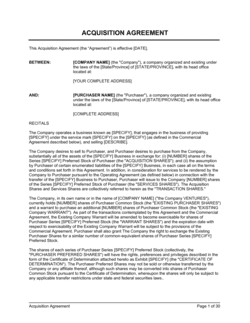
Acquisition and Cross Servicing Agreement Template

Free Word download • Edit online • Save & share with Drive • Export to PDF

6 pages25–35 min to fillDifficulty: ComplexSignature requiredLegal review recommended
Learn more ↓
FreeAcquisition and Cross Servicing Agreement Template

At a glance

What it is
An Acquisition and Cross Servicing Agreement (ACSA) is a binding legal contract under which two parties — typically governments, defense contractors, or allied organizations — agree to provide each other with logistics, supplies, services, and support on a reciprocal basis. This free Word download gives you a structured, lawyer-reviewable starting point you can edit online and export as PDF.
When you need it
Use it when two organizations need to share or exchange services, equipment, fuel, maintenance, transportation, or materiel under a formalized reciprocal arrangement — particularly in defense, aerospace, government contracting, or allied multinational operations.
What's inside
Parties and scope of support, categories of authorized support, ordering and acceptance procedures, pricing and reimbursement methodology, payment terms and currency, liability and indemnification, intellectual property, dispute resolution, term and termination, and governing law.

What is an Acquisition and Cross Servicing Agreement?

An Acquisition and Cross Servicing Agreement (ACSA) is a binding bilateral contract under which two parties formally authorize each other to acquire and provide logistics support, supplies, and services on a reciprocal, reimbursable basis. Originating as a framework for allied military forces operating under NATO and similar multilateral arrangements, the ACSA structure has been widely adopted in defense contracting, aerospace operations, government procurement, and multinational commercial logistics. The agreement establishes a master framework — covering authorized support categories, ordering procedures, reimbursement methodology, liability, and governing law — while individual transactions are documented through subordinate implementing arrangements that record the specifics of each exchange.

Why You Need This Document

Without a written ACSA, reciprocal support arrangements operate on informal terms that leave both parties exposed. When a support transaction goes wrong — delayed delivery, disputed quantities, damaged equipment, or an invoice that doesn't match expectations — there is no shared contractual framework to determine what was authorized, who bears the cost, and how disputes are resolved. The consequences are concrete: unpaid reimbursements compound across billing cycles, liability for loss or damage defaults to the jurisdiction's statutory rules rather than the parties' negotiated allocation, and intellectual property exchanged in the course of providing technical support may be retained or reused without restriction. For cross-border arrangements, currency ambiguity and the absence of a governing law clause add further risk. A properly executed ACSA eliminates these gaps by documenting every material term before the first transaction occurs — so both parties can focus on the support relationship rather than reconstructing what they agreed after a dispute arises.

Which variant fits your situation?

If your situation is…Use this template
Reciprocal logistics support between two allied national defense forcesAcquisition and Cross Servicing Agreement
General services exchange between two private commercial entitiesMutual Services Agreement
Long-term logistics and supply chain outsourcing to a single vendorLogistics Services Agreement
Sharing resources between government agencies at the same levelInteragency Agreement
Short-term equipment or asset loan between two organizationsEquipment Loan Agreement
Broad strategic partnership covering multiple shared servicesStrategic Alliance Agreement
Subcontracting specific support tasks under a prime government contractSubcontractor Agreement

Common mistakes to avoid

❌ Leaving Annex A (categories of support) blank or undefined

Why it matters: An undefined scope of support means any service request can be disputed as outside the agreement, creating friction on every transaction and potentially leaving the supplying party with no reimbursement obligation.

Fix: Complete Annex A exhaustively before signing, listing each support category, applicable sub-categories, and any explicit exclusions — update it by written amendment when new categories are needed.

❌ No currency specification on cross-border agreements

Why it matters: Without a stated currency of account, each party may calculate reimbursement in its home currency, producing different totals when exchange rates are applied — a dispute that compounds with every billing cycle.

Fix: State the currency of account explicitly in the payment terms clause and specify which exchange rate source and date governs conversion.

❌ Omitting a limitation of liability cap

Why it matters: Open-ended liability exposure makes the agreement commercially uninsurable and gives either party leverage to assert disproportionate damages claims whenever a dispute arises.

Fix: Insert a liability cap calibrated to the annual value of support exchanged — a common benchmark is 100–150% of the preceding year's total reimbursements under the agreement.

❌ Oral or informal ordering without a written implementing arrangement

Why it matters: Without written confirmation of each transaction, the parties have no shared record of what was ordered, when it was delivered, and at what price — making accurate reimbursement and dispute resolution practically impossible.

Fix: Require a written implementing arrangement for every support transaction, even for routine or repeat requests, and retain copies for the duration of the agreement plus any applicable audit retention period.

❌ Automatic renewal with no calendar reminder or notice procedure

Why it matters: Parties that intend to exit the arrangement miss the notice window and become contractually bound for another full term, with associated support obligations and payment commitments.

Fix: Insert a notice period of at least 90 days for non-renewal, and assign internal responsibility for tracking the renewal deadline from the date of signing.

❌ No IP or data rights clause when technical data is exchanged

Why it matters: Maintenance manuals, software, specifications, and operational data exchanged in the course of support deliveries create implied licenses if not addressed in writing — often broader than the providing party intended.

Fix: Include an IP and data rights clause specifying that shared technical data is licensed for the limited purpose of the agreement only, with no right to sublicense or use for unrelated purposes.

The 10 key clauses, explained

Parties, Recitals, and Purpose

In plain language: Identifies the contracting parties by full legal name, describes their organizational relationship, and states the purpose of the reciprocal support arrangement.

Sample language
This Acquisition and Cross Servicing Agreement ('Agreement') is entered into as of [DATE] by and between [PARTY A FULL LEGAL NAME] ('Party A') and [PARTY B FULL LEGAL NAME] ('Party B'). The parties desire to establish a framework for the mutual acquisition and provision of logistics support, supplies, and services on a reimbursable basis.

Common mistake: Identifying parties by trade name or acronym only — if the entity names don't match the signing authority's legal credentials, the agreement may be unenforceable against the correct legal entity.

Definitions and Scope of Support

In plain language: Enumerates the categories of authorized support that may be exchanged and defines key terms used throughout the agreement.

Sample language
'Authorized Support' means the categories of logistics support, supplies, and services set forth in Annex A, which may include fuel, transportation, maintenance, medical services, billeting, and spare parts, as agreed by the parties.

Common mistake: Leaving the scope of support undefined or referencing a blank Annex A — a vague scope invites disputes about whether a requested service was ever authorized.

Ordering and Acceptance Procedures

In plain language: Establishes the process by which one party formally requests support, how the supplying party accepts or declines, and what documentation governs each transaction.

Sample language
Requests for support shall be submitted by the Ordering Party using the form set out in Annex B. The Supplying Party shall confirm acceptance or rejection in writing within [X] business days. Each accepted request constitutes an Implementing Arrangement under this Agreement.

Common mistake: No written acceptance requirement — allowing oral requests to trigger obligations creates accounting ambiguity and makes disputed transactions nearly impossible to resolve.

Pricing and Reimbursement Methodology

In plain language: Specifies how the cost of support is calculated — whether on an actual-cost, standard-rate, or replacement-in-kind basis — and which party's cost accounting standards apply.

Sample language
Reimbursement for Authorized Support shall be calculated on the basis of [ACTUAL COST / REPLACEMENT-IN-KIND / STANDARD RATES] as specified in Annex C. Where actual cost applies, the Supplying Party shall provide itemized cost documentation within [30] days of delivery.

Common mistake: Mixing reimbursement methodologies across different support categories without clearly stating which method applies to which category — this routinely causes billing disputes that delay payment for months.

Payment Terms and Currency

In plain language: States the currency of account, the timeline for issuing invoices, when payment is due, and the procedure for raising billing disputes.

Sample language
All payments shall be made in [CURRENCY] within [60] days of receipt of a valid invoice. Disputed amounts shall be notified in writing within [20] days of invoice receipt, with undisputed amounts remaining due on the original schedule.

Common mistake: Omitting the currency of account on cross-border agreements — a USD vs. CAD ambiguity or EUR vs. GBP confusion can turn a straightforward reimbursement into a material financial discrepancy.

Liability, Indemnification, and Insurance

In plain language: Allocates risk between the parties for loss, damage, injury, or death arising from the provision or receipt of support, and sets out insurance requirements.

Sample language
Each party shall indemnify and hold harmless the other from any claims, damages, or losses arising from its own acts or omissions in the performance of this Agreement. Neither party shall be liable for indirect, consequential, or punitive damages. Each party shall maintain [insurance type] in a minimum amount of $[X].

Common mistake: No limitation of liability cap — open-ended liability exposure is uninsurable and gives either party leverage to threaten disproportionate damages claims in any dispute.

Intellectual Property and Data Rights

In plain language: Addresses ownership of any technical data, manuals, software, or innovations exchanged or developed in the course of providing support, and sets restrictions on use.

Sample language
Each party retains ownership of all intellectual property it contributes under this Agreement. Any technical data shared by the Supplying Party shall be used solely for the purposes of this Agreement and shall not be disclosed to third parties without prior written consent.

Common mistake: No IP clause at all in agreements involving maintenance, software integration, or technical support — the absence creates an implied license broader than either party intended.

Term, Renewal, and Termination

In plain language: Sets the initial term of the agreement, automatic renewal conditions, notice required to terminate, and provisions for completing outstanding transactions on termination.

Sample language
This Agreement shall commence on [START DATE] and remain in effect for [X] years, renewing automatically for successive [1]-year terms unless either party provides [90] days' written notice of non-renewal. Either party may terminate for cause upon [30] days' written notice if the other party materially breaches and fails to cure within the notice period.

Common mistake: Automatic renewal clauses without a notice period — parties that intend to exit an arrangement miss the renewal window and become bound for another full term.

Dispute Resolution and Governing Law

In plain language: Specifies the process for resolving disagreements — escalation, mediation, or arbitration — and identifies the jurisdiction whose law governs interpretation and enforcement.

Sample language
The parties shall attempt to resolve disputes through good-faith negotiation within [30] days of written notice. Unresolved disputes shall be submitted to binding arbitration under [AAA / ICC / LCIA] rules in [CITY], conducted in [LANGUAGE]. This Agreement is governed by the laws of [JURISDICTION].

Common mistake: Choosing a governing law with no connection to either party's jurisdiction — enforcement actions in a neutral forum add cost and delay, and courts may decline to apply unrelated law.

Confidentiality and Information Security

In plain language: Restricts disclosure of sensitive operational, financial, and technical information exchanged under the agreement, and sets minimum security standards for handling shared data.

Sample language
Each party shall treat all information designated 'Confidential' or 'Restricted' by the other party as confidential, use it only for purposes of this Agreement, and apply security measures no less protective than those it applies to its own confidential information of similar sensitivity.

Common mistake: No classification or marking requirement — without a mechanism for designating information as confidential, neither party knows which materials are protected and inadvertent disclosure becomes a contractual grey area.

How to fill it out

  1. 1

    Identify the parties and confirm signing authority

    Enter the full legal name and registered address of each party. Confirm that the individual signing on behalf of each party has documented authority — board resolution, power of attorney, or organizational authorization — to bind the entity.

    💡 For government entities, verify the specific statutory or regulatory authority under which the ACSA is being executed before inserting the parties block.

  2. 2

    Define and attach the categories of authorized support

    Complete Annex A by listing every category of support — fuel, maintenance, transportation, medical, billeting, spare parts — that either party may request. Be specific about sub-categories and any excluded items.

    💡 A support category not listed in Annex A cannot be ordered under the agreement — err on the side of inclusion for categories you might need, then restrict via the ordering procedure.

  3. 3

    Establish the ordering and acceptance procedure

    Complete Annex B with a standard request form covering: requesting party, support category, quantity, required delivery date, and delivery location. Set a realistic acceptance window — 3–5 business days is standard for non-emergency requests.

    💡 Build an emergency request track into the ordering procedure for time-critical support, with a shorter acceptance window and a phone-confirmation step.

  4. 4

    Select and document the reimbursement methodology

    Choose one method per support category: actual cost, replacement-in-kind, or standard rate. Complete Annex C with the applicable standard rates or cost-accounting standards if using rate-based reimbursement.

    💡 Replacement-in-kind is administratively simpler for commodities like fuel, but requires a clear quality specification — return of inferior-grade fuel does not satisfy the obligation.

  5. 5

    Set payment terms and currency

    Enter the agreed currency, invoice submission deadline (typically within 30 days of delivery), payment due date (typically Net 30 or Net 60 from invoice), and the dispute notification window.

    💡 For cross-border arrangements, specify whether exchange rates are fixed at the date of delivery, the date of invoice, or the date of payment — each produces a different reimbursement amount when currencies move.

  6. 6

    Complete the liability and indemnification block

    Agree and insert the limitation of liability cap — typically expressed as a multiple of the total annual value of support, or a fixed dollar amount. Confirm insurance minimums are achievable by both parties before signing.

    💡 For agreements involving high-risk activities like aircraft maintenance or medical support, consider requiring evidence of insurance (certificate of insurance) before the first transaction, not just at signing.

  7. 7

    Set the term, renewal, and termination mechanics

    Enter the start date, initial term length, automatic renewal conditions, and the notice period required to prevent renewal or terminate for convenience. Confirm that any outstanding implementing arrangements survive termination until settled.

    💡 Calendar a reminder 120 days before the non-renewal notice deadline so neither party accidentally rolls into an unwanted renewal term.

  8. 8

    Sign before the first transaction occurs

    Both authorized signatories must execute the agreement — and any required annexes — before any support is ordered or provided. Post-transaction signatures create gaps in coverage for the support already delivered.

    💡 Use timestamped electronic signatures to create an unambiguous execution record, particularly for cross-border parties in different time zones.

Frequently asked questions

What is an Acquisition and Cross Servicing Agreement?

An Acquisition and Cross Servicing Agreement (ACSA) is a bilateral legal contract under which two parties authorize each other to acquire and provide logistics support, supplies, and services on a reciprocal, reimbursable basis. Originally developed as a framework for allied military forces, the structure is now used in defense contracting, aerospace, government procurement, and multinational commercial logistics to govern the exchange of fuel, maintenance, transportation, and other operational support.

Who typically uses an Acquisition and Cross Servicing Agreement?

ACSAs are most commonly used by national defense departments and allied military organizations operating under NATO or similar frameworks. They are also used by defense contractors, aerospace companies, government procurement agencies, and multinational logistics operators that provide or receive reciprocal operational support across borders. Any two organizations that need a structured, legally enforceable framework for exchanging services and reimbursing each other can use this agreement structure.

How does reimbursement work under an ACSA?

Reimbursement typically follows one of three methods: actual cost (the receiving party pays the documented cost of the support provided), replacement-in-kind (the receiving party returns equivalent goods or materiel rather than paying cash), or standard rates (both parties agree to pre-set rates for each support category). The agreement specifies which method applies to each category of support, and implementing arrangements confirm the quantities and values for each specific transaction.

What is an implementing arrangement under an ACSA?

An implementing arrangement is a subordinate transaction document executed under the master ACSA that authorizes a specific exchange of support. It records the ordering party, support category, quantities, delivery location, delivery date, and agreed reimbursement for that transaction. The master ACSA sets the framework and terms; implementing arrangements activate and document each individual exchange. Without a signed implementing arrangement, there is no binding obligation to provide or pay for a specific support request.

Is an Acquisition and Cross Servicing Agreement legally binding?

Yes, an ACSA is generally enforceable as a binding contract when properly executed by authorized signatories on both sides, with a defined scope of support, reimbursement methodology, and governing law. For agreements between sovereign governments, enforceability is typically governed by the applicable international treaty framework or domestic implementing legislation. For commercial parties, standard contract law principles apply in the governing jurisdiction. Legal review is strongly recommended before execution.

What are the key differences between an ACSA and a standard services agreement?

A standard services agreement covers a defined scope of services provided by one party to the other for a fixed or variable fee, with no reciprocal obligation. An ACSA is specifically structured for reciprocal exchange — either party may be the ordering or supplying party on any given transaction. ACSAs also typically involve multiple categories of support governed by a master agreement with transaction-level implementing arrangements, while a standard services agreement usually covers a single defined service scope.

Do I need a lawyer to review this agreement?

Legal review is strongly recommended. ACSAs routinely involve cross-border obligations, regulatory compliance requirements, liability exposure for high-value or high-risk support categories, and potential interaction with government procurement regulations. A qualified attorney familiar with defense contracting, government procurement, or international commercial law can identify jurisdiction-specific requirements, confirm that signing authorities are properly documented, and tailor the liability and IP provisions to your specific risk profile.

How long does an ACSA typically last?

Most ACSAs have an initial term of two to five years, with automatic annual renewal unless either party provides advance written notice of non-renewal. The notice period for non-renewal is typically 60 to 90 days. Termination for cause — following a material breach that is not cured within a specified period — is usually available to both parties regardless of the term. Outstanding implementing arrangements at termination are typically allowed to run to completion under the original agreement terms.

Can an ACSA be used between private companies, or is it only for government entities?

The ACSA structure originated in intergovernmental defense logistics, but the framework is equally applicable to private commercial parties that need a reciprocal, multi-category support arrangement with transaction-level documentation. Defense contractors, aerospace operators, and multinational logistics companies regularly use ACSA-style agreements to govern mutual support arrangements. The substantive terms — scope, ordering, reimbursement, liability, IP, and dispute resolution — are standard commercial contract provisions that apply to private parties without modification.

How this compares to alternatives

vs Mutual Services Agreement

A mutual services agreement governs reciprocal service exchange between two commercial parties on broadly equal terms, typically for professional or administrative services. An ACSA is more operationally specific — it covers logistics support categories, implementing arrangement mechanics, and reimbursement methodologies designed for high-volume, multi-category exchanges. Use a mutual services agreement for simple reciprocal professional arrangements; use an ACSA when the exchange involves complex logistics, materiel, or regulated support categories.

vs Logistics Services Agreement

A logistics services agreement covers the provision of logistics services by one vendor to one client — it is a unidirectional arrangement. An ACSA is bilateral: either party may be the ordering or supplying party on any transaction. If your arrangement involves only one party providing logistics support to the other, a standard logistics services agreement is simpler and more appropriate.

vs Strategic Alliance Agreement

A strategic alliance agreement governs a broad commercial partnership — joint marketing, co-development, or shared market access — without necessarily involving direct service exchange or reimbursement. An ACSA is operationally specific, transaction-driven, and reimbursement-focused. If your relationship combines strategic partnership with reciprocal service exchange, you may need both documents — an alliance agreement for the strategic framework and an ACSA for the operational logistics layer.

vs Subcontractor Agreement

A subcontractor agreement engages a third party to perform a defined scope of work under a prime contract, with the subcontractor bearing performance obligations and the prime bearing client obligations. An ACSA creates a peer-to-peer framework in which either party may order or supply support — there is no prime/sub hierarchy. Use a subcontractor agreement when one party is delivering defined work under a prime contract obligation; use an ACSA when the arrangement is genuinely reciprocal.

Industry-specific considerations

Defense and Government Contracting

Governs logistics support exchange between allied national forces or prime and sub-contractors, with compliance requirements tied to FAR, DFARS, or equivalent procurement regulations.

Aerospace and Aviation

Covers reciprocal ground support, maintenance, fuel, and parts exchange between operators at shared or partnered facilities, with airworthiness documentation requirements attached to each implementing arrangement.

Multinational Logistics and Supply Chain

Enables reciprocal warehousing, transportation, and materiel exchange across borders, with currency, customs, and cross-border regulatory provisions critical to the reimbursement methodology.

Energy and Natural Resources

Used for reciprocal equipment, personnel, and emergency response support between operators in shared or adjacent fields, with liability allocation for environmental incidents a critical negotiation point.

Jurisdictional notes

United States

In the US, ACSAs between allied governments are authorized under 10 U.S.C. § 2342 and governed by implementing regulations under the Defense Federal Acquisition Regulation Supplement (DFARS). Commercial ACSAs between private parties are governed by standard contract law in the applicable state. California's implied covenant of good faith applies to all commercial contracts; choosing a neutral state like Delaware or New York for governing law is common for multi-party arrangements.

Canada

Canada participates in NATO ACSA frameworks through the Department of National Defence and is a party to multiple bilateral ACSAs with allied nations. Commercial ACSAs between private Canadian parties are governed by provincial contract law — Ontario and British Columbia are the most common governing law choices. Quebec-based parties should note that contracts subject to Quebec civil law operate under a distinct legal framework, and French-language requirements may apply to certain regulated sectors.

United Kingdom

The UK operates ACSAs with allied nations under the NATO logistics framework and bilateral defence cooperation agreements. Commercial ACSAs are governed by English law, which recognizes reciprocal service arrangements as binding contracts provided consideration flows both ways. Post-Brexit, UK-EU defence cooperation agreements are governed by separate bilateral frameworks rather than EU instruments. English courts are generally favored for dispute resolution in UK-governed commercial ACSAs.

European Union

EU member states operate within NATO logistics frameworks and the EU's Permanent Structured Cooperation (PESCO) for defence logistics. Commercial ACSAs between EU-based parties must comply with the GDPR where personal data is exchanged, and with applicable EU procurement directives if either party is a contracting authority. Governing law choices within the EU are subject to the Rome I Regulation, which may override contractual choice of law where mandatory rules of the performance country apply. Member state variations in defence procurement law are significant — legal review in the applicable national jurisdiction is advised.

Template vs lawyer — what fits your deal?

PathBest forCostTime
Use the templateCommercial parties establishing a straightforward bilateral support framework with clear scope and standard reimbursement termsFree2–4 hours to complete
Template + legal reviewCross-border arrangements, high-value support categories, or agreements involving regulated industries such as aerospace or defense contracting$600–$1,5003–7 days
Custom draftedIntergovernmental agreements, agreements subject to FAR/DFARS or equivalent procurement regulations, or arrangements involving classified information or high-risk liability exposure$3,000–$10,000+2–6 weeks

Glossary

Acquisition and Cross Servicing Agreement (ACSA)
A bilateral or multilateral agreement authorizing parties to acquire and provide logistics support, supplies, and services to each other on a reimbursable basis.
Logistics Support
The provision of food, water, fuel, transportation, ammunition, maintenance, medical services, spare parts, or other materiel required for operations.
Reimbursement Methodology
The agreed formula for calculating what one party owes the other for support rendered — typically cost, replacement-in-kind, or equal-value exchange.
Replacement-in-Kind
A reimbursement method where the receiving party returns identical goods or materiel rather than making a cash payment.
Ordering Party
The party requesting a specific category of support or service under the agreement in a given transaction.
Supplying Party
The party providing the requested support, materiel, or services to the ordering party under a specific transaction.
Categories of Support
The defined list of authorized support types — such as fuel, maintenance, medical, transportation, or billeting — that either party may request under the agreement.
Implementing Arrangement
A subordinate transaction document that activates a specific exchange of support under the master ACSA, specifying quantities, delivery, and reimbursement for that transaction.
Force Majeure
A clause excusing a party from performance obligations when delivery is prevented by events outside its reasonable control, such as war, natural disaster, or government action.
Limitation of Liability
A clause capping the maximum financial exposure of either party for losses arising from performance or non-performance under the agreement.
Mutual Indemnification
An arrangement in which each party agrees to defend and hold the other harmless from claims arising from its own acts, omissions, or negligence.

Part of your Business Operating System

This document is one of 3,000+ business & legal templates included in Business in a Box.

  • Fill-in-the-blanks — ready in minutes
  • 100% customizable Word document
  • Compatible with all office suites
  • Export to PDF and share electronically

Create your document in 3 simple steps.

From template to signed document — all inside one Business Operating System.
1
Download or open template

Access over 3,000+ business and legal templates for any business task, project or initiative.

2
Edit and fill in the blanks with AI

Customize your ready-made business document template and save it in the cloud.

3
Save, Share, Send, Sign

Share your files and folders with your team. Create a space of seamless collaboration.

Save time, save money, and create top-quality documents.

★★★★★

"Fantastic value! I'm not sure how I'd do without it. It's worth its weight in gold and paid back for itself many times."

Managing Director · Mall Farm
Robert Whalley
Managing Director, Mall Farm Proprietary Limited
★★★★★

"I have been using Business in a Box for years. It has been the most useful source of templates I have encountered. I recommend it to anyone."

Business Owner · 4+ years
Dr Michael John Freestone
Business Owner
★★★★★

"It has been a life saver so many times I have lost count. Business in a Box has saved me so much time and as you know, time is money."

Owner · Upstate Web
David G. Moore Jr.
Owner, Upstate Web

Run your business with a system — not scattered tools

Stop downloading documents. Start operating with clarity. Business in a Box gives you the Business Operating System used by over 250,000 companies worldwide to structure, run, and grow their business.

Free Forever Plan · No credit card required