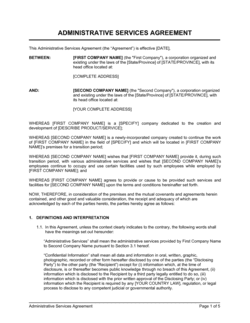
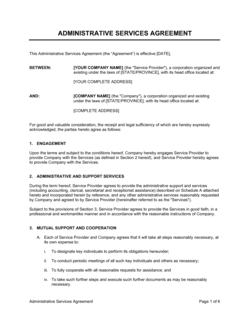
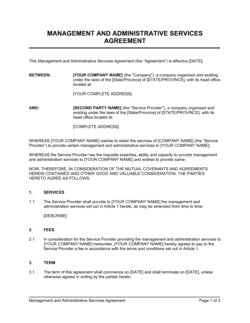
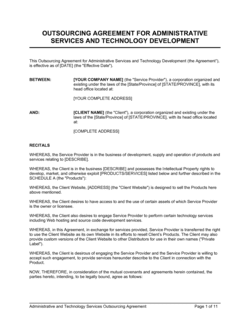
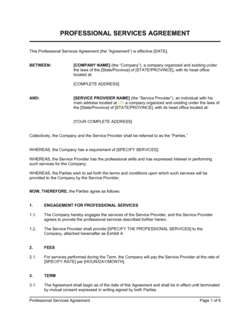
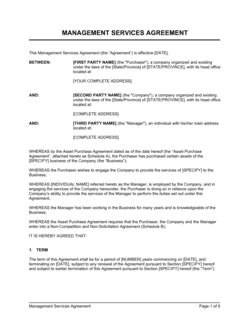
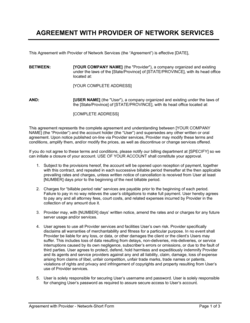
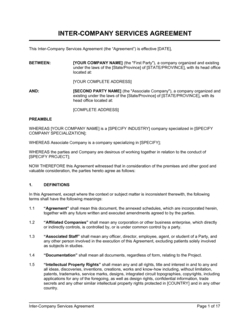
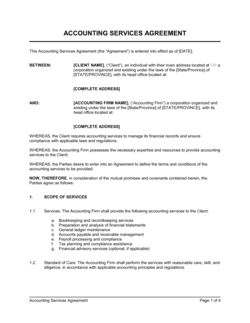
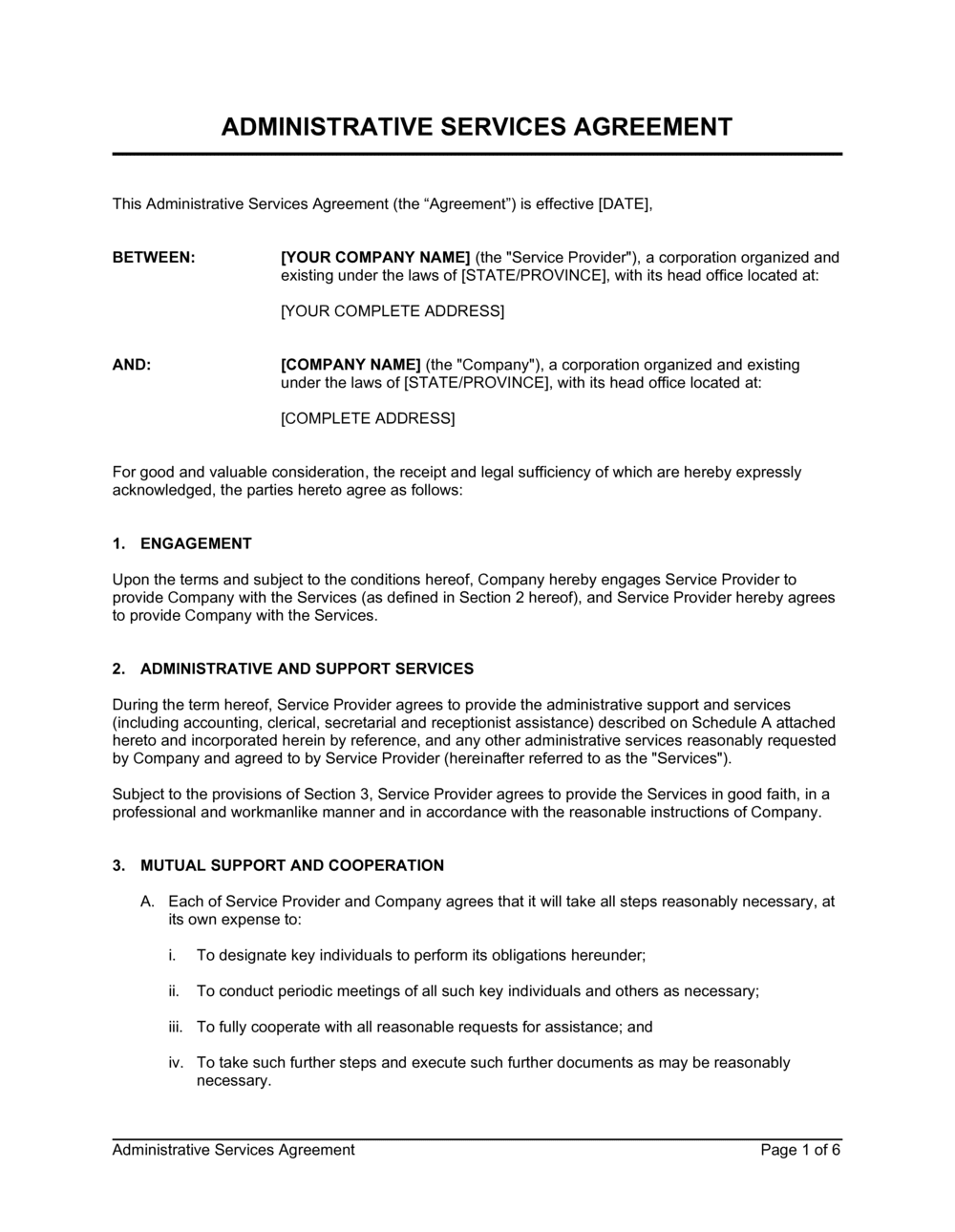
Administrative Services Agreement Template

Free Word download • Edit online • Save & share with Drive • Export to PDF

6 pages25–35 min to fillDifficulty: ComplexSignature requiredLegal review recommended
Learn more ↓
FreeAdministrative Services Agreement Template

At a glance

What it is
An Administrative Services Agreement is a binding contract between a company and an external provider engaged to deliver defined back-office or administrative functions — such as payroll processing, bookkeeping, HR administration, data entry, or facilities management. This free Word download gives you a professionally structured template you can edit online, tailor to your specific service scope, and export as PDF for execution.
When you need it
Use it whenever you outsource administrative or operational support functions to a third party — a specialist firm, shared-services entity, or affiliated company. It is especially important when the provider will access confidential data, handle financial records, or act on the company's behalf with vendors or regulators.
What's inside
Defined scope of services, fee structure and payment schedule, confidentiality and data-handling obligations, intellectual property ownership, representations and warranties, indemnification, liability limitation, term, and termination provisions including transition assistance on wind-down.

What is an Administrative Services Agreement?

An Administrative Services Agreement is a binding contract between a company and an external service provider engaged to perform defined back-office or operational support functions on an ongoing basis — covering activities such as payroll processing, bookkeeping, HR administration, data entry, facilities management, or regulatory compliance filings. Unlike a general service agreement or a one-off project contract, an administrative services agreement is built around a recurring, embedded relationship where the provider routinely accesses confidential data, acts on the company's behalf, and produces work product the company depends on operationally. It defines the exact scope of services in a written schedule, sets the fee structure and payment terms, governs confidentiality and data-handling obligations, assigns ownership of all deliverables to the client, and establishes clear exit mechanics — including transition assistance — to protect continuity when the arrangement ends.

Why You Need This Document

Operating without a signed administrative services agreement exposes you on every front that matters. A provider handling payroll or HR records without a confidentiality clause has no contractual obligation to protect your employee data — and no obligation to return or destroy it when the engagement ends. Without an explicit IP assignment, reports, process documentation, and custom tools the provider builds on your time may legally belong to them. Without a defined scope, the provider decides what is included, and disputes become credibility contests rather than contract interpretation. Without a transition assistance clause, a departing provider can walk away on the last day of their notice period with no obligation to hand over records, credentials, or institutional knowledge. This template gives you enforceable protections across all four fronts, structured for the specific demands of an ongoing back-office outsourcing relationship — ready to execute in under an hour.

Which variant fits your situation?

If your situation is…Use this template
Outsourcing payroll processing and tax filings to a specialist providerPayroll Services Agreement
Engaging a BPO firm for broad back-office operations across multiple functionsBusiness Process Outsourcing Agreement
Contracting an independent administrator for day-to-day office support tasksAdministrative Services Agreement
Hiring an individual virtual assistant rather than a companyIndependent Contractor Agreement
Delegating management functions between affiliated entities in a corporate groupManagement Services Agreement
Engaging an external firm to manage IT helpdesk and systems administrationIT Services Agreement
Outsourcing accounting functions with defined monthly deliverablesAccounting Services Agreement

Common mistakes to avoid

❌ Vague scope with no written schedule

Why it matters: When the scope is defined only as 'administrative support,' disagreements about what is included are inevitable — and the provider typically wins the ambiguity battle because courts construe vague contracts against the drafter.

Fix: Attach a Schedule A that lists every function, deliverable, and turnaround standard. Update it by written amendment whenever the scope changes.

❌ No transition assistance clause

Why it matters: A provider with no contractual obligation to assist with handover can walk away on the last day of the notice period, leaving the client without records, system access credentials, or any continuity plan.

Fix: Include a transition assistance clause requiring the provider to cooperate for 30–90 days post-termination at the existing fee rate, covering record transfer, system access, and successor briefings.

❌ Allowing the provider to start work without a signed agreement

Why it matters: Any confidential data shared and any work product created before execution are legally unprotected — the client has no contractual basis to claim ownership of reports or enforce confidentiality obligations.

Fix: Execute the agreement and any required DPA before the provider touches a single system, file, or data set. Use a digital signing tool to eliminate turnaround delays.

❌ Applying the liability cap to data-breach indemnities

Why it matters: A data breach involving payroll or HR records can trigger regulatory fines, class-action exposure, and remediation costs that far exceed 12 months of administrative fees — leaving the client with unrecoverable losses.

Fix: Carve data-breach indemnities out of the standard liability cap and set a separate, higher sub-limit that reflects the actual regulatory and remediation exposure for the specific data categories involved.

❌ No auto-renewal notice calendar reminder

Why it matters: A 60-day non-renewal notice window that passes unnoticed locks the client into another 12-month term with a provider they wanted to exit — a common and frustrating outcome.

Fix: Calendar the non-renewal notice deadline immediately upon signing — typically the contract end date minus the required notice period — and assign ownership of that deadline to a named person.

❌ Omitting a data processing agreement when personal data is involved

Why it matters: Under GDPR, processing personal data without a compliant DPA exposes both the client and the provider to fines of up to 4% of global annual turnover. Several US states impose similar requirements.

Fix: Attach a DPA as Exhibit B whenever the provider will access, process, or store personal data of employees, customers, or any other individuals — even incidentally.

The 10 key clauses, explained

Parties and recitals

In plain language: Identifies the client and the service provider as legal entities, states the date of the agreement, and briefly describes the purpose of the arrangement.

Sample language
This Administrative Services Agreement ('Agreement') is entered into as of [DATE] between [CLIENT LEGAL NAME], a [STATE/PROVINCE] [ENTITY TYPE] ('Client'), and [PROVIDER LEGAL NAME], a [STATE/PROVINCE] [ENTITY TYPE] ('Provider').

Common mistake: Using a trade name instead of the provider's registered legal entity name — if the provider is a sole proprietor operating under a DBA, the contract may be unenforceable against the individual without using their legal name.

Scope of services

In plain language: Defines precisely which administrative functions the provider will perform, referencing a Schedule A that lists tasks, deliverables, and performance standards in detail.

Sample language
Provider shall perform the administrative services described in Schedule A ('Services'). Any services not expressly listed in Schedule A require a written amendment signed by both parties.

Common mistake: Describing services in vague terms like 'general administrative support' — without a detailed schedule, disputes about what is in or out of scope are almost guaranteed when the relationship is stressed.

Fees, invoicing, and payment terms

In plain language: States the fee structure (hourly, monthly retainer, or per-task), invoicing frequency, payment due date, and late-payment consequences.

Sample language
Client shall pay Provider a monthly retainer of $[AMOUNT], invoiced on the first business day of each month and due within [30] days of invoice date. Overdue balances accrue interest at [1.5]% per month.

Common mistake: Omitting a late-payment interest clause — without it, the provider has no contractual remedy beyond demanding payment and risks disputes about what constitutes timely settlement.

Term, renewal, and termination

In plain language: Sets the initial contract period, whether it auto-renews, the notice period required to terminate for convenience, and the conditions under which either party may terminate for cause immediately.

Sample language
This Agreement commences on [START DATE] and continues for [12] months, renewing automatically for successive [12]-month periods unless either party provides [60] days' written notice of non-renewal. Either party may terminate for Cause upon [30] days' written notice if the other party materially breaches this Agreement and fails to cure within that period.

Common mistake: Setting the termination-for-convenience notice period shorter than the time needed to find a replacement provider — a 30-day exit clause for a complex payroll arrangement leaves the client dangerously exposed.

Confidentiality and data handling

In plain language: Prohibits the provider from disclosing or misusing the client's confidential information, defines what counts as confidential, and specifies how data is stored, secured, and deleted on termination.

Sample language
Provider shall hold all Confidential Information of Client in strict confidence, shall not disclose it to any third party without prior written consent, and shall use it solely to perform the Services. On termination, Provider shall return or destroy all Confidential Information within [15] business days.

Common mistake: Failing to specify a destruction or return obligation on termination — providers who retain client financial or HR records after the contract ends create ongoing data-breach and regulatory exposure.

Intellectual property and work product ownership

In plain language: Assigns ownership of all deliverables, reports, and systems created by the provider under the agreement to the client, while carving out the provider's pre-existing tools and methodologies.

Sample language
All Work Product created by Provider in performing the Services is the sole property of Client and is hereby assigned to Client. Nothing in this Agreement transfers ownership of Provider's pre-existing tools, templates, or proprietary methodologies ('Provider Background IP').

Common mistake: No IP assignment clause at all — without it, the provider may retain ownership of reports, process documentation, and custom tools built on the client's dime and refuse to hand them over on exit.

Representations and warranties

In plain language: Each party confirms that it has the legal authority to enter the agreement, that the provider's staff are qualified to perform the services, and that the services will be delivered with reasonable skill and care.

Sample language
Provider represents and warrants that: (a) it has full authority to enter this Agreement; (b) the personnel assigned to the Services are qualified and experienced; and (c) the Services will be performed in a professional manner consistent with industry standards.

Common mistake: Accepting a provider warranty limited to 'commercially reasonable efforts' without a skill-and-care standard — 'efforts' language lets a provider argue that any attempt, however poor, satisfies the warranty.

Indemnification

In plain language: Requires each party to compensate the other for losses caused by their own breach, negligence, or wilful misconduct — and specifically requires the provider to indemnify the client for data breaches caused by the provider's failures.

Sample language
Provider shall indemnify, defend, and hold harmless Client from any third-party claims, damages, and costs arising from Provider's negligence, wilful misconduct, or breach of this Agreement, including any data breach caused by Provider's failure to maintain required security standards.

Common mistake: Accepting mutual indemnification without carving out gross negligence and wilful misconduct — a provider who causes a regulatory breach should not benefit from an identical indemnity obligation to the one the client carries.

Limitation of liability

In plain language: Caps each party's total financial exposure under the agreement, typically at the fees paid in the prior 12 months, and excludes consequential, indirect, and punitive damages.

Sample language
Each party's total liability under this Agreement shall not exceed the total fees paid by Client to Provider in the [12] months preceding the claim. Neither party shall be liable for indirect, consequential, incidental, or punitive damages.

Common mistake: Applying the liability cap to the provider's indemnification obligations for data breaches — a data breach can trigger regulatory fines and class-action exposure far exceeding 12 months of admin fees, so data-breach indemnities should be carved out of the cap.

Governing law, dispute resolution, and entire agreement

In plain language: Specifies the jurisdiction whose law governs, the mechanism for resolving disputes (arbitration, mediation, or court), and confirms that the written agreement supersedes all prior discussions.

Sample language
This Agreement is governed by the laws of [STATE/PROVINCE/COUNTRY]. Any dispute shall first be submitted to non-binding mediation; if unresolved within [30] days, to binding arbitration administered by [AAA/JAMS] in [CITY]. This Agreement constitutes the entire agreement and supersedes all prior representations.

Common mistake: Choosing a governing law with no connection to either party's jurisdiction — some states and countries will refuse to apply the chosen law, leaving the parties in a forum-selection dispute on top of their underlying dispute.

How to fill it out

  1. 1

    Identify the parties using their full legal entity names

    Enter the client's and provider's registered legal names exactly as they appear in their corporate filings — not trade names or DBAs. Include entity type (LLC, Inc., Ltd.) and state or province of formation.

    💡 Cross-check the provider's entity name against the relevant corporate registry before signing — a misspelled or outdated name can make enforcement difficult.

  2. 2

    Build a detailed Schedule A defining every service

    List each administrative function the provider will perform, the expected output or deliverable, turnaround times, and any quality standards. Move everything granular to the schedule so the main agreement body stays clean and amendment-friendly.

    💡 Use measurable language — 'process payroll for up to [X] employees by the 25th of each month' — not 'handle payroll as needed.'

  3. 3

    Set the fee structure and payment mechanics

    Choose monthly retainer, hourly rate, or per-deliverable pricing and enter the specific amounts. Set the invoicing cycle, due date (Net 15 or Net 30), and the late-payment interest rate you will apply to overdue balances.

    💡 For variable-scope arrangements, include a not-to-exceed monthly cap or a change-order process to avoid invoice surprises.

  4. 4

    Define the term, auto-renewal window, and notice periods

    Set the initial contract length (typically 12 months), confirm whether it auto-renews, and enter the notice period for non-renewal and termination for convenience. Ensure the convenience notice period is long enough to complete a provider transition.

    💡 For arrangements involving access to financial systems or regulated data, a minimum 60-day transition notice is advisable regardless of how smoothly you expect exit to go.

  5. 5

    Complete the confidentiality and data-handling provisions

    Define what qualifies as Confidential Information, specify the security standards the provider must meet (ISO 27001, SOC 2, or equivalent), and include a data-return or destruction timeline triggered on termination.

    💡 If the provider will process personal data of employees or customers, attach a Data Processing Agreement as a separate exhibit — required under GDPR and increasingly expected under US state privacy laws.

  6. 6

    Tailor the indemnification and liability cap

    Set the mutual indemnification obligations and the liability cap amount (typically 12 months of fees). Decide whether data-breach indemnities should be carved out of the cap given the potential regulatory exposure.

    💡 For providers handling payroll or HR data, consider a separate, higher sub-cap for data-breach events — regulatory fines alone can exceed a full year of service fees.

  7. 7

    Add transition assistance obligations

    Include a clause requiring the provider to cooperate with handover for a defined period — typically 30 to 90 days — after notice of termination, including transferring records, briefing a successor, and maintaining service levels during wind-down.

    💡 Specify that transition assistance fees are payable at the existing rate — providers who negotiate exit cooperation as a separate engagement gain leverage you will regret giving them.

  8. 8

    Execute before services begin

    Both parties must sign before the provider commences work. Allowing a provider to start without a signed agreement means any IP created and any confidential data accessed are unprotected from the outset.

    💡 Use Business in a Box eSign to timestamp execution and store the fully executed copy securely — date-stamped execution is important evidence if a breach or dispute arises later.

Frequently asked questions

What is an administrative services agreement?

An administrative services agreement is a binding contract between a company (the client) and a third-party provider engaged to deliver defined back-office or operational support functions — such as payroll processing, bookkeeping, HR administration, facilities management, or data entry. It defines the scope of services, fees, confidentiality obligations, IP ownership, and termination rights, creating enforceable obligations on both sides for the duration of the engagement.

When do I need an administrative services agreement?

You need one any time you outsource a recurring administrative function to a third party — particularly when that provider will access confidential financial or HR data, act on your behalf with regulators or vendors, or produce deliverables you need to own. A verbal or informal email arrangement offers no protection over IP, data confidentiality, or service levels, and creates ambiguity about termination rights.

What is the difference between an administrative services agreement and an independent contractor agreement?

An independent contractor agreement typically governs a single individual performing project-based or task-specific work. An administrative services agreement governs an ongoing services relationship with an entity — a firm or company — that delivers a defined suite of operational functions over a multi-month term. The administrative services agreement is more detailed on scope, SLAs, data handling, IP assignment, and transition obligations because the relationship is more embedded and longer in duration.

Does an administrative services agreement need to be reviewed by a lawyer?

For straightforward arrangements with a small bookkeeping or admin support firm, a well-structured template typically covers the key protections. Legal review is advisable when the provider will access regulated data (payroll, health, or financial records), when the arrangement involves a material fee commitment, or when the provider is an affiliated entity in a corporate group where transfer-pricing and regulatory rules apply. A 1–2 hour review typically costs $300–$600 and is worthwhile for any engagement with significant data or IP exposure.

Who owns the work product created under an administrative services agreement?

Ownership depends on what the contract says. Without an explicit IP assignment clause, the provider may retain ownership of reports, process documentation, and custom tools created during the engagement under the work-for-hire doctrine — which does not automatically apply to services performed by a company rather than an individual employee. The agreement should expressly assign all work product to the client while carving out the provider's pre-existing tools and methodologies.

What happens to confidential data when the agreement ends?

The contract should include a specific obligation requiring the provider to return or destroy all confidential data within a defined period after termination — typically 15 to 30 business days. Without this clause, providers may retain client financial records, employee data, or system credentials indefinitely, creating ongoing data-breach and regulatory exposure. If personal data is involved, the GDPR and several US state privacy laws require a documented data-return or deletion process.

What notice period should I require for termination?

The appropriate notice period depends on how deeply the provider is embedded in your operations. For light-touch admin support, 30 days is typical. For payroll processing, HR administration, or arrangements where the provider manages system access and critical records, 60 to 90 days is more appropriate — enough time to select and onboard a replacement before the outgoing provider's obligations end. Always pair the notice period with a transition assistance clause.

Is an administrative services agreement the same as a management services agreement?

They are closely related but typically used in different contexts. A management services agreement usually governs the provision of strategic, financial, or executive management functions — often between affiliated entities in a corporate group. An administrative services agreement covers operational and back-office support functions delivered by an external vendor. Both follow a similar legal structure, but management services agreements often include transfer-pricing considerations, intercompany fee policies, and regulatory disclosures not found in standard admin services contracts.

Do I need a separate data processing agreement?

Yes, if the provider will process personal data — employee payroll records, customer contact information, or any other individually identifiable data. Under GDPR, a compliant DPA is legally required and must be in place before any personal data is shared. Several US states, including California under the CPRA, impose similar DPA requirements. The DPA should be attached as an exhibit to the administrative services agreement and executed simultaneously.

How this compares to alternatives

vs Independent Contractor Agreement

An independent contractor agreement governs a single individual performing defined project-based tasks, typically on a short-term or non-recurring basis. An administrative services agreement governs an ongoing services relationship with a business entity delivering a suite of operational functions. The admin services agreement is broader in scope, more detailed on data handling and IP assignment, and typically includes SLAs and transition obligations not found in standard contractor agreements. Use the contractor agreement for individual engagements; use the admin services agreement for embedded, multi-function outsourcing relationships.

vs Service Agreement

A general service agreement covers a wide range of one-off or project-based service engagements without the operational depth needed for recurring back-office functions. An administrative services agreement adds SLAs, transition assistance, data-return obligations, and IP assignment provisions that a general service agreement typically omits. Use a general service agreement for discrete professional engagements; use the administrative services agreement when the provider is performing ongoing operational functions that are embedded in your business.

vs Management Services Agreement

A management services agreement typically governs strategic, financial, or executive management functions — commonly between affiliated entities in a corporate group — and often includes transfer-pricing, intercompany fee disclosures, and board-level oversight provisions. An administrative services agreement covers operational and back-office support from an external vendor and focuses on service delivery, data protection, and exit mechanics. The two documents follow a similar legal structure but serve distinct commercial purposes.

vs Employment Contract

An employment contract governs a direct employment relationship with all associated entitlements — benefits, statutory notice, IP assignment, and employment law protections. An administrative services agreement governs a business-to-business outsourcing arrangement with no employment entitlements. Engaging an admin services provider instead of an employee carries misclassification risk if the provider operates like an employee — one test is the degree of control exercised over how the work is performed. When in doubt, legal advice on classification is worthwhile.

Industry-specific considerations

Financial Services

Regulatory record-keeping requirements, data retention schedules under SEC or FINRA rules, and enhanced confidentiality for client financial data all require tailored scope and data-handling provisions.

Healthcare

Any administrative provider touching patient scheduling, billing records, or insurance claims must comply with HIPAA — a Business Associate Agreement must be attached alongside the services agreement.

Professional Services

Law firms, accounting practices, and consultancies outsourcing conflict-check administration, billing support, or document management need strong confidentiality clauses covering privileged and client-confidential materials.

Technology / SaaS

SaaS companies outsourcing HR administration or finance operations need SOC 2 compliance requirements embedded in the SLA and system-access termination procedures tied to the offboarding timeline.

Manufacturing

Procurement administration, supplier payment processing, and inventory record management require defined turnaround SLAs and clear ownership of supplier contracts and pricing data.

Retail / E-commerce

High transaction volumes in accounts-payable and accounts-receivable administration require error-rate SLAs, reconciliation reporting cadences, and explicit ownership of customer payment data.

Jurisdictional notes

United States

No single federal statute governs administrative services agreements, but several regulatory regimes intersect — HIPAA for health data, GLBA for financial data, and FTC Safeguards Rules for consumer financial information. Several states (California, Virginia, Colorado) impose DPA requirements when personal data is processed. Non-compete restrictions on provider key personnel vary significantly by state; California prohibits most post-engagement restrictions entirely.

Canada

PIPEDA (and Quebec's Law 25, which imposes GDPR-comparable obligations) require a written data-processing agreement when a service provider handles personal information on behalf of the client. Provincial employment standards do not apply to arms-length service providers, but worker misclassification rules are actively enforced by CRA — ensure the provider genuinely operates as an independent business. Quebec contracts should include a French-language version or translation clause for provincially regulated entities.

United Kingdom

UK GDPR and the Data Protection Act 2018 require a compliant controller-processor agreement whenever a provider processes personal data — this must be attached as a mandatory exhibit. IR35 off-payroll working rules apply if the provider's personnel operate like employees of the client; a status determination statement may be required. Post-Brexit, cross-border data transfers from the UK to non-adequate countries require additional safeguards such as International Data Transfer Agreements.

European Union

GDPR Article 28 mandates a written Data Processing Agreement before any personal data is shared with the provider — fines for non-compliance can reach 4% of global annual turnover or EUR 20 million, whichever is higher. Several member states (Germany, France, the Netherlands) impose additional sector-specific requirements for financial and HR data. Post-employment non-compete restrictions on provider personnel typically require financial compensation to be enforceable, and standard contractual clauses are required for data transfers to non-EEA countries.

Template vs lawyer — what fits your deal?

PathBest forCostTime
Use the templateSmall businesses and startups outsourcing standard admin functions to a reputable third-party firm with limited data exposureFree30–45 minutes
Template + legal reviewArrangements involving payroll, HR data, financial records, or providers with access to regulated personal data$300–$6002–4 days
Custom draftedComplex multi-function BPO engagements, intercompany management services in regulated industries, or arrangements with material liability exposure$1,500–$4,000+1–3 weeks

Glossary

Scope of Services
The specific administrative tasks and deliverables the provider is contractually obligated to perform, listed in a schedule or exhibit.
Service Level Agreement (SLA)
Performance standards attached to the contract specifying minimum quality, turnaround times, or accuracy rates the provider must meet.
Statement of Work (SOW)
A schedule to the agreement describing a particular project or service package in detail, including deliverables, timelines, and fees.
Indemnification
A clause requiring one party to compensate the other for specific losses, claims, or liabilities arising from defined events — such as the provider's negligence.
Limitation of Liability
A cap on the maximum amount one party can recover from the other, typically expressed as a multiple of fees paid in a trailing 12-month period.
Confidential Information
Non-public business data — financial records, employee information, customer lists, or trade processes — that the provider must protect and not disclose.
Data Processing Agreement (DPA)
A supplementary contract required when the provider processes personal data on the company's behalf, governing how that data is handled and protected.
Term and Renewal
The initial duration of the agreement and whether it renews automatically at expiry unless either party provides written notice to terminate.
Transition Assistance
An obligation on the outgoing provider to cooperate with handover activities — transferring records, briefing a successor, and maintaining services during a wind-down period.
Work Product
Documents, reports, data, or systems created by the provider in performing the services, which the agreement typically assigns to the client company.
Force Majeure
A clause excusing a party from performance obligations when extraordinary events outside their control — natural disasters, government shutdowns — make performance impossible.

Part of your Business Operating System

This document is one of 3,000+ business & legal templates included in Business in a Box.

  • Fill-in-the-blanks — ready in minutes
  • 100% customizable Word document
  • Compatible with all office suites
  • Export to PDF and share electronically

Create your document in 3 simple steps.

From template to signed document — all inside one Business Operating System.
1
Download or open template

Access over 3,000+ business and legal templates for any business task, project or initiative.

2
Edit and fill in the blanks with AI

Customize your ready-made business document template and save it in the cloud.

3
Save, Share, Send, Sign

Share your files and folders with your team. Create a space of seamless collaboration.

Save time, save money, and create top-quality documents.

★★★★★

"Fantastic value! I'm not sure how I'd do without it. It's worth its weight in gold and paid back for itself many times."

Managing Director · Mall Farm
Robert Whalley
Managing Director, Mall Farm Proprietary Limited
★★★★★

"I have been using Business in a Box for years. It has been the most useful source of templates I have encountered. I recommend it to anyone."

Business Owner · 4+ years
Dr Michael John Freestone
Business Owner
★★★★★

"It has been a life saver so many times I have lost count. Business in a Box has saved me so much time and as you know, time is money."

Owner · Upstate Web
David G. Moore Jr.
Owner, Upstate Web

Run your business with a system — not scattered tools

Stop downloading documents. Start operating with clarity. Business in a Box gives you the Business Operating System used by over 250,000 companies worldwide to structure, run, and grow their business.

Start free · No credit card required