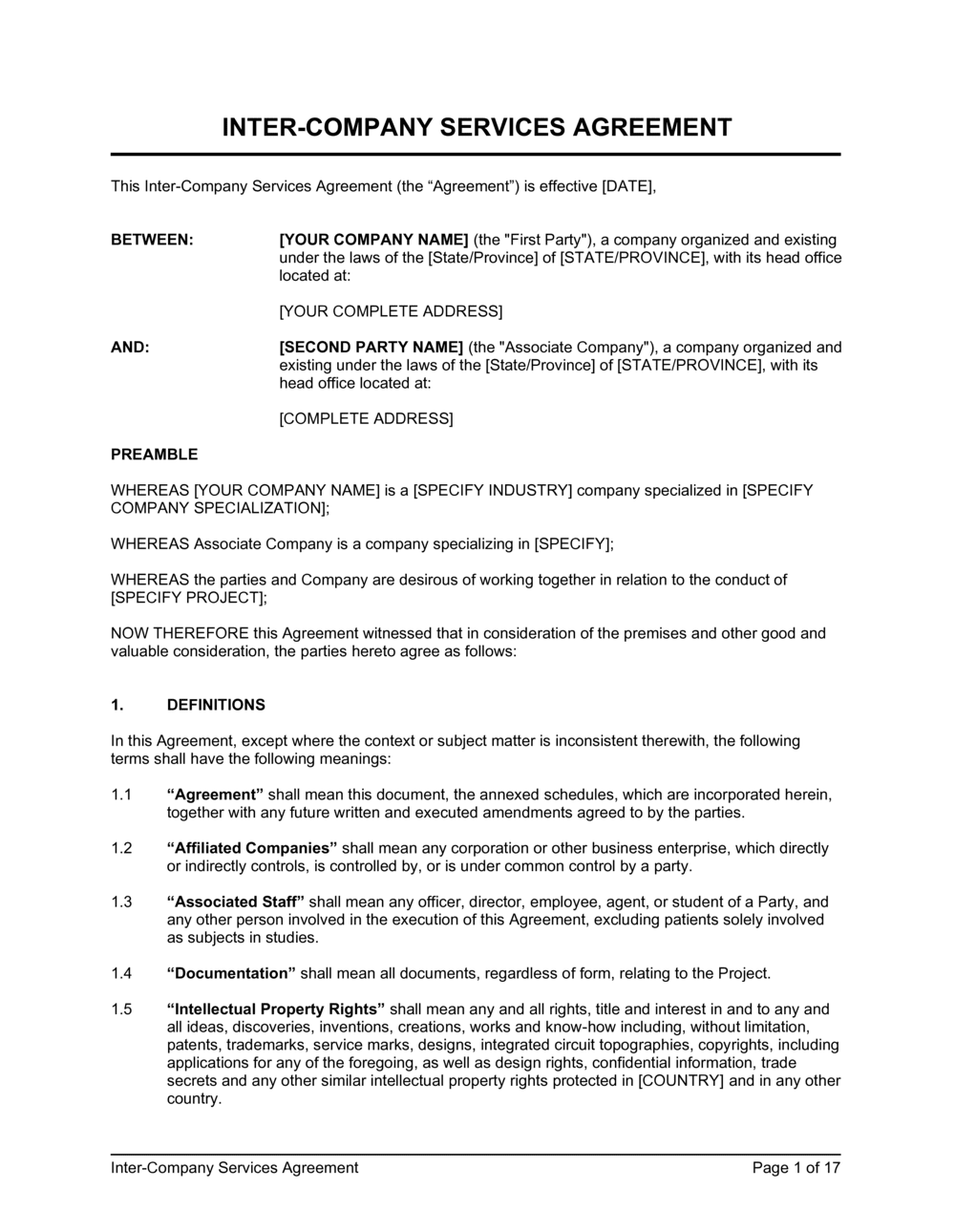
Inter-Company Services Agreement Template

Free Word download • Edit online • Save & share with Drive • Export to PDF

17 pages30–45 min to fillDifficulty: ComplexSignature requiredLegal review recommended
Learn more ↓
FreeInter-Company Services Agreement Template

At a glance

What it is
An Inter Company Services Agreement is a legally binding contract between two or more entities within the same corporate group that governs the provision of services — such as IT support, management consulting, HR administration, or shared finance functions — from one entity to another. This free Word download gives you a structured, audit-ready starting point you can edit online and export as PDF for execution by all relevant entities.
When you need it
Use it whenever a parent company, subsidiary, or affiliate provides services to another entity in the same group, particularly where the arrangement crosses tax jurisdictions or where a regulator, auditor, or lender requires documented arm's-length terms between related parties.
What's inside
Service scope and description, fee structure and payment terms, transfer pricing methodology, IP ownership, confidentiality, liability limits, term and termination, and governing law — all in a single document designed to satisfy both corporate governance and tax authority requirements.

What is an Inter Company Services Agreement?

An Inter Company Services Agreement is a legally binding contract between two or more entities within the same corporate group that governs the provision of services — such as IT infrastructure, management consulting, HR administration, treasury functions, or shared finance operations — by one entity to another. Unlike a standard commercial service agreement between unrelated parties, an intercompany services agreement must satisfy both corporate governance requirements and the arm's-length standards imposed by tax authorities in every jurisdiction where the participating entities operate. It documents the scope of services, the fee and transfer pricing methodology, IP ownership, confidentiality obligations, liability limits, and termination terms in a single enforceable document.

Why You Need This Document

Without a written inter company services agreement, service charges between group entities have no documented basis — and tax authorities in the US, Canada, the UK, and across the EU will treat undocumented intercompany fees as non-arm's-length arrangements, potentially reclassifying them as non-deductible expenses or disguised dividends and imposing back taxes, interest, and penalties of 20–40% of the adjustment. Auditors cannot accept related-party charges in financial statements without supporting documentation, and lenders conducting due diligence on a financing or acquisition will flag the absence of formal intercompany agreements as a governance deficiency. A properly executed agreement — completed before services begin, with a defined transfer pricing methodology and annual review mechanism — protects both entities, satisfies regulatory requirements across jurisdictions, and eliminates the single most avoidable trigger for a transfer pricing audit.

Which variant fits your situation?

If your situation is…Use this template
Parent company providing management services to a wholly owned subsidiaryInter Company Services Agreement
Two sibling subsidiaries sharing IT infrastructure costsCost-Sharing Agreement
Group entity licensing intellectual property to a subsidiaryIntercompany IP Licensing Agreement
Parent lending funds to a subsidiary under formal termsIntercompany Loan Agreement
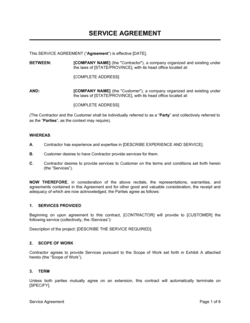
Engaging an unrelated third-party service providerService Agreement
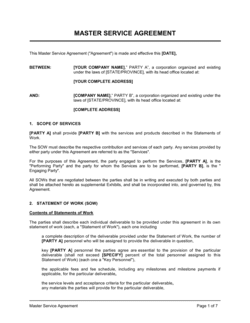
Consolidating multiple intragroup arrangements under a master frameworkMaster Services Agreement
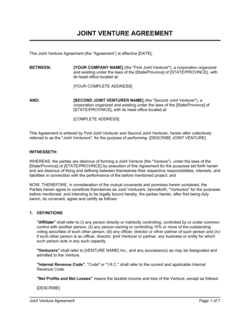
Formalizing a joint venture between two group entitiesJoint Venture Agreement

Common mistakes to avoid

❌ Defining services too broadly

Why it matters: Catch-all service descriptions like 'management support as needed' give tax authorities grounds to argue the arrangement is a disguised profit distribution rather than a genuine service charge, triggering adjustments and penalties.

Fix: List every service category by name in a dedicated schedule with a brief description and estimated resource allocation. Update the schedule annually to reflect any changes in scope.

❌ Omitting a transfer pricing methodology clause

Why it matters: Without a documented pricing method, the agreement cannot demonstrate arm's-length terms. Tax authorities in the US, Canada, UK, and EU all require contemporaneous documentation — the absence of it shifts the burden of proof to the taxpayer.

Fix: Include a clause identifying the chosen transfer pricing method, the markup rate, and a reference to the supporting benchmarking analysis. Attach the analysis as a schedule or cross-reference it in the transfer pricing documentation file.

❌ Leaving the agreement unsigned until after services begin

Why it matters: An undated or backdated intercompany agreement is treated with deep skepticism by tax authorities and auditors. It signals that the arrangement was documented after the fact to justify a recharge rather than as a genuine contemporaneous commercial arrangement.

Fix: Execute the agreement on or before the service commencement date. If services have inadvertently started, correct through a board resolution and execute the agreement immediately — do not backdate.

❌ No annual review or fee adjustment mechanism

Why it matters: A fixed fee that does not change for three or four years while the underlying cost base fluctuates will eventually diverge from arm's-length pricing, exposing both entities to transfer pricing adjustments in the years the divergence is largest.

Fix: Include an annual cost-reconciliation and true-up clause that adjusts the fee to reflect the prior year's actual costs plus the agreed markup, with the adjustment settled within 60 days of year-end.

❌ Using the same agreement template for all intercompany relationships regardless of direction

Why it matters: An agreement drafted for a parent-to-subsidiary service relationship does not accurately reflect the obligations in a sibling-to-sibling arrangement — the risk allocation, IP ownership defaults, and governing-law logic differ materially.

Fix: Create separate agreements for each distinct service relationship in the group, each with schedules tailored to the actual services and entities involved. A master framework agreement can reduce duplication while preserving bilateral specificity.

❌ Failing to address withholding tax obligations in cross-border arrangements

Why it matters: Service fees paid across international borders are often subject to withholding tax in the recipient's jurisdiction. If the agreement is silent, the recipient may deduct withholding and the provider receives less than anticipated, creating a dispute and a potential cash shortfall.

Fix: Include a clause allocating withholding tax responsibility — typically the recipient remits and grosses up the payment so the provider receives the full contracted fee — and confirm treaty entitlement before executing.

The 9 key clauses, explained

Parties and Recitals

In plain language: Identifies both the service provider entity and the service recipient entity by their full legal names, jurisdictions of incorporation, and registered addresses, and explains the commercial rationale for the arrangement.

Sample language
This Inter Company Services Agreement is entered into as of [DATE] between [SERVICE PROVIDER LEGAL NAME], a [ENTITY TYPE] incorporated in [JURISDICTION] ('Provider'), and [SERVICE RECIPIENT LEGAL NAME], a [ENTITY TYPE] incorporated in [JURISDICTION] ('Recipient'). Provider and Recipient are members of the [GROUP NAME] corporate group.

Common mistake: Using informal group or trade names instead of full registered legal entity names. Mismatched names create enforceability problems and fail tax authority documentation requirements.

Scope of Services

In plain language: Describes in specific terms the services the provider will deliver, the personnel or departments responsible, and any service level standards. Typically accompanied by a Schedule A.

Sample language
Provider shall deliver to Recipient the services described in Schedule A ('Services'), including [SERVICE CATEGORY — e.g., group IT infrastructure support, management advisory, finance and accounting functions]. Services shall be performed to the standard described in Schedule B.

Common mistake: Using vague catch-all language like 'management services as required.' Tax authorities and auditors treat undefined scope as evidence of a non-arm's-length arrangement, increasing the risk of a transfer pricing adjustment.

Service Fees and Payment Terms

In plain language: States the fee structure — fixed monthly charge, cost-plus markup, or time-and-materials rate — the invoicing frequency, the payment deadline, and the currency of settlement.

Sample language
Recipient shall pay Provider a monthly service fee of [AMOUNT] [CURRENCY], calculated on a cost-plus basis at [X]% markup over Provider's direct and allocated indirect costs. Invoices shall be issued on the first business day of each month and are payable within [30] days of receipt.

Common mistake: Agreeing a fixed fee without any mechanism to adjust for changes in cost or scope. Fixed fees that diverge significantly from actual costs over time attract transfer pricing scrutiny and may be recharacterized by tax authorities.

Transfer Pricing Methodology

In plain language: Documents the method used to price the services — typically cost-plus or comparable uncontrolled price — and commits both parties to maintaining contemporaneous documentation supporting the arm's-length nature of the charge.

Sample language
The Service Fees have been determined using the [COST-PLUS / COMPARABLE UNCONTROLLED PRICE] method in accordance with the OECD Transfer Pricing Guidelines. Both parties shall maintain contemporaneous documentation as required by applicable tax laws and shall cooperate to support any audit or inquiry by a tax authority.

Common mistake: Omitting the transfer pricing methodology from the agreement entirely and relying on a separate policy document. If the agreement and the internal policy are inconsistent, the discrepancy becomes the first point of attack in a transfer pricing audit.

Intellectual Property Ownership

In plain language: Clarifies who owns any IP, tools, methodologies, or deliverables created or used in performing the services, and what license the recipient has to use any provider-owned IP.

Sample language
All pre-existing IP of Provider used in delivering the Services remains the sole property of Provider. Any work product created specifically for Recipient under this Agreement ('Deliverables') shall be owned by [PROVIDER / RECIPIENT], subject to a perpetual, royalty-free license granted to [THE OTHER PARTY] for internal business purposes.

Common mistake: Leaving IP ownership silent in the agreement. Without explicit allocation, ownership of custom deliverables is governed by statute — and the default rule varies materially between the US, UK, and EU.

Confidentiality

In plain language: Obliges each party to protect the other's confidential information — financials, strategies, customer data, and systems — both during and after the term of the agreement.

Sample language
Each party agrees to hold the other's Confidential Information in strict confidence and not to disclose it to any third party without prior written consent. This obligation survives termination of this Agreement for a period of [3] years.

Common mistake: Using a mutual confidentiality clause when the information flow is entirely one-directional. While mutual clauses are harmless, a one-way clause is cleaner and avoids implying that the recipient has confidential information to protect.

Liability and Indemnification

In plain language: Caps the provider's aggregate liability for failures in service delivery, excludes consequential and indirect damages, and sets out each party's indemnification obligations.

Sample language
Provider's aggregate liability under this Agreement shall not exceed the total Service Fees paid in the [12] months preceding the event giving rise to the claim. Neither party shall be liable for indirect, consequential, or punitive damages. Each party shall indemnify the other against third-party claims arising from its own negligence or wilful misconduct.

Common mistake: Setting no liability cap at all between related entities on the assumption that intragroup disputes will never be litigated. Uncapped liability creates material contingent exposures that must be disclosed in consolidated financial statements.

Term and Termination

In plain language: Sets the initial duration of the agreement, the conditions for renewal, and the notice periods and grounds for early termination — including termination for cause and for convenience.

Sample language
This Agreement commences on [START DATE] and continues for an initial term of [1 YEAR], renewing automatically for successive [1-YEAR] periods unless either party gives [90] days' written notice of non-renewal. Either party may terminate immediately for material breach not cured within [30] days of written notice.

Common mistake: Auto-renewal without a notice period longer than the invoicing cycle. If the agreement renews faster than the recipient can reasonably react to a new invoice, the renewal may later be disputed as involuntary.

Governing Law and Dispute Resolution

In plain language: Specifies which jurisdiction's law governs the agreement and the mechanism for resolving disputes — typically arbitration or the courts of the governing jurisdiction.

Sample language
This Agreement is governed by the laws of [GOVERNING JURISDICTION]. Any dispute shall be referred first to senior management of each party for a [30]-day resolution period, failing which it shall be resolved by binding arbitration under the [ICC / AAA / LCIA] Rules in [CITY].

Common mistake: Choosing a governing law that differs from the jurisdiction of both parties with no commercial rationale. Tax authorities and courts in the parties' home jurisdictions may override an arbitrary governing-law choice when assessing the agreement's validity.

How to fill it out

  1. 1

    Identify and name both entities correctly

    Enter the full registered legal name, jurisdiction of incorporation, registration number, and registered address for both the service provider and the service recipient. Confirm these against your corporate registry filings.

    💡 Cross-reference the entity names against your group structure chart to ensure you are documenting the correct bilateral relationship — groups with three or more entities often need separate agreements for each service pair.

  2. 2

    Define the scope of services in Schedule A

    List every service category the provider will deliver — management, IT, HR, treasury, legal, compliance — with a brief description of what each category includes. Avoid generic language like 'management services as needed.'

    💡 The more specific Schedule A is, the easier it is to defend the associated fee in a transfer pricing audit. Include estimated hours or resource allocations per service category where possible.

  3. 3

    Select and document the transfer pricing method

    Choose the pricing method — cost-plus is most common for support services — and set the markup percentage. Document the benchmarking analysis or comparables that support the chosen rate and attach it as Schedule C.

    💡 A markup of 5–15% is typical for routine support services in most OECD jurisdictions. Markups above 20% require stronger benchmarking support to withstand scrutiny.

  4. 4

    Set the fee amount, invoicing frequency, and currency

    Enter the monthly or quarterly service fee, confirm the invoicing schedule, and state the currency. For cross-border arrangements, specify whether fees will be adjusted annually to reflect changes in the underlying cost base.

    💡 Include a cost-reconciliation mechanism — e.g., an annual true-up comparing estimated charges to actual costs — to keep the fee defensible as arm's-length over time.

  5. 5

    Allocate IP and specify the license terms

    Decide whether deliverables remain with the provider (licensed to the recipient) or transfer to the recipient. Document any pre-existing IP used in service delivery and confirm the license scope and duration.

    💡 If the recipient is paying for the development of proprietary tools or systems, consider whether the recipient should own the output — failing to do so may create an unintended royalty obligation later.

  6. 6

    Set the liability cap and indemnification terms

    Agree an aggregate liability cap — typically 12 months of service fees — and confirm that consequential damages are excluded. Identify which party bears third-party claim indemnification obligations and under what conditions.

    💡 Ensure the liability cap is consistent with any umbrella indemnification policy in your group governance framework to avoid conflicting obligations.

  7. 7

    Confirm governing law and dispute resolution

    Select a governing jurisdiction that has a meaningful connection to at least one of the parties. For cross-border arrangements, consider arbitration rather than litigation to avoid jurisdictional uncertainty.

    💡 Where the service provider and recipient are in different countries, choosing a neutral arbitral seat — London, Singapore, or New York — reduces the risk that one party's home courts gain procedural advantage.

  8. 8

    Execute before services begin and keep copies on file

    Both authorized signatories must execute the agreement — and any schedules — before service delivery commences. Store fully executed copies alongside your transfer pricing documentation file.

    💡 Backdating an intercompany agreement is a significant tax risk. If services have already begun, execute contemporaneously and document the prior period through a board resolution or intercompany account reconciliation.

Frequently asked questions

What is an inter company services agreement?

An inter company services agreement is a legally binding contract between two entities within the same corporate group — such as a parent company and a subsidiary — governing the provision of services from one to the other. It documents the scope of services, the fee and pricing methodology, IP ownership, confidentiality, and termination terms, and serves as the primary record supporting the arm's-length nature of the arrangement for tax and audit purposes.

What is transfer pricing and why does it matter for this agreement?

Transfer pricing refers to the prices charged between related entities for goods, services, or IP. Tax authorities scrutinize these prices to ensure they reflect what unrelated parties would agree to — the arm's-length standard. An inter company services agreement must document the pricing method — typically cost-plus — the markup rate, and the benchmarking analysis supporting it. Failure to do so is the most common trigger for transfer pricing audits and adjustments.

What transfer pricing method is typically used for intercompany services?

The cost-plus method is the most widely used approach for routine support services — the fee equals the direct and allocated indirect costs of providing the service plus an agreed markup, typically 5–15% for standard back-office functions. The comparable uncontrolled price (CUP) method is used when a reliable third-party benchmark exists. The OECD Transfer Pricing Guidelines, adopted by most countries, set out five recognized methods; the choice must be documented and defensible.

Does an inter company services agreement need to be signed before services begin?

Yes. Executing the agreement before services commence is essential. An agreement signed after services have already been delivered is treated as retrospective documentation by tax authorities and carries significantly less weight than a contemporaneous record. If services inadvertently began before execution, execute the agreement immediately, document the gap through a board resolution, and avoid any backdating of the signature date.

Can one master agreement cover multiple intercompany service relationships?

A master framework agreement can establish common terms — confidentiality, IP, governing law, dispute resolution — that apply to all intragroup service arrangements, with bilateral service schedules for each provider- recipient pair. This reduces duplication but each schedule must still specify the services, fees, and pricing methodology for that specific relationship. Tax authorities review each bilateral arrangement separately, so schedules must be sufficiently detailed to stand alone.

What happens if the intercompany service fee is not at arm's length?

If a tax authority determines that the service fee does not reflect arm's- length pricing, it may adjust the taxable income of one or both entities — increasing the tax base of the underpaying recipient or reducing the deduction for the overpaying one. In many jurisdictions, a transfer pricing adjustment also triggers a penalty of 20–40% of the underpaid tax, plus interest. The OECD BEPS project has increased information sharing between tax authorities, making cross-border adjustments more likely than before.

Does the agreement need to be reviewed annually?

The agreement itself does not need to be re-executed annually, but the fee and scope should be reviewed each year against actual costs and market benchmarks. Most practitioners recommend an annual true-up clause that reconciles estimated charges to actual costs and adjusts the following year's fee accordingly. The transfer pricing documentation file — including benchmarking analysis — should also be updated annually to reflect current comparables.

Is an inter company services agreement different from a service agreement with a third party?

The commercial terms are similar, but an intercompany agreement has additional requirements third-party agreements do not: a transfer pricing methodology clause, contemporaneous documentation standards, and — in cross-border arrangements — withholding tax and permanent establishment considerations. The parties also have shared economic interests, which means the agreement must affirmatively demonstrate arm's-length dealing rather than simply record a commercially negotiated outcome.

How this compares to alternatives

vs Service Agreement (Third Party)

A standard service agreement governs services between unrelated commercial parties and focuses on scope, fees, and liability. An inter company services agreement must additionally document transfer pricing methodology, arm's-length pricing evidence, and cross-border tax obligations — requirements that do not apply between genuinely independent parties. Use a standard service agreement for unrelated vendors; use the intercompany version for all related-entity arrangements.

vs Intercompany Loan Agreement

An intercompany loan agreement documents the lending of funds between group entities — principal, interest rate, repayment schedule — while a services agreement documents the provision of ongoing services and the associated service fee. Both are subject to transfer pricing rules, but loan agreements must also address thin-capitalization and interest deductibility limits. Use both where a group entity both lends funds and provides services to a related entity.

vs Master Services Agreement

A master services agreement establishes the overarching commercial terms between two parties — typically unrelated — and is supplemented by individual statements of work. An inter company services agreement is purpose-built for related entities and embeds the transfer pricing, tax, and governance requirements that a standard MSA omits. For intragroup arrangements, start with the intercompany template rather than adapting a third-party MSA.

vs Cost-Sharing Agreement

A cost-sharing agreement allocates the costs of a joint activity — typically R&D or platform development — among group entities in proportion to their anticipated benefit, without a service provider or markup. An inter company services agreement applies when one entity provides services to another and charges a marked-up fee. Use a cost-sharing agreement where all participating entities contribute to the activity; use a services agreement where only one entity delivers and the other receives.

Industry-specific considerations

Technology / SaaS

Centralizing software development, cloud infrastructure, and IP ownership in a single group entity that licenses or provides services to operating subsidiaries in multiple jurisdictions.

Financial Services

Providing group treasury, compliance, risk management, and back-office functions through a shared services center, with fee structures subject to heightened regulatory and tax scrutiny.

Manufacturing

Allocating R&D, procurement, and supply-chain management costs across production entities in different countries, requiring detailed cost-allocation methodologies to satisfy customs and transfer pricing rules.

Professional Services

Sharing brand, methodology, training, and business development functions across affiliated practices or member firms, where fee structures must reflect measurable benefit to each recipient entity.

Healthcare / MedTech

Centralizing regulatory affairs, clinical data management, and quality systems at the group level, with intercompany charges subject to both transfer pricing rules and healthcare-specific cost-reporting requirements.

Retail / E-commerce

Providing e-commerce platform, marketing, and logistics coordination through a group services entity to regional operating subsidiaries, with country-specific VAT and withholding tax treatment for each service stream.

Jurisdictional notes

United States

The IRS requires US taxpayers to maintain contemporaneous transfer pricing documentation under IRC §482 and Treasury Regulation §1.6662-6. The cost-plus and comparable uncontrolled price methods are both recognized. Penalties of 20–40% of underpaid tax apply where the IRS makes a transfer pricing adjustment exceeding a specified threshold. State tax authorities may impose additional documentation requirements, particularly in California and New York.

Canada

The CRA requires Canadian taxpayers to document intercompany transactions under the Income Tax Act, Section 247, using OECD-consistent methods. Contemporaneous documentation must be in place by the filing due date for the taxation year in which the transaction occurs. Penalties of 10% of the transfer pricing adjustment apply where the taxpayer has not made reasonable efforts to determine arm's-length prices. Quebec adds a provincial documentation layer for entities subject to Quebec income tax.

United Kingdom

HMRC applies the arm's-length principle under ICTA 1988 and the TIOPA 2010. Large businesses must maintain a Master File and Local File under the OECD BEPS Action 13 standards. HMRC's Diverted Profits Tax (25%) may apply where intercompany arrangements are used to shift profits from UK activities. Withholding tax on cross-border service fees is generally not applicable under domestic law, but treaty relief may be needed where royalties are embedded in service fees.

European Union

EU member states implement transfer pricing rules through domestic legislation aligned with the OECD Guidelines. The EU Code of Conduct on Transfer Pricing Documentation recommends a Master File and Country File structure. GDPR may be relevant where the services agreement involves processing personal data on behalf of the recipient entity — a data processing addendum may be required. Several member states (Germany, France, Spain) impose strict advance documentation requirements and penalties for inadequate records.

Template vs lawyer — what fits your deal?

PathBest forCostTime
Use the templateSingle-jurisdiction groups with straightforward service arrangements and no material transfer pricing exposureFree1–2 hours
Template + legal reviewCross-border intragroup services, groups subject to transfer pricing documentation requirements, or pre-audit or pre-transaction situations$500–$2,000 for a tax advisor or corporate lawyer review3–7 days
Custom draftedLarge multinationals, groups with country-by-country reporting obligations, complex IP or shared services structures, or entities in heavily regulated industries$3,000–$15,000+2–6 weeks

Glossary

Transfer Pricing
The price charged for goods, services, or IP transferred between related entities within the same corporate group, subject to tax authority scrutiny to ensure arm's-length terms.
Arm's-Length Principle
The standard requiring that transactions between related parties be priced as if the parties were independent and unrelated, to prevent profit-shifting or tax avoidance.
Intragroup Services
Services provided by one entity within a corporate group to another — such as IT support, HR, treasury, or legal — that benefit the receiving entity.
Markup
A percentage added to the cost of providing services to determine the charge to the receiving entity; typically benchmarked against comparable third-party arrangements.
Cost-Plus Method
A transfer pricing methodology where the service fee equals the direct and indirect costs of providing the service plus an agreed profit margin, expressed as a percentage of cost.
Contemporaneous Documentation
Transfer pricing records prepared at the time a transaction is entered into, rather than after the fact, required by most tax authorities to support the arm's-length nature of intercompany pricing.
Service Level Agreement (SLA)
A schedule attached to the services agreement specifying measurable performance standards — response times, availability, and quality benchmarks — the service provider must meet.
Withholding Tax
Tax deducted at source from payments made to a non-resident entity, commonly applicable to cross-border service fees between related parties in different jurisdictions.
Permanent Establishment
A fixed place of business or agency through which an enterprise carries on business in a foreign jurisdiction, potentially creating a tax liability in that jurisdiction.
Beneficial Owner
The entity or individual that ultimately owns or controls an asset or income stream, relevant for determining treaty entitlement in cross-border service arrangements.
Country-by-Country Reporting (CbCR)
A mandatory annual report filed by large multinationals with their home tax authority showing revenue, profit, tax, and headcount for every jurisdiction in which they operate.

Part of your Business Operating System

This document is one of 3,000+ business & legal templates included in Business in a Box.

  • Fill-in-the-blanks — ready in minutes
  • 100% customizable Word document
  • Compatible with all office suites
  • Export to PDF and share electronically

Create your document in 3 simple steps.

From template to signed document — all inside one Business Operating System.
1
Download or open template

Access over 3,000+ business and legal templates for any business task, project or initiative.

2
Edit and fill in the blanks with AI

Customize your ready-made business document template and save it in the cloud.

3
Save, Share, Send, Sign

Share your files and folders with your team. Create a space of seamless collaboration.

Save time, save money, and create top-quality documents.

★★★★★

"Fantastic value! I'm not sure how I'd do without it. It's worth its weight in gold and paid back for itself many times."

Managing Director · Mall Farm
Robert Whalley
Managing Director, Mall Farm Proprietary Limited
★★★★★

"I have been using Business in a Box for years. It has been the most useful source of templates I have encountered. I recommend it to anyone."

Business Owner · 4+ years
Dr Michael John Freestone
Business Owner
★★★★★

"It has been a life saver so many times I have lost count. Business in a Box has saved me so much time and as you know, time is money."

Owner · Upstate Web
David G. Moore Jr.
Owner, Upstate Web

Run your business with a system — not scattered tools

Stop downloading documents. Start operating with clarity. Business in a Box gives you the Business Operating System used by over 250,000 companies worldwide to structure, run, and grow their business.

Free Forever Plan · No credit card required