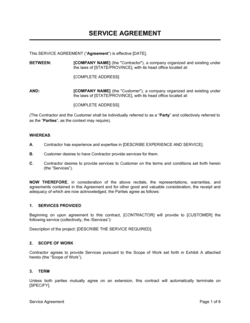
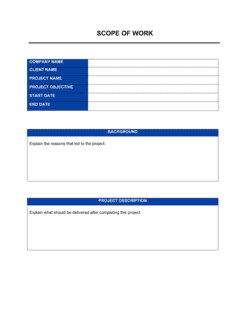
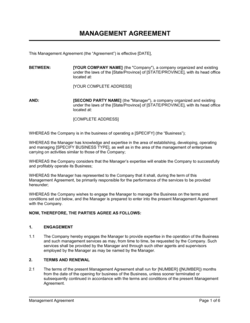
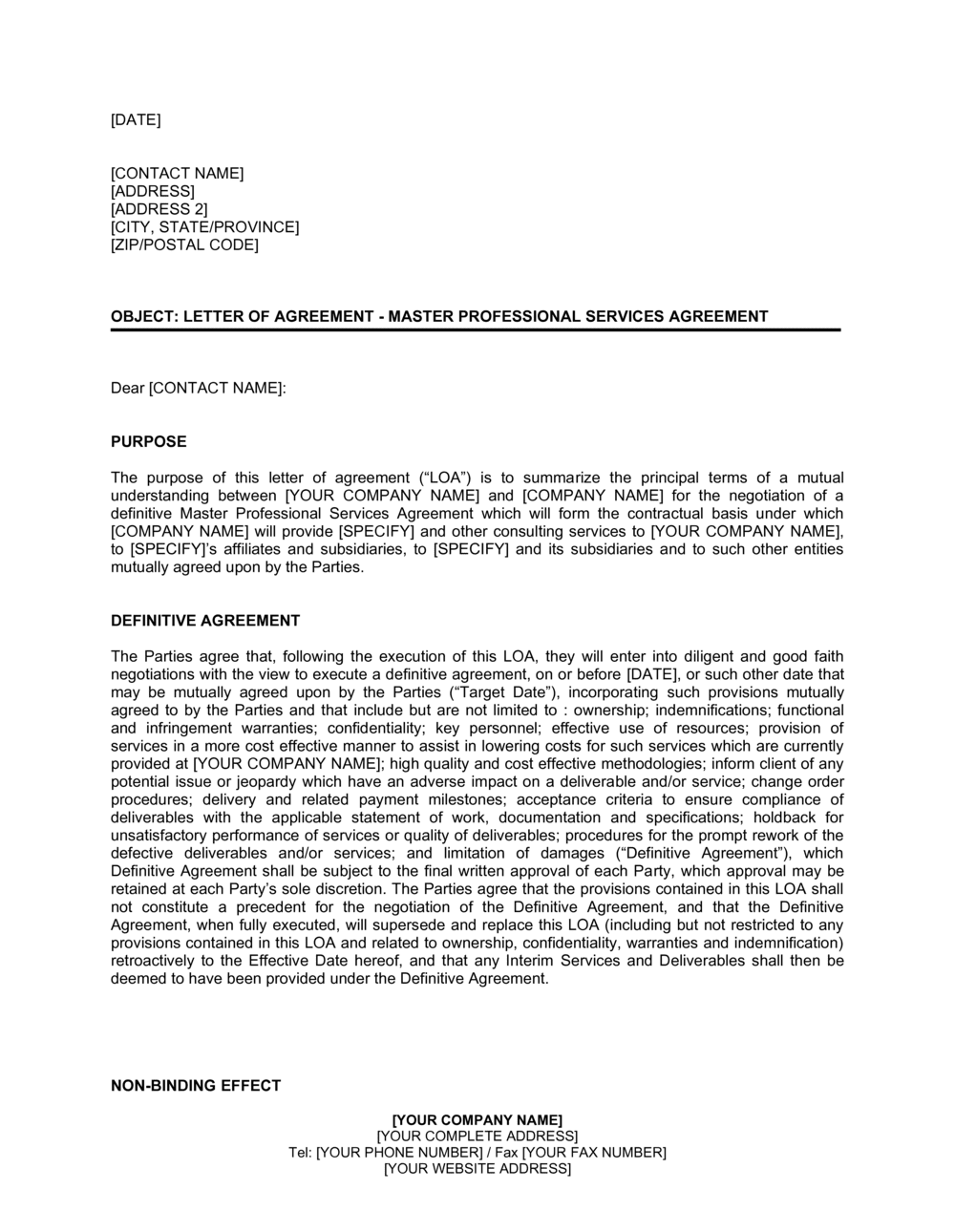
Letter of Agreement_Master Professional Services Agreement Template

Free Word download β€’ Edit online β€’ Save & share with Drive β€’ Export to PDF

5 pagesβ€’25–35 min to fillβ€’Difficulty: Complex
Learn more ↓
FreeLetter of Agreement_Master Professional Services Agreement Template

At a glance

What it is
A Letter of Agreement β€” Master Professional Services Agreement is a formal business letter that establishes the governing terms for an ongoing professional services relationship between a service provider and a client. This free Word download gives you a structured, client-ready template you can edit online and export as PDF to confirm scope, fees, deliverables, and expectations before work begins.
When you need it
Use it when engaging a consultant, agency, or specialist on a recurring or project-by-project basis where a single master document should govern all future work orders or statements of work. It is the right choice when you want written agreement without the length and formality of a full contract.
What's inside
An introduction identifying both parties and the engagement purpose, a scope-of-services description, fee and payment terms, a confidentiality commitment, IP and work-product ownership, termination conditions, and a signature or acknowledgment block.

What is a Letter of Agreement β€” Master Professional Services Agreement?

A Letter of Agreement β€” Master Professional Services Agreement is a formal written document that establishes the governing commercial terms between a service provider and a client for an ongoing or project-based professional services relationship. Written in accessible letter format rather than dense contract prose, it defines scope, fees, deliverables, confidentiality obligations, IP ownership, and termination conditions in a single document both parties can review and confirm quickly. It functions as both the master framework for future work orders and the engagement letter for the current project β€” making it a practical choice for consultants, agencies, and service firms that need binding terms without a lengthy formal contract.

Why You Need This Document

Starting a professional services engagement without a written agreement is one of the most common and costly mistakes service providers make. Without confirmed scope, clients expand expectations and request additional deliverables with no fee adjustment. Without a clear IP clause, ownership of the work product can be disputed even after the client pays. Without a termination provision, either party can exit immediately and leave unresolved payment obligations. A letter of agreement closes all of these gaps in under 30 minutes of document preparation β€” and the written record it creates is far easier to enforce than any amount of email correspondence. This template gives you a professionally structured, client-ready document you can send with confidence before any billable work begins.

Which variant fits your situation?

If your situation is…Use this template
Engaging a single vendor for a one-time project with a fixed deliverableLetter of Agreement (Project-Based)
Ongoing monthly retainer with clearly defined hours and deliverablesConsulting Retainer Agreement
Hiring an independent contractor rather than a service firmIndependent Contractor Agreement
Technology implementation or software development servicesMaster Services Agreement (IT)
Agency or service provider requiring full legal contract termsProfessional Services Agreement
Subcontracting part of a client engagement to a third partySubcontractor Agreement
Confirming a speaking, training, or workshop engagementSpeaking or Training Engagement Letter

Common mistakes to avoid

❌ Vague scope with no exclusions listed

Why it matters: Clients interpret any unlisted task as included. Without explicit exclusions, scope creep goes uncompensated and the provider has no written basis to decline or charge extra.

Fix: Add a two-sentence exclusions paragraph immediately after the scope description naming at least two to three tasks or deliverable types that are not covered.

❌ No late-fee or interest provision

Why it matters: Without financial consequences for late payment, clients have no incentive to prioritize your invoice over others, and average payment cycles lengthen by 10–15 days.

Fix: Include a standard 1.5% per month interest clause on balances unpaid beyond the due date and restate it clearly on every invoice you issue.

❌ Omitting the entire-agreement clause

Why it matters: Prior email threads, proposals, and verbal conversations can be introduced as supplementary terms in a dispute if the letter does not explicitly supersede them.

Fix: Add a single sentence in the closing clause: 'This Agreement supersedes all prior discussions, representations, and proposals relating to this engagement.'

❌ Transferring IP before full payment

Why it matters: If the IP assignment clause does not condition transfer on receipt of full payment, a client who disputes the final invoice may already own the work product and has no incentive to pay.

Fix: Add 'upon receipt of full payment' as an explicit condition in the IP assignment clause, and hold final deliverables until payment clears.

❌ No defined termination notice period

Why it matters: Without a notice requirement, either party can exit immediately, leaving the provider with uncompensated work in progress and the client with an unfinished deliverable.

Fix: State a specific number of days' written notice required for termination and confirm that fees for work completed through that date remain payable.

❌ Starting work before the letter is acknowledged

Why it matters: If the client never returns a signed copy or confirms acceptance, the terms of the engagement are legally uncertain and enforcement becomes difficult.

Fix: Set a written response deadline in the letter and do not begin any billable work until you have written confirmation β€” a reply email referencing the letter is sufficient.

The 8 key clauses, explained

Opening β€” Parties and engagement purpose

In plain language: Identifies the service provider, the client, and the nature of the professional relationship being established.

Sample language
This Letter of Agreement ('Agreement') is entered into as of [DATE] between [SERVICE PROVIDER NAME] ('Provider') and [CLIENT NAME] ('Client') to confirm the terms under which Provider will deliver professional services to Client.

Common mistake: Using a trade name instead of the registered legal entity name, which creates ambiguity about which entity is bound if a dispute arises.

Scope of services

In plain language: Describes precisely what the provider will deliver, including specific outputs, activities, and any tasks that are explicitly out of scope.

Sample language
Provider shall deliver the following services: [DESCRIPTION OF SERVICES]. The following are expressly excluded from this Agreement: [EXCLUSIONS].

Common mistake: Writing the scope too broadly without listing exclusions β€” clients interpret silence as inclusion, leading to scope creep with no fee adjustment.

Fees and payment terms

In plain language: States the fee amount or rate, the invoicing schedule, the payment due date, and any late-fee provisions.

Sample language
Client shall pay Provider [FLAT FEE / HOURLY RATE OF $X] for services rendered. Invoices will be issued [monthly / upon milestone completion] and are due within [30] days of receipt. Overdue balances accrue interest at [1.5]% per month.

Common mistake: Omitting a late-fee or interest clause, which leaves the provider with no financial leverage to accelerate overdue payment.

Term and renewal

In plain language: Sets the start date and duration of the agreement, and states whether it renews automatically or requires a new document.

Sample language
This Agreement commences on [START DATE] and continues for [DURATION], unless terminated earlier. It shall [automatically renew for successive [30]-day periods / expire at the end of the initial term] unless either party provides written notice of non-renewal at least [15] days in advance.

Common mistake: Leaving the term undefined, which makes it unclear when either party can exit without breaching the agreement.

Confidentiality

In plain language: Requires both parties to protect each other's non-public information and restricts use of that information to the engagement only.

Sample language
Each party agrees to hold the other's Confidential Information in strict confidence and not to disclose it to any third party without prior written consent. This obligation survives termination of this Agreement for a period of [TWO] years.

Common mistake: Failing to define what constitutes Confidential Information, which leaves both parties uncertain about what is protected and what can be shared freely.

Intellectual property and work product ownership

In plain language: Determines who owns the deliverables β€” client or provider β€” and under what conditions ownership transfers.

Sample language
Upon receipt of full payment, all work product created specifically for Client under this Agreement shall be the sole property of Client. Provider retains ownership of any pre-existing tools, templates, or methodologies used in delivery.

Common mistake: Omitting the 'upon full payment' condition, which means the client can claim ownership of work product before paying the final invoice.

Termination

In plain language: States how either party can end the agreement, the required notice period, and what happens to work in progress and fees at termination.

Sample language
Either party may terminate this Agreement for convenience upon [15] days' written notice. Upon termination, Client shall pay for all services rendered and expenses incurred through the termination date. Provider shall deliver all completed work product within [5] business days of the final payment.

Common mistake: Not specifying what happens to partially completed work at termination β€” leaving both parties exposed to disputes over deliverables and pro-rated fees.

Governing terms and acknowledgment

In plain language: States that this document represents the full agreement between the parties and invites the client to confirm acceptance in writing.

Sample language
This Agreement constitutes the entire understanding between the parties regarding the subject matter and supersedes all prior discussions. Please confirm your acceptance by signing and returning this letter or by replying in writing by [DATE].

Common mistake: Omitting an entire-agreement clause, which allows prior email exchanges or verbal conversations to be introduced as additional terms.

How to fill it out

  1. 1

    Enter both parties' legal names and contact details

    Replace all placeholders in the opening clause with the full registered name, address, and primary contact for both the service provider and the client.

    πŸ’‘ Cross-check the client's legal entity name against their most recent invoice or contract β€” 'ABC Marketing' and 'ABC Marketing LLC' are different legal entities.

  2. 2

    Write a specific scope of services with exclusions

    Describe every deliverable clearly enough that someone unfamiliar with the project could identify whether it has been completed. Add an explicit list of what is out of scope.

    πŸ’‘ If the scope will vary by project, reference a separate Statement of Work rather than trying to cover every scenario in the master letter.

  3. 3

    Set the fee, invoicing schedule, and late-fee terms

    Enter the exact fee amount or hourly rate, the invoicing cadence (monthly, milestone, or on completion), the due date (Net 30 is standard), and the monthly interest rate on overdue balances.

    πŸ’‘ Always state the currency, especially if you work with international clients β€” USD and CAD look identical on a letter without a currency code.

  4. 4

    Define the agreement term and renewal conditions

    Set a clear start date, duration, and specify whether the agreement auto-renews or expires. Include the notice period required to exit.

    πŸ’‘ Auto-renewal with a 15-day notice window protects recurring revenue without requiring a new letter for every period.

  5. 5

    Complete the IP ownership clause

    Decide whether the client owns the work product outright upon payment, or whether the provider retains a license to reuse methodologies. Fill in the clause accordingly.

    πŸ’‘ Always carve out pre-existing tools and templates β€” you should not transfer ownership of IP you brought into the engagement.

  6. 6

    Add the termination notice period and payment-on-exit terms

    Fill in the number of days' notice required to terminate, and confirm what the client owes for work completed through the exit date.

    πŸ’‘ A 15-day notice period is standard for shorter engagements; use 30 days for retainers or multi-month projects where abrupt exits are disruptive.

  7. 7

    Send and request written acknowledgment

    Export as PDF, send to the client contact, and request they sign and return or reply in writing confirming acceptance before work begins.

    πŸ’‘ Set a response deadline of 5–7 business days in the acknowledgment clause β€” an unsigned letter before day one leaves the engagement terms unconfirmed.

Frequently asked questions

What is a letter of agreement for professional services?

A letter of agreement for professional services is a concise written document that confirms the key terms of an engagement between a service provider and a client β€” including scope, fees, deliverables, and termination conditions. It functions as a binding understanding without the length or formality of a full legal contract, making it a practical choice for consultants, agencies, and freelancers working with trusted clients.

Is a letter of agreement legally binding?

A letter of agreement is generally enforceable when it identifies both parties, describes the services and consideration exchanged, and is acknowledged in writing by both sides. Courts in most jurisdictions treat a signed or confirmed letter of agreement as a binding contract. However, it is typically less detailed than a full services contract, so any gaps will be filled by applicable law or common-law principles rather than specific drafted language.

What is the difference between a letter of agreement and a master services agreement?

A master services agreement (MSA) is a comprehensive legal contract that governs all future work between two parties; individual projects are then documented in separate statements of work that reference the MSA. A letter of agreement is shorter and combines both the governing terms and the project scope in a single document. The two are sometimes merged β€” as in this template β€” when the engagement is ongoing but the parties prefer letter format over a formal contract.

Does a letter of agreement need to be signed?

Formal signatures are not strictly required for a letter of agreement to be enforceable in most jurisdictions β€” written acknowledgment, such as a confirming email reply referencing the letter, is typically sufficient. That said, requesting a signature or written confirmation before starting work is strongly recommended because it eliminates disputes about whether the client accepted the terms.

What should a professional services letter of agreement include?

At minimum: the names of both parties, the scope of services with explicit exclusions, fee amount and payment terms, the agreement term and renewal conditions, a confidentiality obligation, IP ownership on deliverables, a termination notice period, and an entire-agreement clause. Missing any of these creates gaps that clients and providers routinely dispute at the end of an engagement.

When should I use a letter of agreement instead of a full contract?

Use a letter of agreement when the engagement is straightforward and relatively short-term, the client relationship is established, the fee does not justify extensive legal drafting, or both parties prefer accessible language over formal contract prose. For high-value, long-term, or legally complex engagements β€” or when IP is central to the deliverable β€” a full professional services agreement provides more protection and should be preferred.

Can one letter of agreement cover multiple projects?

Yes β€” that is the purpose of a master professional services agreement structure. The letter establishes the governing terms (confidentiality, IP, payment, termination) that apply to all engagements, while individual projects are described in brief addenda or statements of work that reference the master letter. This avoids renegotiating standard terms each time a new project begins.

How do I protect my IP in a professional services letter of agreement?

Include an explicit IP clause stating that ownership of client-specific work product transfers to the client only upon receipt of full payment, and that any pre-existing tools, templates, or methodologies you bring to the engagement remain your property. Without this clause, default rules in many jurisdictions β€” particularly for works made for hire β€” may vest ownership in the client regardless of payment status.

How this compares to alternatives

vs Professional Services Agreement

A professional services agreement is a full legal contract with comprehensive representations, warranties, limitation of liability, and dispute-resolution clauses. A letter of agreement covers the same core commercial terms in a shorter, more accessible format. Use the full agreement for high-value or legally complex engagements; use the letter for straightforward or shorter-term work.

vs Independent Contractor Agreement

An independent contractor agreement focuses on worker classification β€” confirming the provider is not an employee β€” and typically includes tax, benefits, and control-of-work provisions. A letter of agreement focuses on the scope and commercial terms of the services being delivered. Where misclassification risk is a concern, the contractor agreement is the more appropriate document.

vs Consulting Agreement

A consulting agreement is structured as a formal bilateral contract with defined representations and remedies. A letter of agreement uses letter format and is typically acknowledged rather than counter-signed. Both cover scope, fees, and IP, but the consulting agreement is preferable when the engagement is long-term, high-value, or involves sensitive competitive information.

vs Statement of Work

A statement of work is a project-level document that details deliverables, milestones, and fees for a single engagement; it references a master agreement for governing terms. A master professional services letter of agreement combines both the governing terms and the project scope in one document, making it more efficient for single engagements but less scalable than an MSA-plus-SOW structure.

Industry-specific considerations

Marketing and Creative Services

Master terms govern monthly retainers, campaign deliverables, and asset ownership, with project-level SOWs appended for each new brief.

IT and Technology Consulting

Covers managed services, ongoing development work, and SLA references, with clear IP carve-outs for pre-existing code libraries and frameworks.

Professional Services (Legal, Finance, HR)

Establishes confidentiality and engagement scope for advisory work, where a formal retainer contract may be disproportionate to the engagement size.

Training and Development

Documents facilitation scope, materials ownership, and licensing terms for workshops, coaching programs, and e-learning deliverables.

Template vs pro β€” what fits your needs?

PathBest forCostTime
Use the templateConsultants, freelancers, and small agencies formalizing standard professional services engagementsFree15–30 minutes
Template + professional reviewEngagements exceeding $20,000, multi-year retainers, or where IP is a central deliverable$150–$400 for a lawyer or contract specialist review1–2 days
Custom draftedComplex multi-party engagements, regulated industries, or where limitation of liability and indemnification terms are critical$800–$2,500+1–2 weeks

Glossary

Letter of Agreement (LOA)
A shorter, less formal alternative to a full contract that documents the key terms of a business arrangement in letter format, signed or acknowledged by both parties.
Master Professional Services Agreement (MPSA)
A governing document that sets the standing terms for all future engagements between a service provider and client, so individual projects only need a brief statement of work.
Statement of Work (SOW)
A project-level document that references the master agreement and specifies the deliverables, timeline, and fees for a single engagement.
Scope of Services
A written description of exactly what the service provider will do, including specific deliverables, activities, and any explicit exclusions.
Retainer
A recurring fixed fee paid by the client to secure the service provider's availability and a defined amount of work each period.
Work Product
Any deliverable β€” report, design, code, strategy document β€” created by the service provider in the course of the engagement.
Confidential Information
Non-public information about either party β€” including client data, pricing, and business strategy β€” that the receiving party agrees not to disclose.
Termination for Convenience
A clause allowing either party to end the agreement without cause by giving a specified number of days' written notice.
Net 30
Payment terms requiring the client to remit the full invoice amount within 30 calendar days of the invoice date.
Intellectual Property (IP) Assignment
A provision that transfers ownership of work product created during the engagement from the service provider to the client upon full payment.

Part of your Business Operating System

This document is one of 3,000+ business & legal templates included in Business in a Box.

  • Fill-in-the-blanks β€” ready in minutes
  • 100% customizable Word document
  • Compatible with all office suites
  • Export to PDF and share electronically

Create your document in 3 simple steps.

From template to signed document β€” all inside one Business Operating System.
1
Download or open template

Access over 3,000+ business and legal templates for any business task, project or initiative.

2
Edit and fill in the blanks with AI

Customize your ready-made business document template and save it in the cloud.

3
Save, Share, Send, Sign

Share your files and folders with your team. Create a space of seamless collaboration.

Save time, save money, and create top-quality documents.

β˜…β˜…β˜…β˜…β˜…

"Fantastic value! I'm not sure how I'd do without it. It's worth its weight in gold and paid back for itself many times."

Managing Director Β· Mall Farm
Robert Whalley
Managing Director, Mall Farm Proprietary Limited
β˜…β˜…β˜…β˜…β˜…

"I have been using Business in a Box for years. It has been the most useful source of templates I have encountered. I recommend it to anyone."

Business Owner Β· 4+ years
Dr Michael John Freestone
Business Owner
β˜…β˜…β˜…β˜…β˜…

"It has been a life saver so many times I have lost count. Business in a Box has saved me so much time and as you know, time is money."

Owner Β· Upstate Web
David G. Moore Jr.
Owner, Upstate Web

Run your business with a system β€” not scattered tools

Stop downloading documents. Start operating with clarity. Business in a Box gives you the Business Operating System used by over 250,000 companies worldwide to structure, run, and grow their business.

Free Forever PlanΒ Β·Β No credit card required