1
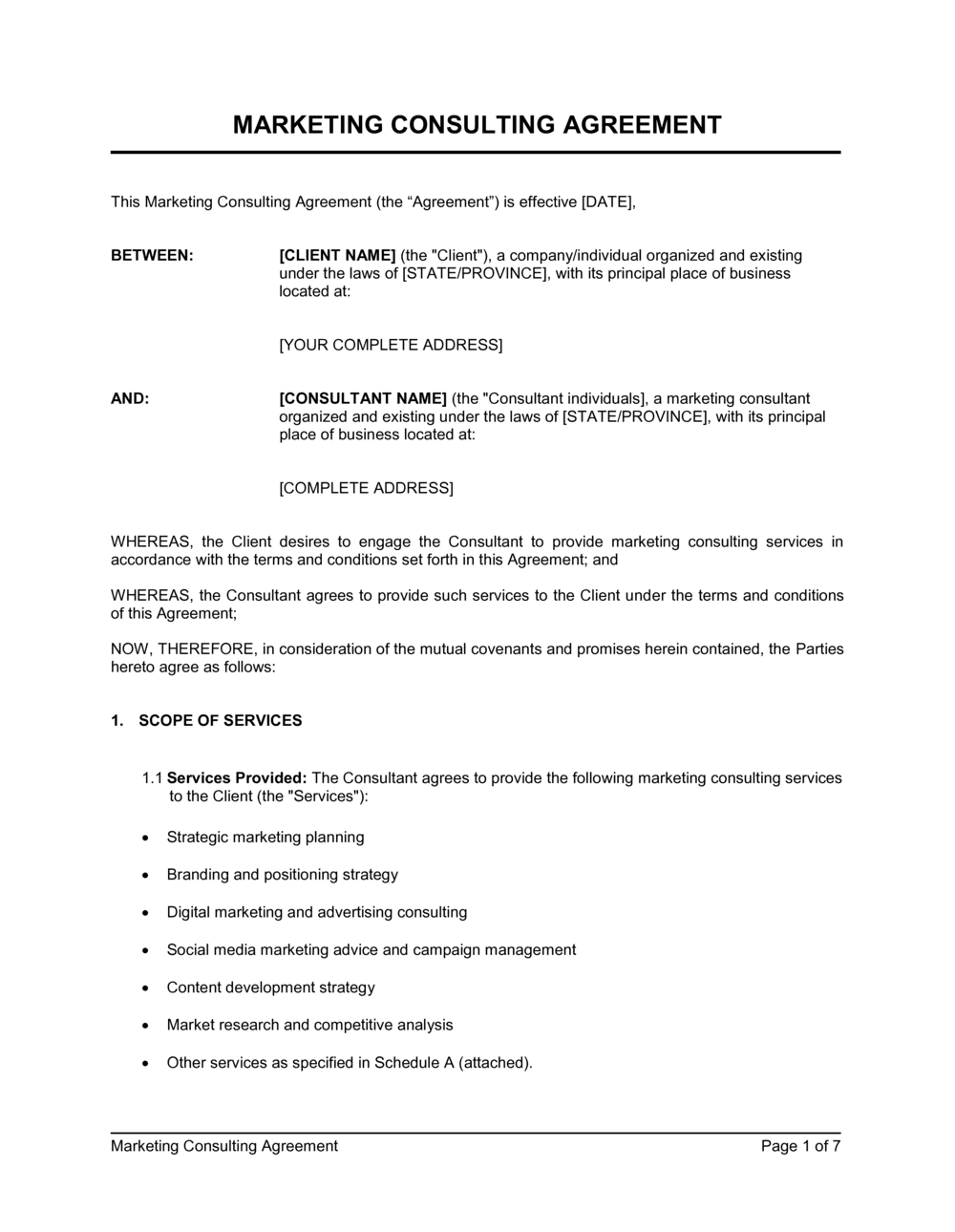
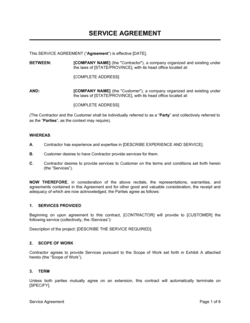
Enter legal entity names and effective date
Fill in the full registered legal name of both the client and the consultant — not trade names or personal nicknames. Add the date on which the agreement takes effect, which should be before work begins.
💡 Cross-check the entity name against a corporate registry or business license filing before signature to avoid enforcement problems later.
2
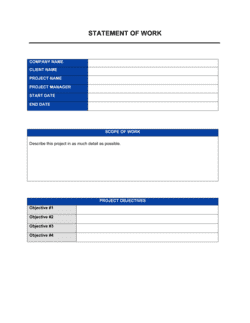
Complete the scope of services in Exhibit A
List every deliverable the consultant will produce — ad copy, campaign reports, social content, strategy decks — with a quantity, format, and due date for each. Attach this as a named exhibit rather than embedding it in the body so it can be updated via a change order without amending the main contract.
💡 Use outcome-based descriptions alongside task descriptions: '4 paid social ad sets per month, each including 3 creative variants, delivered by the 25th' beats 'social media support.'
3
Set the fee structure and payment terms
Choose between a monthly retainer, fixed project fee, or hourly rate. Enter the amount, invoice frequency, due date (Net 15 or Net 30 are standard), accepted payment methods, and whether pre-approved expenses are reimbursable.
💡 Add a 1.5% per-month late-payment interest clause — it is rarely invoked but dramatically accelerates payment when invoices go overdue.
4
Confirm independent contractor status
Ensure the independent contractor clause is present and accurate. If the consultant works exclusively for this client, dictates their schedule entirely to the client's direction, or uses only client-supplied equipment, the relationship may be reclassified as employment by tax authorities — consult a lawyer.
💡 A simple internal checklist of IRS or CRA contractor classification factors takes 10 minutes and can prevent a $50,000+ misclassification penalty.
5
Define IP ownership and Background IP carve-out
Confirm that completed, paid-for deliverables transfer to the client. Add a specific list or description of the consultant's Background IP — proprietary frameworks, template libraries, analytics tools — that is excluded from the assignment and only licensed to the client.
💡 If the consultant uses AI tools to generate any deliverable content, add an explicit clause addressing AI-generated output and IP ownership, as this remains a live legal question in most jurisdictions.
6
Tailor the termination and kill fee terms
Set the notice period for termination without cause (30 days is standard for monthly retainers; 60 days for long-term engagements). Add a kill fee of 25–50% of the remaining project fee for project-based work if the client cancels after the consultant has started.
💡 For retainer agreements, include a minimum initial term — typically 3 months — to give the consultant sufficient time to produce measurable results and recover onboarding costs.
7
Choose governing law and dispute resolution
Select the state or country whose law will govern the contract and the city where arbitration or litigation will take place. For domestic engagements, use the jurisdiction where the consultant performs most of their work.
💡 Arbitration clauses reduce litigation costs significantly for disputes under $100,000 — include one for any engagement above $10,000.
8
Sign before work begins
Both parties must sign the agreement — and the consultant must receive a countersigned copy — before any marketing work commences. Work performed without a signed contract is governed by implied terms, which rarely match what either party expected.
💡 Use an e-signature platform to timestamp execution and store the fully executed agreement in a shared folder both parties can access.