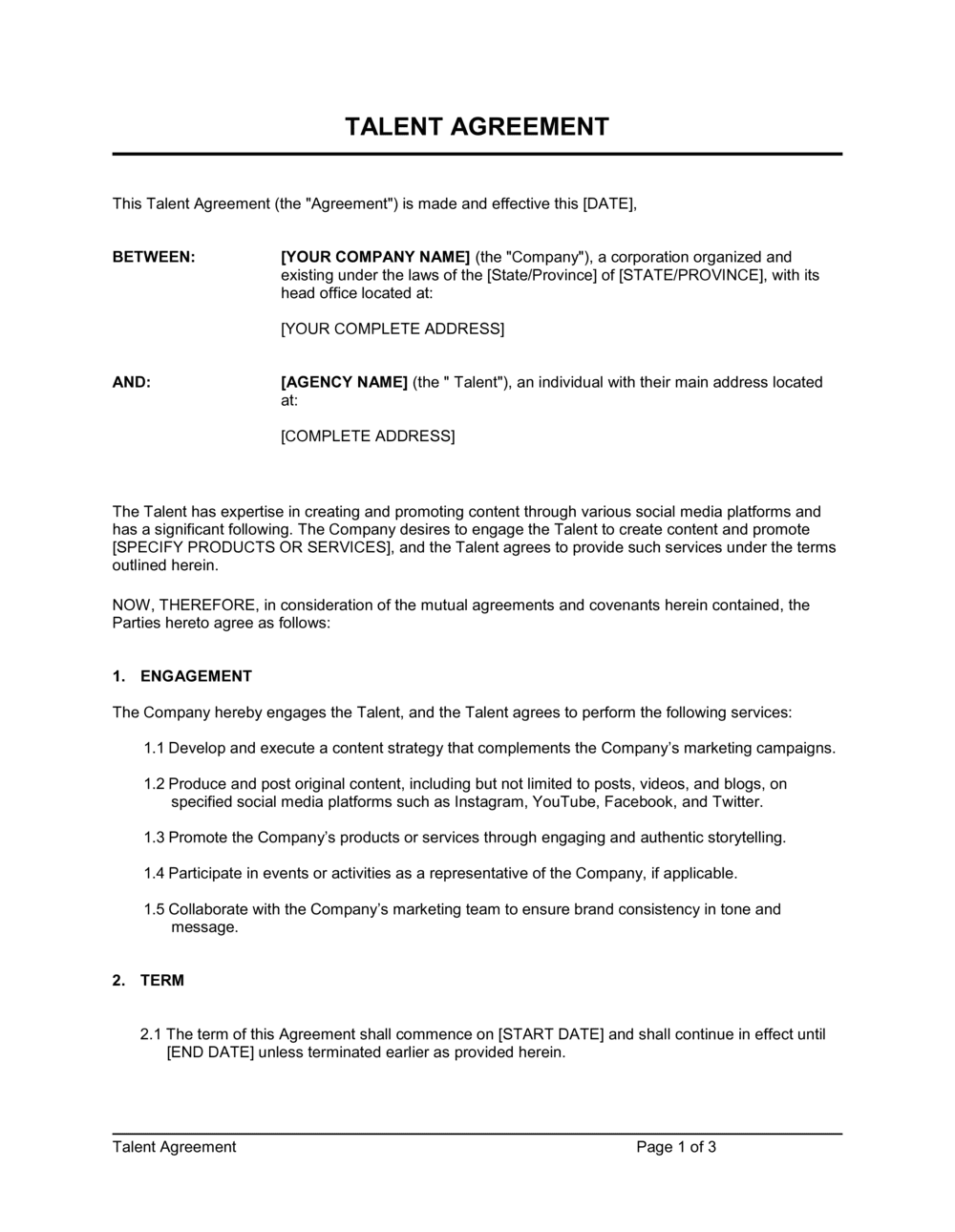
Talent Agreement Template

Free Word download β€’ Edit online β€’ Save & share with Drive β€’ Export to PDF

3 pagesβ€’25–30 min to fillβ€’Difficulty: Standardβ€’Signature requiredβ€’Legal review recommended
Learn more ↓
FreeTalent Agreement Template

At a glance

What it is
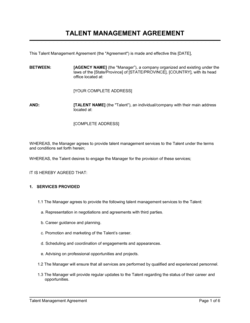
A Talent Agreement is a legally binding contract between a company or producer and an individual performer, influencer, spokesperson, or creative professional that governs the terms under which the talent provides services. This free Word download covers fees, deliverables, usage rights, exclusivity, likeness releases, and termination in a single document you can edit online and export as PDF.
When you need it
Use it whenever you engage an actor, model, influencer, musician, spokesperson, or other on-camera or on-record talent for commercial, promotional, or entertainment purposes β€” before any shoot, appearance, or campaign begins.
What's inside
Scope of services and deliverables, compensation and payment schedule, media usage rights and territory, exclusivity restrictions, likeness and name release, confidentiality, representations and warranties, termination conditions, and governing law.

What is a Talent Agreement?

A Talent Agreement is a legally binding contract between a hiring company, producer, or brand and an individual performer, influencer, spokesperson, model, or creative professional that governs the full terms of a commercial talent engagement. It defines what the talent will do, what they will be paid, how and where their likeness and performance may be used, what competing engagements they are restricted from taking, and the conditions under which either party may exit the relationship. Unlike a generic service contract, a talent agreement addresses the industry-specific considerations that arise whenever a person's name, image, voice, or public identity is used for commercial purposes β€” making it the foundational document for advertising campaigns, film and video productions, event bookings, and brand ambassador programs.

Why You Need This Document

Engaging talent without a signed agreement exposes your business on every dimension that matters in a commercial production. Without defined usage rights, talent can legally demand additional fees β€” or injunctive relief β€” to stop you from continuing to broadcast content you paid to produce. Without an exclusivity clause, a spokesperson you signed last week can endorse a direct competitor tomorrow. Without a kill fee provision, cancelling a production after the talent has cleared their schedule exposes you to common-law damages claims that routinely exceed what a reasonable kill fee would have cost. And without a morality clause, a brand-damaging controversy involving your talent leaves you with no contractual basis to terminate the association. A properly executed talent agreement closes all four gaps before a single shoot day, social post, or public appearance takes place β€” and this template gives you the structure to do it in under an hour.

Which variant fits your situation?

If your situation is…Use this template
Engaging a social media influencer for a sponsored post campaignInfluencer Agreement
Hiring an actor or performer for a commercial or film shootTalent Agreement (Film/Commercial)
Booking a keynote speaker for a conference or corporate eventSpeaker Agreement
Engaging a musician or band for a live performanceEntertainment Contract
Contracting a model for print or digital advertisingModel Release Agreement
Hiring a creative professional on a project basisIndependent Contractor Agreement
Engaging talent on a long-term brand ambassador basisBrand Ambassador Agreement

Common mistakes to avoid

❌ Vague deliverable descriptions

Why it matters: A scope like 'social content as needed' gives the talent no clear production obligation and gives the company no enforceable standard for rejection or revision requests. Disputes about whether deliverables were completed are the leading cause of talent payment litigation.

Fix: List every deliverable in Schedule A with format, quantity, dimensions, word count, and deadline. Define the number of revision rounds included and the process for requesting additional revisions.

❌ Granting all-media perpetual usage without a renegotiation clause

Why it matters: Overly broad usage grants are regularly challenged by talent unions, agents, and courts β€” particularly for digital content where usage patterns were not foreseeable at signing. They also devalue the talent relationship and make re-engagement difficult.

Fix: Limit initial usage rights to the specific media and duration you actually need. Include a renegotiation clause granting the right to extend usage for an additional fee, stated as a percentage of the original fee per 12-month period.

❌ No kill fee provision

Why it matters: Talent decline competing engagements and prepare for productions in reliance on signed agreements. Cancelling without a kill fee exposes the company to quantum meruit or expectation damages claims that often exceed what a fair kill fee would have cost.

Fix: Include a kill fee of 25–50% of the total contracted fee for without-cause cancellation, staggered by production milestone where the engagement involves multiple shoot days or delivery phases.

❌ Relying on work-for-hire language without a fallback IP assignment

Why it matters: Under US copyright law, content created by an independent contractor qualifies as work for hire only in narrow circumstances. Without a fallback assignment clause, copyright in videos, photographs, and recordings may legally remain with the talent β€” giving them leverage to demand additional fees for continued use.

Fix: Add an irrevocable assignment clause immediately after the work-for-hire language, transferring all rights, title, and interest in the deliverables to the company for any content that does not legally qualify as work for hire.

❌ Overbroad or undefined exclusivity categories

Why it matters: An exclusivity clause that covers 'any consumer product' or 'any brand in your industry' will either deter talent from signing or be struck down as an unreasonable restraint of trade. Either outcome leaves the company without the competitive protection it sought.

Fix: Define the exact competing product categories using specific industry codes or named competitors. A narrowly defined, clearly scoped exclusivity clause is both more enforceable and more acceptable to experienced talent.

❌ Omitting the morality clause or using a purely subjective standard

Why it matters: Without a morality clause, the company has no contractual basis to terminate if the talent's public conduct β€” a viral controversy, criminal charge, or brand-damaging statement β€” makes continued association commercially untenable. Purely subjective clauses ('at Company's sole discretion, for any conduct') are frequently voided by courts.

Fix: Include a morality clause tied to an objective standard: conduct that would cause a reasonable person to believe the association materially harms the company's reputation or brand. Define triggering events with examples β€” criminal charges, regulatory sanctions, public statements inconsistent with brand values.

The 10 key clauses, explained

Parties, engagement, and term

In plain language: Identifies the hiring company and the talent as legal parties, defines the nature of the engagement, and states the start date and duration of the agreement.

Sample language
This Talent Agreement ('Agreement') is entered into as of [DATE] between [COMPANY LEGAL NAME], a [STATE/COUNTRY] [ENTITY TYPE] ('Company'), and [TALENT FULL NAME / TALENT AGENCY NAME] ('Talent'). Talent is engaged to provide the Services described in Schedule A for the term commencing [START DATE] and ending [END DATE / upon completion of Services].

Common mistake: Using a trade name instead of the registered legal entity name for the company. If the contracting entity doesn't match the entity that processes payment, enforcing usage rights or pursuing a breach claim becomes procedurally complicated.

Scope of services and deliverables

In plain language: Describes precisely what the talent will do β€” the number of shoot days, appearances, posts, or recordings β€” and attaches a schedule with specific deliverables, formats, and deadlines.

Sample language
Talent agrees to perform the following services ('Services'): [X] shoot days at [LOCATION] on [DATES]; delivery of [NUMBER] final approved [VIDEOS/POSTS/RECORDINGS] in [FORMAT] by [DEADLINE]. Full deliverables are set out in Schedule A.

Common mistake: Leaving deliverables vague β€” 'social media content as needed' with no post count, format, or deadline. Vague scope is the single most common source of talent disputes and gives neither party a clear basis for approval or rejection.

Compensation and payment schedule

In plain language: States the total fee, how and when it is paid (upfront, on delivery, or in milestones), any expense reimbursement, and the currency.

Sample language
Company shall pay Talent a flat fee of $[AMOUNT] USD. Payment shall be made as follows: 50% ($[AMOUNT]) upon execution of this Agreement; 50% ($[AMOUNT]) upon final delivery and approval of all Deliverables. Company shall reimburse pre-approved expenses within [30] days of receipt of itemized receipts.

Common mistake: Omitting a payment trigger tied to approval of deliverables. Paying 100% upfront with no acceptance condition removes the company's primary lever for ensuring quality and timely delivery.

Usage rights, media, and territory

In plain language: Defines the scope of the license to use the talent's performance, image, or voice β€” specifying which media (broadcast, digital, social, print), geographic territories, and the duration of use.

Sample language
Company is granted a [non-exclusive / exclusive] license to use the Deliverables and Talent's likeness in [MEDIA β€” e.g., digital advertising, social media, broadcast television] in [TERRITORY β€” e.g., worldwide / United States and Canada] for a period of [DURATION] from the date of first use.

Common mistake: Granting 'all media in perpetuity' without additional compensation or a renegotiation clause. Courts and talent unions frequently challenge overly broad perpetual grants, and industry norms expect additional fees for extended or expanded usage.

Exclusivity and holdback

In plain language: Restricts the talent from working with competing brands or appearing in competing campaigns during and after the engagement, within defined categories and time frames.

Sample language
During the Term and for [X] months following its expiration ('Holdback Period'), Talent shall not provide services to, endorse, or appear in advertising for any brand in the following competing categories: [CATEGORY LIST]. This restriction applies in [TERRITORY].

Common mistake: Failing to define the competing categories with specificity. An overly broad exclusivity clause (e.g., 'any consumer brand') is often unenforceable and may deter talent from signing, while a vague clause is useless when a competitor relationship arises.

Intellectual property and work for hire

In plain language: Establishes whether the deliverables are owned by the company as works made for hire, and assigns any residual IP rights to the company with a fallback assignment clause.

Sample language
To the extent permitted by applicable law, all Deliverables are works made for hire owned exclusively by Company. To the extent any Deliverable does not qualify as a work made for hire, Talent hereby irrevocably assigns to Company all right, title, and interest in such Deliverable, including all copyright therein.

Common mistake: Relying solely on 'work for hire' language without a fallback assignment clause. Under US copyright law, works made for hire have a narrow definition β€” content created by an independent contractor outside the statutory categories may revert to the creator without an explicit assignment.

Representations, warranties, and morality clause

In plain language: Requires the talent to confirm they have the right to enter the agreement, that their performance won't infringe third-party rights, and gives the company termination rights if the talent's conduct damages its reputation.

Sample language
Talent represents and warrants that: (a) Talent has full authority to enter this Agreement; (b) the Services will not infringe any third-party rights; (c) Talent is not subject to any conflicting exclusivity obligations. Company may terminate this Agreement immediately if Talent engages in conduct that, in Company's reasonable judgment, is likely to materially harm Company's reputation or brand.

Common mistake: Omitting the morality clause or drafting it without an objective standard (e.g., 'reasonable judgment'). Courts have struck down purely subjective morality clauses; tying termination to a reasonableness standard improves enforceability.

Confidentiality

In plain language: Prohibits the talent from disclosing the terms of the engagement, unreleased campaign materials, or any proprietary company information before the agreed launch date or after termination.

Sample language
Talent agrees to keep confidential all non-public information received from Company, including campaign concepts, unreleased products, and the financial terms of this Agreement, and shall not disclose such information to any third party without Company's prior written consent.

Common mistake: No confidentiality clause, or one that expires on the campaign launch date. Talent who discloses creative concepts to competitors or the press before launch can cause material brand damage β€” confidentiality should survive termination for at least 12–24 months.

Termination and kill fee

In plain language: States the conditions under which either party may terminate β€” with cause (breach, morality), without cause on notice, or due to force majeure β€” and the kill fee owed if the company cancels the project.

Sample language
Either party may terminate this Agreement for material breach upon [10] days' written notice if the breach is not cured. Company may terminate without cause upon [X] days' written notice, in which case Company shall pay Talent a kill fee equal to [X]% of the total fee as liquidated damages. Termination for cause (including breach of the morality clause) does not entitle Talent to any unpaid fees.

Common mistake: No kill fee provision. Talent clear their schedules and often decline other work in reliance on signed agreements β€” cancelling without a kill fee exposes the company to quantum meruit claims for preparation work already performed.

Governing law, dispute resolution, and entire agreement

In plain language: Specifies which jurisdiction's law governs, whether disputes go to arbitration or court, and confirms this agreement supersedes all prior negotiations.

Sample language
This Agreement is governed by the laws of [STATE / COUNTRY], without regard to conflicts of law principles. Any dispute shall be resolved by binding arbitration administered by [AAA / JAMS] in [CITY], except that either party may seek injunctive relief in a court of competent jurisdiction. This Agreement constitutes the entire agreement between the parties and supersedes all prior representations and understandings.

Common mistake: No entire-agreement clause. Without it, prior email negotiations, verbal promises about exclusivity scope, or a talent agent's representations can be introduced as binding terms in a dispute.

How to fill it out

  1. 1

    Identify the parties with full legal names

    Enter the company's registered legal entity name β€” not a brand name β€” and the talent's full legal name or, if represented by an agency, the agency's legal name with the talent named as the performing individual.

    πŸ’‘ Confirm in advance whether the talent contracts in their personal name or through a loan-out corporation; the contracting entity determines tax withholding obligations and IP ownership flow-through.

  2. 2

    Define deliverables and shoot dates in Schedule A

    List every specific output: number of shoot days, locations, post formats, word counts, approval rounds, and hard deadlines. Attach this as Schedule A rather than embedding it in the main body so it can be updated without amending the contract.

    πŸ’‘ Include approval turnaround times β€” e.g., 'Company will provide written approval or revision notes within 5 business days of delivery' β€” to prevent indefinite hold-ups on final payment.

  3. 3

    Set the fee structure and payment triggers

    Enter the total fee, payment split, and the specific event that triggers each payment β€” execution, delivery of draft, final approval, or first air date. Include currency and wire or ACH instructions.

    πŸ’‘ For multi-deliverable engagements, tie the final payment to written approval of all deliverables rather than a calendar date β€” this preserves your leverage to request revisions.

  4. 4

    Specify usage rights with media, territory, and duration

    Select the media types (digital, broadcast, out-of-home, social, print), geographic territory (worldwide, specific countries, or region), and duration of use (12 months from first use, perpetual with renegotiation right, etc.).

    πŸ’‘ Extended usage beyond the initial term should trigger an additional fee β€” include a renegotiation clause stating the rate for each additional 12-month extension.

  5. 5

    Define exclusivity categories and holdback period

    List the specific competing product or service categories the talent may not work with, the geographic scope of the restriction, and the holdback period after the agreement ends.

    πŸ’‘ Narrower categories and shorter holdback periods are more consistently enforceable and more likely to be signed without pushback from experienced talent or their agents.

  6. 6

    Include morality clause and representations

    Add the morality clause with a reasonableness standard, and confirm the talent's warranties β€” no conflicting exclusivity, no undisclosed prior commitments, and no known third-party IP conflicts.

    πŸ’‘ Ask the talent's agent to confirm in writing before signing whether the talent has any existing exclusivity obligations in your product category β€” this protects you from a warranty breach claim.

  7. 7

    Set termination terms and kill fee

    State the notice period for without-cause termination and the kill fee percentage. A kill fee of 25–50% of the total fee is industry standard for without-cause cancellation after contract execution.

    πŸ’‘ Stagger the kill fee based on how far into production the cancellation occurs β€” 25% before shoot, 50% after shoot but before delivery, 100% after final delivery β€” to align the fee with actual work performed.

  8. 8

    Execute before any work begins

    Both parties must sign the agreement before the talent performs any services, attends any shoot, or publishes any content. Post-commencement signatures create fresh-consideration issues and leave early work product in a legal grey area.

    πŸ’‘ Use a timestamped e-signature solution so you have an auditable record of exactly when the agreement was executed relative to the first day of services.

Frequently asked questions

What is a talent agreement?

A talent agreement is a legally binding contract between a company, producer, or brand and an individual performer, influencer, spokesperson, or creative professional. It defines the services the talent will provide, the compensation they will receive, the media and territory in which their likeness or performance may be used, any exclusivity restrictions, and the conditions under which either party may terminate the relationship. It is the foundational document for any commercial talent engagement.

Who needs a talent agreement?

Any business engaging a performer, influencer, actor, model, musician, or spokesperson for commercial, advertising, or entertainment purposes needs a talent agreement. This includes marketing teams running brand campaigns, film and video production companies, event organizers booking performers, record labels working with artists, and startups engaging influencers for product launches. Talent agencies also use them when formalizing client placements with third-party companies.

What is the difference between a talent agreement and an independent contractor agreement?

An independent contractor agreement governs a broad range of service relationships β€” freelancers, consultants, developers β€” and focuses on deliverables, payment, and IP. A talent agreement is a specialized contract for performing artists and on-camera personalities that additionally covers likeness rights, usage licensing, exclusivity, morality clauses, and kill fees specific to the entertainment and advertising industries. For talent engagements, a generic contractor agreement is insufficient because it does not address media usage rights or the industry-standard protections both parties expect.

Are talent agreements enforceable?

Talent agreements are generally enforceable when properly executed and reasonably scoped. However, certain provisions β€” particularly exclusivity clauses and morality clauses β€” are subject to heightened scrutiny. Overly broad exclusivity restrictions may be treated as unreasonable restraints of trade. Purely subjective morality clauses have been voided by courts in several jurisdictions. To maximize enforceability, scope restrictions narrowly and tie discretionary termination rights to objective, reasonable standards. Consider having a lawyer review any agreement involving significant fees or a high-profile talent engagement.

What usage rights should I include in a talent agreement?

Usage rights should specify the media types (digital, broadcast, out-of-home, social media, print), geographic territory (worldwide or specific countries), and duration (typically 12–24 months from first use). Avoid granting all-media perpetual rights for a single flat fee β€” industry practice is to grant initial rights for a defined period and include a renegotiation clause for extensions at a stated rate. Broader rights commands higher fees; narrowing the initial grant is often more cost-effective than an all-rights buyout.

What is a morality clause in a talent agreement?

A morality clause gives the hiring company the right to terminate the agreement if the talent engages in conduct that materially damages the company's reputation or brand. Triggering events typically include criminal charges, public statements inconsistent with brand values, regulatory sanctions, or conduct that generates significant negative media coverage. To be enforceable, the clause should reference a reasonableness standard β€” what a reasonable person would consider reputationally harmful β€” rather than granting the company unchecked subjective discretion.

What is a kill fee and when does it apply?

A kill fee is a reduced payment made to the talent if the company cancels the project after the agreement is signed but before all services are performed. Industry standard is 25–50% of the total contracted fee for without-cause cancellation, often staggered by production milestone β€” lower before the shoot, higher after production has begun. Kill fees compensate talent for declining competing work in reliance on the signed agreement and protect the company from larger common-law damages claims for lost opportunity.

Does a talent agreement need to address taxes?

The agreement should state whether the talent is engaged as an independent contractor β€” in which case the company will issue a Form 1099 in the US rather than withholding taxes β€” or, if applicable, as an employee. If the talent uses a loan-out corporation, specify that the company contracts with the corporation and that the corporation is responsible for all tax obligations on the fee. Cross-border engagements may trigger withholding tax obligations on payments to foreign performers; consult a tax advisor for engagements involving talent in a different country.

How long should a talent agreement be in effect?

The term should cover the full period of services plus any post- engagement obligations β€” exclusivity holdback, confidentiality obligations, and usage rights duration. For a single campaign shoot, the services term may be a few weeks, but the usage rights license and exclusivity holdback may extend 12–24 months beyond final delivery. Structure the agreement to distinguish between the services term, the usage rights term, and the post-term obligations so each has an independent, clearly stated duration.

How this compares to alternatives

vs Independent Contractor Agreement

An independent contractor agreement covers general freelance or consulting services β€” deliverables, payment, and basic IP assignment. It does not address likeness rights, usage licensing, exclusivity categories, morality clauses, or kill fees. For any engagement involving on-camera performance, public appearances, or commercial endorsement, a talent agreement is the appropriate document.

vs Model Release Agreement

A model release is a narrow, one-page consent document granting usage rights for photographs or video taken at a specific session β€” it is not a service contract. A talent agreement governs the full commercial relationship: services, fees, exclusivity, IP, and termination. For any paid engagement beyond a single-session release, a talent agreement provides the comprehensive protection both parties need.

vs Brand Ambassador Agreement

A brand ambassador agreement is an ongoing, relationship-based contract covering social media promotion, appearances, and long-term representation over a sustained campaign period. A talent agreement is typically used for a defined project or campaign with a fixed term and specific deliverables. When a talent relationship shifts from project-based to ongoing representation, a brand ambassador agreement is the more appropriate structure.

vs Entertainment Contract

An entertainment contract typically governs live performance engagements β€” concerts, events, and theatrical appearances β€” and focuses on performance fees, rider requirements, and cancellation terms. A talent agreement is broader, covering commercial usage rights, likeness licensing, and exclusivity for advertising and promotional contexts. For live-only bookings, an entertainment contract is sufficient; for campaigns that use recorded performance commercially, a talent agreement is required.

Industry-specific considerations

Advertising and Marketing

Usage rights across digital, broadcast, and out-of-home channels; exclusivity by product category; morality clause critical for brand safety in high-visibility campaigns.

Film and Television Production

Union (SAG-AFTRA) compliance requirements, residuals, day rate vs. flat fee structures, and distribution platform-specific usage licensing.

Music and Live Events

Performance fee and rider requirements, cancellation and force majeure provisions, merchandise revenue splits, and recording consent for live streams.

Technology and SaaS

Influencer and spokesperson engagements for product launches, FTC disclosure compliance obligations, and digital-only usage rights with short exclusivity windows.

Fashion and Retail

Model and brand ambassador agreements with look-book, e-commerce, and social media usage rights; seasonal exclusivity tied to collection launch windows.

Sports and Fitness

Athlete endorsement agreements, league and team approval requirements, performance incentive bonuses, and morality clause provisions aligned with governing body standards.

Jurisdictional notes

United States

SAG-AFTRA union agreements govern most professional film and television talent; non-union productions operate on independent terms but should confirm talent union status before signing. California requires specific language for personal service contracts exceeding $500,000 and limits their enforceability to 7 years. The FTC requires clear and conspicuous disclosure of material connections between brands and endorsers in all paid media. Work-for-hire under the Copyright Act applies to a narrow list of commissioned work categories β€” a fallback assignment clause is essential for non-qualifying content.

Canada

ACTRA (Association of Canadian Cinema, Television and Radio Artists) administers collective agreements for broadcast talent in Canada; productions distributed on Canadian broadcast platforms typically require ACTRA compliance. Quebec's Civil Code applies distinct rules on personal service contracts and may limit the enforceability of broad exclusivity clauses. Privacy legislation β€” PIPEDA federally and provincial equivalents β€” affects how likeness and personal data collected during productions may be used and stored. Payments to non-resident talent may be subject to Canadian withholding tax.

United Kingdom

The Equality Act 2010 limits the extent to which talent agreements can impose restrictions based on protected characteristics. GDPR as retained in UK law applies to the collection and use of talent's personal data, including biometric data captured during production. Restraint of trade doctrine applies to exclusivity and post-term restrictions β€” courts assess reasonableness in light of legitimate business interests and proportionality. Equity (the UK performing arts union) agreements govern theatrical and broadcast engagements, and union rates apply where relevant.

European Union

GDPR applies directly to the processing of talent's personal data, including image and biometric data β€” a lawful basis for processing (typically contractual necessity or legitimate interest) must be identified. Moral rights under most EU member state copyright laws are non-waivable, meaning talent retain the right of integrity over their performance even after assigning commercial rights; the agreement should acknowledge this without purporting to waive it. Post-employment and post-contract restraints vary significantly across member states β€” French and German courts apply strict proportionality tests, and financial compensation for exclusivity restrictions may be required to ensure enforceability.

Template vs lawyer β€” what fits your deal?

PathBest forCostTime
Use the templateStandard digital or social media talent engagements with fees under $10,000 and non-union talentFree30 minutes
Template + legal reviewBroadcast or multi-platform campaigns, exclusivity-sensitive categories, or talent with professional representation$400–$8002–4 days
Custom draftedHigh-profile talent with significant fees, union compliance requirements, multi-jurisdiction usage, or complex IP ownership structures$1,500–$5,000+1–3 weeks

Glossary

Usage Rights
The specific permissions granted to a company to use the talent's likeness, image, voice, or performance across defined media, territories, and time periods.
Exclusivity
A contractual restriction preventing the talent from working with competing brands or in competing categories during a defined period.
Likeness Release
A provision granting the hiring party the right to use the talent's name, image, photograph, or voice in specified commercial contexts.
Work for Hire
A legal doctrine under which creative output produced by the talent in connection with the engagement is owned by the hiring party rather than the creator.
Holdback Period
A defined window after the contract ends during which the talent may not appear in competing campaigns or endorse rival brands.
Morality Clause
A provision allowing the hiring party to terminate the agreement if the talent engages in conduct that damages the company's reputation or brand.
Right of First Refusal
A contractual right that requires the talent to offer the hiring party the opportunity to match any competing engagement before accepting it.
Kill Fee
A reduced payment made to the talent if the project is cancelled after the agreement is signed but before performance is complete.
Deliverable
A specific, defined output the talent is required to produce or perform β€” such as a 30-second video, a social media post, or a live appearance.
Indemnification
A clause requiring one party to compensate the other for losses arising from a specific breach, misrepresentation, or third-party claim.

Part of your Business Operating System

This document is one of 3,000+ business & legal templates included in Business in a Box.

  • Fill-in-the-blanks β€” ready in minutes
  • 100% customizable Word document
  • Compatible with all office suites
  • Export to PDF and share electronically

Create your document in 3 simple steps.

From template to signed document β€” all inside one Business Operating System.
1
Download or open template

Access over 3,000+ business and legal templates for any business task, project or initiative.

2
Edit and fill in the blanks with AI

Customize your ready-made business document template and save it in the cloud.

3
Save, Share, Send, Sign

Share your files and folders with your team. Create a space of seamless collaboration.

Save time, save money, and create top-quality documents.

β˜…β˜…β˜…β˜…β˜…

"Fantastic value! I'm not sure how I'd do without it. It's worth its weight in gold and paid back for itself many times."

Managing Director Β· Mall Farm
Robert Whalley
Managing Director, Mall Farm Proprietary Limited
β˜…β˜…β˜…β˜…β˜…

"I have been using Business in a Box for years. It has been the most useful source of templates I have encountered. I recommend it to anyone."

Business Owner Β· 4+ years
Dr Michael John Freestone
Business Owner
β˜…β˜…β˜…β˜…β˜…

"It has been a life saver so many times I have lost count. Business in a Box has saved me so much time and as you know, time is money."

Owner Β· Upstate Web
David G. Moore Jr.
Owner, Upstate Web

Run your business with a system β€” not scattered tools

Stop downloading documents. Start operating with clarity. Business in a Box gives you the Business Operating System used by over 250,000 companies worldwide to structure, run, and grow their business.

Start freeΒ Β·Β No credit card required