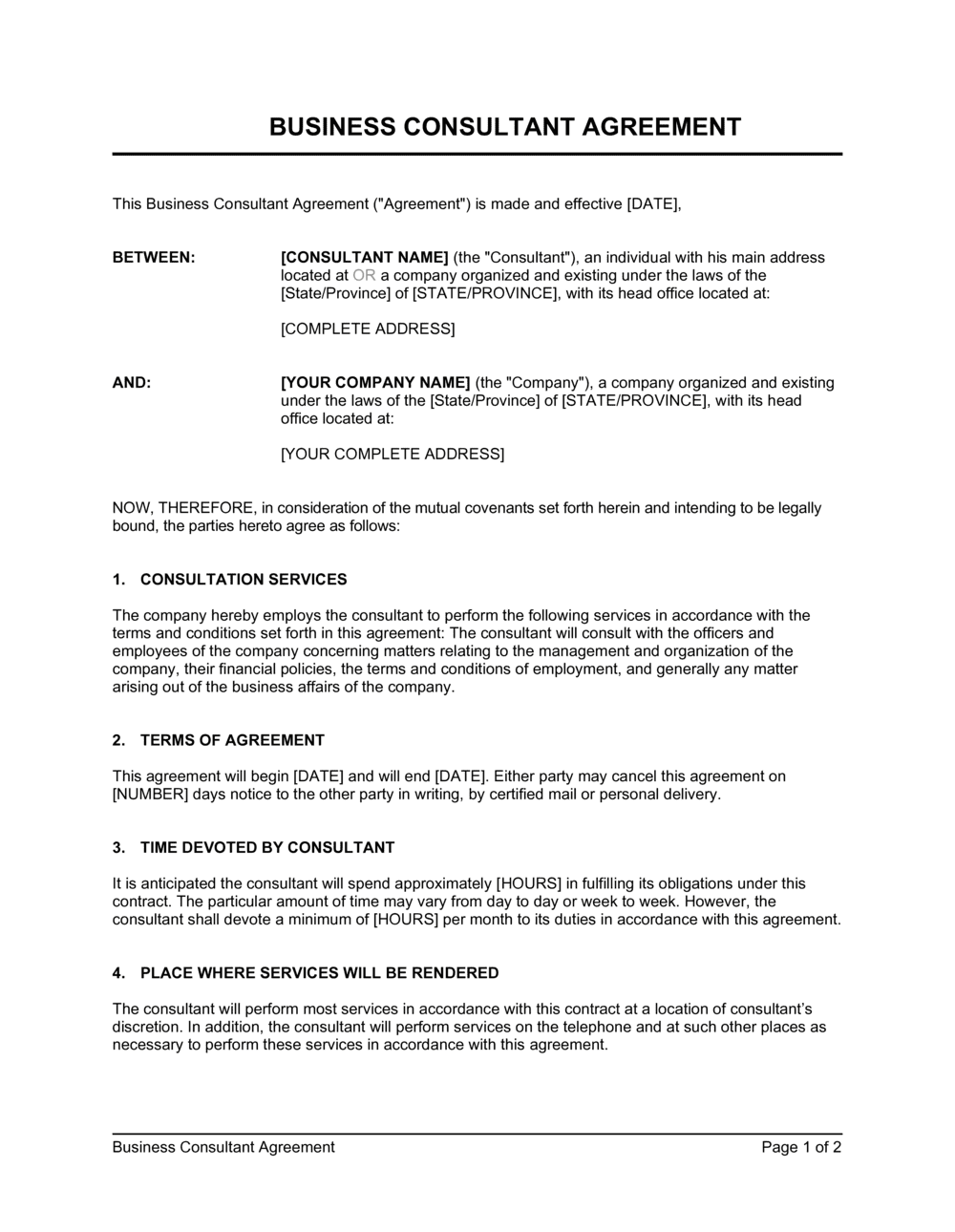
Consulting Contract Template

Free Word download β€’ Edit online β€’ Save & share with Drive β€’ Export to PDF

2 pagesβ€’20–30 min to fillβ€’Difficulty: Standardβ€’Signature requiredβ€’Legal review recommended
Learn more ↓
FreeConsulting Contract Template

At a glance

What it is
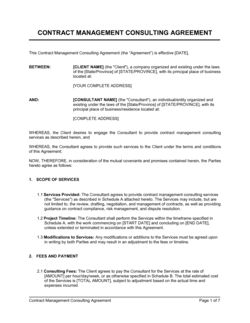
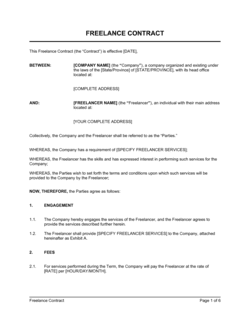
A Consulting Agreement Short is a concise, legally binding contract between a client and an independent consultant that defines the scope of work, fees, payment schedule, IP ownership, confidentiality obligations, and termination rights. This free Word download covers all essential terms in a focused 3–5 page format you can edit online and export as PDF β€” without the bulk of a full-length master services agreement.
When you need it
Use it when engaging a consultant for a defined project or fixed term where the relationship is straightforward enough that a short-form document captures all material terms without a lengthy negotiation. It is appropriate for project-based engagements, advisory retainers, and one-time consulting assignments.
What's inside
Scope of services and deliverables, fee structure and payment terms, independent contractor status, intellectual property assignment, confidentiality obligations, termination provisions, limitation of liability, and governing law.

What is a Consulting Agreement Short?

A Consulting Agreement Short is a concise, legally binding contract between a client and an independent consultant that establishes the full commercial and legal framework for a project-based or advisory engagement in 3–5 pages. It defines the scope of services and deliverables, sets fees and payment terms, confirms the consultant's independent contractor status, assigns ownership of work product to the client, protects confidential information, and provides a clean mechanism for either party to exit the arrangement. Unlike a full master services agreement, the short form keeps legal overhead proportionate to the scale and simplicity of the engagement.

Why You Need This Document

Starting a consulting engagement without a signed agreement is the single most reliable way to generate a payment dispute, an IP ownership conflict, or an unexpected worker misclassification liability. Without a written scope, clients expand the work indefinitely while resisting additional invoices. Without an IP assignment clause, the consultant may retain copyright in deliverables the client paid to commission β€” a problem that surfaces when the client tries to sell, license, or build on the work product. Without an independent contractor clause that is backed by actual working conditions, tax authorities in the US, Canada, and the UK will classify the consultant as an employee and hold the client liable for back payroll taxes, interest, and penalties. This template closes all three gaps in the time it takes to fill in the blanks, giving both parties a clear record of what was agreed before the first billable hour is spent.

Which variant fits your situation?

If your situation is…Use this template
Multi-phase or enterprise-level consulting with complex deliverablesConsulting Agreement (Long Form)
Ongoing advisory role with no defined end dateAdvisory Board Member Agreement
IT or software development consulting specificallyIT Consulting Agreement
Engaging a contractor who will work embedded with an employee teamIndependent Contractor Agreement
Protecting confidential information before consulting discussions beginNon-Disclosure Agreement
Consulting for a fixed monthly retainer with rolling renewalRetainer Agreement
Project scoped as a one-time deliverable with a fixed priceStatement of Work

Common mistakes to avoid

❌ Vague scope of services

Why it matters: Without specific deliverables and completion criteria, scope creep accumulates unchecked and every invoice becomes a negotiation. Clients withhold payment citing unmet expectations; consultants claim the work was completed.

Fix: List each deliverable by name, format, and deadline in a separate Exhibit A. Include an explicit clause stating that any work outside Exhibit A requires a written change order.

❌ No IP assignment condition tied to payment

Why it matters: An unconditional IP assignment gives the client ownership of deliverables even if they never pay β€” stripping the consultant of the only practical leverage available after delivery.

Fix: Add a condition that IP ownership transfers upon receipt of full payment, and that the client receives only a limited license to use the work product in the interim.

❌ Omitting the limitation of liability clause

Why it matters: A consultant who delivers flawed financial analysis or strategic advice on a significant transaction can face damages claims orders of magnitude larger than their engagement fee without a liability cap.

Fix: Include a mutual cap limiting total liability to fees paid in the prior three months, and explicitly exclude consequential, indirect, and punitive damages.

❌ Treating the contractor like an employee after signing

Why it matters: Tax authorities in the US, Canada, and the UK assess worker classification based on actual working conditions, not contract language alone. A misclassified consultant exposes the client to back payroll taxes, penalties, and benefit liabilities.

Fix: Allow the consultant control over when and how they work. Avoid assigning a company email address, fixed hours, or a reporting line in the org chart β€” these behaviors signal employment regardless of the contract.

❌ No termination-for-convenience clause

Why it matters: Without one, a client who ends an engagement early due to budget cuts or a strategic pivot may owe the consultant the full remaining project fee as a breach-of-contract damages claim.

Fix: Include a mutual termination-for-convenience right with 14–30 days' notice, and a clear statement that the client owes only fees for services performed through the termination date, plus any agreed kill fee.

❌ Choosing an unconnected governing law

Why it matters: Courts in California, Ontario, and several EU member states apply local mandatory employment and contractor laws regardless of a contrary choice-of-law clause β€” making a foreign governing law selection ineffective and potentially misleading.

Fix: Choose the jurisdiction where the consultant primarily performs the work or where the client is headquartered. For cross-border engagements, take legal advice on which jurisdiction's mandatory rules will apply regardless of the contract.

The 9 key clauses, explained

Parties and engagement

In plain language: Identifies the client and the consultant as legal entities, records the effective date of the agreement, and establishes the basis of the engagement.

Sample language
This Consulting Agreement ('Agreement') is entered into as of [DATE] between [CLIENT LEGAL NAME], a [STATE] [ENTITY TYPE] ('Client'), and [CONSULTANT NAME / ENTITY], a [DESCRIPTION] ('Consultant').

Common mistake: Using a trading name instead of the consultant's registered legal entity or full legal name β€” if a payment or IP dispute arises, enforcing the agreement against the right party becomes complicated.

Scope of services and deliverables

In plain language: Defines exactly what the consultant will do, what outputs they will produce, and any explicit exclusions from the engagement.

Sample language
Consultant shall perform the services described in Exhibit A ('Services'), including [DELIVERABLE 1] by [DATE] and [DELIVERABLE 2] by [DATE]. Services do not include [EXCLUSION].

Common mistake: Describing services in broad, vague terms such as 'strategic advice.' Without specific deliverables and completion criteria, scope creep is difficult to resist and invoice disputes become inevitable.

Fees, expenses, and payment terms

In plain language: States the fee structure β€” fixed project fee, hourly rate, or monthly retainer β€” payment schedule, expense reimbursement policy, and late payment consequences.

Sample language
Client shall pay Consultant a fixed fee of $[AMOUNT] payable as follows: 50% upon signing and 50% upon delivery of final Deliverables. Approved expenses shall be reimbursed within [15] days of submission. Invoices unpaid after [30] days accrue interest at [1.5]% per month.

Common mistake: Omitting a late payment interest clause. Without it, the consultant has no contractual leverage to accelerate collection on overdue invoices beyond sending a demand letter.

Independent contractor status

In plain language: Confirms that the consultant is not an employee β€” no benefits, no tax withholding, no right to direct and control the manner of work β€” and that the consultant is responsible for their own taxes.

Sample language
Consultant is an independent contractor and not an employee, agent, or partner of Client. Consultant is solely responsible for all taxes, insurance, and benefits arising from this engagement. Client shall not withhold or remit payroll taxes on Consultant's behalf.

Common mistake: Including this clause but then operationally treating the consultant like an employee β€” setting fixed hours, requiring use of company equipment, or integrating them into org charts. Tax authorities look at conduct, not just contract language, to determine worker classification.

Intellectual property assignment

In plain language: Assigns ownership of all work product, deliverables, and inventions created by the consultant in connection with the engagement to the client, effective upon payment in full.

Sample language
All work product, deliverables, and materials created by Consultant in the course of this engagement ('Work Product') are works made for hire and shall be the sole property of Client. To the extent any Work Product does not qualify as a work made for hire, Consultant hereby irrevocably assigns all rights in such Work Product to Client.

Common mistake: Failing to include the 'upon payment in full' condition. Without it, the client receives IP assignment even if they never pay β€” removing the consultant's primary commercial leverage.

Confidentiality

In plain language: Prohibits the consultant from disclosing or misusing the client's confidential information during and after the engagement, and defines what counts as confidential.

Sample language
'Confidential Information' means any non-public information disclosed by Client relating to its business, customers, technology, or finances. Consultant shall not disclose or use Confidential Information for any purpose outside this engagement. This obligation survives termination for [2] years.

Common mistake: Using a mutual confidentiality clause when the information flow is entirely one-directional. Mutual obligations may inadvertently restrict the client's ability to discuss the consultant's work with third parties or share deliverables downstream.

Term and termination

In plain language: Sets the start and end date of the engagement, defines the notice period for early termination, and specifies what payment is owed if either party terminates early.

Sample language
This Agreement commences on [START DATE] and continues until [END DATE] or completion of the Services, whichever is earlier. Either party may terminate for convenience upon [14] days' written notice. Upon termination, Client shall pay Consultant for all Services performed through the termination date.

Common mistake: No termination-for-convenience clause at all. Without one, terminating an ongoing consulting engagement before project completion can expose the client to a claim for the full remaining fee.

Limitation of liability

In plain language: Caps the maximum damages either party can recover from the other β€” typically limited to the total fees paid under the agreement β€” and excludes consequential or indirect damages.

Sample language
In no event shall either party's total liability exceed the fees paid to Consultant in the [3] months preceding the claim. Neither party shall be liable for indirect, incidental, or consequential damages, even if advised of the possibility of such damages.

Common mistake: Omitting this clause from short-form agreements to save space. A consultant who provides flawed advice on a significant transaction could face a damages claim many times the size of their fee without it.

Governing law and dispute resolution

In plain language: Specifies which jurisdiction's law governs the agreement and how disputes are resolved β€” court litigation, arbitration, or mediation.

Sample language
This Agreement is governed by the laws of [STATE / PROVINCE / COUNTRY], without regard to conflict-of-law principles. Any dispute shall be resolved by binding arbitration administered by [AAA / JAMS] in [CITY], except claims for injunctive relief which may be brought in any court of competent jurisdiction.

Common mistake: Selecting a governing law with no meaningful connection to where either party operates. Some jurisdictions β€” notably California β€” apply local law to consulting arrangements regardless of a contrary choice-of-law provision.

How to fill it out

  1. 1

    Identify both parties with their legal names

    Enter the client's full registered legal entity name and the consultant's full legal name or business entity name. Include the state or country of formation for each party.

    πŸ’‘ Ask the consultant for a copy of their business registration or W-9 before drafting β€” this confirms the correct legal name for the agreement and your tax records simultaneously.

  2. 2

    Define the scope of services in Exhibit A

    List every specific deliverable, the format it will take, and the deadline for each. Move granular detail into Exhibit A rather than the body of the agreement so the main terms stay readable.

    πŸ’‘ Use measurable completion criteria for each deliverable β€” 'a 20-page market analysis in PDF format' is enforceable; 'strategic research' is not.

  3. 3

    Set the fee structure and payment schedule

    Choose fixed fee, hourly rate, or monthly retainer. Enter the total or rate, payment milestones or invoicing frequency, and the payment due date (e.g., Net 15 from invoice date). Add an expense reimbursement cap if appropriate.

    πŸ’‘ A 50% deposit on signing and 50% on delivery is the most effective structure for short project engagements β€” it aligns both parties' incentives and reduces collection risk.

  4. 4

    Confirm independent contractor status language

    Review the independent contractor clause to confirm it accurately reflects the working arrangement. If the client will direct the consultant's hours, require specific equipment, or integrate them into day-to-day team operations, the classification may need legal review.

    πŸ’‘ In California, the ABC test applies β€” if the consultant's work is central to the client's core business, contractor classification may not hold regardless of what the contract says.

  5. 5

    Tailor the IP assignment clause

    Decide whether the client needs full ownership of all work product or only a license to use it. For consultants who use proprietary frameworks or tools, consider a narrower assignment covering only bespoke deliverables, with a license grant for pre-existing IP.

    πŸ’‘ Add an explicit carve-out for the consultant's pre-existing tools, templates, and methodologies β€” without one, the client could claim ownership of materials the consultant developed independently before the engagement.

  6. 6

    Set the term, notice period, and termination payments

    Enter the start and end date. Set a termination-for-convenience notice period of 14–30 days. Specify that the client owes payment for work completed through the termination date, and whether any kill fee applies.

    πŸ’‘ A kill fee of 25–50% of remaining fees on client-initiated termination is standard for fixed-price engagements β€” it compensates the consultant for opportunity cost and reserved capacity.

  7. 7

    Choose governing law and dispute resolution

    Select the jurisdiction whose law governs the agreement β€” typically the client's primary operating state or the consultant's location. Choose arbitration if confidentiality and speed matter; litigation if you need discovery rights.

    πŸ’‘ Arbitration clauses in consulting agreements are generally enforced in the US, UK, Canada, and the EU β€” but check that the selected arbitration body (AAA, JAMS, ICC) operates in the chosen jurisdiction.

  8. 8

    Execute before work begins

    Both parties must sign before any work starts. Post-commencement signatures create enforceability questions around IP assignment and restrictive covenants in common-law jurisdictions.

    πŸ’‘ Use an e-signature tool that timestamps execution and delivers a fully executed copy to both parties automatically β€” this eliminates disputes over whether a countersigned version was ever returned.

Frequently asked questions

What is a consulting agreement?

A consulting agreement is a legally binding contract between a client and an independent consultant that defines the scope of services, fees, payment terms, IP ownership, confidentiality obligations, and termination rights. It establishes that the consultant is not an employee and documents the commercial terms of the engagement. A short-form consulting agreement covers all material terms in 3–5 pages, making it suitable for project-based or straightforward advisory engagements.

What is the difference between a short-form and long-form consulting agreement?

A short-form consulting agreement covers the essential terms β€” scope, fees, IP, confidentiality, and termination β€” in a concise document appropriate for defined projects and straightforward relationships. A long-form agreement adds detailed representations and warranties, indemnification provisions, audit rights, insurance requirements, and step-in rights that are typically needed for enterprise engagements, regulated industries, or multi-year arrangements. Use the short form when the project scope is clear, the relationship is trust-based, and the financial exposure is moderate.

Does a consulting agreement need to be signed to be enforceable?

Consulting agreements are generally enforceable when properly executed by both parties with a handwritten or valid electronic signature. While oral agreements can be binding in some jurisdictions, an unsigned consulting arrangement creates serious evidentiary problems around scope, fees, and IP ownership if a dispute arises. Always obtain signatures from both parties before work begins.

Who owns the work product created by a consultant?

Ownership depends entirely on what the agreement says. Without an IP assignment clause, the consultant typically retains copyright in their deliverables and the client receives only an implied license to use them. A written IP assignment clause β€” combined with a work-for-hire designation β€” transfers ownership to the client upon payment. Consultants should carve out pre-existing tools and methodologies so the assignment covers only bespoke deliverables.

Is a consulting agreement the same as an independent contractor agreement?

They cover similar ground but are not identical. An independent contractor agreement focuses primarily on worker classification β€” confirming the person is not an employee β€” and is often used for ongoing operational work. A consulting agreement is scoped around a specific project or advisory relationship and places equal emphasis on deliverables, IP ownership, and confidentiality. For most consulting engagements, the consulting agreement is the more appropriate document.

What payment terms are standard for a consulting agreement?

For fixed-price projects, a 50% deposit on signing and 50% on delivery is the most common structure and the most effective at reducing collection risk. Monthly retainers are typically invoiced in advance on the first of the month. Time-and-materials engagements are usually invoiced bi-weekly or monthly with Net 15 or Net 30 payment terms. Including a late payment interest clause of 1.5% per month on overdue balances is standard and generally enforceable.

Can I use a consulting agreement for an international engagement?

Yes, but the governing law and jurisdiction clauses become more important. Choose the jurisdiction with the strongest connection to the engagement and confirm that the consultant classification holds under local law β€” several EU member states have strict tests for distinguishing contractors from employees. For engagements involving parties in different countries, consider seeking a brief legal review to confirm the agreement's terms will be recognized by both jurisdictions' courts.

What happens if a consulting agreement is terminated early?

The outcome depends on the termination clause. A well-drafted agreement allows either party to terminate for convenience with 14–30 days' notice, with the client owing fees for services performed through the termination date only. Without this clause, early termination by the client may constitute a breach of contract, entitling the consultant to the full remaining project fee as damages. A kill fee provision β€” typically 25–50% of the remaining balance β€” can provide a middle ground.

Do I need a lawyer to draft a consulting agreement?

For straightforward domestic project engagements, a high-quality short-form template is generally sufficient. Consider engaging a lawyer when the engagement involves sensitive IP in a competitive market, the consultant has access to trade secrets or key customer relationships, the fees exceed $50,000, the engagement crosses international borders, or the industry is regulated. A one-hour template review typically costs $200–$400 and is worthwhile when any of these factors are present.

How this compares to alternatives

vs Consulting Agreement (Long Form)

The long-form consulting agreement adds detailed indemnification provisions, representations and warranties, audit rights, insurance requirements, and change-order procedures not included in the short form. Use the long form for enterprise clients, multi-phase projects, regulated industries, or any engagement where the financial exposure justifies the additional drafting overhead. The short form is appropriate when the project scope is defined and the relationship is straightforward.

vs Independent Contractor Agreement

An independent contractor agreement focuses primarily on establishing non-employee status and governing ongoing operational work. A consulting agreement is scoped around a specific project or advisory assignment and places equal weight on deliverables, IP ownership, and confidentiality. For project-based consulting relationships, the consulting agreement is the more precise document.

vs Statement of Work

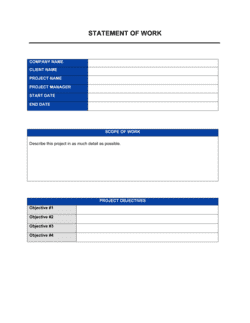
A statement of work defines project scope, milestones, and deliverables in detail but does not contain the legal boilerplate β€” IP assignment, confidentiality, limitation of liability, governing law β€” that makes a contract enforceable on its own. A statement of work typically operates as an exhibit under a master consulting or services agreement. If you have no master agreement in place, the consulting agreement is the right starting point.

vs Non-Disclosure Agreement

An NDA protects confidential information shared before or during preliminary discussions but contains no scope, fee, IP, or termination terms. It is not a substitute for a consulting agreement once the engagement is confirmed. The consulting agreement's confidentiality clause covers the same ground within the broader contract, making a standalone NDA redundant once both parties have signed a properly drafted consulting agreement.

Industry-specific considerations

Technology / SaaS

IP assignment for code, algorithms, and product specifications is the central concern; pre-existing IP carve-outs for proprietary frameworks and open-source components require careful drafting.

Marketing and creative services

Work-for-hire language covers creative deliverables including copy, design assets, and campaign strategies; usage rights and platform-specific licensing should be addressed explicitly.

Financial services

Confidentiality obligations must cover client financial data and trading information; regulatory compliance representations and conflict-of-interest disclosures are standard additions.

Management consulting and professional services

Non-solicitation of clients and employees is critical given fee-based relationships; limitation of liability caps are heavily negotiated relative to the size of the engagement fee.

Jurisdictional notes

United States

Worker classification is governed by a patchwork of federal and state tests. California's ABC test is the most restrictive β€” a consultant whose work is central to the client's core business may be reclassified as an employee regardless of contract language. Non-solicitation clauses are generally enforceable but subject to reasonableness review; non-compete clauses for independent consultants are unenforceable in California and several other states.

Canada

Canada has no federal at-will doctrine, and consultant misclassification carries significant payroll tax and benefit liability under the Canada Revenue Agency's 'worker classification' rules. Quebec requires contracts with provincially regulated entities to be in French. IP assignment clauses are enforceable but must be explicit β€” implied assignment of copyright does not arise in Canada as it does in some US contexts.

United Kingdom

IR35 rules require clients engaging consultants through personal service companies to assess whether the relationship would be one of employment if the intermediary were removed β€” a positive IR35 determination triggers employer National Insurance Contributions. Outside IR35, consulting agreements are enforceable on standard contract principles. Post-termination non-solicitation and confidentiality clauses are enforceable if reasonable in scope and duration.

European Union

EU member states apply varying tests to distinguish employees from independent contractors β€” France, Germany, and Spain impose some of the strictest classification standards. GDPR applies when the consultant processes personal data on behalf of the client, requiring a Data Processing Agreement as a separate document or addendum. Post-engagement non-solicitation clauses typically require financial compensation to the consultant to be enforceable in France and Germany.

Template vs lawyer β€” what fits your deal?

PathBest forCostTime
Use the templateDomestic project-based consulting engagements with a defined scope and moderate feesFree15–30 minutes
Template + legal reviewEngagements involving sensitive IP, fees above $50,000, regulated industries, or cross-border arrangements$200–$500 for a one-hour attorney review1–3 days
Custom draftedEnterprise consulting arrangements, multi-year engagements, or situations where non-compete and indemnification terms are heavily negotiated$1,000–$4,000+1–2 weeks

Glossary

Scope of Work
The specific services, tasks, and deliverables the consultant is contracted to provide, used to measure performance and limit liability.
Independent Contractor
A self-employed individual engaged to perform services for a client without becoming an employee β€” the client does not withhold taxes or provide benefits.
Deliverable
A specific, tangible output β€” report, analysis, design, or presentation β€” that the consultant must produce by a defined date.
IP Assignment
A clause transferring ownership of all work product created by the consultant during the engagement to the client.
Retainer
A fixed periodic fee paid to a consultant in exchange for a defined number of hours or ongoing availability, regardless of specific project completion.
Work for Hire
A legal doctrine under which original work created by an independent contractor within the scope of a written agreement is owned by the commissioning party, not the creator.
Limitation of Liability
A clause capping the maximum financial exposure of one or both parties β€” typically the consultant's total fees paid β€” in the event of a breach or claim.
Non-Solicitation
A post-engagement restriction preventing the consultant from recruiting the client's employees or soliciting the client's customers for a defined period.
Time and Materials
A billing arrangement in which the client pays for actual hours worked at an agreed hourly rate plus any approved out-of-pocket expenses.
Termination for Convenience
A provision allowing either party to end the agreement without cause by providing a specified notice period, typically 14 to 30 days.

Part of your Business Operating System

This document is one of 3,000+ business & legal templates included in Business in a Box.

  • Fill-in-the-blanks β€” ready in minutes
  • 100% customizable Word document
  • Compatible with all office suites
  • Export to PDF and share electronically

Create your document in 3 simple steps.

From template to signed document β€” all inside one Business Operating System.
1
Download or open template

Access over 3,000+ business and legal templates for any business task, project or initiative.

2
Edit and fill in the blanks with AI

Customize your ready-made business document template and save it in the cloud.

3
Save, Share, Send, Sign

Share your files and folders with your team. Create a space of seamless collaboration.

Save time, save money, and create top-quality documents.

β˜…β˜…β˜…β˜…β˜…

"Fantastic value! I'm not sure how I'd do without it. It's worth its weight in gold and paid back for itself many times."

Managing Director Β· Mall Farm
Robert Whalley
Managing Director, Mall Farm Proprietary Limited
β˜…β˜…β˜…β˜…β˜…

"I have been using Business in a Box for years. It has been the most useful source of templates I have encountered. I recommend it to anyone."

Business Owner Β· 4+ years
Dr Michael John Freestone
Business Owner
β˜…β˜…β˜…β˜…β˜…

"It has been a life saver so many times I have lost count. Business in a Box has saved me so much time and as you know, time is money."

Owner Β· Upstate Web
David G. Moore Jr.
Owner, Upstate Web

Run your business with a system β€” not scattered tools

Stop downloading documents. Start operating with clarity. Business in a Box gives you the Business Operating System used by over 250,000 companies worldwide to structure, run, and grow their business.

Start freeΒ Β·Β No credit card required