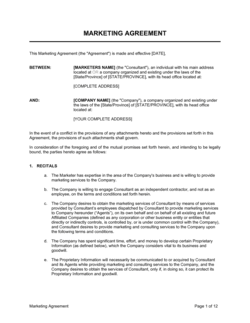
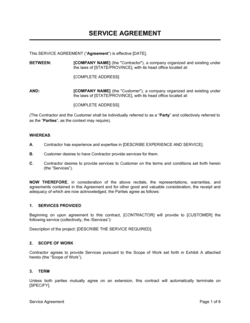
Brand Reputation Management Template

Free Word download β€’ Edit online β€’ Save & share with Drive β€’ Export to PDF

3 pagesβ€’25–30 min to fillβ€’Difficulty: Standardβ€’Signature requiredβ€’Legal review recommended
Learn more ↓
FreeBrand Reputation Management Template

At a glance

What it is
A Brand Reputation Management Agreement is a legally binding contract between a business and an agency or consultant engaged to monitor, protect, and rehabilitate the client's brand presence online and in the press. This free Word download covers the full scope of services, monitoring obligations, takedown procedures, crisis-response protocols, performance benchmarks, confidentiality, and liability β€” ready to edit and export as PDF for immediate execution.
When you need it
Use it before engaging any third party to manage your brand's online presence, handle negative reviews, issue press responses, or conduct content-removal campaigns. It is equally important when you are the agency accepting such an engagement β€” the contract defines deliverables, limits liability, and protects both sides if a crisis escalates.
What's inside
Scope of services and monitoring platforms, performance metrics and reporting cadence, takedown and suppression procedures, crisis-response protocols, confidentiality obligations, IP ownership of produced content, indemnification, limitation of liability, termination rights, and governing law.

What is a Brand Reputation Management Agreement?

A Brand Reputation Management Agreement is a legally binding contract between a business and the agency or consultant engaged to monitor, protect, and β€” when necessary β€” rehabilitate that business's reputation across online platforms, search engines, review sites, and the press. It defines the exact scope of monitoring services, the platforms covered, the performance benchmarks the agency must meet, the procedures for requesting content removal, the pre-approved messaging framework that activates during a crisis, and the liability framework that governs what happens if a campaign makes things worse rather than better. Unlike a general service agreement, it addresses the distinctive legal risks of reputation work: defamation claims arising from aggressive takedown requests, data-handling obligations for sensitive crisis communications, and IP ownership of the content produced on the client's behalf.

Why You Need This Document

Operating without a signed reputation management agreement exposes both sides to serious, concrete risk. A client who hands platform credentials and crisis communications to an agency without a contract has no enforceable basis to demand data deletion when the engagement ends, no defined standard for terminating for cause when results fail to materialize, and no indemnification if the agency's unfounded takedown requests trigger a counterclaim from the target. For agencies, an unsigned engagement means unlimited liability for brand revenue losses the client attributes to a mishandled crisis β€” with no cap and no exclusion for consequential damages. The moment a reputation campaign touches public channels, the stakes are too high for a handshake arrangement. This template gives both parties a clear, enforceable starting point β€” covering scope, metrics, crisis protocols, IP, liability, and termination β€” so that the focus remains on protecting the brand rather than litigating what the contract required.

Which variant fits your situation?

If your situation is…Use this template
Hiring an external agency to manage all online reputation activitiesBrand Reputation Management Agreement (Agency)
Engaging a freelance consultant for a one-time review-removal campaignIndependent Contractor Agreement
Retaining a PR firm for ongoing media monitoring and press responsePublic Relations Retainer Agreement
Partnering with an influencer whose conduct could affect brand reputationInfluencer Marketing Agreement
Protecting brand assets from unauthorized use by third partiesTrademark License Agreement
Commissioning original content as part of a reputation-building campaignContent Creation Agreement
Sharing sensitive brand and crisis data with the reputation management firmNon-Disclosure Agreement

Common mistakes to avoid

❌ Defining scope as 'manage our online reputation' without specifics

Why it matters: Vague scope makes every deliverable negotiable after the fact, leading to disputes over what was owed when results disappoint or fees are contested.

Fix: List every platform, deliverable type, and monthly output count in a signed Schedule A that forms part of the contract.

❌ No performance benchmarks or success metrics

Why it matters: Without defined metrics, the client cannot demonstrate underperformance to justify termination for cause, and the agency has no objective standard against which to demonstrate the value of its work.

Fix: Include at least three measurable KPIs β€” sentiment trend, search position for defined keywords, and review rating target β€” with a reporting cadence tied to them.

❌ Granting the agency unlimited authority to file legal claims

Why it matters: Platforms treat abusive or unfounded removal requests as a terms-of-service violation, which can result in the client's own content being flagged or removed in retaliation.

Fix: Limit the agency's authority to platform-level takedown requests. Require explicit written client authorization before escalating any matter to legal proceedings.

❌ Omitting a data-deletion clause on termination

Why it matters: Reputational data β€” including internal crisis communications, brand vulnerabilities, and customer complaint details β€” is highly sensitive and has ongoing commercial value to an agency.

Fix: Require the agency to certify in writing that all client data has been deleted or returned within 30 days of termination, and retain the right to audit compliance.

❌ No transition-assistance obligation

Why it matters: An agency that terminates without handing over monitoring credentials, alert configurations, and campaign content leaves the client with zero visibility during the period they are most vulnerable to new threats.

Fix: Include a transition clause requiring the agency to deliver all credentials, active campaigns, monitoring configurations, and work product within 10 business days of any termination notice.

❌ One-sided indemnification protecting only the agency

Why it matters: Clients face third-party claims when agencies file unfounded takedown requests or publish content that infringes a competitor's IP β€” exposure that can exceed the value of the entire engagement.

Fix: Structure indemnification as mutual: the client covers claims from inaccurate information it provided; the agency covers claims from its own misconduct, negligence, or unsupported removal submissions.

The 10 key clauses, explained

Scope of services and monitored platforms

In plain language: Defines exactly what the agency will do β€” review monitoring, search suppression, content creation, press outreach β€” and which platforms and channels are covered.

Sample language
Agency shall provide the following services: (a) daily monitoring of [PLATFORM LIST] for mentions of [BRAND NAME] and [ASSOCIATED KEYWORDS]; (b) submission of takedown requests within [X] hours of identifying qualifying content; (c) production of [X] positive content assets per month for suppression purposes.

Common mistake: Describing services in vague terms like 'manage online reputation.' Without a platform list and deliverable counts, scope creep disputes are nearly unavoidable.

Performance metrics and reporting

In plain language: Sets measurable benchmarks β€” sentiment improvement targets, search result position goals, review response rates β€” and the frequency of written reporting to the client.

Sample language
Agency shall deliver a written performance report on the [1st / 15th] of each month covering: (a) total mentions by sentiment category; (b) search result rankings for [TARGET KEYWORDS] on positions 1–10; (c) number of takedown requests submitted and resolved; (d) net promoter score or review rating trend, if applicable.

Common mistake: No defined metrics in the contract. When the client feels reputation has not improved, there is no objective standard to assess performance β€” making payment disputes and termination for cause nearly impossible to resolve.

Takedown and content-removal procedures

In plain language: Specifies the process for identifying infringing or defamatory content, the agency's authority to file removal requests on the client's behalf, and escalation to legal counsel when platforms refuse.

Sample language
Upon identifying content that meets the removal criteria set out in Schedule A, Agency shall submit a formal takedown request to the relevant platform within [X] hours. If the platform denies removal within [Y] days, Agency shall escalate to Client's legal counsel with a written summary of the denial.

Common mistake: Granting the agency unlimited authority to file legal claims or initiate litigation on the client's behalf without a separate written authorization. Platforms treat aggressive or unfounded removal demands as abuse, which can worsen the brand's standing.

Crisis response protocol

In plain language: Defines what constitutes a reputation crisis, the agency's response time obligations, and the pre-approved messaging framework that activates automatically.

Sample language
A 'Crisis Event' is defined as any online mention, news article, or social media post that achieves [X] shares or impressions within [Y] hours and contains a negative sentiment score below [THRESHOLD]. Upon a Crisis Event, Agency shall notify Client within [Z] hours and present a draft response using the pre-approved messaging framework in Schedule B.

Common mistake: Defining 'crisis' so broadly that every negative review triggers the protocol. This wastes resources and dilutes the agency's attention when a genuine crisis occurs.

Confidentiality and data handling

In plain language: Obliges both parties to keep brand data, crisis communications, internal strategies, and customer information confidential, and specifies how data is stored and deleted after the engagement ends.

Sample language
Each party agrees to treat all Confidential Information of the other party with at least the same degree of care it uses to protect its own confidential information, but in no case less than reasonable care. Agency shall not disclose Client's crisis communications, internal reports, or brand data to any third party without prior written consent. All Client data shall be deleted or returned within [30] days of termination.

Common mistake: Omitting a data-deletion requirement on termination. Reputational data β€” especially crisis communications β€” is sensitive; agencies that retain it after the engagement create ongoing exposure.

Intellectual property ownership

In plain language: Assigns ownership of all content, reports, and assets created by the agency during the engagement to the client, or clearly reserves certain pre-existing tools and methodologies to the agency.

Sample language
All content, reports, creative assets, and deliverables produced by Agency specifically for Client under this Agreement ('Work Product') shall be considered work for hire and shall be the sole property of Client upon full payment of applicable fees. Agency retains ownership of its proprietary tools, templates, and methodologies used to produce the Work Product.

Common mistake: No IP clause at all, or one that assigns ownership only after all invoices are paid β€” leaving the client unable to use crisis content if a payment dispute arises mid-campaign.

Fees, payment terms, and expense reimbursement

In plain language: States the monthly retainer or project fee, the billing cycle, late-payment consequences, and which out-of-pocket expenses (press wire fees, legal filing costs) the client reimburses.

Sample language
Client shall pay Agency a monthly retainer of $[AMOUNT], due on the [1st] of each month. Invoices unpaid after [15] days accrue interest at [1.5]% per month. Pre-approved third-party expenses (press releases, legal filing fees, content placement costs) shall be reimbursed within [30] days of receipt of itemized invoices.

Common mistake: Bundling third-party platform costs into the retainer without a cap. Paid content placement and press distribution fees can scale unexpectedly β€” clients should approve individual expenses above a stated threshold.

Indemnification

In plain language: Requires each party to defend and compensate the other for losses arising from their own breach, negligence, or misconduct β€” including claims by third parties that the agency's takedown requests were abusive or the client's brand claims were false.

Sample language
Client shall indemnify Agency against any third-party claims arising from inaccurate brand information provided by Client. Agency shall indemnify Client against any claims arising from Agency's gross negligence, willful misconduct, or submission of takedown requests that Agency knew to be factually unsupported.

Common mistake: One-sided indemnification that only protects the agency. Clients are exposed to platform penalties and third-party defamation counterclaims when agencies file aggressive removal requests β€” the indemnification must flow both ways.

Limitation of liability

In plain language: Caps the total financial exposure of both parties β€” typically at the fees paid in the prior 12 months β€” and excludes liability for consequential damages like brand revenue loss.

Sample language
In no event shall either party's aggregate liability under this Agreement exceed the total fees paid by Client to Agency in the [12] months preceding the claim. Neither party shall be liable for indirect, incidental, or consequential damages, including loss of revenue, loss of goodwill, or reputational harm, even if advised of the possibility of such damages.

Common mistake: No liability cap at all. Reputation management campaigns touch public channels; a poorly executed response can amplify a crisis. Without a cap, the agency faces uncapped exposure for consequential brand damage.

Termination, notice, and transition assistance

In plain language: States the notice period for either party to end the agreement, grounds for immediate termination for cause, and the agency's obligation to hand over monitoring data, credentials, and campaign materials at the end.

Sample language
Either party may terminate this Agreement for convenience with [30] days' written notice. Either party may terminate immediately for Cause. Upon termination, Agency shall deliver to Client all campaign data, login credentials, monitoring reports, and work product within [10] business days.

Common mistake: No transition-assistance obligation. Agencies that terminate without handing over platform credentials, monitoring alerts, or content drafts leave the client blind during the most vulnerable period β€” immediately after ending a reputation engagement.

How to fill it out

  1. 1

    Identify the parties and define the brand scope

    Enter the full legal names of the client business and the agency or consultant. List all brand names, product names, executive names, and associated keywords that fall within the monitoring scope.

    πŸ’‘ Including executive names (especially the CEO) as monitored entities is critical β€” personal reputation events frequently trigger corporate brand crises within hours.

  2. 2

    Define the service scope and monitored platforms

    List every platform the agency will monitor β€” Google, review sites, social networks, news aggregators β€” and specify which services are in scope: monitoring only, content creation, takedown requests, or full crisis response.

    πŸ’‘ Attach a Schedule A with the platform list so the body of the agreement remains clean and Schedule A can be updated without a contract amendment.

  3. 3

    Set measurable performance metrics

    Agree on at least three quantified benchmarks β€” for example, average review rating above 4.0 within 6 months, negative results below position 5 in Google for brand keywords, or crisis response within 4 hours.

    πŸ’‘ Metrics that rely entirely on third-party platform behavior (like Google's index) should include a caveat acknowledging that results depend on platform cooperation.

  4. 4

    Draft the crisis response protocol and messaging framework

    Define the crisis threshold (impressions, sentiment score, or media tier), the agency's alert timeline, and attach a pre-approved messaging framework as Schedule B so response can begin without client approval delays during a live crisis.

    πŸ’‘ Pre-approve at least three message variants β€” holding statement, full response, and no-comment position β€” so the agency can act immediately without phone tag during off-hours.

  5. 5

    Confirm IP ownership and work-for-hire language

    Confirm that all deliverables β€” content pieces, monitoring reports, suppression assets β€” are work for hire and transfer to the client upon payment. Identify any agency tools or proprietary methodologies that remain the agency's property.

    πŸ’‘ If the agency uses proprietary software for sentiment analysis, grant the client a license to the reports (not the tool) so the data remains accessible after termination.

  6. 6

    Set fees, expense approval thresholds, and payment terms

    Enter the monthly retainer, billing date, late-payment interest rate, and the individual expense threshold above which the agency must seek written pre-approval before incurring costs.

    πŸ’‘ Set the pre-approval threshold at $250–$500 per expense for most engagements β€” high enough to avoid micro-managing routine press wire fees but low enough to prevent surprise invoices.

  7. 7

    Complete the liability and indemnification blocks

    Set the liability cap at 12 months of fees paid, confirm mutual indemnification for each party's own breach or misconduct, and ensure consequential damages are excluded for both sides.

    πŸ’‘ Review the indemnification clause specifically for takedown-request liability β€” the agency should indemnify the client for claims arising from removal requests the agency filed without factual basis.

  8. 8

    Execute before any monitoring or campaign work begins

    Both parties must sign before the agency accesses any brand accounts, submits any takedown requests, or publishes any content. Retroactive agreements leave IP ownership, liability, and confidentiality unresolved for all work performed before signing.

    πŸ’‘ Use a countersignature page that requires both parties to initial the service scope schedule β€” this confirms each side reviewed the specific deliverables, not just the boilerplate.

Frequently asked questions

What is a brand reputation management agreement?

A brand reputation management agreement is a legally binding contract between a business (the client) and an agency or consultant engaged to monitor, protect, and rehabilitate the client's brand presence online and in the media. It defines the scope of monitoring and services, performance benchmarks, crisis response obligations, confidentiality requirements, IP ownership of produced content, and the liability framework if things go wrong. Without it, both parties operate on informal expectations that courts cannot enforce.

When do I need a brand reputation management agreement?

You need one any time you engage a third party to monitor your brand online, respond to negative reviews, suppress harmful search results, issue press statements on your behalf, or manage a reputation crisis. It is equally important if you are the agency accepting such an engagement β€” the contract limits your liability for platform decisions outside your control and defines what success looks like before work begins.

What should a reputation management contract include?

At minimum: a defined scope with a platform list, measurable performance KPIs, a crisis response protocol with defined timelines, confidentiality and data-deletion obligations, IP ownership of all deliverables, fee structure with expense approval thresholds, mutual indemnification, a liability cap, and termination terms with a transition-assistance requirement. Missing any of these creates gaps that become expensive disputes.

Can a reputation management agency guarantee results?

No reputable agency can guarantee specific outcomes β€” Google's ranking algorithm, platform moderation decisions, and press coverage are outside any agency's control. Contracts should reference measurable effort-based metrics (takedown requests submitted, content assets produced, monitoring alerts reviewed) alongside outcome benchmarks, and include a carve-out acknowledging that results depend on third-party platform cooperation. Be cautious of any agency that guarantees specific search positions in writing.

Who owns the content created during a reputation management campaign?

Under the work-for-hire doctrine in most jurisdictions, content specifically created for a client belongs to the client if the contract explicitly states this. Without a written IP assignment, the agency may retain copyright over blog posts, press releases, and social content it produced β€” meaning the client cannot repurpose or republish them after the engagement ends. Always include a clear work-for-hire clause covering all deliverables.

What is the right liability cap for a reputation management agreement?

A cap of 12 months' retainer fees paid is standard for most reputation management engagements. Some agencies push for 3 months; clients in high-risk industries (healthcare, financial services, consumer brands) should negotiate for 12–24 months given the potential scale of brand damage from a mishandled crisis. Both parties should also exclude consequential damages β€” including lost revenue and lost goodwill β€” to avoid uncapped exposure.

Does a reputation management agreement need to be reviewed by a lawyer?

For engagements under $2,000 per month with clearly defined deliverables and a straightforward scope, a well-drafted template is typically sufficient. Legal review is recommended when the engagement involves a known crisis, involves executive personal reputation intertwined with corporate brand, includes authority to file legal takedown claims, or exceeds $5,000 per month. Cross-border engagements β€” where defamation law and data-privacy rules differ materially β€” should always be reviewed by counsel familiar with the relevant jurisdictions.

How does GDPR affect a brand reputation management agreement?

If the agency processes personal data of EU residents β€” for example, monitoring individual customer complaints or managing review responses containing personal information β€” GDPR applies. The contract should include a Data Processing Addendum (DPA) designating the agency as a data processor, specifying lawful bases for processing, requiring sub-processor disclosures, and confirming data-deletion timelines. Failure to include a DPA exposes the client to GDPR enforcement even if the client itself is not EU-based.

What happens to monitoring data and credentials when the contract ends?

The contract should require the agency to return or destroy all client data within 30 days of termination and to deliver all platform credentials, monitoring configurations, active campaigns, and work product within 10 business days. Without this obligation, agencies routinely retain access to brand social accounts and monitoring dashboards for months after termination β€” creating both a security risk and a potential competitive intelligence issue.

How this compares to alternatives

vs Non-Disclosure Agreement

An NDA protects confidential information shared between parties but creates no service obligations, performance benchmarks, or liability framework for reputation-related work. A reputation management agreement includes confidentiality provisions as one clause among many, and is the appropriate document when an agency is actively performing services. Use an NDA in addition to β€” not instead of β€” a reputation management agreement when the engagement begins.

vs Marketing Services Agreement

A marketing services agreement governs content creation, advertising campaigns, and channel management for growth purposes. A reputation management agreement focuses on monitoring, crisis response, takedowns, and brand protection β€” including provisions for defamation, indemnification for removal requests, and data handling that a standard marketing agreement does not cover. Use a reputation management agreement when the engagement is primarily defensive or crisis-oriented.

vs Public Relations Retainer Agreement

A PR retainer agreement governs media relations, press release distribution, and journalist outreach. It typically lacks takedown procedures, crisis-threshold definitions, platform-specific monitoring obligations, and the liability framework needed when an agency acts as the client's agent in removal requests. Reputation management agreements are appropriate when the scope extends beyond earned media into active content suppression and review management.

vs Independent Contractor Agreement

An independent contractor agreement establishes the working relationship and payment terms for a self-employed individual but does not define reputation-specific deliverables, crisis protocols, or takedown authority. Use a contractor agreement for one-off or narrowly scoped engagements β€” such as a single review-removal campaign β€” and a full reputation management agreement for ongoing or multi-platform engagements where the contractor acts with significant authority over brand channels.

Industry-specific considerations

Consumer Brands and Retail

High review volume across Amazon, Google, and Yelp means monitoring scope and review-response SLAs are the most negotiated clauses in retail reputation agreements.

Healthcare and Medical Services

HIPAA constraints limit how patient reviews can be responded to publicly, making the crisis protocol and pre-approved messaging framework especially critical to define before engagement.

Financial Services

Regulatory restrictions on advertising and testimonials affect what suppression content can say, and FINRA or FCA oversight means all published responses may require compliance pre-approval.

Technology and SaaS

Developer community forums, GitHub issue trackers, and G2/Capterra reviews require specialized monitoring coverage not captured by standard social listening tools, and should be listed explicitly in the platform schedule.

Hospitality and Tourism

Review velocity on TripAdvisor, Booking.com, and Google is high enough that response-time SLAs β€” typically 24–48 hours β€” and escalation paths for one-star review spikes need explicit contract language.

Professional Services

Bar association and licensing board restrictions affect what lawyers, accountants, and consultants can claim publicly, making the pre-approved messaging framework a compliance document as much as a brand tool.

Jurisdictional notes

United States

Defamation law in the US is governed at the state level, with significant variation β€” New York and California both have strong anti-SLAPP statutes that can expose clients to fee-shifting if takedown requests are deemed meritless. Section 230 of the Communications Decency Act shields most platforms from liability for third-party content, meaning platform-level removal is discretionary. Non-compete restrictions on agency employees vary by state and may affect the scope of non-solicitation clauses included in the agreement.

Canada

Canada's anti-SLAPP legislation (most notably Ontario's Protection of Public Participation Act) can result in early dismissal of strategic defamation claims and cost awards against the party that brought them. PIPEDA and provincial privacy laws (especially Quebec's Law 25) impose data-handling obligations on reputation agencies processing personal data. Quebec contracts should be available in French for provincially regulated entities.

United Kingdom

The UK Defamation Act 2013 sets a 'serious harm' threshold for actionable defamation claims, which affects the legal basis on which takedown requests can be supported. The ICO enforces UK GDPR requirements on data processors, including reputation management agencies handling personal data in review responses or monitoring reports. The Online Safety Act 2023 imposes new obligations on platforms to address harmful content, which may expand the effectiveness of formal takedown requests over time.

European Union

GDPR Article 28 requires a Data Processing Addendum whenever a reputation agency processes personal data on the client's behalf β€” this is not optional and must be signed alongside the main agreement. The right to be forgotten under GDPR Article 17 gives individuals (not businesses) a tool to request search engine de-indexing of outdated or inaccurate content; agencies operating in the EU should understand its scope and limits. The EU Digital Services Act creates new transparency and appeals obligations for large platforms that may affect takedown request outcomes.

Template vs lawyer β€” what fits your deal?

PathBest forCostTime
Use the templateSmall businesses and agencies engaging in standard ongoing reputation monitoring with clearly defined deliverables and fees below $3,000 per monthFree30 minutes
Template + legal reviewEngagements involving crisis response authority, executive personal reputation, or monthly fees above $3,000$400–$8002–4 days
Custom draftedEnterprise brands, regulated industries (healthcare, finance), cross-border engagements, or agreements granting the agency authority to initiate legal proceedings$2,000–$6,000+2–4 weeks

Glossary

Reputation Management
The practice of monitoring, influencing, and rehabilitating how a brand or individual is perceived across online platforms, media, and public channels.
Takedown Request
A formal notice sent to a platform, search engine, or website operator requesting removal of content that is defamatory, infringing, or otherwise harmful to the brand.
Suppression Campaign
A coordinated effort to publish positive content that pushes harmful search results below the first page of search engine results, reducing their visibility.
Crisis Response Protocol
A predefined set of steps, escalation timelines, and pre-approved messaging activated when a significant reputational threat emerges.
Sentiment Analysis
Automated or human review of online mentions to categorize their tone β€” positive, neutral, or negative β€” and track shifts in brand perception over time.
Right to be Forgotten
A legal right under certain privacy laws (notably the EU GDPR) allowing individuals to request deletion of personal data or outdated negative content from search engine indices.
Defamation
A false statement of fact, published to a third party, that causes harm to a person's or business's reputation β€” actionable as libel (written) or slander (spoken).
Indemnification
A contractual obligation by one party to compensate the other for specific losses, damages, or legal costs arising from defined events or breaches.
Limitation of Liability
A clause capping the maximum financial exposure of one or both parties β€” typically set at fees paid in the prior 3–12 months β€” regardless of the nature of the claim.
SLA (Service Level Agreement)
A defined performance standard within the contract β€” for example, a 4-hour response time to a crisis alert or a 48-hour turnaround on takedown submissions.
Work for Hire
A copyright doctrine under which content created by an independent contractor for a client belongs to the client from the moment of creation, provided the contract explicitly states this.

Part of your Business Operating System

This document is one of 3,000+ business & legal templates included in Business in a Box.

  • Fill-in-the-blanks β€” ready in minutes
  • 100% customizable Word document
  • Compatible with all office suites
  • Export to PDF and share electronically

Create your document in 3 simple steps.

From template to signed document β€” all inside one Business Operating System.
1
Download or open template

Access over 3,000+ business and legal templates for any business task, project or initiative.

2
Edit and fill in the blanks with AI

Customize your ready-made business document template and save it in the cloud.

3
Save, Share, Send, Sign

Share your files and folders with your team. Create a space of seamless collaboration.

Save time, save money, and create top-quality documents.

β˜…β˜…β˜…β˜…β˜…

"Fantastic value! I'm not sure how I'd do without it. It's worth its weight in gold and paid back for itself many times."

Managing Director Β· Mall Farm
Robert Whalley
Managing Director, Mall Farm Proprietary Limited
β˜…β˜…β˜…β˜…β˜…

"I have been using Business in a Box for years. It has been the most useful source of templates I have encountered. I recommend it to anyone."

Business Owner Β· 4+ years
Dr Michael John Freestone
Business Owner
β˜…β˜…β˜…β˜…β˜…

"It has been a life saver so many times I have lost count. Business in a Box has saved me so much time and as you know, time is money."

Owner Β· Upstate Web
David G. Moore Jr.
Owner, Upstate Web

Run your business with a system β€” not scattered tools

Stop downloading documents. Start operating with clarity. Business in a Box gives you the Business Operating System used by over 250,000 companies worldwide to structure, run, and grow their business.

Start freeΒ Β·Β No credit card required