Exclusivity, Confidentiality and Assignment of Work Product Template

Free Word download • Edit online • Save & share with Drive • Export to PDF

3 pages25–30 min to fillDifficulty: ComplexSignature requiredLegal review recommended
Learn more ↓
FreeExclusivity, Confidentiality and Assignment of Work Product Template

At a glance

What it is
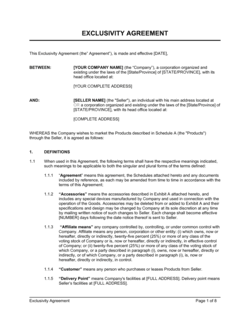
An Exclusivity, Confidentiality, and Assignment of Work Product agreement is a legally binding contract that bundles three critical protections into one document: it prevents the other party from working with your competitors during the engagement, prohibits disclosure of sensitive business information, and transfers ownership of all deliverables to the hiring company. This free Word download is structured for use with consultants, contractors, and service providers — edit it online and export as PDF for immediate execution.
When you need it
Use it before engaging any outside contractor, freelancer, or consultant who will have access to proprietary information, develop original work product, or be asked to refrain from working with competing businesses during the engagement period. It is especially critical before sharing trade secrets, client data, or unreleased product details.
What's inside
The agreement covers the scope and duration of the exclusivity obligation, a detailed confidentiality and non-disclosure framework with defined exceptions, a broad intellectual property and work product assignment clause, moral rights waivers, representations and warranties from both parties, and termination and survival provisions to ensure protections persist after the engagement ends.

What is an Exclusivity, Confidentiality, and Assignment of Work Product Agreement?

An Exclusivity, Confidentiality, and Assignment of Work Product Agreement is a legally binding contract that consolidates three critical protections into a single enforceable document: an exclusivity obligation that prevents a contractor or consultant from serving your competitors during the engagement, a confidentiality framework that prohibits disclosure or misuse of proprietary information, and a comprehensive intellectual property assignment clause that transfers full ownership of all deliverables — code, designs, research, data, and documentation — to the hiring company. Unlike a standalone NDA or a basic contractor agreement, this document addresses all three risks simultaneously, ensuring that protections are in place before any work begins or any sensitive information changes hands.

The agreement functions by treating work product as company property the moment it is created, rather than waiting for delivery or payment. The assignment operates as a present-tense transfer, not a future promise, which is a critical legal distinction in common-law jurisdictions. The confidentiality obligations survive the engagement itself, and the exclusivity scope is defined narrowly enough to be commercially reasonable while broad enough to protect genuine competitive interests.

Why You Need This Document

Engaging a contractor without this agreement exposes you to four simultaneous risks that standard contractor agreements and NDAs do not close. First, without an IP assignment clause, the contractor may own the copyright in code, designs, or reports they produced and invoiced you for — giving them leverage to demand additional payment or restrict your use of the deliverables. Second, without an exclusivity obligation, a contractor briefed on your unreleased product roadmap can walk into a competing client's office the next day. Third, without a moral rights waiver, contractors based in Canada, the UK, or the EU can object to how you modify or present their work, even after you have paid in full. Fourth, without a survival clause, a contractor can argue their confidentiality obligations ended the day the engagement closed.

The cost of discovering these gaps after the fact — in due diligence for an acquisition, in IP litigation, or in a competitive intelligence incident — routinely exceeds the value of the original engagement by an order of magnitude. This template closes all four gaps before work starts, for a fraction of the cost of custom drafting, and gives you an enforceable foundation you can use consistently across every contractor relationship.

Which variant fits your situation?

If your situation is…Use this template
Engaging a freelancer for a single creative or technical projectIndependent Contractor Agreement
Sharing sensitive business information without assigning IP or exclusivityNon-Disclosure Agreement (NDA)
Hiring a full-time employee with IP and non-compete obligationsEmployment Contract
Commissioning a software developer with full IP transfer requirementsSoftware Development Agreement
Requiring a departing employee to confirm IP ownership post-employmentIntellectual Property Assignment Agreement
Engaging an outside agency with exclusivity in a specific vertical or territoryExclusive Service Agreement
Protecting a specific invention or patent from contractor disclosureInvention Assignment Agreement

Common mistakes to avoid

❌ Future-tense IP assignment language

Why it matters: Clauses that say the contractor 'agrees to assign' rather than 'hereby assigns' create a mere contractual promise, not an immediate transfer. If the contractor becomes insolvent or disputes ownership later, the company may need a court order to perfect the assignment.

Fix: Use present-tense grant language: '[CONTRACTOR NAME] hereby irrevocably assigns to [COMPANY NAME] all right, title, and interest in and to the Work Product.' Include a power of attorney clause authorizing the company to execute assignment documents on the contractor's behalf if they refuse.

❌ Omitting the prior inventions schedule

Why it matters: Contractors routinely incorporate pre-existing code libraries, design systems, or frameworks into deliverables. Without a documented carve-out, the broad assignment clause may purport to transfer rights the contractor never owned, creating chain-of-title defects that surface during due diligence or litigation.

Fix: Attach Schedule B and require the contractor to complete it — even if the result is 'None.' Both parties should initial the schedule at signing to confirm it was reviewed.

❌ No moral rights waiver for international contractors

Why it matters: In Canada, the UK, France, Germany, and most EU member states, creators retain moral rights independent of copyright — including the right to attribution and the right to object to modifications. An IP assignment alone does not extinguish these rights, leaving the company exposed to claims if it edits or repurposes the work without credit.

Fix: Include an express moral rights waiver: 'To the extent permitted by applicable law, [CONTRACTOR NAME] irrevocably waives all moral rights in and to the Work Product.' For Canadian contractors, this waiver is the only mechanism available — moral rights cannot be assigned.

❌ Overbroad exclusivity with no compensation adjustment

Why it matters: Requiring a contractor to forgo all competing work for a lengthy period without additional payment is routinely challenged as an unenforceable restraint of trade, particularly in the EU and UK where proportionality is a hard legal requirement.

Fix: Limit exclusivity to the specific competitors or market segment that creates a real competitive risk, cap the duration at the engagement period plus no more than three months, and consider paying an explicit exclusivity fee if the restriction materially limits the contractor's market.

❌ Relying solely on work-for-hire without a backup assignment

Why it matters: The US work-for-hire doctrine covers only nine enumerated categories of works, and custom software that is not part of a collective work often falls outside them. Outside the US, work-for-hire as a concept does not exist at all, leaving the company without ownership of the deliverables.

Fix: Always pair the work-for-hire designation with an express assignment clause as a fallback: 'To the extent any Work Product does not qualify as a work made for hire, [CONTRACTOR NAME] hereby assigns all rights therein to [COMPANY NAME].'

❌ No survival clause for confidentiality obligations

Why it matters: Without an express survival clause, a contractor can argue that confidentiality obligations terminated with the agreement — particularly dangerous for trade secrets disclosed early in an engagement that the contractor continues to hold for years afterward.

Fix: Include a survival clause specifying that confidentiality, IP assignment, representations and warranties, and non-solicitation obligations survive termination or expiration of the agreement for a defined period — or indefinitely for trade secrets.

The 10 key clauses, explained

Definitions

In plain language: Establishes precise meanings for the key terms used throughout the agreement — including 'Work Product,' 'Confidential Information,' 'Exclusivity Period,' and 'Intellectual Property Rights' — to prevent interpretive disputes.

Sample language
As used in this Agreement, 'Work Product' means all works of authorship, inventions, developments, improvements, data, and other materials created, conceived, or developed by [CONTRACTOR NAME] in connection with the Services, whether or not patentable or registrable.

Common mistake: Using the term 'work product' loosely without a definition that explicitly includes software, documentation, and derivative works — which allows contractors to claim partial ownership over key deliverables.

Exclusivity Obligation

In plain language: Restricts the contractor from providing services to named competitors or within a defined market segment during the engagement period, protecting the company's competitive interests.

Sample language
During the Exclusivity Period, [CONTRACTOR NAME] shall not provide services substantially similar to the Services to any entity listed in Schedule A, or to any entity that directly competes with [COMPANY NAME] in the [MARKET / PRODUCT CATEGORY] without prior written consent.

Common mistake: Setting an exclusivity period that outlasts the engagement without additional compensation — courts in several jurisdictions treat post-engagement exclusivity restrictions on contractors as unenforceable restraints of trade.

Confidentiality Obligations

In plain language: Prohibits the contractor from disclosing or using the company's confidential information for any purpose other than performing the services, and imposes a duty of care to protect it from unauthorized access.

Sample language
[CONTRACTOR NAME] agrees to hold all Confidential Information in strict confidence, to use it solely for the purpose of performing the Services, and to disclose it only to those of its personnel with a need to know, who are bound by equivalent obligations.

Common mistake: Omitting standard exceptions — information in the public domain, independently developed information, or information received from a third party without restriction — making the clause overbroad and potentially unenforceable.

Exceptions to Confidentiality

In plain language: Carves out categories of information that are not subject to confidentiality obligations, including information already in the public domain or that the receiving party can prove it knew independently before disclosure.

Sample language
Confidential Information does not include information that: (a) is or becomes publicly available through no fault of [CONTRACTOR NAME]; (b) was known to [CONTRACTOR NAME] prior to disclosure, as evidenced by written records; (c) is independently developed by [CONTRACTOR NAME] without use of the Confidential Information; or (d) is required to be disclosed by law or court order, provided [COMPANY NAME] receives prompt written notice.

Common mistake: Omitting the required-by-law exception — without it, a contractor compelled to produce documents by subpoena may technically be in breach, creating a legal conflict with no clean resolution.

Assignment of Work Product

In plain language: Transfers all intellectual property rights in work product created during the engagement from the contractor to the company — covering copyrights, patents, trade secrets, and any other IP rights.

Sample language
[CONTRACTOR NAME] hereby irrevocably assigns to [COMPANY NAME] all right, title, and interest in and to the Work Product, including all Intellectual Property Rights therein, effective immediately upon creation. [CONTRACTOR NAME] agrees to execute any further documents reasonably requested by [COMPANY NAME] to perfect or record such assignment.

Common mistake: Using present-tense assignment language ('agrees to assign') instead of a present-tense grant ('hereby assigns') — courts in several jurisdictions treat future-tense assignment language as a mere promise, which can fail if the contractor later becomes insolvent or refuses to cooperate.

Work for Hire Designation

In plain language: States that to the extent permitted by applicable copyright law, the work product constitutes a 'work made for hire,' with the company as the statutory author — and that the assignment clause applies as a backup where work-for-hire status is unavailable.

Sample language
The parties agree that all Work Product created by [CONTRACTOR NAME] under this Agreement shall, to the maximum extent permitted by applicable law, be deemed a 'work made for hire' as defined in 17 U.S.C. § 101. To the extent any Work Product does not qualify as a work made for hire, [CONTRACTOR NAME] hereby assigns all rights therein to [COMPANY NAME] pursuant to Section [X].

Common mistake: Relying solely on the work-for-hire doctrine without a backup assignment clause — work-for-hire status under US law is limited to nine specific categories and does not cover all contractor output, particularly software modules and inventions.

Moral Rights Waiver

In plain language: Requires the contractor to waive any moral rights — such as the right to attribution or the right to object to modifications — to the extent permitted by law, giving the company unrestricted freedom to use and modify the work.

Sample language
To the extent permitted by applicable law, [CONTRACTOR NAME] irrevocably waives all moral rights, droit moral, or equivalent rights in and to the Work Product in favor of [COMPANY NAME] and its successors and assigns.

Common mistake: Omitting the moral rights waiver entirely — in Canada, the UK, and EU member states, moral rights exist independently of copyright and cannot be transferred, only waived. Without a waiver, the contractor could object to edits or demand attribution in perpetuity.

Prior Inventions Carve-Out

In plain language: Excludes from the assignment any intellectual property the contractor created before the engagement, which must be listed in a schedule attached to the agreement — protecting the contractor's pre-existing tools, libraries, or frameworks.

Sample language
[CONTRACTOR NAME] has listed in Schedule B all inventions, developments, and works of authorship made prior to the commencement of this Agreement that [CONTRACTOR NAME] wishes to exclude from the assignment. If no items are listed, [CONTRACTOR NAME] represents that there are no such prior inventions.

Common mistake: Failing to complete Schedule B before signing — if a contractor uses pre-existing code libraries in the deliverable and no carve-out is documented, the assignment clause may transfer rights the contractor never intended to give and does not have authority to assign.

Representations and Warranties

In plain language: Each party makes binding statements of fact — the contractor warrants that the work product is original, does not infringe third-party rights, and is free to be assigned; the company warrants it has authority to enter the agreement.

Sample language
[CONTRACTOR NAME] represents and warrants that: (a) the Work Product is and will be original to [CONTRACTOR NAME]; (b) the Work Product does not and will not infringe any third-party intellectual property rights; (c) [CONTRACTOR NAME] has full right and authority to enter into this Agreement and grant the rights herein; and (d) the Work Product is free of any liens, claims, or encumbrances.

Common mistake: No warranty that the work product is free of third-party claims — if the contractor incorporates open-source code under a copyleft license without disclosure, the company may inherit viral licensing obligations that compromise commercial use.

Survival and Governing Law

In plain language: Specifies which obligations survive termination of the agreement — typically confidentiality, IP assignment, and representations — and identifies the governing jurisdiction and dispute resolution mechanism.

Sample language
The obligations of Sections [CONFIDENTIALITY], [ASSIGNMENT], and [REPRESENTATIONS] shall survive the expiration or termination of this Agreement. This Agreement is governed by the laws of [STATE / PROVINCE / COUNTRY]. Any dispute shall be resolved by [ARBITRATION / MEDIATION / COURTS] in [CITY], except claims for injunctive relief which may be pursued in any court of competent jurisdiction.

Common mistake: Omitting a survival clause entirely — without it, a contractor could argue that confidentiality obligations lapsed when the engagement ended, particularly in jurisdictions that apply a strict termination-equals-discharge rule.

How to fill it out

  1. 1

    Identify the parties and engagement scope

    Enter the full legal names of the hiring company and the contractor — using registered entity names, not trade names. Briefly define the services being engaged in a recital or Schedule A to anchor the exclusivity and work product clauses.

    💡 If the contractor is an individual doing business under a trade name, include both the legal name and the DBA to prevent disputes about which entity is bound.

  2. 2

    Define the exclusivity period and scope

    Set the start and end date of the exclusivity obligation and list the specific competitors or market segments the contractor is restricted from serving. Keep the restriction proportionate to the engagement — overly broad exclusivity risks being unenforceable.

    💡 Use Schedule A to list named competitors rather than broad category language in the body — it's easier to update and harder to dispute.

  3. 3

    Tailor the confidentiality definition

    Define 'Confidential Information' to cover what you actually share — product roadmaps, client data, financial projections, source code — and include the standard four exceptions. Decide whether to require the contractor to mark materials as confidential or to rely on a catch-all definition.

    💡 A catch-all definition ('all non-public information') is easier to administer than a marking requirement, especially for verbal disclosures.

  4. 4

    Complete the work product assignment clause

    Confirm the assignment clause uses present-tense grant language ('hereby assigns') rather than future-tense promises. If your jurisdiction recognizes work-for-hire, include both the statutory designation and the backup assignment.

    💡 Have your legal counsel confirm whether the specific deliverables — e.g., custom software — qualify as a work-for-hire category in your jurisdiction before relying solely on the doctrine.

  5. 5

    Fill in Schedule B — prior inventions

    Ask the contractor to list any pre-existing IP — code libraries, design systems, frameworks, or methodologies — they intend to use in the deliverables. Both parties should initial this schedule at signing.

    💡 A blank Schedule B is fine if the contractor has no prior inventions to carve out — but document that the contractor reviewed and confirmed the schedule is blank, rather than leaving it unsigned.

  6. 6

    Add the moral rights waiver

    Include an express waiver of moral rights to the extent permitted by applicable law. For contractors based in or performing work in Canada, the UK, or any EU member state, this clause is non-negotiable for full commercial freedom.

    💡 In Canada, moral rights cannot be transferred — only waived. The waiver must be express; an assignment clause alone does not accomplish it.

  7. 7

    Set the governing law and dispute resolution mechanism

    Choose the jurisdiction whose laws govern the agreement — ideally where the company is incorporated or where the contractor performs work. Specify whether disputes go to arbitration, mediation first, or directly to court.

    💡 For cross-border engagements, choose arbitration (AAA, JAMS, or ICC) over litigation — court judgments from one country are not automatically enforceable in another.

  8. 8

    Execute before the engagement begins and retain executed copies

    Both parties must sign before the contractor starts work, receives any confidential information, or produces any deliverables. Use an e-signature platform that timestamps execution. Retain the fully executed copy on file.

    💡 Post-start-date signatures create a fresh-consideration problem in common-law jurisdictions — IP assignment and exclusivity clauses signed after work begins may be unenforceable without separate documented consideration.

Frequently asked questions

What is an exclusivity, confidentiality, and assignment of work product agreement?

It is a single binding contract that combines three distinct protections: an exclusivity obligation preventing the contractor from working with your competitors during the engagement, a confidentiality obligation prohibiting disclosure of your proprietary information, and an IP assignment clause transferring full ownership of all deliverables to your company. Bundling these protections into one document ensures they are signed simultaneously before any work or information sharing begins.

Why should I use this agreement instead of a standard NDA?

A standard NDA only covers confidentiality — it does not address who owns the work produced or whether the contractor can simultaneously work for your competitors. Without an assignment clause, the contractor may retain copyright in deliverables even if you paid for them. Without an exclusivity obligation, the contractor can take on competing clients the day after receiving your trade secrets. This combined agreement closes all three gaps in a single document.

Does this agreement make a contractor an employee?

No. This agreement governs the IP and exclusivity terms of an independent contractor engagement — it does not create an employment relationship. However, a very broad exclusivity obligation combined with significant behavioral controls could be one factor in a misclassification analysis. To reduce risk, limit exclusivity to the specific competitive context that matters and maintain other hallmarks of independent contractor status, such as allowing the contractor to set their own schedule and work methods.

What is the difference between 'work for hire' and an IP assignment?

Work for hire is a US copyright doctrine under which certain works created by a contractor under a written agreement are automatically owned by the commissioning party as statutory author — no transfer is needed. An IP assignment is a contractual transfer of rights from the creator to another party. Work-for-hire covers only nine statutory categories; it does not apply outside the US and may not cover all deliverable types even within the US. A backup assignment clause ensures ownership transfers regardless of whether work-for-hire status applies.

How long should the exclusivity period last?

The exclusivity period should match the engagement duration — or extend beyond it only if the company can demonstrate a legitimate competitive interest and, ideally, pays an additional fee for the restriction. In most common-law jurisdictions, courts assess whether the restriction is reasonable in duration, geographic scope, and breadth of activity. Restrictions that run 6–12 months beyond the engagement end are generally more defensible than open-ended or multi-year post-engagement restrictions.

Do I need to list prior inventions in a schedule?

Yes. If the contractor uses any pre-existing IP — code libraries, design frameworks, proprietary methodologies — in the deliverables, a completed prior inventions schedule protects them from inadvertently assigning rights they never intended to transfer. It also protects the company from acquiring a deliverable with undisclosed encumbrances. Both parties should initial the schedule at signing. If the contractor has no prior inventions to carve out, the schedule should be completed as 'None' and signed.

Are non-solicitation clauses typically included in this type of agreement?

They can be, and often are included as an additional protective clause in contractor agreements where the contractor has access to client lists or works closely with key employees. A non-solicitation clause prevents the contractor from recruiting your employees or approaching your clients for a defined period after the engagement. Like exclusivity, non-solicitation restrictions must be reasonable in scope and duration to be enforceable, and some jurisdictions require additional consideration for post-engagement restrictions on independent contractors.

What happens to the contractor's confidentiality obligations after the agreement ends?

Without an express survival clause, confidentiality obligations technically terminate with the agreement in some jurisdictions. A properly drafted survival clause ensures confidentiality obligations — and the IP assignment — remain enforceable after termination or expiration. Trade secret protections should survive indefinitely; general confidentiality obligations commonly survive for two to five years post-engagement, depending on the sensitivity of the information and the negotiated terms.

Do I need a lawyer to use this agreement?

For straightforward domestic contractor engagements involving standard deliverables, a well-drafted template reviewed by a lawyer familiar with your jurisdiction is typically sufficient. Legal review becomes important when the contractor is based in a different country, when the deliverables involve patentable inventions, when the exclusivity restriction is materially limiting the contractor's livelihood, or when the company is in a heavily regulated industry. A one-hour review typically costs $300–$600 and is worthwhile for high-value or high-risk engagements.

How this compares to alternatives

vs Non-Disclosure Agreement (NDA)

An NDA addresses only the confidentiality dimension — it does not assign IP ownership to the company or restrict the contractor from working with competitors. Use an NDA for initial exploratory conversations before an engagement begins. Once work starts and deliverables are being created, this combined agreement replaces the NDA by adding assignment and exclusivity protections that a standalone NDA cannot provide.

vs Independent Contractor Agreement

A standard independent contractor agreement defines the scope of services, payment terms, and the basic working relationship. It may include brief IP and confidentiality provisions, but typically lacks the depth needed for high-value engagements involving trade secrets or significant work product. This combined agreement is used alongside or instead of a contractor agreement when IP ownership, exclusivity, and robust confidentiality are the primary concerns.

vs Employment Contract

An employment contract governs a full-time or part-time employment relationship and includes IP assignment and confidentiality as standard clauses alongside compensation, benefits, and termination terms. This agreement applies to independent contractors who are not employees — it cannot and should not substitute for an employment contract, and using it where an employment relationship actually exists creates misclassification risk.

vs Intellectual Property Assignment Agreement

A standalone IP assignment agreement transfers ownership of specific, identified IP — typically used after the fact to confirm or perfect a prior transfer, or to assign pre-existing IP in an acquisition context. This combined agreement is a forward-looking contract that governs the ongoing engagement and captures all work product as it is created, rather than documenting a one-time transfer of defined assets.

Industry-specific considerations

Technology / SaaS

Source code, APIs, and AI training data created by contract developers must be explicitly assigned — work-for-hire alone is insufficient for software under US law, and prior inventions schedules are essential for developers using their own frameworks.

Creative and Marketing Agencies

Moral rights waivers are critical when engaging designers or copywriters from Canada, the UK, or Europe, where creators retain attribution rights that survive an IP assignment unless expressly waived.

Pharmaceutical and Biotech

Research deliverables, compound data, and laboratory notebooks may constitute patentable inventions — the assignment clause must explicitly cover patent rights and require the contractor to assist with patent prosecution after the engagement ends.

Financial Services

Consultants with access to trading algorithms, client portfolios, or non-public financial data require enhanced confidentiality terms and a robust definition of confidential information that includes oral and visual disclosures during meetings.

Manufacturing

Process improvements, tooling designs, and manufacturing methods developed by outside engineers must be captured in the work product definition — and the prior inventions schedule must address any proprietary tools the contractor brings to the engagement.

Professional Services

Management consultants and strategy advisors often develop methodologies during engagements that they consider reusable IP — the prior inventions carve-out and the definition of work product must be negotiated carefully to distinguish client-specific deliverables from reusable frameworks.

Jurisdictional notes

United States

Work-for-hire under 17 U.S.C. § 101 covers only nine categories of works and is particularly limited for software — a backup assignment clause is essential. IP assignment clauses are generally enforceable but California Labor Code § 2870 prohibits assignment of inventions developed entirely on the contractor's own time without company resources. Non-compete and exclusivity terms for independent contractors vary significantly by state, with California, Minnesota, and Oklahoma imposing near-total restrictions.

Canada

Canada does not recognize the work-for-hire doctrine for independent contractors — the assignment clause is the only mechanism for transferring copyright ownership. Moral rights exist under the Copyright Act and cannot be assigned, only waived; the waiver must be express. Quebec contractors may require French-language versions of key documents under the Charter of the French Language. Post-engagement exclusivity restrictions on contractors are enforceable only if reasonable in scope and duration.

United Kingdom

Under the Copyright, Designs and Patents Act 1988, works created by independent contractors are owned by the contractor by default — assignment is required to transfer ownership to the company. Moral rights exist and must be expressly waived. Post-engagement exclusivity and non-solicitation restrictions are enforceable under the restraint-of-trade doctrine only if they protect a legitimate business interest and are no wider than reasonably necessary. Restrictive covenants must be supported by adequate consideration.

European Union

Most EU member states recognize moral rights that cannot be transferred and require express waiver in the contractor agreement. GDPR obligations apply where the contractor processes personal data — the agreement should reference a Data Processing Agreement if personal data is involved. Post-engagement exclusivity restrictions on contractors must be proportionate and, in several member states including France and Germany, require financial compensation to be enforceable. Dutch, Belgian, and Italian law impose particularly strict scrutiny on restraints of trade.

Template vs lawyer — what fits your deal?

PathBest forCostTime
Use the templateDomestic contractor engagements with standard deliverables, low-value work product, and no cross-border complexityFree20–30 minutes
Template + legal reviewEngagements involving patentable inventions, cross-border contractors, or exclusivity restrictions that materially limit the contractor's livelihood$300–$7002–4 days
Custom draftedHigh-value IP development, pharmaceutical or biotech R&D engagements, or multi-party international arrangements with complex ownership structures$1,500–$5,000+1–3 weeks

Glossary

Work Product
Any deliverable, output, invention, or creation produced by the contractor during the engagement — including documents, code, designs, data, and reports.
Assignment
The legal transfer of ownership rights in intellectual property from the creator to another party, typically the hiring company.
Work for Hire
A US copyright doctrine under which certain works created by an employee or contractor under a written agreement are automatically owned by the commissioning party.
Exclusivity Obligation
A contractual restriction preventing the contractor from performing similar services for a defined list of competitors or within a defined market segment during the engagement period.
Confidential Information
Non-public information — including trade secrets, financial data, customer lists, and product roadmaps — that the disclosing party designates as confidential or that a reasonable person would understand to be confidential.
Moral Rights
Rights recognized in many jurisdictions allowing creators to claim authorship and object to modifications — these must be expressly waived in the contract to give the hiring party full freedom to use the work.
Residual Knowledge
General skills, experience, and know-how retained in a contractor's unaided memory after the engagement — typically carved out of confidentiality restrictions.
Survival Clause
A provision specifying that certain obligations — typically confidentiality and IP assignment — remain enforceable even after the agreement is terminated or expires.
Representations and Warranties
Statements of fact and assurances made by each party at signing — for example, that the contractor has the right to assign the work product and has not already licensed it to a third party.
Prior Inventions
Intellectual property created by the contractor before the engagement, which is typically excluded from the assignment clause by listing it in a schedule attached to the agreement.
Non-Solicitation
A restriction preventing the contractor from recruiting the hiring company's employees or soliciting its clients for a defined period after the engagement ends.

Part of your Business Operating System

This document is one of 3,000+ business & legal templates included in Business in a Box.

  • Fill-in-the-blanks — ready in minutes
  • 100% customizable Word document
  • Compatible with all office suites
  • Export to PDF and share electronically

Create your document in 3 simple steps.

From template to signed document — all inside one Business Operating System.
1
Download or open template

Access over 3,000+ business and legal templates for any business task, project or initiative.

2
Edit and fill in the blanks with AI

Customize your ready-made business document template and save it in the cloud.

3
Save, Share, Send, Sign

Share your files and folders with your team. Create a space of seamless collaboration.

Save time, save money, and create top-quality documents.

★★★★★

"Fantastic value! I'm not sure how I'd do without it. It's worth its weight in gold and paid back for itself many times."

Managing Director · Mall Farm
Robert Whalley
Managing Director, Mall Farm Proprietary Limited
★★★★★

"I have been using Business in a Box for years. It has been the most useful source of templates I have encountered. I recommend it to anyone."

Business Owner · 4+ years
Dr Michael John Freestone
Business Owner
★★★★★

"It has been a life saver so many times I have lost count. Business in a Box has saved me so much time and as you know, time is money."

Owner · Upstate Web
David G. Moore Jr.
Owner, Upstate Web

Run your business with a system — not scattered tools

Stop downloading documents. Start operating with clarity. Business in a Box gives you the Business Operating System used by over 250,000 companies worldwide to structure, run, and grow their business.

Start free · No credit card required