Frequently asked questions
What documents do I need to transfer shares in a private company?
At minimum you need a share transfer or sale of shares agreement signed by both parties, a share transfer form, and an update to the company's share register. Some jurisdictions also require board approval or the satisfaction of any right of first refusal held by existing shareholders. Check your shareholders' agreement and articles of incorporation before proceeding.
Is a SAFE agreement the same as a convertible note?
No. A SAFE is not a debt instrument — it carries no interest and no maturity date. A convertible note is a loan that accrues interest and must be repaid or converted by a deadline. SAFEs are simpler and avoid creating debt on the balance sheet, but they also offer investors fewer protections than a note. The right choice depends on investor expectations and the stage of the company.
Can employees receive equity without the company losing control?
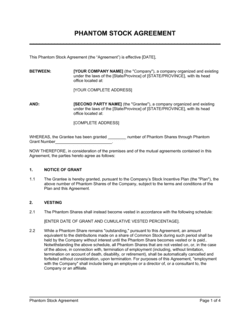
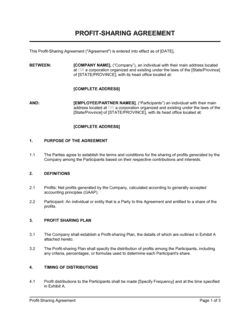
Yes. Phantom equity plans, profit share agreements, and carefully designed option plans can give employees the economic benefit of ownership without transferring voting rights or diluting the founders' control. Phantom plans in particular provide cash payouts tied to share value without ever issuing real shares.
What is the difference between common shares and preferred shares?
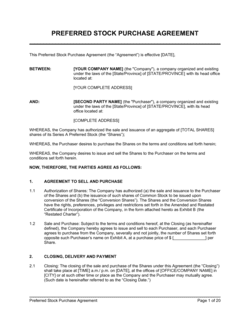
Common shares typically carry voting rights and residual claim on assets after debts are paid. Preferred shares usually carry a priority dividend or liquidation preference — meaning preferred shareholders are paid before common shareholders in a sale or wind-down. Investors in early-stage rounds often receive preferred shares as downside protection.
Do I need board approval to issue new shares?
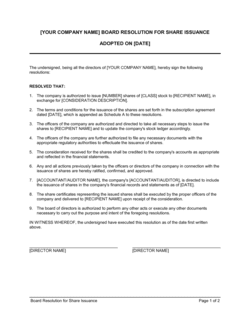
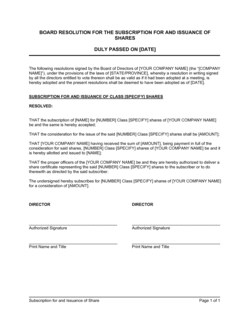
In most jurisdictions, yes. Issuing new shares typically requires authorization from the board of directors and, in some cases, existing shareholders — particularly if the issuance would dilute them below certain thresholds or if your articles require shareholder approval. Review your articles of incorporation and any existing shareholders' agreement before issuing.
What is a right of first refusal in a share agreement?
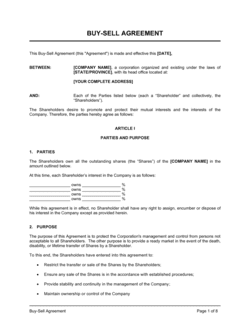
A right of first refusal (ROFR) requires a shareholder who wants to sell their shares to offer them to the company or existing shareholders first, at the same price and terms offered by any third-party buyer. ROFRs are common in private company shareholders' agreements to prevent outside parties from acquiring a stake without the existing owners having a chance to buy first.
What is a vesting cliff in an employee equity agreement?
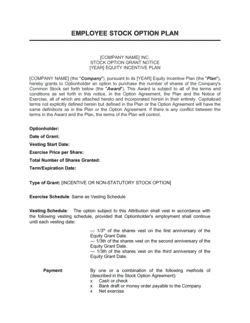
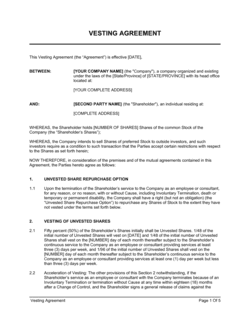
A vesting cliff is a minimum period an employee must remain at the company before any of their equity vests. A common structure is a one-year cliff followed by monthly vesting over three more years. If the employee leaves before the cliff, they receive nothing; after the cliff, vesting continues on the agreed schedule for the remainder of the grant.
Are equity agreements enforceable without a lawyer?
A well-drafted template signed by authorized representatives is generally enforceable for routine transactions such as employee option grants or straightforward share sales. For complex transactions — venture capital rounds, acquisitions, cross-border deals, or transactions with regulatory implications — engaging legal counsel to review or customize the agreement is strongly advisable. Legal requirements vary significantly by jurisdiction.
Key clauses every Equity and Merger contains
Despite the variety of documents in this category, most equity and mergers agreements share the same core clauses — the wording and detail level vary by transaction size and type.
- Parties and recitals. Identifies the buyer, seller, or issuer by full legal name and sets out the background to the transaction.
- Consideration and price. States the purchase price, subscription amount, or valuation methodology and when payment is due.
- Representations and warranties. Each party confirms that the shares are free of encumbrances, that they have authority to transact, and that disclosed information is accurate.
- Conditions to closing. Lists what must happen before the deal closes — regulatory approvals, board consent, due diligence sign-off.
- Vesting schedule. For equity plans and option grants, sets the timeline over which the recipient earns their shares or options.
- Conversion or exercise mechanics. For SAFEs, convertible instruments, and options, specifies the trigger events and formula for converting or exercising.
- Transfer restrictions. Limits when and to whom shares can be transferred — common in private companies to maintain control of the cap table.
- Governing law and dispute resolution. Names the jurisdiction whose corporate and securities laws apply and how disputes will be resolved.
How to write an equity or mergers agreement
The structure varies by document type, but every equity agreement follows the same drafting logic — identify the parties, describe the equity being dealt with, set the commercial terms, and handle the mechanics of closing.
1
Choose the right document type
Determine whether you are selling existing shares, issuing new shares, granting options, or creating an equity plan — the document type follows the transaction structure.
2
Identify all parties precisely
Use full registered legal names for all companies and individuals, and confirm each party has authority to enter the transaction.
3
Describe the equity in detail
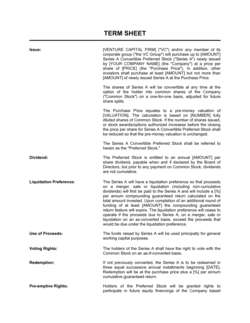
State the class of shares, the number, any par value, and whether they carry voting rights, dividend rights, or liquidation preferences.
4
Set the commercial terms
Specify the price per share or the valuation cap, the total consideration, and the payment or delivery mechanics.
5
Define conditions and closing steps
List every condition that must be satisfied before the deal closes and who is responsible for satisfying each one.
6
Add restrictions and governance provisions
Include transfer restrictions, rights of first refusal, drag-along and tag-along rights, and any anti-dilution provisions relevant to the transaction.
7
State governing law and sign
Name the applicable jurisdiction, have authorized signatories execute the agreement, and file or record the transaction as required by local corporate law.
Glossary
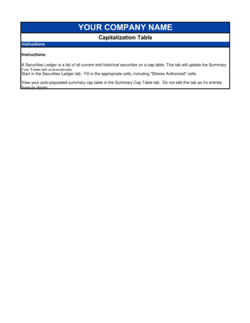
- Cap table
- A record of who owns shares in a company, in what class, and in what amounts — used to track dilution across all financing rounds.
- Dilution
- The reduction in an existing shareholder's ownership percentage caused by the issuance of new shares.
- Vesting
- The process by which an employee or founder earns shares or options over time, usually tied to continued employment or performance milestones.
- Conversion
- The mechanism by which an instrument such as a SAFE or convertible note transforms into equity shares, typically at a priced financing round.
- Right of first refusal (ROFR)
- A contractual right giving existing shareholders the opportunity to purchase shares before a seller offers them to a third party.
- Liquidation preference
- A provision giving preferred shareholders priority repayment from sale or wind-down proceeds before common shareholders receive anything.
- Anti-dilution protection
- A clause adjusting the conversion price of preferred shares or options if the company later issues shares at a lower price.
- Phantom equity
- A compensation arrangement that mirrors the value of real equity without transferring actual shares or ownership rights.
- Drag-along right
- A provision allowing majority shareholders to require minority shareholders to join in a sale of the company on the same terms.
- Tag-along right
- A provision allowing minority shareholders to join a majority shareholder's sale and sell their shares on the same terms.
- Valuation cap
- The maximum company valuation at which a SAFE or convertible note will convert into equity, protecting early investors from excessive dilution.
- Exercise price
- The price at which an option holder can purchase shares once their options have vested, also called the strike price.
What is an equity and mergers agreement?
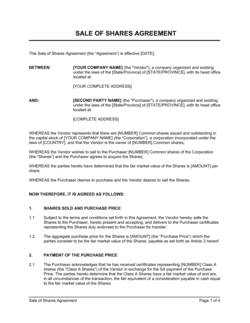
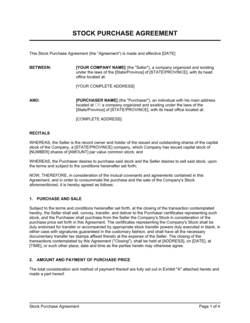
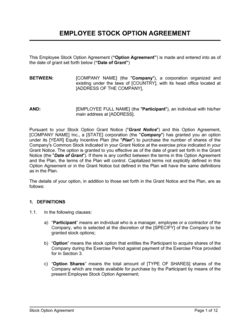
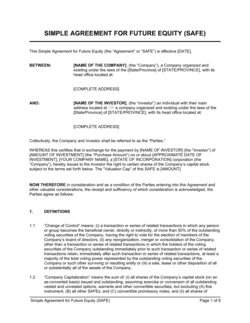
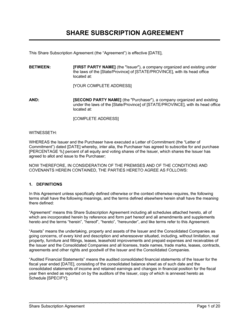
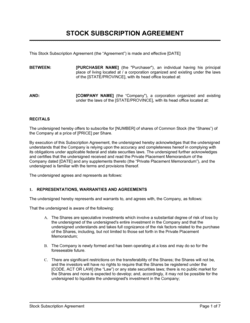
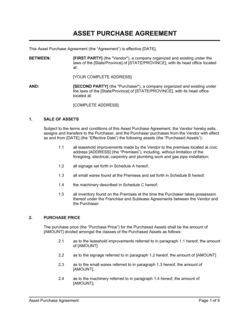
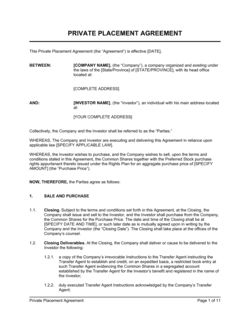
An equity and mergers agreement is a legal document that governs how ownership in a company is created, transferred, sold, or restructured. This category covers a wide range of instruments — from share purchase agreements and stock option grants to SAFE notes and phantom equity plans — each designed for a specific point in a company's ownership lifecycle. Together they form the documentary backbone of any transaction involving a company's share capital.
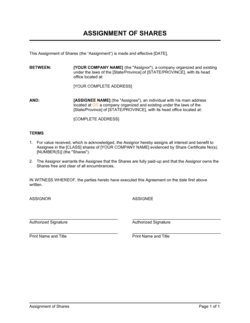
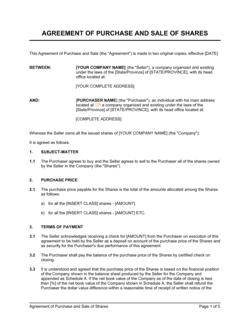
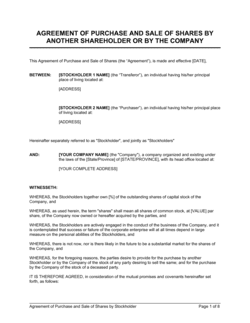
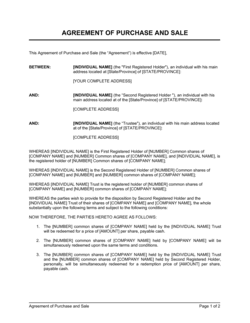
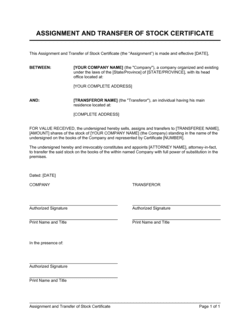
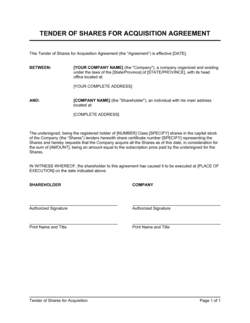
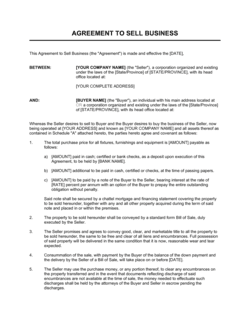
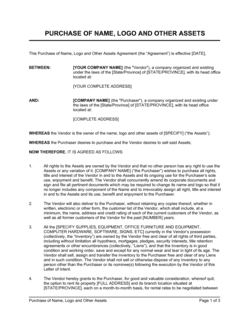
Equity documents divide broadly into two families. Ownership transfer documents — such as sale of shares agreements, assignment of shares, and tender agreements — record the movement of existing shares from one party to another. Equity creation and incentive documents — such as equity incentive plans, SAFE agreements, and stock option grants — govern the issuance of new equity or the right to acquire it in the future. Mergers and acquisitions typically involve both families simultaneously, which is why due diligence checklists and valuation proposals are included in this folder alongside the transactional agreements themselves.
The specific document you need depends on the structure of your deal, the counterparty (employee, investor, or corporate acquirer), and whether new shares are being issued or existing shares are changing hands.
When you need an equity and mergers agreement
Any time ownership in a company is about to shift — even partially — a written agreement is essential to protect every party, create an accurate record on the cap table, and satisfy the requirements of regulators, auditors, and future investors. Disputes over undocumented equity transfers are among the most damaging and expensive a business can face.
Common triggers:
- A founder or early investor sells a portion of their shares to a new backer
- A company closes a seed or Series A round and issues shares or SAFE notes to investors
- An employee receives stock options as part of their compensation package
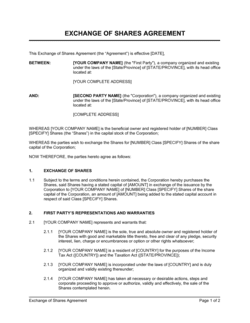
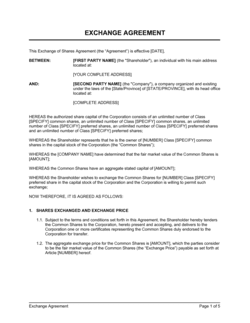
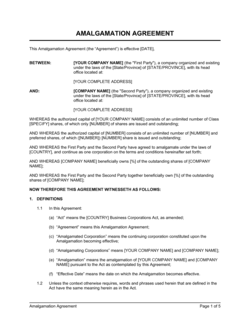
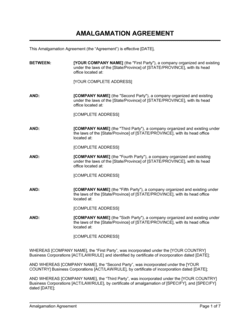
- Two companies merge or one acquires the other through a share exchange
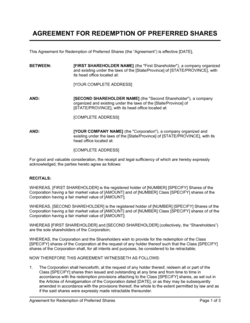
- A business restructures its capital by redeeming or reclassifying preferred shares
- A private company sets up a formal equity incentive plan to attract and retain talent
- A shareholder pledges shares as collateral to secure a loan
- A company invites a venture capital firm to subscribe for new shares at an agreed valuation
Without proper documentation, even straightforward share transactions can create disputes over price, ownership percentage, or the rights attached to shares. With the right agreement in place, every party knows exactly what they own, on what terms, and what happens next.