Stock Redemption Agreement Template

Free Word download • Edit online • Save & share with Drive • Export to PDF

5 pages25–35 min to fillDifficulty: ComplexSignature requiredLegal review recommended
Learn more ↓
FreeStock Redemption Agreement Template

At a glance

What it is
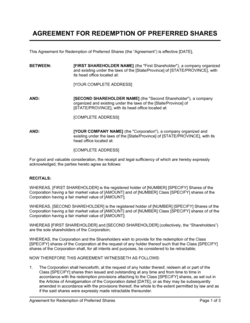
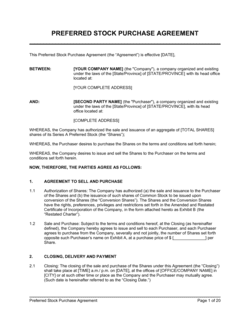
A Stock Redemption Agreement is a legally binding contract between a corporation and one or more of its shareholders under which the corporation agrees to repurchase a specified number of shares at an agreed price and on agreed terms. This free Word download gives you a complete, attorney-reviewed starting point you can edit online and export as PDF for execution at closing.
When you need it
Use it when a corporation is buying back shares from a departing owner, funding a shareholder exit through retained earnings or life insurance proceeds, or reducing the number of outstanding shares as part of a planned capital restructuring.
What's inside
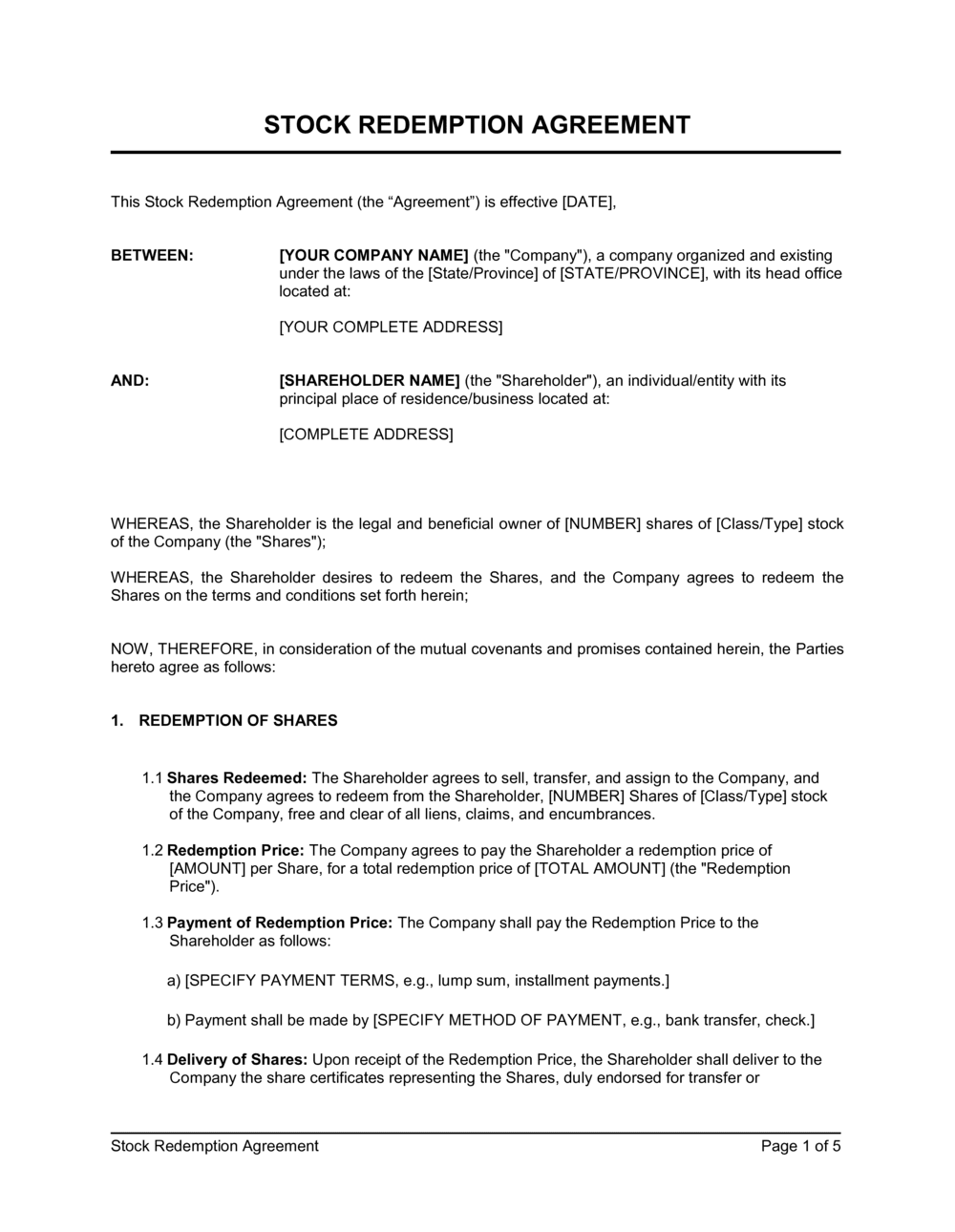
Parties and recitals, share description and purchase price, payment terms and closing mechanics, representations and warranties from both sides, conditions to closing, tax treatment acknowledgment, restrictive covenants, indemnification, and governing law.

What is a Stock Redemption Agreement?

A Stock Redemption Agreement is a legally binding contract under which a corporation agrees to repurchase a specified number of its own outstanding shares directly from a selling shareholder at an agreed price, on agreed payment terms, and subject to the conditions required by corporate law. Unlike a transfer between shareholders, the corporation itself is the buyer — it pays the redemption price and either cancels the shares or holds them as treasury stock, permanently reducing the number of shares outstanding. The agreement governs every aspect of the transaction: how fair market value is determined, whether payment is made in a lump sum or installments, what representations each party makes about the shares and corporate authority, and what restrictions apply to the departing shareholder after closing.

Why You Need This Document

Attempting a corporate share buyback without a written redemption agreement exposes the corporation, its directors, and the selling shareholder to serious legal and financial risk simultaneously. Without a formal document, there is no clear record of the agreed purchase price or valuation method — disputes about what was promised arise routinely and are expensive to litigate. Directors who authorize a redemption without documenting board approval and a solvency confirmation may face personal liability under state corporation law if the transaction is later challenged as a fraudulent transfer. The selling shareholder faces equally concrete risks: without a written agreement specifying a closing date and payment obligations, there is no enforceable mechanism to compel payment or share delivery if either party has second thoughts. A properly executed Stock Redemption Agreement closes all of these gaps — documenting board authority, confirming the surplus test, recording the agreed price, and creating enforceable indemnification rights that survive closing. This template gives you a complete, attorney-reviewed starting point for straightforward redemptions, with the structure needed to escalate to a full legal review when the transaction warrants it.

Which variant fits your situation?

If your situation is…Use this template
Corporation redeeming all shares from a single exiting shareholderStock Redemption Agreement
Remaining shareholders (not the corporation) buying out a departing ownerCross-Purchase Buy-Sell Agreement
Pre-arranging buyback terms triggered by death, disability, or retirementBuy-Sell Agreement
Redeeming shares in exchange for promissory note payments over timeInstallment Stock Redemption Agreement
Repurchasing shares from an employee upon terminationStock Repurchase Agreement (Employee)
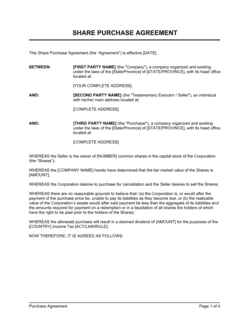
Buying back shares as part of a broader merger or acquisitionShare Purchase Agreement
Redeeming LLC membership interests rather than corporate sharesMembership Interest Redemption Agreement

Common mistakes to avoid

❌ Skipping the board resolution before signing

Why it matters: A stock redemption executed without formal board authorization is ultra vires — beyond the corporation's authority — and can be voided by minority shareholders or creditors, unwinding the entire transaction.

Fix: Hold a board meeting or execute a unanimous written consent authorizing the specific redemption before any party signs the agreement or any funds change hands.

❌ Failing to verify the statutory surplus test

Why it matters: In most US states and Canadian provinces, a corporation may only redeem shares from available surplus. Redeeming from stated capital when surplus is insufficient exposes directors to personal liability and the transaction to clawback.

Fix: Obtain a current balance sheet from the corporation's accountant and confirm available surplus exceeds the Redemption Price before proceeding to closing.

❌ Ignoring existing rights of first refusal

Why it matters: Many shareholder agreements and articles of incorporation grant remaining shareholders a right of first refusal before shares can be transferred — even to the corporation. Bypassing this right can expose the redemption to legal challenge.

Fix: Review the shareholders' agreement, buy-sell agreement, and corporate charter before proceeding. Obtain written waivers from any rights holders as a condition to closing.

❌ Using a vague or undefined valuation method

Why it matters: Ambiguous price terms such as 'book value' or 'fair value' invite disputes over balance sheet dates, accounting treatments, and off-balance-sheet liabilities — disputes that can take years and significant legal fees to resolve.

Fix: Define the valuation method with specificity: name the appraiser, the standard of value (fair market value), the valuation date, and the accounting basis (GAAP). Attach the supporting analysis as a schedule.

❌ No survival clause on representations and warranties

Why it matters: Without a survival clause, a party's indemnification obligation for false representations may terminate at closing, leaving the non-breaching party with no contractual remedy when a warranty breach surfaces months later.

Fix: Add a clause stating that representations and warranties survive closing for a specified period — typically 12–24 months — and that indemnification rights are not extinguished by closing.

❌ Paying the redemption price before receiving endorsed share certificates

Why it matters: If the corporation pays before receiving endorsed certificates, it may have no legal mechanism to compel delivery — leaving it without title to shares it has already paid for.

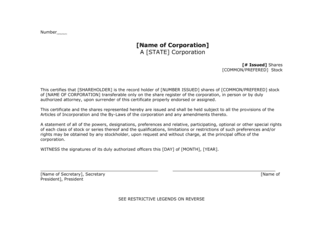
Fix: Structure closing as a simultaneous exchange: endorsed certificates (or a lost-certificate affidavit and indemnity) against payment. Make delivery of certificates an express condition precedent to any payment obligation.

The 10 key clauses, explained

Parties and recitals

In plain language: Identifies the corporation and the selling shareholder by their full legal names and states the factual background — number of shares issued, class, and the parties' intent to proceed with redemption.

Sample language
This Stock Redemption Agreement ('Agreement') is entered into as of [DATE] by and between [CORPORATION LEGAL NAME], a [STATE] corporation ('Corporation'), and [SHAREHOLDER FULL NAME] ('Shareholder'). Shareholder currently holds [NUMBER] shares of [CLASS] stock of the Corporation, representing [X]% of the issued and outstanding shares.

Common mistake: Using a trade name instead of the corporation's registered legal name. A mismatch between the agreement and corporate registry records can void the transfer or create chain-of-title problems in a later sale.

Description of shares being redeemed

In plain language: Precisely identifies the shares being purchased — class, certificate numbers if certificated, and exact quantity — so there is no ambiguity about what is being transferred.

Sample language
Corporation hereby agrees to redeem and purchase from Shareholder, and Shareholder hereby agrees to sell and transfer to Corporation, [NUMBER] shares of [CLASS] common stock, certificate number(s) [CERT NO.] ('Redeemed Shares'), free and clear of all liens, claims, and encumbrances.

Common mistake: Failing to specify that shares are transferred free and clear of liens. If the selling shareholder has pledged the shares as loan collateral, the corporation may acquire encumbered stock without knowing it.

Purchase price and valuation method

In plain language: States the agreed redemption price per share, the total consideration, and how fair market value was determined — by formula, independent appraisal, or mutual agreement.

Sample language
The aggregate redemption price for the Redeemed Shares shall be $[TOTAL AMOUNT] (the 'Redemption Price'), calculated at $[PRICE PER SHARE] per share, as determined by [mutual agreement / independent appraisal by [APPRAISER NAME] dated [DATE] / the formula set forth in Schedule A].

Common mistake: Using a vague valuation method such as 'book value' without defining which balance sheet date and accounting standard apply. This creates disputes when the parties interpret 'book value' differently.

Payment terms and closing mechanics

In plain language: Specifies whether the Redemption Price is paid in full at closing, in installments via promissory note, or funded by life insurance proceeds — and sets the closing date, location, and deliverables.

Sample language
The Redemption Price shall be paid as follows: (a) $[AMOUNT] in cash at Closing; (b) the balance of $[AMOUNT] pursuant to the Promissory Note attached as Exhibit A, bearing interest at [X]% per annum, payable in [N] equal monthly installments. Closing shall occur on [DATE] at [LOCATION].

Common mistake: Not addressing what happens if the corporation cannot fund the full payment at closing due to the surplus test. Building in an installment fallback prevents the entire transaction from failing.

Representations and warranties of the shareholder

In plain language: The selling shareholder confirms they own the shares outright, have authority to sell them, and that no liens, options, or third-party claims affect the shares being redeemed.

Sample language
Shareholder represents and warrants that: (a) Shareholder has full legal capacity and authority to enter into this Agreement; (b) Shareholder is the record and beneficial owner of the Redeemed Shares; (c) the Redeemed Shares are free and clear of all liens, pledges, encumbrances, and adverse claims; and (d) no consent of any third party is required for this transfer.

Common mistake: Omitting a warranty that no right of first refusal or transfer restriction in the shareholders' agreement has been triggered. If a ROFR exists and was not honored, the redemption can be challenged by other shareholders.

Representations and warranties of the corporation

In plain language: The corporation confirms it has board authorization, has satisfied the statutory surplus test, and that the redemption complies with its articles and bylaws.

Sample language
Corporation represents and warrants that: (a) the Board of Directors has duly authorized this Agreement by resolution dated [DATE]; (b) the redemption does not violate any provision of the Corporation's Articles of Incorporation, Bylaws, or any shareholder agreement; and (c) after giving effect to the redemption, the Corporation will not be rendered insolvent.

Common mistake: Skipping the solvency representation. If the corporation is insolvent at the time of redemption, the transaction can be unwound as a fraudulent transfer under state or federal law, and directors may face personal liability.

Conditions to closing

In plain language: Lists the specific steps each party must complete before closing is required — board resolution, share certificate delivery, third-party consents, and any regulatory filings.

Sample language
The obligations of each party to consummate the transactions are subject to: (a) delivery by Shareholder of original stock certificate(s) duly endorsed for transfer; (b) delivery by Corporation of a certified Board Resolution authorizing the redemption; (c) execution of all ancillary documents listed in Schedule B; and (d) receipt of any required third-party consents.

Common mistake: Not requiring delivery of original stock certificates (or a lost-certificate affidavit) as a condition to payment. Paying before receiving endorsed certificates leaves the corporation with no legal title to the shares.

Non-competition and non-solicitation

In plain language: Restricts the departing shareholder from competing with the corporation or soliciting its customers and employees for a defined period and geography following closing.

Sample language
For a period of [24] months following the Closing Date, Shareholder shall not, directly or indirectly: (a) own, manage, or operate a Competing Business within [GEOGRAPHIC AREA]; or (b) solicit any customer, supplier, or employee of the Corporation.

Common mistake: Including a broad non-compete with no geographic limitation for a shareholder who only operated locally. Courts regularly strike down unlimited-geography non-competes, potentially voiding the restriction entirely.

Indemnification

In plain language: Allocates responsibility for losses, claims, or liabilities that arise if either party's representations turn out to be false or if undisclosed obligations surface after closing.

Sample language
Shareholder shall indemnify and hold harmless the Corporation from any losses arising out of any breach of Shareholder's representations, warranties, or covenants in this Agreement. Corporation shall indemnify Shareholder from any losses arising out of the Corporation's breach of its representations, warranties, or covenants.

Common mistake: No survival clause for representations and warranties. Without one, the indemnification obligation may terminate at closing, leaving the non-breaching party with no remedy for post-closing discoveries.

Governing law and dispute resolution

In plain language: Specifies which jurisdiction's law governs the agreement and how disputes are resolved — arbitration, mediation, or litigation in a specified court.

Sample language
This Agreement shall be governed by and construed in accordance with the laws of the State of [STATE], without regard to its conflict-of-law principles. Any dispute shall be resolved by binding arbitration administered by [AAA / JAMS] in [CITY, STATE], except that either party may seek injunctive relief in any court of competent jurisdiction.

Common mistake: Choosing a governing law that differs from the state of incorporation. Corporate law issues — such as the surplus test and board authorization requirements — are governed by the law of the state of incorporation regardless of what the contract says.

How to fill it out

  1. 1

    Identify the parties and confirm corporate authority

    Enter the corporation's full registered legal name, state of incorporation, and the shareholder's legal name. Confirm a board resolution authorizing the redemption has been passed before filling in any other section.

    💡 Pull the exact legal name from the state corporate registry — a minor discrepancy between the agreement and the registry can cloud title and delay a later sale or financing.

  2. 2

    Describe the shares being redeemed with precision

    Specify the share class, exact number of shares, and certificate numbers if the corporation uses certificated shares. Confirm no liens, options, or transfer restrictions encumber those specific shares.

    💡 Check the corporation's stock ledger and any shareholders' agreement for rights of first refusal before completing this section — a ROFR may need to be waived in writing before the redemption can proceed.

  3. 3

    Set the redemption price and document the valuation method

    Enter the agreed price per share and total consideration. If using a formula or appraisal, attach it as Schedule A and cross-reference it in this clause.

    💡 For closely held companies, an independent business valuation — even an informal one — protects both sides from later disputes and supports the capital gains tax treatment the selling shareholder likely needs.

  4. 4

    Choose the payment structure and set a closing date

    Decide whether the price is paid in full at closing or in installments via a promissory note. Enter the closing date, location, and list all deliverables — certificates, board resolutions, and ancillary documents — in the conditions-to-closing section.

    💡 If using installment payments, attach a promissory note as Exhibit A and specify what happens on default — acceleration of the full balance is standard.

  5. 5

    Run the statutory surplus test

    Confirm the corporation has legally available surplus equal to or greater than the Redemption Price. In most US states, redemptions out of stated capital are prohibited if they would render the company insolvent.

    💡 Have your accountant pull a current balance sheet and calculate available surplus before signing — this is the single most common transactional failure point.

  6. 6

    Calibrate the non-compete terms to the shareholder's role

    Set the non-compete duration and geographic scope proportionate to the departing shareholder's actual involvement. A 12–24 month restriction limited to the relevant trade area is typically enforceable; a nationwide, indefinite restriction is not.

    💡 In California and several other states, post-employment non-competes are unenforceable outside of a business-sale context — confirm the applicable jurisdiction's rules before finalizing this clause.

  7. 7

    Execute the agreement before transferring any payment or certificates

    Both the corporation (by an authorized officer) and the selling shareholder must sign the agreement. Attach the certified board resolution and all exhibits before exchanging consideration.

    💡 Use Business in a Box eSign to timestamp execution and store the fully executed copy — maintaining a clear documentary chain is essential for tax reporting and any future audit.

  8. 8

    Update the stock ledger and file any required tax forms

    After closing, cancel the redeemed certificates on the stock ledger (or record the uncertificated share cancellation), and ensure the required tax reporting — including IRS Form 1099-B for the selling shareholder — is completed within the applicable deadlines.

    💡 The corporation should also notify its transfer agent, if any, and update its cap table on the same day as closing to prevent any discrepancy between records.

Frequently asked questions

What is a stock redemption agreement?

A stock redemption agreement is a binding contract under which a corporation repurchases shares directly from one or more of its shareholders. The corporation pays the agreed redemption price in exchange for the cancellation or treasury holding of those shares, reducing the total number of shares outstanding. It is most commonly used in closely held corporations to facilitate shareholder exits, fund buy-sell events, or restructure the ownership base before a sale or financing.

What is the difference between a stock redemption and a cross-purchase agreement?

In a stock redemption, the corporation itself buys back the departing shareholder's shares using corporate funds. In a cross-purchase arrangement, the remaining individual shareholders — not the corporation — each buy a proportionate share of the departing owner's interest using personal funds or insurance proceeds. The key difference affects tax basis, insurance ownership, and the corporate surplus rules that apply only to redemptions.

Does a stock redemption agreement require board approval?

Yes. In virtually every US state and Canadian province, a board resolution authorizing the specific redemption is required before the corporation can validly repurchase its own shares. Without formal board authorization, the transaction is ultra vires and may be challenged or voided by minority shareholders or creditors. The signed resolution should be attached to the agreement as an exhibit.

What is the surplus test in a stock redemption?

Most corporate statutes prohibit a corporation from redeeming its own shares unless it has legally available surplus — retained earnings and paid-in capital above stated capital — equal to or greater than the redemption price. If the redemption would leave the corporation insolvent or would be funded from stated capital rather than surplus, it is generally prohibited. Directors who approve a redemption that fails this test may face personal liability.

How is the redemption price taxed for the selling shareholder?

If the redemption qualifies as a sale or exchange under Section 302 of the Internal Revenue Code — typically because it terminates or substantially reduces the shareholder's interest — the selling shareholder recognizes capital gain or loss equal to the difference between the redemption price and their adjusted tax basis in the shares. If the redemption does not qualify as a sale, it may be taxed as a dividend at ordinary income rates. Tax treatment varies by jurisdiction and individual circumstances, so consulting a tax advisor before closing is strongly recommended.

Can a stock redemption be paid in installments?

Yes. When the corporation cannot fund the full redemption price at closing, the balance is typically documented in a promissory note attached to the agreement. The note bears a specified interest rate and repayment schedule. Installment redemptions may have tax consequences — particularly related to the imputed interest rules and installment sale reporting under Section 453 of the Internal Revenue Code — so the parties should confirm the treatment with their tax advisors before executing.

What happens to redeemed shares after closing?

Redeemed shares are either cancelled — reducing the total authorized and outstanding shares — or held by the corporation as treasury stock, which remain authorized but unissued and carry no voting rights or dividend entitlements. The corporation's articles and the applicable corporate statute determine whether retirement or treasury holding is the default. The stock ledger must be updated at closing to reflect the change.

Is a stock redemption agreement the same as a buy-sell agreement?

Not exactly. A buy-sell agreement is a broader advance arrangement that predetermines the terms under which a shareholder's interest will be transferred upon specified triggering events — death, disability, divorce, or voluntary departure. It may use a redemption structure, a cross-purchase structure, or a hybrid. A stock redemption agreement is the transactional document that actually executes the repurchase once a triggering event occurs or the parties negotiate a specific exit — it is often prepared in connection with, or alongside, an existing buy-sell arrangement.

Do I need a lawyer to prepare a stock redemption agreement?

For a straightforward redemption between two parties who have already agreed on price and terms, a well-structured template is a sound starting point. However, because a redemption implicates corporate law, tax law, and potentially securities regulation simultaneously, a legal review is strongly recommended in most situations. Engage a lawyer when the redemption involves a significant dollar amount, complex valuation, installment payments, life insurance funding, or any shareholder who may contest the transaction.

How this compares to alternatives

vs Buy-Sell Agreement

A buy-sell agreement is a standing arrangement that pre-sets the terms, triggers, and valuation method for any future shareholder exit — it governs what will happen. A stock redemption agreement is the transactional document that actually executes a specific repurchase when the exit occurs. Many closely held corporations need both: the buy-sell agreement as the governing framework and the stock redemption agreement to close each transaction under it.

vs Share Purchase Agreement

A share purchase agreement governs the sale of shares from one shareholder to another individual or entity — the corporation is not the buyer. A stock redemption agreement specifically documents the corporation buying back its own shares. The distinction matters for tax treatment, the surplus test, and how the remaining shareholders' ownership percentages change post-transaction.

vs Stock Transfer Agreement

A stock transfer agreement records the transfer of shares between two parties — typically shareholder to shareholder — without the corporation being the purchaser. A stock redemption agreement is used exclusively when the corporation itself is repurchasing shares from a holder. A transfer agreement does not trigger the corporate surplus rules or board authorization requirements that apply to redemptions.

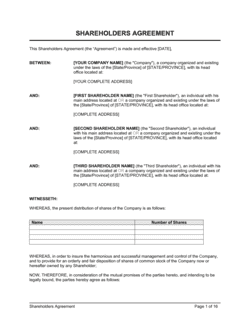
vs Shareholders Agreement

A shareholders agreement governs the ongoing relationship among all shareholders — voting rights, dividend policy, transfer restrictions, and dispute resolution. A stock redemption agreement is a one-time transactional document for a specific buyback. The shareholders agreement typically sets the framework (including any right of first refusal and valuation formula) within which a stock redemption agreement is later executed.

Industry-specific considerations

Professional Services

Law firms, accounting firms, and consulting partnerships routinely use stock redemption agreements when an equity partner retires or is bought out, with redemption price often tied to a multiple of trailing revenue or client book value.

Manufacturing

Family-owned manufacturers use redemption agreements for generational transitions, with installment payment structures spread over 5–10 years to avoid disrupting working capital needed for equipment and inventory.

Technology / SaaS

Startups use stock redemption to reclaim shares from a departing co-founder before a Series A, with price often set at original issue price or a nominal formula to avoid inflating the pre-money cap table.

Healthcare

Medical practices structured as professional corporations use redemption agreements for physician buyouts, with valuation tied to patient panel size and collections, and regulatory restrictions on non-physician ownership adding complexity.

Retail / Franchise

Multi-location retail and franchise businesses use redemptions when a location partner exits, with price typically based on a EBITDA multiple and non-compete restrictions tied to the specific trade area of the redeemed interest.

Real Estate

Real estate holding companies structured as corporations use redemption agreements to exit passive investors, with valuation informed by independent property appraisals and complex capital account reconciliations.

Jurisdictional notes

United States

Corporate redemptions are governed by the state of incorporation — typically the Delaware General Corporation Law or the Model Business Corporation Act as adopted by the relevant state. The statutory surplus test must be satisfied before a redemption is valid. Federal tax treatment is governed by IRC Section 302, which determines whether the redemption is taxed as a capital gain or as a dividend. California, Minnesota, and several other states restrict post-employment non-competes even in a business-sale redemption context.

Canada

Under the Canada Business Corporations Act and most provincial statutes, a corporation may only redeem shares if it is able to pay its liabilities as they come due and the realizable value of its assets exceeds its liabilities plus the amount required to pay any senior redemption obligations. Board approval is mandatory. In Quebec, corporate documents must comply with French-language requirements for provincially incorporated entities. The tax treatment of redemptions — particularly the deemed dividend rules under the Income Tax Act — differs significantly from US treatment and requires specialized Canadian tax advice.

United Kingdom

Under the Companies Act 2006, a private company may redeem shares only if they are designated as redeemable at the time of issue. Redemptions must generally be funded out of distributable profits or the proceeds of a fresh share issue, or — for private companies — out of capital following a special resolution and a solvency statement from the directors. The transaction must be filed at Companies House. Stamp Duty at 0.5% applies to the consideration paid, unless an exemption applies.

European Union

EU member state rules on share redemption vary significantly. Most civil-law jurisdictions — including France, Germany, the Netherlands, and Spain — require that shares be designated as redeemable in the articles of association, that the redemption be funded from distributable reserves, and that creditors be notified or protected. GDPR considerations arise when shareholder personal data is processed in connection with the transaction. Cross-border transactions involving EU shareholders may also trigger securities and foreign investment notification requirements in the relevant member state.

Template vs lawyer — what fits your deal?

PathBest forCostTime
Use the templateSimple redemptions in closely held corporations where parties have already agreed on price and no minority shareholder disputes are anticipatedFree1–2 hours
Template + legal reviewRedemptions involving installment payments, life insurance funding, valuation disputes, or shareholders in regulated industries$500–$1,5003–5 business days
Custom draftedComplex transactions with material dollar amounts, contested valuations, multiple share classes, tax-driven structuring, or litigation risk$2,500–$10,000+2–6 weeks

Glossary

Redemption
The repurchase of outstanding shares by the issuing corporation, which then cancels or holds them as treasury stock.
Treasury Stock
Shares that have been repurchased by the issuing corporation and are held by it, reducing the number of shares outstanding.
Fair Market Value (FMV)
The price at which shares would change hands between a willing buyer and a willing seller, neither under compulsion and both having reasonable knowledge of the relevant facts.
Buy-Sell Agreement
A broader arrangement — often set up in advance — that governs how a departing shareholder's interest is transferred or redeemed upon a triggering event such as death, disability, or retirement.
Closing
The point at which the share transfer, payment, and all other conditions to the transaction are completed simultaneously and the agreement becomes fully effective.
Representations and Warranties
Factual statements made by each party about itself and the shares being transferred, which, if false, can give the other party a right to damages or rescission.
Conditions Precedent
Specific requirements that must be satisfied — such as board authorization or regulatory approval — before either party is obligated to complete the transaction.
Promissory Note
A written promise by the corporation to pay the redemption price to the selling shareholder in installments over a defined period, used when the full price is not paid at closing.
Board Resolution
A formal written decision by the corporation's board of directors authorizing the share redemption, required under most state and provincial corporate statutes.
Surplus Test
A statutory requirement in most jurisdictions that a corporation may only redeem shares out of available surplus — not if doing so would render the corporation insolvent.
Capital Gains Treatment
Tax treatment applied to the selling shareholder's gain on redemption — generally more favorable than dividend treatment — when the redemption qualifies as a sale under applicable tax law.

Part of your Business Operating System

This document is one of 3,000+ business & legal templates included in Business in a Box.

  • Fill-in-the-blanks — ready in minutes
  • 100% customizable Word document
  • Compatible with all office suites
  • Export to PDF and share electronically

Create your document in 3 simple steps.

From template to signed document — all inside one Business Operating System.
1
Download or open template

Access over 3,000+ business and legal templates for any business task, project or initiative.

2
Edit and fill in the blanks with AI

Customize your ready-made business document template and save it in the cloud.

3
Save, Share, Send, Sign

Share your files and folders with your team. Create a space of seamless collaboration.

Save time, save money, and create top-quality documents.

★★★★★

"Fantastic value! I'm not sure how I'd do without it. It's worth its weight in gold and paid back for itself many times."

Managing Director · Mall Farm
Robert Whalley
Managing Director, Mall Farm Proprietary Limited
★★★★★

"I have been using Business in a Box for years. It has been the most useful source of templates I have encountered. I recommend it to anyone."

Business Owner · 4+ years
Dr Michael John Freestone
Business Owner
★★★★★

"It has been a life saver so many times I have lost count. Business in a Box has saved me so much time and as you know, time is money."

Owner · Upstate Web
David G. Moore Jr.
Owner, Upstate Web

Run your business with a system — not scattered tools

Stop downloading documents. Start operating with clarity. Business in a Box gives you the Business Operating System used by over 250,000 companies worldwide to structure, run, and grow their business.

Start free · No credit card required