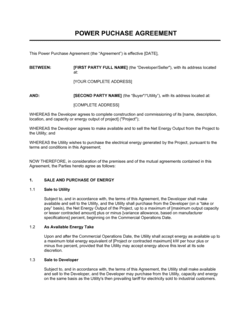
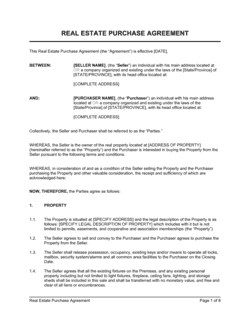
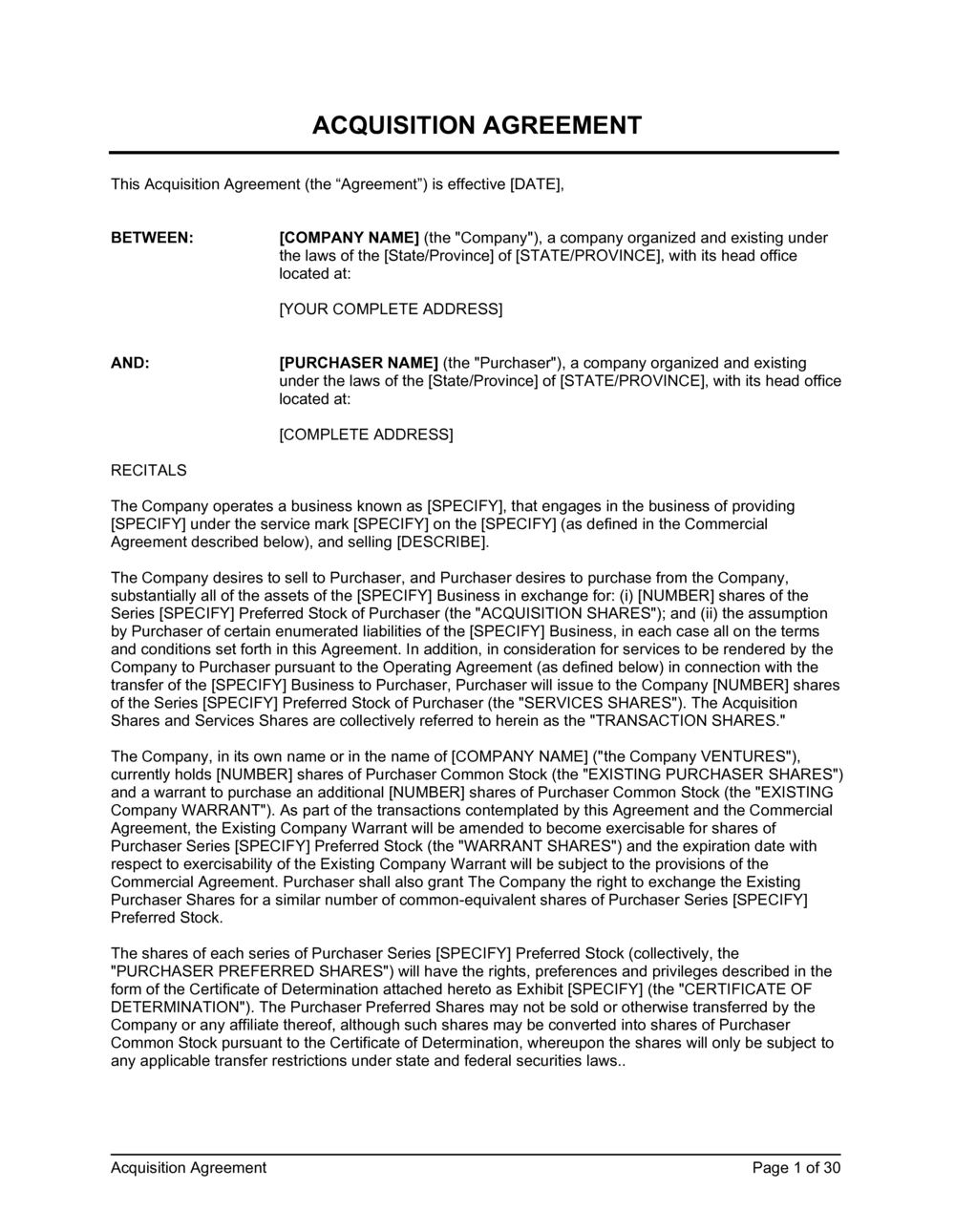
Acquisition Agreement Template

Free Word download • Edit online • Save & share with Drive • Export to PDF

30 pages45 min – 1h to fillDifficulty: ExpertSignature requiredLegal review recommended
Learn more ↓
FreeAcquisition Agreement Template

At a glance

What it is
An Acquisition Agreement is the definitive legal contract under which one company purchases another — either by buying the target's shares or its assets. This free Word download covers purchase price, deal structure, representations and warranties, indemnification, closing conditions, and post-closing covenants in a single master M&A document you can edit online and export as PDF.
When you need it
Use it when a buyer and seller have agreed in principle on a deal and need to reduce the full terms to an enforceable, binding contract before closing. It follows due diligence and any letter of intent, and governs the transaction from signing through post-closing obligations.
What's inside
Deal structure election (asset vs. share purchase), purchase price and adjustment mechanics, representations and warranties from both parties, indemnification obligations and caps, conditions to closing, covenants (pre- and post-closing), non-compete and non-solicit restrictions, employee matters, and governing law and dispute resolution.

What is an Acquisition Agreement?

An Acquisition Agreement is the definitive legal contract under which one company purchases another — either by acquiring all outstanding shares of the target entity or by purchasing selected assets and assuming specified liabilities. It translates the commercial terms agreed in a letter of intent into a fully binding, enforceable document that governs every dimension of the transaction: purchase price and its components, deal structure, representations and warranties made by both parties, indemnification obligations and their limits, conditions that must be satisfied before closing can occur, and the post-closing covenants that bind the parties for months or years after the deal closes. Without a signed acquisition agreement, there is no enforceable deal — only an agreement to agree.

Why You Need This Document

The consequences of closing an acquisition without a properly drafted agreement are severe and lasting. Undisclosed liabilities transfer with the business and become the buyer's problem the moment ownership changes hands. Without indemnification baskets, caps, and survival periods negotiated in writing, post-closing disputes over misrepresented financials, unknown litigation, or defective IP title have no contractual framework to resolve them — leaving both parties in expensive arbitration or litigation. Sellers who close without a non-compete clause in place have started competing businesses within months of receiving the purchase price, with no legal recourse for the buyer. A complete acquisition agreement with fully populated disclosure schedules, a calibrated indemnification structure, and precise pre-closing covenants eliminates each of these risks — and gives both buyer and seller a clear, enforceable roadmap from signing through the final post-closing true-up.

Which variant fits your situation?

If your situation is…Use this template
Buying selected assets and liabilities rather than the entire companyAsset Purchase Agreement
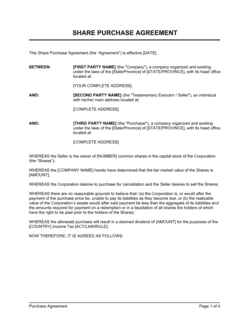
Acquiring 100% of a company's issued sharesShare Purchase Agreement
Two companies combining into a new or surviving entityMerger Agreement
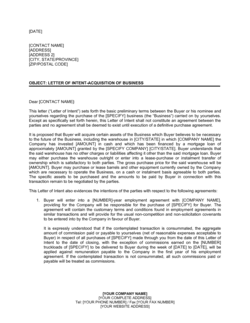
Preliminary deal terms before full agreement is negotiatedLetter of Intent (M&A)
Protecting confidential information during due diligenceNon-Disclosure Agreement
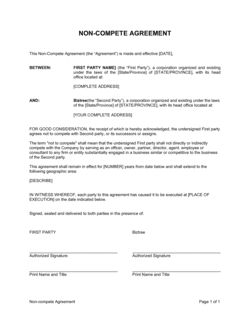
Preventing the seller from competing after closingNon-Compete Agreement
Seller financing part of the purchase price post-closingPromissory Note

Common mistakes to avoid

❌ Signing without completed disclosure schedules

Why it matters: An acquisition agreement signed with blank or incomplete disclosure schedules means every seller representation is unqualified — any exception discovered post-closing becomes a breach triggering indemnification.

Fix: Treat disclosure schedules as a parallel workstream to negotiating the agreement body. Both must be complete and cross-referenced before signing.

❌ Mismatched working capital accounting policies

Why it matters: If the buyer and seller apply different GAAP interpretations to inventory, receivables, or accruals, post-closing true-up disputes routinely produce adjustments of 5–15% of purchase price and years of litigation.

Fix: Attach an illustrative working capital calculation as an exhibit at signing, agreed by both parties, showing the specific line items and accounting policies that will govern the true-up.

❌ Setting the outside date too early

Why it matters: A deal requiring Hart-Scott-Rodino antitrust clearance, foreign investment review, or lender consent can easily take 120–180 days — an outside date of 60–90 days gives the other party a free termination right before the process can complete.

Fix: Build in an outside date of at least 180 days for deals with regulatory conditions, plus an automatic extension provision if regulatory clearance is the sole remaining condition.

❌ Applying a single indemnification cap to all representations equally

Why it matters: Fundamental representations — authority, capitalization, title to shares — carry existential risk for the buyer and should have a higher cap than general operating reps, which have bounded, quantifiable exposure.

Fix: Tier the cap structure: fundamental reps at 100% of purchase price (or uncapped for fraud), general reps at 10–30%, and tax reps at 100% with a survival period matching the applicable statute of limitations.

❌ Omitting the ordinary-course covenant between signing and closing

Why it matters: Without an express covenant, sellers have paid out dividends, hired key executives at above-market salaries, or entered major contracts in the period between signing and closing — materially changing the business the buyer contracted to acquire.

Fix: Include a dollar-threshold consent requirement (e.g., expenditures over $[X] require buyer approval) alongside a general ordinary-course obligation, and list specific prohibited actions explicitly.

❌ Using a boilerplate non-compete without tailoring jurisdiction and duration

Why it matters: Post-closing non-competes that exceed five years or cover geographies where the seller never operated are routinely struck down in whole — not narrowed — in jurisdictions that do not apply a blue-pencil doctrine.

Fix: Limit the non-compete to the specific markets, products, and geographies in which the target actually operated at closing. For multi-state deals, review enforceability state by state before finalizing duration.

The 10 key clauses, explained

Parties, recitals, and definitions

In plain language: Identifies the buyer, seller, and target entity by their full legal names, summarizes the purpose of the agreement, and defines every capitalized term used throughout the document.

Sample language
This Acquisition Agreement (the 'Agreement') is entered into as of [DATE] between [BUYER LEGAL NAME], a [STATE] [ENTITY TYPE] ('Buyer'), and [SELLER LEGAL NAME], a [STATE] [ENTITY TYPE] ('Seller'), with respect to [TARGET COMPANY LEGAL NAME] (the 'Company').

Common mistake: Using trade names instead of registered legal entity names. Mismatched names between the agreement and corporate registry filings can delay regulatory approvals and create enforceability questions.

Deal structure and purchase price

In plain language: States whether the transaction is an asset purchase or share purchase, the total consideration, the form of payment (cash, stock, seller note, or earn-out), and the allocation among components.

Sample language
Buyer agrees to purchase [all issued and outstanding shares of / the Acquired Assets of] the Company for an aggregate purchase price of $[AMOUNT] (the 'Purchase Price'), payable as follows: (a) $[CASH AMOUNT] in cash at Closing; (b) a promissory note in the principal amount of $[NOTE AMOUNT]; and (c) an earn-out of up to $[EARNOUT AMOUNT] pursuant to Section [X].

Common mistake: Failing to specify the exact form and timing of each payment component. Vague language like 'cash and stock consideration' has triggered multi-million dollar disputes over conversion rates and payment timing.

Purchase price adjustments

In plain language: Establishes the working capital target, the mechanism for calculating the adjustment at closing versus a reference date, and the post-closing true-up process with a neutral accountant fallback.

Sample language
The Purchase Price shall be adjusted dollar-for-dollar to the extent that the Closing Date Working Capital is greater or less than the Target Working Capital of $[AMOUNT]. Any dispute shall be submitted to [ACCOUNTING FIRM] as neutral arbitrator within [30] days.

Common mistake: Agreeing on a purchase price adjustment mechanism without first aligning on the accounting policies used to calculate working capital. Different GAAP interpretations between the parties produce large and unexpected true-up invoices.

Representations and warranties of the seller

In plain language: The seller's factual statements about the target — legal organization, financial statements, title to assets, material contracts, intellectual property, litigation, taxes, and employee matters — that must be true at signing and at closing.

Sample language
Seller represents and warrants to Buyer that, as of the date hereof and as of the Closing Date: (a) the Company is duly organized, validly existing, and in good standing under the laws of [STATE]; (b) the Financial Statements fairly present the financial condition of the Company; (c) the Company owns or has valid rights to use all Intellectual Property material to its business.

Common mistake: Accepting seller reps without a disclosure schedule. Reps are only as useful as the exceptions carved out against them — an undisclosed liability not on the schedule remains the seller's indemnification obligation.

Representations and warranties of the buyer

In plain language: The buyer's statements confirming its authority to enter into the agreement, the absence of conflicts with other obligations, and — in stock deals — that the shares issued as consideration are validly authorized.

Sample language
Buyer represents and warrants to Seller that: (a) Buyer has full power and authority to execute, deliver, and perform this Agreement; (b) execution does not conflict with any agreement to which Buyer is a party; (c) no governmental approval is required to consummate the transaction other than as set forth on Schedule [X].

Common mistake: Omitting buyer reps entirely in smaller deals. Seller needs assurance that the buyer can legally close and, in stock-consideration deals, that the shares being issued are free of undisclosed encumbrances.

Conditions to closing

In plain language: Lists what must be true or completed by each party before either is obligated to close — including regulatory clearances, third-party consents, bring-down of reps, and absence of a material adverse change.

Sample language
The obligations of Buyer to close are conditioned upon: (a) all representations and warranties of Seller being true and correct in all material respects as of the Closing Date; (b) Seller having performed all covenants required by this Agreement; (c) no Material Adverse Change having occurred; (d) receipt of consents listed in Schedule [X].

Common mistake: Setting conditions to closing so broadly that either party can manufacture a reason not to close. Courts have found that a party who prevents satisfaction of a condition cannot then rely on that condition as a termination right.

Indemnification, baskets, and caps

In plain language: Defines each party's obligation to compensate the other for post-closing losses from breaches of reps, warranties, and covenants — including the deductible basket, the indemnification cap, and the survival period.

Sample language
Seller shall indemnify Buyer against all Losses arising from any breach of Seller's representations, warranties, or covenants, subject to: (a) a deductible basket of $[BASKET AMOUNT] (with claims only payable to the extent total Losses exceed such basket); (b) an aggregate cap of $[CAP AMOUNT]; and (c) a survival period of [24] months from the Closing Date, except for Fundamental Reps, which survive for [6] years.

Common mistake: Setting the indemnification cap at 100% of purchase price for all reps equally. Sophisticated buyers differentiate: fundamental reps (title, authority, capitalization) warrant a higher cap; general operating reps warrant a lower one.

Pre-closing covenants

In plain language: Obligations binding on the seller between signing and closing — typically operating in the ordinary course, not taking on new debt or making material commitments, and giving the buyer access for due diligence.

Sample language
From the date hereof until the Closing, Seller shall cause the Company to: (a) operate its business in the ordinary course consistent with past practice; (b) not incur indebtedness exceeding $[AMOUNT] without Buyer's prior written consent; (c) provide Buyer and its representatives reasonable access to the Company's books, records, and personnel.

Common mistake: Omitting an ordinary-course covenant. Without it, sellers have made significant hires, capital expenditures, or distribution payments between signing and closing that materially changed what the buyer was paying for.

Non-compete and non-solicit covenants

In plain language: Post-closing restrictions preventing the seller (and often its principals) from competing with the acquired business or soliciting its customers and employees for a defined period and geography.

Sample language
For a period of [3] years following the Closing Date, Seller and its principals shall not, directly or indirectly, (a) engage in any business that competes with the Company within [GEOGRAPHIC AREA]; or (b) solicit, hire, or induce any employee or customer of the Company to terminate their relationship with Buyer.

Common mistake: Using a non-compete duration longer than five years in jurisdictions that cap enforceability at three to five years. Courts that strike down the clause as written apply a 'blue pencil' in some states — but void the clause entirely in others.

Termination rights and break fees

In plain language: Sets out the circumstances under which either party may walk away before closing, and any break fee or reverse break fee payable upon termination.

Sample language
This Agreement may be terminated: (a) by mutual written consent; (b) by either party if Closing has not occurred by [OUTSIDE DATE]; (c) by Buyer if any condition in Section [X] is not satisfied; (d) by Seller if Buyer breaches a material obligation and fails to cure within [10] Business Days. Upon termination by Seller under clause (d), Buyer shall pay a break fee of $[AMOUNT].

Common mistake: Setting the outside date too tightly. Regulatory review timelines for deals requiring antitrust clearance routinely run 90–180 days — a 60-day outside date can trigger a termination right before the deal has a realistic chance to close.

How to fill it out

  1. 1

    Insert full legal entity names for all parties

    Enter the buyer's registered legal name, the seller's registered legal name, and the target company's registered legal name exactly as they appear in corporate registry filings. Include entity type and jurisdiction of formation for each.

    💡 Cross-reference the certificate of incorporation or articles of organization — not the trade name, website, or letterhead — to confirm the exact legal name.

  2. 2

    Select and document the deal structure

    Choose asset purchase or share purchase and complete the structure section accordingly. For an asset purchase, attach a schedule listing the acquired assets and assumed liabilities. For a share purchase, specify the number and class of shares being transferred.

    💡 Asset purchases generally allow buyers to step up asset basis for tax purposes and avoid assuming unknown liabilities — but require individual transfer of contracts that prohibit assignment. Confirm with your tax and legal advisors before finalizing.

  3. 3

    Define the purchase price and each payment component

    Enter the total consideration and break it into components — cash at closing, seller note, earn-out, and any stock consideration. For each component, state the amount, timing, and conditions triggering payment.

    💡 Denominate all amounts in a single stated currency and include a conversion mechanism if the buyer and seller operate in different currencies.

  4. 4

    Set the working capital target and adjustment mechanism

    Agree on a target net working capital figure based on a trailing 12-month average and document the calculation methodology in a schedule. Define the true-up period (typically 60–90 days post-closing) and the neutral accountant process for resolving disputes.

    💡 Align on the specific GAAP policies — particularly inventory valuation and accounts receivable aging cutoffs — before signing. These choices drive the size of any post-closing adjustment.

  5. 5

    Complete the disclosure schedules against each rep

    Work through the seller's representations section by section and populate the corresponding disclosure schedule with every exception, pending litigation, material contract, IP registration, and encumbrance. Blank schedules do not limit reps — they confirm none.

    💡 Over-disclose rather than under-disclose. An item on the schedule is explicitly carved out of indemnification; an undisclosed item that later surfaces is a breach.

  6. 6

    Calibrate indemnification baskets, caps, and survival periods

    Set the deductible basket at 0.5–1% of enterprise value, the general rep cap at 10–30% of enterprise value, and the fundamental rep cap at 100% of purchase price. Set general rep survival at 18–24 months; tax and environmental reps at 3–6 years.

    💡 Consider requiring the seller to fund an escrow equal to the general rep cap amount at closing rather than relying on post-closing claims against individual sellers.

  7. 7

    Define pre-closing operating covenants

    List the specific actions the seller must take and must not take between signing and closing — spending limits, hiring freezes, dividend restrictions, and access rights for the buyer's confirmatory due diligence.

    💡 Include a consent threshold (e.g., any single expenditure over $25,000 requires buyer approval) rather than a general 'ordinary course' standard, which is litigated more often.

  8. 8

    Set the outside date and break fee

    Choose an outside date that allows enough time for regulatory clearance (90–180 days for most mid-market deals), third-party consents, and financing. Negotiate a mutual break fee for deals where both parties bear termination risk.

    💡 Include an automatic extension right (typically 30–60 days) if the only outstanding condition at the outside date is a pending regulatory approval.

Frequently asked questions

What is an acquisition agreement?

An acquisition agreement is the definitive legal contract under which one company purchases another, either by acquiring all issued shares of the target or by buying specific assets and assuming selected liabilities. It covers the purchase price, deal structure, representations and warranties, indemnification obligations, conditions to closing, and post-closing covenants. It is the master document of any M&A transaction and supersedes any prior letter of intent or term sheet.

What is the difference between an asset purchase and a share purchase?

In a share purchase, the buyer acquires all outstanding shares of the target company, inheriting its entire balance sheet — including unknown or contingent liabilities. In an asset purchase, the buyer selects which assets to acquire and which liabilities to assume, leaving unwanted obligations with the seller. Asset purchases are generally preferred by buyers for liability isolation and tax step-up benefits; share purchases are simpler to execute when the target has many contracts that restrict assignment.

What should an acquisition agreement include?

At minimum: full legal identification of buyer, seller, and target; deal structure election; purchase price with each payment component clearly defined; working capital adjustment mechanism; seller and buyer representations and warranties with disclosure schedules; conditions to closing; indemnification obligations with basket, cap, and survival periods; pre-closing operating covenants; non-compete and non-solicit restrictions; termination rights and any break fee; and governing law and dispute resolution. Missing any of these creates gaps that become expensive post-closing disputes.

Do I need a lawyer to draft an acquisition agreement?

An acquisition agreement is one of the highest-stakes legal documents a business will ever sign, and legal review is strongly recommended for any deal. A high-quality template gives you a structured starting point and reduces drafting time significantly, but deal-specific issues — tax structure, regulatory approvals, complex earn-outs, and jurisdictional nuances — require qualified M&A counsel to address properly. At minimum, have a lawyer review the indemnification, reps and warranties, and closing conditions before signing.

What are representations and warranties in an acquisition agreement?

Representations and warranties are factual statements each party makes about itself and the business being sold — for example, that financial statements are accurate, that the company owns its IP free of encumbrances, and that no material litigation is pending. They must typically be true at both signing and closing. If a representation proves false, the other party generally has a right to indemnification for resulting losses, subject to the basket, cap, and survival period negotiated in the agreement.

What is an earn-out and when should one be used?

An earn-out is a portion of the purchase price paid after closing based on the target company's future financial performance — typically tied to revenue or EBITDA milestones over one to three years. Earn-outs are used when buyer and seller disagree on valuation, often because the seller projects faster growth than the buyer is willing to price in. They introduce post-closing complexity and are a frequent source of disputes; the earn-out definition, measurement methodology, and buyer's operating obligations during the measurement period must be precisely drafted.

What is a working capital adjustment?

A working capital adjustment is a post-closing true-up that adjusts the purchase price based on the difference between the actual net working capital delivered at closing and a pre-agreed target. If the seller delivers more working capital than the target, the buyer pays more; if less, the seller pays back. These adjustments can run into the millions on mid-market deals if the accounting policies are not locked down at signing. A typical true-up period runs 60–90 days post-closing, with a neutral accounting firm resolving disputes.

What is a MAC clause in an acquisition agreement?

A Material Adverse Change (or Material Adverse Effect) clause allows the buyer to terminate the agreement or decline to close if a significant negative event affects the target's business, financial condition, or prospects between signing and closing. Courts have generally set a high bar for what qualifies as a MAC — short-term earnings declines, general market downturns, and industry-wide disruptions are typically excluded. The precise definition of what is and is not a MAC is heavily negotiated and has material consequences for deal certainty.

How long does an acquisition agreement typically take to negotiate?

For a straightforward mid-market deal with no regulatory issues, two to six weeks is typical from first draft to signing. Complex transactions — those requiring antitrust clearance, foreign investment review, or multi-jurisdiction regulatory approval — can take three to nine months from signing to closing. The disclosure schedule preparation and indemnification negotiation are usually the longest poles in the tent.

What happens after an acquisition agreement is signed?

Signing triggers the pre-closing period during which both parties satisfy the conditions to closing — regulatory approvals, third-party consents, confirmatory due diligence, and lender funding. Once all conditions are met, the parties conduct a closing at which transfer documents are exchanged, consideration is wired, and ownership legally transfers. Post-closing obligations then commence: working capital true-up, earn-out measurement, indemnification claims within survival periods, and fulfillment of any transition services obligations.

How this compares to alternatives

vs Letter of Intent

A letter of intent is a preliminary, largely non-binding document that outlines the key commercial terms — price range, deal structure, and exclusivity — before full due diligence and legal drafting begin. An acquisition agreement is the definitive, fully binding contract signed after due diligence. The LOI gets the parties aligned on the deal; the acquisition agreement closes it.

vs Asset Purchase Agreement

An asset purchase agreement is a specific form of acquisition agreement used when the buyer is acquiring only selected assets and assuming selected liabilities, rather than the entire company. It requires individual transfer instruments for each asset class and does not transfer unknown liabilities. A general acquisition agreement can accommodate either structure, but the asset purchase variant is more granular on schedules of acquired and excluded assets.

vs Share Purchase Agreement

A share purchase agreement is the share-acquisition variant of an acquisition agreement, focused on the transfer of equity ownership rather than individual assets. It transfers the entire entity — including all liabilities, disclosed and undisclosed — making the reps and warranties and disclosure schedules particularly critical. The acquisition agreement template covers both structures; the standalone SPA is optimized for pure equity transactions.

vs Non-Disclosure Agreement

An NDA is signed at the very start of an M&A process to protect confidential information shared during due diligence — it precedes the acquisition agreement by weeks or months. The acquisition agreement is signed only after due diligence is substantially complete and the parties have agreed on price and structure. Both documents are needed; they serve entirely different stages of the transaction.

Industry-specific considerations

Technology / SaaS

IP assignment confirmations, software escrow arrangements, data privacy reps under GDPR and CCPA, key-employee retention packages, and deferred revenue working capital treatment.

Professional Services

Client consent requirements for contract assignment, key-person retention as a closing condition, and earn-outs tied to client revenue retention over 12–24 months post-closing.

Manufacturing

Environmental representations and Phase I/II site assessment conditions, equipment title and lien searches, supply contract assignment consents, and inventory valuation methodology.

Healthcare / MedTech

Regulatory license transfer conditions (state pharmacy boards, CMS provider numbers, FDA clearances), HIPAA compliance reps, and Stark Law / Anti-Kickback indemnification carve-outs.

Retail / E-commerce

Lease assignment consents for physical locations, inventory count and valuation at closing, customer data transfer compliance under applicable privacy laws, and trademark ownership confirmation.

Financial Services

Regulatory change-of-control approvals from banking, securities, or insurance regulators as hard closing conditions; net capital requirement reps; and FINRA or FCA notification obligations.

Jurisdictional notes

United States

US acquisition agreements are governed by state law — Delaware is the most common choice for corporate transactions given its developed case law. Hart-Scott-Rodino (HSR) antitrust pre-merger notification is required for deals exceeding current thresholds (approximately $119M in 2025). CFIUS review applies when a foreign buyer acquires a US business in a sensitive sector. Non-compete enforceability varies sharply by state: California voids most post-closing seller non-competes, while courts in Delaware, Texas, and New York generally enforce reasonable restrictions.

Canada

Canadian M&A transactions above applicable thresholds require pre-closing notification or review under the Competition Act, with mandatory waiting periods of 30 days for non-complex transactions. The Investment Canada Act requires review of foreign acquisitions of Canadian businesses above size thresholds in most sectors, and net-benefit review for transactions in cultural, financial services, and transportation sectors. Quebec requires French-language disclosure of material documents where the target operates in the province. Non-compete covenants must be reasonable in scope and duration to be enforceable under each province's civil or common law.

United Kingdom

UK M&A transactions may require merger clearance from the Competition and Markets Authority (CMA) when combined share of supply exceeds 25% or UK turnover of the target exceeds £70M. The National Security and Investment Act 2021 mandates mandatory notification for acquisitions of more than 25% of shares in companies operating in 17 sensitive sectors. Stamp duty of 0.5% applies to share transfers. Post-Brexit, UK acquisition agreements now operate independently of EU merger control and no longer benefit from the EU one-stop-shop mechanism.

European Union

Transactions meeting EU Merger Regulation thresholds (combined worldwide turnover above €5B and EU-wide turnover of each of at least two parties above €250M) fall under exclusive European Commission jurisdiction — the 'one-stop-shop' mechanism. Below EU thresholds, national competition authority filings may be required in multiple member states simultaneously. GDPR creates significant data protection due diligence obligations when the target processes EU personal data; data transfer mechanisms must be confirmed as part of deal planning. Foreign direct investment screening regimes now exist in over 20 EU member states.

Template vs lawyer — what fits your deal?

PathBest forCostTime
Use the templateSimple, small-dollar acquisitions between known parties with straightforward asset transfers and no regulatory approvals requiredFree2–4 hours to complete the template
Template + legal reviewMid-market deals up to $5M, single jurisdiction, standard asset or share purchase with no earn-out or significant regulatory conditions$2,000–$8,000 for M&A counsel review and markup2–4 weeks signing to closing
Custom draftedAny deal over $5M, transactions requiring regulatory approval, cross-border acquisitions, complex earn-outs, or public company targets$15,000–$150,000+ depending on deal size and complexity4–16 weeks signing to closing

Glossary

Asset Purchase
A deal structure in which the buyer acquires specific assets and assumes selected liabilities of the target, rather than buying its shares.
Share Purchase
A deal structure in which the buyer acquires all or a controlling block of the target company's outstanding shares, inheriting all its assets and liabilities.
Representations and Warranties
Factual statements made by each party about themselves and the business being sold — accuracy at signing and closing is typically a condition to the deal proceeding.
Indemnification
A contractual obligation by one party to compensate the other for losses arising from a breach of reps, warranties, or covenants after closing.
Conditions to Closing
Specific requirements — regulatory approvals, third-party consents, bring-down of reps — that must be satisfied before either party is obligated to complete the transaction.
Earn-Out
A purchase price component paid post-closing based on the target's future financial performance, typically tied to revenue or EBITDA milestones.
Working Capital Adjustment
A post-closing true-up mechanism that adjusts the purchase price based on the difference between actual and target net working capital at closing.
Material Adverse Change (MAC)
A clause allowing the buyer to walk away if a significant negative event affects the target's business, financial condition, or prospects between signing and closing.
Escrow
A portion of the purchase price held by a neutral third party after closing to satisfy potential indemnification claims for a defined period, typically 12–24 months.
Closing Conditions
The checklist of deliverables — executed documents, officer certificates, consents, and wire transfers — that each party must provide before the transaction is deemed closed.
Sandbagging
A buyer's right to make indemnification claims for breaches of reps and warranties even if the buyer had prior knowledge of the breach before closing.
Basket / Deductible
The minimum aggregate loss threshold the buyer must exceed before the seller becomes obligated to pay indemnification claims — typically 0.5–1% of enterprise value.

Part of your Business Operating System

This document is one of 3,000+ business & legal templates included in Business in a Box.

  • Fill-in-the-blanks — ready in minutes
  • 100% customizable Word document
  • Compatible with all office suites
  • Export to PDF and share electronically

Create your document in 3 simple steps.

From template to signed document — all inside one Business Operating System.
1
Download or open template

Access over 3,000+ business and legal templates for any business task, project or initiative.

2
Edit and fill in the blanks with AI

Customize your ready-made business document template and save it in the cloud.

3
Save, Share, Send, Sign

Share your files and folders with your team. Create a space of seamless collaboration.

Save time, save money, and create top-quality documents.

★★★★★

"Fantastic value! I'm not sure how I'd do without it. It's worth its weight in gold and paid back for itself many times."

Managing Director · Mall Farm
Robert Whalley
Managing Director, Mall Farm Proprietary Limited
★★★★★

"I have been using Business in a Box for years. It has been the most useful source of templates I have encountered. I recommend it to anyone."

Business Owner · 4+ years
Dr Michael John Freestone
Business Owner
★★★★★

"It has been a life saver so many times I have lost count. Business in a Box has saved me so much time and as you know, time is money."

Owner · Upstate Web
David G. Moore Jr.
Owner, Upstate Web

Run your business with a system — not scattered tools

Stop downloading documents. Start operating with clarity. Business in a Box gives you the Business Operating System used by over 250,000 companies worldwide to structure, run, and grow their business.

Start free · No credit card required