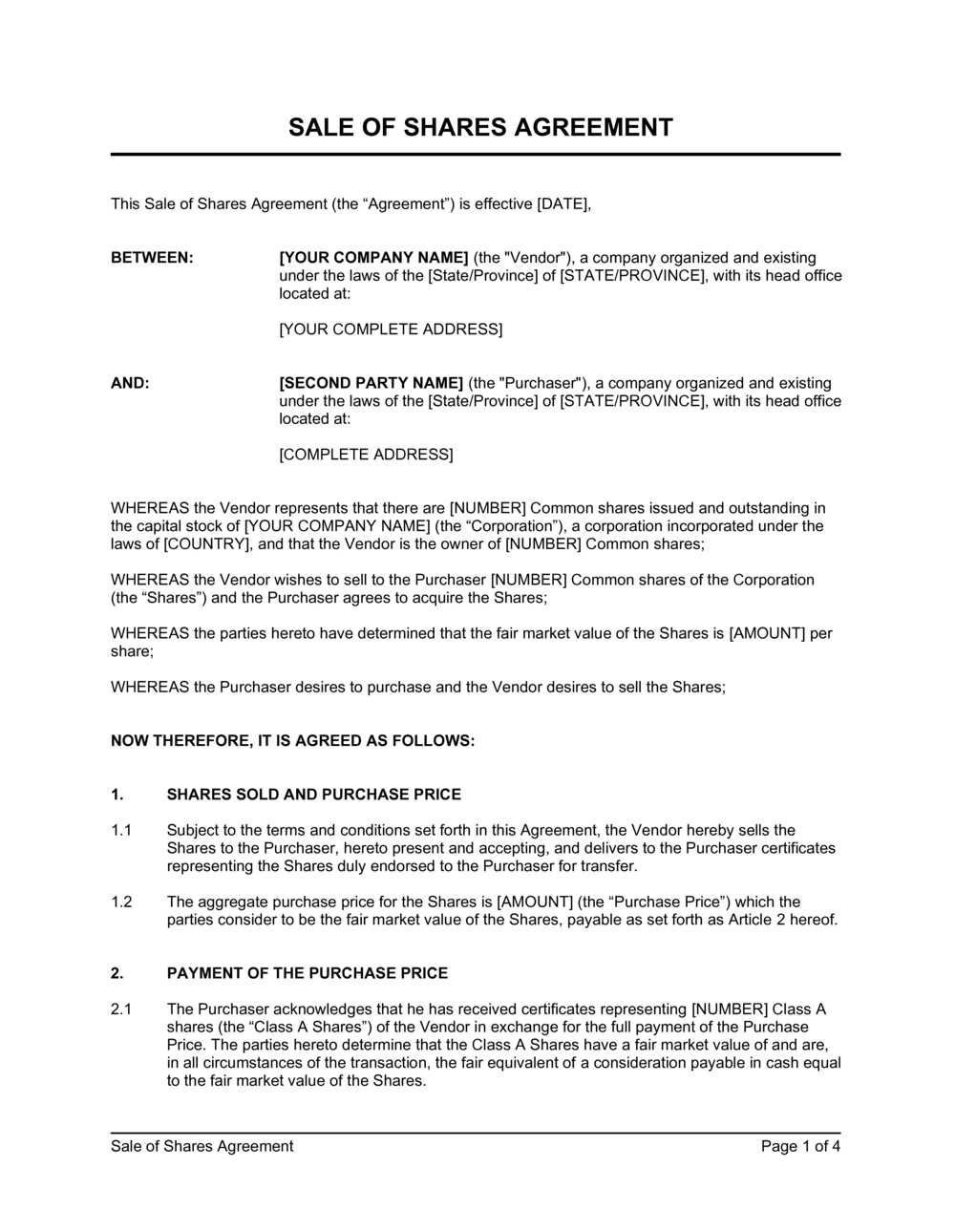
This sale of shares agreement template has 4 pages and is a MS Word file type listed under our finance & accounting documents.
Sale of shares agreement template
SALE OF SHARES AGREEMENT This Sale of Shares Agreement (the "Agreement") is effective [DATE], BETWEEN: [YOUR COMPANY NAME] (the "Vendor"), a company organized and existing under the laws of the [State/Province] of [STATE/PROVINCE], with its head office located at: [YOUR COMPLETE ADDRESS] AND: [SECOND PARTY NAME] (the "Purchaser"), a company organized and existing under the laws of the [State/Province] of [STATE/PROVINCE], with its head office located at: [COMPLETE ADDRESS] WHEREAS the Vendor represents that there are [NUMBER] Common shares issued and outstanding in the capital stock of [YOUR COMPANY NAME] (the "Corporation"), a corporation incorporated under the laws of [COUNTRY], and that the Vendor is the owner of [NUMBER] Common shares; WHEREAS the Vendor wishes to sell to the Purchaser [NUMBER] Common shares of the Corporation (the "Shares") and the Purchaser agrees to acquire the Shares; WHEREAS the parties hereto have determined that the fair market value of the Shares is [AMOUNT] per share; WHEREAS the Purchaser desires to purchase and the Vendor desires to sell the Shares; NOW THEREFORE, IT IS AGREED AS FOLLOWS: 1. SHARES SOLD AND PURCHASE PRICE 1.1 Subject to the terms and conditions set forth in this Agreement, the Vendor hereby sells the Shares to the Purchaser, hereto present and accepting, and delivers to the Purchaser certificates representing the Shares duly endorsed to the Purchaser for transfer. 1.2 The aggregate purchase price for the Shares is [AMOUNT] (the "Purchase Price") which the parties consider to be the fair market value of the Shares, payable as set forth as Article 2 hereof. 2. PAYMENT OF THE PURCHASE PRICE 2.1 The Purchaser acknowledges that he has received certificates representing [NUMBER] Class A shares (the "Class A Shares") of the Vendor in exchange for the full payment of the Purchase Price. The parties hereto determine that the Class A Shares have a fair market value of and are, in all circumstances of the transaction, the fair equivalent of a consideration payable in cash equal to the fair market value of the Shares. 3. CONDITIONS TO THE PURCHASE OF SHARES 3.1 The purchase of the Shares under this Agreement is subject to the following conditions: 3.1.1 the consent by the regular authorities of the further acquisition by [COMPANY NAME] of the Shares hereby purchased by the Purchaser under this Agreement (the "Further Acquisition"); 3.1.2 the approval by the shareholders of [COMPANY NAME] of the Further Acquisition; being understood that if any one of the said conditions is not fulfilled, the present Agreement shall be null and void. 4. VENDOR'S REPRESENTATIONS AND WARRANTIES 4.1 The Vendor represents and warrants to the Purchaser that: the Corporation is incorporated under the laws of the [state/province] of [STATE/PROVINCE] and is duly organized and validly existing thereunder; the Shares have been duly issued, are outstanding as fully paid and non-assessable; the sale and delivery of the Shares as provided for in this Agreement shall not conflict with or result in or cause the occurrence of an event or condition which, immediately or after notice or lapse of time or both, constitutes a breach of or default under the Corporation's articles or by-laws or under any agreement, instrument, order, judgment or decree to which the Vendor or the Corporation is subject; and
 Dashboard
 HR Management
 Links
Links Chat
Chat Connect
 Contacts
 Inbox
Inbox Business Al
 Project Management
 Notes
Notes Business Templates
 Cloud Drive
 Docs
Docs Sheets