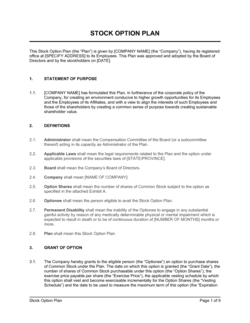
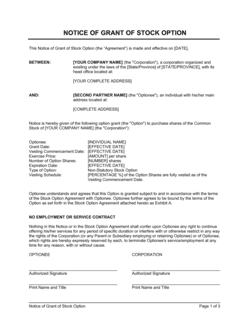
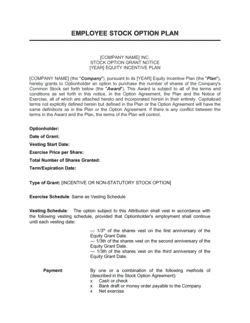
Employee Stock Option Agreement Template

Free Word download • Edit online • Save & share with Drive • Export to PDF

12 pages30–45 min to fillDifficulty: ComplexSignature requiredLegal review recommended
Learn more ↓
FreeEmployee Stock Option Agreement Template

At a glance

What it is
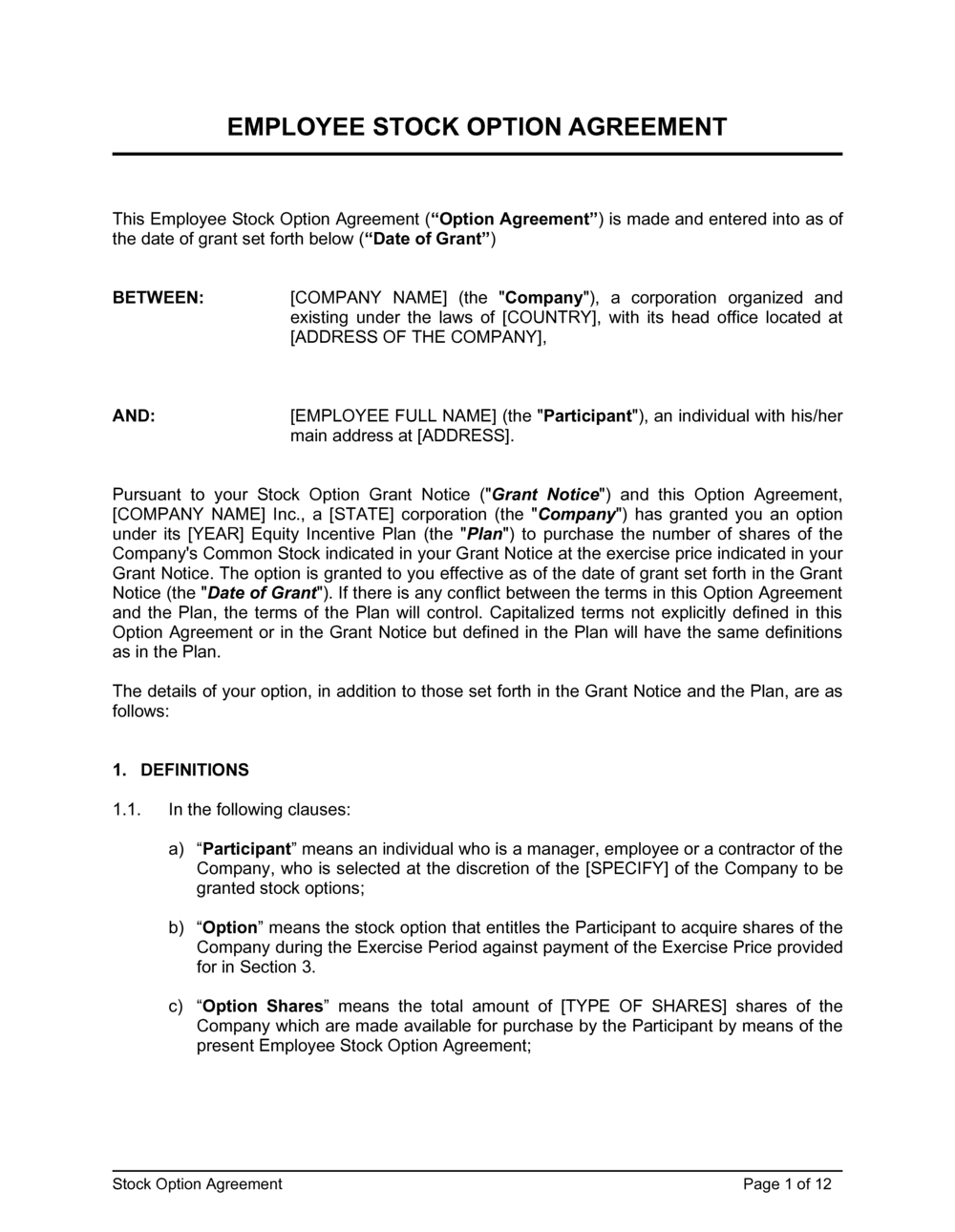
An Employee Stock Option Agreement is a legally binding contract between a company and an employee that grants the employee the right to purchase a specified number of company shares at a fixed exercise price after a defined vesting schedule. This free Word download covers grant size, vesting milestones, option type (ISO or NSO), exercise mechanics, and termination treatment in a single ready-to-edit document.
When you need it
Use it whenever you grant stock options to an employee, advisor, or key contractor as part of a compensation or incentive package. It is typically executed at or shortly after hire, or when a new option pool is established under a formal equity plan.
What's inside
Grant details and option type, vesting schedule with cliff and acceleration provisions, exercise price and fair market value basis, treatment upon termination or change of control, tax representations, and governing plan incorporation by reference.

What is an Employee Stock Option Agreement?

An Employee Stock Option Agreement is a legally binding contract between a company and an employee that grants the employee the right — but not the obligation — to purchase a specified number of company shares at a fixed price, known as the exercise price or strike price, after defined vesting conditions are satisfied. The agreement documents whether the options qualify as Incentive Stock Options (ISOs) under IRC Section 422 or Non-Qualified Stock Options (NSOs), sets the exact vesting schedule and cliff period, establishes the exercise mechanics, and defines what happens to vested and unvested options when employment ends or the company is acquired. For private companies, the exercise price must equal the fair market value of common stock on the grant date, established by a 409A independent valuation to avoid penalties under IRC Section 409A.

Why You Need This Document

Without a signed stock option agreement, an employee's equity entitlement exists only as an informal promise — unenforceable, undocumented, and legally meaningless. Option grants made without a properly adopted equity plan and a written agreement do not qualify for Rule 701 securities exemptions, may disqualify ISO tax treatment, and leave the company exposed to rescission claims if the terms are ever disputed. For the employee, the document is equally critical: it establishes the exercise price that locks in their tax position, the vesting schedule that governs their earning timeline, and the post-termination window that determines how long they have to act after leaving the company. A missing or defective agreement is not just a paperwork gap — it can result in six-figure tax penalties for employees and cap table restatements, securities violations, and M&A complications for the company. This template gives both parties a clear, enforceable record of every material term from the day the grant is made.

Which variant fits your situation?

If your situation is…Use this template
Granting options to a US employee eligible for favorable ISO tax treatmentIncentive Stock Option Agreement (ISO)
Granting options to a non-employee consultant, advisor, or non-US employeeNon-Qualified Stock Option Agreement (NSO)
Granting actual shares rather than the right to purchase themRestricted Stock Agreement
Establishing the company-wide plan that governs all individual option grantsEmployee Stock Option Plan (ESOP)
Granting options to an independent contractor or advisorAdvisor Stock Option Agreement
Providing phantom equity without diluting actual ownershipPhantom Stock Plan Agreement
Offering a right to purchase shares at a future financing priceWarrant Agreement

Common mistakes to avoid

❌ Granting options without a current 409A valuation

Why it matters: Setting the exercise price below fair market value without a qualified appraisal triggers Section 409A penalties: immediate income inclusion, a 20% excise tax, and interest charges on the employee — with no safe harbor available retroactively.

Fix: Commission a 409A valuation before each new grant round or material event. Most companies refresh valuations every 12 months or after a financing, major revenue milestone, or change in business model.

❌ Issuing grant agreements before the board formally approves the grants

Why it matters: Options granted without valid board authorization may be legally unenforceable and can expose the company to securities law violations, rescission claims, and cap table restatements.

Fix: Adopt a written board resolution approving each grant — or a batch of grants at a specific meeting — before signing or delivering any grant agreements to employees.

❌ Using a post-termination exercise window longer than 90 days for ISOs without disclosure

Why it matters: Any ISO exercise occurring more than 3 months after termination (other than disability or death) is automatically disqualified and taxed as an NSO. Employees who are not warned may exercise expecting ISO treatment and face unexpected ordinary income tax.

Fix: Explicitly state in the agreement that exercises after day 90 of termination will be treated as NSO exercises for tax purposes, and confirm this in a separate employee communication at the time of grant.

❌ Granting single-trigger acceleration to all employees

Why it matters: Single-trigger acceleration — where all unvested options vest automatically at deal close — can increase deal cost by millions of dollars, making the company less attractive to acquirers and reducing proceeds available for shareholders.

Fix: Limit single-trigger acceleration to co-founders and C-suite executives only. Use double-trigger acceleration (requiring both a change of control and an involuntary termination) as the default for all other employees.

❌ Failing to obtain an 83(b) election acknowledgment for early-exercisable options

Why it matters: Employees who exercise unvested options early must file an IRS 83(b) election within 30 days of exercise to lock in tax treatment at the exercise price FMV. Missing the deadline can result in ordinary income tax on the full spread at each future vesting date.

Fix: If the agreement permits early exercise, include an 83(b) election notice, instructions, and a 30-day deadline reminder as an exhibit. Confirm with the employee that they filed the election with the IRS.

❌ Omitting a plan document or issuing grants outside a formal equity plan

Why it matters: Ad hoc option grants not made under a formally adopted equity plan may not qualify for the Rule 701 securities exemption, can create ISO disqualification, and leave the company without a governing framework for disputes over exercise rights and cap table corrections.

Fix: Adopt a formal equity incentive plan with board and stockholder approval before making any option grants. All individual grant agreements must reference and be subject to this plan.

The 10 key clauses, explained

Grant of option and option type

In plain language: Identifies the optionee, the number of shares covered, the option type (ISO or NSO), and the grant date.

Sample language
Subject to the terms of the [COMPANY NAME] [YEAR] Equity Incentive Plan, the Company hereby grants to [EMPLOYEE NAME] ('Optionee') an option to purchase [NUMBER] shares of the Company's Common Stock at the Exercise Price set forth herein. This option is intended to qualify as an Incentive Stock Option under IRC Section 422.

Common mistake: Designating an option as an ISO for a non-employee or for a grant exceeding the $100,000 per-year ISO limit. The excess automatically converts to NSO treatment, and incorrect designation creates tax confusion for both parties.

Exercise price and 409A basis

In plain language: States the per-share exercise price and confirms it equals or exceeds fair market value on the grant date, referencing the 409A valuation that supports it.

Sample language
The Exercise Price per share shall be $[PRICE], which the Board has determined to be no less than the Fair Market Value of a share of Common Stock on the Grant Date of [DATE], as supported by the [DATE] independent valuation report.

Common mistake: Setting the exercise price below fair market value without a 409A valuation to support it. This creates a Section 409A violation resulting in immediate income inclusion, a 20% penalty tax, and interest charges for the employee.

Vesting schedule and cliff

In plain language: Defines exactly when options vest — typically 25% after 12 months of continuous service, then 1/48th per month for the following 36 months — and the conditions required for vesting to continue.

Sample language
Subject to Optionee's continuous Service, this Option shall vest as follows: 25% of the shares shall vest on the one-year anniversary of the Vesting Commencement Date of [DATE], and 1/48th of the total shares shall vest monthly thereafter, such that the Option is fully vested on the four-year anniversary of the Vesting Commencement Date.

Common mistake: Using a vesting commencement date that differs from the grant date without documenting why. Backdating or forward-dating vesting commencement without clear documentation invites IRS scrutiny and cap table disputes.

Exercise mechanics and payment methods

In plain language: Describes how the optionee exercises vested options — the notice required, acceptable payment forms (cash, cashless, net exercise), and the mechanics of share delivery.

Sample language
This Option may be exercised by delivering a written exercise notice to the Company, specifying the number of shares to be purchased, accompanied by payment of the aggregate Exercise Price by (a) cash or check, (b) cashless broker-assisted exercise, or (c) net exercise, as permitted by the Plan Administrator.

Common mistake: Omitting cashless or net exercise as a payment method for private-company options. Employees who cannot sell shares to cover the exercise price may be unable to exercise at all without this provision, effectively making the option worthless.

Term and expiration

In plain language: Sets the maximum life of the option — typically 10 years from the grant date for ISOs — after which the option expires regardless of vesting status.

Sample language
This Option shall expire at 5:00 p.m. Pacific Time on the tenth anniversary of the Grant Date (the 'Expiration Date'), unless earlier terminated in accordance with the terms herein or the Plan.

Common mistake: Setting an ISO term beyond 10 years. IRC Section 422 requires that ISOs expire no later than 10 years from grant (5 years for 10%+ shareholders). A term exceeding 10 years automatically disqualifies the ISO.

Treatment upon termination

In plain language: Specifies how long the optionee has to exercise vested options after employment ends — typically 90 days for voluntary termination, 12 months for death or disability, and immediate forfeiture for cause.

Sample language
If Optionee's Service terminates for any reason other than Cause, death, or Disability, Optionee may exercise vested options within 90 days of the termination date. In the event of termination for Cause, this Option shall terminate immediately and without notice.

Common mistake: Applying a post-termination exercise window of more than 90 days for ISOs. IRS rules require exercise within 3 months of termination (12 months for disability) to preserve ISO treatment; a longer window converts the option to NSO status.

Acceleration upon change of control

In plain language: Defines whether unvested options accelerate upon a merger, acquisition, or other change of control — single trigger (acceleration on closing), double trigger (acceleration only if employment is also terminated), or no acceleration.

Sample language
In the event of a Change of Control, unvested options shall be subject to double-trigger acceleration: 50% of then-unvested shares shall vest if Optionee is involuntarily terminated without Cause within 12 months following the Change of Control closing date.

Common mistake: Granting single-trigger acceleration to all employees without considering the acquirer's perspective. Single-trigger acceleration inflates deal costs, can make the company less attractive in an M&A process, and is typically reserved for founders or C-suite executives.

Tax representations and withholding

In plain language: Requires the optionee to acknowledge their tax obligations, authorizes the company to withhold shares or cash to satisfy tax liabilities at exercise, and disclaims any company responsibility for tax advice.

Sample language
Optionee acknowledges that the tax consequences of this Option depend on individual circumstances and that the Company has not provided tax advice. The Company is authorized to withhold shares with a fair market value equal to the minimum statutory withholding amount upon exercise of any NSO tranche.

Common mistake: Omitting withholding authorization for NSO exercises. When an employee exercises an NSO, the spread is ordinary income subject to payroll withholding — if the agreement doesn't authorize share withholding or cash collection, the company faces payroll tax liability with no mechanism to collect it.

Plan incorporation and entire agreement

In plain language: States that the grant agreement is subject to and governed by the company's equity incentive plan, and that together they constitute the entire agreement between the parties on equity compensation.

Sample language
This Agreement is subject to all terms and provisions of the [COMPANY NAME] [YEAR] Equity Incentive Plan, which is incorporated herein by reference. In the event of any conflict between this Agreement and the Plan, the terms of the Plan shall control. This Agreement and the Plan constitute the entire agreement between the parties with respect to the subject matter herein.

Common mistake: Issuing a grant agreement without an underlying plan document. Without a formally adopted plan, option grants may lack board authorization, violate state securities exemptions, and expose the company to rescission claims from employees.

Securities law representations and legends

In plain language: Requires the optionee to confirm they are acquiring shares for investment and not resale, and states the transfer restrictions and legend that will appear on any share certificates or book-entry records.

Sample language
Optionee represents that the shares to be acquired upon exercise are for investment for Optionee's own account and not with a view to resale or distribution. Shares issued upon exercise shall bear the following legend: 'THESE SECURITIES HAVE NOT BEEN REGISTERED UNDER THE SECURITIES ACT OF 1933 AND MAY NOT BE SOLD OR TRANSFERRED ABSENT REGISTRATION OR AN APPLICABLE EXEMPTION.'

Common mistake: Skipping securities law representations for small private companies. Private company shares issued without registration must satisfy an exemption — typically Rule 701 or Section 4(a)(2) — and the representations in the agreement are part of the exemption conditions.

How to fill it out

  1. 1

    Confirm board approval and plan adoption

    Before issuing any grant agreement, verify that the board has formally adopted an equity incentive plan and authorized the specific grant by resolution. The agreement must reference the plan by its exact name and adoption date.

    💡 Most state corporation laws require board approval for each option grant, not just the plan. Keep a copy of the board resolution with the signed agreement in your equity records.

  2. 2

    Enter the optionee's legal name and employee details

    Use the employee's full legal name as it appears on government-issued ID. Include their title, department, and the grant date — which is the date the board approved the grant, not the date of signature.

    💡 The grant date governs the 409A valuation that must support the exercise price. Using a retroactive grant date without a contemporaneous valuation is a Section 409A violation.

  3. 3

    Set the option type, share count, and exercise price

    Designate the option as ISO or NSO based on the recipient's eligibility and the grant amount relative to the $100,000 ISO limit. Enter the number of shares and the per-share exercise price equal to the 409A FMV on the grant date.

    💡 For grants to employees who own more than 10% of company stock, the ISO exercise price must be at least 110% of FMV and the term cannot exceed 5 years.

  4. 4

    Define the vesting commencement date and schedule

    Set the vesting commencement date — often the employee's hire date, which may differ from the grant date — and confirm the vesting schedule matches your standard plan (typically 4-year with 1-year cliff, 1/48th monthly thereafter).

    💡 Document any deviation from the standard vesting schedule in the grant agreement itself and in the board resolution. Non-standard schedules require explicit board approval.

  5. 5

    Specify post-termination exercise windows

    Enter the exercise window for each termination scenario: voluntary resignation, involuntary termination without cause, termination for cause, death, and disability. Confirm ISO windows comply with IRS timing rules.

    💡 Consider extending post-termination exercise windows beyond 90 days for senior employees — but document in the agreement that doing so converts ISO treatment to NSO treatment for exercises occurring after day 90.

  6. 6

    Configure the change-of-control acceleration provision

    Choose single-trigger, double-trigger, or no acceleration based on the employee's seniority. For most employees, double-trigger acceleration (change of control plus involuntary termination) is the market standard and least disruptive to acquirers.

    💡 Consult your lead investor or M&A counsel before granting single-trigger acceleration to anyone other than co-founders. It can reduce deal value in a sale process.

  7. 7

    Attach the plan document and have both parties sign

    Attach or provide a copy of the equity incentive plan referenced in the agreement. Both the authorized company signatory (typically CEO or CFO) and the optionee must sign before or on the grant date.

    💡 Use a digital signature platform with timestamped audit trails. For ISO compliance, the grant date must be established before signature — not by signature.

  8. 8

    Update the cap table and file with your equity management platform

    Record the grant in your cap table immediately — share count, exercise price, vesting commencement date, and option type. File signed copies in the employee's personnel record and your corporate document system.

    💡 Platforms like Carta or Pulley automate 409A triggers, vesting calculations, and exercise notices. Manual cap tables with stock option complexity are an audit and litigation risk.

Frequently asked questions

What is an employee stock option agreement?

An employee stock option agreement is a legally binding contract between a company and an employee that grants the employee the right to purchase a set number of company shares at a fixed exercise price, subject to a vesting schedule. It documents the option type (ISO or NSO), grant date, exercise price, vesting terms, expiration, and what happens to the options when employment ends. It is the core document governing equity-based compensation for individual employees.

What is the difference between an ISO and an NSO?

An Incentive Stock Option (ISO) qualifies for preferential US federal tax treatment under IRC Section 422 — the employee pays no ordinary income tax at exercise and may qualify for long-term capital gains rates if shares are held for the required periods. A Non-Qualified Stock Option (NSO) does not qualify for ISO treatment; the spread between exercise price and fair market value at exercise is taxed as ordinary income. ISOs are available only to employees, while NSOs can be granted to consultants, advisors, and directors as well.

What is a 409A valuation and why does it matter for stock options?

A 409A valuation is an independent appraisal of a private company's common stock fair market value, required under IRC Section 409A to support the exercise price set in each option grant. If a company grants options at below-FMV prices without a qualified appraisal, employees face immediate income inclusion, a 20% excise tax, and interest charges — regardless of whether they have exercised or profited from the options. A current 409A valuation provides a safe harbor that protects both the company and employees from this exposure.

What is a standard vesting schedule for employee stock options?

The most common vesting schedule in the US is 4 years with a 1-year cliff: no options vest during the first 12 months, 25% vest on the 1-year anniversary, and the remaining 75% vest monthly (1/48th per month) over the following 36 months. This structure aligns employee retention with a typical product or growth cycle and is the benchmark expected by most institutional investors.

What happens to stock options when an employee leaves the company?

Vested options typically remain exercisable for a post-termination window that depends on the reason for departure: 90 days for voluntary resignation or involuntary termination without cause, 12 months for death or disability, and immediate forfeiture in the event of termination for cause. Unvested options are forfeited on the termination date in all cases. Exercises after the post-termination window closes result in permanent expiration of the options regardless of their value.

Is a stock option agreement the same as an equity plan?

No. An equity incentive plan is the company-level governing document adopted by the board and stockholders that establishes the option pool, defines eligible participants, sets plan-wide rules, and authorizes the types of grants permitted. A stock option agreement is the individual grant document issued to a specific employee under that plan, incorporating the plan by reference. You need both — the agreement has no legal standing without a valid underlying plan.

Do stock options give an employee ownership in the company?

Not until they are exercised. A stock option is the right to purchase shares at a fixed price — the employee becomes a stockholder only when they exercise vested options by paying the exercise price and receiving shares. Until exercise, option holders have no voting rights, no dividend rights, and no direct ownership stake. The option agreement itself grants only the contractual right to buy shares in the future.

Does an employee stock option agreement need to be reviewed by a lawyer?

Yes, for most companies. Option agreements involve federal tax law (IRC Sections 422 and 409A), securities law exemptions (Rule 701), state corporate law, and potentially cross-border tax issues for international employees. Errors in grant date, exercise price, option type, or post-termination windows can have six-figure tax consequences for employees with no ability to correct them retroactively. A qualified startup or employment attorney typically charges $1,500–$5,000 to establish a plan and review template grant agreements, which is a fraction of the exposure of getting it wrong.

What is double-trigger acceleration and why does it matter?

Double-trigger acceleration means unvested options vest only if two events both occur: a change of control (such as an acquisition) and an involuntary termination of the employee without cause within a defined period afterward (typically 12–18 months). Single-trigger acceleration vests options on the change of control alone, regardless of whether the employee loses their job. Most acquirers prefer double-trigger because it preserves employee retention incentives post-close and reduces the immediate cash cost of the deal.

Can stock options be granted to contractors or advisors?

ISOs cannot be granted to non-employees — they are limited to employees of the granting company. NSOs can be granted to independent contractors, advisors, and board members. However, grants to non-employees are subject to different securities law analysis and may require separate valuation treatment. Advisors often receive options under a separate advisor grant agreement with a shorter vesting schedule (typically 1–2 years) than employee grants.

How this compares to alternatives

vs Restricted Stock Agreement

A restricted stock agreement grants actual shares upfront, subject to forfeiture if vesting conditions are not met. A stock option agreement grants the right to buy shares at a future date at a fixed price. Restricted stock is taxed at grant on the FMV of shares received; options are generally not taxed until exercise. Restricted stock is more common for founders; options are standard for employees hired after formation when FMV has increased.

vs Phantom Stock Plan Agreement

A phantom stock plan pays cash bonuses equal to the value of a specified number of shares — without issuing actual equity or diluting existing stockholders. Stock options grant a real equity interest upon exercise and create actual stockholders with voting rights. Phantom plans are used when the company wants to provide equity-linked incentives without complicating the cap table or triggering securities law obligations.

vs Employee Stock Option Plan (ESOP)

The equity incentive plan is the company-level governing document that establishes the option pool, eligibility criteria, and plan-wide rules. The stock option agreement is the individual grant document issued to a specific employee under the plan. You cannot have a valid option agreement without an underlying plan; the two documents work together and the plan controls in any conflict.

vs Warrant Agreement

A warrant is a right to purchase shares issued to investors, lenders, or strategic partners — not employees — typically as part of a financing transaction. Stock options are compensation instruments issued under an equity incentive plan to employees and service providers. Warrants are generally not subject to IRC Section 422 or 409A and carry different securities law treatment than employee option grants.

Industry-specific considerations

Technology / SaaS

Equity compensation is core to SaaS talent strategy; standard 4-year ISO grants with double-trigger acceleration are the market norm, and 409A refresh cycles align with annual ARR milestones and financing rounds.

Biotech and Life Sciences

Long development timelines make 10-year option terms and extended post-termination windows common; grants often include performance-vesting tranches tied to clinical trial milestones rather than purely time-based schedules.

Financial Services / Fintech

Regulatory restrictions under FINRA, SEC rules, or banking regulations may limit option plan eligibility and exercise mechanics; clawback provisions tied to restatement events are increasingly required by regulators.

Professional Services

Equity grants are used to retain senior partners and rainmakers; NSO structures are more common where recipients include non-employee directors, and grants may be tied to billable revenue or client origination targets.

Jurisdictional notes

United States

IRC Sections 409A and 422 govern the tax treatment of stock options. ISOs require exercise prices at or above FMV on the grant date, expiration within 10 years, and exercise within 3 months of termination. A qualified 409A valuation is the only safe harbor for private company FMV. Rule 701 provides a federal securities exemption for compensatory grants up to $10M in a 12-month period; larger programs require disclosure obligations. State securities laws (blue sky) may impose additional filing requirements.

Canada

Canada does not recognize ISOs; all employee stock options are subject to the employee stock option deduction rules under the Income Tax Act, which allow a 50% deduction on the employment benefit if certain conditions are met. As of 2021, options granted by non-CCPC employers exceeding $200,000 CAD per year in vesting value are fully taxed as income with no deduction. Quebec residents face additional provincial tax treatment differences. Securities exemptions under National Instrument 45-106 apply to compensatory option grants.

United Kingdom

The UK offers HMRC-approved Enterprise Management Incentive (EMI) schemes for qualifying SMEs — EMI options benefit from reduced income tax at exercise and CGT treatment on the gain. Companies that do not qualify for EMI use unapproved options where the spread at exercise is subject to income tax and National Insurance contributions. HMRC requires notification of EMI grants within 92 days of the grant date. Post-Brexit, UK rules no longer align with EU treatment and apply independently.

European Union

EU member states each have separate tax regimes for employee equity; France, Germany, the Netherlands, and Sweden all offer qualified option programs with favorable tax treatment subject to holding period and plan approval requirements. The EU has no single pan-European framework equivalent to the US ISO regime. GDPR implications arise when processing employee equity data across borders. Companies granting options to employees in multiple EU countries must analyze each member state's securities law exemptions and tax treatment independently.

Template vs lawyer — what fits your deal?

PathBest forCostTime
Use the templateEarly-stage startups with a board-approved equity plan making standard 4-year grants to domestic employeesFree30–60 minutes per grant
Template + legal reviewCompanies granting options to senior employees, international staff, or making non-standard acceleration or vesting terms$500–$1,500 for a startup attorney review of template and plan3–7 days
Custom draftedPre-IPO companies, cross-border grants, grants with performance vesting, or any situation involving regulatory constraints on equity compensation$2,000–$8,000+ depending on plan complexity and jurisdiction2–4 weeks

Glossary

Stock Option
A contractual right to purchase a specified number of company shares at a predetermined price, exercisable after vesting conditions are met.
Exercise Price (Strike Price)
The fixed per-share price at which the option holder may purchase shares, set at fair market value on the grant date.
Vesting Schedule
The timeline over which an employee earns the right to exercise options — commonly a 4-year schedule with a 1-year cliff.
Cliff Vesting
A provision under which no options vest until a minimum service period (typically 12 months) has been completed, after which a lump percentage vests at once.
Incentive Stock Option (ISO)
A type of employee stock option that qualifies for preferential US federal tax treatment under IRC Section 422, available only to employees of the granting company.
Non-Qualified Stock Option (NSO / NQO)
A stock option that does not qualify for ISO tax treatment; the spread at exercise is taxed as ordinary income to the recipient.
Fair Market Value (FMV)
The price at which company shares would change hands between a willing buyer and seller on the grant date, typically established by a 409A valuation for private companies.
409A Valuation
An independent appraisal of a private company's common stock fair market value, required under IRC Section 409A to set a defensible exercise price for option grants.
Acceleration
A provision that causes unvested options to vest immediately upon a triggering event, such as a change of control or involuntary termination following an acquisition.
Exercise Window
The period after a vesting event — or after termination of employment — during which the option holder may exercise vested options before they expire.
Option Pool
A block of authorized shares set aside by a company specifically for employee equity grants, expressed as a percentage of fully diluted capitalization.
Spread
The difference between the exercise price and the fair market value of the shares at the time of exercise, representing the option holder's built-in gain.

Part of your Business Operating System

This document is one of 3,000+ business & legal templates included in Business in a Box.

  • Fill-in-the-blanks — ready in minutes
  • 100% customizable Word document
  • Compatible with all office suites
  • Export to PDF and share electronically

Create your document in 3 simple steps.

From template to signed document — all inside one Business Operating System.
1
Download or open template

Access over 3,000+ business and legal templates for any business task, project or initiative.

2
Edit and fill in the blanks with AI

Customize your ready-made business document template and save it in the cloud.

3
Save, Share, Send, Sign

Share your files and folders with your team. Create a space of seamless collaboration.

Save time, save money, and create top-quality documents.

★★★★★

"Fantastic value! I'm not sure how I'd do without it. It's worth its weight in gold and paid back for itself many times."

Managing Director · Mall Farm
Robert Whalley
Managing Director, Mall Farm Proprietary Limited
★★★★★

"I have been using Business in a Box for years. It has been the most useful source of templates I have encountered. I recommend it to anyone."

Business Owner · 4+ years
Dr Michael John Freestone
Business Owner
★★★★★

"It has been a life saver so many times I have lost count. Business in a Box has saved me so much time and as you know, time is money."

Owner · Upstate Web
David G. Moore Jr.
Owner, Upstate Web

Run your business with a system — not scattered tools

Stop downloading documents. Start operating with clarity. Business in a Box gives you the Business Operating System used by over 250,000 companies worldwide to structure, run, and grow their business.

Start free · No credit card required