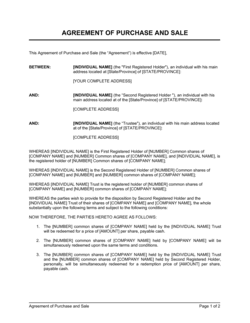
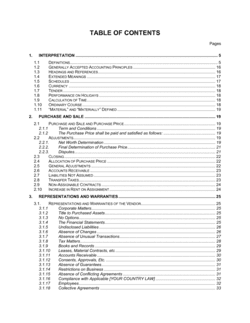
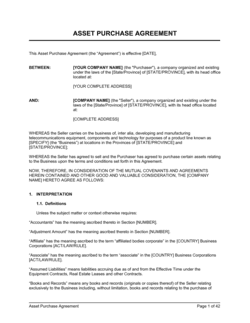
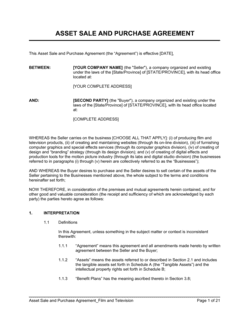
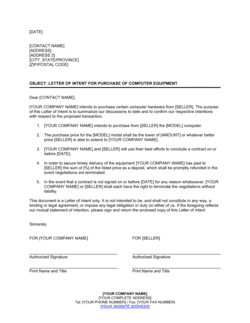
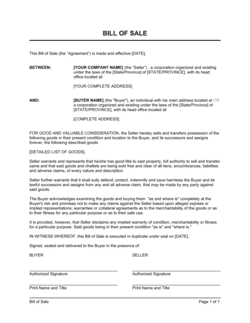
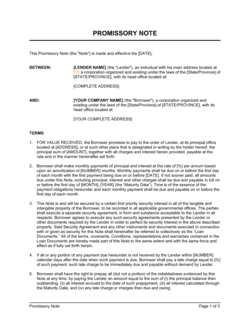
Agreement of Purchase and Sale of Business Assets Template

Free Word download • Edit online • Save & share with Drive • Export to PDF

5 pages30–40 min to fillDifficulty: ComplexSignature requiredLegal review recommended
Learn more ↓
FreeAgreement of Purchase and Sale of Business Assets Template

At a glance

What it is
An Agreement of Purchase and Sale of Business Assets is a legally binding contract between a buyer and seller that governs the transfer of specific business assets — equipment, inventory, intellectual property, customer lists, and goodwill — from one party to another. Unlike a share purchase, the buyer selects exactly which assets and liabilities to acquire. This free Word download gives you a structured, attorney-ready starting point you can edit online and export as PDF for execution at closing.
When you need it
Use it when buying or selling the operating assets of a business rather than its corporate shares — common in SME acquisitions, franchise resales, and transactions where the buyer wants to avoid inheriting unknown liabilities. It is also used when a company divests a product line, subsidiary, or division without transferring the entire legal entity.
What's inside
Identified purchased assets and excluded assets, purchase price and payment mechanics, assumed and excluded liabilities, representations and warranties from both parties, closing conditions, employee transition provisions, non-compete and non-solicitation covenants, indemnification obligations, and governing law.

What is an Agreement of Purchase and Sale of Business Assets?

An Agreement of Purchase and Sale of Business Assets is a legally binding contract that governs the transfer of specific named assets from a seller's business to a buyer for an agreed purchase price. Rather than acquiring the seller's corporate entity and its full liability history — as occurs in a share purchase — the buyer selects exactly which assets to acquire (equipment, inventory, intellectual property, customer lists, contracts, permits, and goodwill) and expressly assumes only the liabilities it chooses. The agreement defines every material dimension of the transaction: what transfers, what stays, how the price is calculated and paid, what the seller represents about the business, and what happens after closing if problems surface.

Why You Need This Document

Without a written asset purchase agreement, both sides of a business sale are exposed to claims that can far exceed the transaction value. A buyer who closes on a handshake has no contractual basis to recover losses from undisclosed liens on equipment, unresolved employment claims, or a seller who reopens a competing business the following week. A seller without a written agreement has no protection against post-closing demands that specific assets were not delivered or that the business was misrepresented. The indemnification, representation, and liability-exclusion mechanics in a properly drafted agreement are what make an asset sale structurally different — and buyer-protective — compared to acquiring shares. This template gives buyers and sellers a complete, attorney-ready framework that covers every standard element of an asset acquisition, reducing the cost and time of legal drafting while ensuring nothing critical is left to chance.

Which variant fits your situation?

If your situation is…Use this template
Acquiring an entire company including its legal entity and share structureShare Purchase Agreement
Buying only specific equipment from a businessEquipment Purchase Agreement
Acquiring intellectual property rights separately from physical assetsIP Assignment Agreement
Purchasing commercial real estate as part of the transactionCommercial Real Estate Purchase Agreement
Acquiring a distressed business's assets through an insolvency processAsset Purchase Agreement (363 Sale / Insolvency)
Documenting a business sale with seller financing arrangementsSeller Financing Promissory Note
Transferring franchise location ownership between operatorsFranchise Transfer Agreement

Common mistakes to avoid

❌ No itemized asset schedule

Why it matters: Catch-all language transfers ambiguous ownership and triggers post-closing disputes over specific pieces of equipment, IP, and contracts. Some assets require individual assignment to transfer valid title.

Fix: Attach a detailed Schedule A with every asset grouped by category. For equipment, include serial numbers and model details. For IP, list registrations and application numbers.

❌ Assuming liabilities without a defined list

Why it matters: Vague assumed-liabilities language has caused buyers to inherit employment claims, tax assessments, and environmental obligations they never intended to take on — sometimes worth more than the assets themselves.

Fix: Use an express assumption model: Schedule C lists every assumed liability by name and amount. Everything not on the list is automatically excluded, regardless of whether it relates to the business.

❌ No inventory adjustment mechanism

Why it matters: A business with $200,000 in target inventory that closes with $150,000 on hand still generates a full payment under a fixed-price contract, overpaying the seller by $50,000.

Fix: Include a closing-date physical inventory count procedure and a dollar-for-dollar price adjustment tied to the variance between actual and target inventory value.

❌ Overbroad non-compete scope

Why it matters: Non-compete covenants that run five years or cover entire countries are routinely struck down as unreasonable, leaving the buyer with no protection against the seller reopening a competing business immediately.

Fix: Limit the non-compete to the seller's actual operating geography and a two-to-three-year term. Tie it explicitly to the goodwill purchased to reinforce enforceability.

❌ No MAC (material adverse change) closing condition

Why it matters: Without a MAC condition, the buyer is legally obligated to close even if the business loses its largest customer, suffers a fire, or faces regulatory action between signing and closing.

Fix: Include a MAC condition defining what constitutes a material adverse change for this specific business — referencing revenue thresholds, key customer retention, and asset condition.

❌ Signing without verifying lien status on assets

Why it matters: A buyer who closes without confirming all liens have been released can acquire assets that are still subject to a secured creditor's interest — meaning the creditor can repossess them post-closing.

Fix: Run UCC, PPSA, or equivalent security interest searches on the seller and all transferred assets before closing, and require lien releases as a condition of closing in Schedule E.

The 10 key clauses, explained

Identification of parties and recitals

In plain language: Names the buyer and seller as legal entities, describes the nature of the business being sold, and sets out the intent of the agreement.

Sample language
This Agreement of Purchase and Sale of Business Assets is entered into as of [DATE] between [SELLER LEGAL NAME], a [STATE/PROVINCE] [ENTITY TYPE] ('Seller'), and [BUYER LEGAL NAME], a [STATE/PROVINCE] [ENTITY TYPE] ('Buyer').

Common mistake: Using a trade name instead of the seller's registered legal entity name. If the entity name does not match title records for the assets, the transfer may be defective and require corrective filings.

Schedule of purchased assets

In plain language: An exhaustive list — usually in a schedule — of every asset being transferred: tangible assets, inventory, contracts, IP, permits, customer lists, and goodwill.

Sample language
The Purchased Assets shall include all assets listed in Schedule A, including but not limited to: (i) equipment and machinery listed in Exhibit A-1; (ii) inventory as of the Closing Date; (iii) the trade name '[BUSINESS NAME]'; (iv) customer and supplier lists; and (v) goodwill.

Common mistake: Using catch-all language ('all assets of the business') without a detailed schedule. Ambiguity about what transferred creates post-closing disputes over specific items and can void the transfer of assets that require individual assignment.

Excluded assets

In plain language: Explicitly identifies assets the seller keeps — cash and cash equivalents, personal property, specific receivables, and assets unrelated to the business.

Sample language
Notwithstanding the foregoing, the Purchased Assets shall not include: (i) all cash and cash equivalents; (ii) accounts receivable outstanding as of the Closing Date; (iii) the assets listed in Schedule B ('Excluded Assets').

Common mistake: Omitting an excluded-assets schedule entirely. Without it, disputes arise over whether specific items — company vehicles, personal equipment, pending receivables — were included in the sale price.

Purchase price and payment mechanics

In plain language: States the total consideration, how it is calculated (lump sum, adjusted for inventory, or earnout-based), the deposit amount, and the payment method at closing.

Sample language
The aggregate purchase price for the Purchased Assets is $[AMOUNT] ('Purchase Price'), subject to the inventory adjustment set out in Section [X]. At Closing, Buyer shall pay $[CLOSING AMOUNT] by wire transfer, with $[DEPOSIT] having been paid upon execution of this Agreement.

Common mistake: No mechanism for a working capital or inventory adjustment at closing. If inventory levels change between signing and closing, a fixed price overpays or underpays by a material amount.

Assumed and excluded liabilities

In plain language: Defines exactly which liabilities the buyer takes on (typically specific listed contracts and leases) and explicitly states that all other liabilities remain with the seller.

Sample language
Buyer assumes only the liabilities listed in Schedule C ('Assumed Liabilities'). Except as expressly set out in Schedule C, Buyer does not assume and shall have no liability for any obligation or liability of Seller, whether known or unknown, arising before or after the Closing Date.

Common mistake: Vague assumed-liabilities language such as 'ordinary course obligations.' Courts have found that broad language inadvertently includes liabilities the buyer never intended to assume, including employment claims and vendor disputes.

Representations and warranties

In plain language: Both parties make factual statements on which the other relies: the seller warrants title to assets, absence of undisclosed liabilities, and accuracy of financial statements; the buyer warrants capacity and financing.

Sample language
Seller represents and warrants that: (i) Seller has good and marketable title to all Purchased Assets, free and clear of all liens and encumbrances except as listed in Schedule D; (ii) the Financial Statements fairly present the financial condition of the Business; (iii) no material adverse change has occurred since [DATE].

Common mistake: Seller reps that are too broad without a disclosure schedule to qualify them. Representations made without qualification expose the seller to indemnity claims for items the buyer could have discovered in due diligence.

Closing conditions and pre-closing covenants

In plain language: Lists what must happen before the deal closes — third-party consents, lien releases, regulatory approvals, continued operation of the business in the ordinary course, and delivery of closing documents.

Sample language
The obligations of each party to consummate the transactions are conditioned upon: (i) all consents listed in Schedule E having been obtained; (ii) no material adverse change having occurred; (iii) Seller having obtained releases of all liens on the Purchased Assets; and (iv) delivery of all closing documents.

Common mistake: No material adverse change (MAC) condition. Without one, the buyer is obligated to close even if the business deteriorates significantly between signing and closing.

Employee transition provisions

In plain language: Addresses which employees the buyer offers to hire, any obligations to notify or consult with employees, and the allocation of pre-closing employee liabilities such as accrued wages and severance.

Sample language
Buyer shall offer employment to the employees listed in Schedule F on terms no less favorable than their current compensation. Seller shall be solely responsible for all employment liabilities, including accrued wages, vacation pay, and severance, accrued prior to the Closing Date.

Common mistake: No clear allocation of accrued vacation pay and pending employment claims. Buyer inheriting unquantified employee liabilities is one of the most common post-closing surprises in SME asset deals.

Non-compete and non-solicitation covenants

In plain language: Restricts the seller from competing with the acquired business or soliciting its customers and employees for a defined period and within a defined geography after closing.

Sample language
For a period of [X] years following the Closing Date, Seller shall not, within [GEOGRAPHIC AREA], directly or indirectly carry on, be engaged in, or be financially interested in any business that competes with the Business, nor solicit any customer or employee of the Business.

Common mistake: Setting the non-compete duration at more than three years or the geography broader than the seller's actual operating territory. Courts apply a reasonableness test, and overbroad covenants are struck down entirely rather than narrowed in many jurisdictions.

Indemnification and survival

In plain language: Defines each party's obligation to compensate the other for losses from breaches of representations, warranties, or covenants, and how long those obligations survive after closing.

Sample language
Seller shall indemnify Buyer against all losses arising from: (i) any breach of Seller's representations, warranties, or covenants; (ii) any Excluded Liability. The representations and warranties shall survive Closing for a period of [X] months, except for Fundamental Representations, which shall survive indefinitely.

Common mistake: No indemnification cap or basket (deductible). Without a cap, a seller faces unlimited post-closing liability; without a basket, the buyer can pursue indemnification for trivial claims that erode goodwill and burden both parties.

How to fill it out

  1. 1

    Identify and describe both parties as legal entities

    Enter the full registered legal names of the buyer and seller — not trade names or owner names — along with their entity types and states or provinces of incorporation. Include the date of the agreement.

    💡 Run a corporate registry search for each party to confirm the exact legal name and that the entity is in good standing before execution.

  2. 2

    Build Schedule A — the purchased assets list

    Create a detailed, itemized schedule of every asset transferring to the buyer. Group assets by category: tangible assets and equipment (with serial numbers where possible), inventory, intellectual property, contracts, permits, and goodwill. Attach supporting lists as sub-exhibits.

    💡 A physical walk-through of the business premises during due diligence is the most reliable way to build a complete tangible-asset schedule — cross-reference against the seller's fixed-asset register.

  3. 3

    Define excluded assets and excluded liabilities

    List in Schedule B every asset the seller retains — cash, receivables, personal property, unrelated equipment. List in Schedule C only those liabilities the buyer expressly assumes. Everything else is automatically excluded.

    💡 Defaulting to 'buyer assumes no liabilities except those listed' is the safest starting position. Expand the assumed list only after reviewing each item individually.

  4. 4

    Set the purchase price and adjustment mechanism

    Enter the total consideration, the deposit amount, and the closing payment. If inventory is part of the deal, include a closing-date inventory count procedure and a price adjustment formula tied to variance from a target inventory value.

    💡 For businesses with significant inventory, conduct a physical count within 48 hours of closing and use that count as the final adjustment figure rather than relying on the seller's records.

  5. 5

    Populate the representations and warranties with disclosure schedules

    Review each seller representation and attach a disclosure schedule that qualifies any statement that is not fully accurate. Common disclosure items include pending litigation, liens on assets, and contracts requiring consent to assign.

    💡 The disclosure schedule is a negotiated document, not a formality — a seller who discloses a known issue cannot be sued for it post-closing, which is why both sides should take it seriously.

  6. 6

    List closing conditions and required consents

    Identify every third-party consent needed to assign contracts, leases, and permits. Enter these in Schedule E. Include a MAC condition and specify what constitutes a material adverse change for this particular business.

    💡 Landlord consent to assign a commercial lease is the condition that most frequently delays or kills small business asset closings — obtain it as early in the process as possible.

  7. 7

    Draft the employee transition and non-compete terms

    List in Schedule F which employees the buyer intends to offer employment. Set the non-compete duration and geographic scope proportionate to the nature of the business — two years and the seller's actual trading territory is a typical starting point.

    💡 In Canada, the EU, and California, post-sale non-competes face additional scrutiny. In those jurisdictions, tie the covenant to a reasonable payment or confirmed goodwill allocation to strengthen enforceability.

  8. 8

    Set indemnification caps, baskets, and survival periods

    Negotiate an indemnification cap (typically 10–30% of purchase price for general reps, 100% for fundamental reps) and a deductible basket (typically 0.5–1% of purchase price). Set survival periods of 12–24 months for general representations and indefinite survival for title, authority, and tax reps.

    💡 Fundamental representations — title to assets, authority to sell, no undisclosed liabilities — should always survive indefinitely regardless of the cap on general indemnification.

Frequently asked questions

What is an agreement of purchase and sale of business assets?

It is a legally binding contract between a buyer and a seller that governs the transfer of specific named assets from a business — equipment, inventory, intellectual property, customer lists, contracts, and goodwill — from the seller to the buyer for an agreed purchase price. Unlike a share purchase, the buyer does not acquire the seller's legal entity or its historical liabilities, only the assets expressly listed in the agreement.

What is the difference between an asset purchase and a share purchase?

In an asset purchase, the buyer acquires specific assets and assumes only the liabilities it expressly agrees to take on. In a share purchase, the buyer acquires the entire legal entity — including all of its liabilities, known and unknown. Buyers generally prefer asset deals because they avoid inheriting undisclosed liabilities. Sellers often prefer share deals for tax reasons, since capital gains treatment on shares is frequently more favorable than on individual assets.

What assets are typically included in a business asset sale?

Tangible assets such as equipment, machinery, furniture, and inventory are the most common. Intangible assets — trade names, trademarks, patents, customer lists, supplier relationships, non-compete agreements, and goodwill — are often the most valuable. Contracts and leases may also transfer if the counterparty consents. Cash, accounts receivable, and assets unrelated to the business are typically excluded.

Do I need a lawyer for an asset purchase agreement?

For any asset purchase above $50,000, having a lawyer review the agreement is strongly recommended. Asset purchases involve title transfer mechanics, lien searches, tax allocation elections, third-party consents, and indemnification structures that vary significantly by jurisdiction and transaction size. A template provides the framework, but a qualified lawyer helps identify deal-specific risks — such as environmental liabilities, pending litigation, or employment obligations — that a general template cannot anticipate.

What liabilities does the buyer assume in an asset sale?

In a properly structured asset sale, the buyer assumes only the liabilities expressly listed in Schedule C of the agreement. All other liabilities — pre-closing tax assessments, employment claims, vendor disputes, and undisclosed obligations — remain with the seller. This is the primary reason buyers prefer asset deals over share deals when the seller's liability history is uncertain or complex.

How is the purchase price typically structured in a business asset sale?

Most asset sales use a combination of a fixed closing payment and one or more adjustments. A working capital or inventory adjustment trues up the price based on actual asset levels at closing. Larger transactions may include an earnout — a portion of the price paid post-closing based on revenue or EBITDA performance over 12–36 months. A seller note or seller financing arrangement is common in SME deals where the buyer cannot fully fund the acquisition at closing.

What is a bulk sale notice and when is it required?

Bulk sale or bulk transfer laws — which remain in force in some US states and Canadian provinces — require a seller transferring a major portion of business inventory or assets outside the ordinary course to notify creditors in advance. Failure to comply can allow the seller's creditors to void the transfer and claim the assets. A lawyer should confirm whether bulk sale requirements apply in the relevant jurisdiction before closing.

How are employees handled in a business asset sale?

In an asset sale, the buyer is not legally obligated to hire any of the seller's employees — employment does not transfer automatically as it does in some share transactions. The agreement typically lists the employees the buyer intends to offer employment, and the seller is responsible for any employment liabilities accrued before the closing date — including accrued wages, vacation pay, and any statutory severance owed upon termination. In some jurisdictions, specific employment transition obligations apply when a business transfer occurs.

How long should a non-compete clause last in an asset purchase agreement?

Two to three years is the most commonly enforced range for post-sale non-competes in North American and UK jurisdictions. The geographic scope should match the seller's actual operating territory — a regional retailer's non-compete covering the entire continent will not survive a reasonableness challenge. Non-competes tied to a goodwill allocation in the purchase price are generally more enforceable than standalone restrictions because they have clearer consideration.

How this compares to alternatives

vs Share Purchase Agreement

A share purchase agreement transfers ownership of the entire legal entity — shares, assets, and all liabilities, known and unknown. An asset purchase agreement transfers only named assets and only expressly assumed liabilities. Buyers prefer asset deals to avoid inherited liabilities; sellers often prefer share deals for favorable capital gains tax treatment. The choice typically depends on the size of the transaction and the seller's liability profile.

vs Letter of Intent (Business Acquisition)

A letter of intent is a non-binding preliminary document that records the agreed deal terms — price, structure, and key conditions — before the parties invest in full due diligence and legal drafting. The asset purchase agreement is the binding closing document that supersedes it. The LOI creates negotiating momentum; the asset purchase agreement creates legal obligations.

vs Bill of Sale

A bill of sale transfers title to specific personal property — a vehicle, piece of equipment, or inventory lot — in a single transaction without the representations, warranties, covenants, indemnification, or conditions precedent of an asset purchase agreement. Use a bill of sale for simple, low-value transfers of individual items; use an asset purchase agreement for multi-asset business acquisitions where post-closing obligations and liability allocation matter.

vs Business Purchase Agreement (Goodwill Only)

A goodwill-only purchase agreement transfers the intangible value of a business — brand, customer relationships, and reputation — without physical assets. An asset purchase agreement covers both tangible and intangible assets. When a buyer is acquiring a service business whose primary value is client relationships and a trade name, a combined agreement covering all asset categories is typically more appropriate than a goodwill-only instrument.

Industry-specific considerations

Retail and Hospitality

Inventory valuation and physical count mechanics, liquor and food-service license transfer, and lease assignment consent from the landlord are the three most deal-critical elements in retail and restaurant asset sales.

Manufacturing

Environmental representations about site contamination and equipment condition are heavily negotiated; buyers typically require Phase I environmental assessments and equipment appraisals as closing conditions.

Technology / SaaS

IP assignment for software, source code, domain names, and data assets requires separate assignment agreements and may trigger third-party software license consent obligations not covered by a general asset schedule.

Professional Services

Client relationship goodwill is the dominant asset and hardest to transfer; non-solicitation and transition service obligations — including the seller introducing the buyer to key clients — are often more valuable than any physical asset.

Healthcare

Patient records, Medicare and Medicaid provider numbers, and clinical equipment certifications each require separate regulatory consent or re-enrollment processes that must be addressed as closing conditions in the agreement.

Food and Beverage

Health permits, supplier contracts, branded recipes, and commercial kitchen equipment are the core assets; alcohol license transfers involve regulatory timelines that typically set the closing date, not the parties.

Jurisdictional notes

United States

Buyers and sellers must file IRS Form 8594 to allocate the purchase price across asset classes — the allocation affects depreciation for the buyer and gain characterization for the seller. UCC-1 lien searches should be run on the seller in every state where assets are located before closing. Bulk sale laws have been repealed in most states but remain in force in a small number — confirm applicability before closing. California imposes specific wage and hour successor liability that survives an asset sale in some circumstances.

Canada

Buyers must conduct PPSA (Personal Property Security Act) searches in each province where assets are located to identify security interests that survive an asset sale. GST/HST applies to most asset transfers, with elections available under section 167 of the Excise Tax Act to zero-rate the sale of a business as a going concern — both parties must file the election jointly. Ontario and other provinces retain bulk sales notification requirements in specific circumstances. Employment Standards Act liabilities for accrued vacation and statutory severance must be expressly allocated between the parties.

United Kingdom

TUPE (Transfer of Undertakings (Protection of Employment) Regulations 2006) may apply to business asset transfers, requiring the buyer to take on the seller's employees on their existing terms and conditions — this is a significant departure from North American asset deal mechanics and requires specific employment law advice. Stamp duty land tax applies to any real property included in the transaction. VAT treatment of the sale depends on whether the transaction qualifies as a Transfer of a Going Concern (TOGC), which can zero-rate the supply if specific conditions are met.

European Union

The EU's Acquired Rights Directive, implemented nationally in each member state, generally requires employee contracts to transfer automatically in business asset transfers — buyers cannot avoid inherited employment obligations by structuring as an asset deal to the extent TUPE or equivalent national law applies. GDPR imposes specific obligations on the transfer of customer and employee personal data: a data protection impact assessment and appropriate legal bases for transfer are required. VAT treatment varies by member state but TOGC equivalents are available in most jurisdictions. France, Germany, and Spain each have mandatory creditor-notification requirements before completing a major asset transfer.

Template vs lawyer — what fits your deal?

PathBest forCostTime
Use the templateAsset sales under $75,000 with straightforward tangible assets, no employees, and no complex IP or lease obligationsFree2–4 hours to complete; 1–2 weeks to negotiate and execute
Template + legal reviewSME asset deals from $75,000 to $500,000 involving inventory adjustments, lease assignments, and employee transitions$750–$2,500 for a lawyer review and negotiation of key terms2–4 weeks
Custom draftedTransactions above $500,000, deals with significant IP, environmental risk, healthcare licensing, or cross-border elements$3,000–$15,000+ depending on complexity and transaction size4–10 weeks

Glossary

Asset Purchase
A transaction in which the buyer acquires specific named assets of a business rather than its shares or ownership entity.
Purchased Assets
The specific assets itemized in the agreement that transfer from seller to buyer at closing — equipment, IP, inventory, contracts, and goodwill.
Excluded Assets
Assets the seller retains and does not transfer to the buyer, such as cash, certain receivables, or assets unrelated to the acquired business.
Assumed Liabilities
Obligations the buyer expressly agrees to take on at closing — typically specific contracts, leases, or vendor agreements listed in a schedule.
Excluded Liabilities
All liabilities not expressly assumed by the buyer, which remain the seller's responsibility — the primary advantage of an asset deal over a share deal.
Representations and Warranties
Factual statements made by each party about the business, its assets, and their authority to complete the transaction, upon which the other party relies.
Indemnification
A contractual obligation requiring one party to compensate the other for losses arising from a breach of representations, warranties, or covenants.
Closing Conditions
Prerequisites that must be satisfied before the transaction is legally complete — such as regulatory approvals, lien releases, or third-party consents.
Goodwill
The intangible value of a business above its net tangible assets, reflecting customer relationships, brand reputation, and market position.
Bulk Sale / Bulk Transfer
A transfer of a major portion of a business's inventory or assets outside the ordinary course — subject to creditor-notification statutes in some jurisdictions.
Non-Compete Covenant
A post-closing restriction preventing the seller from operating a competing business within a defined geography and time period.
Earnout
A portion of the purchase price paid to the seller after closing, contingent on the acquired business meeting defined revenue or performance targets.

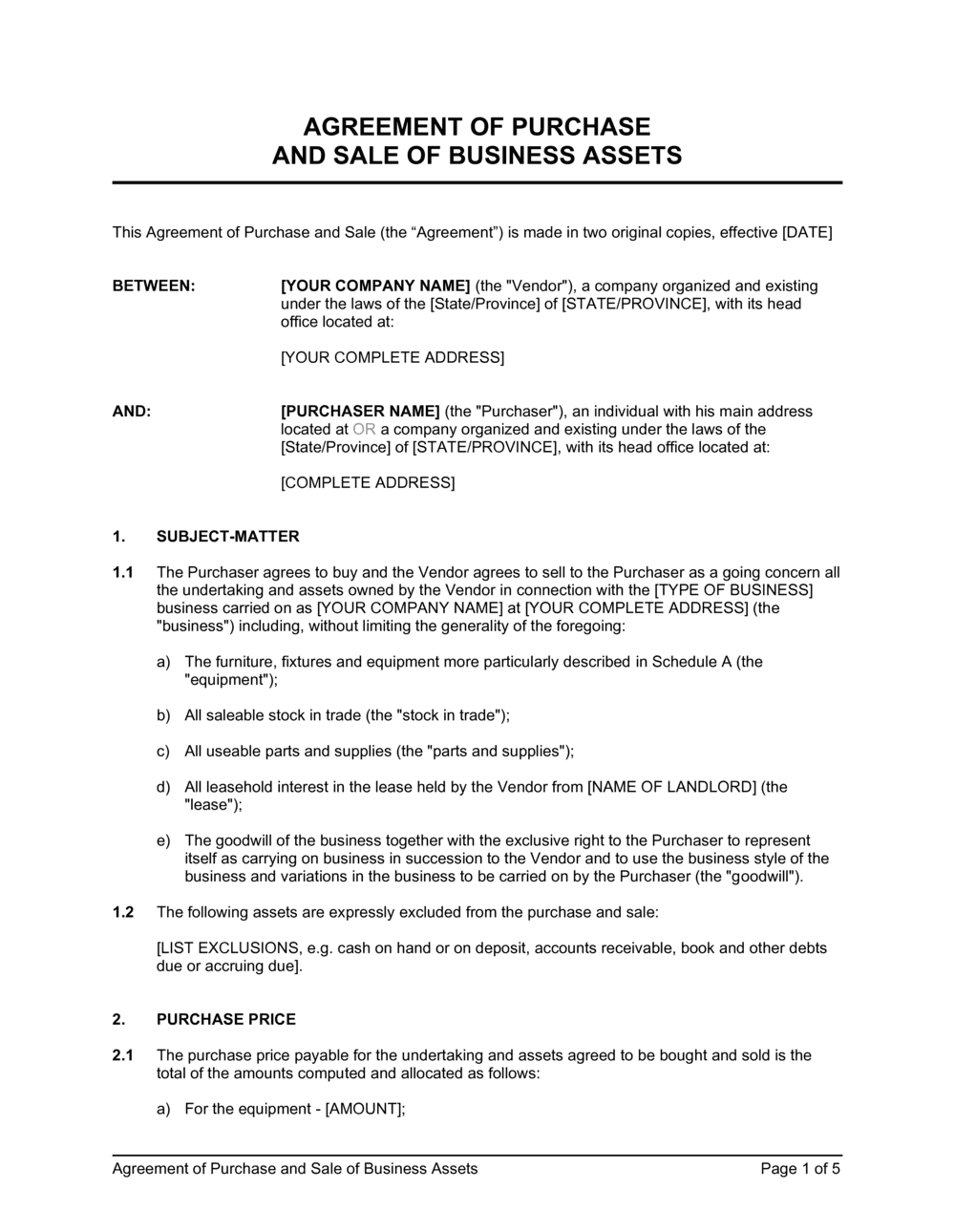
Part of your Business Operating System

This document is one of 3,000+ business & legal templates included in Business in a Box.

  • Fill-in-the-blanks — ready in minutes
  • 100% customizable Word document
  • Compatible with all office suites
  • Export to PDF and share electronically

Create your document in 3 simple steps.

From template to signed document — all inside one Business Operating System.
1
Download or open template

Access over 3,000+ business and legal templates for any business task, project or initiative.

2
Edit and fill in the blanks with AI

Customize your ready-made business document template and save it in the cloud.

3
Save, Share, Send, Sign

Share your files and folders with your team. Create a space of seamless collaboration.

Save time, save money, and create top-quality documents.

★★★★★

"Fantastic value! I'm not sure how I'd do without it. It's worth its weight in gold and paid back for itself many times."

Managing Director · Mall Farm
Robert Whalley
Managing Director, Mall Farm Proprietary Limited
★★★★★

"I have been using Business in a Box for years. It has been the most useful source of templates I have encountered. I recommend it to anyone."

Business Owner · 4+ years
Dr Michael John Freestone
Business Owner
★★★★★

"It has been a life saver so many times I have lost count. Business in a Box has saved me so much time and as you know, time is money."

Owner · Upstate Web
David G. Moore Jr.
Owner, Upstate Web

Run your business with a system — not scattered tools

Stop downloading documents. Start operating with clarity. Business in a Box gives you the Business Operating System used by over 250,000 companies worldwide to structure, run, and grow their business.

Free Forever Plan · No credit card required